
Learning · Tax on Investments
Capital gains tax on shares and equity mutual funds in FY 2026-27, with the rates, the holding periods and worked rupee examples.
Quick answer
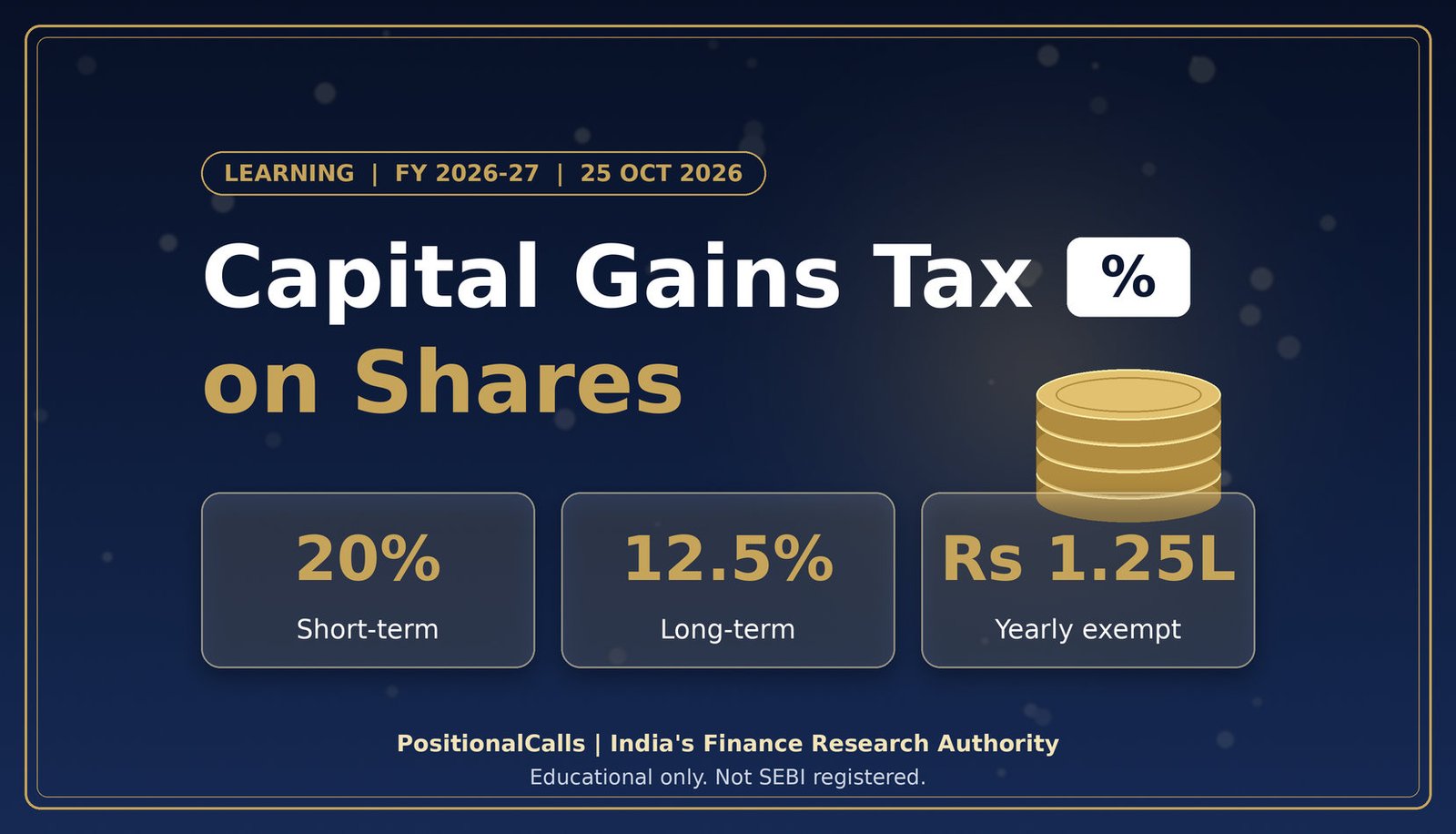
Capital gains tax on shares for FY 2026-27 is 20% on short-term gains (held 12 months or less) and 12.5% on long-term gains above Rs 1.25 lakh a year (held more than 12 months). This applies to listed shares and equity mutual funds on which STT is paid. Budget 2026 left these rates unchanged. Cess of 4% is added.
Latest update (25 October 2026, 8:00 PM IST): Rates, holding periods and the Rs 1.25 lakh exemption are unchanged for FY 2026-27. The Income-tax Act, 2025 has applied since 1 April 2026, so section numbers differ from older guides. Next: advance tax due on 15 December 2026.
Key takeaways
- Short-term rate: capital gains tax on shares is 20% on listed shares and equity funds sold within 12 months (STT paid).
- Long-term rate: 12.5% on gains above Rs 1.25 lakh a year, no indexation.
- Holding test: more than 12 months for listed equity; more than 24 months for most other assets.
- Losses: short-term loss can be set off against any gain; long-term loss only against long-term gain.
- Dividends: taxed at your slab rate; 10% TDS when a resident individual’s dividend from one company exceeds Rs 10,000 in the year.
- Own examples: worked rupee calculations below, with the arithmetic shown.
In plain words: a capital gain is your selling price minus your buying price. You pay tax only on the profit, and the rate depends on how long you held the shares. Hold more than a year and the rate is lower.
Data note: as of 25 October 2026, 8:00 PM IST. Capital gains tax on shares rates are cross-checked across the Income Tax Department pages and several tax publishers; section numbers under the new Act are not quoted because sources differ. Illustrations ignore brokerage, surcharge and other charges unless stated.
Capital gains tax on shares is the income tax you pay on the profit when you sell shares or equity mutual fund units for more than you paid. If you buy 100 shares at Rs 1,000 and sell them at Rs 1,400, the gain is Rs 40,000. The tax applies to that Rs 40,000, not to the full sale value.
Capital gains tax on shares arises only when you sell (the law calls it a transfer). A share that has risen in value but is still in your demat account has an unrealised gain, and no capital gains tax is due on it. The gain is taxed in the financial year of the sale. For FY 2026-27 that means sales from 1 April 2026 to 31 March 2027.
This guide to capital gains tax on shares covers gains on listed Indian shares and equity-oriented mutual funds (funds that hold at least 65% in equity) bought and sold through a demat account or a fund house. It also explains how debt funds and dividends differ. It does not cover property, gold, crypto or futures and options. Futures and options income is normally treated as business income, not capital gains, so it follows different rules (check with a chartered accountant).
What changed with the new Income-tax Act?
The Income-tax Act, 2025 replaced the 1961 Act from 1 April 2026, so FY 2026-27 is the first year under it. Tax publishers report that the capital gains rates and holding periods carried over unchanged, with provisions renumbered. Older articles that quote section 111A or 112A describe the same rules under the old numbering. The ITR you file for FY 2025-26 still follows the old Act, so you will see both sets of terms for a while. The Income Tax Department keeps pages for both: see its Income Tax Department page on short-term capital gains and its Income Tax Department page on long-term capital gains.
The earlier rise in capital gains tax on shares took effect for sales on or after 23 July 2024. Short-term equity gains moved from 15% to 20%, long-term equity gains from 10% to 12.5%, and the yearly exemption from Rs 1 lakh to Rs 1.25 lakh. Budget 2026 made no further change to these rates, as reported by several tax publishers.
If you are new to investing, the first step is a demat account and, for IPOs, knowing how allotment works. See our guide on how to check IPO allotment status for that part. The tax comes later, when you sell.
For listed equity shares and equity mutual funds, short-term gains are taxed at 20% and long-term gains at 12.5% above Rs 1.25 lakh in a year. Both rates need Securities Transaction Tax (STT) to have been paid on the sale. Add 4% health and education cess on the tax. Surcharge may apply on high incomes, and for these gains it is reported to be capped at 15%.
| Asset | Short-term if held | Short-term tax | Long-term if held | Long-term tax | Why it matters |
|---|---|---|---|---|---|
| Listed shares (STT paid) | 12 months or less | 20% | More than 12 months | 12.5% above Rs 1.25 lakh a year | The main case for most retail investors |
| Equity mutual funds (65%+ equity) | 12 months or less | 20% | More than 12 months | 12.5% above Rs 1.25 lakh a year | The Rs 1.25 lakh limit is shared with shares |
| Unlisted shares | 24 months or less | Slab rate | More than 24 months | 12.5%, no indexation | Relevant for pre-IPO or ESOP shares |
| Debt-oriented mutual funds | Any period | Slab rate | Not applicable for funds bought after 1 April 2023 | Slab rate | No lower long-term rate |
| Dividend or IDCW | Not a capital gain | Slab rate | Not a capital gain | Slab rate | Separate rule, see section 8 |
As of 25 October 2026, 8:00 PM IST, these are the capital gains tax on shares rates reported for FY 2026-27 by the Income Tax Department pages and multiple tax publishers. The yearly Rs 1.25 lakh exemption applies to long-term gains from listed equity and equity funds taken together, not to each share separately.
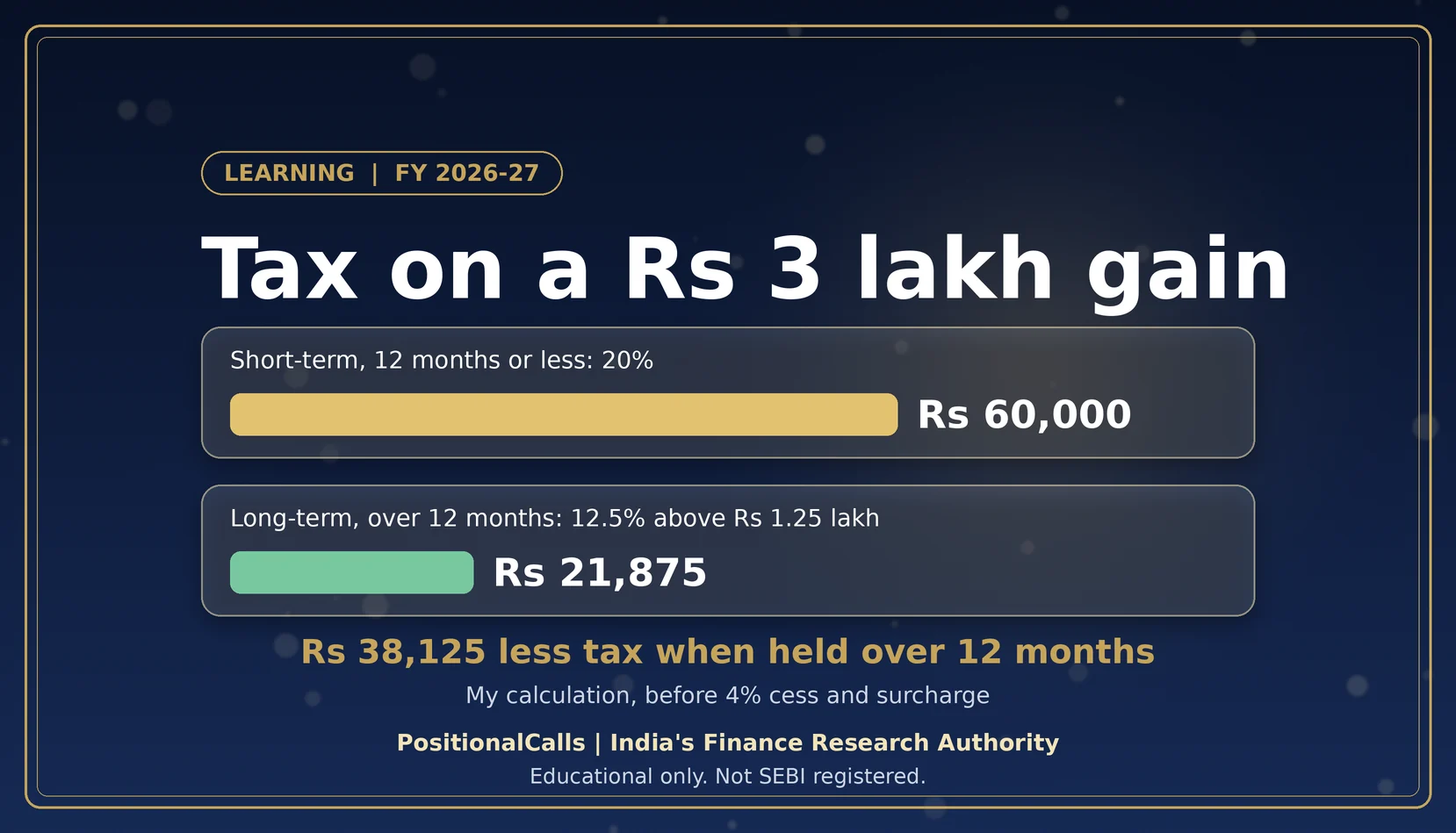
My calculation for a Rs 3,00,000 gain, before cess and surcharge: short-term tax is 20% of Rs 3,00,000 = Rs 60,000. Long-term tax is 12.5% of (Rs 3,00,000 minus Rs 1,25,000) = 12.5% of Rs 1,75,000 = Rs 21,875. The difference of Rs 38,125 is why the holding period matters so much. This is arithmetic, not a suggestion to hold or sell.
No. Indexation, which adjusted your purchase price for inflation, was removed for most assets for sales on or after 23 July 2024, as reported by tax publishers. The lower flat long-term rate replaced it. Your cost is simply what you paid, plus eligible buying costs.
Short-term means you sold listed shares or equity fund units within 12 months of buying them; long-term means you held them for more than 12 months. For most other assets the dividing line is 24 months. The holding period decides which capital gains tax on shares rate applies. The older 36-month category was removed in the July 2024 changes, as reported by tax publishers.
| Bought on | Sold on | Holding | Class | Reason |
|---|---|---|---|---|
| 10 October 2025 | 20 March 2026 | About 5 months | Short-term | Under 12 months |
| 10 October 2025 | 10 October 2026 | Exactly 12 months | Check the day count | The test is more than 12 months, so sell a few days later to be safe |
| 10 October 2025 | 15 November 2026 | About 13 months | Long-term | More than 12 months |
When does the holding period start?
The period generally starts on the date you acquired the shares, which is the trade date on your contract note. Under T+1 settlement the shares reach your demat account one trading day later, but the contract note date is what most investors use. If a sale is close to the 12-month mark, confirm the exact day count with your broker statement or a tax adviser.
For shares bought in an IPO, the holding period generally runs from the date of allotment. If you sell on the listing day, the gain is short-term. Our Jio Platforms IPO allotment and listing guide shows how allotment and listing dates work for a large issue.
What if you bought in several lots?
Shares in a demat account are normally sold on a first-in, first-out basis. The oldest units are treated as sold first, and each lot has its own holding period. Mutual fund units follow the same first-in, first-out order. A single sale can therefore have a long-term part and a short-term part.
Equity mutual funds (65% or more in equity) are taxed like shares: 20% short-term and 12.5% long-term above Rs 1.25 lakh. Debt-oriented funds are taxed at your slab rate whatever the holding period, for units bought after 1 April 2023. The fund type decides the tax, not the fund house.
| Fund type | Holding for long-term | Short-term tax | Long-term tax | Note |
|---|---|---|---|---|
| Equity fund (65%+ equity) | More than 12 months | 20% | 12.5% above Rs 1.25 lakh | Shares and equity funds share one exemption |
| Index fund or equity ETF | More than 12 months | 20% | 12.5% above Rs 1.25 lakh | Taxed as equity if equity share is 65% or more |
| Debt fund bought after 1 April 2023 | Not applicable | Slab rate | Slab rate | No indexation and no lower rate |
| Hybrid fund | Depends on equity share | Check the fund’s equity share | Check the fund’s equity share | Fund fact sheet shows the equity share |
| International fund of funds | Check the fund’s category | Often slab rate | Often slab rate | Confirm with the fund’s tax note |
How does a SIP affect the holding period?
Each SIP instalment is a separate purchase with its own date. If you run a monthly SIP for two years and redeem everything, the oldest instalments may be long-term and the newest short-term. The fund house capital gains statement shows the split, so use it when you file.
Is switching between funds a sale?
Yes. A switch from one scheme to another is a redemption and a fresh purchase, so it can trigger tax. Moving between the regular and direct plan of the same scheme is also generally treated as a transfer. Check the statement before you switch.
Equity funds are sometimes compared with direct shares. The capital gains tax on shares and on equity funds is the same rate, but costs and risk differ. This is a neutral note, not a recommendation. Read our insurance stocks guide to see how a single sector is analysed before you decide how concentrated you want to be.
To calculate capital gains tax on shares, subtract your cost from the sale value, check the holding period, apply the rate, then add 4% cess. Here are the five steps, followed by three examples. All figures are my own illustrations and ignore brokerage and surcharge.
- Find the gain: sale value minus purchase cost (and eligible buying costs).
- Sort by holding period: 12 months or less is short-term; more than 12 months is long-term.
- Net your losses: set off losses as explained in section 6.
- Apply the exemption and rate: subtract Rs 1.25 lakh from net long-term gains, then use 12.5%; use 20% on short-term gains.
- Add cess: add 4% of the tax, plus surcharge if your income is high.
| Item | Amount | Working |
|---|---|---|
| Bought | Rs 1,00,000 | 100 shares at Rs 1,000 |
| Sold after 8 months | Rs 1,40,000 | 100 shares at Rs 1,400 |
| Short-term gain | Rs 40,000 | 1,40,000 minus 1,00,000 |
| Tax at 20% | Rs 8,000 | 40,000 times 20% |
| Cess at 4% | Rs 320 | 8,000 times 4% |
| Total tax | Rs 8,320 | 8,000 plus 320 |
Example 2: a long-term gain on an equity mutual fund
| Item | Amount | Working |
|---|---|---|
| Long-term gain after 2 years | Rs 3,00,000 | Redemption value minus cost |
| Exempt limit | Rs 1,25,000 | Yearly exemption |
| Taxable gain | Rs 1,75,000 | 3,00,000 minus 1,25,000 |
| Tax at 12.5% | Rs 21,875 | 1,75,000 times 12.5% |
| Cess at 4% | Rs 875 | 21,875 times 4% |
| Total tax | Rs 22,750 | 21,875 plus 875 |
Example 3: short-term and long-term gains in the same year
| Item | Amount | Working |
|---|---|---|
| Short-term gain | Rs 50,000 | Shares sold within 12 months |
| Long-term gain | Rs 2,00,000 | Shares and funds held over 12 months |
| Tax on short-term gain | Rs 10,000 | 50,000 times 20% |
| Taxable long-term gain | Rs 75,000 | 2,00,000 minus 1,25,000 |
| Tax on long-term gain | Rs 9,375 | 75,000 times 12.5% |
| Cess at 4% | Rs 775 | (10,000 plus 9,375) times 4% |
| Total tax | Rs 20,150 | 19,375 plus 775 |
Notice that the Rs 1.25 lakh exemption is applied only to the long-term part. It cannot be used against the short-term gain. Your broker and fund houses issue profit-and-loss or capital gains statements that give the gain per sale, so you rarely need to compute lot by lot yourself.
PositionalCalls WhatsApp channel
Get capital gains tax on shares changes first
- Alerts when capital gains rates or limits change
- Advance tax and filing dates, explained in plain words
- Updates to this guide with the date of each change
6. How do set-off, carry-forward and the Rs 1.25 lakh limit work?
When you work out capital gains tax on shares, a short-term capital loss can be set off against both short-term and long-term gains, while a long-term capital loss can be set off only against long-term gains. This is the standard rule under the old Act, and tax publishers report it continues. Some publishers also report a change in how long-term losses are carried forward from FY 2026-27, but I could not confirm it from a primary source, so check the current provision before you plan around it.
| Loss type | Can be set off against | Carried forward? |
|---|---|---|
| Short-term capital loss | Short-term and long-term gains | Yes, for up to 8 years if the return is filed by the due date (check the current rule) |
| Long-term capital loss | Long-term gains only | Yes, same condition (check the current rule) |
| Unused Rs 1.25 lakh exemption | Not applicable | No, it lapses at 31 March each year |
Example 4: using a loss against gains
| Item | Amount | Working |
|---|---|---|
| Short-term gain on shares | Rs 20,000 | Sold within 12 months |
| Short-term loss on other shares | Rs 30,000 | Sold within 12 months |
| Net short-term position | Loss of Rs 10,000 | 20,000 minus 30,000 |
| Long-term gain | Rs 1,80,000 | Held over 12 months |
| Long-term gain after set-off | Rs 1,70,000 | 1,80,000 minus 10,000 |
| Taxable long-term gain | Rs 45,000 | 1,70,000 minus 1,25,000 |
| Tax at 12.5% plus 4% cess | Rs 5,850 | 5,625 plus 225 |
To carry a loss forward you must file your return on time and report the loss, even if you owe no tax that year. A loss that is not reported is generally lost.
What is gain harvesting and loss harvesting?
Some investors sell long-term holdings up to the Rs 1.25 lakh limit and buy them back, which resets the purchase price. Others sell losing holdings to book a loss that offsets gains. Both ideas are discussed widely, but each sale has costs such as STT, brokerage and fund exit loads, and tax authorities may look at transactions that exist only to cut tax. This is an explanation, not advice. Discuss it with a chartered accountant.
Grandfathering protects the gain made up to 31 January 2018 on listed equity bought before 1 February 2018. For these shares, the cost used to compute capital gains tax on shares is the higher of your actual cost and the lower of (a) the market price on 31 January 2018 and (b) your sale price. This is the long-standing rule; check the provision under the new Act when you file.
| Case | Actual cost | Price on 31 Jan 2018 | Sale price | Cost used | Gain per share |
|---|---|---|---|---|---|
| Example 5a | Rs 200 | Rs 500 | Rs 900 | Rs 500 | Rs 400 |
| Example 5b | Rs 200 | Rs 500 | Rs 300 | Rs 300 | Rs 0 |
In case 5a, the lower of Rs 500 and Rs 900 is Rs 500, and the higher of Rs 200 and Rs 500 is Rs 500. On 100 shares the gain is Rs 40,000, inside the Rs 1.25 lakh limit. In case 5b, the sale price of Rs 300 is below the 2018 price, so the cost used is Rs 300 and there is no gain and no loss.
Brokers usually show the grandfathered cost in their capital gains report, but check old holdings carefully. Shares received through a bonus, split or demerger have their own cost rules, so look at the company filing for the cost split.
If you hold long-held large caps, the same rules apply. For a sense of how companies report the numbers behind such holdings, see our Reliance Q2 results FY27 preview.
8. How is dividend income taxed?
Dividends from shares and mutual fund IDCW options are added to your income and taxed at your slab rate, and TDS of 10% applies when a resident individual receives more than Rs 10,000 in a year from one company. The company, not you, deducts it before paying. You then claim credit for the TDS when you file your return.
| Recipient | TDS rate | Threshold | Source type |
|---|---|---|---|
| Resident individual with PAN | 10% | No TDS if dividend is Rs 10,000 or less in the year | NSE company letter for FY 2026-27 |
| Resident individual without a valid PAN | Higher rate (reported as 20%) | Check the company letter | Tax publishers |
| Resident who gives Form 121 | Nil, if eligible | Form 121 replaces Forms 15G and 15H from 1 April 2026 | NSE company letter for FY 2026-27 |
| Non-resident | 20% plus surcharge and cess, or a lower treaty rate | No threshold | Tax publishers |
Companies have filed notices on NSE explaining these points for FY 2026-27. One example is a company letter filed on NSE on dividend TDS for FY 2026-27. It confirms the Rs 10,000 threshold, the 10% rate and the switch to Form 121.
Example 6: dividend and TDS
If one company pays you Rs 15,000 in a year, the company deducts 10% of Rs 15,000 = Rs 1,500 as TDS. The full Rs 15,000 is still part of your income, and the Rs 1,500 is credited against your final tax. If another company pays you Rs 8,000, no TDS is deducted, but the Rs 8,000 is still taxable. Check your Annual Information Statement (AIS) so that your return matches what companies report.
Dividends are not covered by the capital gains tax on shares rates. Their tax depends on your slab, which is a separate computation from the rates in section 2. For how to read a dividend announcement, see the corporate-action explainers in our stock market section.
9. What do you need, what does it cost and what is the tax angle?
You need your demat and fund statements, the broker capital gains report, and your tax statements; the costs are STT, brokerage and other charges; the tax angle is the capital gains tax on shares rate, the cess and advance tax.
What you need
- A PAN linked to your demat account and bank account.
- The broker profit-and-loss or capital gains report for the full financial year.
- Mutual fund capital gains statements from each fund house or the registrar.
- Your AIS and Form 26AS from the income tax portal, to match dividends and TDS.
What it costs
Delivery trades attract STT, commonly 0.1% on each buy and sell, plus brokerage, exchange charges, GST, stamp duty and demat charges. These change, so check your broker’s current schedule and your contract notes. STT is not a deduction when you compute the gain, but brokerage and eligible transfer costs can be. Ask a tax adviser how to treat them.
If your total tax liability for the year, after TDS, is Rs 10,000 or more, advance tax may apply. The remaining instalment dates in FY 2026-27 are 15 December 2026 and 15 March 2027, as set in the usual schedule (check the current rules). Capital gains are taxed in the year of sale, so a sale on 25 March counts for FY 2026-27, while the same sale on 1 April counts for FY 2027-28. Capital gains usually mean you file ITR-2 or ITR-3, and the right form depends on your whole income, so check the form instructions on the e-filing portal.
Longer holding periods, SIPs that spread purchases, and tax-saving funds with a lock-in change how gains are taxed. Each has trade-offs and none is a recommendation. If a large tax bill makes you review your wider finances, our guides on term insurance and health insurance plans cover protection, which is a separate topic from investing.
NRI note
Tax publishers report that NRIs pay the same headline rates on listed equity, but tax is often deducted at source by the broker or fund house, and a tax treaty may reduce the final liability. Rules for NRE and NRO accounts, repatriation and treaty relief are detailed, so take advice before you sell.
Scam warning
Fake messages offer “tax refunds”, “capital gains tax saving tips” or paid “guaranteed” groups. Never share an OTP or PAN with unknown callers, and file only through the official income tax portal.
Before you sell, check the capital gains tax on shares position: the holding period of each lot, your gains and losses so far in the year, and the cost of selling. This checklist is educational and does not tell you to sell or hold.
- How many days have I held each lot, and does any lot cross the 12-month mark within a few days?
- What are my long-term gains for the year so far, and how much of the Rs 1.25 lakh limit is used?
- Do I have losses I can set off, and have I recorded them for my return?
- Did I buy before 1 February 2018, and does my broker show the grandfathered cost?
- What are STT, brokerage and fund exit load on this sale?
- Is a dividend record date close, so TDS and income may change?
- Will the sale push my total tax above the advance tax threshold?
- Have I matched my broker report with AIS and Form 26AS?
What are the key dates for FY 2026-27?
| Date | What it means | Why it matters |
|---|---|---|
| 15 December 2026 | Advance tax instalment date (usual schedule) | Capital gains booked so far may count towards advance tax |
| 15 March 2027 | Final advance tax instalment date (usual schedule) | Gains booked late in the year may need quick payment |
| 31 March 2027 | Last day of FY 2026-27 | Sales settled by this date fall in this year’s gains and the Rs 1.25 lakh limit |
| 1 April 2027 | FY 2027-28 begins | A fresh Rs 1.25 lakh long-term limit starts |
These are the usual dates; check the current notifications, because the new Act may change forms and procedures. The T+1 cycle means a trade made on the last trading day of the year settles a day later, but the trade date is what counts for most investors. Confirm with your broker.
The Muhurat session on Sunday, 8 November 2026 is a normal trading session, so trades made in it are generally taxed like other trades; read our Muhurat trading 2026 guide for exchange timings, and check the exchange circular for settlement details.
Listing day gains also count. If you sell IPO shares after listing, the gain is the sale price minus the allotment price, short-term if sold within 12 months. Our EAAA India Alternatives IPO guide shows how issue price and listing price are laid out in an IPO.
What are the most common mistakes?
Treating the Rs 1.25 lakh limit as per share. The limit is per financial year across all your listed equity and equity funds. If you book Rs 90,000 on one share and Rs 80,000 on a fund, the total of Rs 1,70,000 uses the whole exemption and leaves Rs 45,000 taxable at 12.5%, which is Rs 5,625 before cess (my calculation).
Forgetting that a switch is a sale. Moving money from one fund to another, or from a regular to a direct plan, is a redemption. It can create a gain and a tax bill even though no money reached your bank account.
Leaving out small dividends. No TDS below Rs 10,000 does not mean no tax. The dividend is still income, and the AIS usually shows it, so a missing entry can trigger a mismatch notice.
Mixing up the year labels. Gains from April 2026 to March 2027 belong to FY 2026-27, which is Tax Year 2026-27 under the new Act and Assessment Year 2027-28 in the old language. Older guides use the old labels, so match the dates, not the names.
Using a grandfathered cost for newer shares. The 31 January 2018 price helps only on listed equity bought before 1 February 2018. Applying it to later purchases understates your gain.
Following tax-saving advice from messaging groups. Unregistered groups often promise to cut your tax. Treat them as a warning sign and rely on the official portal and a qualified adviser.
12. Analyst’s note and bottom line
- What stands out: the gap between 20% and 12.5% in capital gains tax on shares is large enough that the holding period is the single most important tax variable for a small investor.
- Easy to miss: the Rs 1.25 lakh limit is shared across shares and equity funds, and it lapses every 31 March.
- What would change the view: a rate change in a Union Budget, or a clarification under the Income-tax Act, 2025.
- Caution: tax should follow the investment decision, not drive it. A lower rate is not a reason to hold a weak position.
- Action for the reader: download your broker report before 31 March 2027 and see where you stand.
Bottom line
For FY 2026-27, capital gains tax on shares and equity funds is 20% on short-term gains and 12.5% on long-term gains above Rs 1.25 lakh, plus 4% cess. Dividends follow your slab, with 10% TDS above Rs 10,000 from one company. Work out your numbers early, and confirm the details with a chartered accountant. This guide is educational and does not recommend any trade.
Next read: see how a results filing is read in our Eternal Q2 results FY27 analysis.
Part of the Personal Finance and Tax series on PositionalCalls.
PositionalCalls WhatsApp channel
Keep your tax calendar in one place
- Reminders for the 15 December and 15 March tax dates
- New explainers on dividends, TDS and mutual funds
- A message when this guide is updated
For listed shares with STT paid, short-term gains are taxed at 20% and long-term gains at 12.5% above Rs 1.25 lakh a year. Add 4% cess. Budget 2026 made no change to these rates, as reported by tax publishers.
Capital gains tax on shares sold within 12 months is 20% on listed shares and equity funds, plus 4% cess. On a Rs 40,000 gain, my calculation gives Rs 8,000 tax and Rs 320 cess.
No. Long-term gains from listed equity and equity funds up to Rs 1.25 lakh in a financial year are exempt. Only the amount above it is taxed at 12.5%. The limit is shared across all your equity holdings.
How is capital gains tax on mutual funds calculated?
Equity funds follow the same 20% and 12.5% rates as shares. Debt-oriented funds bought after 1 April 2023 are taxed at your slab rate. Units are sold first-in, first-out, and each SIP instalment has its own holding period.
Listed shares and equity fund units must be held for more than 12 months. Most other assets, such as unlisted shares, need more than 24 months. Count from the contract note date and leave a margin of a few days.
Yes, if you sell, and the usual capital gains tax on shares rates apply. The gain is the sale price minus the allotment price. Selling on listing day is a short-term gain taxed at 20%. The holding period for IPO shares generally runs from the allotment date.
A short-term loss can be set off against short-term and long-term gains. A long-term loss can be set off only against long-term gains. Report the loss on time to carry it forward. Check the current rule under the new Act.
Is dividend income taxed, and is TDS deducted?
Yes. Dividends are taxed at your slab rate. A resident individual sees 10% TDS when dividends from one company exceed Rs 10,000 in the year. Below that, no TDS is cut, but the dividend is still taxable.
Tax publishers report the same 20% and 12.5% rates for NRIs on listed equity, often with TDS deducted at source. A tax treaty may reduce the final tax. NRI cases vary, so take professional advice before selling.
This site gives no buy or sell advice. The tax year ends on 31 March, so gains and losses booked by then count in FY 2026-27. Whether to sell depends on your goals, costs and risk. Discuss it with a chartered accountant.
Sources
- Income Tax Department, Government of India: long-term capital gains provision (primary)
- Income Tax Department, Government of India: short-term capital gains provision (primary)
- NSE corporate filing: dividend TDS communication for FY 2026-27 (primary filing)
- Tax publishers consulted for cross-checks (named, not linked): Bajaj Finserv, INDmoney, Zerodha Varsity, Patron Accounting, CalcGuru, as of 25 October 2026, 8:00 PM IST.
Editorial disclosure: PositionalCalls.com is an independent Indian stock market research and education site founded by Shubham Chaudhary. It is not SEBI registered. This guide is educational only and is not tax, legal or investment advice. It gives no targets, buy or sell calls or guarantees. How I researched this capital gains tax on shares guide: I read the Income Tax Department provisions and an exchange filing, and cross-checked rates across several tax publishers as of 25 October 2026, 8:00 PM IST. Figures are illustrations and exclude brokerage and surcharge unless stated. Check current rules or ask a chartered accountant before you act.

Shubham Chaudhary is the founder of PositionalCalls, an independent Indian stock market research website. He writes company fundamentals, quarterly results analysis, IPO analysis and sector research for NSE and BSE listed companies, with a focus on banking stocks, insurance and long-term value investing. Every article is built from primary sources such as RBI, SEBI, NSE and BSE filings and company annual reports, and states its risks plainly in simple language for retail investors.
Coverage areas Our research standards- Numbers checked against NSE, BSE and SEBI filings
- Risks and limits stated in every article
- No paid promotions or broker tie-ups
- Articles updated when new filings arrive