
Sector outlook · Banking
Looking for high dividend bank stocks in India 2026? This page replaces the earlier top-five list and its unsourced yield table with what eleven banks actually declared for FY26, the record dates, the money paid to the government, and the profit and asset-quality data behind each payout. It names no winners.
Quick answer
The high dividend bank stocks in India 2026 cannot be named from data alone, because a dividend per share is not a yield. For FY26 the banks I checked declared from Rs 1 (Axis Bank) to Rs 18.25 (Indian Bank) a share, but face values and prices differ. Yield needs a live price, which this page does not use.
Latest update (Saturday, 14 November 2026, 5:30 PM IST): Rebuilt with FY26 dividends per share, record dates and Q2 FY27 profit data, replacing the earlier table whose amounts, yields and payout ratios had no source. The page also no longer links to the old long-term and safe bank-stock posts, which redirect elsewhere. I could not open any bank filing, so figures are from press reports and exchange-style summaries.
Key takeaways
- No picks: there is no ranked list, “quick decision” or “best mix” here. The earlier yield and payout-ratio figures had no source and several amounts were wrong.
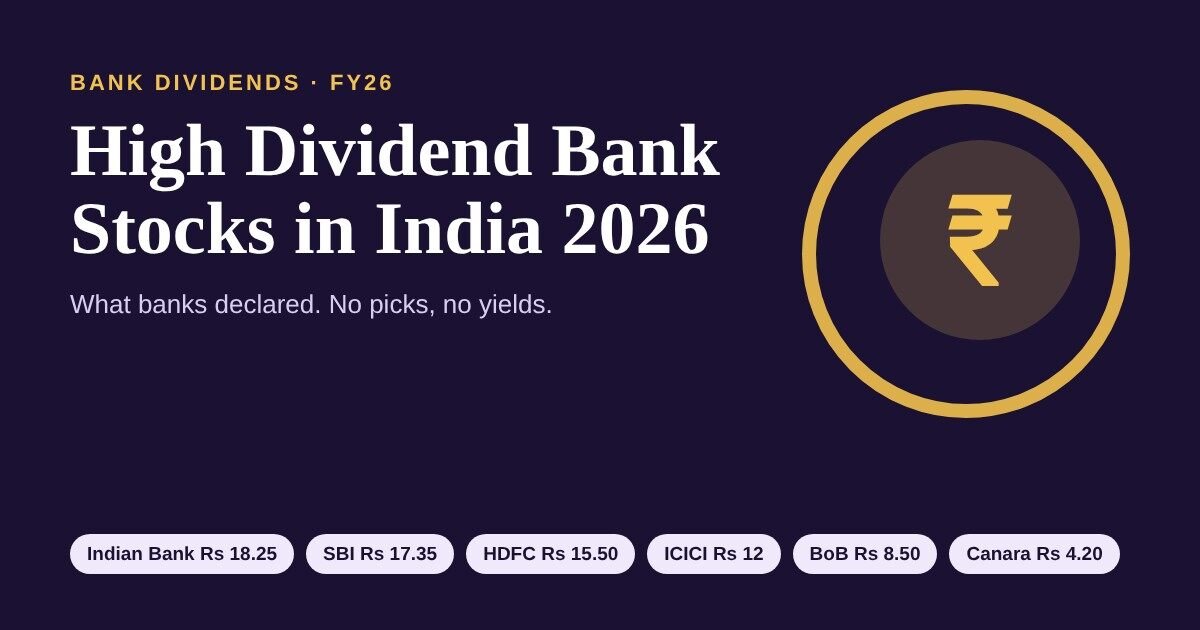
- FY26 dividend per share: Indian Bank Rs 18.25, SBI Rs 17.35, HDFC Bank Rs 15.50 (Rs 13 final plus Rs 2.50 special interim), ICICI Bank Rs 12, Bank of Baroda Rs 8.50, Union Bank Rs 5, Bank of India Rs 4.65, Canara Rs 4.20, PNB Rs 3, Axis Rs 1.
- Per share is not yield: face values run from Re 1 to Rs 10 and prices differ, so Rs 18.25 at one bank can be a smaller income per rupee invested than Rs 4.20 at another. Yield needs a live price.
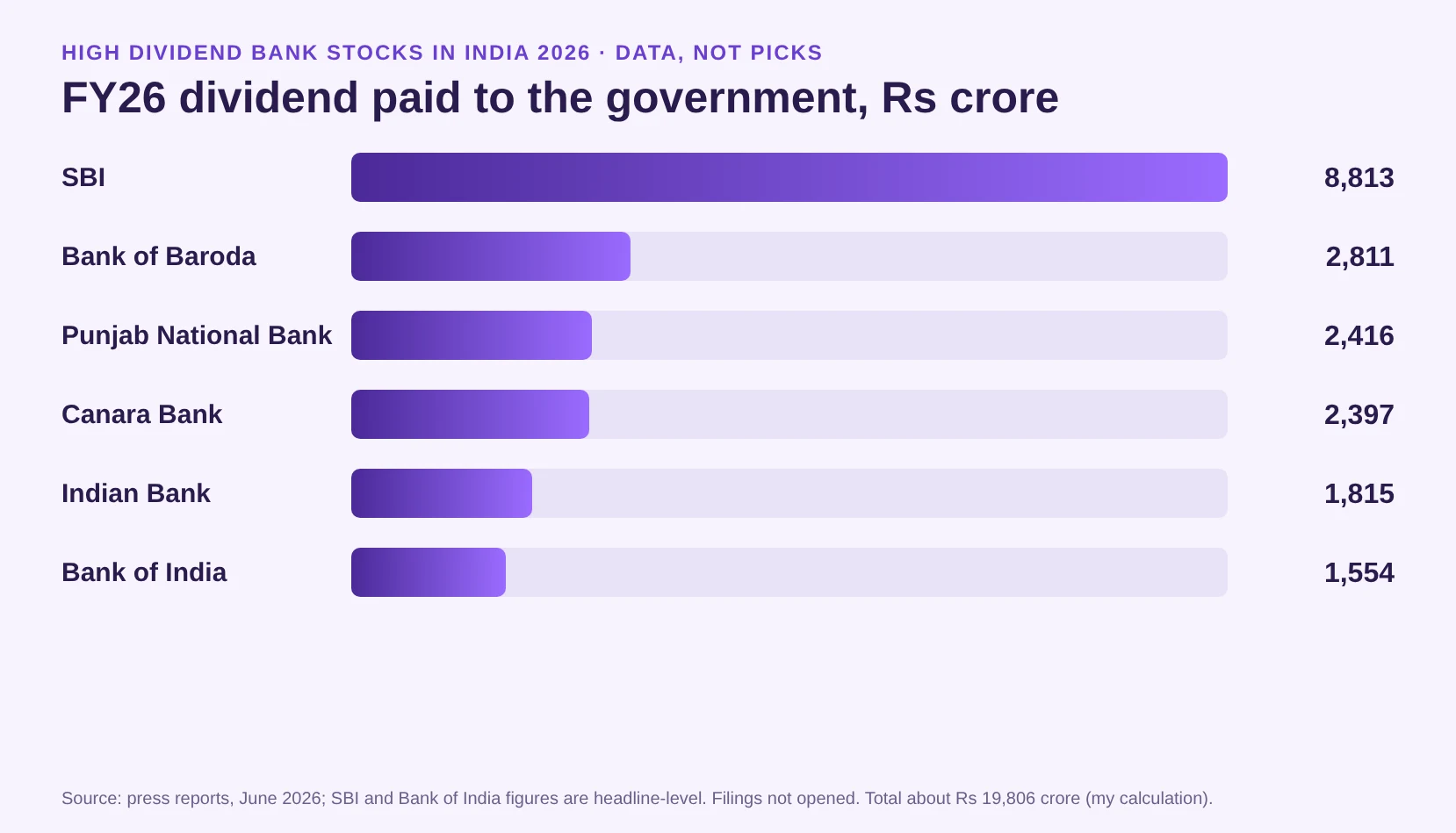
- Where the money goes: six public sector banks paid about Rs 19,806 crore of FY26 dividends to the government (my calculation), SBI alone Rs 8,813 crore.
- Capacity: every dividend bank grew Q2 FY27 profit, from +4.7% at HDFC Bank to +38% at Axis; gross NPA was 1.11% to 2.55%.
- Timing: payouts are mostly once a year. Record dates for FY26 ran from 16 May to 3 August 2026.
In plain words: a high dividend per share does not make a high dividend stock. What you earn depends on the price you pay, and what you keep depends on whether the bank can afford to pay again next year. This page gives the declared amounts and the data on affordability, and leaves the choice to you.
Data note: Figures are as of 14 November 2026, 5:30 PM IST. Dividends are for FY26 (April 2025 to March 2026) and were declared in April to July 2026. Profit and NPA figures are Q2 FY27 (quarter to 30 September 2026). They follow Multibagg, Kotak Neo, Angel One, Business Today, Free Press Journal, PSU Connect, PSU Watch and my own result posts. I could not open the exchange filings. Derived numbers are my calculation. Kotak Mahindra Bank and Punjab & Sind Bank dividends were not found.
1. What can a data page say about high dividend bank stocks in India 2026?
A data page can show what each bank declared for FY26, when the record date fell and what profit and asset quality stand behind the payout, but it cannot name the best high dividend bank stocks in India 2026, because that depends on the price you pay and the income you need.
Searches for high dividend bank stocks in India 2026 usually want a short list with a yield. A list is a recommendation, and PositionalCalls is not SEBI registered and gives no buy or sell calls. A yield is a dividend divided by a price, and I do not use prices on this page. What I can do is put the declared dividends and the data on affordability side by side. The table below maps the common income goals to the measure that tests them.
| If your goal is | Check this measure | Evidence on this page | Caution |
|---|---|---|---|
| Highest income per rupee invested | Dividend yield: dividend per share divided by your purchase price | FY26 dividends per share, from Rs 1 to Rs 18.25 | Yield needs a live price, which is not used here |
| A payout that can continue | Profit growth, gross NPA and capital adequacy | Q2 FY27 profit +4.7% to +38%; gross NPA 1.11% to 2.55% | A single quarter is not a track record |
| Regular cash flow | Number and timing of payments each year | Mostly one final dividend a year; HDFC Bank also paid a special interim | Dividends are lumpy, not monthly |
| Growth plus income | Dividend history together with earnings growth | Not covered in depth here | See the data pages on all banks and PSU banks |
| After-tax income | Dividend tax and TDS in your hands | Not computed | See the dividend tax guide |
Cite this table: Goal-to-measure map by PositionalCalls; evidence from the FY26 dividend and Q2 FY27 data in the tables below, as of 14 November 2026, 5:30 PM IST.
What changed from the earlier version
The earlier page was titled “Top 5 Picks” and listed SBI, Canara Bank, Bank of Baroda, PNB and HDFC Bank with a dividend, a yield and a payout ratio for each. It also gave a “Quick Decision” and a “best mix” of three banks. None of those figures had a source or a date, and several do not match what the banks declared: the page showed Rs 11 for SBI against Rs 17.35 declared, Rs 7 for Bank of Baroda against Rs 8.50, Rs 12 for Canara against Rs 4.20 and Rs 19 for HDFC Bank against Rs 15.50 in total. I removed the list, the yields and the verdict. The page also linked to two old posts that redirect to my best bank stocks in India 2026 data page, and I replaced those links.
2. What did eleven banks declare for FY26?
For FY26 the banks I checked declared from Rs 1 a share at Axis Bank to Rs 18.25 at Indian Bank, with SBI at Rs 17.35, HDFC Bank at Rs 15.50 in total and ICICI Bank at Rs 12, and most record dates fell between mid-May and early August 2026.
| Bank | FY26 dividend per share | Date found | Face value | Note |
|---|---|---|---|---|
| Indian Bank | Rs 18.25 | 10 June 2026 (record date per Multibagg; ex-date per Kotak Neo) | Not found | Rs 1,815 crore paid to the government |
| SBI | Rs 17.35 | Record date 16 May 2026; payment 4 June if approved | Re 1 | Rs 8,813 crore paid to the government |
| HDFC Bank | Rs 15.50 (Rs 13 final + Rs 2.50 special interim) | Record date 19 June 2026 for the Rs 13 | Not found | Special interim paid earlier in the year; date not found |
| ICICI Bank | Rs 12 | Record date 3 August 2026; AGM 21 August | Rs 2 | Per an Angel One headline, the highest payout in 12 years |
| Bank of Baroda | Rs 8.50 | Ex-date 5 June 2026 | Not found | Rs 2,811 crore paid to the government |
| Union Bank of India | Rs 5 | Recommended; record date not found | Not found | Subject to approval at the AGM |
| Bank of India | Rs 4.65 | Record date 29 May 2026 | Rs 10 | Subject to AGM approval; Rs 1,553.5 crore paid to the government per a PSU Connect headline |
| Canara Bank | Rs 4.20 | Ex-date 12 June 2026 | Not found | Rs 2,397 crore paid to the government |
| Bank of Maharashtra | About Rs 2.2 (sources conflict: Rs 1.50 to Rs 2.50) | Not found | Not found | Q4 portion Rs 1.2 per one source |
| Punjab National Bank | Rs 3 | Ex-date 12 June 2026 | Not found | Rs 2,416 crore paid to the government per PSU Connect |
| Axis Bank | Rs 1 | Not found | Not found | Single source, PSU Connect |
Cite this table: FY26 dividends per Multibagg, Kotak Neo, Angel One, Business Today, Free Press Journal and PSU Connect; face value shown only where a source gave it; filings not opened.
Two points stand out. First, per-share amounts are not comparable across banks, because the face value differs (Re 1 at SBI, Rs 2 at ICICI Bank, Rs 10 at Bank of India) and the share prices differ even more. Second, a PSU Connect article dated 29 September 2026 quoted approximate yields of about 3.3% to 3.6% for Bank of Baroda and about 1.9% to 2.0% for SBI, but it stated no price and no date for the calculation, so I do not repeat them. Kotak Mahindra Bank is missing because I found no FY26 dividend figure for it.
How much of the payout goes to the government?
| Bank | FY26 dividend paid to the government (Rs crore) | Share of the six-bank total (my calculation) |
|---|---|---|
| SBI | 8,813 | 44.5% |
| Bank of Baroda | 2,811 | 14.2% |
| Punjab National Bank | 2,416 | 12.2% |
| Canara Bank | 2,397 | 12.1% |
| Indian Bank | 1,815.05 | 9.2% |
| Bank of India | 1,553.5 | 7.8% |
| Total, six banks | About 19,806 | 100% |
Cite this table: Government dividend cheques for FY26 per Angel One, PSU Watch, Tribune and PSU Connect; the Bank of India and SBI figures are headline-level; PNB per PSU Connect.
The government is the largest shareholder in these public sector banks, so a large part of each payout goes to it and not to minority holders. That is not a flaw, but it means a bank’s total dividend bill can look large while your own income depends only on your per-share amount and your purchase price. One PSU Connect article put SBI’s total payout at about Rs 16,015 crore without a date, which looks high against the Rs 8,813 crore paid to the government, so I did not use it.
3. What does the dividend data show bank by bank?
Each card below lists the FY26 dividend and the Q2 FY27 data that bears on whether it can continue, with one thing to verify in the filing. None is a rating.
Indian Bank
Declared Rs 18.25 a share for FY26 with a record date of 10 June 2026 and paid Rs 1,815 crore to the government. Q2 FY27 net profit was Rs 3,462 crore (+14.7%), gross NPA 1.61% against 2.60%, net NPA 0.14%. Operating profit rose 46.58%, or 18% without NSE-related gains. Check in the filing: The face value and the total capital adequacy ratio, which sources report differently.
SBI
Declared Rs 17.35 a share (record date 16 May 2026) and paid Rs 8,813 crore to the government. Q2 FY27 net profit was Rs 23,038 crore (+14.3%) on a year-ago base that included a Rs 4,593 crore gain, gross NPA 1.39%, NIM 2.94%. See my SBI Q2 results FY27 post. Check in the filing: Dividend payout as a share of profit, which I did not compute.
HDFC Bank
Declared a Rs 13 final dividend (record date 19 June 2026) on top of a Rs 2.50 special interim paid earlier in the year, Rs 15.50 in total, against FY26 profit of Rs 44,962 crore. Q2 FY27 net profit was Rs 19,510 crore (+4.7%), gross NPA 1.11%. Check in the filing: Whether the special interim is a one-off, since a special payment need not repeat.
ICICI Bank
Declared Rs 12 a share (face value Rs 2, record date 3 August 2026, AGM 21 August); an Angel One headline called it the highest payout in 12 years. Q2 FY27 net profit was Rs 14,843 crore (+20.1%), NIM 4.18%, gross NPA 1.20%. Check in the filing: The earlier years’ payouts behind the “12 years” claim, which I did not open.
Bank of Baroda
Declared Rs 8.50 a share (ex-date 5 June 2026) and paid Rs 2,811 crore to the government. Q2 FY27 net profit was Rs 6,531.5 crore (+35.8%), including a Rs 4,093 crore treasury gain linked to an NSE share sale, gross NPA 1.78%, capital adequacy 16.61%. See my Bank of Baroda Q2 results FY27 post. Check in the filing: How much of the profit growth is one-time, since it may not repeat.
Union Bank of India
Recommended Rs 5 a share, subject to AGM approval; I did not find the record date. Q2 FY27 net profit was Rs 5,537 crore (+30.3%), gross NPA 2.42% against 3.29%, NIM 2.86%. Check in the filing: The record date and the final approved amount.
Bank of India
Declared Rs 4.65 a share (face value Rs 10, record date 29 May 2026, subject to AGM approval). Q2 FY27 net profit was Rs 3,202 crore (+25.34%), gross NPA 1.60%, net NPA 0.42%. Check in the filing: NIM and capital adequacy, which I did not find.
Canara Bank
Declared Rs 4.20 a share (ex-date 12 June 2026) and paid Rs 2,397 crore to the government. Q2 FY27 net profit was Rs 5,175 crore (+8.4%), gross NPA 1.33%, capital adequacy 17.19% per a summary page, which also reports that management expects extra provisioning over one to two years (unconfirmed). Check in the filing: The provisioning plan and what it could mean for next year’s profit.
Punjab National Bank
PositionalCalls WhatsApp channel
Follow bank dividend announcements
- Dividend amounts and record dates in plain words
- Bank results explained without tips
- A message when this page is updated
Declared Rs 3 a share (ex-date 12 June 2026) and paid Rs 2,416 crore to the government per PSU Connect. Q2 FY27 net profit was Rs 5,532 crore (+12.8%), gross NPA 2.55%, NIM 2.58%. Check in the filing: Why gross NPA remains the highest of the banks here.
Bank of Maharashtra
Dividend for FY26 about Rs 2.2 a share, but sources conflict (Rs 1.50 to Rs 2.50). Q2 FY27 net profit was Rs 2,310 crore (+41.42%), gross NPA 1.25%, net NPA 0.12%. The shares rose 1.06% to Rs 76.10 on the results day, 26 October. Check in the filing: The exact dividend and record date.
Axis Bank
Rs 1 a share for FY26 per one source. Q2 FY27 net profit was Rs 7,003 crore (+38%), partly from provisions that fell 52.2%, gross NPA 1.16%. Check in the filing: The dividend amount, since only one source gave it.
4. Why a dividend per share is not a yield on high dividend bank stocks in India 2026
For high dividend bank stocks in India 2026, a dividend per share tells you the rupees paid on one share, and a yield divides that by the price you pay, so the same dividend gives a different yield at a different price. This page gives declared amounts only, because yield needs a live price.
| Assumed dividend per share | Assumed purchase price | Yield (my calculation) |
|---|---|---|
| Rs 10 | Rs 250 | 4.0% |
| Rs 10 | Rs 400 | 2.5% |
| Rs 10 | Rs 500 | 2.0% |
| Rs 10 | Rs 1,000 | 1.0% |
Cite this table: Illustration with assumed numbers, not quotes for any bank; yield is dividend divided by price.
The table uses made-up numbers to show the mechanism, so do not read it as a statement about any bank. The earlier page used a similar example: Rs 5,00,000 invested at an assumed 3% yield gives about Rs 15,000 a year, or about Rs 1,250 a month on average (my calculation). The arithmetic is right, but the 3% was an assumption, and bank dividends are not paid monthly. Most banks here pay one final dividend a year, and one paid an extra special interim, so the cash arrives in lumps.
A second trap is the ex-dividend date. On that date the share price is normally adjusted for the dividend, so you do not gain the amount on top of the price. Think of the dividend as part of the total return, together with the price change, and not as free income. For a public sector bank with a government majority, the dividend amount also reflects government policy and capital needs, which I discuss in section 9.
5. Can the banks keep paying? The data behind the high dividend bank stocks in India 2026
A bank’s ability to repeat a dividend depends on profit, asset quality and capital. In Q2 FY27 every bank in the table grew profit, gross NPA ranged from 1.11% to 2.55%, and I found capital adequacy for only four of them.
| Bank | FY26 dividend per share | Q2 FY27 profit change | Gross NPA | Capital adequacy found |
|---|---|---|---|---|
| SBI | Rs 17.35 | +14.3% | 1.39% | Not found |
| Indian Bank | Rs 18.25 | +14.7% | 1.61% | 16.21% (sources conflict) |
| HDFC Bank | Rs 15.50 | +4.7% | 1.11% | Not found |
| ICICI Bank | Rs 12 | +20.1% | 1.20% | Not found |
| Bank of Baroda | Rs 8.50 | +35.8% | 1.78% | 16.61% |
| Union Bank | Rs 5 | +30.3% | 2.42% | Not found |
| Bank of India | Rs 4.65 | +25.3% | 1.60% | Not found |
| Canara Bank | Rs 4.20 | +8.4% | 1.33% | 17.19% |
| PNB | Rs 3 | +12.8% | 2.55% | Not found |
| Axis Bank | Rs 1 | +38% | 1.16% | Not found |
Cite this table: FY26 dividends and Q2 FY27 data per the sources on this page and my PSU bank and best bank stocks data pages; filings not opened.
Profit growth in Q2 FY27 is a good sign but not a promise, because some of it came from one-off items. Bank of Baroda’s includes a treasury gain, SBI’s year-ago base included a gain, and Axis’s reflects lower provisions. A dividend is also a board decision. RBI rules link payouts to capital and asset quality, and I did not check the current rules for this page, so confirm them in the RBI circulars. For the full asset-quality, growth and capital tables, see my PSU bank stocks in India 2026 and best bank stocks in India 2026 data page pages.
6. How do public sector and private high dividend bank stocks in India 2026 compare?
Public sector banks in the table declared from Rs 3 to Rs 18.25 a share and private banks from Rs 1 to Rs 15.50, but because face values and prices differ, the per-share gap says little about yield, and the real difference is who receives the money.
| Factor | Public sector banks here | Private banks here |
|---|---|---|
| FY26 dividend per share | Rs 3 to Rs 18.25 (SBI, Indian, BoB, Union, BoI, Canara, PNB) | Rs 1 to Rs 15.50 (HDFC, ICICI, Axis) |
| Record or ex-dates found | 16 May to 12 June 2026 | 19 June and 3 August 2026 |
| Special payments | None found | HDFC Bank Rs 2.50 special interim |
| Largest recipient | The government, as majority holder | Public shareholders |
| Q2 FY27 profit change | +8.4% to +35.8% (seven banks) | +4.7% to +38% (HDFC, ICICI, Axis) |
| Gross NPA | 1.33% to 2.55% | 1.11% to 1.20% |
| Yield | Not computed | Not computed |
Cite this table: Per the dividend and Q2 FY27 sources on this page; groups are not like-for-like; filings not opened.
The earlier page said public sector banks give high yield and private banks give low yield, with no numbers. I cannot confirm that without prices, and per-share dividends do not show it. What the data shows is a different split: public sector payouts go largely to the government, private payouts go to the public, and the private banks’ gross NPA ratios were lower in Q2 FY27.
7. How do dividends compare with price gains?
A dividend is cash paid once or twice a year that is also reflected in the share price on the ex-date, while a price gain is realised only when you sell, so the two are taxed at different times and in different ways.
| Factor | Dividend income | Price gain |
|---|---|---|
| When it arrives | On the payout date, once or twice a year here | When you sell |
| Price effect | Share price is normally adjusted on the ex-date | Depends on the market and results |
| Tax | Taxed in your hands; see the dividend tax guide | Capital gains rules; see the capital gains guide |
| Predictability | Can be cut or skipped by the board | Not predictable |
| Reinvestment | You must reinvest the cash yourself | Compounds inside the share price |
Cite this table: Comparison by PositionalCalls; tax rules are in my guides and were not recomputed here.
The earlier page called dividend banks “moderate” risk and growth banks “lower” risk in the same table, which contradicts its own text. I removed that table. The practical point is that dividend income and price gain are two parts of the same return, and a bank that pays out more keeps less capital to grow, so neither is free. For tax, read my dividend tax in India guide and my capital gains tax on shares guide.
8. How do you compare high dividend bank stocks in India 2026 yourself?
Pick the income you need, read the declared dividend and record date in each filing, divide by the price you would actually pay, and then test whether profit, asset quality and capital can support the payout.
- Fix the goal: income per rupee, a payout that continues, or growth plus income each need different measures, as the table in section 1 shows.
- Read the dividend notice: on the NSE or BSE site find the amount, face value, record date, ex-date and payment date for the latest year.
- Check the type: separate the final dividend from any special or interim payment, because only the regular part is likely to repeat.
- Divide by the price you would pay: yield is dividend divided by price, and it changes every day.
- Test affordability: check profit growth, gross and net NPA, capital adequacy and provisioning, across at least four quarters.
- Read the shareholding pattern: note how much of the payout goes to the government.
- Think about tax and reinvestment: see my dividend tax in India guide, and if you plan regular buying see SIP in bank stocks.
- Add price last: a bank can be strong and expensive, and the lower-priced names are covered on my bank stocks under Rs 100 page.
If your question is narrower, see my PSU bank stocks in India 2026 page for the ten public sector banks and my best bank stocks in India 2026 data page for the large private ones. Each keeps to its own question, so this page does not repeat them.
9. What are the risks of high dividend bank stocks in India 2026?
The main risks of high dividend bank stocks in India 2026 are a dividend cut or skipped payout, a special dividend that does not repeat, profit that leans on one-off gains, rising provisions, government decisions at public sector banks, and a falling share price that wipes out the dividend.
Price risk is separate. The share price can fall by more than the dividend, and the ex-date adjustment means the dividend is not additional to the price. This page uses no price data, apart from one results-day move for Bank of Maharashtra, so it cannot tell you whether a bank looks expensive or cheap. Brokerage ratings were also not used, because a rating is an opinion and not a company fact.
10. What most people miss about high dividend bank stocks in India 2026
- What stands out: the highest dividend per share (Indian Bank at Rs 18.25) says nothing about yield without the price, and the lowest (Axis at Rs 1) says nothing about quality.
- Easy to miss: HDFC Bank’s Rs 15.50 includes a special interim of Rs 2.50, so the regular final payout was Rs 13.
- What would change the picture: final dividends declared with the Q4 FY27 results, which in FY26 were followed by record dates from 16 May to 3 August, plus any interim dividend.
- Caution: this page does not say which bank to buy. It shows what was declared and where the data is thin.
Bottom line
The best high dividend bank stocks in India 2026 depend on the income you need and the price you pay, and the data does not name one winner. For FY26 the banks I checked declared from Rs 1 to Rs 18.25 a share, mostly as one final dividend a year, and a large part of the public sector payouts went to the government. Compare banks on yield at your own price and on the profit and asset quality behind the payout, and read the filings.
Next read: see the data on the PSU bank stocks in India 2026.
Part of the Sector Outlook series on PositionalCalls.
PositionalCalls WhatsApp channel
Keep the dividend data in one place
- Bank dividend and results updates
- RBI decisions and what they mean for banks
- Updates when the next dividends are declared
FAQs on high dividend bank stocks in India 2026
What are the best high dividend bank stocks in India 2026?
This page does not name them, because PositionalCalls gives no buy or sell calls and the best high dividend bank stocks in India 2026 depend on the price you pay and the income you need. It lists what eleven banks declared for FY26 and the profit and asset-quality data behind each payout.
Which bank declared the highest dividend per share for FY26?
Among the banks I checked, Indian Bank declared the highest at Rs 18.25 a share, followed by SBI at Rs 17.35, HDFC Bank at Rs 15.50 including a Rs 2.50 special interim, ICICI Bank at Rs 12 and Bank of Baroda at Rs 8.50. Per-share amounts are not comparable because face values and prices differ.
Which bank has the highest dividend yield?
I cannot say, because yield is the dividend divided by the price you pay, and this page uses no live prices. A PSU Connect article quoted approximate yields without stating a price or date, so I do not repeat them. Divide the declared dividend by the current price to compute it yourself.
Are high dividend bank stocks in India 2026 safe?
No share is risk free. A board can cut or skip a dividend, and the share price can fall by more than the payout. A safety check uses profit trends, gross and net NPA and capital adequacy across several quarters. I found capital adequacy for only four of ten banks, so verify it before relying on a payout.
Do bank stocks pay dividends every month?
No. The banks I checked paid one final dividend a year, with record dates between 16 May and 3 August 2026, and HDFC Bank also paid a special interim earlier in the year. The earlier page’s monthly income figure was an average of an assumed yield, so the cash itself arrives in lumps.
How much income can Rs 5,00,000 in bank stocks give?
At an assumed 3% yield it would be about Rs 15,000 a year, or Rs 1,250 a month on average (my calculation), but the 3% is an assumption. Actual income depends on the dividend per share, the price you paid and the number of shares, and a board can change the dividend each year.
What happens to the share price on the ex-dividend date?
The share price is normally adjusted downward on the ex-dividend date by about the dividend amount, other factors aside, so the dividend is not extra money on top of the price. Treat it as part of total return together with the price change, and check the ex-date before you buy.
Who receives most of the public sector bank dividend?
The government, as the largest shareholder. For FY26 it received about Rs 19,806 crore from six public sector banks (my calculation), including Rs 8,813 crore from SBI, Rs 2,811 crore from Bank of Baroda and Rs 2,416 crore from PNB. Minority shareholders receive the same per-share amount as the government.
Is bank dividend income taxable?
Yes. Dividends are taxed in the recipient’s hands, and tax may also be deducted at source. The rates and thresholds change, so I do not state them here. My dividend tax in India guide, linked on this page, covers the current rules, and the capital gains guide covers tax on the sale of shares.
What should I monitor each year for high dividend bank stocks in India 2026?
Track the declared dividend and whether it includes a special payment, the record and ex-dates, profit and its source, gross and net NPA, capital adequacy, and the shareholding pattern. The next data point is the final dividend declared with the Q4 FY27 results, which in FY26 came with record dates from 16 May.
Sources
- Multibagg: PSU dividends for Q4 FY26; SBI, Indian Bank, PNB, Union Bank and Bank of Maharashtra amounts and dates.
- Kotak Neo: banking stocks ex-dividend in June 2026; ex-dates for Bank of Baroda, Indian Bank, Canara, PNB and HDFC Bank.
- Free Press Journal: HDFC Bank FY26 dividend; Rs 13 final plus Rs 2.50 special interim.
- Business Today: ICICI Bank final dividend record date, 1 July 2026.
- Multibagg: Bank of India dividend record date; Rs 4.65, record date 29 May 2026.
- Angel One: Union Bank recommends Rs 5 dividend; record date not stated.
- Angel One: Canara Bank, Bank of Baroda and Indian Bank dividend to the government, 30 June 2026.
- PSU Connect: PSU against private bank dividend yield, 29 September 2026; approximate yields with no stated price, not used.
- Tribune: SBI hands over Rs 8,813 crore dividend cheque to the government; headline.
- PositionalCalls: PSU bank stocks in India 2026 (my Q2 FY27 data page).
- PositionalCalls: best bank stocks in India 2026 (my Q2 FY27 data page).
- Reserve Bank of India: policy statements, circulars and statistics.
- Named, not linked: PSU Watch coverage of the Canara Bank and SBI dividend cheques, a PSU Connect headline on Bank of India’s Rs 1,553.5 crore payment, Angel One and Zee Business headlines on ICICI Bank and Canara Bank dividends, and Upstox, 5paisa and Multibagg coverage of the Q2 FY27 results, as read for my banking sector posts, as of 14 November 2026, 5:30 PM IST. No BSE or NSE filing was opened.

Shubham Chaudhary is the founder of PositionalCalls, an independent Indian stock market research website. He writes company fundamentals, quarterly results analysis, IPO analysis and sector research for NSE and BSE listed companies, with a focus on banking stocks, insurance and long-term value investing. Every article is built from primary sources such as RBI, SEBI, NSE and BSE filings and company annual reports, and states its risks plainly in simple language for retail investors.
Coverage areas Our research standards- Numbers checked against NSE, BSE and SEBI filings
- Risks and limits stated in every article
- No paid promotions or broker tie-ups
- Articles updated when new filings arrive