
Insurance · Life Insurers
Looking for the best life insurance stocks in India 2026? All five listed life insurers have reported H1 FY27. This page compares margin, growth, solvency and persistency from results as reported, tracks the IRDAI commission draft and names no winner.
Quick answer
The best life insurance stocks in India 2026 cannot be ranked on one number. H1 FY27 VNB margins ran from 22.3% (LIC) to 27.9% (SBI Life), with HDFC Life at 24.7%, ICICI Life 26.0% and Axis Max Life 25.4%. VNB growth ran from 12.1% (HDFC Life) to 34% (LIC). IRDAI’s commission draft is the main open risk.
Latest update (Sunday, 15 November 2026, 8:56 AM IST): Rebuilt on H1 FY27 results for HDFC Life, SBI Life, ICICI Life, LIC and Axis Max Life, replacing the Q1 figures the 27 October version used for three of them. The share prices, market caps, P/E ratios and brokerage targets of that version are dropped because I collected no live prices. ICICI Prudential Life is reported as ICICI Life Insurance, formerly ICICI Prudential Life.
Key takeaways
- No ranking: this page compares five insurers on reported numbers. The earlier “best overall” and “best value” labels are removed, and the page gives no rating, target or buy list.
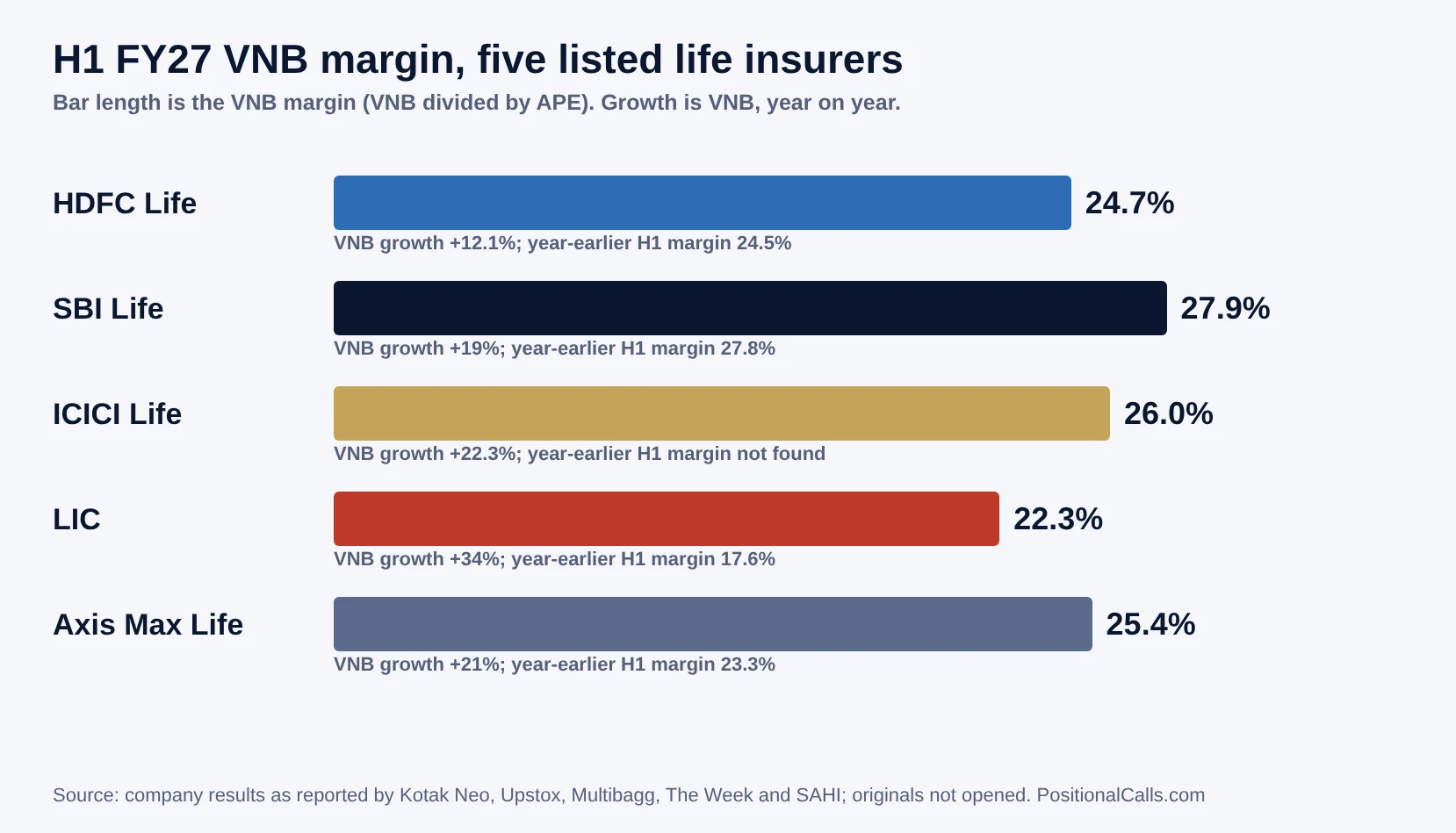
- Margins: H1 FY27 VNB margin was 27.9% at SBI Life, 26.0% at ICICI Life, 25.4% at Axis Max Life, 24.7% at HDFC Life and 22.3% at LIC.
- Growth: VNB grew 34% at LIC, 22.3% at ICICI Life, 21% at Axis Max Life, about 19% at SBI Life and 12.1% at HDFC Life. LIC’s APE grew only 5.72%, so its VNB gain came mainly from margin.
- Persistency: LIC’s 13-month persistency (premium basis) was 74.69% and HDFC Life’s 83%, down from 86%, which is the weakest signal in the numbers.
- IRDAI: the commission and expense draft is not final. Feedback closed on 31 October, and a Bloomberg-based report says another consultation is expected before final rules.
In plain words: VNB (value of new business) is the estimated profit from policies sold in a period. APE (annualised premium equivalent) is a standard measure of new sales. VNB margin is VNB divided by APE. Solvency shows how many times capital covers the required minimum, and persistency is the share of policies still active after 13 or 61 months.
Data note: H1 FY27 figures are from news and results summaries of company releases: Kotak Neo, Cafemutual, Compounding AI, Upstox, SAHI, Free Press Journal, Multibagg, The Week and Investywise. Q1 inputs, GST, claims, penetration and IRDAI proposal details are carried from the 27 October version. I opened no exchange filing in this rebuild, so confirm each figure against the company filing.
1. What are the best life insurance stocks in India 2026?
No one number produces a list of the best life insurance stocks in India 2026. These five are the listed life insurers most readers track, and each differs on margin, growth, capital and channel exposure, so this page compares them on reported H1 FY27 figures and does not rank.
| Insurer | H1 FY27 VNB | VNB margin | APE | Profit after tax |
|---|---|---|---|---|
| HDFC Life | Rs 2,037 crore (+12.1%) | 24.7% (24.5% a year earlier) | Rs 8,245 crore (+11%) | Rs 1,119 crore (+12.7%) |
| SBI Life | Rs 3,270 crore (+19%) | 27.9% (27.8% a year earlier) | Rs 11,750 crore (+18%) | Rs 1,270 crore (+17%) |
| ICICI Life | Rs 1,283 crore (+22.3%) | 26.0% | Rs 4,935 crore (+15.1%) | Rs 760 crore (+26.5%) |
| LIC | Rs 6,846 crore (+34%) | 22.3% (17.6% a year earlier) | Rs 30,696 crore (+5.72%) | Rs 25,568 crore (+21.5%) |
| Axis Max Life (Max Financial) | Rs 1,180 crore (+21%) | 25.4% (23.3% a year earlier) | Rs 4,638 crore (+11%) | Max Financial consolidated Rs 219 crore (+137%) |
Cite this table: H1 FY27 (April to September 2026) as reported by Kotak Neo, Compounding AI, Upstox, SAHI, Multibagg, The Week and Investywise; originals not opened.
ICICI Life is the company formerly named ICICI Prudential Life; the Free Press Journal reports the new name without a date. Axis Max Life is the insurance subsidiary of Max Financial Services, so the listed stock is Max Financial, and a merger of the two is proposed but not complete. Profit figures are not like for like: LIC and SBI Life report standalone profit, and Max Financial’s consolidated profit includes its holding structure.
2. What changed in the best life insurance stocks in India 2026 page since 27 October?
This rebuild replaces first-quarter figures with H1 FY27 results for all five insurers, adds the SBI Life, LIC and Axis Max Life results that were pending on 27 October, and removes price, valuation and brokerage-target data that I could not refresh.
| Item | 27 October version | This rebuild | Why |
|---|---|---|---|
| SBI Life | Q1 FY27 margin 26.2%; results due 27 October | H1 FY27 margin 27.9%; VNB Rs 3,270 crore | Half-year results are out |
| LIC | Q1 FY27 margin 22.9%; VNB +61.3% | H1 FY27 margin 22.3%; VNB +34% | H1 results filed 5 November |
| Axis Max Life | Q1 FY27 margin 23.2%; solvency 198% | H1 FY27 margin 25.4%; solvency 197% | H1 results announced 30 October |
| ICICI Life | Solvency 225.4% (Q1) | Solvency 229.9% at 30 September | Q2 results out |
| HDFC Life solvency | 180% | Not shown | The two sources I opened give no solvency ratio |
| Prices, market caps, P/E, 52-week range | 26 October tracker data | Removed | I collected no live prices; stale multiples would mislead |
| Brokerage targets | Systematix, Elara, PL Capital targets | Removed | Targets were tied to the 16 October price context; I add no calls |
| Category labels | Best overall, best growth, best value | Replaced by a table of reported leaders by metric | A label implies a ranking this page cannot support |
| Star Health | Profiled as an adjacent stock | Linked to the general insurance page | It is a health insurer; see my best general insurance stocks in India 2026 page |
| Dead and stale links | A results calendar and a PSU bank page | Removed | The calendar is a week old; the other link is not needed |
Cite this table: Comparison of the PositionalCalls 27 October version with sources opened in this rebuild; originals not opened.
The pattern is that the earlier page leaned on price-dependent items that go stale in days, while reported results hold. I kept the results and dropped the prices, and I say so. Any valuation view needs live data from NSE or BSE.
3. How do the best life insurance stocks in India 2026 compare on key metrics?
On H1 FY27 numbers, SBI Life leads on VNB margin at 27.9%, LIC on VNB growth at 34%, and LIC and ICICI Life on solvency. HDFC Life has the lowest VNB growth at 12.1%, while LIC’s APE grew only 5.72%, so no single insurer leads on every measure.
| H1 FY27 | HDFC Life | SBI Life | ICICI Life | LIC | Axis Max Life |
|---|---|---|---|---|---|
| VNB margin | 24.7% | 27.9% | 26.0% | 22.3% | 25.4% |
| VNB growth | +12.1% | +19% | +22.3% | +34% | +21% |
| APE growth | +11% | +18% | +15.1% | +5.72% | +11% |
| Solvency | Not found | 1.97x | 229.9% | 2.35x | 197% |
| Embedded value | Rs 66,461 crore | Rs 87,350 crore | Not found | Rs 7.97 lakh crore (-1.95%) | Rs 31,437 crore (+17%) |
| Check: VNB divided by APE (my calculation) | 24.7% | 27.8% | 26.0% | 22.3% | 25.4% |
Cite this table: H1 FY27 data as reported by Kotak Neo, Compounding AI, Upstox, Multibagg, The Week and Free Press Journal; originals not opened; the last row is my division of reported VNB by APE.
The check row matters. Dividing reported VNB by APE reproduces each reported margin within rounding, which supports the numbers even though I did not open the filings. The solvency row mixes formats: 1.97x, 2.35x, 229.9% and 197% are the same measure, so 1.97x equals 197% and 2.35x equals 235%. Solvency headroom over the 150% minimum is therefore about 47 points at SBI Life, 85 at LIC, 80 at ICICI Life and 47 at Axis Max Life (my calculation).
| Persistency, H1 FY27 | HDFC Life | SBI Life | LIC (premium basis) | ICICI Life | Axis Max Life |
|---|---|---|---|---|---|
| 13th month | 83% (from 86%) | 85.82% | 74.69% (from 75.29%) | Not found | Not found |
| 61st month | 66% (from 62%) | 58.01% | 61.03% (from 63.81%) | Not found | Not found |
Cite this table: Persistency as reported by Cafemutual, Compounding AI and Multibagg; originals not opened; LIC also reports a policy-number basis (13th month 67.58%).
Persistency tells you whether policies stay in force. HDFC Life’s 13-month figure fell three points while its 61-month figure rose four, so early lapses rose even though older policies held. LIC’s 61-month figure fell 2.8 points (my calculation). I could not find persistency for ICICI Life or Axis Max Life.
4. Which life insurers lead on which metric among the best life insurance stocks in India 2026?
Reading across the insurers, each leads on a different reported metric, which is the case for not using one score. The table lists the leader, the figure and the caution, and it is a summary of reported numbers, not a recommendation.
| Metric | Reported leader (H1 FY27) | Caution |
|---|---|---|
| VNB margin | SBI Life, 27.9% | Costs are rising: operating expense ratio 6.9% against 6.2% |
| VNB growth | LIC, +34% | APE grew only 5.72%; the gain came from margin, up from 17.6% |
| Solvency | LIC, 2.35x (235%) | LIC’s embedded value fell 1.95% in the source I opened |
| Margin improvement | LIC, up 470 bps | Still the lowest margin of the five |
| Fastest profit growth | ICICI Life, +26.5% H1 profit | Q2 margin of 25.43% missed some analyst estimates |
| Embedded value growth | Axis Max Life, +17% | A merger with Max Financial is not complete |
Cite this table: Leaders drawn from the H1 FY27 figures in section 3; no rating is implied.
HDFC Life
- H1: profit Rs 1,119 crore (+12.7%), VNB Rs 2,037 crore (+12.1%), margin 24.7% against 24.5%, APE Rs 8,245 crore (+11%).
- Q2: VNB +14.8% and APE +13%, against APE growth of 9% in Q1.
- Return and size: rolling 12-month operating return on embedded value 14.9%; AUM Rs 4.10 lakh crore (+14%).
- Costs and persistency: expense ratio 22.3% against 21.6%; 13-month persistency 83% against 86%.
Using Q1 inputs from the earlier version (VNB Rs 879 crore at a 25.0% margin), Q2 VNB is about Rs 1,158 crore on APE of about Rs 4,729 crore, a margin near 24.5% (my calculation). That matches the 24.5% the earlier page showed for Q2, so that figure may have been right; I corrected my own insurance overview in error and will flag it. The Q1 inputs are not re-checked.
SBI Life
- H1: profit Rs 1,270 crore (+17%), VNB Rs 3,270 crore (+19%), margin 27.9% against 27.8%, APE Rs 11,750 crore (+18%).
- Capital and return: solvency 1.97x against 1.94x; return on equity 12.9% against 12.3%; AUM Rs 5.27 lakh crore (+9%).
- Costs: operating expense ratio 6.9% against 6.2%; commission ratio 4.8% against 4.7%.
- Persistency: 13-month 85.82%, 61-month 58.01%.
Subtracting Q1 (VNB Rs 1,410 crore, margin 26.2%, from the earlier version) implies a Q2 VNB of about Rs 1,860 crore on APE of about Rs 6,370 crore, a margin near 29.2% (my calculation). The chain mixes sources and rounded inputs, so treat it as indicative. Compounding AI said SBI Life did not disclose a margin in the summary it used, while Kotak Neo gave 27.9%, and my division gives 27.8%.
ICICI Life Insurance
- Q2: VNB Rs 712 crore (+20.7%), APE Rs 2,799 crore (+16.6%), margin 25.43%, profit Rs 374.22 crore (+24.8%).
- H1: VNB Rs 1,283 crore (+22.3%), margin 26.0%, APE Rs 4,935 crore (+15.1%), profit Rs 760 crore (+26.5%).
- Capital: solvency 229.9% against 213.2% a year earlier; AUM Rs 3.29 lakh crore.
- Analysts: Nomura said the 25.4% margin missed its 26.7% estimate, while SAHI put the street estimate at 25.79%; Jefferies cut FY27 to FY29 VNB estimates by 2%, citing group funds and retail protection mix.
Q2 VNB of Rs 712 crore plus Q1’s Rs 571 crore equals the reported H1 figure of Rs 1,283 crore, a consistency check (my calculation). The Q2 margin of 25.43% is below Q1’s 26.7%, so the half-year 26.0% hides a sequential fall.
LIC
- H1: profit Rs 25,568 crore (+21.5%), VNB Rs 6,846 crore (+34%), margin 22.3% against 17.6%, APE Rs 30,696 crore (+5.72%).
- Q2: net profit Rs 12,076.02 crore (+20.1%); net premium income Rs 1,47,018.18 crore (+16.2%).
- Capital and scale: solvency 2.35x against 2.13x; AUM Rs 59.61 lakh crore (+4.16%); embedded value Rs 7.97 lakh crore (-1.95%).
- Quality signals: expense ratio 10.41% against 11.28%; 13-month persistency 74.69%; individual policies sold fell 2.25%; investment yield 8.67% against 8.90%.
LIC’s VNB rose 34% on APE growth of 5.72%, so most of the gain is margin: 22.3% against 17.6%. Using Q1 inputs from the earlier version (VNB Rs 3,136 crore, margin 22.9%), I estimate a Q2 margin near 21.8% (my calculation, rounded inputs), which suggests the margin slipped from Q1 even as the half-year margin rose from a low base. The fall in embedded value is one source and I could not explain it.
Axis Max Life and Max Financial
- H1: VNB Rs 1,180 crore (+21%), margin 25.4% against 23.3%, APE Rs 4,638 crore (+11%), individual adjusted first year premium Rs 4,368 crore (+12%).
- Q2: new business margin 27.0%, up 150 bps, and annuity growth of 130%.
- Capital and return: solvency 197% against 208%; embedded value Rs 31,437 crore (+17%); operating return on embedded value 17.3%.
- Max Financial: consolidated H1 profit Rs 219 crore (+137%).
PositionalCalls WhatsApp channel
Follow life insurer results plainly
- Quarterly insurer results in plain words
- Explainers on VNB, APE and solvency
- A message when this page is updated
Q1 VNB of Rs 446 crore (earlier version) leaves Rs 734 crore for Q2, and Q1 APE implied by a 23.2% margin leaves about Rs 2,716 crore, so Q2 margin is 27.0% (my calculation), matching the reported figure. On the merger, Max Financial first disclosed the proposal on 28 January 2026. Axis Entities gave a conditional in-principle no-objection on 4 March and Axis Bank on 6 March, per PSU Connect. Regulatory approvals and final consent were still listed as pending, and I found no later status.
5. How reliable are life insurers at paying claims?
The best public comparison is the share of individual death claims settled within 30 days, which ranged from 96.42% to 99.97% in FY2023-24. This is not the same as the claim settlement ratio, and the data is two years old, so use it as a guide only.
| Insurer | Individual death claims settled within 30 days (FY2023-24) |
|---|---|
| HDFC Life | 99.97% |
| Axis Max Life | 99.79% |
| SBI Life | 98.99% |
| ICICI Prudential Life | 97.09% |
| LIC | 96.42% |
Cite this table: IRDAI Handbook on Indian Insurance Statistics 2023-24, as reported by The Economic Times and cited by Angel One in the 27 October version; originals not opened.
Axis Max Life separately reported a claims paid ratio of 99.8% in FY26, a company figure I could not check against the filing. The earlier version also had claim ratios of 96% to 98.5% that I could not trace, and they stay removed.
6. What is the IRDAI commission draft, and why does it matter for the best life insurance stocks in India 2026?
IRDAI’s 23 September 2026 consultation paper, “Recalibrating Economics of Insurance Distribution”, proposes lower commission and expense limits. Feedback closed on 31 October after an extension, and final rules had not appeared in my searches as of 15 November 2026.
| Draft proposal | Why it matters | Status |
|---|---|---|
| Lower first-year commission limits for life insurance | Distributors earn less, which could cut costs for insurers or reduce bank push | Draft |
| Lower expense-of-management limits over five years (life limit cited at 12.5%) | Caps what insurers can spend on acquiring and running business | Draft |
| Curbs on volume-linked incentives for bank and NBFC staff, with clawbacks for mis-selling | Directly affects bancassurance-heavy insurers such as SBI Life and HDFC Life | Draft |
| Credit life commissions capped at 2% (single premium) and 2.5% (multi-year) | Hits group credit life, where commissions are highest | Draft |
| Timing | Caps may start 1 January or 1 April 2027, per a Bloomberg interview reported by Inc42; another consultation expected first | Under consideration |
Cite this table: Proposal details carried from the 27 October version (Business Standard and SAHI); timing per Inc42, 9 October 2026; feedback extension and 650+ responses per SAHI, 26 October; IRDAI paper not opened.
Share-price reactions on announcement, as reported on 24 September, included a fall of about 36% for PB Fintech, and the earlier version cited falls of about 10% for Max Financial and 4% to 5% for HDFC Life and ICICI Prudential. I did not re-check those. The effect on each insurer depends on final rules: lower commissions could raise margins if insurers keep the savings, or slow sales if distributors push less. The Insurance Brokers Association of India warned of a 60% to 70% revenue hit for brokers, per Inc42. My best insurance stocks in India 2026 page carries the cross-sector timeline, and my best bank stocks in India 2026 guide covers the bank-fee angle.
7. How did the GST exemption change life insurers’ margins?
Individual life premiums have been exempt from GST since September 2025, which helped demand but removed input tax credit that insurers used to claim. The cost shows up in margins, but the two H1 numbers I opened do not isolate it.
| Evidence | What was reported | Source |
|---|---|---|
| HDFC Life, Q1 FY27 | Profit +12%, or +17% excluding the GST impact; VNB margin 25.0%, or 25.6% excluding GST | 27 October version |
| SBI Life, Q1 FY27 | VNB margin 26.2% against 27.4%; PL Capital cited product mix and GST | 27 October version |
| SBI Life, H1 FY27 | VNB margin 27.9% against 27.8% | Kotak Neo |
| Industry, FY26 | Life insurers’ new business premium +16% | Arihant Capital, 22 April 2026, carried |
Cite this table: GST figures carried from the 27 October version; I did not re-check them; H1 margin from Kotak Neo.
SBI Life’s H1 margin of 27.9% sits above its Q1 26.2%, so any GST drag in Q1 did not carry through the half. When you compare quarters, check whether a company shows margin with and without GST.
8. Life insurance sector outlook India 2026: what is driving growth?
India’s overall insurance penetration was 3.7% of GDP in FY2025 against a global average of 7.3%, but life penetration was 2.7% against a 3.0% benchmark, so the larger gap is in non-life insurance. That tempers the “massive life opportunity” argument.
| Trend | What the evidence says | Caveat |
|---|---|---|
| Penetration | Overall 3.7% of GDP against 7.3% global; life 2.7% against 3.0% (McKinsey, via Business Today, 24 September 2026) | Life is close to its benchmark; non-life has the larger gap |
| Private players against LIC | FY26 premium growth 16.75% private, 14.91% LIC (Arihant Capital, 22 April 2026); LIC held 38.89% of individual first-year premium in Q1 FY27 | Share shift is gradual |
| LIC mix | H1 FY27 VNB +34% on APE +5.72% | Margin-led, not volume-led |
| Bancassurance | SBI Life, HDFC Life and Axis Max Life rely on bank channels | The IRDAI draft targets this channel |
| Premium growth | Industry new business premium +16% in FY26; HDFC Life Q2 APE +13% | The base is higher after FY26 |
Cite this table: Penetration and growth data carried from the 27 October version with sources as stated; LIC and HDFC Life H1 figures per Multibagg and Kotak Neo; originals not opened.
For the wider sector see my best insurance stocks in India 2026 overview and best general insurance stocks in India 2026 page, and for banks, my banking sector outlook 2026.
9. How do you test these numbers yourself?
You can check any VNB claim with one division and one multiplication. These examples use reported figures and my arithmetic, and they show why a margin should always carry its period.
| Example | Reported | Working (my calculation) | Result |
|---|---|---|---|
| LIC H1 margin | VNB Rs 6,846 crore; APE Rs 30,696 crore | 6,846 divided by 30,696 | 22.3%, matches the reported margin |
| LIC growth source | VNB +34%; APE +5.72% | Margin 22.3% against 17.6% | Most of the VNB gain is margin |
| Axis Max Life Q2 margin | H1 VNB 1,180; Q1 VNB 446; H1 APE 4,638; Q1 margin 23.2% | (1,180 minus 446) divided by (4,638 minus 446 divided by 0.232) | About 27.0%, matches the reported Q2 margin |
| ICICI Life H1 VNB | Q1 Rs 571 crore; Q2 Rs 712 crore | 571 plus 712 | Rs 1,283 crore, matches the reported H1 figure |
| HDFC Life Q2 margin | H1 VNB 2,037; Q1 VNB 879 at 25.0%; H1 APE 8,245 | (2,037 minus 879) divided by (8,245 minus 879 divided by 0.25) | About 24.5% for Q2 |
Cite this table: Worked checks by PositionalCalls from reported figures; Q1 inputs are from the 27 October version and are not re-checked.
10. How to choose among the best life insurance stocks in India 2026
Match the criterion you care about to the reported evidence, then check the live price and the risks. This is a screen of reported figures and not advice, and a name can screen well on one row and poorly on another.
- If you weigh margin: compare VNB margin with and without GST, for the same period.
- If you weigh growth: compare VNB growth with APE growth, so you can see whether it came from volume or margin.
- If you weigh balance-sheet buffer: compare solvency headroom over 150%, and the direction.
- If you weigh quality: compare 13-month and 61-month persistency and claim settlement data.
- If you weigh valuation: use price to embedded value with live prices from NSE or BSE; this page has none.
- If you weigh regulation: check bank-channel dependence against the IRDAI draft.
The earlier version showed names against each row. I removed them because a name on a row reads as a pick, and the figures that justified them have changed since 27 October.
11. What are the risks and common mistakes with the best life insurance stocks in India 2026?
The main risks are the draft IRDAI rules, rising costs, weaker persistency, a merger that is not complete, and a margin that can move on product mix within a quarter.
Common mistakes:
- Quoting a margin without its period or GST treatment.
- Comparing a life insurer’s VNB margin with a general insurer’s combined ratio.
- Reading VNB growth without APE growth.
- Reading a draft regulation as a final rule.
- Treating a price-based screen from one date as current.
What you need: a demat and trading account with a SEBI-registered broker, PAN, bank account and KYC. Costs and tax: brokerage and charges vary, so check your broker’s current schedule; for tax see capital gains tax on shares. NRIs: see NRI investment in the Indian stock market. Not a policy: shares of an insurer differ from cover; for cover see term insurance plans and health insurance plans. PositionalCalls is not SEBI registered, and OTP and fake-allotment requests are scams.
12. What to watch next for the best life insurance stocks in India 2026
Watch the IRDAI draft regulations and any second consultation, Q3 FY27 margins, persistency, the LIC margin and embedded value, the Max Financial merger, and live valuation data. I found no confirmed Q3 dates, and this list is not a forecast.
| Watch item | A stronger reading | A weaker reading |
|---|---|---|
| IRDAI regulations | Final rules close to the draft with a long transition | Caps start on 1 January 2027 with little transition |
| Margins | H1 margins hold in Q3 | Q3 margins fall on mix or cost |
| Persistency | HDFC Life 13-month persistency recovers | Persistency keeps falling at HDFC Life and LIC |
| LIC embedded value and margin | Embedded value recovers; margin holds near 22% | Embedded value falls again; margin slips |
| Max Financial merger | Approvals completed | Approvals delayed |
| Valuation | Live price to embedded value checked on NSE or BSE | Prices bought without checking the multiple |
Cite this table: Watch list by PositionalCalls; these are conditions to check, not forecasts or probabilities.
- What stands out: five insurers sit in a 22.3% to 27.9% margin band, and the fastest VNB growth (LIC, +34%) came from margin, not volume.
- Easy to miss: solvency is quoted as 1.97x, 2.35x, 229.9% and 197%, which are the same measure; and a derived Q2 margin can differ from the half-year margin.
- What would change the picture: final IRDAI rules and Q3 FY27 results.
- Reader action: open each company’s results release on NSE or BSE and recompute the margin before relying on it.
Reasoning from the data above; not a forecast.
Bottom line
The best life insurance stocks in India 2026 cannot be ranked on one number. H1 FY27 VNB margins ran from 22.3% to 27.9%, LIC grew VNB fastest on margin, HDFC Life grew slowest, and the IRDAI draft is the main open risk. Check the same-period figures yourself, and add live prices before judging value.
Next read: best general insurance stocks in India 2026
Part of the Insurance series on PositionalCalls.
PositionalCalls WhatsApp channel
Keep IRDAI changes in one place
- A dated note when IRDAI rules move
- Insurer results as they come
- Updates when new data is out
FAQs on the best life insurance stocks in India 2026
What are the best life insurance stocks in India 2026?
There is no single best. HDFC Life, SBI Life, ICICI Life, LIC and Axis Max Life (via Max Financial) are the listed names compared here, each judged on VNB margin, growth, solvency and persistency. The best life insurance stocks in India 2026 depend on your criteria, so compare the company filings and not a ranking.
Which of the best life insurance stocks in India 2026 have the highest VNB margin?
In H1 FY27, SBI Life reported the highest VNB margin at 27.9%, then ICICI Life at 26.0%, Axis Max Life at 25.4%, HDFC Life at 24.7% and LIC at 22.3%. A margin is only part of the picture, so also check VNB growth, solvency, persistency and the period before comparing.
Is LIC among the best life insurance stocks in India 2026?
This page gives no verdict. LIC reported H1 FY27 VNB of Rs 6,846 crore, up 34%, at a 22.3% margin, with solvency of 2.35x. But APE grew only 5.72%, embedded value fell 1.95% in one source and 13-month persistency was 74.69%. Check the filing and live price before deciding.
How do life and general insurance stocks differ?
Life insurers sell long-term protection and savings and are read on VNB margin, APE growth and embedded value. General and health insurers sell mostly one-year cover and are read on combined ratio and claims. See my guide to the best general insurance stocks in India 2026 for that scorecard.
How to invest in life insurance stocks in India?
Life insurance stocks are bought through a demat and trading account with a SEBI-registered broker after KYC. Read the results filing first, check brokerage and tax charges with your broker, and remember these are listed company shares, not insurance policies. PositionalCalls is not SEBI registered and gives no buy or sell advice.
What is the IRDAI commission draft for life insurers?
On 23 September 2026 IRDAI proposed lower commission and expense limits in a paper called Recalibrating Economics of Insurance Distribution. Feedback closed on 31 October after an extension, with more than 650 responses reported. It is a draft, and I found no final regulations as of 15 November 2026.
Are life insurance stocks cheap in 2026?
This page gives no valuation verdict, because valuation depends on live prices that I did not collect. Life insurers are usually checked on price to embedded value using the company disclosure, such as HDFC Life at Rs 66,461 crore and SBI Life at Rs 87,350 crore. Check live prices on NSE or BSE.
Why did LIC VNB grow 34% when APE grew 5.72%?
Because VNB is APE multiplied by margin. LIC’s H1 FY27 VNB margin rose to 22.3% from 17.6%, a gain of 470 bps, while APE grew only 5.72% to Rs 30,696 crore. So most of the VNB growth came from a better product mix and not from selling more. The margin is still the lowest of the five.
What is happening with Max Financial and Axis Max Life?
Max Financial proposed on 28 January 2026 to merge into Axis Max Life, its insurance subsidiary, and Axis Bank and Axis entities gave conditional in-principle approval in March. Regulatory approvals and final consent were listed as pending, and I found no later status. Axis Max Life reported an H1 FY27 VNB margin of 25.4%.
Does this page say which life insurance stock to buy?
No. This page names no stock to buy and gives no rating or target, so it is not a buy list of the best life insurance stocks in India 2026. It reports company and regulatory data and says where data is missing, such as live prices. Read the filings and consider a registered adviser before investing.
Sources
- Kotak Neo: SBI Life H1 FY27 results; 27 October 2026.
- Compounding AI: SBI Life Q2 FY27 results analysis; persistency, embedded value and solvency.
- Kotak Neo: HDFC Life H1 FY27 results; 16 October 2026.
- Cafemutual: HDFC Life July to September profit; persistency and expense ratio.
- Upstox: ICICI Life Q2 FY27 VNB and analyst views; 14 October 2026.
- Free Press Journal: ICICI Life Insurance Q2 FY27 profit; name change and solvency.
- Multibagg: LIC H1 FY27 profit and VNB margin; 5 November 2026.
- Free Press Journal: LIC Q2 profit; Q2 profit and premium income.
- The Week: Axis Max Life H1 FY27 VNB; 30 October 2026.
- Investywise: Max Financial Services H1 FY27 profit; consolidated profit.
- PSU Connect: Axis Bank approves Max Financial and Axis Max Life amalgamation proposal; March 2026 approvals.
- SAHI: IRDAI extends feedback deadline to 31 October; 26 October 2026.
- Inc42: IRDAI may introduce commission caps from January 2027; 9 October 2026, citing Bloomberg.
- IRDAI press releases: consultation paper of 23 September 2026 (not opened).
- NSE India and BSE India for company results filings.
- Carried from the 27 October version, not re-opened: IRDAI Handbook on Indian Insurance Statistics 2023-24 via The Economic Times and Angel One; McKinsey via Business Today (24 September 2026); Arihant Capital (22 April 2026); Business Standard and PL Capital on GST and the IRDAI draft. Named, not linked. I opened no exchange filing in this rebuild.

Shubham Chaudhary is the founder of PositionalCalls, an independent Indian stock market research website. He writes company fundamentals, quarterly results analysis, IPO analysis and sector research for NSE and BSE listed companies, with a focus on banking stocks, insurance and long-term value investing. Every article is built from primary sources such as RBI, SEBI, NSE and BSE filings and company annual reports, and states its risks plainly in simple language for retail investors.
Coverage areas Our research standards- Numbers checked against NSE, BSE and SEBI filings
- Risks and limits stated in every article
- No paid promotions or broker tie-ups
- Articles updated when new filings arrive