
Tax and trading costs · Explainer
STT in India is the one tax you pay on every listed trade, win or lose. This guide gives the 2026 rate for delivery, intraday, futures and options, what changed on 1 April 2026, a calculator and how the tax is treated.
Quick answer
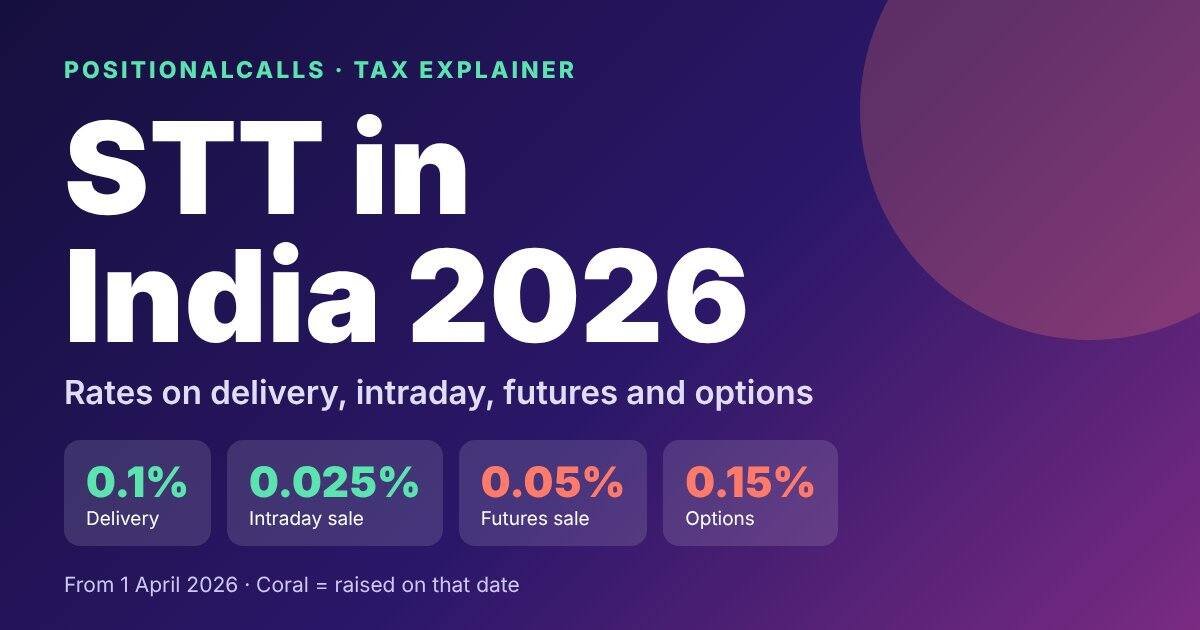
STT in India, from 1 April 2026: 0.1% on delivery buy and sale, 0.025% on intraday sale, 0.05% on futures sale and 0.15% on options premium and exercise. Only futures and options rose; delivery and intraday did not change, as of 14 November 2026.
Latest update (Saturday, 14 November 2026, 5:00 AM IST): this guide carries the rates in force since 1 April 2026. I found no later change in the sources I read, but I did not open the Finance Act or the exchange circulars, so check them before you rely on a rate for a large position.
Key takeaways
- Delivery: STT in India is 0.1% on the buy and 0.1% on the sale, so a round trip costs 0.2% of value (my calculation).
- Intraday: 0.025% on the sale only.
- Futures: 0.05% on the sale, up 150% from 0.02%.
- Options: 0.15% on the premium when sold, and 0.15% on intrinsic value when exercised.
- Tax treatment: not deductible against capital gains; deductible as a business expense, as reported. Get advice for your case.
- Refunds: none, even on a loss.
In plain words: STT is a small percentage the government takes each time you buy or sell on an exchange. It is charged on the size of the trade, not on whether you made money. For a long-term investor it is a minor cost; for a trader doing many trades a day it adds up.
Data note: as of Saturday, 14 November 2026, 5:00 AM IST. Rates and the 1 April 2026 date come from ICICI Direct (4 June 2026), the Income Tax Department’s clarification as reported by Moneylife (1 February 2026), Motilal Oswal (February 2026), Groww (11 February 2026) and Upstox (13 February 2026). Tax treatment comes from Courtkutchehry (29 August 2026) and eztax. I did not open the Finance Act, the NSE and BSE circulars or any income tax rule. Derived figures are my calculation. Analysis only; PositionalCalls is not SEBI-registered.
What is STT in India, and who collects it?
STT in India is the securities transaction tax, charged on the value of trades in listed shares, equity-oriented mutual fund units and derivatives on recognised exchanges. It is charged on turnover, not on profit, and it is not refunded.
STT in India is built into every exchange trade. It appears as a line on your contract note, next to brokerage, GST and exchange charges, and it is paid whether the trade makes money or not. Groww states that STT is non-refundable, even on losing trades, and Upstox describes it as a fee charged on turnover and not on profit. That one feature explains why STT matters so much more to people who trade often than to people who buy a share and hold it.
STT is separate from income tax. Groww makes the point that STT is charged at the time of trading, while capital gains tax is calculated when you file your return. A trade can therefore carry STT and also create a gain, a loss or business income that is taxed later. How those two interact is covered below and in our capital gains tax on shares guide.
Different transactions carry different rates, and the person who pays also differs. For delivery trades both sides pay. For intraday trades, futures and options sold, the seller pays. For an option that is exercised, the buyer pays. The next section puts every rate in one table, and the section after it explains the only change made in 2026.
What are the STT rates in India for 2026?
From 1 April 2026, STT is 0.1% on delivery buy and sale, 0.025% on intraday sale, 0.001% on equity mutual fund sale, 0.05% on futures sale, 0.15% on options sale premium and 0.15% on options exercised.
| Transaction | STT rate from 1 Apr 2026 | Paid by | Charged on | Changed in 2026? |
|---|---|---|---|---|
| Equity shares, delivery purchase | 0.1% | Buyer | Trade value | No |
| Equity shares, delivery sale | 0.1% | Seller | Trade value | No |
| Equity shares, intraday sale | 0.025% | Seller | Trade value | No |
| Equity-oriented mutual fund units, sale | 0.001% | Seller | Redemption value | No |
| Futures, sale | 0.05% | Seller | Traded price (contract value) | Yes, from 0.02% |
| Options, sale | 0.15% | Seller | Premium | Yes, from 0.1% |
| Options, exercised | 0.15% | Buyer | Intrinsic value | Yes, from 0.125% |
Cite this table: PositionalCalls, “STT in India: Rates from 1 April 2026, as of 14 November 2026, 5:00 AM IST”; rates from Groww (11 February 2026), ICICI Direct (4 June 2026) and the Income Tax Department’s clarification via Moneylife; I did not open the Finance Act.
Read the STT in India table by transaction, not by instrument. A delivery buy and a delivery sale are two separate taxable events, so a round trip in a share costs 0.2% of value in STT if you sell at the price you paid (my calculation). An intraday trade has only a sale leg, so the round trip costs 0.025%. That is one reason intraday STT looks small, even though intraday traders place far more trades than investors do.
The ICICI Direct and Moneylife pieces both say that the options STT is charged on the premium when an option is sold and on the intrinsic value when it is exercised. Intrinsic value is the gap between the strike and the settlement price. For an option bought and held to expiry, the buyer pays no STT on the premium, but the buyer pays the exercise-based STT if the option finishes in the money, as reported.
What changed in STT on futures and options on 1 April 2026?
Futures STT rose from 0.02% to 0.05%, up 150%. Options premium STT rose from 0.1% to 0.15%, up 50%, and exercised options STT rose from 0.125% to 0.15%, up 20%. The new rates took effect on 1 April 2026.
| Derivative | Rate before 1 Apr 2026 | Rate from 1 Apr 2026 | Increase (my calculation) |
|---|---|---|---|
| Futures, sale | 0.02% | 0.05% | +150% |
| Options, sale on premium | 0.1% | 0.15% | +50% |
| Options, exercised on intrinsic value | 0.125% | 0.15% | +20% |
Cite this table: PositionalCalls, “STT in India: Futures and Options Before and After 1 April 2026, as of 14 November 2026, 5:00 AM IST”; ICICI Direct, Moneylife and Upstox.
The Income Tax Department said on 1 February 2026, the day of the Budget, that STT in India had been raised only on options and futures, and that the other STT rates stay the same, as reported by Moneylife. ICICI Direct reports that the revised rates took effect on 1 April 2026 through exchange circulars NSE/FATAX/73524 and BSE 20260331-7, dated 31 March 2026. Upstox adds that the higher STT could squeeze margins in arbitrage funds, which trade the gap between cash and futures, though it expects a less severe effect on balanced advantage, equity savings and multi-asset funds.
Motilal Oswal’s table also shows the earlier history, with futures at 0.0125% and options at 0.0625% in the older regime, then 0.02% and 0.1% in 2025. On that table the STT in India futures rate has gone from 0.0125% to 0.05% over a few years, which is a fourfold rise (my calculation). The Motilal page does not say when the new rates start, so I rely on ICICI Direct and the Income Tax Department for the date.
| Derivative | Until 2024 (Motilal) | 2025 (Motilal) | From 1 Apr 2026 |
|---|---|---|---|
| Futures, sale | 0.0125% | 0.02% | 0.05% |
| Options, sale on premium | 0.0625% | 0.1% | 0.15% |
Cite this table: PositionalCalls, “STT History for Futures and Options, as of 14 November 2026, 5:00 AM IST”; Motilal Oswal table (February 2026); the page does not give the dates of each change.
STT in India calculator: work out the tax on your trade
Pick the trade type, enter the turnover or premium in rupees, and the calculator applies the rates in the table above. It is an illustration of the reported rates, not a contract note.
Illustration, not tax advice. Brokerage, GST, stamp duty and exchange charges are not included.
For a futures sale of Rs 10 lakh, the STT in India calculator shows STT of Rs 500, against Rs 200 under the old 0.02% rate (my calculation). The same Rs 10 lakh as an options premium sale shows Rs 1,500, against Rs 1,000. Delivery, intraday and mutual fund results do not change with the Budget, so the calculator shows only one figure for them.
Hinglish summary: STT ek tax hai jo har exchange trade par lagta hai, chahe profit ho ya loss. 1 April 2026 se delivery par 0.1%, intraday sale par 0.025%, futures sale par 0.05% aur options premium par 0.15% hai. Sirf futures aur options badhe. Yeh sirf jaankari hai, tax ya buy-sell salah nahi.
What does STT in India cost on a Rs 1 lakh trade, and what does the hike cost a trader?
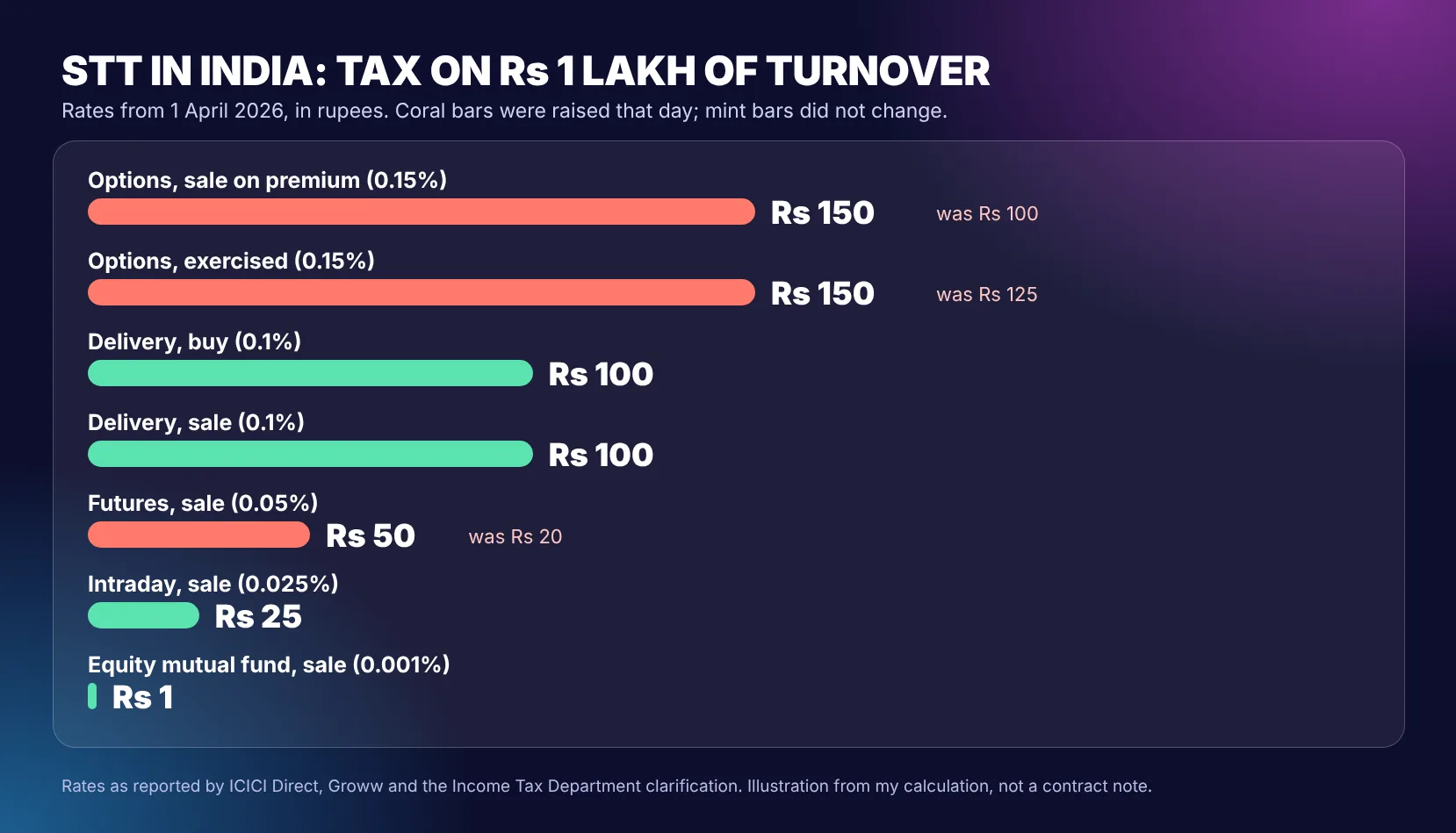
On Rs 1 lakh of turnover, STT is Rs 100 on a delivery buy, Rs 25 on an intraday sale, Rs 50 on a futures sale and Rs 150 on options premium sold (my calculation). The 1 April 2026 hike added Rs 30 on futures and Rs 50 on options per lakh.
PositionalCalls WhatsApp channel
Get tax and trading-cost explainers on WhatsApp
- STT and charge changes, dated
- Calculators explained without tips
- Links to updated tax guides
| Per Rs 1 lakh of turnover | STT from 1 Apr 2026, Rs | STT before, Rs | Extra from the hike, Rs |
|---|---|---|---|
| Equity delivery, buy | 100 | 100 | 0 |
| Equity delivery, sale | 100 | 100 | 0 |
| Equity intraday, sale | 25 | 25 | 0 |
| Equity mutual fund, sale | 1 | 1 | 0 |
| Futures, sale | 50 | 20 | 30 |
| Options, sale on premium | 150 | 100 | 50 |
| Options, exercised on intrinsic value | 150 | 125 | 25 |
Cite this table: PositionalCalls, “STT on Rs 1 Lakh of Turnover, as of 14 November 2026, 5:00 AM IST”; my calculation from the reported rates; illustration, not a contract note.
Scale shows why the STT in India hike matters. Suppose a futures trader sells Rs 10 lakh of contracts ten times a day for 20 trading days. That is Rs 20 crore of sale turnover a month, and STT of Rs 1,00,000 at 0.05%, against Rs 40,000 at 0.02%, which is Rs 60,000 more (my calculation, an illustration and not a typical trader). Upstox gives a similar example for the Nifty future, with a contract value of Rs 16,25,000, where STT goes from Rs 325 to Rs 812.50 a sale, an extra Rs 487.50, or Rs 4,875 a day at ten sales and Rs 97,500 over 20 trading days, as reported.
For options the sums are smaller per trade but build up with frequency. Upstox’s options example uses a premium turnover of Rs 9,750 and a sale STT of Rs 14.625 against Rs 9.75, an extra Rs 4.875, or about Rs 2,438 a month at 500 trades. A long-term investor who buys a share and holds it pays only the unchanged 0.1% on each side and sees no effect from the hike at all.
| Illustration | Assumption | STT before, Rs | STT from 1 Apr 2026, Rs | Extra, Rs |
|---|---|---|---|---|
| Futures seller (my calculation) | Rs 10 lakh sold, ten times a day, 20 days (Rs 20 crore) | 40,000 | 1,00,000 | 60,000 |
| Nifty future (Upstox example) | One sale, contract value Rs 16,25,000 | 325 | 812.50 | 487.50 |
| Options seller (Upstox example) | Premium turnover Rs 9,750 a trade, 500 trades a month | 4,875 | 7,312.50 | About 2,438 |
Cite this table: PositionalCalls, “STT Trader Cost Illustrations, as of 14 November 2026, 5:00 AM IST”; first row my calculation, others as reported by Upstox; illustrations, not typical traders.
These rows show scale only. They assume every trade is a sale and ignore brokerage, GST and exchange charges, so they are the STT piece of cost and not a profit or loss figure.
How is STT in India treated for tax: is it deductible?
As reported, STT in India is not deductible when you compute capital gains, but it is deductible as a business expense when your trading income is taxed as business income. Which head applies depends on your facts, so check with a chartered accountant.
| Income head | Is STT deductible? | Source |
|---|---|---|
| Capital gains (delivery shares, equity funds held as investment) | No. Courtkutchehry says the law explicitly forbids deducting STT against capital gains, and eztax says it cannot be deducted in computing gains | Courtkutchehry, 29 Aug 2026; eztax |
| Business income (active trading taxed as a business) | Yes. Courtkutchehry says STT is deductible as business expenditure; eztax says it is deductible against business income | Courtkutchehry; eztax |
Cite this table: PositionalCalls, “STT Tax Treatment as Reported, as of 14 November 2026, 5:00 AM IST”; secondary sources, not the Act.
Courtkutchehry cites older section numbers for these rules, and I did not verify the current numbering after the Income-tax Act changeover, so I do not quote section numbers here. Eztax adds that STT is linked to the lower capital gains rates on listed equity, which is a reminder that the concessional rates apply to trades on which STT was paid. For the rates themselves, see our capital gains tax on shares guide.
Two cautions. First, both sources are commentary, not the statute, and the deductibility rules depend on whether your trading counts as investment or business, which turns on facts that only you and your adviser know. Second, a Budget can change rates and rules. Before you file, check the current Act and your broker’s annual statement, which usually totals the STT you paid. PositionalCalls is not SEBI-registered and does not give tax advice.
Where does STT in India not apply?
Groww says STT does not apply to commodity derivatives, currency derivatives, off-market transactions, debt securities and debt mutual funds, or unlisted securities.
STT in India is tied to listed equity and equity derivatives traded on recognised exchanges. A transfer of shares between two demat accounts without an exchange trade is an off-market transaction and carries no STT, though other rules and taxes can still apply. Debt mutual funds, bonds and unlisted shares sit outside the STT net, but they have their own tax rules. Commodity and currency derivatives are traded on recognised exchanges but are listed as outside STT by Groww, and I did not look into any separate tax on them.
If you hold an equity-oriented mutual fund, STT arises when units are sold, at 0.001% and paid by the seller. On a redemption of Rs 1 lakh that is Re 1 (my calculation). The fund house usually shows it on the statement, but I did not check each fund’s format.
How does STT compare with brokerage, GST and other trading charges?
STT goes to the government and is set by the Finance Act. Brokerage goes to your broker and varies by broker. Exchange transaction charges, SEBI fees, stamp duty and GST are separate lines on the same contract note.
| Charge | Who receives it | Fixed or negotiable |
|---|---|---|
| STT | Government | Fixed by law, same at every broker |
| Brokerage | Your broker | Negotiable; varies by broker |
| Exchange transaction charges | The exchange | Set by the exchange |
| GST | Government | Charged on brokerage and certain fees |
| Stamp duty | State government | Set by law |
| Depository (DP) charge | Depository and broker | On certain demat sales; see the demat guide |
Cite this table: PositionalCalls, “Who Receives Each Trading Charge, as of 14 November 2026, 5:00 AM IST”; general description, rates not shown here.
The practical point is that STT in India is the one charge you cannot negotiate. If your total cost looks high, compare brokerage and DP charges first, since those differ by broker. For the full list of rates, including DP charges, stamp duty and the exchange charge, see our guide to demat account charges in India, which prices a whole trade end to end.
What do most people miss about STT in India?
- STT in India is charged on turnover. A Rs 10 lakh futures sale that makes no profit still pays Rs 500 of STT (my calculation).
- Delivery costs twice. A buy and a sell each carry 0.1%, so the round trip is 0.2%.
- Only futures and options rose. Delivery, intraday and mutual fund rates were unchanged on 1 April 2026.
- Options STT has two bases. The seller pays on premium; the buyer pays on intrinsic value if the option is exercised.
- Sources differ on the old rate. 0.13% against 0.125% for exercised options is rounding, not a change.
- Deductibility depends on the head of income. Not against capital gains; yes against business income, as reported.
How do I check the STT I paid?
Open your broker’s contract note for the trade, find the STT line, and compare it with the turnover multiplied by the rate in the table above.
- Open the contract note or the daily statement for the trade date in your broker app or email.
- Find the STT or securities transaction tax line, which is separate from brokerage and GST.
- Note the transaction type: delivery, intraday, futures, options sold or options exercised.
- Multiply the relevant turnover by the rate (for example, premium turnover by 0.15% for options sold).
- Allow for rounding to the nearest rupee or paisa and for the way a broker groups trades.
- If a line is far off, ask the broker to explain it before you file your return.
For a tax return, your broker’s annual or profit-and-loss statement usually totals the STT paid in the year, but I did not check any broker’s format. Treat any message that offers an STT refund or asks for an OTP, payment or login as fake. STT is not refundable, and PositionalCalls never asks for payment.
PositionalCalls WhatsApp channel
Tax and trading-cost updates in one channel
- Budget and circular changes for STT
- Plain-English tax explainers
- Links to new guides
STT in India: frequently asked questions
What is STT in India?
STT in India is the securities transaction tax, a tax charged on the value of trades in listed shares, equity-oriented mutual funds and derivatives on recognised exchanges. It is levied on turnover, not on profit, so it applies even to a losing trade. Delivery and intraday equity, futures and options each have their own rate.
What are the STT rates in India in 2026?
From 1 April 2026, STT in India is 0.1% on delivery buy and on delivery sale, 0.025% on intraday sale, 0.001% on equity mutual fund unit sale, 0.05% on futures sale, 0.15% on options sale premium and 0.15% on options exercised. Delivery, intraday and mutual fund rates did not change; only futures and options rose.
How much did STT on futures and options rise on 1 April 2026?
Futures STT in India rose from 0.02% to 0.05%, an increase of 150%. Options STT on the premium rose from 0.1% to 0.15%, up 50%, and STT on exercised options rose from 0.125% to 0.15%, up 20%. The Income Tax Department clarified on 1 February 2026 that only options and futures were raised.
Who pays STT, the buyer or the seller?
STT in India depends on the transaction. For delivery trades both the buyer and the seller pay 0.1%. For intraday equity, futures and options sold on premium, the seller pays. For exercised options the buyer pays. Equity mutual fund STT falls on the seller at redemption. Check the contract note for the exact line.
Is STT charged on intraday trades?
Yes. STT in India on intraday equity is 0.025% and is charged on the sale side only, so the buy leg carries none. It did not change on 1 April 2026. On a sale of Rs 10 lakh the STT is Rs 250 (my calculation). Intraday trades also carry brokerage and other charges, which are separate from STT.
Is STT refundable?
No. Groww states that STT is non-refundable even on losing trades, and Upstox describes it as charged on turnover, not on profit. A trade that ends in a loss still carries the full STT. That is why STT matters more to high-turnover traders than to people who buy and hold a few times a year.
Can I deduct STT from my tax?
As reported by Courtkutchehry and eztax, STT is not deductible against capital gains, but it is deductible as a business expense when the income is taxed as business income. The rules turn on how your income is classified, so ask a chartered accountant. This page is information, not tax advice.
Does STT apply to mutual funds?
STT applies to the sale of equity-oriented mutual fund units at 0.001%, paid by the seller, per Groww. It does not apply to debt securities and debt mutual funds. On a redemption of Rs 1 lakh the STT is Re 1 (my calculation). Check your fund house statement for how it is shown.
How do I calculate STT on an options trade?
For options sold, multiply the premium turnover by 0.15%. A sale with Rs 1 lakh of premium carries Rs 150 of STT (my calculation). If an option is exercised, STT is 0.15% on the intrinsic value and the buyer pays. The calculator on this page shows both bases.
Where does STT not apply?
Groww says STT does not apply to commodity derivatives, currency derivatives, off-market transactions, debt securities and debt mutual funds, or unlisted securities. It applies to listed equity, equity-oriented funds and equity derivatives traded on recognised exchanges. Other charges such as brokerage and GST are separate and are covered in our demat charges guide.
Sources
- ICICI Direct: STT changes in Budget 2026, 4 June 2026.
- Moneylife: STT hike applies only to options and futures, I-T Dept clarifies, 1 February 2026.
- Motilal Oswal: Union Budget 2026-27 STT update, February 2026.
- Groww: Securities Transaction Tax in India, 11 February 2026.
- Upstox: how the STT hike affects traders and investors, updated 13 February 2026.
- Courtkutchehry: capital gains, brokerage, STT and deductions, 29 August 2026.
- eztax: does STT affect capital gains tax.
- PositionalCalls: demat account charges in India and capital gains tax on shares.

Shubham Chaudhary is the founder of PositionalCalls, an independent Indian stock market research website. He writes company fundamentals, quarterly results analysis, IPO analysis and sector research for NSE and BSE listed companies, with a focus on banking stocks, insurance and long-term value investing. Every article is built from primary sources such as RBI, SEBI, NSE and BSE filings and company annual reports, and states its risks plainly in simple language for retail investors.
Coverage areas Our research standards- Numbers checked against NSE, BSE and SEBI filings
- Risks and limits stated in every article
- No paid promotions or broker tie-ups
- Articles updated when new filings arrive