
Learning · NRI Banking
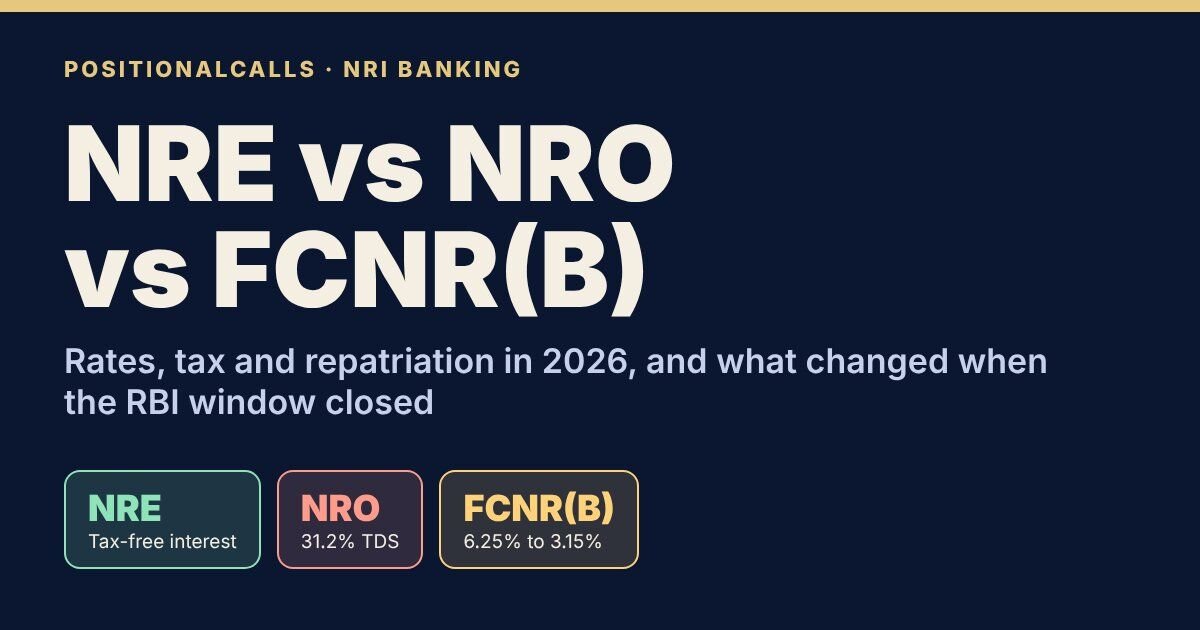
NRE vs NRO vs FCNR(B) in 2026: how each deposit works, what is taxed, what can be repatriated and what changed when the RBI window for FCNR(B) deposits closed.
Quick answer
In NRE vs NRO vs FCNR, NRE and NRO are rupee accounts and FCNR(B) is a foreign currency deposit. NRE and FCNR(B) interest is tax-free in India for an NRI, as reported, while NRO interest is taxable with TDS of about 31.2%. NRE and FCNR(B) are repatriable; NRO is limited to USD 1 million a year.
Latest update (Saturday, 14 November 2026, 6:30 PM IST): first version. It covers the RBI FAQ on non-resident accounts, the 2026 FCNR(B) rate relaxation and its end, dated bank rates and the tax treatment as reported. I did not open the RBI circulars, the Income-tax Act, 2025 or any bank rate card dated November.
Key takeaways
- Currency: NRE and NRO hold rupees; FCNR(B) holds a permitted foreign currency, as per the RBI FAQ.
- Tax: NRE and FCNR(B) interest is tax-free in India for an NRI, as reported; NRO interest is taxable with TDS of 31.2% (my calculation of 30% plus 4% cess).
- Repatriation: NRO balances up to USD 1 million per financial year; NRE and FCNR(B) are repatriable.
- Tenor: NRE 1 to 3 years (longer allowed); FCNR(B) 1 to 5 years.
- 2026 change: USD 3 to 5 year FCNR(B) rates hit about 6% to 6.5% during the RBI window, then fell about 310 basis points at HDFC and ICICI after 31 August.
In plain words: an NRE account is for money you earn abroad and bring to India in rupees. An NRO account is for money you earn in India, such as rent or dividends. An FCNR(B) deposit keeps your money in a foreign currency, so the rupee going up or down does not change your return in dollars.
Data note: as of Saturday, 14 November 2026, 6:30 PM IST. Account rules come from the RBI FAQ on accounts in India by non-residents (page dated 16 January 2025, site updated 13 November 2026). The 2026 FCNR(B) window comes from Business Today (17 June, 3 August), Outlook Business (2 September), a law-firm note on the RBI Third Amendment Directions and Daily Financial (7 September). Tax treatment and the 31.2% TDS come from Belong (April 2026) and Priyanka Personal Finance (May 2026). NRE rates come from Business Today (18 August 2026). PositionalCalls is not SEBI-registered and gives no tax, legal or investment advice.
What are NRE, NRO and FCNR(B) accounts?
An NRE account is a rupee account for foreign earnings, an NRO account is a rupee account for income earned in India, and an FCNR(B) deposit is a term deposit held in a freely convertible foreign currency, as per the RBI FAQ on accounts in India by non-residents. All three are for people who live outside India.
The RBI names the schemes the Non-Resident (External) Rupee Account scheme for NRE, and the Foreign Currency (Non-Resident) Account (Banks) scheme for FCNR(B). It describes an NRO account as one for any person resident outside India to put through bona fide transactions in rupees. NRE accounts are open to NRIs and persons of Indian origin, and the RBI notes that individuals and entities of Pakistan and Bangladesh need prior RBI approval for NRE and NRO.
An NRI comparing NRE vs NRO vs FCNR is really choosing between three questions: which currency do I want my money in, how much tax do I want to pay in India, and how freely do I want to send it back out. The next table answers those questions side by side. Where I rely on a blog and not on the RBI, I say so.
One note on scope. This page covers deposits in these three accounts. Investing in shares needs a separate route through a demat account and the RBI permissions for non-residents, which our guide to NRI investment in the Indian stock market covers.
How do NRE vs NRO vs FCNR compare on currency, tenor, tax and repatriation?
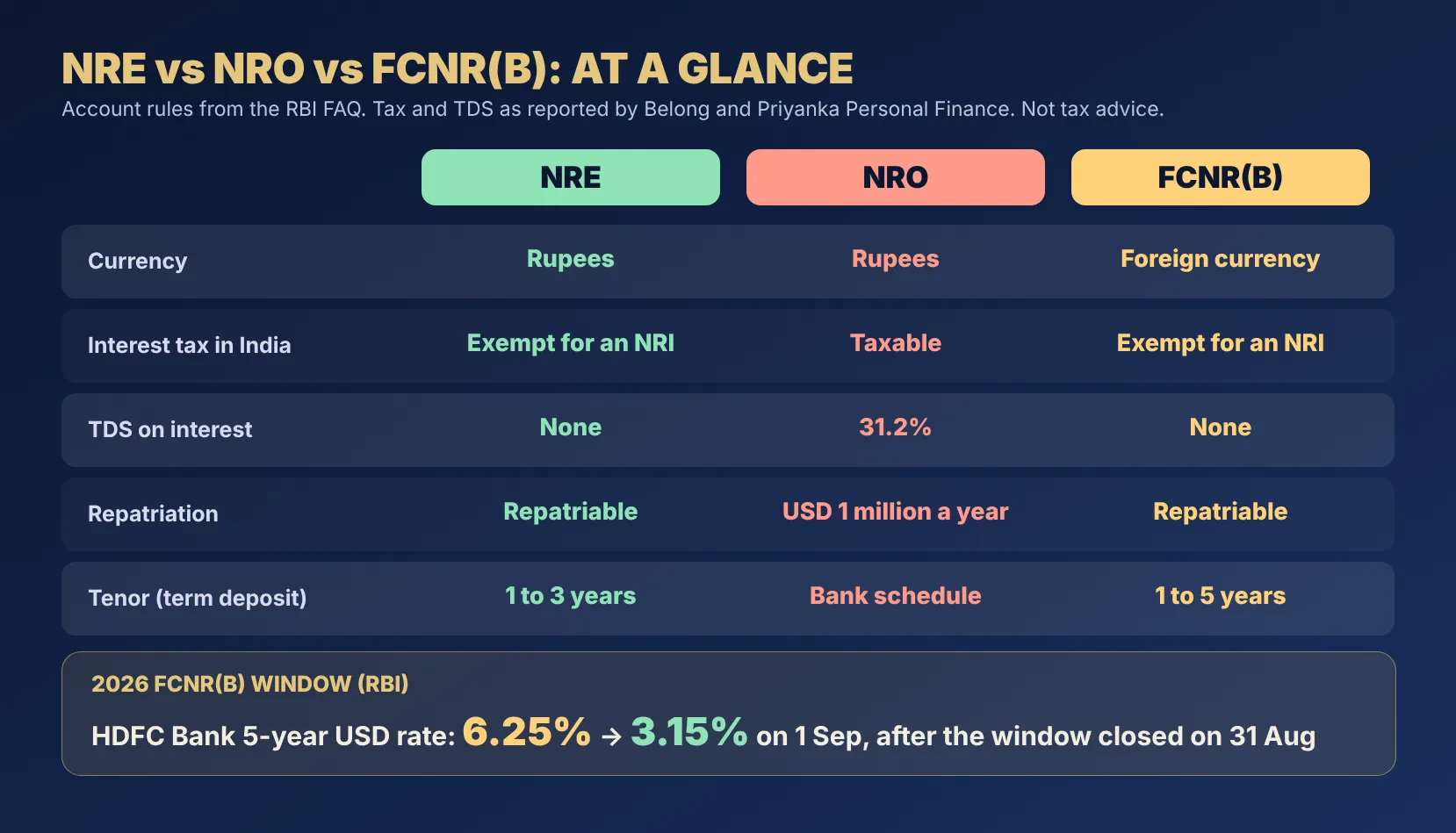
NRE vs NRO vs FCNR differs mainly in currency, tax and repatriation: NRE and NRO are in rupees, FCNR(B) is in a foreign currency; NRE and FCNR(B) interest is tax-free for an NRI, as reported, while NRO interest is taxed with TDS; NRE and FCNR(B) are repatriable, and NRO is capped at USD 1 million a year.
| Feature | NRE | NRO | FCNR(B) |
|---|---|---|---|
| Currency | Indian rupees | Indian rupees | Any permitted, freely convertible foreign currency |
| Who can open | NRIs and persons of Indian origin | Any person resident outside India | NRIs and persons of Indian origin |
| Term deposit tenor | 1 to 3 years, banks may accept longer | Treated as resident deposits | Not less than 1 year and not more than 5 years |
| Repatriation | Principal repatriable | USD 1 million per financial year, with current income | Repatriable |
| Tax on interest in India | Exempt for an NRI, as reported | Taxable, with TDS | Exempt for an NRI, as reported |
| TDS on interest | None, as reported | 30% plus 4% cess, 31.2% before surcharge, as reported | None, as reported |
| Joint holder | Another NRI, or a resident relative on a former or survivor basis (RBI FAQ) | Another NRI, or a resident, on a former or survivor basis (RBI FAQ) | Not stated on the FAQ page I read |
| If you return to India | Redesignate as resident or move to an RFC account | Becomes a resident account | Continues to maturity at the contracted rate |
Cite this table: PositionalCalls, “NRE vs NRO vs FCNR(B) Comparison, as of 14 November 2026, 6:30 PM IST”; RBI FAQ for account rules, Belong and Priyanka Personal Finance for tax and TDS, as reported.
Two cells need care. The FAQ page I read does not state whether FCNR(B) interest is repatriable or who can be a joint holder, so I have not filled those from memory. The tax and TDS rows come from two tax blogs, not from the Income-tax Act, 2025, which I did not open, so confirm them with a chartered accountant before you act.
How are NRE, NRO and FCNR(B) deposits taxed in India?
As reported by Belong and Priyanka Personal Finance, NRE and FCNR(B) interest is exempt from Indian income tax for an NRI, while NRO interest is fully taxable and banks deduct TDS of 30% plus 4% cess, an effective 31.2%. The exemption depends on you being a non-resident under the tax rules, which is a separate test from holding an NRI passport status.
Belong adds that NRE and FCNR(B) interest must still be reported in your Indian return as exempt income, and that NRIs cannot use Form 15G or 15H, which are for residents only. If TDS on NRO interest exceeds your actual tax, a refund is claimed by filing a return. Form 13, a lower deduction certificate, is mentioned but not explained.
A tax treaty can lower the NRO deduction. Priyanka Personal Finance says you need a tax residency certificate from your country and Form 10F to claim the reduced rate, and lists rates of 15% for the US, UK and Singapore and 12.5% for the UAE without citing the treaties. I did not verify those rates, so check the treaty text for your country.
Both sources cite section numbers of the old Income Tax Act. The Income-tax Act, 2025 has applied since 1 April 2026, so numbers differ, and I do not quote any here. Also remember that your country of residence may tax interest that India exempts. Our guides to dividend tax in India and capital gains tax on shares cover the other main NRI income streams.
What are the NRE and FCNR(B) deposit rates in 2026?
In an 18 August 2026 Business Today compilation, one-year NRE rates ranged from 6.70% at Axis Bank to 7.75% at IndusInd Bank, with SBI at 6.80%, and DCB Bank listed 8.05% for more than one and up to three years. These may be out of date, so use them to compare banks, not as a quote.
| Bank | 1 year | Above 1 to 3 years | Above 3 to 5 years | Above 5 to 10 years |
|---|---|---|---|---|
| SBI | 6.80% | 6.80% | 6.50% | 6.25% |
| Axis Bank | 6.70% | 6.70% to 7.10% | 7.10% | 7.00% |
| Kotak Mahindra Bank | 7.10% | 7.10% to 7.40% | 7.00% | 6.20% |
| Bank of Baroda | 6.80% | 6.75% to 7.10% | 6.75% | 6.45% |
| Canara Bank | 6.80% | 6.85% to 7.30% | 7.40% | 6.70% |
| Union Bank of India | 6.80% | 6.40% to 7.30% | 6.50% | 6.50% |
| Federal Bank | 7.00% | 7.15% to 7.50% | 7.10% to 7.40% | 6.60% |
| DCB Bank | 7.10% | 7.10% to 8.05% | 7.40% | 7.25% |
| IndusInd Bank | 7.75% | 7.25% to 7.99% | 7.25% | 7.00% |
Cite this table: PositionalCalls, “NRE Fixed Deposit Interest Rates by Bank, as of 18 August 2026”; Business Today, updated 18 August 2026; rates change often.
Three cautions on these NRE fixed deposit interest rates, which matter in any NRE vs NRO vs FCNR comparison. First, the compilation is dated 18 August, which was inside the RBI window when ceilings on NRE deposits of three years and above were lifted, so the longer tenors may have moved since. Second, the RBI raised the repo rate by 25 basis points to 5.50% on 7 October 2026, as per its press release cited on our CPI page, and bank deposit rates can change after a rate move. Third, I tried to open an Axis Bank rate card dated 5 November but could not, so I have no November bank rate card.
For FCNR deposit rates, the picture changed sharply in 2026, and the next section explains why. The rates in the table below are US dollar rates for 3 to 5 year deposits, compiled by Business Today as reported by Daily Financial on 7 September.
| Bank | Peak in the window | 3 to 4 years | 4 to 5 years | 5 years |
|---|---|---|---|---|
| HDFC Bank | 6.25% | 3.50% | 3.15% | 3.15% |
| Kotak Mahindra Bank | 6.30% | 3.40% | 3.20% | 3.00% |
| SBI | 6.00% | 3.35% | 2.95% | 3.05% |
| ICICI Bank | 6.25% | 3.25% | 3.25% | 3.25% |
| PNB | 6.50% | 3.25% | 3.06% | 3.06% |
| Axis Bank | 6.25% | 3.25% | 2.95% | 2.95% |
Cite this table: PositionalCalls, “FCNR(B) USD Deposit Rates After the Window, effective 1 September 2026”; Business Today compilation as reported by Daily Financial, 7 September 2026; the underlying rate cards were not available to me.
There is a conflict. Outlook Business, on 2 September, reports ICICI Bank cutting its five-year USD rate from 6.00% to 2.90%, while the compilation above shows a 6.25% peak and 3.25% after the window. Rates differ by deposit size, and I could not see the rate cards, so check the bank. Daily Financial also notes that the best 3-year FCNR(B) rate of 3.50% sat about 91 basis points below the 3-year US Treasury yield of 4.41% on 3 September, so the dollar rate is not a yield play; this comparison is from that single source.
What changed for FCNR(B) deposits in 2026, and is the high rate still available?
The RBI lifted rate ceilings on 3 to 5 year FCNR(B) deposits from 17 June 2026, banks raised US dollar rates to about 6% to 6.5%, and the window closed on 31 August, after which HDFC Bank cut its five-year rate from 6.25% to 3.15%. The high rate is no longer on offer, as far as I could find.
PositionalCalls WhatsApp channel
Get NRI tax and deposit explainers on WhatsApp
- NRI deposit and tax rule changes, dated
- RBI circulars explained in plain words
- No tips or calls, only sourced facts
| Date (2026) | What happened | Source |
|---|---|---|
| 8 June | RBI operationalises a special scheme for banks to take FCNR(B) deposits under relaxed norms | Business Today, 3 August |
| 17 June | RBI lifts the rate ceiling on fresh 3 to 5 year FCNR(B) deposits and fresh NRE deposits of 3 years and above, until 30 September | Business Today, 17 June |
| 3 and 7 August | ICICI Bank and HDFC Bank raise USD FCNR(B) rates to 6.25% | Business Today, 3 and 7 August |
| 14 to 25 August | RBI advances the end of the relaxation to 31 August; the amendment is issued on 25 August | Daily Financial; KS&K |
| 31 August | The window closes | Outlook Business, 2 September |
| 1 September | HDFC Bank cuts its 5-year USD rate from 6.25% to 3.15%, a fall of 310 basis points (my calculation: 6.25 minus 3.15) | Outlook Business |
Cite this table: PositionalCalls, “FCNR(B) 2026 Window Timeline, as of 14 November 2026, 6:30 PM IST”; Business Today, Outlook Business, Daily Financial and KS&K; I did not open the RBI circulars.
Before 17 June, Business Today says FCNR(B) deposits of 3 to 5 years were capped at the overnight alternative reference rate for the currency, or the swap rate, plus 350 basis points, and 1 to under 3 year deposits at the reference or swap rate plus 250 basis points, which was unchanged. NRE and NRO banks were not allowed to pay more than comparable domestic rupee deposits. After the window, KS&K says the ordinary ceilings apply, but it does not give the formula, and I could not confirm the margin.
Daily Financial reports a mandatory one-year lock-in, with no interest paid on withdrawal inside 12 months. If you locked in a deposit at 6% to 6.5% in the window, it keeps that rate to maturity, as I read the sources, but check the receipt. If you did not, the window has passed. Whether the RBI reopens it is not something I found any report on, so treat any such claim as unverified.
What do NRE vs NRO vs FCNR look like in worked examples?
On Rs 10 lakh at an illustrative 7% a year, NRE earns Rs 70,000 with no Indian tax, while NRO earns the same Rs 70,000 but loses Rs 21,840 to TDS at 31.2%, leaving Rs 48,160, an effective 4.82% (my calculation). The 7% is an example, not a bank quote.
| Illustration, Rs 10 lakh for one year at 7% | NRE | NRO |
|---|---|---|
| Interest earned | Rs 70,000 | Rs 70,000 |
| TDS at 31.2% | Rs 0, as reported | Rs 21,840 |
| Interest after TDS | Rs 70,000 | Rs 48,160 |
| Effective rate after TDS | 7.00% | 4.82% |
| NRO rate needed to match NRE net | – | 10.17% |
Cite this table: PositionalCalls, “NRE vs NRO One-Year Illustration, my calculation, as of 14 November 2026”; assumes 31.2% TDS and no surcharge, treaty relief or refund.
That last row says an NRO deposit would need about 10.17% before tax to match a 7% NRE deposit, which is not available at ordinary banks (my calculation, ignoring surcharge). The point is not that NRO is bad. NRO is where Indian income such as rent lands, and the TDS can be lower if a treaty applies. The point is that NRE should usually be the place for foreign earnings you bring in, because the tax exemption is worth a lot.
Next, the currency choice in NRE vs FCNR. Say a 3-year NRE deposit pays 6.80% (the SBI rate in the August table) and a 3-year USD FCNR(B) deposit pays about 3.25% (the typical post-window rate). For an NRI who wants dollars back, NRE wins if the rupee falls less than about 3.4% a year against the dollar, and FCNR(B) wins if it falls more (my calculation: 1.068 divided by 1.0325, minus 1, ignoring tax in your country, fees and timing).
And on the window: on USD 10,000, a 6.25% rate pays USD 625 a year and 3.15% pays USD 315 a year, a difference of USD 310 (my calculation). That gap is why timing mattered in 2026, and why a rate seen in a June article is not a rate on offer.
How does repatriation work in NRE vs NRO vs FCNR?
As per the RBI FAQ, NRE principal is repatriable, FCNR(B) is repatriable, and NRO balances can be remitted up to USD 1 million per financial year (April to March), along with other eligible assets, plus current income. The RBI page says NRO is “not repatriable except for all current income.”
Practically, banks ask for tax paperwork on NRO remittances, which is where NRE vs NRO vs FCNR differs most in effort. Priyanka Personal Finance says Form 15CA, an online declaration, and Form 15CB, a chartered accountant certificate, are needed above Rs 5 lakh in a financial year, but it cites no rule, so confirm with your bank. NRE and FCNR(B) funds can also be used for local payments and investment in India; the RBI FAQ lists local disbursements, remittances abroad and transfers between NRE and FCNR(B) accounts as permitted debits for NRE.
A useful point for planning: NRO to NRE transfers do not qualify for the 2026 NRE rate relaxation, as per Business Today, and NRO funds going to NRE fall within the USD 1 million limit. Move the money for what you will spend, not for the highest rate.
Which account suits which kind of money?
As a common-sense guide, not advice: foreign earnings you will spend in India or bring back in rupees usually go to NRE, income earned in India goes to NRO, and money you want to keep in a foreign currency goes to FCNR(B).
| Kind of money | Common choice | Why | Watch out for |
|---|---|---|---|
| Salary earned abroad, to be used in India | NRE | Rupees, tax-free interest, repatriable | Rupee risk if you want dollars back |
| Rent, dividends or sale proceeds from Indian assets | NRO | Where Indian income is credited | TDS of 31.2% on interest; USD 1 million limit a year |
| Savings you want to keep in dollars or pounds | FCNR(B) | No rupee risk, tax-free for an NRI | Rates are low after the window; the tenor starts at one year |
| Money you may need in India within a few years | NRE or FCNR(B) | Both are tax-free and flexible on tenor | Early withdrawal can cost interest |
Cite this table: PositionalCalls, “Which Account for Which Money, as of 14 November 2026, 6:30 PM IST”; general guide, not advice.
Many NRIs hold all three. An NRO account is often needed anyway because Indian income arrives in rupees. The question in NRE vs NRO vs FCNR is rarely which one alone, but how much to put in each. For that, a chartered accountant who knows the rules in your country of residence is the right person.
What happens to these accounts if you return to India?
As per the RBI FAQ, an NRE account must be redesignated as a resident account when you return for employment or to stay, or the money can be moved to an RFC account; an FCNR(B) deposit can continue to maturity at the contracted rate; and an NRO account is designated as a resident account. An FCNR(B) deposit then converts at maturity to a resident rupee deposit or an RFC account, at your option, if eligible.
Belong says you cannot create new NRE or FCNR(B) deposits after becoming a resident, and that existing deposits run to maturity with tax-free interest. Priyanka Personal Finance adds that the status called resident but not ordinarily resident, which can last two to three years, keeps foreign income free of Indian tax, but it cites no law and describes it loosely. The tax rule that decides your status, and when the NRE exemption stops, depends on days of stay, which I do not cover. Ask an adviser before you move.
What are the risks in choosing between NRE vs NRO vs FCNR?
These are not reasons to pick one account or avoid another in NRE vs NRO vs FCNR. They are the points where NRIs most often get surprised. If your situation involves a treaty, a recent move, or a large sum, get advice first.
What should you check before you open or move a deposit?
- Am I a non-resident for tax purposes this year, and will that change within the deposit term?
- Which currency will I spend this money in, and when?
- What is the bank’s current rate card for my tenor and deposit size, not an article rate?
- Does the bank charge for early withdrawal, and is there a lock-in?
- Do I need a tax residency certificate and Form 10F to lower TDS on NRO interest?
- What forms does the bank need for repatriation, and what is the limit?
- Who will be a joint holder, and does the bank allow a resident relative?
- Have I checked how my country of residence taxes this interest?
This checklist is educational and is not tax or investment advice. PositionalCalls is not SEBI-registered.
Analyst’s note and bottom line
- What stands out: the 2026 window showed how fast FCNR(B) rates can move, from about 6% to 6.5% to about 3% in a day, when the RBI changed the rules.
- Easy to miss: NRO interest at 31.2% TDS is worth much less than NRE interest at the same headline rate; at 7%, the NRO net is 4.82% (my calculation).
- What I could not verify: the RBI circulars, the Income-tax Act, 2025 and any November bank rate card.
- What would change this page: a new RBI window, a change to ceilings or a tax rule change.
Bottom line
NRE and FCNR(B) interest is tax-free for an NRI, as reported, and NRO interest is taxed with TDS of about 31.2%. NRE is in rupees and FCNR(B) is in a foreign currency, so the real choice is the currency you will spend in. The high 2026 FCNR(B) rates ended with the RBI window on 31 August, and this page does not tell you which account to use.
PositionalCalls WhatsApp channel
NRI finance updates in one channel
- Rate and rule changes for NRE, NRO and FCNR
- New NRI guides as they go live
- Plain-English explainers
NRE vs NRO vs FCNR: frequently asked questions
What is the difference between NRE vs NRO vs FCNR?
In NRE vs NRO vs FCNR, NRE and NRO accounts hold Indian rupees while FCNR(B) deposits hold a foreign currency such as US dollars. NRE and FCNR(B) interest is tax-free in India for an NRI, as reported, while NRO interest is taxable with tax deducted at source. NRE and FCNR(B) are repatriable; NRO is capped at USD 1 million a year.
Which is better in NRE vs NRO vs FCNR for an NRI?
Neither is better for everyone. NRE pays in rupees, so you carry rupee risk but usually earn a higher rate. FCNR(B) pays in a foreign currency, so you avoid rupee risk but, after the RBI window closed on 31 August 2026, USD rates fell to about 3%. The choice depends on the currency you will spend in.
Is NRO interest taxable and what is the TDS?
Yes. In NRE vs NRO vs FCNR, NRO is the taxed one. As reported by two sources, banks deduct TDS at 30% plus 4% cess, an effective 31.2% before any surcharge. A tax treaty with your country may lower the final tax if you give the bank a tax residency certificate and Form 10F, but check your own case with a tax adviser.
Is NRE interest really tax-free?
In NRE vs NRO vs FCNR, NRE gets the tax break: as reported by tax sites, interest on NRE deposits is exempt from Indian income tax while you are a non-resident, though you still report it as exempt income. It may still be taxed in your country of residence. If you return to India and become a resident, the exemption stops, so check the rules for your status.
How much can I repatriate from an NRO account?
The RBI says NRO balances can be remitted up to USD 1 million per financial year (April to March), together with other eligible assets, and current income such as interest is repatriable. Banks need tax paperwork before remitting. NRE and FCNR(B) balances are repatriable, including interest, subject to the bank’s checks.
What are NRE fixed deposit interest rates in 2026?
In an 18 August 2026 Business Today compilation, one-year NRE rates ranged from 6.70% at Axis Bank to 7.75% at IndusInd Bank, and SBI was at 6.80%. DCB Bank listed 8.05% for more than one to three years. Rates change often, and I did not find a November compilation, so check the bank.
What happened to FCNR deposit rates after the RBI window?
The RBI relaxed rate ceilings for 3 to 5 year FCNR(B) deposits from 17 June 2026, and several banks raised US dollar rates to about 6% to 6.5%. The window closed on 31 August, and HDFC Bank cut its five-year USD rate from 6.25% to 3.15% on 1 September, as per Outlook Business.
What is the tenor of an NRE and an FCNR(B) deposit?
The RBI FAQ says an NRE term deposit runs from one to three years, though banks may accept longer terms. An FCNR(B) deposit must be for not less than one year and not more than five years. NRO fixed deposits are treated like resident deposits, so tenors follow the bank’s resident schedule.
What happens to my accounts if I return to India?
In NRE vs NRO vs FCNR, each account is treated differently. As per the RBI FAQ, an NRE account must be redesignated as a resident account or moved to an RFC account when you return to stay. An FCNR(B) deposit can continue to maturity at the contracted rate, and then convert to a resident rupee deposit or an RFC account. An NRO account becomes a resident account.
Can a resident Indian be a joint holder of an NRE account?
The RBI FAQ says an NRE account can be held jointly by two or more NRIs, and that an NRI can also hold it jointly with a resident relative on a former or survivor basis. One blog says residents cannot be joint holders. I follow the RBI FAQ, but check your bank’s current rule before you open it.
Sources
- RBI: FAQ on accounts in India by non-residents, page dated 16 January 2025, site updated 13 November 2026.
- Belong: tax on fixed deposits for NRIs, 5 April 2026 (promotional; sells GIFT City products).
- Priyanka Personal Finance: NRE vs NRO account, 25 May 2026.
- Business Today: RBI temporarily lifts interest rate caps on select FCNR(B), NRE deposits, 17 June 2026.
- Business Today: FCNR(B) rates rise as banks compete for NRI dollars, 3 August 2026.
- Business Today: NRE fixed deposit rates 2026, updated 18 August 2026.
- Outlook Business: FCNR rates crash after RBI window closes, 2 September 2026.
- KS&K: RBI Third Amendment Directions, 2026.
- Daily Financial: should NRIs lock money into FCNR deposits after the 6% window closed, 7 September 2026.
- PositionalCalls: NRI investment in the Indian stock market, dividend tax in India and capital gains tax on shares.

Shubham Chaudhary is the founder of PositionalCalls, an independent Indian stock market research website. He writes company fundamentals, quarterly results analysis, IPO analysis and sector research for NSE and BSE listed companies, with a focus on banking stocks, insurance and long-term value investing. Every article is built from primary sources such as RBI, SEBI, NSE and BSE filings and company annual reports, and states its risks plainly in simple language for retail investors.
Coverage areas Our research standards- Numbers checked against NSE, BSE and SEBI filings
- Risks and limits stated in every article
- No paid promotions or broker tie-ups
- Articles updated when new filings arrive