
IPO Allotment Status · Listing Update
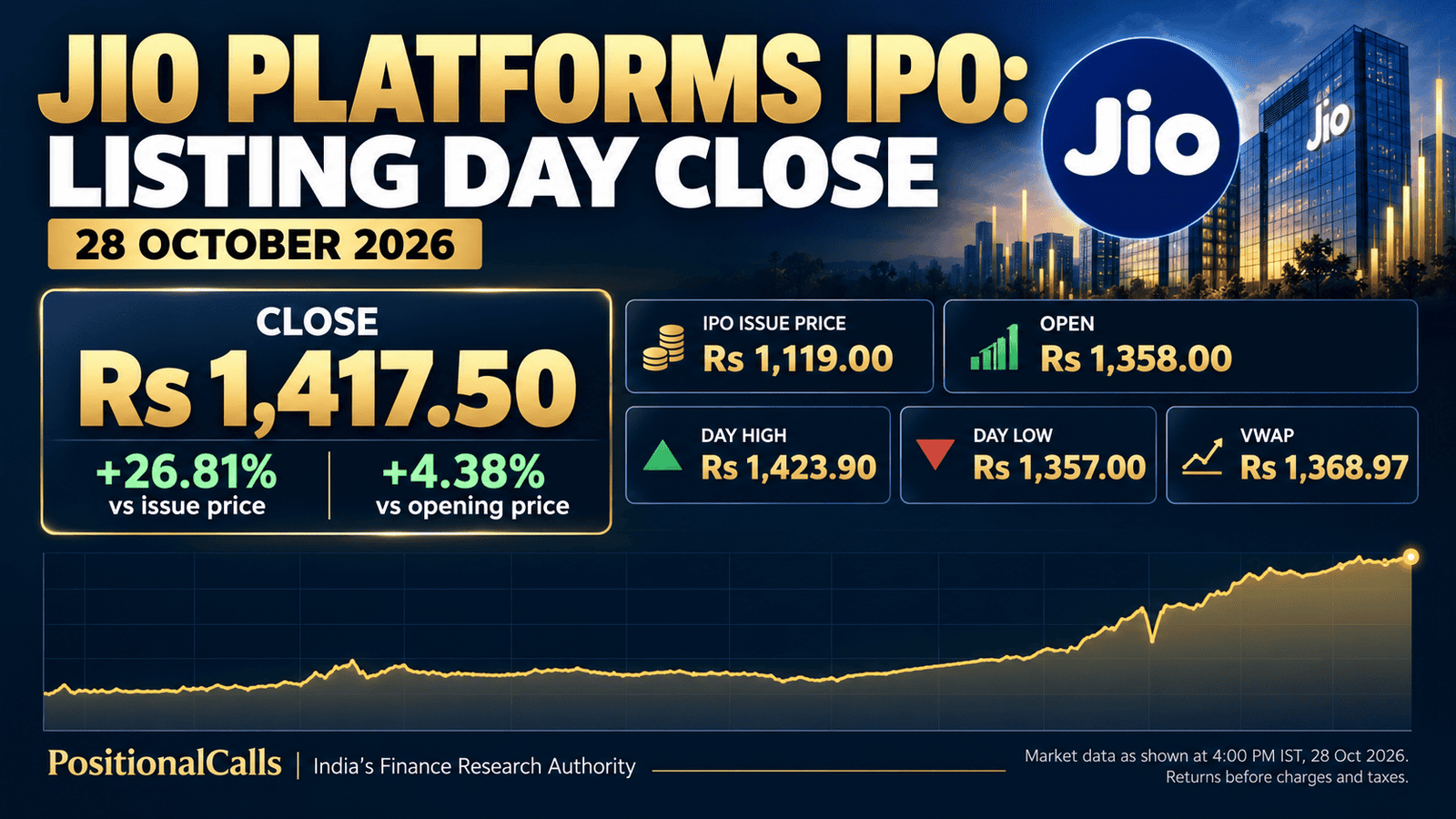
The Jio Platforms IPO allotment was reported finalized on 27 October 2026. Check your result through KFin, NSE or BSE using your PAN or application number. The shares listed on 28 October: NSE closed at ₹1,417.50 and BSE at ₹1,417.35, versus the ₹1,119 issue price.
Quick answer
Jio Platforms IPO allotment was reported finalized on 27 October 2026. Check on KFin, NSE or BSE using your PAN or application number. Shares listed on 28 October: NSE closed at ₹1,417.50 and BSE at ₹1,417.35, versus the ₹1,119 issue price. Gains were 26.68% and 26.66%, respectively (my calculations).
Check your allotment status
- KFin Technologies IPO status portal
- NSE IPO bid-verification page
- BSE IPO application-status page
- BSE official JPL quote and closing-price page
Use your PAN or application number. Never share an OTP or pay anyone to check allotment.
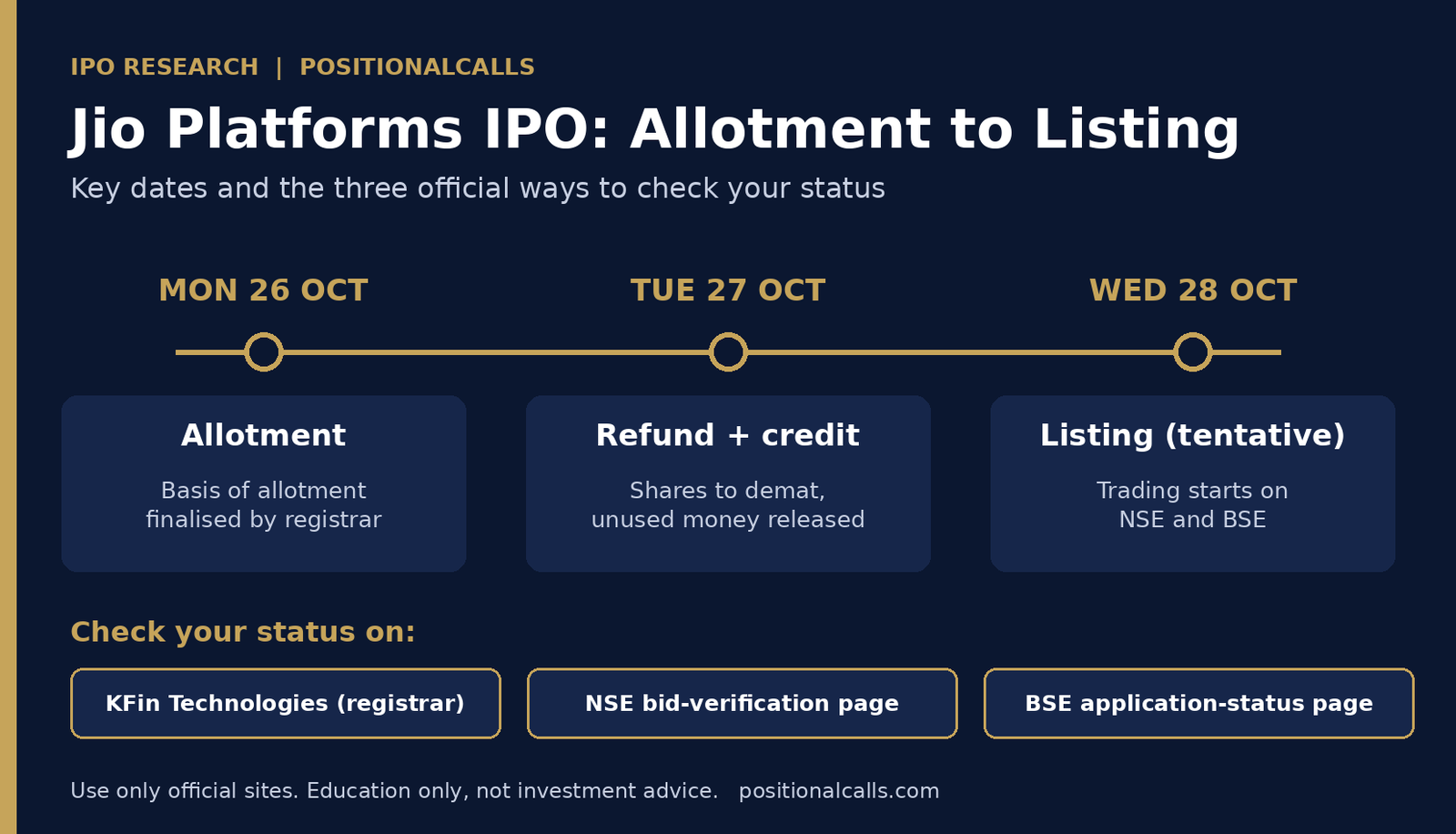
- Tuesday, 27 October 2026, 2:00 PM IST: Basis of allotment reported finalised. Refunds and share credit due. Listing scheduled for 28 October at 10:00 AM.
- Monday, 26 October 2026, 5:00 PM IST: Final subscription 22.19x (QIB 70.55x, NII 14x, retail 2.72x). GMP ₹250 at 2:30 PM IST.
- Saturday, 24 October 2026, 10:00 AM IST: Issue closed at about 22x. Allotment due 26 October; listing tentatively 28 October.
Key takeaways
- Opening/listing price: ₹1,358, or 21.36% above the ₹1,119 issue price.
- Closing prices: NSE ₹1,417.50 (+26.68%); BSE ₹1,417.35 (+26.66%) versus the ₹1,119 issue price (my calculations).
- One-lot paper gain: ₹3,582 at the NSE close or ₹3,580.20 at the BSE close, before charges and taxes (my calculations).
- GMP check: the last GMP of ₹250 implied ₹1,369, so the listing came in about ₹11 or 0.8% lower (my calculation).
- Market value: about ₹12.5 lakh crore at listing, against about ₹10.3 lakh crore at the issue price.
- Allotment: reported finalised on 27 October 2026. Check KFin, NSE or BSE with your PAN or application number.
- Next: verify the reported 30 October 2026 September-quarter results date against the company’s exchange filing.
In plain words: The listing price is the price at which a share first trades after the exchanges’ special pre-open session. Premium means the listing price is above the ₹1,119 issue price. Market value, or market capitalisation, is the share price multiplied by all shares. QIB means qualified institutional buyers, such as mutual funds, insurers and foreign funds. NII means non-institutional investors who bid more than ₹2 lakh. Retail means bids up to ₹2 lakh. GMP, or grey market premium, is an unofficial price gap traded before listing. “x” means times: 22x means investors bid for 22 times the shares on offer.
Price note: The exchange-specific 28 October closes were ₹1,417.50 on NSE and ₹1,417.35 on BSE. BSE’s official quote page confirms the BSE figure; Deccan Herald and Rediff report both exchange closes. Compared with the ₹1,119 issue price, the gains are 26.68% on NSE and 26.66% on BSE (my calculations). Some coverage reports 26.67% for NSE; recalculating ₹298.50 against ₹1,119 rounds to 26.68% at two decimals. The earlier version’s ₹1,417.50 figure was the reported NSE close; this update clarifies the exchange rather than treating that price as erroneous. Intraday quotes elsewhere are historical.
What was the Jio Platforms listing price on 28 October 2026?
Jio Platforms opened/listed on NSE and BSE at ₹1,358 on 28 October 2026, a 21.36% premium to the ₹1,119 issue price, as reported by market coverage. BSE’s official listing page displayed JPL at ₹1,417.35 in its 4:00 PM IST view, or 26.66% above the issue price (my calculation). This is the BSE-displayed last traded price; the exchange page is linked below.
| Metric | Figure | Source and note |
|---|---|---|
| Issue price | ₹1,119 | Upper end of the ₹1,065 to ₹1,119 band. |
| Listing price | ₹1,358 on NSE and BSE | Upstox live blog and Inc42, 10:00 AM. |
| Premium | 21.36% | ₹239 divided by ₹1,119 (my calculation; it matches the reports). |
| NSE closing price | ₹1,417.50 (+26.68% vs issue price) | Deccan Herald and Rediff, 28 October 2026. |
| BSE closing price | ₹1,417.35 (+26.66% vs issue price) | BSE official JPL quote page; corroborated by Deccan Herald and Rediff. |
| Market value | About ₹12.5 lakh crore (about $131 billion) | Inc42. My check: about 920.9 crore shares after the issue multiplied by ₹1,358. |
| Market value at the issue price | About ₹10.3 lakh crore | Business Today implied figure of ₹10,30,490.55 crore. |
| Broker reference | Motilal Oswal target ₹1,350, rating Buy | Reported by Inc42 on 28 October. It is one broker’s view and not our recommendation. It sits ₹8 below the listing price (my calculation). |
How did the listing day unfold?
| Time (IST) | What happened | Source |
|---|---|---|
| 9:00 to 9:45 AM | Special pre-open session, when orders are collected and the opening price is found | DAM Apps and India IPO, as reported before listing |
| 10:00 AM | Listing at ₹1,358, a 21.36% premium | Upstox, Inc42 |
| 10:12 AM | ₹1,357, down 0.07% from the listing price | Upstox |
| 10:16 AM | ₹1,357.1, with a high of ₹1,374.5 and a low of ₹1,357 | Bajaj Finserv |
What was one lot worth at the exchange closes?
One lot is 12 shares and cost ₹13,428 at the issue price. At the NSE close of ₹1,417.50, it was worth ₹17,010, a paper gain of ₹3,582. At the BSE close of ₹1,417.35, it was worth ₹17,008.20, a gain of ₹3,580.20 (my calculations). These amounts exclude brokerage, taxes and other charges.
| Price per share | Value of 1 lot | Gain on ₹13,428 | Note |
|---|---|---|---|
| ₹1,119 | ₹13,428 | ₹0 | Issue price |
| ₹1,417.50 | ₹17,010 | +₹3,582 | NSE close, as reported by Deccan Herald and Rediff |
| ₹1,417.35 | ₹17,008.20 | +₹3,580.20 | BSE close, confirmed on the BSE quote page |
| ₹1,358 | ₹16,296 | +₹2,868 | Listing price |
These are illustrative paper gains. Brokerage, securities transaction tax (STT), exchange and depository charges and applicable tax reduce the net amount. Tax treatment depends on current rules and your circumstances; verify with an appropriately qualified tax adviser.
Jio Platforms listing price vs GMP: did the grey market get it right?
Here is how the grey market works. GMP, or grey market premium, is the extra amount traders in an unofficial market pay for an IPO share before it lists. The grey market is unregulated. It is not run by the exchanges or SEBI, and its quotes can change within hours. GMP has no effect on your Jio Platforms IPO allotment status. It only reflects mood. For the latest daily quote, see our live page on Jio Platforms IPO historical GMP. Jio listed at ₹1,358. The last GMP we logged, ₹250 at 2:30 PM IST on 26 October, implied ₹1,369. The listing came in about ₹11 or 0.8% lower (my calculation). In percentage terms the grey market pointed to about 22.3% and the listing premium was 21.36%, about 1 percentage point lower.
| Measure | Grey market (last log) | Actual listing |
|---|---|---|
| Premium per share | ₹250 (2:30 PM IST, 26 Oct) | ₹239 |
| Premium in percent | about 22.3% | 21.36% |
| Price per share | ₹1,369 implied | ₹1,358 |
| Tracker range, 21 to 26 Oct | ₹245 to ₹280 (₹1,364 to ₹1,399) | ₹6 below the bottom of the range |
| Date (2026) | GMP per share | Implied listing price (₹1,119 + GMP) | Tracker |
|---|---|---|---|
| 4 Oct | ₹148 | ₹1,267 | IIFL |
| 8 Oct | ₹167 | ₹1,286 | IIFL |
| 12 Oct | ₹182 | ₹1,301 | IIFL |
| 15 Oct | ₹221 | ₹1,340 | IIFL |
| 19 Oct | ₹245 | ₹1,364 | IIFL |
| 21 Oct | ₹265 (10:37 AM) | ₹1,384 | IIFL (IPO Watch logged a ₹280 high that day) |
| 23 Oct | ₹260 (evening) | ₹1,379 | IPO Watch |
| 26 Oct | ₹246 (8:00 AM IST) | ₹1,365 | IPOji |
| 26 Oct | ₹250 (2:30 PM IST) | ₹1,369 | IPO Market |
| 28 Oct | Listing at ₹1,358 (₹239 above issue) | ₹1,358 | NSE and BSE (actual) |
The premium rose from ₹148 on 4 October to about ₹260 by 21 to 23 October, then settled near ₹245 to ₹250 on 26 October. Across trackers between 21 and 26 October it ranged between roughly ₹245 and ₹280, or about 22% to 25% over ₹1,119. At 2:30 PM IST on 26 October one tracker showed ₹250, or about 22.3% (my calculation: 250 divided by 1,119). Different sites quote different numbers for the same day, so use the range, not one figure. No grey market quote after 26 October is shown, because the listing on 28 October replaced it.
Why can GMP mislead you?
GMP reflects a small number of private trades. It does not set your allotment price and it does not forecast the listing price. Listings in October 2026 show it can miss in both directions.
| Company (listed in Oct 2026) | Final GMP | Actual listing gain |
|---|---|---|
| HD Fire Protect (21 Oct) | +30.26% | +23.62% |
| Fusion CX (22 Oct) | +3.46% | +5.54% |
| Vaibhav Vyapaar (21 Oct) | +3.70% | -2.04% |
| Jio Platforms (28 Oct) | about +22.3% (₹250 at 2:30 PM IST, 26 Oct) | +21.36% |
Source: IPO Market GMP tracker, as of 23 October 2026 (secondary source), plus our own GMP log and exchange data for Jio. Jio missed its last GMP by about 1 percentage point, a smaller gap than the Vaibhav Vyapaar miss, but GMP is still not a promise.
What are the key numbers for the Jio Platforms IPO?
Jio Platforms Limited is the telecom and digital-services subsidiary of Reliance Industries Limited (RIL). Its IPO is the largest in India so far, ahead of Hyundai Motor India’s ₹27,859 crore issue in 2024. The IPO terms and historical subscription data below refer to the stated dates. The current price reference is BSE’s official JPL listing page, which displayed ₹1,417.35 in its 4:00 PM IST view on 28 October 2026.
| Metric | Figure | Why it matters |
|---|---|---|
| Price band | ₹1,065 to ₹1,119 per share | Anchors were allotted shares at ₹1,119, the upper end, so the final issue price is expected there. Confirm it in your allotment notice. |
| Lot size and bid limits | 12 shares. Minimum ₹13,428. Retail maximum 14 lots (168 shares, ₹1,87,992) | Retail bids are capped at ₹2 lakh. Each lot is the smallest unit the allotment lottery hands out. |
| Issue structure | Up to 27 crore fresh shares. About ₹30,213 crore at the upper band (some trackers show ₹30,187.6 crore) | No offer for sale. RIL, Meta and Google are not selling in this IPO, so all the money goes to the company. |
| Implied valuation | About ₹10.3 lakh crore at the upper band. About ₹12.5 lakh crore at the ₹1,358 listing price | On the 15 October market values quoted by Business Today (Reliance ₹16.40 lakh crore, Bharti Airtel ₹11.64 lakh crore, HDFC Bank ₹11.19 lakh crore), ₹12.5 lakh crore would place Jio second (my calculation; market values have moved since). |
| Subscription (23 Oct, 7:00 PM IST) | Overall 22.19x. QIB 70.55x. NII 14.00x. Retail 2.72x | Institutions drove the demand. Retail covered its quota 2.7 times, so a lottery is possible. |
| Anchor book | ₹8,109.85 crore. 7,24,74,066 shares at ₹1,119. Demand reportedly above ₹2.5 lakh crore | Anchors are long-term institutions whose shares are locked in for a period, which limits early selling. |
| Use of proceeds | Up to ₹27,500 crore to repay borrowings of Reliance Jio Infocomm | About 91% of the issue (my calculation) pays down debt rather than funding new capacity. |
| Reservations | RIL shareholders up to ₹2,500 crore. Employees up to ₹500 crore, with a ₹54 per share discount. Retail at least 35% of the net issue | Eligible RIL shareholders can bid in a separate quota in addition to a normal retail bid. |
When were the Jio IPO allotment date and the Jio Platforms IPO listing date?
The Jio Platforms IPO allotment date was Monday, 26 October 2026. Allotment means the registrar decides who receives shares and how many. The “basis of allotment” is the document that explains the method used. The registrar for this issue is KFin Technologies. The exchanges are NSE (National Stock Exchange) and BSE (Bombay Stock Exchange). SEBI, the Securities and Exchange Board of India, is the market regulator. Your Jio Platforms IPO allotment status depends on the basis of allotment, which was reported finalised by 27 October 2026.
| Date | Event | What it means for you |
|---|---|---|
| Mon, 19 Oct | Anchor bidding | ₹8,110 crore raised from 212 institutions before the public issue. |
| Wed, 21 Oct | Issue opens | Tuesday, 20 October was a market holiday, so bidding started on Wednesday. |
| Fri, 23 Oct | Issue closes | Last day to bid. UPI mandates had to be approved by the cut-off. |
| Mon, 26 Oct | Basis of allotment | Registrar finalises who gets shares. Reported finalised by the morning of 27 October. Not confirmed live as of 5:00 PM IST on 26 October. |
| Tue, 27 Oct | Refunds and share credit due | Unused blocked money is released. Allotted shares appear in your demat account. |
| Wed, 28 Oct | Listing on NSE and BSE | Listed at ₹1,358 at 10:00 AM after the exchanges’ special pre-open price discovery. |
Why is the Jio listing date 28 October?
SEBI’s timeline asks issuers to list within three working days of the issue closing. The issue closed on Friday, 23 October. Counting Monday, Tuesday and Wednesday gives 28 October (my calculation). The shares listed at 10:00 AM on 28 October, as reported by Upstox.
How to check Jio Platforms IPO allotment status online?
You can check Jio Platforms IPO allotment status on the registrar’s website, on NSE or on BSE. Use only these official pages. The basis of allotment has been reported as finalised, so your result should now show.
- Confirm the result is out: The basis of allotment was reported finalised on 27 October 2026. If a page shows nothing, try again later or use another official page.
- Open the registrar page: Go to the KFin Technologies IPO status page, choose Jio Platforms Ltd from the IPO list, then pick PAN, application number or demat account as the search type.
- Enter your details and submit: Type your PAN, application number or demat ID, complete the captcha if shown, and submit. The page shows shares applied for, shares allotted and any refund amount.
- Cross-check on NSE or BSE: On the NSE bid-verification page choose Equity and SME IPO bid details, select the Jio Platforms symbol (JPL), and enter your PAN and application number. On BSE, choose Equity, select Jio Platforms and enter the same details.
- Confirm refund or share credit: Shares were due in your demat account and unused blocked amounts released on 27 October 2026. Check your broker app and bank statement.
How to check Jio IPO allotment on KFin
Here is how to check Jio IPO allotment on KFin in a minute. KFin Technologies is the registrar for this issue, so its page is the quickest place to see your result. Select Jio Platforms Ltd from the IPO list, pick PAN, application number or demat account, enter the details and submit. If the page is blank, try again later or use the NSE or BSE page. If you applied through a broker, your application number is in the broker app or the UPI mandate message.
Official pages to use
- Registrar: KFin Technologies IPO status page. Pick “Jio Platforms Ltd” from the IPO list.
- NSE: NSE bid-verification page. Choose “Equity & SME IPO bid details” and the symbol JPL.
- BSE: BSE application-status page. Select Equity, then Jio Platforms.
How do you read the result?
Your Jio Platforms IPO allotment status will show one of two outcomes. An “allotted” result shows how many shares you received and your refund, if any. A “not allotted” result means your blocked money will be released. If you bid through UPI, the bank mandate is cancelled and no money leaves your account for shares you did not get. If you were allotted shares, they now trade on NSE and BSE under the symbol JPL (Upstox). Check that they show in your demat holdings before you place a sell order. Be careful with scams. Nobody can guarantee allotment, and the registrar never asks for payment, an OTP or your banking password. Fake “status” sites that ask for fees are common around big IPOs.
What does 22x subscription mean for your Jio Platforms IPO allotment status?
Overall subscription hides how each group bid. Institutions bid heavily. Retail investors bid for about 2.7 times their quota. The table shows each category at the close on 23 October 2026, 7:00 PM IST.
| Category | Share of the issue | Subscription | Plain-language meaning |
|---|---|---|---|
| QIB (institutions) | 50% of the net issue | 70.55x (another tracker: 67.15x) | Funds bid about 70 times their quota. Institutions often bid late, so this number grows fast on the last day. |
| NII (above ₹2 lakh) | 15% | 14.00x | Wealthy individuals and firms bid 14 times their quota. Many use borrowed money, so this group can sell quickly on listing. |
| Retail (up to ₹2 lakh) | At least 35% | 2.72x | Supply covers about 37% of retail demand by share count (1 divided by 2.72, my calculation). |
| RIL shareholders (reserved) | Up to ₹2,500 crore | About 7.6x | A separate quota for eligible Reliance shareholders. It does not reduce the normal retail quota. |
| Employees (reserved) | Up to ₹500 crore | About 2.93x | Small quota with a ₹54 per share discount. |
How does retail allotment work?
Under SEBI’s allotment rules, every valid retail applicant is meant to receive at least the minimum lot if enough shares are available. Here, that lot is 12 shares. If valid applications are more than the lots available, a lottery decides who gets one lot. If lots are enough for everyone, extra shares are shared in proportion. The exact formula sits in the “Basis of Allotment” section of the RHP.
| If this is true | Likely result for a retail bidder |
|---|---|
| Valid applications are fewer than the retail lots available | Everyone gets at least one lot. Bids for more lots may get more, in proportion. |
| Valid applications are more than the retail lots available | A computer lottery picks who gets one lot. Nobody gets more than one lot. |
| You bid below the final issue price or your UPI mandate was not approved | The bid is invalid and cannot be allotted. |
| You bid twice on the same PAN in the retail category | Duplicate bids on the same PAN are rejected under the rules. |
Sources disagree on which row applies. One tracker quotes retail applications at about 1.42x and also says almost every application may be allotted. Those two statements do not fit together. A UAE-based analyst quoted by Khaleej Times expects most retail applicants to receive only one lot. Treat every odds estimate as unconfirmed until you read the final retail ratio in the published basis of allotment.
What does Jio Platforms do and how does it make money?
Jio Platforms Limited was incorporated in 2019. It owns Reliance Jio Infocomm Limited (RJIL), the mobile and broadband operator, and builds digital, cloud and AI services. RJIL still drives almost everything. In FY26 (April 2025 to March 2026) it contributed 87.74% of consolidated revenue, 94.88% of EBITDA and 93.76% of profit after tax (PAT). Here are the terms in plain language. EBITDA is operating profit before interest, tax, depreciation and amortisation. PAT is the profit left after all costs and tax. ARPU is average revenue per user per month. Churn is the share of customers who leave in a period.
- Customers: 524.4 million at 31 March 2026, including 268.5 million on 5G and 27.1 million fixed broadband users. One report puts subscribers at about 533 million at 30 June 2026.
- Monthly ARPU: ₹181.7 in FY24, ₹206.2 in FY25, ₹214.0 in FY26 and ₹215.6 in Q1 FY27.
- Churn: 1.67% in FY26, against 1.81% in FY25.
- Distribution: Reliance Retail is the sole distributor of Jio’s prepaid services. Prepaid made up about 77.08% of FY26 consolidated revenue.
The business is powerful and concentrated. That is why the same facts appear later under risks.
What do Jio Platforms’ financials show?
The RHP reports restated consolidated numbers. The table converts the filing’s rupee-million units into crore.
| ₹ crore | FY24 | FY25 | FY26 | Q1 FY27 (Apr-Jun 2026) |
|---|---|---|---|---|
| Revenue from operations | 1,09,558 | 1,28,218 | 1,46,885 | 39,173 |
| EBITDA | 54,958 | 64,170 | 76,255 | 20,865 |
| Profit after tax | 21,423 | 26,109 | 30,049 | 7,764 |
| Revenue growth (my calculation) | – | 17.0% | 14.6% | 11.8% year on year |
| PAT growth (my calculation) | – | 21.9% | 15.1% | about 9% year on year |
| EBITDA margin | about 50.2% | 50.05% | 51.91% | – |
Two patterns stand out. First, profit is high: FY26 profit after tax crossed ₹30,000 crore on a margin of about 20%. Second, growth is slowing. Revenue growth fell from 17.0% in FY25 to 14.6% in FY26 and 11.8% in Q1 FY27. Profit growth fell from 21.9% to 15.1% and then to about 9%.
Why do old Jio numbers not match the RHP?
Do not mix the RHP’s restated table with Jio’s earlier quarterly releases. For example, the July 2025 release reported Q1 FY26 revenue of ₹41,054 crore. The RHP’s restated figure for the same quarter is ₹35,032 crore. Profit matches at about ₹7,110 crore. The gap likely comes from restatement or presentation changes. Always use one consistent source when you compare growth.
How does Jio compare with Bharti Airtel?
| FY26 metric | Jio Platforms | Bharti Airtel |
|---|---|---|
| Monthly ARPU | ₹214 | about ₹257 |
| EBITDA margin | 51.91% | 57.48% |
| Return on capital employed (ROCE) | 10.76%, down from 12.5% | Not confirmed here |
ARPU is only an average, and a lower figure can reflect a different customer mix. Still, an analyst quoted by Khaleej Times argues Jio’s growth leans on tariff increases expected after listing. ROCE, or return on capital employed, shows how much operating profit each rupee of capital earns.
Jio buys and sells services with other Reliance Group companies. The RHP shows ₹6,330.3 crore of related-party revenue and other income in FY26 and ₹13,726.1 crore of related-party expenses, including donations. The expenses equal about 9.3% of FY26 revenue (my calculation). Related-party dealings are normal for a group, but they deserve a closer look because prices are set inside the group.
Is the Jio Platforms valuation expensive at the ₹1,358 listing price?
This site does not say whether to buy or sell. It shows how to measure the price so you can decide. At the issue price Jio was valued at about ₹10.3 lakh crore. At the ₹1,358 listing price it is about ₹12.5 lakh crore. P/E, or price-to-earnings, divides the share price by earnings per share (EPS). It tells you how many years of current profit you pay for.
| Measure | Working (my calculation) | At ₹1,119 | At ₹1,358 |
|---|---|---|---|
| P/E on RHP diluted EPS | Share price divided by FY26 EPS of ₹33.59 | about 33.3x | about 40.4x |
| Market value to FY26 profit | Market value divided by ₹30,049 crore | about 34.3x | about 41.6x |
| Market value to FY26 revenue | Market value divided by ₹1,46,885 crore | about 7.0x | about 8.5x |
| Market value to FY26 EBITDA | Market value divided by ₹76,255 crore (equity value, not enterprise value) | about 13.5x | about 16.4x |
The two profit-based figures differ because EPS uses shares before the new issue, while market value uses shares after it. The new 27 crore shares are about 2.9% of post-issue equity, which fits the ₹10.3 lakh crore figure (₹10.3 lakh crore divided by ₹1,119 gives about 92 crore shares, my calculation). Before the listing, Chola Securities valued the issue at about 32x FY27 estimated earnings (Business Today, 19 October 2026). Motilal Oswal’s reported target of ₹1,350 is below the ₹1,358 listing price. A broker target is one opinion, and this page does not endorse it.
Five questions to ask before you judge the price
- Growth: Profit grew 15.1% in FY26 and revenue growth is slowing. Is 15% enough for a multiple of about 40x to 42x?
- Margin: EBITDA margin is already about 52%. How much more can it rise?
- ARPU path: ARPU is about ₹215 against Airtel’s roughly ₹257. Will tariffs rise, and by how much?
- Capital needs: ROCE slipped to 10.76%. Will 5G and AI spending keep it low?
- Concentration: One subsidiary and one distributor drive most of the numbers. Is that priced in?
Where does the ₹30,213 crore from the Jio Platforms IPO go, and what does it mean for Reliance?
Jio plans to use up to ₹27,500 crore to repay or prepay borrowings of its subsidiary, Reliance Jio Infocomm. That is about 91% of the issue. The rest, about ₹2,700 crore before issue expenses (my calculation), is for general corporate purposes. Reports say the loans funded 5G rollout and spectrum, with repayments scheduled between March and June 2028. This is a fresh issue, so existing owners are not cashing out. Before the issue, RIL held 66.43%, Meta 9.98% and Google 7.73%. If RIL does not buy new shares, its stake falls to about 64.5% after the issue (66.43% multiplied by 1 minus 2.9%, my calculation). One report says Reliance keeps about 66.4%, which is the pre-issue figure. RIL remains the majority holder, so claims that Jio leaves the Reliance group after listing do not match the numbers. For more on the group, see our energy and Reliance coverage. At the ₹1,358 listing price, Reliance’s roughly 593.8 crore Jio shares are worth about ₹8.06 lakh crore, against about ₹6.64 lakh crore at the issue price. That is a paper difference of about ₹1.42 lakh crore (my calculation: 66.43% of 893.9 crore pre-issue shares, if RIL did not buy new shares). For the parent’s own numbers, read our Reliance Q2 FY27 results analysis. Reliance Industries shareholders do not get Jio shares automatically. This is an IPO, not a demerger. Eligible RIL shareholders could only use the reserved quota.
What should you watch after the Jio Platforms listing?
The listing price is only the first print. Three things can move the stock next: the quarterly results, the price band on the day, and supply from locked-in holders.
How did the listing compare with the scenarios we published?
Before the listing we set out four reference levels. Here is how each one turned out.
| Scenario | Reference level | Outcome on 28 October |
|---|---|---|
| A. Lists below the issue price | Under ₹1,119 | No |
| B. Flat listing | Close to ₹1,119 | No |
| C. Premium below the grey market | Between ₹1,119 and about ₹1,360 | Yes. Jio listed at ₹1,358, just inside the top of this range. |
| D. Premium near the grey market | About ₹1,364 to ₹1,399 | No. The listing was ₹6 below the bottom of this range. |
When are the next Jio Platforms results?
Upstox’s listing-day blog reports that Jio Platforms will declare its September-quarter results on Friday, 30 October 2026. They will be its first results as a listed company. For comparison, Q1 FY27 showed revenue of ₹39,173 crore, EBITDA of ₹20,865 crore, profit after tax of ₹7,764 crore and ARPU of ₹215.6. Confirm the date and time in the company’s exchange filing.
What is the listing-day price band?
The exchanges publish the band in a circular. A Chittorgarh FAQ from 2018 says IPOs above ₹250 crore get a 20% band, measured from the closing price of the special session. On that basis the band around ₹1,358 would be about ₹1,086 to ₹1,630 (my calculation). One quote page showed limits of ₹559.50 and ₹2,238, which are 50% and 200% of the issue price and look like placeholders. Rely on the exchange circular, and check it against SEBI’s current rules.
What is the anchor lock-in, and why does it matter?
Anchor investors bought ₹8,110 crore worth of shares before the public issue. Under SEBI norms, half of an anchor’s shares are normally locked in for 30 days and the rest for 90 days after allotment. Counting from the 26 to 27 October allotment, those dates fall around 25 to 26 November 2026 and 24 to 25 January 2027 (my calculation). Lock-in expiries can add supply, so they are worth noting in your calendar. Our stock market research tracks such events.
How does the first trading session work?
New listings start with a special pre-open session, where the exchanges collect orders and discover an opening price. After that, normal trading begins. Reports put Jio’s session at 9:00 to 9:45 AM, with listing at 10:00 AM on 28 October. The exchanges publish the listing-day price band in a circular, so check it on the NSE or BSE site.
What do most people miss on listing day?
- You can only sell shares that are in your demat account. Allotted shares were due on 27 October, so check your holdings before you plan a sale.
- The ₹2,868 gain per lot is before costs. Brokerage, STT, exchange and depository charges and tax come off it. Short-term gains are taxed at 20% (DAM Apps), so ask a tax adviser.
- The listing price is not a forecast. Jio listed about 1 percentage point below the grey market, and Vaibhav Vyapaar listed below its GMP at -2.04% against +3.70%.
- Reliance shareholders hold Jio indirectly. Their exposure is through RIL’s stake of about 64.5% (my calculation), so the Jio price changes the value of RIL’s holding and not the number of RIL shares you own.
- Plan before the next move. A written plan made before the 30 October results usually beats a decision made in the first five minutes of a big move.
What is the post-listing checklist?
- Check your Jio Platforms IPO allotment status on the registrar, NSE or BSE page, not on a link from a message.
- Confirm the shares show in your demat account under the symbol JPL and that any refund reached your bank.
- Write your plan (hold, sell part or sell all, and why) based on your goals and not on the GMP. Our Jio Platforms IPO historical GMP page explains how to read the premium.
- Remember brokerage, taxes and charges when you compare gains. Ask a tax adviser about the current capital gains rules.
- Note Friday, 30 October (reported Q2 results date) and the anchor lock-in dates in your calendar.
- Avoid borrowing to buy more on listing day.
- Read other guides in our IPO research section before the next issue opens.
What is the bottom line on the Jio Platforms listing?
Bottom line
Verified price reference: Jio Platforms opened at ₹1,358. At the 28 October close, NSE was ₹1,417.50 and BSE was ₹1,417.35, against the ₹1,119 issue price. The returns were 26.68% and 26.66%, respectively; 12-share lot gains were ₹3,582 and ₹3,580.20 before charges and taxes (my calculations). The IPO was reported as 22.19x subscribed. Still to verify: the final retail allotment ratio and the reported 30 October results schedule against the company filing. Your move: Check your shares in your demat account, understand your costs and tax, and make your own plan. This is education, not advice. Next read: Reliance Q2 results FY27, because Reliance holds about 64.5% of Jio (my calculation).
If you missed out on shares, the listing is only the start. This page includes BSE’s time-stamped listing-page price reference; we will update the results section only after checking the company’s exchange filing. You can browse every issue in our IPO category.
Jio Platforms IPO listing and allotment status: frequently asked questions
What was the Jio Platforms listing price?
BSE’s official listing page displayed Jio Platforms (JPL) at ₹1,417.35 against the ₹1,119 issue price in its 4:00 PM IST view on 28 October 2026. The difference is ₹298.35 per share, or 26.66% (my calculation). At that displayed price, a 12-share lot had a paper gain of ₹3,580.20 before charges and taxes.
What were Jio Platforms’ closing prices on NSE and BSE?
The reported 28 October 2026 closing prices were ₹1,417.50 on NSE and ₹1,417.35 on BSE. BSE’s official quote page confirms its close; Deccan Herald and Rediff report both exchange prices. The opening/listing price was ₹1,358.
Did Jio Platforms list above or below the GMP?
Slightly below. The last grey market premium we logged was ₹250 at 2:30 PM IST on 26 October, which implied ₹1,369. The stock listed at ₹1,358, about ₹11 or 0.8% lower (my calculation). GMP is unofficial and is not a forecast.
What is the market cap of Jio Platforms at listing?
About ₹12.5 lakh crore at the ₹1,358 listing price, according to Inc42, against about ₹10.3 lakh crore at the issue price. My check gives the same figure: about 920.9 crore shares after the issue multiplied by ₹1,358.
Is Jio Platforms IPO allotment status out?
Yes. The basis of allotment was reported finalised by 27 October 2026 and shares were due in demat accounts that day. Listing happened on 28 October. To check your result, use KFin, NSE or BSE with your PAN or application number.
How can I check Jio Platforms IPO allotment status online?
Open the KFin Technologies IPO status page, the NSE bid-verification page or the BSE application-status page. Select Jio Platforms, enter your PAN or application number, and submit. Use only these official sites, and never share OTPs or pay anyone for guaranteed allotment.
How do I check Jio IPO allotment on KFin?
Open the KFin Technologies IPO status page and select Jio Platforms Ltd from the IPO list. Choose PAN, application number or demat account, enter the details and submit. The page shows shares applied for, shares allotted and any refund. The basis of allotment has been reported as finalised, so your result should now show.
What is the Jio Platforms IPO price band and lot size?
The price band was ₹1,065 to ₹1,119 per share, and one lot is 12 shares. At the upper band, the minimum retail bid was ₹13,428. The maximum retail bid was 14 lots, or 168 shares, which comes to ₹1,87,992.
How many times was the Jio Platforms IPO subscribed?
The issue was subscribed 22.19 times overall at the close on 23 October 2026, per exchange data reported by several outlets. Qualified institutions bid 70.55 times, non-institutional investors 14 times and retail investors 2.72 times. Final figures in the basis of allotment may differ slightly.
How does Jio Platforms IPO allotment status work for retail investors?
Retail demand was about 2.7 times the shares reserved, so roughly 1 in 2.7 by share count (my calculation). If valid applications exceed the lots available, a lottery decides who gets the minimum lot of 12 shares. Your result is in the basis of allotment, which is now out.
Is the Jio Platforms IPO a fresh issue or an offer for sale?
It is a 100% fresh issue of up to 27 crore equity shares. Reliance Industries, Meta, Google and other existing shareholders are not selling shares. About ₹27,500 crore of the proceeds is planned to repay borrowings of Reliance Jio Infocomm.
When are the Jio Platforms Q2 results?
Upstox’s listing-day blog reports that Jio Platforms will declare its September-quarter results on Friday, 30 October 2026. They will be its first results as a listed company. Confirm the date and time in the company’s exchange filing.
What is the Jio Platforms listing-day price band?
The exchanges publish the band in a circular. A Chittorgarh FAQ from 2018 says IPOs above ₹250 crore get a 20% band from the special-session closing price, which would be about ₹1,086 to ₹1,630 around ₹1,358 (my calculation). Confirm it in the exchange circular, because one quote page showed placeholder limits.
How does the Jio Platforms listing affect Reliance Industries?
Reliance held 66.43% of Jio Platforms before the issue and about 64.5% after it, if it did not buy new shares (my calculation). At ₹1,358 that stake is worth about ₹8.06 lakh crore (my calculation: 593.8 crore shares × ₹1,358). Reliance shareholders do not get Jio shares directly, because this was an IPO and not a demerger.
What happens if I do not get an allotment in the Jio Platforms IPO?
The money blocked for your bid is released after allotment is finalised, with refunds scheduled to start on 27 October 2026. If you applied through UPI, the mandate is unblocked in your bank account. No money is debited for shares you are not allotted.
This site does not give buy or sell calls. Your decision depends on your goals, time horizon, tax position and risk appetite, not on the grey market premium or the listing gain alone. Write your plan before the next move, and consult a SEBI-registered adviser if you are unsure.
What are the sources behind this guide?
Official pages are linked below. Other sources used for this guide are listed after them. BSE’s official quote page confirms the BSE close. Deccan Herald and Rediff report the NSE close as well; historical opening and intraday references are labeled with their source and time.
Primary and official sources
- SEBI filings and public issue documents (find the Jio Platforms RHP and prospectus)
- NSE IPO bid-verification page
- BSE IPO application-status page
- BSE official JPL listing page (time-stamped price and issue price)
- KFin Technologies IPO status page
- RBI monetary policy statements (repo rate of 5.50% on 7 October 2026)
- Reliance Industries stock exchange filings dated 14 October 2026 (RHP and price band)
Other reference sources
- Upstox, Jio Platforms IPO listing live updates (28 October 2026, 10:12 AM IST)
- Deccan Herald, Jio Platforms listing closes on NSE and BSE (28 October 2026)
- Rediff, Jio Platforms market debut and exchange closes (28 October 2026)
- Inc42, “Jio Platforms Lists At 21.36% Premium After India’s Largest IPO” (28 October 2026, 10:05 AM IST)
- Bajaj Finserv, Jio Platforms (JPL) share price page (28 October 2026, 10:16 AM IST)
- Business Today, Jio Platforms implied market value and ranking (15 October 2026) and brokerage views (19 October 2026)
- DAM Apps, Jio share listing price guide (26 October 2026)
- Chittorgarh FAQ on listing-day circuit limits (2018; check the current SEBI circular)
- Upstox, Jio Platforms IPO allotment finalised and live updates (27 October 2026)
- India IPO, Jio listing date and time (24 October 2026)
- Upstox, Jio Platforms IPO allotment steps (updated 26 October 2026, 3:22 PM IST)
- IPOji and IPO Market GMP and subscription pages (26 October 2026)
- IndiaIPO, IndMoney and Angel One allotment-day explainers (26 October 2026)
- HDFC Sky, “Jio IPO subscribed 22.19x on final day” (23 October 2026)
- Trendlyne, Jio Platforms IPO details (23 October 2026)
- Inc42, “Jio Platforms Sets Stage For India’s Largest IPO At ₹10.3 Lakh Cr Valuation”
- Business Today and Free Press Journal on the anchor book (20 October 2026)
- Reuters via The Star, anchor bids of about $25 billion (19 October 2026)
- TechCrunch on the price band and June-quarter results
- TaxGuru, JM Financial and Univest summaries of the RHP financials and risks
- CMA Knowledge and StockBox analysis of Jio versus Airtel
- Khaleej Times on NRI participation and analyst comments (16 October 2026)
- Bajaj Broking and Free Press Journal on lot sizes and quotas
- IIFL and IPO Watch GMP trackers; IPO Market GMP list (23 October 2026)
- Business Standard market close for 23 October 2026
- Upstox on how to check allotment, including the NSE symbol JPL
Editorial disclosure: PositionalCalls is an independent Indian stock market research site founded by Shubham Chaudhary. We are not SEBI registered. This article is for education only and is not investment advice, a recommendation, or an offer to buy or sell any security. We do not give targets or guarantee returns. IPO and stock investments carry risk, including loss of capital. Research for this article was done with AI assistance, and the draft was reviewed by the editor before publication. Read the RHP and consult a SEBI-registered adviser before you invest.

Shubham Chaudhary is the founder of PositionalCalls, an independent Indian stock market research website. He writes company fundamentals, quarterly results analysis, IPO analysis and sector research for NSE and BSE listed companies, with a focus on banking stocks, insurance and long-term value investing. Every article is built from primary sources such as RBI, SEBI, NSE and BSE filings and company annual reports, and states its risks plainly in simple language for retail investors.
Coverage areas Our research standards- Numbers checked against NSE, BSE and SEBI filings
- Risks and limits stated in every article
- No paid promotions or broker tie-ups
- Articles updated when new filings arrive