

News · Market Calendar
Muhurat trading 2026 falls on Sunday, 8 November, with a special Diwali session on NSE and BSE that runs from 2:20 pm to 3:30 pm. This guide has the full order windows, the new closing auction, the settlement date, the 10 November holiday and ten years of session returns.
Muhurat trading stocks 2026: five names with facts and Street targets as reported
Read the watchlist for the Sunday session: Q2 results, the Bank Nifty backdrop, and brokerage targets quoted as reported with their source and date. It is facts only, with no picks from this site.
Quick answer
Muhurat trading 2026 is on Sunday, 8 November 2026, for Diwali Laxmi Pujan and the start of Samvat 2083. NSE and BSE run continuous trading from 2:20 pm to 3:30 pm IST after a 2:05 pm pre-open. Trades settle on Monday, 9 November, and both exchanges are closed on Tuesday, 10 November.
Latest update (Sunday, 8 November 2026, 12:50 AM IST): The session takes place on Sunday, 8 November 2026, with pre-open at 2:05 pm and continuous trading from 2:20 pm to 3:30 pm IST. I did not re-check the circulars after the earlier update below, so the schedule is as reported then. A separate post, Muhurat trading stocks 2026, covers five names with facts and brokerage targets as reported, and this guide stays the reference for the schedule, settlement and history. I will add the session close and the Monday open after the session.
Earlier update (Thursday, 5 November 2026, 12:30 PM IST): NSE circulars dated 19 October 2026 set the schedule: equity NSE/CMTR/76941, F&O NSE/FAOP/76940, commodity NSE/COM/76978 and corporate bonds NSE/DS/77072, as reported. BSE’s circular of the same date gives continuous trading from 2:20 pm to 3:30 pm, as reported. NSE Clearing’s calendar lists Monday, 9 November 2026 for settlement of Sunday’s trades. I have not opened the circulars themselves.
- Sunday, 25 October 2026: first version, built from reports of the NSE circular, with the BSE schedule not yet checked.
Key takeaways
- Date: Sunday, 8 November 2026, Diwali Laxmi Pujan; it opens Samvat 2083.
- Equity timings: pre-open 2:05 pm; continuous trading 2:20 pm to 3:30 pm; closing-auction securities stop at 3:15 pm.
- F&O: normal trading from 2:20 pm to 3:40 pm, as reported.
- Settlement: Monday, 9 November 2026 for normal T+1 equity trades.
- Holiday: Tuesday, 10 November 2026; trading resumes on Wednesday, 11 November.
- History: Nifty and Sensex rose in eight of ten sessions from 2016 to 2025, mostly by under 1% (one compilation).
- Picks: this guide publishes no Muhurat stock picks or calls; a separate facts-only watchlist with brokerage targets as reported is in Muhurat trading stocks 2026.
In plain words: “Muhurat” means an auspicious time. On Diwali the exchanges open for a special session to mark the start of the new Hindu calendar year, the Samvat. “CAS” is the closing auction session, a separate auction that fixes the closing price of some shares. “T+1” means a trade settles one working day later.
Data note: as of Thursday, 5 November 2026, 12:30 PM IST. Timings, circular numbers and the settlement date come from reports of the NSE and BSE circulars and NSE Clearing’s calendar (Finnovate, Paytm Money, Anand Rathi, StockGro, Univest); the circular PDFs were not opened. Session returns are one compilation, with the 2024 and 2025 rows cross-checked against news reports. Derived numbers are marked “my calculation”.
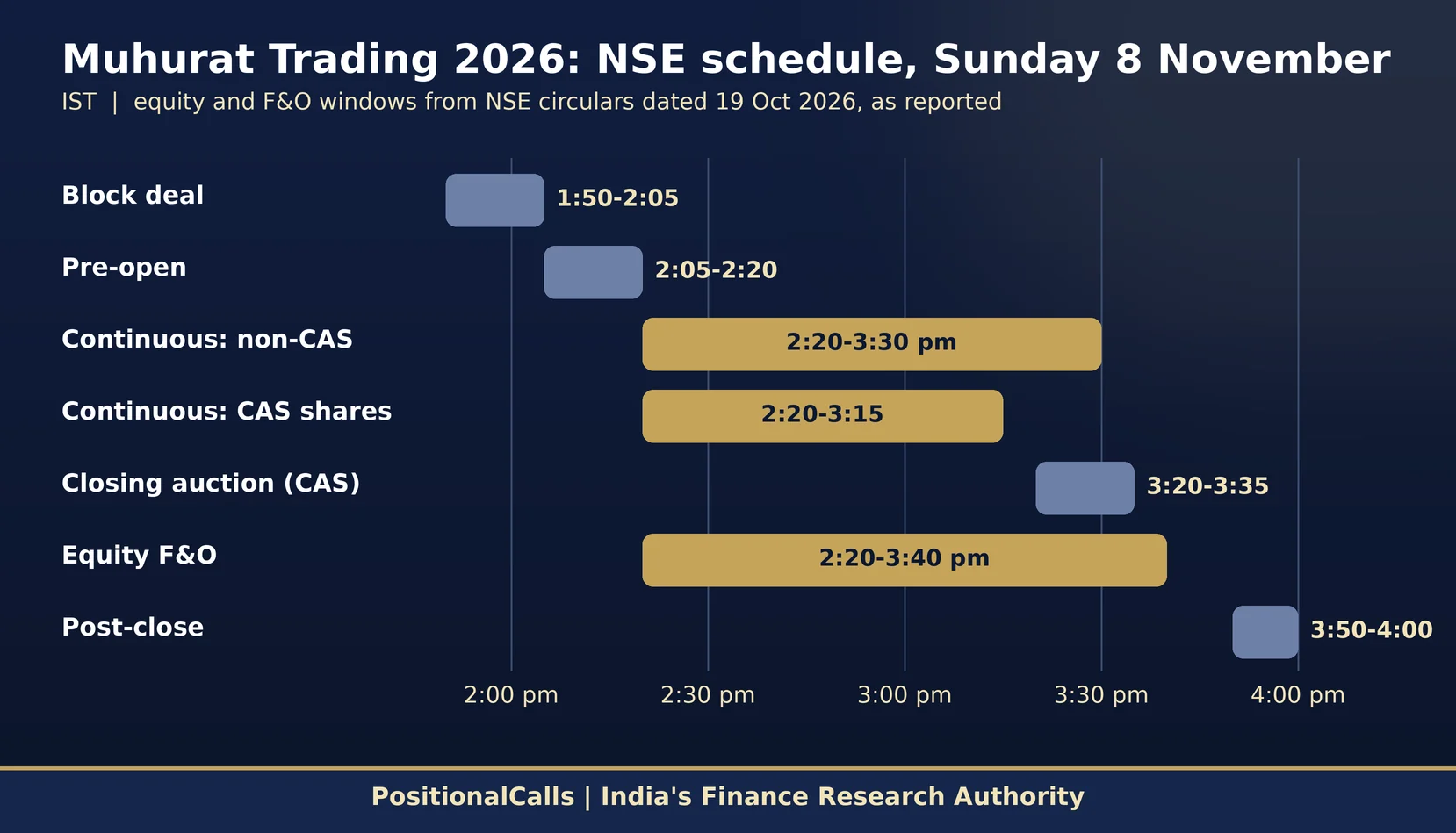
When is Muhurat trading 2026?
Muhurat trading 2026 is on Sunday, 8 November 2026, the day of Diwali Laxmi Pujan, and it marks the start of Samvat 2083 on NSE and BSE.
| Item | Detail | Status as of 5 Nov 2026 |
|---|---|---|
| Session date | Sunday, 8 November 2026 | Confirmed by NSE and BSE circulars of 19 Oct, as reported |
| Occasion | Diwali Laxmi Pujan; start of Samvat 2083 | Reported |
| Equity continuous trading | 2:20 pm to 3:30 pm IST on NSE and BSE | NSE circular NSE/CMTR/76941, as reported |
| Settlement of Sunday trades | Monday, 9 November 2026 (T+1) | NSE Clearing calendar, as reported |
| Next holiday | Tuesday, 10 November 2026 (Diwali-Balipratipada) | Listed in the 2026 holiday calendar |
| Trading resumes | Wednesday, 11 November 2026 | Follows from the holiday list |
Cite this table: PositionalCalls, “Muhurat Trading 2026 Key Dates, as of 5 November 2026”.
What are the Muhurat trading 2026 timings?
On NSE, equity pre-open starts at 2:05 pm and continuous trading runs from 2:20 pm to 3:30 pm IST; securities in the closing auction session stop continuous trading at 3:15 pm.
| NSE equity window | Time (IST) | What happens |
|---|---|---|
| Block deal | 1:50 pm to 2:05 pm | Large negotiated trades |
| Pre-open: all order types | 2:05 pm to 2:10 pm | Limit and market orders can be entered, changed or cancelled |
| Pre-open: limit orders only | 2:10 pm to 2:15 pm | Random closure in the last two minutes |
| Pre-open matching and buffer | 2:15 pm to 2:20 pm | Opening price discovery, then a buffer |
| Continuous trading, non-CAS shares | 2:20 pm to 3:30 pm | The main session |
| Continuous trading, CAS shares | 2:20 pm to 3:15 pm | Then a transition to the closing auction |
| Closing auction order entry | 3:20 pm to 3:30 pm | All order types to 3:25 pm, then limit orders only |
| Closing auction matching | 3:30 pm to 3:35 pm | Closing price discovery for CAS shares |
| Post-close session | 3:50 pm to 4:00 pm | Trades at the closing price |
| Trade modification cut-off | 4:15 pm | Last time to modify trades |
Cite this table: PositionalCalls, “NSE Equity Session Windows, as of 5 November 2026”.
NSE also set separate windows for IPO and relisted securities (special pre-open 2:05 pm to 2:50 pm, normal trading 3:05 pm to 3:30 pm) and a call auction for illiquid securities (2:25 pm to 3:10 pm), as reported. Most retail investors need only the pre-open, continuous trading and the closing auction.
| Segment | NSE circular (19 Oct 2026) | Window (IST) |
|---|---|---|
| Equity F&O | NSE/FAOP/76940 | Normal trading 2:20 pm to 3:40 pm |
| Commodity derivatives | NSE/COM/76978 | Normal market 2:20 pm to 3:30 pm |
| Corporate bonds (T+1) | NSE/DS/77072 | Trading 2:05 pm to 3:00 pm |
| MCX | Separate notice | Timings to be announced, as reported |
Cite this table: PositionalCalls, “Muhurat Trading 2026 Other Segments, as of 5 November 2026”.
How is Muhurat trading 2026 different from earlier years?
The 2026 session is a 70-minute afternoon session on a Sunday, against a 60-minute session in earlier years, and it adds a closing auction for eligible shares.
| Year | Day and date | Normal trading window | Source type |
|---|---|---|---|
| 2023 | Sunday, 12 November | 6:15 pm to 7:15 pm | News report |
| 2024 | Friday, 1 November | 6:00 pm to 7:00 pm | Prasar Bharati report |
| 2025 | Tuesday, 21 October | 1:45 pm to 2:45 pm | News report |
| 2026 | Sunday, 8 November | 2:20 pm to 3:30 pm | NSE circular, as reported |
Cite this table: PositionalCalls, “Muhurat Session Times 2023 to 2026, as of 5 November 2026”.
Many guides still call the session “one hour”. For 2026 that is not accurate: normal trading lasts 70 minutes for non-CAS shares and 55 minutes for CAS shares (2:20 pm to 3:15 pm), before the auction (my calculation). The closing auction is the main change to understand.
How do you place an order in the 2026 windows?
- Check the security: ask your broker whether your share is a CAS security, because it stops continuous trading at 3:15 pm.
- Use the pre-open early: from 2:05 pm to 2:10 pm you can enter, change or cancel limit and market orders.
- Expect limit-only phases: from 2:10 pm to 2:15 pm only limit orders can change, and market orders cannot be cancelled.
- Trade from 2:20 pm: continuous trading starts after the buffer.
- Watch 3:15 pm: CAS shares move to the auction, and the auction order windows start at 3:20 pm.
- Remember no order is guaranteed: a limit order sets your price but may not fill.
What is Samvat 2083, and why does Muhurat trading start it?
Samvat 2083 is the Hindu calendar year that traditionally begins around Diwali, and Muhurat trading is the exchanges’ ceremonial first session of that year.
Brokers and traders have long treated the Diwali session as the start of a new accounting year, and many families open fresh books or make a small token purchase for luck. The custom dates from 1957 on BSE and 1992 on NSE, as reported. It is a tradition, not a market rule: prices move on the same news, liquidity and orders as on any day.
The year just ending, Samvat 2082, began on 21 October 2025 with a flat session, in which the Sensex closed up 0.07% and the Nifty up 0.10%, as reported. Its full-year return will be known only at the Diwali 2026 close.
When do Muhurat trading 2026 trades settle?
Normal T+1 equity trades done on Sunday, 8 November 2026 are scheduled to settle on Monday, 9 November 2026, according to NSE Clearing’s calendar as reported.
| Date | What happens | Why it matters |
|---|---|---|
| Sun, 8 Nov 2026 | Muhurat session; real trades | Orders create settlement obligations |
| Mon, 9 Nov 2026 | Normal trading day; Sunday trades settle | Shares reach your demat per broker and depository processing |
| Tue, 10 Nov 2026 | Exchange holiday | Trades done on 9 Nov settle after the holiday (my reading) |
| Wed, 11 Nov 2026 | Trading resumes | Settlement for 9 Nov trades follows normal rules |
Cite this table: PositionalCalls, “Muhurat Trading 2026 Settlement Dates, as of 5 November 2026”.
The session is not a practice round. Brokerage, statutory charges and taxes apply as on any day, and sold shares must be in your demat account. Other settlement types may follow different calendars, so check your broker.
Which dividend record dates fall around the Muhurat trading 2026 session?
Power Grid’s Rs 3 record date is Friday, 6 November, Dabur’s Rs 3.50 is Tuesday, 10 November (a holiday) and HUL’s Rs 19 is Thursday, 12 November, as in our earlier posts; confirm each ex-date on NSE or BSE.
Under T+1, the ex-date normally equals the record date, so you must buy at least one settlement day earlier. A holiday on the record date moves the ex-date to the previous trading day, and Sunday’s Muhurat trades settle on Monday, which changes the count (my reading, not an exchange statement).
| Company | Dividend | Record date | Last day to buy for it (my reading) |
|---|---|---|---|
| Power Grid | Rs 3 interim | Fri, 6 Nov 2026 | Thursday, 5 Nov; ex-date is the record date |
| Dabur | Rs 3.50 interim | Tue, 10 Nov 2026 (holiday) | The Muhurat session on Sunday, 8 Nov, if the ex-date is Monday, 9 Nov |
| HUL (see the calendar hub) | Rs 19 | Thu, 12 Nov 2026 | Wednesday, 11 Nov; ex-date is the record date |
Cite this table: PositionalCalls, “Dividend Record Dates Around the Diwali Holiday, as of 5 November 2026”.
The Dabur row is the tricky one. A trade on Monday, 9 November settles after the Tuesday holiday, so it misses the record date, while a Sunday Muhurat trade settles on Monday and should count. Wait for the exchange’s ex-date notice before you rely on this, and see our guide to dividend TDS and tax.
Is the stock market open on Diwali 2026?
Only for the special session: regular trading does not happen on Sunday, 8 November 2026, but NSE and BSE hold Muhurat trading from 2:20 pm to 3:30 pm, and both are closed on Tuesday, 10 November 2026.
| Date | Day | Event | NSE and BSE equity | MCX |
|---|---|---|---|---|
| 8 Nov 2026 | Sunday | Diwali Laxmi Pujan | Special Muhurat session | Special session; timings announced separately |
| 9 Nov 2026 | Monday | Normal day | Open | Open |
| 10 Nov 2026 | Tuesday | Diwali-Balipratipada | Closed | Morning closed, evening open |
| 11 Nov 2026 | Wednesday | Trading resumes | Open | Open |
| 24 Nov 2026 | Tuesday | Guru Nanak Jayanti | Closed | Morning closed, evening open |
| 25 Dec 2026 | Friday | Christmas | Closed | Closed |
Cite this table: PositionalCalls, “Diwali Stock Market Holiday 2026 Calendar, as of 5 November 2026”.
What is the Diwali stock market holiday 2026 date?
The weekday Diwali stock market holiday 2026 is Tuesday, 10 November for Diwali-Balipratipada. Monday, 9 November is a normal trading day, as it does not appear on the NSE or BSE holiday lists, as reported.
PositionalCalls WhatsApp channel
Muhurat session-day reminder, in one message
- The final timings and your closing-auction checklist
- Ex-dates around the 10 November holiday
- The Sensex and Nifty close, posted after 3:30 pm
What do ten years of Muhurat trading returns show?
Nifty and Sensex closed higher in eight of the ten Muhurat sessions from 2016 to 2025, mostly by under 1%, and fell only in 2016 and 2017, in one compilation of session closes.
| Year | Nifty close | Nifty change | Sensex close | Sensex change |
|---|---|---|---|---|
| 2025 | 25,868.60 | +0.10% | 84,426.34 | +0.07% |
| 2024 | 24,304.35 | +0.40% | 79,724.12 | +0.42% |
| 2023 | 19,525.55 | +0.51% | 65,259.45 | +0.54% |
| 2022 | 17,730.75 | +0.87% | 59,831.66 | +0.87% |
| 2021 | 17,916.80 | +0.49% | 60,067.62 | +0.49% |
| 2020 | 12,780.25 | +0.47% | 43,637.98 | +0.45% |
| 2019 | 11,627.15 | +0.37% | 39,250.20 | +0.49% |
| 2018 | 10,598.40 | +0.65% | 35,237.68 | +0.70% |
| 2017 | 10,146.55 | -0.63% | 32,389.96 | -0.59% |
| 2016 | 8,625.70 | -0.14% | 27,930.21 | -0.04% |
Cite this table: PositionalCalls, “Muhurat Session Returns 2016 to 2025, as of 5 November 2026”.
Each change is from the previous close to the session close, not from the session open, and it excludes dividends, taxes and costs. The 2024 and 2025 rows match news reports (Sensex +335 points to 79,724 and +63 points to 84,426). Older rows come from one compilation, so treat them as indicative. The average gain is small, and a one-session move says little about the next twelve months.
Participation has changed more than prices. NSE’s Market Pulse for November 2024, as summarised by Finnovate, reported 24.5 lakh individual investors in that year’s cash-market session, who made up 63.4% of buy-side value against 33% on regular October days.
How did Samvat 2082 end, and what are analysts saying about Samvat 2083?
The Nifty was down about 10.3% from its Diwali 2025 reference close by 31 October 2026, an interim figure, and analysts quoted in reports give wide ranges for Samvat 2083.
| Reported view | Detail | Source type |
|---|---|---|
| Samvat 2082 so far | Nifty about 10.3% lower by 31 Oct 2026; final figure set at the Diwali 2026 close | HDFC Sky, interim |
| Muhurat 2025 start | Nifty closed at 25,868.60 on 21 Oct 2025 | Compilation and news reports |
| Level before the session | Nifty near 23,700 in early November | Business Standard, 3 Nov 2026 |
| SMC Global view | Nifty 25,000 to 26,500; Sensex 82,000 to 87,000 | Reported third-party view |
| Kotak Neo view | Broad Nifty range of 21,700 to 26,300 | Reported third-party view |
Cite this table: PositionalCalls, “Samvat 2082 Review and Samvat 2083 Views, as of 5 November 2026”.
These are other firms’ views, not ours, and PositionalCalls gives no index targets. The width of the ranges is the useful signal: even professional analysts disagree by more than 4,000 Nifty points (my calculation from 21,700 and 26,300).
Muhurat trading 2026 stock picks: should you follow them?
Treat any Muhurat pick list as a starting point to research, not a recommendation: brokerages publish them every year, and this site lists no picks and gives no calls.
For example, Shriram Research published a list of 11 Samvat 2083 picks on 4 November 2026, as reported. I do not repeat such lists, because a list cannot know your goals, tax position or risk. For a facts-only watchlist with brokerage targets quoted as reported, see Muhurat trading stocks 2026. Use these six questions on any list you see.
| Question to ask | Why it matters |
|---|---|
| Who published it, and are they SEBI-registered? | Unregistered tips are a common scam |
| What is the time horizon? | A one-year pick is not a one-day trade |
| What are the stated risks and exit conditions? | A pick without risks is marketing |
| Does the business fit your portfolio? | Concentration is the usual mistake |
| Are charges and tax included? | Costs reduce small gains |
| Is the data dated and sourced? | Stale prices mislead |
Cite this table: PositionalCalls, “Muhurat Pick List Checklist, as of 5 November 2026”.
Derivatives deserve extra caution. SEBI data summarised by Finnovate says 87.7% of individual F&O traders lost money in FY26, with aggregate losses of Rs 91,685 crore. A festive session does not change those odds.
What do you need to trade in Muhurat trading 2026?
You need a working demat and trading account with completed KYC, money or shares for settlement, and a plan made before the session.
| Product | How it works in the session | Check |
|---|---|---|
| Listed shares | Trade in the windows above | CAS or non-CAS status |
| ETFs | Trade on the exchange at market prices | Liquidity and bid-ask spread |
| Mutual funds and SIPs | No special Sunday NAV; normal cut-offs apply | AMFI applicable-NAV rules |
| F&O | Normal trading 2:20 pm to 3:40 pm | Margin and risk; high loss rates |
Cite this table: PositionalCalls, “Muhurat Trading 2026 Product Guide, as of 5 November 2026”.
- What it costs: brokerage, securities transaction tax, GST and stamp duty apply; check your broker’s current charge schedule.
- Tax angle: gains on listed shares follow capital gains rules; see tax on shares or ask a tax adviser.
- NRI note: see NRI investment in the Indian stock market for account and limit rules.
- Safer alternatives: a monthly SIP in a diversified fund does not depend on one festive hour.
- Scam warning: fake “Muhurat picks”, KYC links and OTP requests are common. Never share an OTP.
How do you read the Muhurat trading 2026 closing report?
Compare the Sensex and Nifty close with the previous regular close on Friday, 6 November, not with the session open, and then check breadth, volume and the closing auction.
Over the ten sessions in the table, the average change was +0.31% for the Nifty and +0.34% for the Sensex, and no session moved more than 0.87% in either direction (my calculation). Use that as a yardstick when the 8 November numbers arrive.
| What to read | Compare with | Why it matters |
|---|---|---|
| Index change | Close of Friday, 6 Nov 2026; ten-year range -0.63% to +0.87% | Shows whether the move is ordinary |
| Breadth | Advances against declines | A thin rally can hide weak stocks |
| Volume | A normal weekday | Short sessions can have low volume |
| Closing-auction shares | Last traded price at 3:15 pm | Shows how the auction set the close |
| Equity F&O close | 3:40 pm, ten minutes after cash | Derivatives run longer than cash |
| Sector moves | Previous session leaders | Festive buying is often narrow |
Cite this table: PositionalCalls, “Muhurat Closing Report Decoder, as of 5 November 2026”.
PositionalCalls will add the Sensex and Nifty close, the breadth and the session’s top moves to this page after 3:30 pm on 8 November, from exchange data. Until then no session figure is claimed.
What do most people miss about Muhurat trading 2026?
Most miss the closing auction, the Monday settlement and the Tuesday holiday, and many repeat “one hour” timings that no longer match the schedule.
A worked example of the closing auction
Say you hold 100 shares of a CAS security and want to sell at 3:22 pm. Continuous trading in that share ended at 3:15 pm, so your order enters the auction order book, where all order types are accepted until 3:25 pm. As I read the circular, matching at 3:30 pm to 3:35 pm sets one closing price for the auction, so you may not get the last price you saw on screen. A limit order protects your price but may not fill. A non-CAS share would have kept trading until 3:30 pm.
- Note the date: Sunday, 8 November 2026, 2:20 pm to 3:30 pm.
- Ask your broker if your share is a CAS security.
- Plan the trade before 2:05 pm, and use limit orders.
- Check ex-dates for any dividend you want.
- Remember the closed market on Tuesday, 10 November.
| Date | What to do or expect |
|---|---|
| Sun, 8 Nov | Session from 2:05 pm; check CAS status and use limit orders |
| Mon, 9 Nov | Sunday trades settle; likely Dabur ex-date; check the exchange notice |
| Tue, 10 Nov | No equity trading; Dabur record date |
| Wed, 11 Nov | Trading resumes; last day to buy for HUL’s Rs 19 dividend (my reading) |
Cite this table: PositionalCalls, “Muhurat Week Calendar 8 to 11 November, as of 5 November 2026”.
Analyst’s note
- What stands out: for Muhurat trading 2026 the closing auction and the Monday settlement matter more to your order than the ceremony does.
- Easy to miss: the 10 November holiday changes dividend ex-dates, so a Muhurat trade can decide who gets a payout.
- What would change the view: a circular change on timings or a different settlement date would override this page.
- Caution: this is reasoning from reported schedules, not a recommendation. No outcome is assured.
- Reader action: decide your plan before the session and ignore pick lists.
Bottom line
Muhurat trading 2026 is on Sunday, 8 November, with continuous trading from 2:20 pm to 3:30 pm IST, a closing auction for eligible shares, settlement on Monday, 9 November and a market holiday on Tuesday, 10 November. History shows small gains in most sessions but no forecast. This guide is educational and is not a call to buy or sell.
Next read: Capital gains tax on shares: rates, dividend TDS and examples
Part of the market news and calendar series.
PositionalCalls WhatsApp channel
Never miss a market holiday or special session
- Muhurat and Diwali holiday reminders
- Results, dividend and IPO date notices
- A note when this guide changes
Want company facts for Sunday’s session? Read the Muhurat stocks watchlist
The watchlist covers ICICI Bank, DLF, Indian Hotels, Alembic Pharma and the Bank Nifty backdrop, with Q2 results and brokerage targets quoted as reported. No picks, no calls from this site.
FAQs on Muhurat trading 2026
When is Muhurat trading 2026?
Muhurat trading 2026 is on Sunday, 8 November 2026, for Diwali Laxmi Pujan and the start of Samvat 2083. NSE and BSE hold a special live session that day under exchange circulars dated 19 October 2026, as reported.
What are the Muhurat trading 2026 timings?
NSE equity pre-open starts at 2:05 pm and continuous trading runs from 2:20 pm to 3:30 pm IST. Securities in the closing auction session stop continuous trading at 3:15 pm. BSE continuous trading is also 2:20 pm to 3:30 pm, as reported.
Is the stock market open on Diwali 2026?
Only for the special session. Regular trading does not happen on Sunday, 8 November 2026, but NSE and BSE hold Muhurat trading from 2:20 pm to 3:30 pm. Both exchanges are closed on Tuesday, 10 November 2026 for Diwali-Balipratipada.
When do Muhurat trading 2026 trades settle?
NSE Clearing’s November 2026 calendar lists Monday, 9 November 2026 as the T+1 settlement date for normal equity trades done on Sunday, 8 November, as reported. Other segments may differ, so check your broker.
What is the Diwali stock market holiday 2026 date?
The weekday holiday is Tuesday, 10 November 2026 (Diwali-Balipratipada). NSE and BSE equity trading is shut and resumes on Wednesday, 11 November. The next weekday holiday is Tuesday, 24 November 2026 for Guru Nanak Jayanti.
What is the closing auction in Muhurat trading 2026?
It is a separate auction that sets the closing price of eligible securities. For these securities, continuous trading ends at 3:15 pm, order entry runs from 3:20 pm and matching ends at 3:35 pm. Other securities trade until 3:30 pm.
Do the Nifty and Sensex usually rise in Muhurat trading?
In one compilation, both closed higher in eight of ten sessions from 2016 to 2025, mostly by under 1%. They fell in 2016 and 2017. A one-session gain does not predict the year ahead.
What is Samvat 2083?
Samvat 2083 is the Hindu calendar year that traditionally begins around Diwali, and the 8 November 2026 session marks its start. The Nifty was down about 10.3% in Samvat 2082 by 31 October 2026, as an interim figure.
Which stocks should I buy in Muhurat trading 2026?
This site gives no buy or sell calls and lists no stock picks. Brokerages publish Muhurat lists, but a list is not advice for your goals. Check the six questions in this guide before you act on any pick. For five names with facts and brokerage targets as reported, see Muhurat trading stocks 2026.
What are the Muhurat trading 2026 F&O timings?
NSE’s equity derivatives circular sets normal trading from 2:20 pm to 3:40 pm on 8 November 2026, as reported. SEBI data summarised by Finnovate says 87.7% of individual F&O traders lost money in FY26, so trade with care.
Sources
- NSE circular NSE/CMTR/76941, 19 October 2026: equity Muhurat session
- NSE Clearing circular: November 2026 settlement calendar
- NSE Market Pulse, November 2024
- AMFI: applicable NAV and cut-off rules
- Finnovate, Paytm Money, Anand Rathi, StockGro, Univest, HDFC Sky, Business Standard, Prasar Bharati and TradingView reports (secondary; not linked)
Editorial disclosure. PositionalCalls.com is not a SEBI-registered research analyst or investment adviser. Investments in securities markets are subject to market risks. Read all related documents carefully before investing. Returns are never guaranteed. This page is educational, is independent and was written by Shubham Chaudhary, founder of PositionalCalls. How I researched this: I compared reports of the NSE and BSE circulars and the NSE Clearing calendar, recomputed derived figures and labelled third-party views. Corrections are published in the Data note.

Shubham Chaudhary is the founder of PositionalCalls, an independent Indian stock market research website. He writes company fundamentals, quarterly results analysis, IPO analysis and sector research for NSE and BSE listed companies, with a focus on banking stocks, insurance and long-term value investing. Every article is built from primary sources such as RBI, SEBI, NSE and BSE filings and company annual reports, and states its risks plainly in simple language for retail investors.
Coverage areas Our research standards- Numbers checked against NSE, BSE and SEBI filings
- Risks and limits stated in every article
- No paid promotions or broker tie-ups
- Articles updated when new filings arrive