
Income Tax · FY 2026-27 guide
This guide to income tax in India for FY 2026-27 explains the slabs, the two regimes, the Section 87A rebate, return dates, TDS and the tax on shares, funds and deposits, then points to the calculator or guide that works out your own number.
Quick answer
Income tax in India for FY 2026-27 is charged on slab rates under two regimes, with the new regime as the default: nil up to Rs 4 lakh, rising to 30% above Rs 24 lakh. A Rs 60,000 rebate and Rs 75,000 standard deduction make a salary of Rs 12.75 lakh tax-free.
Income tax in India: key takeaways
- Slabs: unchanged for FY 2026-27 in both regimes, per Bhatt and Joshi Associates and Zoho Payroll.
- Tax-free: taxable income up to Rs 12 lakh in the new regime, which is Rs 12.75 lakh of salary.
- Law: the Income-tax Act 2025 applies from 1 April 2026, but FY 2025-26 returns filed by 31 July 2026 stay under the 1961 Act, per Zoho Payroll.
- Investments: share and fund gains, dividends and deposit interest each follow their own rule, linked below.
- Not covered here: advice. This page gives no investment, regime or filing recommendation for your own case.
In plain words: the government taxes what you earn in a year, in slices. Each slice has its own rate, so only the part of your income above a line pays the higher rate. India lets most salaried people pick between a low-rate regime with few deductions and a high-rate regime with many.
Data note: as of Friday, 20 November 2026, 5:30 PM IST. Slab, rebate, return-date and Budget statements come from the pages named in the sources list, read as search extracts or opened where the text says so. I opened the Zoho Payroll guide and the Bhatt and Joshi Associates page. I did not open the Income-tax Act 2025, the Finance Act 2026 or the Income Tax Department portal. Figures marked my calculation are arithmetic.
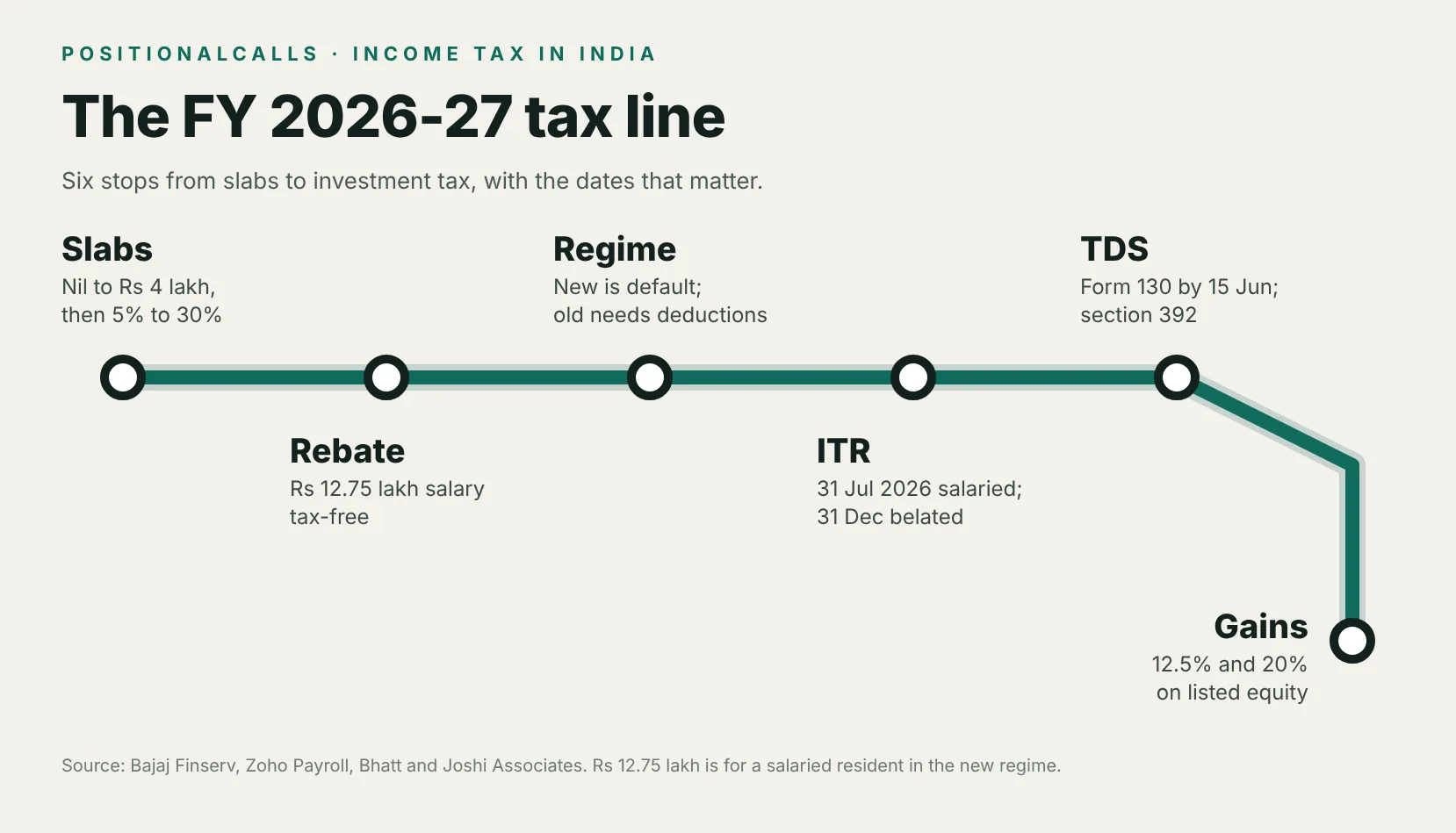
Income tax in India for FY 2026-27: slabs, the Rs 12.75 lakh limit and the dates that matter.
What is income tax in India and who has to pay it?
Income tax in India is a direct tax on income, collected by the Central Government and administered by the Central Board of Direct Taxes under the Income Tax Department. Native Teams describes it as applying to salaried people, freelancers, business owners and NRIs depending on residential status, and Wikipedia says the central government taxes non-agricultural income under Entry 82 of the Union List.
You owe tax when your taxable income crosses the basic limit. Bajaj Finserv says that is Rs 4 lakh in the new regime and Rs 2.5 lakh in the old regime for an individual below 60. A person with income below the limit may still need to file a return in some cases, such as when TDS was deducted and a refund is due. The rest of this guide covers the rates, the forms, the deadlines and the tax on investments.
| Question | Short answer | Where it is covered |
|---|---|---|
| How much is taxed? | Slab rates on taxable income, in both regimes | Slabs section below |
| Which regime applies? | New regime unless you choose the old one | Old or new regime section |
| When do I file? | 31 July 2026 for salaried FY 2025-26 returns | ITR forms and dates section |
| Who deducts tax? | Employer and payers deduct TDS, you pay advance tax | TDS and advance tax section |
| How are gains taxed? | Special rates for listed shares and funds | Tax on investments section |
Cite this table: PositionalCalls, “Tax guide: the questions this guide answers”; sources as named in the text.
Is it a direct or indirect tax?
It is a direct tax. Moneyview says a direct tax is imposed on a person’s annual earnings, and the person who earns it pays it, unlike GST, which is built into the price of goods and services and collected from the buyer. Income tax and customs duty are both central taxes, and Wikipedia says the Income-tax Act 2025 has governed income tax in India since 1 April 2026.
What do Tax Year, financial year and assessment year mean in income tax in India?
Under the Income-tax Act 2025, the old terms Previous Year and Assessment Year are replaced by a single Tax Year, so Tax Year 2026-27 means the same period as FY 2026-27 and AY 2027-28. Bhatt and Joshi Associates describe the Tax Year as the 12 months starting on 1 April, and Zoho Payroll says the Tax Year replaces the Assessment Year from FY 2026-27.
| Income earned | Old term (1961 Act) | New term (2025 Act) | Return filed |
|---|---|---|---|
| 1 Apr 2025 to 31 Mar 2026 | FY 2025-26, AY 2026-27 | Still under the 1961 Act | By 31 Jul 2026 for salaried, per Zoho Payroll |
| 1 Apr 2026 to 31 Mar 2027 | FY 2026-27, AY 2027-28 | Tax Year 2026-27 | From April 2027, due 31 Jul 2027 for salaried |
| 1 Apr 2027 to 31 Mar 2028 | FY 2027-28, AY 2028-29 | Tax Year 2027-28 | 2028 |
Cite this table: PositionalCalls, “Tax guide: year terms”; Bhatt and Joshi Associates and Zoho Payroll; the row for FY 2027-28 is my extension of the same pattern.
The mix of names is the biggest reason pages disagree. A page written in 2025 says AY 2026-27 for the return you filed this year, while a page written in 2026 says Tax Year 2026-27 for income you are earning this year. This guide uses FY 2026-27 for the income and flags the Tax Year name where a source uses it. Zoho Payroll says the new section numbers apply fully to returns filed from July 2027, so the Rs 12.75 lakh rule and the 31 July 2026 return date you may be reading about belong to the 1961 Act.
Does the Income-tax Act 2025 change my tax for FY 2026-27?
Not by itself. Zoho Payroll, Tax2win and Bhatt and Joshi Associates say the rates, slabs and deduction limits carry over, and the Budget 2026 statements in the sources say no slab changed. What changes is the wording, the section numbers and the forms. Check the form your employer gives you for the new names.
What are the income tax in India slabs for FY 2026-27?
Income tax in India for FY 2026-27 has two sets of slabs: the new regime from nil up to Rs 4 lakh to 30% above Rs 24 lakh, and the old regime from nil up to Rs 2.5 lakh to 30% above Rs 10 lakh. Bhatt and Joshi Associates say the Union Budget 2026-27 changed no slab, rate, surcharge or cess, and Bajaj Finserv lists the same 0%, 5%, 10%, 15%, 20%, 25% and 30% bands for the new regime.
| New regime taxable income | Rate | Tax on that band, my calculation |
|---|---|---|
| Up to Rs 4,00,000 | Nil | Rs 0 |
| Rs 4,00,001 to Rs 8,00,000 | 5% | Rs 20,000 |
| Rs 8,00,001 to Rs 12,00,000 | 10% | Rs 40,000 |
| Rs 12,00,001 to Rs 16,00,000 | 15% | Rs 60,000 |
| Rs 16,00,001 to Rs 20,00,000 | 20% | Rs 80,000 |
| Rs 20,00,001 to Rs 24,00,000 | 25% | Rs 1,00,000 |
| Above Rs 24,00,000 | 30% | On the excess |
Cite this table: PositionalCalls, “Tax guide slabs, new regime, FY 2026-27”; rates from Bajaj Finserv; band tax is my calculation.
| Old regime taxable income | Below 60 | 60 to 79 | 80 and above |
|---|---|---|---|
| Up to Rs 2,50,000 | Nil | Nil | Nil |
| Rs 2,50,001 to Rs 3,00,000 | 5% | Nil | Nil |
| Rs 3,00,001 to Rs 5,00,000 | 5% | 5% | Nil |
| Rs 5,00,001 to Rs 10,00,000 | 20% | 20% | 20% |
| Above Rs 10,00,000 | 30% | 30% | 30% |
Cite this table: PositionalCalls, “Tax guide slabs, old regime, FY 2026-27”; below-60 rates from Bajaj Finserv and Native Teams; the senior limits are the long-standing old regime limits and the 2025 Act text was not opened.
Slabs are marginal. Only the income inside each band pays that band’s rate, so crossing Rs 8 lakh does not tax the first Rs 8 lakh at 10%. Add 4% health and education cess on the total tax, and surcharge for incomes above Rs 50 lakh, as the income tax calculator page explains. The new regime has the same slabs for every age, while the old regime has higher basic limits for seniors.
How does the rebate make income tax in India nil up to Rs 12 lakh?
The Section 87A rebate in the new regime is up to Rs 60,000 for taxable income up to Rs 12 lakh, per Upstox, which cancels the whole slab tax. A salaried person also gets the Rs 75,000 standard deduction, so the nil-tax salary is Rs 12.75 lakh, per 1Finance and Paisabazaar. The old regime rebate is Rs 12,500 up to Rs 5 lakh, and the benefit is lost in full just above that line.
| Gross salary | New regime tax with cess | Old regime tax, Rs 2 lakh deductions | Lower of the two |
|---|---|---|---|
| Rs 8,00,000 | Rs 0 | Rs 23,400 | New regime |
| Rs 12,75,000 | Rs 0 | Rs 1,24,800 | New regime |
| Rs 15,00,000 | Rs 97,500 | Rs 1,95,000 | New regime |
| Rs 20,00,000 | Rs 1,92,400 | Rs 3,51,000 | New regime |
| Rs 30,00,000 | Rs 4,75,800 | Rs 6,63,000 | New regime |
Cite this table: PositionalCalls, “Tax guide: tax on a salary, FY 2026-27”; my calculation for a salaried resident below 60; Rs 2 lakh of old regime deductions is an illustration, not advice.
Which regime should you use for income tax in India, the old or the new?
The new regime is the default and usually costs less up to about a Rs 15 lakh salary, while the old regime pays off only when your deductions are large, about Rs 5.4 lakh at Rs 15 lakh on my calculation. The choice is arithmetic, so it needs your own salary and deductions, and the income tax calculator on this site runs it.
| Feature | New regime | Old regime |
|---|---|---|
| Status | Default | Chosen explicitly |
| Standard deduction | Rs 75,000 | Rs 50,000 |
| Section 80C, 80D, HRA | Not allowed | Allowed |
| Employer NPS, Section 80CCD(2) | Up to 14% of basic plus DA | 10% of basic plus DA for private employers |
| Rebate | Rs 60,000 up to Rs 12 lakh taxable | Rs 12,500 up to Rs 5 lakh taxable |
| Best for | Few deductions, simple filing | Large deductions such as HRA and home loan interest |
Cite this table: PositionalCalls, “Tax guide: old and new regime side by side, FY 2026-27”; Tata Capital, TaxGuru, Protean and Bajaj Finserv; the 2025 Act text was not opened.
A salaried taxpayer with no business income can choose either regime each year, per TaxGuru, so the decision is not permanent. Business or professional income is stricter, with a one-time return to the new regime after opting out. The old regime keeps the deductions people already use, such as Section 80C items, explained in the Section 80C limit guide, and the extra NPS deduction in the NPS calculator.
How much do deductions need to be for the old regime to win?
At a Rs 15 lakh salary the new regime tax is Rs 97,500, and the old regime needs about Rs 5.4 lakh of deductions, besides the standard deduction, to equal it. At Rs 10 lakh the new regime pays nil. Few people reach those totals with 80C, health insurance and a modest home loan alone, which is why the new regime wins for most salaried filers on these slabs, my calculation. TaxGuru’s own break-even figures are lower and conflict with its tax figure, which the calculator page shows. Rent is the other large old-regime item, and the HRA exemption guide shows the three-limb formula, the eight metro cities from 1 April 2026 and when claiming it is worth it.
Which ITR form and due date apply to income tax in India for FY 2025-26?
Most salaried people use ITR-1 or ITR-2 and file by 31 July, while non-audit business and professional filers use ITR-3 or ITR-4 and file by 31 August, and audit cases file by 31 October. Zoho Payroll lists these dates for FY 2025-26, with a belated return up to 31 December 2026.
| Form | Who uses it, per Zoho Payroll | Due date, FY 2025-26 |
|---|---|---|
| ITR-1 (Sahaj) | Most salaried individuals | 31 Jul 2026 |
| ITR-2 | Salaried with capital gains, several properties or foreign income or assets | 31 Jul 2026 |
| ITR-3 | Business or professional income | 31 Aug 2026 if non-audit |
| ITR-4 | Presumptive income | 31 Aug 2026 |
| Tax audit cases | Accounts need an audit | 31 Oct 2026 |
| Belated return | Late, with a fee | 31 Dec 2026 |
| Revised return | Correct a filed return | 31 Mar 2027, unsourced |
Cite this table: PositionalCalls, “Tax guide: ITR forms and due dates, FY 2025-26”; Zoho Payroll guide, opened; the revised-return date carries no source on that page.
The late fee is Rs 1,000 if total income is Rs 5 lakh or less and Rs 5,000 above that, per Zoho Payroll, and Bhatt and Joshi Associates describe it as a fee, not a penalty, under a new section 234-I of the 1961 Act, Section 428(b) of the 2025 Act. The full rules, including the loss of some deductions on a late return, are in the belated ITR last date guide. To pick your form, see which ITR to file.
PositionalCalls WhatsApp channel
Get tax and savings explainers on WhatsApp
- Slab and deduction changes, dated
- Calculators explained without tips
- Links to updated tax guides
| Return for | Salaried | Non-audit business | Audit cases | Belated | Revised |
|---|---|---|---|---|---|
| FY 2025-26 | 31 Jul 2026 | 31 Aug 2026 | 31 Oct 2026 | 31 Dec 2026 | 31 Mar 2027 |
| Tax Year 2026-27 | 31 Jul 2027 | 31 Aug 2027 | 31 Oct 2027 | 31 Dec 2027 | 31 Mar 2028 |
Cite this table: PositionalCalls, “Tax guide: return dates for two years”; Zoho Payroll; the Tax Year 2026-27 row reflects Budget 2026 proposals as reported by Bhatt and Joshi Associates, which I could not confirm as enacted.
Why does the revised return date differ across sources?
Bhatt and Joshi Associates say the Finance Bill 2026 proposed to lengthen the revised-return window from 9 months to 12 months, which gives 31 March of the next year. Zoho Payroll shows 31 March 2027 for FY 2025-26 as extended from 31 December without a source. I show both and rely on neither for a deadline decision; check the Income Tax Department notice before the date.
How do TDS and advance tax work under income tax in India?
TDS is tax deducted at source by the employer or payer, and for salary it falls under Section 392 of the 2025 Act, previously Section 192, with deposit by the 7th of the next month and Form 130, the new Form 16, due by 15 June. Zoho Payroll gives these rules, and TaxGuru says the 2025 Act consolidates the old scattered TDS sections into Section 392 and TCS into Section 393.
| Item | Rule | Source |
|---|---|---|
| TDS on salary | Employer divides estimated annual tax into monthly deductions | Zoho Payroll |
| Deposit date | 7th of the next month, 30 April for March | Zoho Payroll |
| Salary certificate | Form 130, the new Form 16, by 15 June | Zoho Payroll |
| No regime declared | New regime applies | Zoho Payroll |
| TCS | Consolidated under Section 393 | TaxGuru |
Cite this table: PositionalCalls, “Tax guide: TDS on salary”; Zoho Payroll and TaxGuru; section numbers as reported.
If your employer deducts too little or too much, the difference is settled when you file. People with income outside salary, such as capital gains, rent or interest, may also owe advance tax in instalments on 15 June, 15 September, 15 December and 15 March when the tax due is large enough. The advance tax due date guide covers who must pay and the interest for missing it.
What is Form 130?
Zoho Payroll describes Form 130 as the new Form 16 for Tax Year 2026-27, due by 15 June 2027. It carries the section references of the 2025 Act. The form for FY 2025-26 is still the old Form 16, due by 15 June 2026. Keep your declaration and proofs with it, because the return and the form must agree. The TDS on salary guide covers the monthly calculation, Form 124 and what to do about excess tax.
How is income from shares, funds and deposits taxed in income tax in India?
Listed shares and equity funds held more than 12 months pay 12.5% on gains above Rs 1.25 lakh, those held up to 12 months pay 20%, and dividends and deposit interest are added to income at slab rates. Bhatt and Joshi Associates give the 12.5% and 20% rates and the Rs 1.25 lakh limit, with Sections 112A and 111A of the 1961 Act and Sections 198 and 196 of the 2025 Act.
| Income | How it is taxed | Where to read more |
|---|---|---|
| Long-term gain, listed equity | 12.5% above Rs 1.25 lakh, held over 12 months | Capital gains tax on shares |
| Short-term gain, listed equity | 20%, held up to 12 months | Capital gains tax calculator |
| Dividends | Added to income at slab rates; TDS may apply | Dividend tax in India |
| Mutual fund gains | Depends on fund type and holding period | Mutual fund taxation |
| IPO listing gain | Capital gain on sale | IPO tax in India |
| Trading charge | Securities Transaction Tax on each trade | STT in India |
| Fixed deposit interest | Added to income at slab rates | FD calculator |
Cite this table: PositionalCalls, “Tax guide: tax on investments”; rates from Bhatt and Joshi Associates; details are on the linked pages, which cite their own sources.
The slab-rate items matter for the regime choice, because they raise taxable income, while capital gains at special rates do not qualify for the Section 87A rebate, per Bajaj Finserv. A person with a Rs 12 lakh salary and some share gains can therefore owe tax even though the salary alone is nil. The gains go on ITR-2, per Zoho Payroll, not on the simple ITR-1. NRIs follow different TDS rules, covered in the NRI investment guide.
Were share buybacks taxed differently from April 2026?
Bhatt and Joshi Associates say the Finance Bill 2026 proposed treating buyback proceeds as capital gains for all shareholders, not as dividend income, from 1 April 2026, with the same 12.5% and 20% rates for listed equity. They quote a PIB release for promoter rates of about 22% for corporate promoters and about 30% for others. Confirm the enacted wording before relying on it.
What changed in income tax in India from 1 April 2026?
The Income-tax Act 2025 took effect on 1 April 2026 with renumbered sections, a Tax Year, new forms such as Form 130 and some compliance changes, while slabs, rates and the main deduction limits stayed the same. Tax2win, Zoho Payroll and Bhatt and Joshi Associates agree on that core, and differ on some details.
| Change | What the source says | Source |
|---|---|---|
| New law | Income-tax Act 2025 replaces the 1961 Act from 1 Apr 2026 | Tax2win, Wikipedia |
| Slabs | No change for FY 2026-27 | Bhatt and Joshi Associates |
| HRA | 50% limit covers eight cities, with landlord details needed for a claim | TaxGuru |
| Return dates | ITR-3 and ITR-4 move to 31 Aug 2027 for Tax Year 2026-27, proposed | Bhatt and Joshi Associates |
| Revised return | Window proposed to extend from 9 to 12 months | Bhatt and Joshi Associates |
| Form 15G and 15H | One submission to NSDL or CDSL can serve all deductors, proposed | Bhatt and Joshi Associates |
| TCS on foreign remittances | Overseas tour packages at a flat 2% and education or medical LRS at 2%, proposed | Bhatt and Joshi Associates |
| Buybacks | Proceeds taxed as capital gains, proposed | Bhatt and Joshi Associates |
Cite this table: PositionalCalls, “Tax guide: changes from 1 April 2026”; each row as the source describes it; proposed means a Finance Bill 2026 proposal I could not confirm as enacted.
The honest limit is that several rows come from a description of the Finance Bill, and I did not open the Finance Act. Treat the proposed rows as likely, not certain, until you read the notified text. The rows without that label come from more than one source. The Union Budget 2027 guide tracks what is expected in the next Budget, due 1 February 2027, to be confirmed.
Do the section number changes affect how I file?
Only on the forms. Zoho Payroll says the section references on your payslip, Form 130 and the ITR forms are new from Tax Year 2026-27, and FY 2025-26 filing still uses the 1961 Act. Where two sources give different new numbers, as for the rebate, the conflict box near the top lists them, and the tax rule itself is the same.
What is the income tax in India calendar from December 2026 to July 2027?
The dates that matter are 15 December 2026 for advance tax, 31 December 2026 for a belated FY 2025-26 return, the 1 February 2027 Budget, 15 March 2027 for the last advance tax instalment and 31 July 2027 for salaried returns. The advance tax dates are from the guide on this site, the return dates from Zoho Payroll, and the Budget date is to be confirmed.
| Date | Event | Source |
|---|---|---|
| 15 Dec 2026 | Advance tax instalment | Advance tax guide on this site |
| 31 Dec 2026 | Last date for a belated FY 2025-26 return, with a fee | Zoho Payroll |
| 1 Feb 2027 | Union Budget, date to be confirmed | Union Budget 2027 guide on this site |
| 15 Mar 2027 | Last advance tax instalment for FY 2026-27 | Advance tax guide on this site |
| 31 Mar 2027 | FY 2026-27 ends; revised FY 2025-26 date, unsourced | Zoho Payroll |
| 15 Jun 2027 | Form 130 due; first advance tax date of FY 2027-28 | Zoho Payroll |
| 31 Jul 2027 | Salaried returns for Tax Year 2026-27 | Zoho Payroll |
| 31 Aug 2027 | Non-audit business returns, proposed | Bhatt and Joshi Associates |
Cite this table: PositionalCalls, “Tax guide calendar, December 2026 to August 2027”; sources as named; dates are tentative until the Income Tax Department notifies them.
Put these in a calendar early. The 15 December instalment falls within a month, and the belated return date is the last chance for a return you missed. If you pay advance tax, the capital gains you book in the second half of the year can change the final instalment.
Which calculators and guides cover each part of income tax in India?
Use the income tax calculator for the regime choice, the Section 80C, NPS, PPF and SIP pages for the deductions and savings behind it, and the capital gains, dividend and mutual fund pages for investment tax. Each page cites its own sources and shows where they disagree.
| Need | Page | What it gives |
|---|---|---|
| Compare the two regimes | Income tax calculator | Tax in both regimes and the deduction break-even |
| Section 80C deductions | Section 80C limit | What counts and the Rs 1.5 lakh limit |
| Rent and HRA | HRA exemption | Three-limb formula, 8 metros and a calculator |
| Pension and employer NPS | NPS calculator | Corpus and deduction view |
| Safe savings | PPF calculator and FD calculator | Maturity and interest estimates |
| Market investing | SIP calculator | Illustration of regular investing |
| Share and fund gains | Capital gains tax calculator | Tax on a sale |
| Loans | EMI calculator | Monthly instalment on a loan |
| Deadlines | Belated ITR and advance tax | Dates, fees and interest |
Cite this table: PositionalCalls, “Tax guide: calculators and guides by need”; pages on this site.
These pages are tools and explainers, not advice. They show how a rule works on example numbers, and your own result depends on figures only you have.
What mistakes do people make with income tax in India?
The common errors are reading a page written for FY 2025-26 as if it were new, treating Rs 12 lakh as a salary limit, claiming 80C in the new regime, missing advance tax on gains and mixing the old and new section numbers. Each follows from the rules above.
- Stale pages: many income tax in India guides still show FY 2025-26, although the slabs are the same, so check the year in the title.
- Rs 12 lakh as salary: the tax-free limit is Rs 12 lakh taxable, or Rs 12.75 lakh salary.
- 80C in the new regime: it is not allowed, so the claim helps only in the old regime.
- Gains and the rebate: special-rate gains do not get the Section 87A rebate.
- Forgetting the declaration: with no regime declared, the employer uses the new regime, per Zoho Payroll.
- Section numbers: sources differ on the new numbers, so quote the form you hold.
What is a short checklist for income tax in India?
Take your Form 16 or Form 130 and payslips, list deductions with proofs, run the income tax calculator for both regimes, check the due date for your form, note advance tax dates if you have gains, and keep proofs for the return. If your case includes business income or foreign assets, ask a chartered accountant.
What does this income tax in India guide leave out?
It leaves out company and firm tax, GST, property and agricultural income, NRI residential tests, tax audits and personal advice. It is a map of the individual taxpayer’s rules with links to deeper pages.
- No statute text: I did not open the Income-tax Act 2025 or the Finance Act 2026.
- No portal check: I did not open the Income Tax Department site to confirm dates.
- No personal advice: a chartered accountant should confirm your own case.
When will this income tax in India guide be updated?
After the 1 February 2027 Budget, after any Rules or notification under the Income-tax Act 2025, and before each return and advance tax date in the calendar above. The update line at the top shows the last real change.
PositionalCalls WhatsApp channel
Tax updates in one channel
- Budget and notification changes
- Plain-English tax explainers
- Links to new guides
Income tax in India: frequently asked questions
What is income tax in India and who pays it?
Income tax in India is a direct tax on the income of individuals, firms and companies, collected by the Central Government and administered by the Central Board of Direct Taxes, per Native Teams. Under the new regime a person earning above Rs 4 lakh a year owes tax, and under the old regime the limit is Rs 2.5 lakh, per Bajaj Finserv.
What are the income tax in India slabs for FY 2026-27?
Budget 2026 left the slabs unchanged, per Bhatt and Joshi Associates. The new regime is nil to Rs 4 lakh, then 5%, 10%, 15%, 20%, 25% and 30% above Rs 24 lakh. The old regime is nil to Rs 2.5 lakh, then 5%, 20% and 30% above Rs 10 lakh, with higher limits for seniors.
Is income tax in India nil up to Rs 12.75 lakh?
For a salaried resident in the new regime, yes. The Section 87A rebate of up to Rs 60,000 makes taxable income up to Rs 12 lakh tax-free, and the Rs 75,000 standard deduction lifts the salary limit to Rs 12.75 lakh, per Upstox and 1Finance. Special-rate income such as some capital gains does not get that rebate.
Which regime for income tax in India is the default?
The new regime is the default, so an employer deducts tax under it unless you declare otherwise, per Zoho Payroll. A salaried taxpayer with no business income can choose either regime each year, per TaxGuru. On my calculation a Rs 15 lakh salary needs about Rs 5.4 lakh of old regime deductions to match the new regime.
What changed in the tax rules from 1 April 2026?
The Income-tax Act 2025 replaced the 1961 Act with renumbered sections and a single Tax Year concept, while slabs, rates and deduction limits stayed, per Bhatt and Joshi Associates and Zoho Payroll. Form 130 is described as the new Form 16. Some Budget changes were proposals in the Finance Bill, so confirm each before relying on it.
What are the ITR due dates for FY 2025-26?
For FY 2025-26, Zoho Payroll lists 31 July 2026 for salaried filers on ITR-1 or ITR-2, 31 August 2026 for non-audit business filers and 31 October 2026 for audit cases. A belated return is listed up to 31 December 2026 with a fee of Rs 1,000 or Rs 5,000, the revised-return date of 31 March 2027 is unsourced.
How is TDS handled on salary?
The employer estimates annual tax on the regime you declare, divides it into monthly amounts and deducts it, under Section 392 of the 2025 Act, previously Section 192, per Zoho Payroll. TDS is deposited by the 7th of the following month, and Form 130, the new Form 16, is due by 15 June.
How are shares, funds and deposits taxed?
On listed shares and equity funds, long-term gains above Rs 1.25 lakh are taxed at 12.5% after 12 months and short-term gains at 20%, per Bhatt and Joshi Associates. Dividends and fixed deposit interest are added to income at slab rates. See the capital gains and dividend tax pages on this site for the details.
Which calculators should I use?
Start with the income tax calculator to compare both regimes, then use the Section 80C, NPS, FD, PPF and SIP calculators for the deductions and savings that feed it, and the capital gains tax calculator for share and fund gains. All are free, and they show their sources and the limits of the estimate.
Is this guide tax advice?
No. PositionalCalls is not a SEBI-registered research analyst or investment adviser and is not a tax practitioner. This page explains the rules as the sources describe them, with the Income-tax Act 2025 text not opened. Confirm figures with the Income Tax Department or a chartered accountant before you file or choose a regime.
Sources for this tax guide
- Native Teams: complete guide to income tax.
- Wikipedia: Taxation in India.
- Moneyview: types of income tax.
- Bajaj Finserv: income tax slabs FY 2026-27.
- Zoho Payroll: income tax on salary, FY 2025-26 and TY 2026-27.
- Bhatt and Joshi Associates: Union Budget 2026-27 income tax changes.
- TaxGuru: TDS and TCS restructuring for FY 2026-27.
- TaxGuru: old regime vs new regime for FY 2026-27.
- Tax2win: income tax changes from 1 April 2026.
- Canara HSBC Life: what is income tax.
- Paisabazaar: income tax guide.
- Tata Capital: income tax slabs FY 2026-27.
- Upstox: tax on Rs 4 lakh to Rs 5 crore, FY 2026-27.
- 1Finance: new tax regime slabs and rebate.
- Protean: corporate NPS tax regime 2026.
- India Briefing: individual income tax.

Shubham Chaudhary is the founder of PositionalCalls, an independent Indian stock market research website. He writes company fundamentals, quarterly results analysis, IPO analysis and sector research for NSE and BSE listed companies, with a focus on banking stocks, insurance and long-term value investing. Every article is built from primary sources such as RBI, SEBI, NSE and BSE filings and company annual reports, and states its risks plainly in simple language for retail investors.
Coverage areas Our research standards- Numbers checked against NSE, BSE and SEBI filings
- Risks and limits stated in every article
- No paid promotions or broker tie-ups
- Articles updated when new filings arrive