
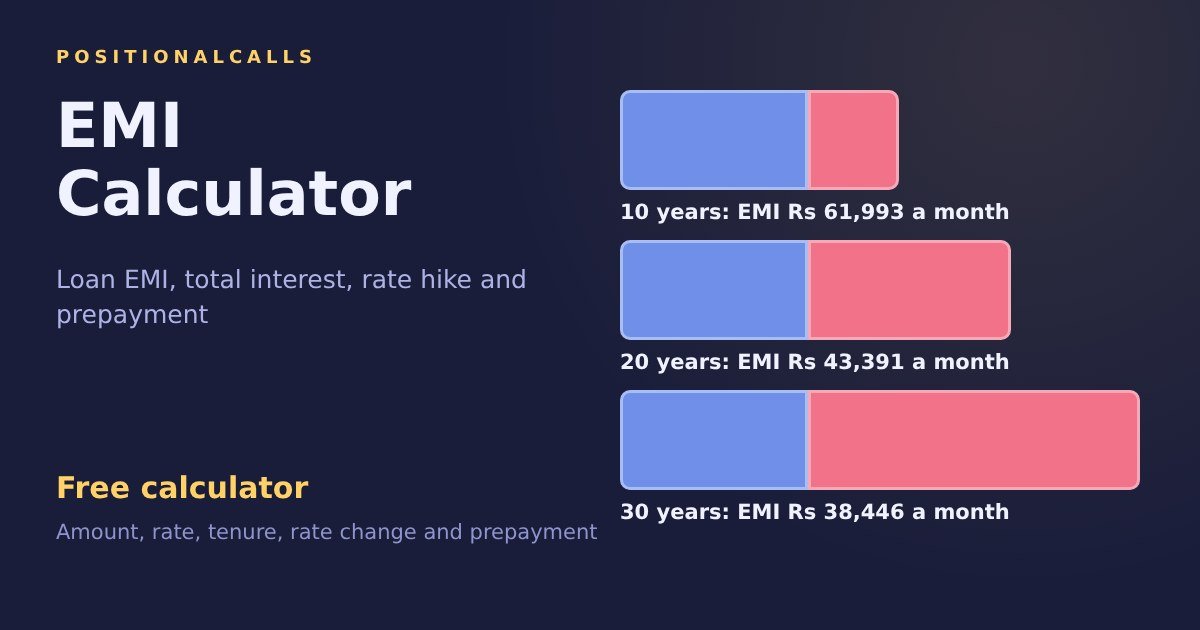
Learning · Loans and tool
An EMI calculator turns a loan amount, a rate and a tenure into a monthly instalment, but after the RBI raised the repo rate to 5.50% on 7 October 2026 the useful questions are what a rate reset does to that instalment and what a prepayment does to the tenure. This page gives an EMI calculator with both, worked examples for home, car and personal loans, and the points where sources disagree.
Quick answer
An EMI calculator finds the monthly instalment from the loan, the yearly rate and the tenure, using EMI = P × r × (1+r)^n ÷ ((1+r)^n − 1). Rs 50 lakh at 8.5% for 20 years gives an EMI of Rs 43,391 and total interest of Rs 54,13,879. A 0.25 point rate rise adds about Rs 794 a month.
EMI calculator: key takeaways
- Formula: EMI = P × r × (1+r)^n ÷ ((1+r)^n − 1), with r as the yearly rate ÷ 12 ÷ 100 and n in months.
- Example: Rs 50 lakh at 8.5% for 20 years is Rs 43,391 a month and Rs 54,13,879 of interest.
- Rate hike: 8.50% to 8.75% adds about Rs 794 a month on that loan, and 82% of the first EMI is interest.
- Choices: after a reset you can take a higher EMI, a longer tenure or a mix.
- Prepayment: keeping the EMI and cutting the tenure saves the most interest.
In plain words: an EMI is one fixed amount you pay every month, and each payment is part interest and part repayment of the loan. Early on most of it is interest, and the balance falls slowly. An EMI calculator repeats that monthly split for every month of the tenure, so you can see the cost of a higher rate, a longer tenure or a prepayment before you decide.
Data note: as of Wednesday, 18 November 2026, 10:50 PM IST. Rate-hike figures come from Paisabazaar, Kotak Neo, OneIndia, Business Today and Free Press Journal. Formula and example figures come from Shriram Finance, Finnovate, Fermor and the calculators named in the text. Tax statements come from TaxGuru and ClearTax. Figures marked my calculation use the standard reducing-balance formula. RBI circulars and bank rate sheets were not opened.
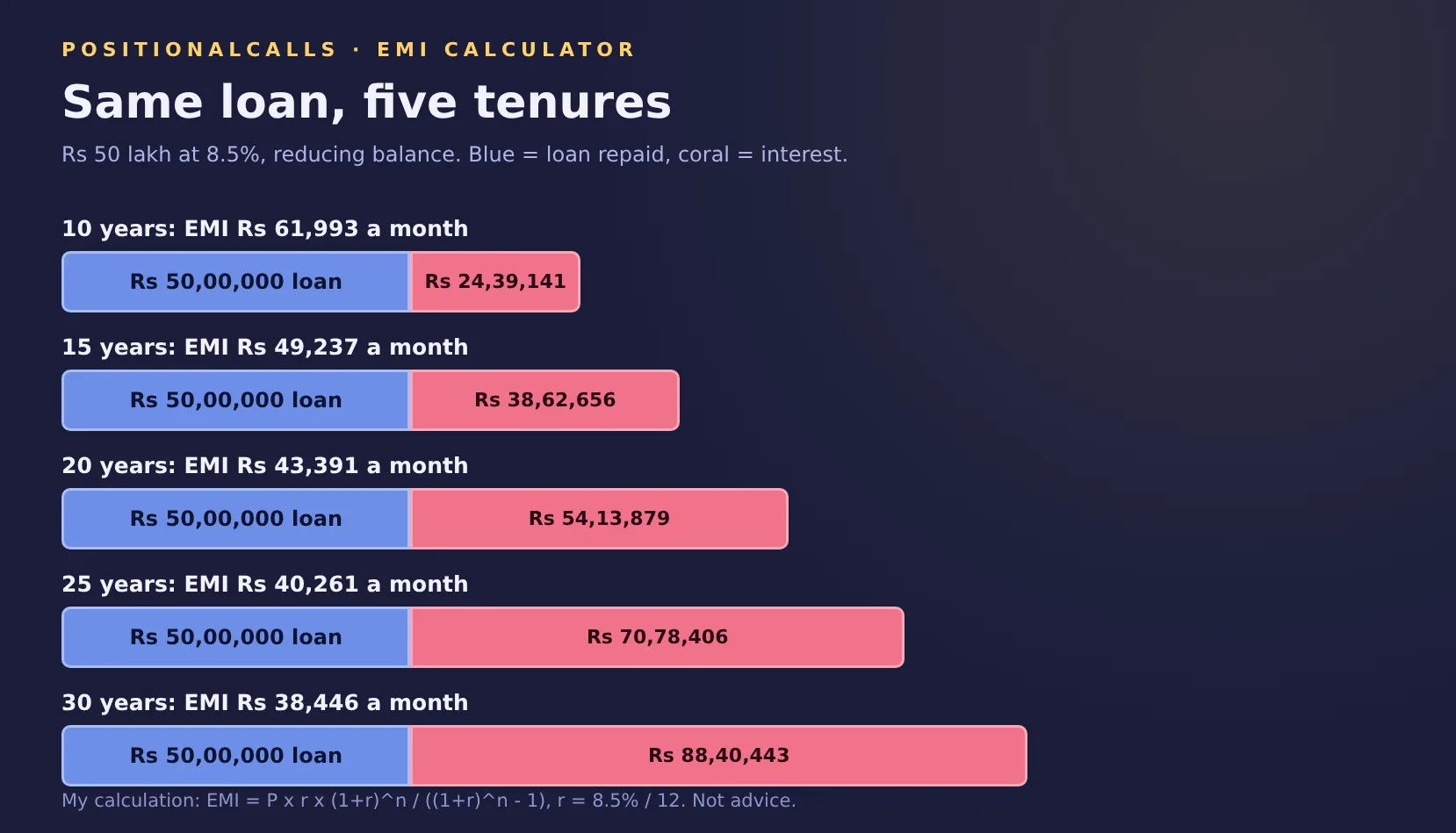 Same loan, five tenures. Source: PositionalCalls calculation at 8.5%, reducing balance.
Use this EMI calculator to find your EMI, a rate change and a prepayment
Enter the loan, the rate and the tenure, and the EMI calculator shows the monthly EMI, the total interest and the first-month split; add the months paid, a rate change and a prepayment to see what happens to an existing loan. The defaults are Rs 50,00,000 at 8.5% for 20 years, with 36 EMIs paid and a 0.25 point rise.
Leave at 0 for a new loan. For an existing loan, enter the months paid so far.
For example 0.25 for a quarter-point rise, or -0.25 for a cut. Use 0 for no change.
Paid after the EMIs above. The calculator assumes the prepayment goes to principal.
How does this EMI calculator work?
It uses the reducing-balance method, which Shriram Finance says most Indian lenders use for home loans, with the yearly rate divided by 12. For an existing loan, the EMI calculator finds the balance after the months you have paid, then applies the prepayment and the new rate to it.
How do I use this EMI calculator in four steps?
Enter the amount, the sanction-letter rate and the tenure, then the months paid and the rate change in percentage points, such as 0.25 after the October hike, and any prepayment. Option A keeps the end date, and option B keeps the EMI.
What does this EMI calculator not include?
Rupeeful states that its EMI output excludes processing fees, GST and insurance, and the same applies here. This EMI calculator also ignores moratoriums, pre-EMI interest, your lender's reset date and its rounding, so use your loan statement for final figures.
What is the EMI calculator formula and a worked example?
An EMI calculator uses EMI = P × r × (1+r)^n ÷ ((1+r)^n − 1), so Rs 50 lakh at 8.5% for 20 years gives Rs 43,391 a month. Shriram Finance, Finnovate, Fermor and Bajaj Finserv print the same formula, with P as the loan, r as the yearly rate divided by 12 and 100, and n as the months.
| Loan | Rate | Tenure | EMI | Total interest |
|---|---|---|---|---|
| Rs 50,00,000 | 8.5% | 20 years | Rs 43,391 | Rs 54,13,879 |
| Rs 50,00,000 | 8.75% | 20 years | Rs 44,186 | Rs 56,04,529 |
| Rs 30,00,000 | 9% | 20 years | Rs 26,992 | Rs 34,78,027 |
| Rs 25,00,000 | 8.5% | 20 years | Rs 21,696 | Rs 27,06,939 |
| Rs 1,00,00,000 | 8.5% | 20 years | Rs 86,782 | Rs 1,08,27,758 |
| Rs 5,00,000 | 12% | 3 years | Rs 16,607 | Rs 97,858 |
| Rs 5,00,000 | 15% | 5 years | Rs 11,895 | Rs 2,13,698 |
Cite this table: PositionalCalls, “EMI calculator”; my calculation from the formula above; the EMI figures match Richify, EMI Mitra, FinanceTools, Fermor, PaisaCalc and Tickertape, with small rounding differences noted on this page.
The total interest is the EMI times the number of months, minus the loan. For the Rs 50 lakh case the borrower repays Rs 1,04,13,879 in all, so the interest is slightly more than the loan itself. SMFG India Credit gives a smaller example, where Rs 1 lakh at 10% for 5 years charges Rs 9,270 of interest in the first year, which this formula also gives.
What does each part of the EMI calculator formula mean?
P is the amount you borrow. The monthly rate r is the yearly rate divided by 12, so 8.5% becomes 0.7083% a month. The number n is the tenure in months, so 20 years is 240. The term (1+r)^n is how much one rupee would grow at the monthly rate over the whole tenure, and the formula spreads the loan evenly against that growth. Finnovate adds that if r is zero the EMI is simply P divided by n.
Because the rate is applied monthly, an EMI calculator is not the same as a simple yearly calculation. EMI Mitra's interest figure for the 8.75% case differs from mine by Rs 125, and I could not confirm why. A lender's own rounding can also make its statement differ from any EMI calculator by a small amount.
How do tenure, rate and loan amount change the result of an EMI calculator?
A longer tenure lowers the EMI but raises the total interest sharply, a higher rate raises both, and the EMI rises in direct proportion to the loan amount. The three tables use Rs 50 lakh at 8.5% for 20 years as the base case.
| Tenure | EMI | Total interest | Interest as a share of the loan |
|---|---|---|---|
| 10 years | Rs 61,993 | Rs 24,39,141 | 49% |
| 15 years | Rs 49,237 | Rs 38,62,656 | 77% |
| 20 years | Rs 43,391 | Rs 54,13,879 | 108% |
| 25 years | Rs 40,261 | Rs 70,78,406 | 142% |
| 30 years | Rs 38,446 | Rs 88,40,443 | 177% |
Cite this table: PositionalCalls, “EMI calculator”; my calculation at 8.5% on Rs 50 lakh, reducing balance.
Moving from 20 to 30 years cuts the EMI by about Rs 4,945, from Rs 43,391 to Rs 38,446, but adds about Rs 34,26,564 of interest. An EMI calculator makes this trade visible before you accept a longer tenure to fit a monthly budget.
What does the rate do to an EMI calculator result?
| Rate | EMI, 20 years | Total interest | Change in EMI from the row above |
|---|---|---|---|
| 7.5% | Rs 40,280 | Rs 46,67,118 | — |
| 8.0% | Rs 41,822 | Rs 50,37,281 | +Rs 1,542 |
| 8.5% | Rs 43,391 | Rs 54,13,879 | +Rs 1,569 |
| 9.0% | Rs 44,986 | Rs 57,96,711 | +Rs 1,595 |
| 9.5% | Rs 46,607 | Rs 61,85,574 | +Rs 1,620 |
| 10.0% | Rs 48,251 | Rs 65,80,260 | +Rs 1,645 |
Cite this table: PositionalCalls, “EMI calculator”; my calculation on Rs 50 lakh for 20 years, reducing balance.
Each half-point step adds roughly Rs 1,540 to Rs 1,650 a month on this loan, and the step grows slightly as the rate rises. Between 7.5% and 10% the EMI climbs from Rs 40,280 to Rs 48,251. The 0.25 point repo move is therefore worth about half of one of these steps, or the Rs 794 shown above.
The EMI scales in a straight line with the loan: Rs 50 lakh at 8.5% for 20 years is Rs 868 per lakh, so Rs 1 crore is Rs 86,782, which matches Fermor.
How much of each EMI is interest and how much is principal?
On the Rs 50 lakh loan, the first EMI of Rs 43,391 is Rs 35,417 of interest and Rs 7,974 of principal, so about 82% of the first payment is interest. The share of principal grows every month as the balance falls.
| Year | Interest paid in the year | Principal repaid in the year | Balance at the end of the year |
|---|---|---|---|
| 1 | Rs 4,21,182 | Rs 99,511 | Rs 49,00,489 |
| 5 | Rs 3,81,053 | Rs 1,39,641 | Rs 44,06,359 |
| 10 | Rs 3,07,420 | Rs 2,13,274 | Rs 34,99,691 |
| 15 | Rs 1,94,961 | Rs 3,25,733 | Rs 21,14,937 |
| 20 | Rs 23,202 | Rs 4,97,492 | Rs 0 |
Cite this table: PositionalCalls, “EMI calculator”; my calculation at 8.5% on Rs 50 lakh for 20 years; year 20 ends with a zero balance.
Upgrowth says 70% to 80% of an EMI goes to interest in the early years of a long loan. On this loan the figure is 81.6% for the first payment, which is just above that range, because the share depends on the rate and the tenure. It falls below half only from the 143rd month, in year 12.
Why does an EMI calculator schedule matter for prepayments?
Because interest is charged on the balance, a rupee repaid early removes interest on every later month, while a rupee repaid late removes little. That is why Finnovate says prepaying in the first few years reduces the interest you would otherwise pay for the rest of the tenure. The prepayment section below puts numbers on this.
How does the 7 October repo rate hike change an EMI?
The RBI raised the repo rate by 25 basis points from 5.25% to 5.50% on 7 October 2026, and on a repo-linked loan a 0.25 point rise adds about Rs 758 to Rs 794 a month per Rs 50 lakh over 20 years. Ambak calls it the first hike since February 2023, and Paisabazaar says the stance moved from neutral to calibrated tightening.
| Source | Loan | Rate move | Reported EMI | My check |
|---|---|---|---|---|
| Paisabazaar | Rs 50 lakh, 20 years | 7.15% to 7.40% | Rs 39,216 to Rs 39,974 (+Rs 758) | Rs 39,216 to Rs 39,974 (+Rs 758) |
| Kotak Neo | Rs 50 lakh, 20 years | 8.50% to 8.75% | About Rs 794 more a month | Rs 794.37 more a month |
| OneIndia | Rs 50 lakh, 30 years | 7.25% to 7.50% | Rs 34,109 before the hike | Rs 34,109 before and Rs 34,961 after (+Rs 852) |
| OneIndia | Rs 50 lakh, 30 years | 7.75% to 8.00% | Rs 35,821 before the hike | Rs 35,821 before and Rs 36,688 after (+Rs 868) |
Cite this table: PositionalCalls, “EMI calculator”; reported figures from Paisabazaar, Kotak Neo and OneIndia as named; my check uses the standard formula.
All four reported figures agree with the formula. The Rs 758 and Rs 794 gaps differ only because the loans start at different rates, and a higher starting rate makes the same 0.25 point step cost slightly more. The larger the loan and the longer the tenure, the bigger the monthly change.
When does the new rate reach my EMI calculator result?
That depends on how the loan is priced. A repo-linked loan is the repo rate plus a fixed spread, and CalcGuru says the RBI requires it to reset at least once a quarter, so a hike usually shows up within about three months. Kotak Neo says the change depends on the benchmark and the reset date, so the EMI may not move immediately after the decision.
A loan linked to the lender's own MCLR moves when the lender revises that rate. Free Press Journal reports that HDFC Bank raised its MCLR by 5 to 15 basis points from 7 November, so the range moved from 7.75% to 8.55% up to 7.85% to 8.70%. Outlook Money says a fixed-rate loan usually does not change when the repo rate moves, unless the contract has a reset clause.
How do I use the EMI calculator for an existing loan after a hike?
Enter your original amount, rate and tenure, the months you have paid and the rate change. For the default case, 36 EMIs have been paid and the balance is Rs 46,74,300. A 0.25 point rise at that point takes the EMI from Rs 43,391 to Rs 44,102 if the end date is kept, which is Rs 710 more, because 17 of the 20 years remain.
Should a rate hike raise the EMI or lengthen the tenure?
After a reset a borrower can keep the end date and pay a higher EMI, keep the EMI and extend the tenure, or combine the two, and the EMI calculator shows the cost of each. Business Today lists these three choices, and Outlook Money says RBI guidelines require lenders to offer such options.
PositionalCalls WhatsApp channel
Get loan and rate explainers on WhatsApp
- Repo rate and EMI changes, dated
- Calculators explained without tips
- Links to updated guides
| Choice | EMI | Remaining tenure | Interest from here |
|---|---|---|---|
| No rate change (reference) | Rs 43,391 | 17 years (204 months) | Rs 41,77,497 |
| Option A: higher EMI, same end date | Rs 44,102 | 17 years (204 months) | Rs 43,22,409 |
| Option B: same EMI, longer tenure | Rs 43,391 | about 212 months (17 years 8 months) | Rs 45,19,769 |
Cite this table: PositionalCalls, “EMI calculator”; my calculation for a Rs 50 lakh, 8.5% loan after 36 EMIs, with a 0.25 point rise to 8.75%; option B interest is approximate.
Option A costs about Rs 710 more each month and about Rs 1,45,000 more in interest than the no-change case. Option B keeps the EMI at Rs 43,391 but runs about 8 months longer and costs about Rs 3,42,000 more in interest than the no-change case. Option A is cheaper in total than option B by about Rs 1,97,000 on these inputs, since it repays principal sooner.
Paisabazaar adds two other routes: move the loan to a lender with a lower rate, or make a part-prepayment and compare the interest saved with what the money could earn if invested. Each can be tested in the EMI calculator, and none is a recommendation.
How does a part-prepayment change the EMI calculator result?
If you keep the EMI and prepay principal, the tenure shortens: on the example loan a Rs 5 lakh prepayment after 36 EMIs removes about 42 months and about Rs 13,19,648 of interest. The earlier the prepayment, the more months of interest it removes.
| Prepayment after 36 EMIs | Balance after | Remaining tenure | Interest from here | Interest saved |
|---|---|---|---|---|
| None (reference) | Rs 46,74,300 | 17 years 0 months | Rs 41,77,497 | — |
| Rs 2,00,000 | Rs 44,74,300 | 15 years 6 months | Rs 35,83,945 | Rs 5,93,551 |
| Rs 5,00,000 | Rs 41,74,300 | 13 years 6 months | Rs 28,57,849 | Rs 13,19,648 |
| Rs 10,00,000 | Rs 36,74,300 | 10 years 10 months | Rs 19,55,604 | Rs 22,21,892 |
| Rs 20,00,000 | Rs 26,74,300 | 6 years 9 months | Rs 8,52,504 | Rs 33,24,992 |
Cite this table: PositionalCalls, “EMI calculator”; my calculation for Rs 50 lakh at 8.5% over 20 years with the EMI kept at Rs 43,391; interest from here is approximate for the final partial month.
Finnovate says most lenders offer two options after a prepayment: cut the remaining tenure and keep the EMI, or cut the EMI and keep the tenure. It adds that many lenders do not recalculate the EMI on their own, so the default often shortens the tenure. A fincalculator.in answer advises stating in writing that the payment is towards principal and that you want the tenure reduced.
Are there charges when I prepay with an EMI calculator plan?
For floating-rate loans to individuals for non-business purposes, the RBI bars prepayment charges, per Angel One and Tribune, and Tribune adds that there is no minimum lock-in. A dual-rate loan qualifies if it is floating at the time of prepayment. The Pre-payment Charges on Loans Directions, 2025 apply to loans sanctioned or renewed from 1 January 2026, per Probe42 and Business Standard.
Fixed-rate loans are not covered, per fincalculator.in, and EMI Mitra says fixed-rate and some personal loans may charge 2% to 5%, so check your agreement. LoansJagat dates the ban to 1 January 2026, but Business Standard says individuals were already protected and the new directions add business loans.
Is prepaying the same as investing the money elsewhere?
No, and this page does not rank the two. A prepayment saves interest at your loan rate on the amount prepaid, which is the figure to compare with any alternative. Paisabazaar says to compare the interest saved with what the money could earn if invested. The FD calculator and the SIP calculator show the arithmetic for a deposit and for a market-linked plan, and neither says which suits you.
How do flat and reducing rates change an EMI calculator result?
A flat rate charges interest on the full original loan for the whole tenure, so it costs far more than the same number as a reducing rate; a 10% flat rate on a 5-year loan is about 17.3% reducing on my calculation. Tata Capital puts 10% flat at roughly 17% to 19% reducing, depending on the tenure.
| Flat rate quoted | Effective reducing rate, 3 years | Effective reducing rate, 5 years |
|---|---|---|
| 7% | 12.8% | 12.5% |
| 10% | 17.9% | 17.3% |
| 15% | 26.0% | 24.7% |
Cite this table: PositionalCalls, “EMI calculator”; my calculation using a bisection on the monthly rate; the 10% row is consistent with Tata Capital and the 7% row with Sum Money, which says about 12% to 14%.
For Rs 5 lakh over 5 years at 10% flat, the flat EMI is (Rs 5,00,000 plus 10% a year for 5 years) divided by 60 months, which is Rs 12,500, using the flat formula printed by PolicyBazaar. At 10% reducing the EMI is Rs 10,624. The difference is Rs 1,876 a month, and the flat loan repays Rs 7,50,000 in all against Rs 6,37,411.
Which loans quote a flat rate, and how do I use an EMI calculator for them?
Tata Capital says most personal loans use the reducing-balance method, although some lenders may still quote flat rates. Sum Money says the RBI Fair Practices Code requires lenders to state the effective rate on a reducing basis. Ask for that rate, then enter it in the EMI calculator.
How much EMI is safe, and what loan does an EMI calculator figure support?
Banks test affordability with the fixed obligation to income ratio, which is all fixed monthly obligations divided by monthly income, and most lenders look for about 40% to 50%. Godrej Capital, SMFG India Credit and IDFC FIRST Bank give that range, and Moneyview and Freo give 40% to 55%.
Money9 shows a Rs 20,000 salary with an Rs 8,000 EMI as 40%. The ratio counts every EMI you already pay, so the room for a new loan is what is left after those. Ambak and Brigade say 35% to 40% of take-home pay is a healthier limit than the maximum a bank may approve.
| Monthly income | EMI at 35% | EMI at 40% | EMI at 50% | Loan supported by a 40% EMI |
|---|---|---|---|---|
| Rs 50,000 | Rs 17,500 | Rs 20,000 | Rs 25,000 | Rs 23,04,617 |
| Rs 1,00,000 | Rs 35,000 | Rs 40,000 | Rs 50,000 | Rs 46,09,234 |
| Rs 2,00,000 | Rs 70,000 | Rs 80,000 | Rs 1,00,000 | Rs 92,18,467 |
| Rs 3,00,000 | Rs 1,05,000 | Rs 1,20,000 | Rs 1,50,000 | Rs 1,38,27,701 |
Cite this table: PositionalCalls, “EMI calculator”; my arithmetic with no existing EMIs; the loan column assumes 8.5% for 20 years, where the EMI is Rs 868 per lakh; this is not a lender eligibility result.
A real lender also looks at credit score, age, the property and the loan-to-value ratio, so the sanctioned loan can differ. Use the table to relate income to an EMI calculator result, not to predict an approval.
How do I use the EMI calculator to test a tenure against my income?
Run the loan at two or three tenures and compare each EMI with the income table above. A 25-year tenure on the Rs 50 lakh loan gives Rs 40,261, against Rs 43,391 for 20 years, and the longer tenure lowers the monthly outgo by Rs 3,130 but adds Rs 16,64,527 of interest. Choose by comparing the EMI with your own income and other commitments, which this page cannot see.
Is a home loan EMI tax deductible, and under which sections?
Only the interest and principal parts of the EMI can be claimed, and only in the old regime for a self-occupied home: up to Rs 2 lakh of interest under Section 24(b) and up to Rs 1.5 lakh of principal under Section 80C. ClearTax says that adds up to Rs 3.5 lakh a year.
| Item | Section, 1961 Act and 2025 Act | Limit | Regime |
|---|---|---|---|
| Interest, self-occupied home | 24(b); 22(1)(b) and (c) | Rs 2,00,000 a year | Old regime only |
| Interest, let-out home | 24(b); 21 | Actual interest per TaxGuru | Old and new regime |
| Principal repayment | 80C; 123 | Rs 1,50,000, within the overall limit | Old regime only |
| Stamp duty and registration | 80C | Within the Rs 1.5 lakh limit, per Bajaj Finserv | Old regime only |
| Additional interest | 80EEA | Rs 1,50,000, for loans sanctioned before 31 March 2022, per TaxGuru | Old regime only |
Cite this table: PositionalCalls, “EMI calculator”; TaxGuru article of 29 May 2026 for the section numbers and limits; Bajaj Finserv for stamp duty; I did not open the Income-tax Act 2025.
TaxGuru says a joint claim is typically in proportion to ownership, while ClearTax says each loan holder can claim the limits separately. Grihashakti and Homefirst say the new regime allows no deduction on self-occupied home loan interest, and LoansJagat says Budget 2026 did not raise the Section 24(b) limit.
Why do some pages say Rs 5 lakh and others Rs 3.5 lakh?
TaxGuru and Bajaj Finserv say up to Rs 5 lakh, and ClearTax says Rs 3.5 lakh. The Rs 5 lakh total appears to include the extra Rs 1.5 lakh under Section 80EEA, which TaxGuru limits to loans sanctioned before 31 March 2022, but I could not confirm how those pages reach it. The EMI calculator on this page shows the interest and principal split for a year, which is the input to any of these claims, and it does not compute your tax.
Where do EMI calculator sources disagree?
Sources disagree on small arithmetic, on flat-rate conversions, on the history of the prepayment rule and on tax totals, and this page states which figure it uses. The rows below are the disagreements I found while checking each EMI calculator and article.
| Point | One reading | Another reading | Used here |
|---|---|---|---|
| Interest on Rs 5 lakh, 12%, 3 years | PaisaCalc: Rs 98,652 | Formula: Rs 97,858 (EMI Rs 16,607 × 36 less Rs 5,00,000) | Formula |
| Interest on Rs 50 lakh, 8.75%, 20 years | EMI Mitra: Rs 56,04,654 | My calculation: Rs 56,04,529 | Mine |
| EMI on Rs 25 lakh, 8.5%, 20 years | PromptSpace: Rs 21,698 | Formula: Rs 21,696 | Formula |
| 15% flat as a reducing rate | Finluk: 28% to 30% | My calculation: 24.7% to 26.0% | Mine |
| Start of the prepayment-charge ban | LoansJagat: 1 January 2026 | Business Standard: already barred for individuals; 2026 adds business loans | Business Standard |
| Let-out property interest | TaxGuru: actual interest, no cap | ClearTax: up to rental income | Both shown |
| Total home loan deduction | ClearTax: Rs 3.5 lakh | TaxGuru, Bajaj Finserv: Rs 5 lakh | Both shown |
| Floating loan reset | CalcGuru: at least quarterly | RealtyHunting snippet: draft rule for 1 April 2027, unopened | Quarterly |
Cite this table: PositionalCalls, “EMI calculator”; each reading from the page named; calculations are mine.
Pages also quote different starting home loan rates, from 7.1% at Paisabazaar to 7.25% at Ambak for September 2026 and 8.25% for SBI at Fermor for June 2026, on different dates and borrower profiles. For that reason this page gives no bank rate table. Use the rate in your own sanction letter in the EMI calculator, because it overrides any average.
What mistakes do people make with an EMI calculator?
The common errors are using an advertised starting rate, comparing EMIs without total interest, mixing flat and reducing rates, counting only the new EMI against income, and assuming a hike or a prepayment works instantly or automatically. Each follows from the rules above.
- Starting rate: pages quote starting rates between 7.1% and 8.25%, and your sanction letter decides yours.
- EMI only: a 30-year tenure lowers the EMI by Rs 4,945 and adds Rs 34,26,564 of interest on the example loan.
- Flat as reducing: 10% flat is about 17.3% reducing on a 5-year loan.
- Income test: the ratio counts every fixed EMI, not just the new one.
- Reset timing: a repo-linked loan changes at its next reset, which is at least quarterly.
- Prepayment default: many lenders shorten the tenure unless you ask them to recalculate the EMI.
What is a quick checklist before you use an EMI calculator?
First, take the rate, amount and tenure from the sanction letter. Second, check whether the loan is repo-linked, MCLR-linked or fixed. Third, enter the months paid and any rate change. Fourth, compare options A and B for total interest, not just the EMI. Fifth, check the prepayment terms in the agreement. None of this says whether a loan or a prepayment suits you, and this page gives no such view. The page will be updated after the RBI decision of 2 to 4 December 2026 and when I open the RBI directions; the RBI repo rate page tracks the policy rate.
PositionalCalls WhatsApp channel
Loan and rate updates in one channel
- RBI notices and EMI impact, dated
- Plain-English explainers
- Links to new guides
EMI calculator: frequently asked questions
What does an EMI calculator do?
An EMI calculator works out the fixed monthly instalment on a loan from the amount, the yearly interest rate and the tenure. For Rs 50 lakh at 8.5% over 20 years it gives Rs 43,391, per the standard reducing-balance formula. This EMI calculator also shows total interest, the effect of a rate change and the effect of a part-prepayment.
What is the EMI calculator formula?
The formula is EMI = P × r × (1+r)^n ÷ ((1+r)^n − 1), where P is the loan, r the yearly rate divided by 12 and 100, and n the number of months, per Shriram Finance, Finnovate and Fermor. If the rate is zero, the EMI is simply P divided by n. An EMI calculator applies this each time you press the button.
How much is the EMI on a Rs 50 lakh home loan?
At 8.5% for 20 years the EMI is Rs 43,391 and the total interest is Rs 54,13,879, on my calculation, which matches Richify and Sharpely. At 8.75% the EMI is Rs 44,186, per EMI Mitra. Enter your own sanctioned rate in the EMI calculator.
How does the repo rate hike change my EMI?
The RBI raised the repo rate by 0.25 percentage point to 5.50% on 7 October 2026, per Ambak and Paisabazaar. On a Rs 50 lakh, 20-year loan, a rise from 8.50% to 8.75% adds about Rs 794 a month, per Kotak Neo and my check. It reaches a repo-linked loan at its next reset, which is at least quarterly.
Should I take a higher EMI or a longer tenure after a rate hike?
Business Today says borrowers can accept a higher EMI, keep the EMI and extend the tenure, or combine both. A higher EMI costs less interest overall, while a longer tenure keeps the monthly outgo steady and raises total interest. The EMI calculator on this page shows both outcomes.
Does a part-prepayment reduce the EMI or the tenure?
Either, depending on what you ask the lender for. Finnovate says many lenders do not recalculate the EMI automatically, and the default often shortens the tenure. This EMI calculator assumes the EMI stays the same and shows the months saved and the interest saved.
What is the difference between a flat rate and a reducing rate?
A flat rate charges interest on the full original loan for the whole tenure, while a reducing rate charges it only on the balance still owed. Tata Capital says a 10% flat rate equals roughly 17% to 19% reducing, and my calculation gives 17.3% for 5 years. Ask for the reducing-balance rate before you use any EMI calculator.
How much EMI is safe for my income?
Banks look at the fixed obligation to income ratio, which Godrej Capital, SMFG India Credit and IDFC FIRST Bank put at about 40% to 50% for most lenders. Ambak and Brigade say 35% to 40% of take-home pay is a healthier limit. Compare the EMI calculator result with your income, including existing EMIs.
Is the EMI on a home loan tax deductible?
Not as a whole. Interest on a self-occupied home is deductible up to Rs 2 lakh under Section 24(b) and principal up to Rs 1.5 lakh under Section 80C, both in the old regime only, per TaxGuru and ClearTax. The new regime does not allow the self-occupied interest deduction. An EMI calculator shows the split, but it does not compute your tax.
Is this EMI calculator page investment or loan advice?
No. PositionalCalls is not a SEBI-registered research analyst or investment adviser and does not arrange loans. This EMI calculator shows arithmetic from the inputs you enter and the rules as the sources describe them. It does not say which lender, rate, tenure or prepayment suits you. I did not open RBI circulars or any bank's rate sheet.
Sources for the EMI calculator page
- Shriram Finance: home loan.
- Finnovate: EMI calculator.
- Finnovate: loan prepayment.
- Fermor: home loan.
- Bajaj Finserv: EMI in.
- Sharpely: EMI calculator.
- Richify: home loan.
- EMI Mitra: home loan.
- FinanceTools: how EMI.
- PaisaCalc: how to.
- PromptSpace: EMI calculator.
- Tickertape: flat and.
- Rupeeful: EMI calculator.
- SMFG India Credit: reducing balance.
- Tata Capital: flat vs.
- PolicyBazaar: flat vs.
- Sum Money: flat vs.
- Finluk: flat vs.
- Business Standard: two rates.
- Paisabazaar: repo rate.
- Kotak Neo: repo hike.
- OneIndia: repo rate.
- Business Today: higher EMI.
- Free Press Journal: HDFC Bank.
- CalcGuru: a 25.
- Ambak: repo rate.
- Outlook Money: why home.
- Outlook Money: repo rate.
- RealtyHunting: repo rate.
- Angel One: no prepayment.
- Tribune: RBI bars.
- Business Standard: RBI bars.
- Fox Mandal: RBI prohibits.
- Probe42: pre-payment charges.
- fincalculator.in: loan prepayment.
- LoansJagat: home loan.
- Godrej Capital: what is.
- SMFG India Credit: what is.
- IDFC FIRST Bank: what is.
- Aditya Birla Capital: FOIR calculation.
- Moneyview: FOIR full.
- Freo: what is.
- Money9: FOIR and.
- Ambak: safe EMI.
- Brigade Group: home loan.
- Upgrowth: loan amortization.
- TaxGuru: home loan.
- ClearTax: home loan.
- Bajaj Finserv: home loan.
- Piramal Realty: home loan.
- Grihashakti: home loan.
- Homefirst: old vs.
- LoansJagat: home loan.
- Not opened: RBI circulars and directions, bank rate sheets, the Income-tax Act 2025 and the Budget 2026 text; Kotak Neo and RealtyHunting could not be opened, so their points rest on search snippets; statements are from the sources above, and calculations are mine.
PositionalCalls.com is an independent research site founded by Shubham Chaudhary. PositionalCalls.com is not a SEBI-registered research analyst or investment adviser. Investments in securities markets are subject to market risks. Read all related documents carefully before investing. Returns are never guaranteed. This page is educational, does not arrange loans and publishes no subscribe, avoid, buy, sell, rating or target calls. Sources: lender, broker, tax and news pages as named; no RBI circular, Act or bank rate sheet opened; no view on whether any loan, rate or prepayment suits any person.

Shubham Chaudhary is the founder of PositionalCalls, an independent Indian stock market research website. He writes company fundamentals, quarterly results analysis, IPO analysis and sector research for NSE and BSE listed companies, with a focus on banking stocks, insurance and long-term value investing. Every article is built from primary sources such as RBI, SEBI, NSE and BSE filings and company annual reports, and states its risks plainly in simple language for retail investors.
Coverage areas Our research standards- Numbers checked against NSE, BSE and SEBI filings
- Risks and limits stated in every article
- No paid promotions or broker tie-ups
- Articles updated when new filings arrive