
Learning · Deposits and tool
An FD calculator turns an amount, a rate and a tenure into a maturity value, but the number that matters after the bank deducts tax is lower. This page gives an FD calculator with a post-tax yield, the November 2026 bank rates after the 5.50% repo rate, the TDS limits and the points where sources disagree.
Quick answer
An FD calculator estimates fixed deposit maturity from the amount, the rate, the tenure and the compounding. Rs 1,00,000 at 7% for 5 years with quarterly compounding grows to Rs 1,41,478. Taxed at the 30% slab with 4% cess, the yield falls from 7.19% to about 5.15% a year.
FD calculator: key takeaways
- Maturity: A = P × (1 + r/n)^(n×t); Rs 1 lakh at 7% for 5 years is Rs 1,41,478 quarterly and Rs 1,40,255 yearly.
- Tax: interest is taxed at your slab rate, so the 30% slab turns 7.19% into about 5.15%.
- TDS: 10% above Rs 50,000 of interest a year, Rs 1,00,000 for seniors, and 20% without PAN, per AU Small Finance Bank.
- Rates: HDFC Bank and ICICI Bank list 6.60% for 3 to 5 years from November 2026, with 7.20% for seniors.
- Repo: the RBI raised the repo rate to 5.50% on 7 October 2026.
In plain words: a fixed deposit pays interest on interest, usually every quarter, and the bank hands you one figure at the end. The tax office treats that interest as ordinary income, so what you keep depends on your slab. An FD calculator repeats the quarterly step for every quarter of the tenure and then takes away your tax, so you can compare the bank rate with what reaches your account.
Data note: as of Wednesday, 18 November 2026, 11:30 PM IST. Bank rates come from Upstox, citing the HDFC Bank, ICICI Bank and PNB sites, with the highest advertised rate from Business Today. Tax and TDS statements come from AU Small Finance Bank, Outlook Money, TaxGuru, Business Today and IndusInd Bank. The repo rate comes from the 7 October 2026 policy reports. Figures marked my calculation use the standard compound formula. Section 393 and bank rate sheets were not opened.
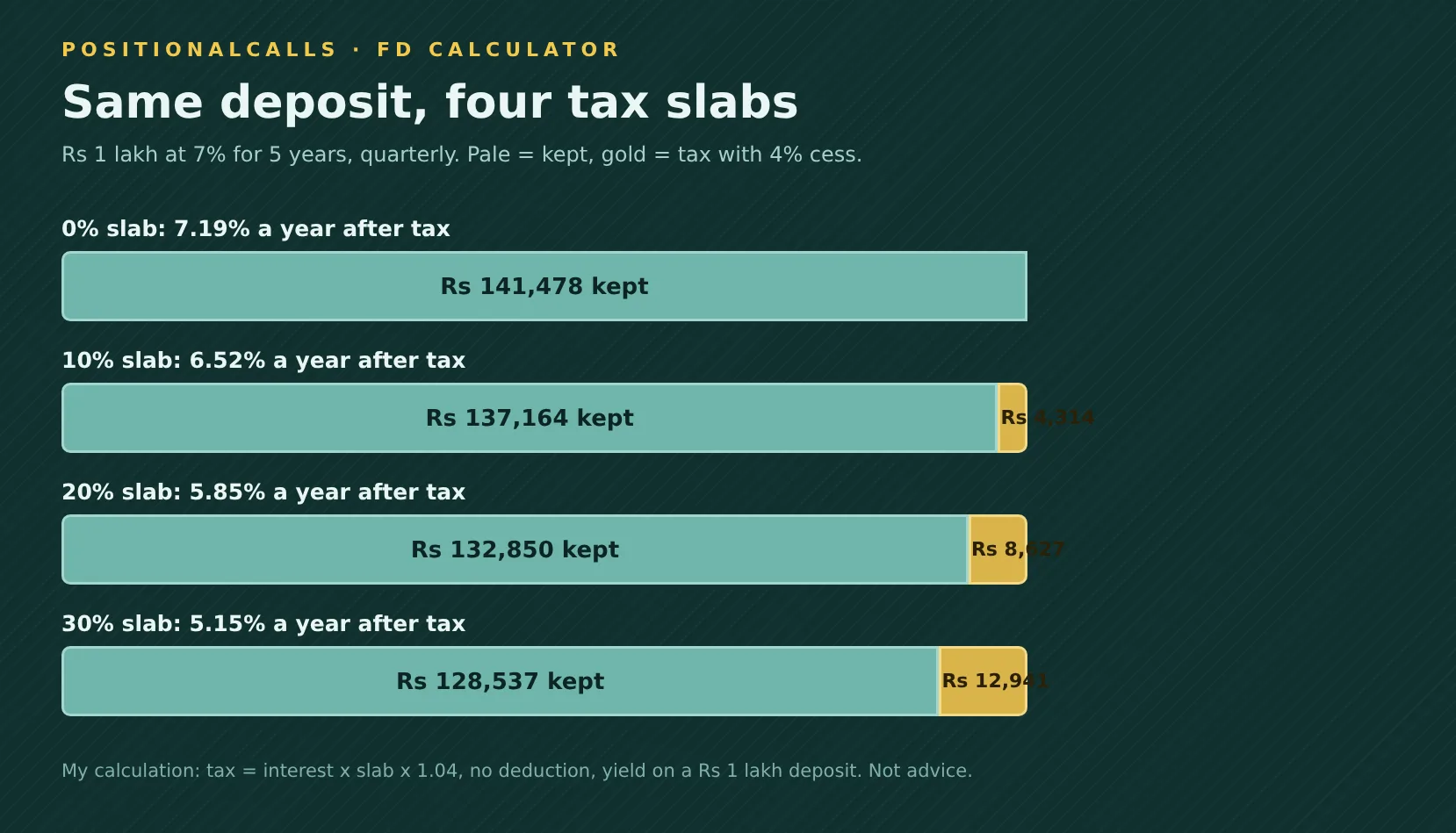 Same deposit, four tax slabs. Source: PositionalCalls calculation at 7%, quarterly compounding.
Use this FD calculator to estimate maturity and the yield after tax
Enter the deposit, the rate, the tenure, the compounding, your depositor type and your slab, and the FD calculator shows the maturity, the interest, the first-year interest against the TDS limit and the maturity after tax. The defaults are Rs 1,00,000 at 7% for 5 years, compounded quarterly, at the 30% slab.
FD interest is added to your income and taxed at your slab rate. The calculator adds 4% cess.
For example the old regime senior citizen deduction on deposit interest. Leave at 0 if unsure.
How does this FD calculator work out the tax?
It takes the total interest, subtracts any deduction you enter, and multiplies by your slab rate plus 4% cess. Richify describes the same method: the slab rate plus 4% cess on the interest, less the senior citizen deduction under the old regime. This FD calculator does not change the compounding for tax, which is a simplification, since tax is paid out of your other money each year.
How do I use this FD calculator in four steps?
First, enter the amount and the rate printed on your deposit receipt or the bank’s rate sheet. Second, enter the tenure in years, using a quarter-year step for odd terms. Third, choose quarterly compounding unless your bank says otherwise. Fourth, pick your depositor type and slab and press the button. The last two rows show the maturity after tax and the yearly yield after tax.
What does this FD calculator not include?
It does not model premature withdrawal penalties, monthly or quarterly payout plans, loans against the deposit, rate changes during the tenure, or the tax effect of interest accruing in different years. It also does not combine your deposits at one bank. A real bank applies the TDS threshold across all of your deposits there, which a single-deposit FD calculator cannot see.
How does an FD calculator work out the maturity value?
An FD calculator uses A = P × (1 + r/n)^(n×t), so Rs 1 lakh at 7% for 5 years compounded quarterly matures at Rs 1,41,478. Chola Securities, StockCalc and IDFC FIRST Bank print that formula, and Chola’s worked example gives the same Rs 1,41,478.
| Compounding | Periods a year | Maturity, Rs 1 lakh at 7% for 5 years | Interest earned |
|---|---|---|---|
| Simple, paid at maturity | 0 | Rs 1,35,000 | Rs 35,000 |
| Yearly | 1 | Rs 1,40,255 | Rs 40,255 |
| Half-yearly | 2 | Rs 1,41,060 | Rs 41,060 |
| Quarterly | 4 | Rs 1,41,478 | Rs 41,478 |
| Monthly | 12 | Rs 1,41,763 | Rs 41,763 |
Cite this table: PositionalCalls, “FD calculator”; my calculation from the formula above; the quarterly figure matches Chola Securities and the yearly figure Rs 1,40,255 matches Astrowealth.
Monthly compounding adds about Rs 1,500 over yearly on this deposit, so the compounding choice is worth setting in an FD calculator but is not decisive. Simple interest is the odd one out: at Rs 3,500 a year on Rs 1 lakh it ends well below the compounded cases, which is why simple interest suits payout plans and not cumulative deposits.
How does the FD calculator result change with tenure?
| Tenure | Maturity at 7%, quarterly | Interest earned |
|---|---|---|
| 1 year | Rs 1,07,186 | Rs 7,186 |
| 2 years | Rs 1,14,888 | Rs 14,888 |
| 3 years | Rs 1,23,144 | Rs 23,144 |
| 5 years | Rs 1,41,478 | Rs 41,478 |
| 7 years | Rs 1,62,541 | Rs 62,541 |
| 10 years | Rs 2,00,160 | Rs 1,00,160 |
Cite this table: PositionalCalls, “FD calculator”; my calculation for Rs 1 lakh at 7% with quarterly compounding; the 1, 3 and 10 year rows match Kotak Neo, Fermor and Bharti AXA.
The 10-year figure of Rs 2,00,160 is double the deposit, which is the point at which interest equals the principal at this rate. Bharti AXA prints Rs 2,00,159.73 for the same case. The 1-year row is Rs 1,07,186 when rounded, and some pages print Rs 1,07,185 by cutting the decimals, which is only a rounding choice.
What does the rate do to an FD calculator result?
| Rate | Maturity, 5 years, quarterly | Interest earned |
|---|---|---|
| 6.0% | Rs 1,34,686 | Rs 34,686 |
| 6.5% | Rs 1,38,042 | Rs 38,042 |
| 7.0% | Rs 1,41,478 | Rs 41,478 |
| 7.5% | Rs 1,44,995 | Rs 44,995 |
| 8.0% | Rs 1,48,595 | Rs 48,595 |
Cite this table: PositionalCalls, “FD calculator”; my calculation for Rs 1 lakh over 5 years with quarterly compounding.
Half a percentage point on a 5-year deposit moves the maturity by about Rs 3,000 per lakh. That is the size of the choice between two nearby bank rates, and it is smaller than the effect of your tax slab, shown below.
What are FD rates in November 2026 for an FD calculator?
HDFC Bank and ICICI Bank list 6.60% for 3 to 5 years, and 7.20% for senior citizens, in November 2026. Upstox, citing the bank sites, gives the effective dates, and Business Today says HDFC Bank raised some rates by up to 50 basis points from 4 November.
| Bank, effective date | Tenure | General citizen | Senior citizen |
|---|---|---|---|
| HDFC Bank, 4 Nov 2026 | 1 year to under 15 months | 6.25% | 6.75% |
| HDFC Bank, 4 Nov 2026 | 3 years 1 day to under 4 years 7 months | 6.60% | 7.20% |
| HDFC Bank, 4 Nov 2026 | 5 years 1 day to 10 years | 6.60% | 7.10% |
| ICICI Bank, 11 Nov 2026 | 1 year to under 18 months | 6.25% | 6.75% |
| ICICI Bank, 11 Nov 2026 | 3 years 1 day to 5 years | 6.60% | 7.20% |
| PNB, 5 Nov 2026 | 1205 days to 5 years | 6.35% | 6.85% |
| PNB, 5 Nov 2026 | 680 days | 6.80% | 7.30% |
Cite this table: PositionalCalls, “FD calculator”; rates for deposits below Rs 3 crore as printed by Upstox on 12 November 2026 from the bank sites; PNB also lists 7.55% for super senior citizens on 680 days.
The spread between banks is wide. Business Today says Suryoday Small Finance Bank advertises up to 8.60% for senior citizens, with Utkarsh Small Finance Bank at 8.50%. Business Today in October said senior citizens can earn more by looking beyond HDFC Bank and ICICI Bank, with smaller lenders at up to 8.50% for select tenures. A higher rate at a smaller lender is a different risk, which an FD calculator cannot rate.
Why did FD rates move after the repo rate?
The RBI raised the repo rate by 25 basis points to 5.50% on 7 October 2026 and moved to a calibrated tightening stance, per Upstox and corplawupdates. Earlier, banks cut deposit rates after 125 basis points of cuts in 2025, per Mint. The next policy meeting is on 2 to 4 December 2026. For the policy background, see the RBI repo rate page.
Does a repo rate change alter my existing deposit?
No. Ujjivan Small Finance Bank says an FD booked before a repo change keeps its rate, and new deposits may be repriced at the bank’s discretion. So the rate you enter in an FD calculator should be the rate fixed on the day the deposit is booked, not the current card rate for a deposit you made months ago.
How is FD interest taxed in an FD calculator?
FD interest is taxed at your income slab rate under both the old and new regimes, whatever the bank deducted as TDS. Business Today says a person in the 30% slab pays 30% on the interest irrespective of the TDS rate, and Pension Bazaar says the rule is the same in both regimes.
| Slab rate | Tax on Rs 41,478 interest, with 4% cess | Maturity after tax | Yearly yield after tax |
|---|---|---|---|
| 0% | Rs 0 | Rs 1,41,478 | 7.19% |
| 10% | Rs 4,314 | Rs 1,37,164 | 6.52% |
| 20% | Rs 8,627 | Rs 1,32,850 | 5.85% |
| 30% | Rs 12,941 | Rs 1,28,537 | 5.15% |
Cite this table: PositionalCalls, “FD calculator”; my calculation for Rs 1 lakh at 7% for 5 years, quarterly compounding; tax is total interest times the slab rate times 1.04 with no deduction; the pre-tax yield is 7.19%.
The slab matters more than the bank. At 30% the yield after tax is about 5.15%, which is well below the 7% printed on the receipt. Business Today carries a warning from a chartered accountant that 6% to 7% FD returns can fall below 5% after tax. This is why the FD calculator shows the post-tax row.
Is interest taxed when it is paid or when it accrues?
Business Today advises calculating the tax on the interest earned during the year before you file the return. IndusInd Bank says FD interest is taxable every year and is added to your total income. So a 5-year cumulative deposit creates a tax bill each year, even though the cash arrives at maturity. The calculator above spreads none of this, and treats the total as one lump.
Which tax regime changes the FD calculator result?
Not the tax rate on the interest, but the deductions around it. IndusInd Bank says the old regime allows deductions such as Section 80C for 5-year tax saver FDs and Section 80TTB for seniors, while the new regime restricts most deductions. For tax on market-linked returns instead, see mutual fund taxation in India and the capital gains tax calculator. For a monthly payout taken from a mutual fund instead of FD interest, the SWP calculator shows how long the corpus lasts.
What are the TDS limits on FD interest and how does Form 121 work?
A bank deducts 10% TDS when FD interest in a financial year exceeds Rs 50,000, or Rs 1,00,000 for senior citizens, and 20% if PAN is missing or inoperative. AU Small Finance Bank sets out the thresholds and the rates, and Outlook Money and the Income Tax Department notes say they are unchanged under the Income-tax Act 2025.
| Point | What the sources say | Source |
|---|---|---|
| TDS threshold, general | Rs 50,000 interest a year; Rs 40,000 till 31 March 2025 | AU Small Finance Bank |
| TDS threshold, senior citizen | Rs 1,00,000 interest a year; Rs 50,000 till 31 March 2025 | AU Small Finance Bank |
| TDS rate | 10%, with no surcharge or cess; 20% without a valid PAN | AU Small Finance Bank |
| Section after 1 April 2026 | Section 393(1) replaces Section 194A; threshold rows Rs 50,000 and Rs 1,00,000 | TaxGuru, Compliance Calendar |
| Declaration form | Form 121 replaces Forms 15G and 15H from 1 April 2026 | AU Small Finance Bank, Suryoday Bank |
| Form 121 limits | Income test of Rs 4 lakh under 60 and Rs 12 lakh for seniors, assuming the new regime | AU Small Finance Bank |
Cite this table: PositionalCalls, “FD calculator”; statements as the sources named describe them; Section 393 itself was not opened.
Two ideas get mixed up. The threshold is the interest at which a bank starts deducting. Form 121 is a declaration that your estimated tax for the year is nil, so the bank may not deduct. AU Small Finance Bank says the form is needed afresh each financial year and again for deposits booked later in the year. A deposit crossing the threshold does not mean extra tax, since TDS is credited against the tax you owe, as Ujjivan describes.
PositionalCalls WhatsApp channel
Get savings and tax explainers on WhatsApp
- Rate and TDS changes, dated
- Calculators explained without tips
- Links to updated guides
How do I check TDS with this FD calculator?
| Deposit | First-year interest | Against the threshold |
|---|---|---|
| Rs 7,00,000 at 6.5%, quarterly, general | Rs 46,621 | Below Rs 50,000 |
| Rs 8,00,000 at 6.5%, quarterly, general | Rs 53,281 | Above Rs 50,000 |
| Rs 14,00,000 at 7.2%, quarterly, senior | Rs 1,03,554 | Above Rs 1,00,000 |
| Rs 12,00,000 at 7.2%, quarterly, senior | Rs 88,761 | Below Rs 1,00,000 |
Cite this table: PositionalCalls, “FD calculator”; my calculation of the first-year interest on a single deposit; a bank counts all deposits you hold with it, so the real position can be higher.
Which deposits and accounts does the TDS rule cover?
Kotak Neo says the rule reaches fixed deposits, recurring deposits, post office deposits, NBFC deposits and company deposits. ClearTax says interest on a savings account is not covered by this limit, and Whalesbook adds that savings interest carries no TDS but is taxable above Rs 10,000 under the deduction for savings interest. So a deposit-heavy household can cross the threshold at one lender even when each account looks small.
What happens to TDS if PAN is missing or inoperative?
AU Small Finance Bank says the rate is 20% on resident deposits whose interest reaches the threshold, and the same 20% applies if the PAN is inoperative because it is not linked with Aadhaar. It adds that Form 121 is invalid when the PAN is inoperative. Fixing the PAN link before the deposit is booked is therefore a cheaper step than claiming back a higher deduction at filing.
ClearTax words the rule as TDS on interest crossing the limit, and AU Small Finance Bank words it as TDS applicable once the interest exceeds the limit. I did not open Section 393, so I cannot say whether the 10% applies to the whole interest or only the part above the threshold. Check with your bank before you rely on the first reading.
What do senior citizens and tax saver FDs change in an FD calculator?
Seniors get a higher rate, a Rs 1,00,000 TDS threshold and, in the old regime, a deduction on deposit interest, while a 5-year tax saver FD adds a Section 80C deduction of up to Rs 1.5 lakh. Each of these changes the tax, not the maturity.
| Feature | What the sources say | Regime |
|---|---|---|
| Extra rate for seniors | 0.50% in the HDFC Bank, ICICI Bank and PNB rows above; BankBazaar also lists 0.50% for SBI | Either |
| TDS threshold | Rs 1,00,000 against Rs 50,000 | Either |
| Deduction on deposit interest | Up to Rs 50,000, called Section 80TTB, since merged into Section 153 of the 2025 Act per ABSLI and CalcGuru | Old regime only |
| Tax saver FD | 5-year lock-in; up to Rs 1.5 lakh under Section 80C; interest still taxable | Old regime only |
| Form 121 income test | Rs 12 lakh for seniors against Rs 4 lakh under 60 | New regime assumed |
Cite this table: PositionalCalls, “FD calculator”; extra rate from the Upstox tables and BankBazaar; the other rows from ClearTax, Upstox, Business Today and AU Small Finance Bank.
The senior deduction is where sources split. ClearTax and Business Today give Rs 50,000. One tax-planning page says Budget 2026 raised the deduction to Rs 1 lakh, while ABSLI and CalcGuru, writing for the 2025 Act, say the limits are unchanged. I did not open the Budget text or the Act, so the calculator treats the deduction as an input and defaults it to zero.
When does a deduction wipe out the tax on FD interest?
When the deduction is at least as large as the interest. A senior citizen in the old regime with Rs 5,00,000 at 8% earns about Rs 40,000 in the first year, which is below a Rs 50,000 deduction, so the taxable interest is nil on my calculation. In the new regime the deduction is not allowed, per Upstox and Business Today, so the same interest is added to income. Enter your own deduction in the calculator to see the effect.
Who counts as a senior citizen for FD rates and TDS?
The sources say a depositor aged 60 or above. ClearTax uses the 60-year line for Form 15H, and PNB lists a third column for super senior citizens, with 7.55% on 680 days against 7.30% for seniors in the Upstox table. The calculator has two depositor types only, general and senior, and it uses the senior TDS threshold of Rs 1,00,000 for the second. A super senior rate must be typed into the rate box.
What does the first-year interest row show?
It shows the interest the deposit earns in its first twelve months, which is the figure a bank would compare with the TDS threshold for a single deposit made at the start of a financial year. For a deposit made mid-year, the interest falling in that financial year is smaller. For tenures under one year the row shows all of the interest, and for simple interest it shows one year of interest.
How do I model a tax saver FD in an FD calculator?
Use a 5-year tenure and your deposit. The maturity is the same as any 5-year cumulative FD at that rate, and ICICI Bank lists a 5-year tax saver at 6.60% for general citizens and 7.20% for seniors in the Upstox table. The deduction lowers your tax in the year you deposit and is not part of the maturity figure.
How does an FD compare with PPF, NPS and a SIP in an FD calculator?
An FD gives a rate fixed at booking, with interest taxed at your slab, which differs from PPF, NPS and a mutual fund SIP on rate setting and tax. The table uses the rules already covered on this site.
| Feature | Bank FD | PPF | NPS |
|---|---|---|---|
| Return | Fixed at booking, bank decides | 7.1% for October to December 2026, reviewed each quarter | Market-linked, not guaranteed |
| Tax on the return | Interest taxed at your slab each year | Described as tax-free on maturity by bank pages | Part of the corpus is exempt; pension taxed |
| Tenure | 7 days to 10 years at HDFC Bank | 15 years, extendable | To age 60, with exit rules |
| Where to calculate | This FD calculator | PPF calculator | NPS calculator |
Cite this table: PositionalCalls, “FD calculator”; FD rows from Upstox and Pension Bazaar; PPF and NPS rows from the PositionalCalls PPF and NPS pages.
The tax column is the one that changes the ranking at a 30% slab. A 7% FD that yields about 5.15% after tax is a different number from a 7.1% PPF whose maturity bank pages describe as tax-free. That comparison depends on your slab and is not advice. For the borrowing side of the same rate move, the EMI calculator shows what a rate change does to a loan. For a market-linked equivalent, run the SIP calculator and convert the result with the CAGR calculator.
Where do FD calculator sources disagree?
The disagreements concern maturity figures, TDS limits, the form limits and the senior deduction. The table lists each reading and what I did with it.
| Point | Reading one | Reading two | What this page does |
|---|---|---|---|
| 5-year maturity, Rs 1 lakh at 7%, quarterly | Rs 1,41,478, Chola Securities | Rs 1,41,452, Kotak Neo table | Uses Rs 1,41,478, which the formula gives |
| Rs 1,40,255 | Called quarterly by a rate page | Yearly compounding on my calculation | Labels it yearly |
| Monthly compounding interest | Rs 41,938, Astrowealth | Rs 41,763, my calculation | Uses my figure |
| TDS thresholds, FY 2026-27 | Rs 50,000 and Rs 1,00,000, AU Small Finance Bank and others | Rs 40,000 and Rs 50,000, Stablemoney | Uses the first pair |
| When the senior limit applies | From 1 April 2025, AU Small Finance Bank | From 1 April 2026, a Business Standard snippet | Uses the first, which fits the later notes |
| Form 121 Rs 4 lakh and Rs 12 lakh | Income test, AU Small Finance Bank | Interest figure, a Suryoday Bank page | Uses the income test |
| Senior deduction | Rs 50,000, ClearTax and ABSLI | Rs 1 lakh, a Budget 2026 page | Treats it as an input |
Cite this table: PositionalCalls, “FD calculator”; each reading from the page named; calculations are mine.
None of these changes the compounding formula. They matter when you compare tools or estimate the tax. If an FD calculator you use gives a different maturity, check the compounding frequency, whether it rounds each quarter and whether it shows the amount before or after tax.
What mistakes do people make with an FD calculator?
The common errors are reading the maturity as the amount you keep, using the wrong compounding, treating the TDS threshold as a tax limit, and using a card rate that is not your booked rate. Each follows from the rules above.
- Gross maturity: at the 30% slab the yearly yield on a 7% deposit is about 5.15% after tax.
- Wrong compounding: quarterly is the usual default, and yearly lowers the 5-year result by about Rs 1,200 per lakh at 7%.
- Threshold confusion: TDS starts at Rs 50,000 of interest, but tax is due on all interest at your slab.
- Stale rate: existing deposits keep their booked rate, per Ujjivan Small Finance Bank.
- Pooling: a bank adds up your deposits, so one calculator run can understate the TDS position.
What is a quick checklist before you use an FD calculator?
First, take the rate from the receipt or the bank’s current rate sheet. Second, set quarterly compounding. Third, enter your slab. Fourth, compare the yield after tax with other options on this site. Fifth, check the TDS threshold across all your deposits at that bank. None of this says whether an FD suits you, and this page gives no such view.
What does this FD calculator page leave out?
It leaves out premature withdrawal, payout plans, loans against deposits, the effect of rate changes during a tenure and any view on which bank or tenure to choose. It explains the arithmetic and shows the tax rules as the sources describe them.
- No bank rate sheets: the rates in the table come from Upstox and Business Today, not from each bank’s own page.
- No Section 393 text: the TDS and deduction statements are from bank, tax and news pages.
- No forecast: the next RBI decision is on 2 to 4 December 2026 and the page does not predict it.
- No advice: the page does not rank FDs against other products for any person.
Will this FD calculator page be updated?
Yes, after the RBI policy decision of 2 to 4 December 2026, when major banks revise their rate sheets, and when I open Section 393 and a bank rate page. A change to the TDS thresholds or the senior deduction would also change the FD calculator and this page.
PositionalCalls WhatsApp channel
Savings and tax updates in one channel
- RBI and tax notices, dated
- Plain-English explainers
- Links to new guides
FD calculator: frequently asked questions
What does an FD calculator do?
An FD calculator works out the maturity value of a fixed deposit from the amount, the interest rate, the tenure and how often interest compounds. Most banks compound quarterly, which gives Rs 1,41,478 on Rs 1 lakh at 7% for 5 years, per Chola Securities. This FD calculator also estimates the tax on the interest, so you see the yield after tax.
What is the FD calculator formula?
The formula is A = P × (1 + r/n)^(n×t), where P is the deposit, r the yearly rate as a decimal, n the compounding periods a year and t the years, per StockCalc, IDFC FIRST Bank and Scripbox. For simple interest, the maturity is P plus P × r × t. An FD calculator applies the first version for cumulative deposits.
How is FD interest taxed in 2026?
FD interest is taxed at your income slab rate under both regimes, per Business Today and Pension Bazaar. It is added to your income each year and taxed as income from other sources. Your slab decides the tax, whatever the bank deducted at source. This FD calculator uses your slab plus 4% cess to estimate the yield after tax.
When does a bank deduct TDS on FD interest?
AU Small Finance Bank says TDS applies when interest in a financial year exceeds Rs 50,000, or Rs 1,00,000 for senior citizens, at 10%, and 20% without a valid PAN. Outlook Money and the Income Tax Department notes report these thresholds unchanged under the Income-tax Act 2025. Stablemoney gives lower figures, which conflict with the other pages.
What is Form 121 for FD interest?
AU Small Finance Bank says Form 121 replaces Forms 15G and 15H from 1 April 2026. It lets a depositor whose estimated tax is nil ask the bank not to deduct TDS. The limits it quotes are Rs 4 lakh for under 60 and Rs 12 lakh for senior citizens, which are income tests, not interest limits. A fresh form is needed each year.
Is an FD calculator result before or after tax?
Most pages show a result before tax, so the maturity is the gross figure. Business Today notes that a 6% to 7% FD can fall below 5% after tax for higher slabs. This FD calculator shows both, using your slab and 4% cess, so you can compare the gross yield with the yield after tax before choosing a tenure.
What is the difference between quarterly and monthly compounding?
On Rs 1 lakh at 7% for 5 years, yearly compounding gives Rs 1,40,255, quarterly gives Rs 1,41,478 and monthly gives Rs 1,41,763, on my calculation. The gap between monthly and yearly is about Rs 1,500. An FD calculator should let you pick the frequency, because banks differ and the default is usually quarterly.
Do FD rates change after an RBI repo rate move?
Existing deposits keep their rate, per Ujjivan Small Finance Bank. New deposits can be repriced at the bank’s discretion. The repo rate rose to 5.50% on 7 October 2026, per Upstox and corplawupdates, and HDFC Bank raised some FD rates from 4 November. Use the rate on your own deposit receipt in the FD calculator.
Is a tax saver FD different in an FD calculator?
A tax saver FD has a 5-year lock-in, and up to Rs 1.5 lakh qualifies for a deduction under Section 80C in the old regime, per Business Today. The interest is still taxable at your slab. For the calculation, use a 5-year tenure in the FD calculator. The deduction does not change the maturity amount, only your tax.
Is this FD calculator page investment advice?
No. PositionalCalls is not a SEBI-registered research analyst or investment adviser. This FD calculator shows arithmetic from the inputs you enter and the tax rules as the sources describe them. It does not say which bank, tenure or scheme to choose. I did not open the text of Section 393 of the Income-tax Act 2025 or any bank’s rate sheet.
Sources for the FD calculator page
- Upstox: banks revise FD, broker.
- Business Today: FD rates rise, news.
- Business Today: HDFC vs ICICI, news.
- Outlook Money: banks revised FD, news.
- BankBazaar: SBI fixed deposit, tool.
- Chola Securities: FD calculator, broker.
- Kotak Neo: FD calculator, broker.
- StockCalc: FD returns, tool.
- IDFC FIRST Bank: FD calculation formula, bank.
- Scripbox: FD calculator, broker.
- Bharti AXA: FD calculator, insurer.
- Astrowealth: FD calculator, tool.
- SIP Calculators: Rs 1 lakh, tool.
- Fermor: FD calculator, tool.
- AU Small Finance Bank: TDS on deposits, bank.
- ClearTax: TDS on FD, tax.
- Stablemoney: TDS on fixed, broker.
- Suryoday Bank: TDS on FD, bank.
- Outlook Money: TDS on bank, news.
- TaxGuru: TDS rates under, tax.
- Compliance Calendar: TDS rates under, tax.
- Whalesbook: no TDS hike, news.
- Business Today: FD interest tax, news.
- Business Today: FD returns below, news.
- IndusInd Bank: tax on FD, bank.
- Pension Bazaar: fixed deposits 2026, tool.
- Richify: FD calculator, tool.
- ClearTax: Section 80TTB, tax.
- ABSLI: Section 80TTB and, insurer.
- CalcGuru: Sections 80TTA and, tool.
- Basunivesh: deductions old vs, blog.
- Upstox: RBI MPC October, broker.
- Corplawupdates: repo rate hike, news.
- Ujjivan SFB: FD interest and, bank.
- Mint: FDs to PPF, news.
- Not opened: Section 393 of the Income-tax Act 2025, the Budget 2026 text, bank rate sheets and the RBI site; statements are from the sources above, and calculations are mine.
PositionalCalls.com is an independent research site founded by Shubham Chaudhary. PositionalCalls.com is not a SEBI-registered research analyst or investment adviser. Investments in securities markets are subject to market risks. Read all related documents carefully before investing. Returns are never guaranteed. This page is educational and publishes no subscribe, avoid, buy, sell, rating or target calls. Sources: bank, broker, tax and news pages as named; no Act or bank rate sheet opened; no view on whether an FD suits any person.

Shubham Chaudhary is the founder of PositionalCalls, an independent Indian stock market research website. He writes company fundamentals, quarterly results analysis, IPO analysis and sector research for NSE and BSE listed companies, with a focus on banking stocks, insurance and long-term value investing. Every article is built from primary sources such as RBI, SEBI, NSE and BSE filings and company annual reports, and states its risks plainly in simple language for retail investors.
Coverage areas Our research standards- Numbers checked against NSE, BSE and SEBI filings
- Risks and limits stated in every article
- No paid promotions or broker tie-ups
- Articles updated when new filings arrive