
Tax · Deductions guide
Section 80C still caps tax-saving deductions at Rs 1,50,000, but for income earned from 1 April 2026 the provision is Section 123 of the Income-tax Act 2025. This guide lists what qualifies, shows where sources disagree on the new numbers, and works out in code when Section 80C is worth claiming at all. It makes no investment call.
Quick answer
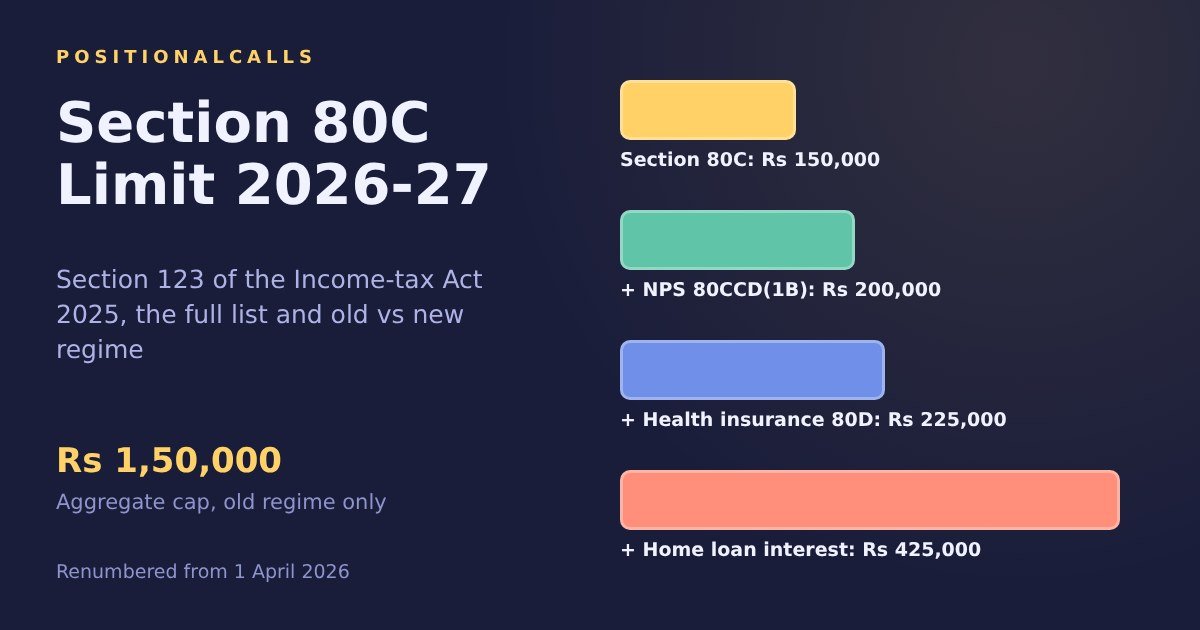
Section 80C allows a deduction of up to Rs 1,50,000 a year for PPF, ELSS, EPF, life insurance and similar items, but only under the old tax regime. From 1 April 2026 it is Section 123 of the Income-tax Act 2025, read with Schedule XV. The limit is unchanged, and the new regime gives no deduction.
80C: key takeaways
- Limit: Rs 1.5 lakh in aggregate, for individuals and HUFs.
- New number: Section 123 and Schedule XV from Tax Year 2026-27; the 1961 Act number still applies to the FY 2025-26 return.
- Regime: old regime only; the new regime is the default and allows no 80C claim.
- Extra room: Rs 50,000 for NPS under Section 80CCD(1B), old regime only.
- Break-even: from Rs 10 lakh to Rs 30 lakh gross, the old regime needs Rs 4.5 lakh to Rs 8 lakh of deductions beyond the standard deduction, my calculation.
- Not a call: the page compares rules and arithmetic, and recommends no product.
In plain words: India lets you subtract certain savings and payments from your income before tax is worked out. 80C was the most used of these, with a Rs 1.5 lakh ceiling. The 2025 Act renumbers it, and the default tax system offers lower rates instead of such deductions. So the real question is whether your deductions are large enough to beat those lower rates. This page answers that with numbers, not a recommendation.
Data note: as of Friday, 20 November 2026, 8:05 AM IST. Section numbers and the Schedule XV list come from ClearTax, TaxGuru, Tax2win, Tata Capital, Basunivesh and Calcguru and are reconciled on this page. Rates come from the Finance Ministry office memorandum of 30 September 2026 as shown by Indian Bank, and from Business Today and Angel One. ELSS tax rules come from Groww, Kuvera and DSP. Slabs and break-evens come from Basunivesh and are recomputed in code. Figures marked my calculation use only numbers on this page. I did not open the Act, the Rules or any portal.
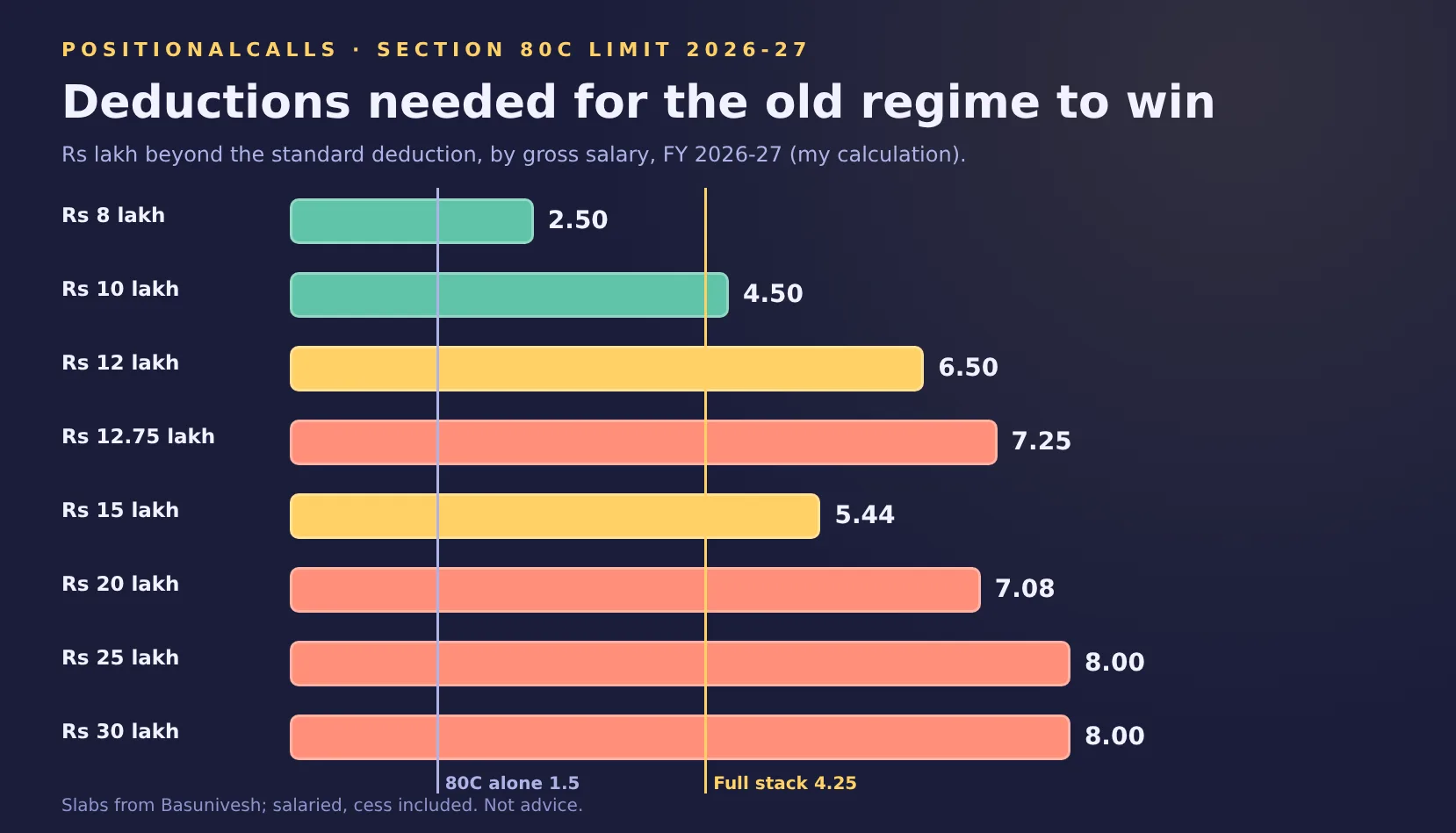 Deductions beyond the standard deduction needed for the old regime to match the new regime, by gross salary. Slabs from Basunivesh; break-even is my calculation.
What is Section 80C and what changed from 1 April 2026?
Section 80C is the deduction that lets you subtract up to Rs 1,50,000 of specified investments and payments from taxable income, and for income earned from 1 April 2026 it sits in Section 123 of the Income-tax Act 2025. ClearTax says Section 123 replaces 80C and takes effect from Tax Year 2026-27. The substance is described as unchanged: the same Rs 1.5 lakh ceiling, the same family of eligible items, and the same restriction to the old tax regime.
The 2025 Act replaces the 1961 Act from 1 April 2026. It also replaces the pair of terms previous year and assessment year with a single tax year, so FY 2026-27 is simply Tax Year 2026-27. TaxGuru adds that the 1961 Act continues to govern the return for FY 2025-26 and proceedings for earlier years, while income, TDS and advance tax for Tax Year 2026-27 fall under the new Act.
Section 80C and the Act that applies to each year
| Income year | Act that applies | 80C number | Return and timing |
|---|---|---|---|
| FY 2025-26 (AY 2026-27) | Income-tax Act 1961 | 80C | Filed during 2026 on the old forms |
| Tax Year 2026-27 (FY 2026-27) | Income-tax Act 2025 | Section 123, read with Schedule XV | Filed in 2027; one source gives 31 July 2027 for individuals without audit |
| Tax Year 2027-28 onwards | Income-tax Act 2025 | Section 123 | Same structure unless Parliament changes Schedule XV |
Cite this table: 80C and Section 123 by income year, as of Friday, 20 November 2026, 8:05 AM IST; TaxGuru, ClearTax and Patron Accounting
Section 80C, Section 123 or Section 100: which number is right?
Most sources that name the number say Section 123, read with Schedule XV, but one widely indexed mapping page prints Section 100, so the safe way to write it is Section 80C (Section 123 of the 2025 Act). TaxGuru warns that published concordance tables conflict and tells readers to check the enacted Act, the Income-tax Rules 2026 and the CBDT concordance before quoting numbers in a filing or reply. I did not open those documents, so the table below shows what each source says and does not pick a winner for the minor numbers.
Section 80C and neighbouring deductions across sources
| Provision | 1961 Act | Most sources say | Dissenting or different source |
|---|---|---|---|
| LIC, PPF, ELSS, tuition fees (the 80C basket) | 80C, with 80CCC and 80CCE | 123, read with Schedule XV (ClearTax, TaxGuru, Tata Capital, Basunivesh, Calcguru) | Tax2win: Section 100 |
| NPS contributions | 80CCD | 124 (TaxGuru, Tata Capital, Basunivesh); 80CCD(1B) at 124(3) per Incorpx | Tax2win: 102; ClearTax points to 125 for the extra Rs 50,000 |
| Health insurance premium | 80D | 126 (TaxGuru, Tata Capital) | Tax2win: 103 |
| Education loan interest | 80E | 129 (Tata Capital) | Tax2win: 105 |
| Donations | 80G | 133 (TaxGuru, Tata Capital) | Tax2win: 108 |
| Rebate for resident individuals | 87A | 156 (TaxGuru, Tata Capital) | None found |
| Standard deduction on salary | 16 | 19 (TaxGuru) | TaxGuru notes one source says 123 |
| New tax regime | 115BAC | 202 (TaxGuru, ClearTax) | None found |
Cite this table: 80C and related section numbers across sources, as of Friday, 20 November 2026, 8:05 AM IST; my tabulation
The Tax2win numbers all sit lower than the others, which suggests a different draft or numbering of the Act, but I cannot confirm that from the pages. For a reader the practical rule is simple. Write the old number when you mean the FY 2025-26 return, write Section 123 for Tax Year 2026-27, and let your employer or tax professional confirm the exact clause before you quote it in writing.
What is the Section 80C limit and who can claim it?
The Section 80C limit is Rs 1,50,000 per year in aggregate, and individuals and HUFs can claim it. ClearTax stresses that it is an aggregate limit: all eligible items together cannot exceed the cap, and amounts above it give no extra relief. Companies, partnership firms, LLPs and associations of persons or bodies of individuals cannot claim it. The deduction reduces taxable income. It is not a tax credit or a refund, as Tata Capital notes.
How the Section 80C cap interacts with NPS
80C, 80CCC and 80CCD(1) share one Rs 1.5 lakh ceiling under Section 80CCE. Share.market reports that Section 80CCD(1B), an extra Rs 50,000 for NPS, sits above that ceiling in the old regime, and that employer NPS under Section 80CCD(2) is the one item still allowed in the new regime. Under the 2025 Act, these NPS rules are reported at Section 124.
| Deduction (1961 number) | Limit | Shares the Rs 1.5 lakh cap? | Old regime | New regime |
|---|---|---|---|---|
| 80C basket | Rs 1,50,000 | Yes | Allowed | Not allowed |
| Section 80CCC annuity plans | Within Rs 1,50,000 | Yes | Allowed | Not allowed |
| Section 80CCD(1) own NPS | Within Rs 1,50,000 | Yes | Allowed | Not allowed |
| Section 80CCD(1B) extra NPS | Rs 50,000 | No, extra | Allowed | Not allowed |
| Section 80CCD(2) employer NPS | Employer contribution within limits | No | Allowed | Allowed |
Cite this table: 80C cap and NPS deductions by regime, as of Friday, 20 November 2026, 8:05 AM IST; Share.market and ClearTax
The practical ceiling for an old-regime taxpayer using only these items is therefore Rs 2,00,000: Rs 1.5 lakh under 80C and Rs 50,000 under Section 80CCD(1B), before employer NPS. Other deductions, such as health insurance, home loan interest and HRA exemption, are separate and are covered in the break-even section below.
What qualifies under Section 80C: the full Schedule XV list
Section 80C covers life insurance premiums, the employee’s own EPF, PPF, NSC, ELSS, ULIPs, five-year tax-saver FDs, NPS Tier I, SCSS, Sukanya Samriddhi, home loan principal, stamp duty and registration, tuition fees and some annuity and pension products. ClearTax lists these as the items in Schedule XV of the 2025 Act. Two limits within the list are worth noting. Life insurance premium must not exceed 10% of the sum assured for policies issued after 1 April 2012, and tuition fees count for up to two children. Employer EPF does not count towards the cap.
Section 80C options with lock-in and tax on returns
| Option | Lock-in or term | Return basis | Tax on the return |
|---|---|---|---|
| ELSS (tax-saving mutual fund) | 3 years per instalment | Market-linked | LTCG 12.5% above Rs 1.25 lakh a year (Groww, Kuvera) |
| PPF | 15 years | 7.1% for Oct to Dec 2026, government-set | Reported tax-free (INDmoney) |
| EPF (employee share) | Until retirement, per Sahi | 8.25% for FY 2025-26 (Sahi, Stableinvestor) | Reported tax-free (Sahi) |
| NSC | 5 years | 7.7% for Oct to Dec 2026 | Interest taxable at slab (DSP) |
| Tax-saver fixed deposit | 5 years | Fixed, set by the bank | Interest taxable at slab (DSP) |
| Sukanya Samriddhi | For a girl child under 10 at opening | 8.2% for Oct to Dec 2026 | Rules per scheme; not set out on the pages I opened |
| SCSS | Per scheme rules | 8.2% for Oct to Dec 2026 | Rules per scheme; not set out on the pages I opened |
| Life insurance premium | Policy term | Policy-specific | Premium capped at 10% of sum assured for policies after 1 April 2012 |
| Home loan principal, stamp duty, tuition fees | Not applicable | Not applicable | A payment, not an investment; claimed in the year paid |
Cite this table: 80C options, lock-ins and tax on returns, as of Friday, 20 November 2026, 8:05 AM IST; ClearTax, Sahi, Tata Mutual Fund and DSP
The table separates the deduction from the return. The 80C deduction is claimed when you invest or pay. Tax on the return arises later and depends on the product. ELSS gains are taxed as long-term capital gains on redemption, a topic covered on the mutual fund taxation page. A tax-saving FD pays interest that is taxed every year, which lowers its after-tax return for anyone in a higher slab.
Can you claim Section 80C in the new tax regime or only the old one?
Section 80C is allowed only in the old tax regime; the new regime, which is the default, gives no Section 80C, Section 80D or Section 80CCD(1B) deduction. ClearTax, Tata Capital and Share.market all say so. The new regime trades deductions for lower slab rates, a higher standard deduction of Rs 75,000 against Rs 50,000, and a Rs 60,000 rebate under Section 87A that makes taxable income up to Rs 12 lakh tax-free, which Basunivesh and Instahyre both report.
Section 80C eligibility and the two regimes side by side
| Feature | New regime (default) | Old regime |
|---|---|---|
| 80C or Section 123 deduction | Not allowed | Allowed, Rs 1.5 lakh |
| Standard deduction on salary | Rs 75,000 | Rs 50,000 |
| Basic exemption (below 60 years) | Up to Rs 4 lakh | Up to Rs 2.5 lakh |
| Section 87A rebate | Rs 60,000; zero tax to Rs 12 lakh taxable | Rs 12,500; zero tax to Rs 5 lakh taxable |
| Top rate | 30% above Rs 24 lakh | 30% above Rs 10 lakh |
| Health and education cess | 4% | 4% |
| Gross salary taxed at zero | Up to Rs 12.75 lakh | Needs deductions to reach Rs 5 lakh taxable |
Cite this table: 80C eligibility and regime features for FY 2026-27, as of Friday, 20 November 2026, 8:05 AM IST; Basunivesh and Instahyre
Slab rates for FY 2026-27
| New regime slab | Rate | Old regime slab (below 60) | Rate |
|---|---|---|---|
| Up to Rs 4 lakh | Nil | Up to Rs 2.5 lakh | Nil |
| Rs 4 lakh to 8 lakh | 5% | Rs 2.5 lakh to 5 lakh | 5% |
| Rs 8 lakh to 12 lakh | 10% | Rs 5 lakh to 10 lakh | 20% |
| Rs 12 lakh to 16 lakh | 15% | Above Rs 10 lakh | 30% |
| Rs 16 lakh to 20 lakh | 20% | Not applicable | Not applicable |
| Rs 20 lakh to 24 lakh | 25% | Not applicable | Not applicable |
| Above Rs 24 lakh | 30% | Not applicable | Not applicable |
Cite this table: 80C regimes: slab rates for FY 2026-27, as of Friday, 20 November 2026, 8:05 AM IST; Basunivesh and Instahyre report no slab change from FY 2025-26
Calcguru adds that the new regime is what applies if you do nothing, and that opting out of it for business income can be withdrawn only once. Salaried taxpayers should check their own position with their employer or adviser. Investing in PPF or ELSS under the new regime is still possible; the 80C tax benefit simply does not arise, as Value Research notes for ELSS.
How much tax does Section 80C actually save?
A full Rs 1,50,000 Section 80C claim saves Rs 46,800 at the 30% slab including cess, Rs 31,200 at 20% and Rs 7,800 at 5%, my calculation. The saving is the deduction multiplied by your marginal old-regime rate, plus 4% cess. Tata Capital shows the same Rs 46,800 figure for the 30% case. If your taxable income falls to Rs 5 lakh or below, the Rs 12,500 rebate under Section 87A already removes the tax, so the 80C deduction beyond that point saves nothing more.
Section 80C saving by marginal rate
PositionalCalls WhatsApp channel
Get tax explainers on WhatsApp
- Section changes and rates, dated
- Calculators explained without tips
- Links to updated tax guides
| Marginal old-regime rate | Tax on Rs 1,50,000 | Cess at 4% | Total saving |
|---|---|---|---|
| 5% | Rs 7,500 | Rs 300 | Rs 7,800 |
| 20% | Rs 30,000 | Rs 1,200 | Rs 31,200 |
| 30% | Rs 45,000 | Rs 1,800 | Rs 46,800 |
Cite this table: 80C tax saving by slab for a full Rs 1.5 lakh claim, my calculation
The saving is only half of the comparison. The other half is what the new regime would have charged you anyway. A person on Rs 8 lakh gross pays nil in the new regime, so the Rs 31,200 80C saving in the old regime has to be set against a bill the new regime already makes zero. That is why the next section works from the regime comparison, not from the deduction. To run your own salary and deductions through both regimes, use the income tax calculator, which also shows the deduction break-even. For slabs, return dates and TDS in one place, see the guide to income tax in India.
Section 80C break-even: how many deductions make the old regime win?
From Rs 10 lakh to Rs 30 lakh gross, the old regime needs between Rs 4.5 lakh and Rs 8 lakh of deductions beyond the standard deduction to match the new regime, so Section 80C alone never gets there. My calculation uses the slabs, rebates and cess listed above. At Rs 15 lakh the break-even is Rs 5.44 lakh, and at Rs 25 lakh and Rs 30 lakh it is Rs 8 lakh. A full stack of 80C Rs 1.5 lakh, NPS Rs 50,000, health insurance Rs 25,000 and home loan interest Rs 2 lakh totals Rs 4.25 lakh, which is the figure Moneykit uses and the rule of thumb Motilal Oswal gives.
Section 80C versus the full deduction stack, by salary
| Gross salary | New regime tax | Old tax, 80C only (Rs 1.5 lakh) | Old tax, Rs 4.25 lakh stack | Break-even deductions | Cheaper at the Rs 4.25 lakh stack |
|---|---|---|---|---|---|
| Rs 8 lakh | Rs 0 | Rs 33,800 | Rs 0 | Rs 2.50 lakh | Equal, both nil |
| Rs 10 lakh | Rs 0 | Rs 75,400 | Rs 18,200 | Rs 4.50 lakh | New regime by Rs 18,200 |
| Rs 12 lakh | Rs 0 | Rs 1,17,000 | Rs 59,800 | Rs 6.50 lakh | New regime by Rs 59,800 |
| Rs 12.75 lakh | Rs 0 | Rs 1,40,400 | Rs 75,400 | Rs 7.25 lakh | New regime by Rs 75,400 |
| Rs 15 lakh | Rs 97,500 | Rs 2,10,600 | Rs 1,24,800 | Rs 5.44 lakh | New regime by Rs 27,300 |
| Rs 20 lakh | Rs 1,92,400 | Rs 3,66,600 | Rs 2,80,800 | Rs 7.08 lakh | New regime by Rs 88,400 |
| Rs 25 lakh | Rs 3,19,800 | Rs 5,22,600 | Rs 4,36,800 | Rs 8.00 lakh | New regime by Rs 1,17,000 |
| Rs 30 lakh | Rs 4,75,800 | Rs 6,78,600 | Rs 5,92,800 | Rs 8.00 lakh | New regime by Rs 1,17,000 |
Cite this table: 80C break-even by gross salary for FY 2026-27, my calculation from Basunivesh slabs; salaried, standard deduction applied, cess included
Reading the break-even table
Two readings follow. First, the Rs 4.25 lakh rule of thumb is accurate only near a Rs 9.75 lakh gross salary, where the break-even is exactly Rs 4.25 lakh. Above Rs 10 lakh the new regime is cheaper at that stack and the old regime needs HRA, a larger home loan interest claim or other deductions to catch up. Second, below Rs 12.75 lakh the new regime already taxes a salaried person at nil, so 80C cannot lower the bill further.
My table skips gross salaries just above Rs 12.75 lakh, where marginal relief near the rebate limit changes the new-regime bill, and the sources I opened do not set that band out. It also ignores HRA exemption arithmetic, surcharge above Rs 50 lakh and age-based old-regime slabs. Treat it as a screening table and compare both regimes on your payslip numbers before choosing.
Five worked Section 80C cases rechecked: two do not tie out
Basunivesh publishes five case studies comparing the regimes, and when I recompute the old-regime tax from the taxable incomes it gives, three tie out to the rupee and two do not. Cases 1, 2 and 5 match. Case 3 shows Rs 80,600 where the slabs on that page give Rs 85,800, and case 4 shows Rs 1,95,000 where they give Rs 2,10,600. The new-regime figures all tie out. The difference matters because case 4 would flip: the new regime saves Rs 18,200 on my numbers, not Rs 2,600.
Section 80C case studies, source figures against my recalculation
| Case (gross salary) | Old taxable income (source) | Old tax per source | Old tax, my calculation | New tax | Cheaper regime, my numbers | Source old tax |
|---|---|---|---|---|---|---|
| 1. Rs 10 lakh, EPF only | Rs 8,00,000 | Rs 75,400 | Rs 75,400 | Rs 0 | New regime by Rs 75,400 | Ties out |
| 2. Rs 15 lakh, no HRA or home loan | Rs 12,25,000 | Rs 1,87,200 | Rs 1,87,200 | Rs 97,500 | New regime by Rs 89,700 | Ties out |
| 3. Rs 15 lakh, metro rent and home loan | Rs 8,50,000 | Rs 80,600 | Rs 85,800 | Rs 97,500 | Old regime by Rs 11,700 | Does not tie out |
| 4. Rs 20 lakh, maximum deductions | Rs 13,00,000 | Rs 1,95,000 | Rs 2,10,600 | Rs 1,92,400 | New regime by Rs 18,200 | Does not tie out |
| 5. Rs 30 lakh, all deductions stacked | Rs 22,00,000 | Rs 4,91,400 | Rs 4,91,400 | Rs 4,75,800 | New regime by Rs 15,600 | Ties out |
Cite this table: 80C regime case studies from Basunivesh, rechecked; my calculation uses the 5%, 20% and 30% old-regime slabs, the Rs 12,500 rebate to Rs 5 lakh and 4% cess
How does ELSS fit under Section 80C: lock-in, gains tax and SIP rules?
ELSS is the Section 80C option with the shortest lock-in, three years, and its gains above Rs 1.25 lakh a year are taxed at 12.5% on redemption. Groww, Kuvera, ClearTax and DSP all report the same pair of rules. The 80C deduction is claimed in the year you invest. The tax on gains is a separate event at redemption, and the Rs 1.25 lakh exemption is shared across all equity-oriented holdings in the year, not given per fund.
Section 80C and ELSS lock-in by instalment
Each SIP instalment has its own three-year lock-in, so a monthly SIP unlocks one instalment a month, not all together. DSP gives the example that a March 2028 instalment unlocks only in March 2031. Switching to another fund is treated as a redemption and a fresh investment, according to Kuvera, which restarts the lock-in.
| ELSS investment date | 80C year | Earliest redemption |
|---|---|---|
| 15 December 2026, lump sum | FY 2026-27 | 15 December 2029 |
| 5 January 2027, SIP instalment | FY 2026-27 | 5 January 2030 |
| 10 March 2027, SIP instalment | FY 2026-27 | 10 March 2030 |
| 10 April 2027, SIP instalment | FY 2027-28 | 10 April 2030 |
Cite this table: 80C year and ELSS lock-in end by investment date, my calculation using a three-year lock-in per instalment
Tax on an ELSS gain after the lock-in
TaxGuru works a gain of Rs 1,70,000 through the rules. The exemption of Rs 1,25,000 leaves Rs 45,000 taxable. At 12.5% that is Rs 5,625, and 4% cess adds Rs 225, so the total tax is Rs 5,850. I reproduced each step. IDCW payouts are taxed at your slab rate, according to Groww, and short-term gains at 20% do not arise on ELSS because redemption is possible only after three years.
| Step | Amount |
|---|---|
| ELSS long-term gain in the year | Rs 1,70,000 |
| Less annual exemption | Rs 1,25,000 |
| Taxable gain | Rs 45,000 |
| Tax at 12.5% | Rs 5,625 |
| Cess at 4% | Rs 225 |
| Total tax | Rs 5,850 |
Cite this table: 80C ELSS gain taxation worked example, as of Friday, 20 November 2026, 8:05 AM IST; TaxGuru, reproduced by my calculation
Value Research notes that under the new regime ELSS loses its tax-saving appeal, because there is no deduction, though it still behaves as an equity fund for returns and gains tax. For the SIP side, the SIP calculator shows how a monthly amount grows under an assumed return, and the capital gains tax on shares page explains the same 12.5% rate for direct equity.
Section 80C small savings rates for October to December 2026
The government kept small savings rates unchanged for the October to December 2026 quarter: PPF 7.1%, NSC 7.7%, and 8.2% for both SCSS and Sukanya Samriddhi. Business Today and Angel One report the decision, and Indian Bank quotes the office memorandum dated 30 September 2026. The quarter runs from 1 October to 31 December 2026. Free Press Journal prints 30 December as the end date, which looks like a slip against the memorandum.
Section 80C schemes and their quoted rates
| Scheme | Rate | 80C relevance | Source |
|---|---|---|---|
| PPF | 7.1% | Qualifies; rate floats each quarter | Business Today, Angel One |
| Sukanya Samriddhi | 8.2% | Qualifies for a girl child under 10 | Business Today, Angel One |
| SCSS | 8.2% | Qualifies | Business Today |
| NSC | 7.7% | Qualifies; five-year term | Free Press Journal, Angel One |
| Kisan Vikas Patra | 7.5%, matures in 115 months | Not listed in the Schedule XV items I saw | Free Press Journal |
| Post Office MIS | 7.4% | Not listed in the Schedule XV items I saw | Indianpaycalculator |
| 5-year time deposit | 7.5% | Policybazaar lists the post office time deposit | Indianpaycalculator |
| 5-year recurring deposit | 6.7% | Not listed in the Schedule XV items I saw | Business Today, Indianpaycalculator |
Cite this table: 80C small savings rates for 1 October to 31 December 2026, as of Friday, 20 November 2026, 8:05 AM IST
Sources disagree on the streak: Business Today calls it the ninth quarter without a broad change, while Outlook Money and CAalley call it the tenth. The count depends on whether the October 2025 quarter is included, and I did not open the Finance Ministry notices to settle it. One source also notes that PPF and Sukanya rates float on the whole balance, while SCSS, NSC and MIS lock the rate on the day you open them. The PPF calculator and FD calculator show maturity values at these rates.
Section 80C, NPS and the extra Rs 50,000: what stacks and what does not
NPS can add Rs 50,000 on top of the Section 80C limit under Section 80CCD(1B), for a total of Rs 2,00,000 in the old regime, while employer NPS under Section 80CCD(2) is the one NPS deduction reported for both regimes. Share.market sets out the stacking rule. Your own Tier I contribution under Section 80CCD(1) counts inside the Rs 1.5 lakh 80C cap, and only the separate Rs 50,000 sits outside it.
Section 80C and NPS: sources on the employer limit differ
| Item | Figure | Source and note |
|---|---|---|
| Own NPS inside the 80C cap | Within Rs 1,50,000 | Share.market |
| Extra NPS deduction | Rs 50,000, old regime only | Share.market, Bajaj Finserv |
| Employer NPS limit, one source | 14% | Bajaj Finserv, for FY 2026-27 in the new regime |
| Employer NPS limit, another source | 10% of basic for private employers, 14% for government | Tenhash comparator page |
| Lock-in | Largely until age 60, limited partial withdrawal | Value Research |
Cite this table: 80C and NPS deduction limits, as of Friday, 20 November 2026, 8:05 AM IST; sources differ on the employer limit, which I did not resolve from the Rules
The employer-limit mismatch is the kind of detail to confirm on your payslip and with your employer before relying on it. The NPS calculator shows how contributions compound under an assumed return. Because NPS money is largely locked until age 60, the extra Rs 50,000 is a retirement decision first and a tax decision second.
How and when to claim Section 80C for FY 2026-27
To claim Section 80C for FY 2026-27 you must invest or pay by 31 March 2027, be in the old regime, keep the proofs, and report the deduction through your employer or in your return. Motilal Oswal says investments for the 2026-27 year must be completed by 31 March 2027. Qwikfilings adds that a claim can be made in the return even if it was missing from Form 16, provided the payment was made within the year and you keep the proof.
Section 80C claim steps and dates
| Step | What to do | Date or note |
|---|---|---|
| 1. Choose the regime | Opt for the old regime, since 80C is not allowed in the new one | Tell the employer early; the new regime is the default |
| 2. Invest or pay | Complete the investment or payment inside the tax year | By 31 March 2027 |
| 3. Collect proofs | Premium receipts, passbooks, statements, fee receipts, loan certificates | Keep them for the return |
| 4. Declare to payroll | Submit the declaration so TDS reflects the deduction | Employer-set date |
| 5. Claim in the return | Enter the capped total in the deductions schedule | 31 July 2027 for individuals without audit, per Patron Accounting |
| 6. Verify | Aadhaar OTP, net banking or EVC | After filing |
Cite this table: 80C claim steps for Tax Year 2026-27, as of Friday, 20 November 2026, 8:05 AM IST; ClearTax, Motilal Oswal, Qwikfilings and Patron Accounting
If you miss the date, the return deadline and its penalties are explained on the belated ITR last date page, and quarterly tax timing is on the advance tax due date page. Budget changes can alter any of these rules; the Union Budget 2027 page tracks that calendar.
PositionalCalls WhatsApp channel
Tax updates in one channel
- Budget and CBDT changes, dated
- Plain-English tax explainers
- Links to new guides
Section 80C: frequently asked questions
What is the Section 80C limit for FY 2026-27?
The Section 80C limit is Rs 1,50,000 per year, and sources report it unchanged for FY 2026-27. It is an aggregate cap across every eligible item, so PPF, ELSS, EPF, life insurance and tuition fees share it. The deduction is available to individuals and HUFs, and only under the old tax regime. Amounts above the cap earn no extra relief.
Is Section 80C the same as Section 123?
Yes for income earned from 1 April 2026. The Income-tax Act 2025 replaces the 1961 Act from that date, and most sources map Section 80C to Section 123, read with Schedule XV. Tax2win’s mapping page prints Section 100 instead, so the numbers conflict across sources. Returns for FY 2025-26 still use Section 80C under the 1961 Act.
Can I claim Section 80C in the new tax regime?
No. Section 80C, and its parallel Section 123 for Tax Year 2026-27, is allowed only under the old regime. The new regime is the default and gives no deduction for PPF, ELSS or insurance premiums. You can still invest in them, but they will not reduce your taxable income. Employer NPS under Section 80CCD(2) is the notable exception reported for both regimes.
Which investments qualify under Section 80C?
ClearTax lists life insurance premiums, the employee’s own EPF, PPF, NSC, ELSS, ULIPs, five-year tax-saver FDs, NPS Tier I, SCSS, Sukanya Samriddhi, home loan principal, stamp duty and registration, tuition fees for up to two children and deferred annuity plans. The 80C list sits in Schedule XV of the 2025 Act. Employer EPF does not count.
Is the NPS deduction over and above the Section 80C limit?
Partly. 80C, 80CCC and 80CCD(1) share the Rs 1.5 lakh cap. The extra Rs 50,000 under 80CCD(1B) sits above it, but only under the old regime. Sources map the NPS provisions to Section 124 of the 2025 Act, while another page prints Section 102, so quote the old number or the 124 reference with care.
By when must I invest to claim Section 80C for FY 2026-27?
Motilal Oswal says investments for the 2026-27 year must be completed by 31 March 2027. A payment made on 1 April 2027 belongs to the next year. Employers set their own proof dates, so check your payroll deadline. A 80C claim not made through payroll can be made in the return.
Which return uses Section 80C, the one filed in 2026 or in 2027?
The return for FY 2025-26, filed during 2026 as AY 2026-27, uses the 1961 Act and 80C. The return for Tax Year 2026-27, filed in 2027, uses the 2025 Act and Section 123. Income earned from 1 April 2026 is under the new Act, so Form 16 and the portal will show the new numbers.
How much tax does Section 80C save?
The saving is the deduction times your marginal rate, plus 4% cess. A full Rs 1,50,000 saves Rs 46,800 at the 30% slab, my calculation. It saves Rs 31,200 at 20% and Rs 7,800 at 5%. If your taxable income is already within the Rs 5 lakh old-regime rebate limit, the 80C deduction may save little or nothing.
How is ELSS taxed after the three-year lock-in?
ELSS redemptions are long-term capital gains. Sources report 12.5% on gains above Rs 1.25 lakh in a financial year, across all equity holdings combined, plus 4% cess. Each SIP instalment has its own three-year lock-in. The 80C deduction is claimed in the year you invest, and the tax on gains is separate, due at redemption. IDCW is taxed at slab rates.
Does Section 80C make the old regime better at Rs 15 lakh?
Not by itself. My calculation shows a Rs 15 lakh gross salary pays Rs 97,500 in the new regime. The old regime needs about Rs 5.44 lakh of deductions beyond the standard deduction to match. 80C of Rs 1.5 lakh plus NPS Rs 50,000 and health insurance Rs 25,000 is Rs 2.25 lakh, so HRA or home loan interest must close the rest.
Sources for the Section 80C limit page
- ClearTax: Section 123.
- ClearTax: Section 80.
- TaxGuru: Income-tax Act.
- Tax2win: Income-tax Act.
- Tata Capital: Section 80C.
- Basunivesh: new vs.
- Basunivesh: all tax.
- Calcguru: Section 80C.
- Share.market: Section 80C,.
- Motilal Oswal: tax-saving options.
- Sahi: Section 80C.
- Groww: LTCG tax.
- Kuvera: ELSS tax.
- DSP: ELSS and.
- TaxGuru: ELSS tax.
- Value Research: what are.
- Business Today: small savings.
- Indian Bank: small savings.
- Free Press Journal: small savings.
- Angel One: small savings.
- Outlook Money: small savings.
- Patron Accounting: Income Tax.
- Instahyre: old vs.
- Bajaj Finserv: income tax.
- Qwikfilings: Section 80C.
- Not opened: the red herring prospectus, the NSE live bid page, the anchor allocation note, the registrar page and any broker research; IPO Central failed to load in full, so its points rest on search snippets; GMP and subscription pages are unofficial and change quickly; calculations are mine.
PositionalCalls.com is an independent research site founded by Shubham Chaudhary. PositionalCalls.com is not a SEBI-registered research analyst or investment adviser, and is not a tax adviser or chartered accountant. Investments in securities markets are subject to market risks. Returns are never guaranteed. This page is educational and publishes no subscribe, avoid, buy, sell, rating or target calls. Sources: tax, broker and news pages as named; the Income-tax Act 2025, Schedule XV and the CBDT concordance were not opened; confirm your own position with a qualified tax professional.

Shubham Chaudhary is the founder of PositionalCalls, an independent Indian stock market research website. He writes company fundamentals, quarterly results analysis, IPO analysis and sector research for NSE and BSE listed companies, with a focus on banking stocks, insurance and long-term value investing. Every article is built from primary sources such as RBI, SEBI, NSE and BSE filings and company annual reports, and states its risks plainly in simple language for retail investors.
Coverage areas Our research standards- Numbers checked against NSE, BSE and SEBI filings
- Risks and limits stated in every article
- No paid promotions or broker tie-ups
- Articles updated when new filings arrive