
Learning · Small savings and tool
A PPF calculator turns a yearly deposit, a rate and a tenure into a maturity value, but the answer depends on one rule most pages mention only in passing: interest is worked on the lowest balance between the 5th and month end. This page gives a PPF calculator, the October to December 2026 rate, the cost of late deposits and the points where sources disagree.
Quick answer
A PPF calculator estimates Public Provident Fund maturity from your yearly deposit, the rate and the years. At the 7.1% rate reported for October to December 2026, Rs 1,50,000 deposited on or before 5 April each year grows to Rs 40,68,209 over 15 years, on Rs 22,50,000 deposited.
PPF calculator: key takeaways
- Rate: 7.1% a year, compounded annually, reported unchanged for October to December 2026.
- Maturity: Rs 1.5 lakh deposited by 5 April for 15 years reaches Rs 40,68,209.
- Timing: a deposit after the 5th earns nothing for that month; the PPF calculator above models four patterns.
- Extension: blocks of 5 years, with or without deposits; 30 years at the maximum reaches about Rs 1.55 crore.
- Limits: Rs 500 to Rs 1.5 lakh a year; loan from year 3, partial withdrawal from year 7.
In plain words: think of PPF as a government-run savings box with a fifteen-year lid. Each month the account looks at the smallest balance you held from the 5th onward and pays interest on that, then adds the year’s interest on 31 March. Money that arrives on the 4th earns for the month, and money that arrives on the 6th waits a month. A PPF calculator simply repeats that for every month of every year.
Data note: as of Wednesday, 18 November 2026, 8:30 PM IST. Rates come from the Indian Bank page quoting the 30 September 2026 office memorandum and from press reports. Rules come from bank and broker pages, including UCO Bank, SBI, Motilal Oswal, Taxmann and ClearTax. Figures marked my calculation use the monthly method on round numbers, and they match published examples where one exists. The PPF Scheme 2019 text and the Finance Ministry notification were not opened.
Use this PPF calculator to estimate your maturity value
Enter your yearly deposit, the rate, the number of years and when in the year you deposit, and the PPF calculator shows the total deposited, the interest and the maturity value. The defaults are Rs 1,50,000 a year at 7.1% for 15 years, deposited on or before 5 April, which gives Rs 40,68,209. Nothing you type leaves your browser.
The scheme allows Rs 500 to Rs 1,50,000 a year. Amounts above Rs 1,50,000 are capped here.
7.1% is the rate reported for October to December 2026. The government reviews it every quarter.
After 15 years an account can be extended in blocks of 5 years. This tool assumes you keep depositing.
How does this PPF calculator treat the deposit pattern?
It works the account month by month. Interest for each month is the lowest balance from the 5th to month end times the rate divided by 12, and the year’s interest is added to the balance on 31 March. That is the rule described by UCO Bank, Motilal Oswal and Taxmann. The four patterns in the list differ only in which months a deposit counts.
How do I use this PPF calculator in four steps?
First, type the amount you plan to deposit in a year, from Rs 500 to Rs 1,50,000. Second, keep 7.1% or type a rate to test. Third, choose the years, with 15 as the standard tenure. Fourth, pick the deposit pattern and press the button. The last two rows show the value for a 5 April deposit and the gap, so you can see what timing costs without running the PPF calculator twice.
What does this PPF calculator not include?
It does not change the rate from year to year, because nobody can know the future quarterly rates. It does not model loans or partial withdrawals, tax or the rule on deposits in the account of a minor. It assumes you keep depositing during any extension. Treat the PPF calculator output as an estimate and check the scheme text for rules.
What is the PPF interest rate for October to December 2026?
The rate is 7.1% a year, compounded annually, and it is unchanged from the July to September quarter. Indian Bank’s page quotes office memorandum F.No.1/4/2019-NS dated 30 September 2026 for the third quarter of FY 2026-27. A PPF calculator should use this rate unless you want to test another.
| Scheme | Rate, Oct-Dec 2026 | Compounding | Source |
|---|---|---|---|
| Public Provident Fund (PPF) | 7.10% | Annually | Indian Bank, Outlook Money |
| Sukanya Samriddhi Account | 8.20% | Annually | Indian Bank, Outlook Money |
| Senior Citizens Savings Scheme | 8.20% | Quarterly | Indian Bank, Outlook Money |
| National Savings Certificate (5 years) | 7.70% | Annually | Indian Bank, Outlook Money |
| Post Office Savings Account | 4.00% | Not stated | Outlook Money |
| 5-year recurring deposit | 6.70% | Not stated | IndianPayCalculator, July-Sept list |
Cite this table: PositionalCalls, “PPF calculator”; rates from the Indian Bank page for the 30 September 2026 memorandum, Outlook Money and IndianPayCalculator as named; the last row is the July to September rate, reported as held unchanged.
Does the PPF rate stay fixed for the life of the account?
No. Business Today says PPF, SSY and SCSS rates are reviewed every quarter and are not locked when an account is opened, and a rate declared for a quarter applies to the outstanding balance. So a PPF calculator that holds 7.1% for fifteen years shows one path, not a promise. A cut or a rise would change the balance from that quarter onward.
Why do sources count the unchanged streak differently?
Outlook Money and Free Press Journal call October to December 2026 the tenth consecutive quarter without a change, while Business Today says ninth and describes the rates as unchanged since January to March of FY 2023-24 on most schemes. I did not open the notifications for each quarter, so I give both counts. The rate itself is not in dispute across the pages I read.
What if the rate changes in the PPF calculator?
| Rate | 15 years, Rs 1.5 lakh a year | 30 years, Rs 1.5 lakh a year |
|---|---|---|
| 6.0% | Rs 37,00,879 | Rs 1,25,70,252 |
| 6.5% | Rs 38,63,102 | Rs 1,37,98,385 |
| 7.1% | Rs 40,68,209 | Rs 1,54,50,911 |
| 7.5% | Rs 42,11,586 | Rs 1,66,73,154 |
| 8.0% | Rs 43,98,642 | Rs 1,83,51,880 |
Cite this table: PositionalCalls, “PPF calculator”; my calculation with the rate held constant for the whole period and deposits on or before 5 April; the rates other than 7.1% are test values, not forecasts.
A step of half a percentage point moves the 15-year result by about Rs 1.6 lakh to Rs 1.9 lakh in this table, and the effect grows with the tenure. The table does not predict a rate change. It shows how sensitive a PPF calculator result is to the one input the government resets each quarter.
How is the rate set?
Business Today says a formula framework exists but is a recommendation, and the government does not have to follow it mechanically. For the wider rate backdrop, the page on the RBI repo rate covers the central bank side, which is a separate decision from the small savings notification.
How does a PPF calculator work out the maturity value?
A PPF calculator compounds your yearly deposits at the annual rate, and the standard result for Rs 1.5 lakh at 7.1% over 15 years is Rs 40,68,209. ClearTax, FundsIndia and StockCalc print that figure, with Rs 22,50,000 deposited and Rs 18,18,209 as interest, and my calculation reproduces it.
Which formula does a PPF calculator use?
ClearTax, Pension Bazaar and StockCalc print F = P × [((1 + i)^n − 1) / i], and Bharti AXA prints the same with a final × (1 + i). On my calculation the printed version without the last term gives Rs 37,98,515 for Rs 1.5 lakh, while the version with it gives Rs 40,68,209. The second matches the examples, because it assumes the deposit is in the account for the whole year.
How much do other yearly deposits reach?
| Yearly deposit | Total deposited | Interest earned | Maturity, 15 years |
|---|---|---|---|
| Rs 1,50,000 | Rs 22,50,000 | Rs 18,18,209 | Rs 40,68,209 |
| Rs 1,00,000 | Rs 15,00,000 | Rs 12,12,139 | Rs 27,12,139 |
| Rs 75,000 | Rs 11,25,000 | Rs 9,09,105 | Rs 20,34,105 |
| Rs 50,000 | Rs 7,50,000 | Rs 6,06,070 | Rs 13,56,070 |
| Rs 25,000 | Rs 3,75,000 | Rs 3,03,035 | Rs 6,78,035 |
| Rs 12,000 | Rs 1,80,000 | Rs 1,45,457 | Rs 3,25,457 |
Cite this table: PositionalCalls, “PPF calculator”; my calculation at 7.1%, deposit on or before 5 April each year, no rate change; the Rs 1.5 lakh row matches ClearTax and FundsIndia.
The results scale in line with the deposit, because the formula is linear in the amount. A deposit of one third of the maximum reaches one third of the maturity. That is useful when a source quotes only one example and you want another.
What do monthly PPF deposits reach in a PPF calculator?
| Monthly deposit | Total deposited, 15 years | Maturity, deposits on or before the 5th |
|---|---|---|
| Rs 12,500 | Rs 22,50,000 | Rs 39,44,599 |
| Rs 10,000 | Rs 18,00,000 | Rs 31,55,679 |
| Rs 5,000 | Rs 9,00,000 | Rs 15,77,840 |
| Rs 2,500 | Rs 4,50,000 | Rs 7,88,920 |
| Rs 1,000 | Rs 1,80,000 | Rs 3,15,568 |
Cite this table: PositionalCalls, “PPF calculator”; my calculation at 7.1%, each deposit made on or before the 5th of the month, rate unchanged; Rs 12,500 a month is the Rs 1.5 lakh yearly maximum.
Monthly deposits reach slightly less than a yearly lump sum of the same size, because only part of the money is in the account for the full year. Salaried savers often prefer them for cash flow reasons. The cost of that choice is the Rs 1,23,610 gap in the earlier table for the maximum amount.
What does the year-by-year schedule look like?
| Year | Opening balance | Deposit | Interest for the year | Closing balance |
|---|---|---|---|---|
| 1 | Rs 0 | Rs 1,50,000 | Rs 10,650 | Rs 1,60,650 |
| 2 | Rs 1,60,650 | Rs 1,50,000 | Rs 22,056 | Rs 3,32,706 |
| 3 | Rs 3,32,706 | Rs 1,50,000 | Rs 34,272 | Rs 5,16,978 |
| 5 | Rs 7,14,334 | Rs 1,50,000 | Rs 61,368 | Rs 9,25,701 |
| 7 | Rs 11,52,076 | Rs 1,50,000 | Rs 92,447 | Rs 13,94,524 |
| 10 | Rs 19,32,282 | Rs 1,50,000 | Rs 1,47,842 | Rs 22,30,124 |
| 15 | Rs 36,48,515 | Rs 1,50,000 | Rs 2,69,695 | Rs 40,68,209 |
Cite this table: PositionalCalls, “PPF calculator”; my calculation for Rs 1.5 lakh deposited on or before 5 April each year at 7.1%; selected years shown; the year 1 interest of Rs 10,650 matches the Business Today example.
The first-year interest of Rs 10,650 is the full 7.1% on Rs 1.5 lakh, because the deposit sat in the account for all twelve months. Later years add interest on the earlier balance as well, which is why the closing balance climbs faster in the final years than in the first. The schedule is what a PPF calculator prints as its yearly table.
Why does the 5th of the month matter in a PPF calculator?
PPF interest for a month is paid on the lowest balance between the close of the 5th and the last day, so a deposit after the 5th earns nothing for that month. The Public Provident Fund Scheme 2019, notified as G.S.R. 915(E) on 12 December 2019, says so, as quoted by Taxmann and Beincareer.
What does the 5th rule cost over 15 years?
| Deposit pattern | Maturity, 15 years | Gap to 5 April |
|---|---|---|
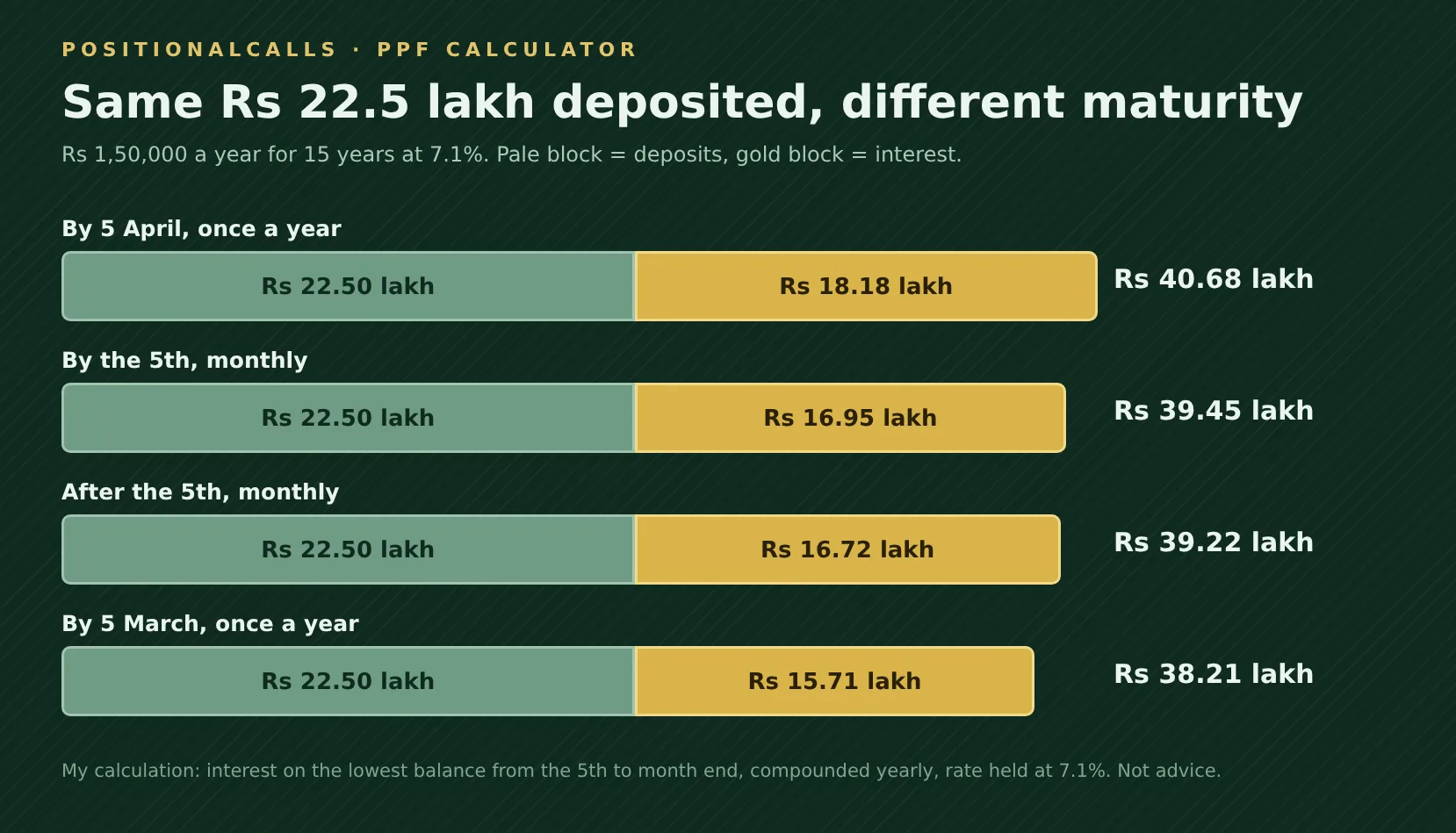
| Once a year, on or before 5 April | Rs 40,68,209 | Rs 0 |
| Monthly, on or before the 5th | Rs 39,44,599 | Rs 1,23,610 lower |
| Monthly, after the 5th | Rs 39,22,125 | Rs 1,46,085 lower |
| Once a year, on or before 5 March | Rs 38,20,989 | Rs 2,47,220 lower |
Cite this table: PositionalCalls, “PPF calculator”; my calculation for Rs 1,50,000 a year at 7.1%, rate unchanged.
All four patterns deposit the same Rs 22,50,000. A yearly lump sum by 5 April comes first because the money works for all twelve months. A deposit made by 5 March earns for one month of that year only, which is the pattern Outlook Money describes for a March deposit.
What does a single late deposit cost?
Business Today says Rs 1.5 lakh in the account before 5 April earns Rs 10,650 over the year. If the same sum lands on 6 April, the balance on the 5th was nil, so April earns nothing. CalcGuru puts one month at Rs 887.50, which is Rs 1,50,000 × 7.1% ÷ 12, and I get the same figure. The year then earns about Rs 9,762 on a simple basis.
Do experts agree the 5th rule matters?
Not fully. Full Stack FIRE and StableInvestor say the April deadline matters little in the long run, and the first points out that monthly deposits before or after the 5th end up close. My numbers agree for monthly deposits: the gap between the two monthly patterns is Rs 22,474 on a corpus above Rs 39 lakh. The lump sum pattern is where the gap is large, at Rs 2.47 lakh for 5 March.
PositionalCalls WhatsApp channel
Get savings and tax explainers on WhatsApp
- Small savings rate changes, dated
- Calculators explained without tips
- Links to updated guides
What happens to a PPF calculator result after 15 years?
A PPF account can be extended in blocks of 5 years, with or without further deposits, and the balance keeps earning interest. Cholamandalam Securities and bank pages describe the extension, and Axis Bank says the 15 years run from the end of the financial year in which the account was opened.
| Years | Total deposited | Maturity at 7.1% | Multiple of deposits |
|---|---|---|---|
| 15 | Rs 22,50,000 | Rs 40,68,209 | 1.81 |
| 20 | Rs 30,00,000 | Rs 66,58,288 | 2.22 |
| 25 | Rs 37,50,000 | Rs 1,03,08,015 | 2.75 |
| 30 | Rs 45,00,000 | Rs 1,54,50,911 | 3.43 |
| 35 | Rs 52,50,000 | Rs 2,26,97,857 | 4.32 |
| 40 | Rs 60,00,000 | Rs 3,29,09,660 | 5.48 |
| 50 | Rs 75,00,000 | Rs 6,75,75,988 | 9.01 |
Cite this table: PositionalCalls, “PPF calculator”; my calculation for Rs 1,50,000 deposited on or before 5 April each year at a constant 7.1%; the 30-year figure is close to the Rs 1.55 crore shown by ItoolVerse.
When does interest overtake what you deposit?
On my calculation at a constant 7.1%, cumulative interest first exceeds total deposits in year 18 for the Rs 1.5 lakh pattern. At 15 years the interest of Rs 18,18,209 is still below the Rs 22,50,000 deposited. ItoolVerse makes a similar point, that the later years matter most, and this is why an extension changes the PPF calculator result by far more than five years of deposits suggest.
When does an account opened in 2026 mature?
If the account is opened in FY 2026-27, the financial year ends on 31 March 2027, and 15 years from that end is 31 March 2042, on my reading of the Axis Bank wording. Many calculators simply model fifteen yearly deposits, which is the convention this PPF calculator follows. Check the exact maturity date with your bank.
What changes in an extended account?
SBI’s FAQ says partial withdrawal in an extended account is limited to 60% of the balance at the start of the block, across the five years. A PPF calculator cannot show that, because it depends on when you withdraw. The calculator here assumes you deposit the same amount in every year of the extension.
What limits apply to a PPF calculator: deposits, loan and withdrawal?
The limits are Rs 500 to Rs 1.5 lakh a year, a loan from the third financial year and a partial withdrawal from the seventh. Bank pages agree on the headline rules and differ on some wording, which the next table lays out.
| Rule | What the sources say | Source |
|---|---|---|
| Yearly deposit | Minimum Rs 500, maximum Rs 1,50,000 a financial year | Taxmann, Motilal Oswal |
| Number of deposits | Up to 12 in a year | UCO Bank |
| Interest basis | Lowest balance from the 5th to month end; credited on 31 March | UCO Bank, Motilal Oswal |
| Loan | From the 3rd to the 6th financial year; up to 25% of the balance at the end of the second preceding year | Ditto, Richify |
| Partial withdrawal | From the 7th financial year, once a year; up to 50% of an earlier balance | UCO Bank, Ujjivan SFB |
| Extended account | Withdrawal capped at 60% of the balance at the start of the 5-year block | SBI FAQ |
| Minor and guardian | Combined limit of Rs 1,50,000 | Agridots |
Cite this table: PositionalCalls, “PPF calculator”; rules as stated by the sources named; the PPF Scheme 2019 text was not opened.
Does a PPF calculator include loans?
Almost none do, and this one does not. A loan reduces the balance for a time and carries its own interest, and the scheme repays it over a set period. Richify says 36 months. Because the terms depend on your account date, a general PPF calculator leaves the loan out and leaves the maturity estimate for a plain account.
What is the withdrawal limit in practice?
UCO Bank says the limit is 50% of the balance at the end of the fourth year before the year of withdrawal. Richify and Agridots say it is 50% of the lower of two balances, the fourth preceding year or the preceding year. The versions give the same result when the balance has only grown. Where they could differ, the scheme text decides.
Is the PPF maturity from a PPF calculator taxable?
Bank and broker pages say PPF is exempt at all three stages: deposit, interest and maturity. 5paisa says deposits up to Rs 1.5 lakh a year, the interest and the maturity amount are all tax-free, and ICICI Bank describes PPF returns as tax-free. This is the EEE label that appears across the pages.
Does every deposit get a tax deduction?
The deduction on deposits depends on the tax regime you choose, and I did not open the Income-tax Act to confirm the current section or its limit. Taxmann notes that Rs 1.5 lakh is the most that is eligible for interest and for the deduction, which is why the PPF calculator caps the yearly amount at that figure.
What about interest on deposits above the cap?
Taxmann says the limit applies to both interest and the deduction. So a PPF calculator that lets you type Rs 3 lakh a year would overstate the result, and this one caps the amount. Check with your bank how it treats an excess deposit before you make one.
For how other investments are taxed, see mutual fund taxation in India and the capital gains tax calculator. They cover market-linked products, which are taxed differently from PPF.
How does PPF compare with other small savings in a PPF calculator?
PPF sits below Sukanya Samriddhi, the senior citizen scheme and NSC on the quoted rate, and it is the only one of these with a fifteen-year base tenure. The sources I read list the rates, and the table adds what they say about each scheme.
| Scheme | Rate | Tenure or purpose, per sources | Rate floats or locks |
|---|---|---|---|
| PPF | 7.10% | 15 years, extendable in 5-year blocks | Floats with quarterly reviews |
| Sukanya Samriddhi | 8.20% | Savings for a daughter, until she attends 21 per Motilal Oswal | Floats with quarterly reviews |
| NSC | 7.70% | Five-year maturity per Outlook Money | Rate fixed for accounts opened in the quarter |
| SCSS | 8.20% | For senior citizens; interest compounded quarterly per Indian Bank | Rate fixed for accounts opened in the quarter |
Cite this table: PositionalCalls, “PPF calculator”; rates from the Indian Bank page and Outlook Money; purpose and tenure as quoted; float and lock reading from the Indian Bank note on accounts opened in the quarter and the IndianPayCalculator headline.
The Indian Bank page says the SCSS, KVP, NSC and some other rates apply to accounts opened in October to December 2026, which reads as a fixed rate for those accounts. PPF and SSY are reviewed every quarter and apply to the whole balance. That is why a PPF calculator is an estimate and an NSC or SCSS maturity is closer to a fixed schedule.
How do I compare PPF with a market-linked return?
Put the PPF result next to a projection from the SIP calculator, and convert both to a yearly rate with the CAGR calculator. Market returns are not guaranteed and PPF’s are set by the government, so the two numbers measure different things. For a market-linked pension account with an annuity rule, see the NPS calculator. For a bank deposit at a rate fixed at booking, see the FD calculator. This page does not say which is better.
Where do PPF calculator sources disagree?
The disagreements are about the rate streak, the printed formula, one broker example, how much the 5th rule matters and the withdrawal balance test. The table lists each reading and what I did with it.
| Point | Reading one | Reading two | What this page does |
|---|---|---|---|
| Unchanged-rate streak | Tenth quarter, Outlook Money and Free Press Journal | Ninth, Business Today | Shows both; the rate is 7.1% in all |
| Maturity formula | ClearTax prints F = P × [((1+i)^n − 1)/i], giving Rs 37,98,515 | Its example shows Rs 40,68,209, which needs the × (1+i) term | Uses the monthly method, which gives Rs 40,68,209 |
| Rs 1 lakh a year example | 5paisa page shows Rs 31,17,276 | My calculation gives Rs 27,12,139 | Uses my figure; 5paisa’s assumption not found |
| Weight of the 5th rule | Costs lakhs over 15 years, per a ppf-calc-india blog | Matters little long run, per StableInvestor and Full Stack FIRE | Shows my numbers for four patterns |
| Withdrawal base | 50% of the balance at the end of the 4th preceding year, UCO Bank | 50% of the lower of two balances, Richify | Shows both; scheme text decides |
| Loan window | 3rd to 5th year, TaxGuru | 3rd to 6th year, Ditto and Beincareer | Uses 3rd to 6th |
Cite this table: PositionalCalls, “PPF calculator”; each reading from the page named; calculations are mine.
None of these changes the headline result for a standard account. They matter when you plan a withdrawal or compare tools, and they are why I show the working instead of one number. If a PPF calculator you use gives a different maturity, check the rate, the tenure and the deposit date it assumes.
What mistakes do people make with a PPF calculator?
The common errors are depositing after the 5th, assuming the rate is fixed, entering more than the yearly cap and treating the estimate as a guarantee. Each follows from the rules above.
- Depositing on the 6th: the deposit earns nothing for that month, per UCO Bank and Motilal Oswal.
- Holding the rate fixed: the PPF rate is reviewed every quarter, so a long projection is one path.
- Typing above Rs 1.5 lakh: amounts above the cap earn no eligible interest, per Taxmann.
- Ignoring the lump sum timing: a deposit by 5 March in this PPF calculator reaches Rs 2.47 lakh less than one by 5 April over 15 years.
- Counting the loan as free: a loan has its own terms, and a withdrawal has its own cap.
What is a quick checklist before you deposit?
First, check the rate for the current quarter. Second, decide a yearly amount within Rs 500 and Rs 1.5 lakh. Third, pick a date on or before the 5th. Fourth, run the PPF calculator for your tenure. Fifth, note the loan and withdrawal years. None of this says whether PPF suits you, and this page gives no such view.
What does this PPF calculator page leave out?
It leaves out loans, withdrawals, tax computation, premature closure, nominee rules and any view on whether PPF is the right product. It explains the interest mechanics and shows arithmetic.
- No scheme text: the PPF Scheme 2019 and the Finance Ministry notification were not opened; rules are as bank and broker pages state them.
- No tax computation: the section and limit for the deduction were not checked in the Act.
- No rate forecast: the January to March 2027 rate is not known, and the PPF calculator holds the rate constant.
- No premature closure: the conditions were not covered.
- No calls: there is no subscribe, buy, sell, avoid or rating view here.
Will this PPF calculator page be updated?
Yes, when the government notifies the January to March 2027 small savings rates, which is the next scheduled review, and when I open the scheme text and the notification. Any change to the deposit cap or to the interest rule would also change the PPF calculator and this page.
PositionalCalls WhatsApp channel
Savings and tax updates in one channel
- Quarterly rate notices, dated
- Plain-English explainers
- Links to new guides
PPF calculator: frequently asked questions
What does a PPF calculator do and how does it work?
A PPF calculator projects the maturity value of a Public Provident Fund account from your yearly deposit, the interest rate and the tenure. The scheme works interest monthly on the lowest balance between the 5th and month end and compounds it once a year, per bank pages. A good PPF calculator also asks when in the year you deposit.
What is the PPF interest rate for October to December 2026?
The rate is 7.1% a year, compounded annually, unchanged from the July to September quarter. Indian Bank’s page quotes office memorandum F.No.1/4/2019-NS dated 30 September 2026, and press reports agree. Outlook Money and Free Press Journal call it the tenth straight quarter without change, while Business Today says ninth, so the count differs.
How much will Rs 1.5 lakh a year become in a PPF calculator over 15 years?
At 7.1% with the full Rs 1,50,000 deposited on or before 5 April each year, the maturity value is Rs 40,68,209 on Rs 22,50,000 deposited, with Rs 18,18,209 as interest. ClearTax, FundsIndia and StockCalc show the same figure, and my own calculation matches. The rate can change in later quarters, so this is an estimate.
Why does the PPF calculator ask about the 5th of the month?
PPF interest for a month is worked on the lowest balance between the close of the 5th and the last day, so a deposit after the 5th earns nothing for that month. UCO Bank, Motilal Oswal and Taxmann describe the rule. A yearly lump sum on or before 5 April earns for all twelve months, which is why a PPF calculator should model it.
How much interest do I lose by depositing late in the PPF year?
On my calculation at 7.1% for 15 years, Rs 1.5 lakh a year deposited on or before 5 March reaches Rs 38,20,989, against Rs 40,68,209 for 5 April, a gap of Rs 2,47,220. Monthly deposits after the 5th reach Rs 39,22,125. Sources disagree on how much the 5th rule matters in the long run.
Can I extend a PPF account after 15 years?
Yes. Cholamandalam Securities and bank pages say an account can be extended in blocks of 5 years, with or without further deposits, and the balance keeps earning interest. SBI’s FAQ says the extended account has its own partial withdrawal cap. A PPF calculator for 30 years at Rs 1.5 lakh a year, deposited every April, gives about Rs 1.55 crore, on my calculation.
When can I take a loan or a partial withdrawal from PPF?
Bank pages say a loan is available from the third to the sixth financial year, up to 25% of the balance at the end of the second preceding year, and a partial withdrawal is allowed from the seventh year, once a year, up to 50% of an earlier balance. Sources word the balance test differently, so check the scheme text before you plan around it.
Is the PPF maturity amount taxable?
Bank and broker pages, including 5paisa and ICICI Bank, say deposits up to Rs 1.5 lakh a year, the interest and the maturity amount are tax-free, called EEE. Whether a deposit gives a deduction depends on your tax regime. I did not open the Income-tax Act, so confirm with a professional before you rely on a PPF calculator for tax.
Why do different PPF calculator pages show different maturity values?
Differences come from the deposit timing, the rate and the tenure each tool assumes. Most show Rs 40,68,209 for Rs 1.5 lakh a year, which assumes a deposit by 5 April. A 5paisa page example shows Rs 31,17,276 for Rs 1 lakh a year, which does not match the standard formula, which gives Rs 27,12,139. I did not find its assumption.
Is this PPF calculator page investment advice?
No. PositionalCalls is not a SEBI-registered research analyst or investment adviser. This PPF calculator shows arithmetic from stated rules and the rate reported for the quarter, and it does not say whether PPF suits you. I did not open the PPF Scheme 2019 text or the Finance Ministry notification, so check the scheme rules and your tax position before you act.
Sources for the PPF calculator page
- Indian Bank: small savings interest, bank.
- Outlook Money: small savings rates, news.
- Free Press Journal: small savings rates, news.
- Business Today: small savings unchanged, news.
- Business Today: PPF SSY SCSS, news.
- Angel One: small savings Oct-Dec, broker.
- IndianPayCalculator: small savings lock, tool.
- StableInvestor: small savings rates, blog.
- ClearTax: PPF maturity page, tax.
- FundsIndia: PPF maturity page, broker.
- StockCalc: PPF for 15, tool.
- Bharti AXA: PPF maturity page, insurer.
- Pension Bazaar: PPF maturity page, tool.
- 5paisa: PPF maturity page, broker.
- ICICI Bank: PPF maturity page, bank.
- Axis Bank: PPF maturity page, bank.
- Chola Securities: PPF maturity page, broker.
- UCO Bank: PPF account, bank.
- Motilal Oswal: how PPF interest, broker.
- Taxmann: Public Provident Fund, tax.
- SBI: PPF FAQ, bank.
- SBI: PPF FAQ extended, bank.
- Ujjivan SFB: PPF rules, bank.
- Beincareer: PPF Scheme 2019, blog.
- Richify: PPF glossary, tool.
- Agridots: PPF notes, tool.
- Ditto: public provident fund, insurer.
- TaxGuru: PPF rules, tax.
- CalcGuru: how PPF interest, tool.
- Business Today: PPF April 5, news.
- StableInvestor: Rs 1.5 lakh, blog.
- Full Stack FIRE: April 5th deadline, blog.
- Outlook Money: invest in PPF, news.
- ItoolVerse: PPF maturity page, tool.
- Not opened: the PPF Scheme 2019 text, the Finance Ministry notification, the Income-tax Act and the NSI site; statements are from the sources above, and calculations are mine.
PositionalCalls.com is an independent research site founded by Shubham Chaudhary. PositionalCalls.com is not a SEBI-registered research analyst or investment adviser. Investments in securities markets are subject to market risks. Read all related documents carefully before investing. Returns are never guaranteed. This page is educational and publishes no subscribe, avoid, buy, sell, rating or target calls. Sources: bank, broker, tax and news pages as named; no scheme text or Act opened; no view on whether PPF suits any person.

Shubham Chaudhary is the founder of PositionalCalls, an independent Indian stock market research website. He writes company fundamentals, quarterly results analysis, IPO analysis and sector research for NSE and BSE listed companies, with a focus on banking stocks, insurance and long-term value investing. Every article is built from primary sources such as RBI, SEBI, NSE and BSE filings and company annual reports, and states its risks plainly in simple language for retail investors.
Coverage areas Our research standards- Numbers checked against NSE, BSE and SEBI filings
- Risks and limits stated in every article
- No paid promotions or broker tie-ups
- Articles updated when new filings arrive