
Tax · Dates and tool
The belated ITR last date for FY 2025-26 (AY 2026-27) is Thursday 31 December 2026. This page shows what a late return costs, how the fee and interest work, what you lose on losses, where sources disagree on the revised return date and what is left after 31 December, with a late-filing cost calculator.
Quick answer
The belated ITR last date for FY 2025-26 is 31 December 2026, 43 days after 18 November. Filing late costs a Section 234F fee of Rs 5,000, or Rs 1,000 if income is Rs 5 lakh or less, plus 1% a month interest on unpaid tax. Capital and business losses cannot be carried forward.
Belated ITR last date: key takeaways
- Date: 31 December 2026 for a belated return under Section 139(4).
- Cost: one-time fee of Rs 5,000 or Rs 1,000, plus 1% a month on unpaid tax.
- Losses: capital and business losses are not carried forward in a late return.
- After 31 December: only an updated return, with additional tax, until 31 March 2031.
- Paid tax still needs a return: TDS or advance tax does not replace filing.
In plain words: an income tax return is a yearly form that reports what you earned and paid. If you missed the usual deadline you can still file until the end of December, but you pay a fixed fee and interest on any tax still owed, and you lose the right to carry some losses into future years. After 31 December the only route is a costlier updated return.
Data note: as of Wednesday, 18 November 2026, 7:30 PM IST. Dates, fees and interest come from ClearTax, TaxGuru, BankBazaar, Outlook Money, Bajaj Finserv, Patron Accounting, Qwikfilings, Tally and the other pages named in the sources. Figures marked as my calculation apply those rules to round numbers. The Income-tax Act, the CBDT notifications and the e-filing portal were not opened.
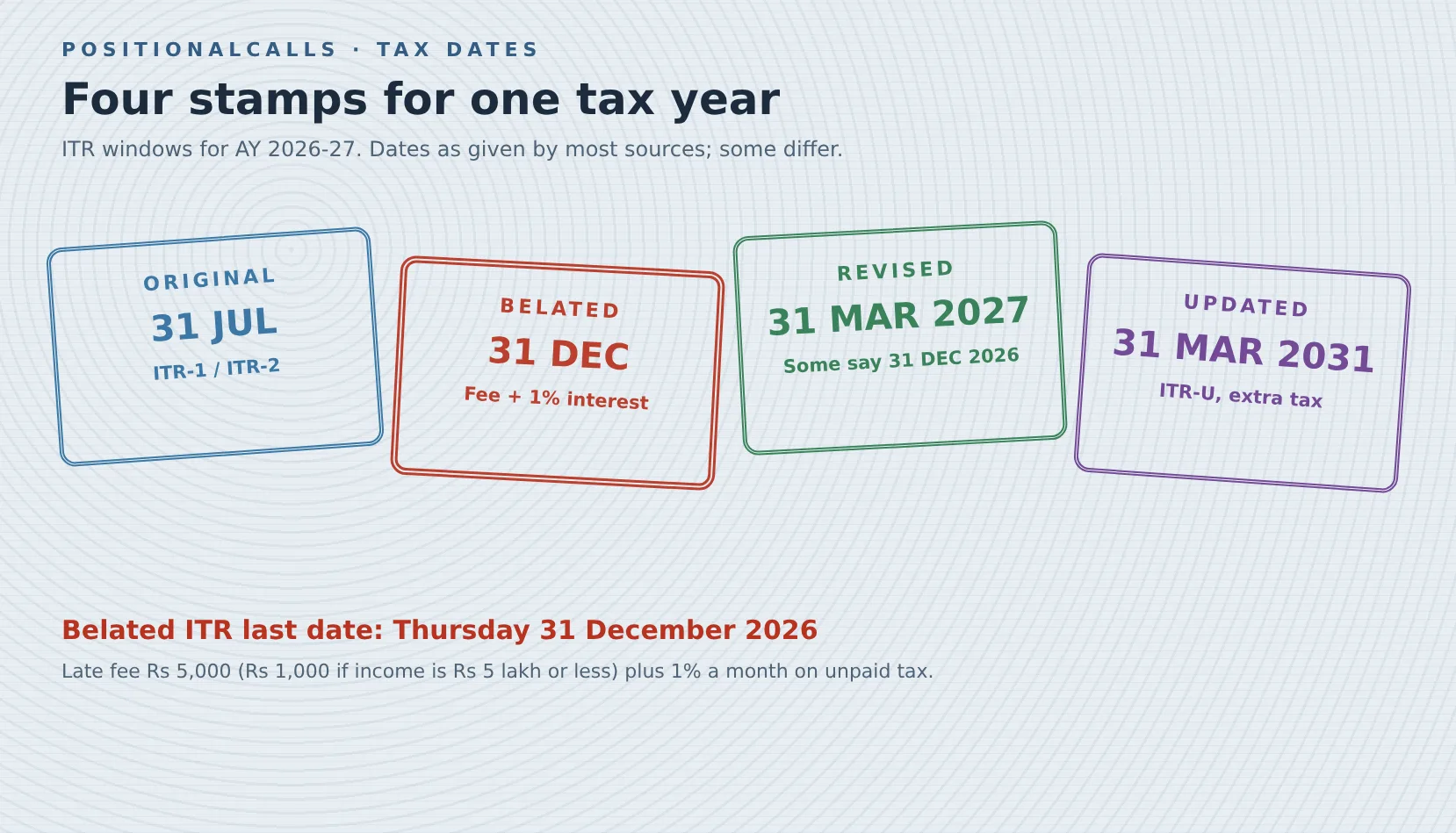
ITR windows for AY 2026-27 from the original date to the updated return. Source: ClearTax, TaxGuru and Tally, as named in the sources.
Use this calculator to see what filing after the belated ITR last date window opens costs
Choose your return type, income band, unpaid tax and the month you file, and the calculator shows the late fee, the interest and the total. The defaults are an ITR-1 or ITR-2 filer with income above Rs 5 lakh, Rs 80,000 unpaid and a filing in December 2026. Nothing you type leaves your browser.
How does the calculator count the interest months?
It counts each month after the original due date as one month, because Section 234A charges 1% per month or part of a month. For ITR-1 and ITR-2, with a 31 July due date, a December filing is five months. For ITR-3 and ITR-4 without audit, with a 31 August due date, it is four months.
What does the calculator not include?
It does not work out your tax, interest for advance tax shortfalls, surcharge or any penalty. Sources also differ on when the interest count starts. The calculator uses the month after the due date, which is the same as counting from 1 August for a 31 July due date. Confirm the final amount on the portal.
What are the ITR due dates for AY 2026-27, including the belated ITR last date?
The original date is 31 July 2026 for ITR-1 and ITR-2, the belated date is 31 December 2026, and the updated return runs to 31 March 2031. ClearTax, Tally and TaxGuru give the same dates. The table also shows the revised return date, which sources do not agree on.
| Return | Due date (AY 2026-27) | Source |
|---|---|---|
| ITR-1 and ITR-2 | 31 July 2026 | ClearTax, Patron |
| ITR-3 and ITR-4, no audit | 31 August 2026 | ClearTax, Patron |
| Audit cases | 31 October 2026 | ClearTax |
| Transfer pricing cases | 30 November 2026 | ClearTax |
| Belated return | 31 December 2026 | ClearTax, TaxGuru, BankBazaar, Tally |
| Revised return | 31 March 2027 (some sources: 31 December 2026) | ClearTax table, Qwikfilings, Patron, Tally; Kissht, BankBazaar |
| Updated return (ITR-U) | 31 March 2031 | TaxGuru, Outlook Money, Tally |
Cite this table: PositionalCalls, “ITR dates for AY 2026-27”; dates from the sources named; the dates apply unless the Income Tax Department extends them.
Can the belated ITR last date be extended?
ClearTax’s table says the dates apply unless the Income Tax Department extends them, and Taxaj says an extension is never guaranteed and is official only once the CBDT issues a notification. I found no extension of the belated date, so plan on 31 December 2026.
Why does the due date before the belated ITR last date depend on the return form?
Because the original date follows the type of taxpayer. Salaried people and investors filing ITR-1 or ITR-2 face 31 July, while business filers without audit face 31 August. The belated date is the same for all of them, so the form decides only when interest starts.
What is the difference between belated, revised and updated returns?
A belated return is a first filing after the due date, a revised return corrects a filed return, and an updated return reports missed income after the other windows close. Tally and TaxGuru set out the same split, and the table adds cost and limits.
| Return | Purpose | Deadline (AY 2026-27) | Cost and limits |
|---|---|---|---|
| Belated, Section 139(4) | File after missing the original date | 31 December 2026 | Late fee and 234A interest; some losses lost |
| Revised, Section 139(5) | Correct errors in a filed return | 31 March 2027 per most sources | Possible Section 234I fee after 31 December, per Patron |
| Updated, Section 139(8A) | Report missed income or file after all other windows | 31 March 2031 | Additional tax; one per year; no new refunds, per Tally |
Cite this table: PositionalCalls, “Types of return”; rules from Tally, TaxGuru, Patron Accounting and Outlook Money as named.
Can a belated return be revised?
Yes. ClearTax says a belated return can be revised, and Patron says a revised return can be filed until 31 March 2027, with a Section 234I fee after 31 December. The two sources on this page that give 31 December for revisions describe the older rule, so check which one applies.
Which return applies to me after 18 November 2026, before the belated ITR last date?
If you have not filed, the belated return is the route until 31 December 2026. If you filed and spotted a mistake, the revised return applies. If you missed the belated date, only the updated return remains. The belated ITR last date is therefore the point where the choices change.
How much is the late filing fee for a belated return?
The Section 234F fee is Rs 5,000 for total income above Rs 5 lakh, Rs 1,000 for Rs 5 lakh or less, and nothing below the basic exemption limit. ClearTax, Bajaj Finserv, Sahi and TaxGuru agree. Patron adds that the fee is one-time and does not rise with the delay.
| Total income | Late fee (Section 234F) | Source |
|---|---|---|
| Above Rs 5 lakh | Rs 5,000 | ClearTax, Bajaj Finserv |
| Rs 5 lakh or less, above the exemption limit | Rs 1,000 | ClearTax, Bajaj Finserv |
| Below the basic exemption limit | Nil | TaxGuru, Patron |
Cite this table: PositionalCalls, “Late fee by income”; rates from ClearTax, Bajaj Finserv, TaxGuru and Patron Accounting as named.
Is the fee the same whether I file in August or December?
Yes. Patron says the fee does not increase with delay, and ClearTax gives the same amounts for any filing between the original date and 31 December. The cost of waiting comes from interest and from the loss rule, not from the fee.
What is the basic exemption limit?
Patron names Rs 2.5 lakh under the old regime and Rs 4 lakh under the new regime. I have not checked this against the Act, so confirm the figure for your own regime before you rely on the nil fee.
How is interest on a belated return worked out?
Section 234A charges 1% per month or part of a month on the unpaid tax, and the amount grows with every month you wait. Bajaj Finserv and Tally describe the rule. Outlook Money and KoinX say it runs from 1 August, while Taxbuddy says from the original due date until filing. The table applies it to round numbers.
| Case | Fee | Interest | Total | Source |
|---|---|---|---|---|
| Rs 50,000 unpaid, filed 3 months late | Rs 5,000 | Rs 1,500 | Rs 6,500 | Patron example |
| Rs 80,000 unpaid, filed 3 months late | Rs 5,000 | Rs 2,400 | Rs 7,400 | Patron example |
| Rs 60,000 unpaid, ITR-1, filed in December | Rs 5,000 | Rs 3,000 | Rs 8,000 | My calculation |
| Rs 20,000 unpaid, income Rs 5 lakh or less, filed in September | Rs 1,000 | Rs 400 | Rs 1,400 | My calculation |
Cite this table: PositionalCalls, “Fee and interest on round numbers”; first two lines from Patron Accounting, last two my calculation at 1% a month.
Do I owe interest if all my tax is already paid?
Interest applies to unpaid tax. If TDS and advance tax already cover the full liability, there is nothing for Section 234A to run on, although the fee still applies. Interest for shortfalls in advance tax is a separate matter, covered on the advance tax due date page.
Does interest stop on the belated ITR last date?
It stops when you file and pay. Waiting until 31 December costs the most interest of any belated filing date, so each month earlier saves 1% of the unpaid tax. After that date the updated return carries additional tax on top, as the section on it explains.
What happens to losses if I miss the belated ITR last date window or file late?
Business and capital losses cannot be carried forward if the return is filed after the due date, and Patron names house property loss as the exception. Sahi and Qwikfilings say the same, and Qwikfilings calls it a costly miss for traders.
| Loss | Carry forward in a belated return? | Source |
|---|---|---|
| Capital loss on shares | No | Patron, Sahi, Qwikfilings |
| Business loss, including trading | No | Patron, Qwikfilings |
| Speculative loss | No | Qwikfilings |
| House property loss | Yes, as the exception named | Patron (Section 71B) |
Cite this table: PositionalCalls, “Loss carry-forward and late returns”; rules from Patron, Sahi and Qwikfilings as named; Act text not opened.
What can a lost carry-forward cost?
Patron’s example is an investor with a Rs 4 lakh short-term capital loss who files one day late. At a 20% short-term rate on equity, the future tax relief lost is about Rs 80,000, my calculation, and Patron gives the same estimate. The fee is Rs 5,000, so the loss rule can be the larger cost.
Does this matter for share investors?
It can. A loss from selling shares can be set off against gains in later years only if the return was filed on time. The capital gains tax on shares page explains the rates, and the capital gains tax calculator shows the tax on a trade.
PositionalCalls WhatsApp channel
Get tax deadline alerts on WhatsApp
- Tax date and rule changes, dated
- Plain-English tax guides, no tips
- Links to updated tax pages
What is the revised return deadline, and what is the Section 234I fee?
Most sources say 31 March 2027 for the revised return, and Patron says Budget 2026 moved it from 31 December and added a Section 234I fee for revisions filed after 31 December. The fee in Patron’s account is Rs 1,000 for income below Rs 5 lakh and Rs 5,000 otherwise.
| Source | Revised return deadline | Fee after 31 December |
|---|---|---|
| ClearTax due-date table | 31 March 2027 | Not stated |
| Qwikfilings, Tally, Jio Finance | 31 March 2027 | Not stated |
| Patron Accounting | 31 March 2027, extended from 31 December by Budget 2026 | Rs 1,000 or Rs 5,000 (Section 234I) |
| Kissht, BankBazaar, ClearTax guide | 31 December 2026 | Not stated |
| Incorpx | 12 months from the end of the tax year | An additional fee, amount not stated |
Cite this table: PositionalCalls, “Revised return deadline by source”; sources as named; Act text and notifications not opened.
Why does the revised return date matter for a belated filer?
Patron’s example is a belated filer who revises on 15 February 2027 and pays both the Section 234F and the Section 234I fee. If you file late and later find an error, the date and the extra fee decide the cost of fixing it.
Is the Section 234I fee confirmed?
Only Patron names it, and Sahi describes a fee of Rs 1,000 or Rs 5,000 that applies if the revision happens beyond nine months from the end of the assessment year, which does not match Patron’s wording. Treat the fee as unconfirmed here until you check the notification.
What can I do if I miss the belated ITR last date?
After 31 December 2026 the only route for AY 2026-27 is an updated return, ITR-U, under Section 139(8A), available until 31 March 2031. Outlook Money and TaxGuru give the date, and Patron describes the additional tax.
| Point | What the sources say | Source |
|---|---|---|
| Window | Up to 48 months from the end of the assessment year, to 31 March 2031 | TaxGuru, Outlook Money |
| Additional tax | 25% of tax and interest in the first 12 months, 50% later in the timeline | Patron |
| Refunds | Cannot claim new refunds or extra benefits | Tally |
| Number of filings | One updated return per assessment year | Patron |
| Deductions | Cannot add a deduction you forgot, such as 80C or HRA | Finnovate |
| Budget 2026 | Loss-reduction returns are allowed; 10% additional tax if reassessment is open | Patron |
Cite this table: PositionalCalls, “Updated return, ITR-U”; rules from the sources named; KoinX gives 31 March 2030, which looks like a typing difference.
Is the updated return a substitute for filing by the belated ITR last date?
No. It costs more, offers less and is built for disclosing income, not for ordinary late filing. It can be filed only when it results in additional tax payable, per Finnovate. Plan to file the belated return before 31 December 2026 if you can.
What does waiting until the last week of December cost in practice?
Nothing extra in fees, since the Section 234F amount is fixed, but each extra month adds 1% of the unpaid tax in interest, and a filing in the last week adds the full period. On Rs 80,000 of unpaid tax that is Rs 800 for each month of delay, my calculation. There is also the practical risk that the portal is busy near a deadline and that a return needs e-verification to count. Filing a few days early leaves time to correct a failed upload or a payment that did not post.
What did earlier years show about the cliff dates?
TaxGuru’s cliff-date article for AY 2025-26 says a taxpayer had to file by 31 December 2025 to stay in belated mode, or face a gap and then an updated return with 25% or more additional tax. The same pattern applies to this year.
How do I file a belated return online?
Use the income-tax e-filing portal, choose the 139(4) after-due-date filing type, complete the return, pay what is due and e-verify. Quicko, PersonalFN and Taxbuddy describe the steps.
- Log in to the e-filing portal.
- Go to E-file, then Income Tax Return, then File Income Tax Return.
- Select the assessment year 2026-27 and the filing type 139(4) after due date.
- Choose the ITR form that fits your income.
- Fill in income, deductions and taxes already paid, then pay any balance with interest and the fee.
- Submit and e-verify through Aadhaar OTP, net banking or another accepted method.
Can I claim a refund in a belated return?
Taxbuddy says a refund can be claimed if tax paid through TDS, advance tax or self-assessment exceeds the final liability. The late fee is still payable. Refund interest rules differ for late filers, which I have not researched here.
What should I keep ready before I file?
Keep your Form 16 or salary statement, the annual tax statement showing TDS, interest and dividend certificates, your broker’s tax profit-and-loss and capital gains statement, and challans for any advance tax or self-assessment tax paid. Having these ready before the last week of December avoids a rushed return, because the portal can be slow as the deadline nears.
Which ITR form should I use?
The form depends on your income, such as salary, capital gains or business. A belated return can use any ITR form, per Taxbuddy. Capital gains normally move a filer from ITR-1 to ITR-2, as Patron’s senior citizen page notes, but check the form instructions for your case.
What should share investors check before the belated ITR last date?
Investors should check unreported gains and dividends, losses they want to carry forward and tax paid in advance, because paying tax does not replace filing. Compliance Calendar says the return is mandatory even if tax is paid through TDS, advance tax or self-assessment, and that not filing can attract a Section 271F penalty.
| Check | Why it matters |
|---|---|
| Capital gains and losses from shares and funds | Gains are taxed and losses can be carried forward only in a timely return |
| Dividends and interest | Taxed at the slab rate; TDS already deducted is credited |
| Advance tax already paid | Counts as tax paid but does not file the return |
| Brokerage and other statements | Your tax profit-and-loss and annual statement support the figures |
| Late fee and interest | Fixed fee plus 1% a month on unpaid tax |
Cite this table: PositionalCalls, “Investor checklist for a belated return”; points from Compliance Calendar, Patron and the sources named.
Where can I read about tax on dividends and funds?
The dividend tax in India and mutual fund taxation in India pages cover the rules, and the IPO tax in India page covers listing gains. They do not replace a return, and they are general information only.
What does this belated ITR last date page leave out?
It gives dates, fees and round-number arithmetic, and it leaves out everything that depends on your own return. The table lists the main gaps.
| Left out | Why it matters |
|---|---|
| Your tax calculation | Regime, slabs, deductions and surcharge decide the amount |
| Audit cases and companies | Different deadlines and rules were not worked out here |
| Refund interest for late filers | Not researched on this page |
| Prosecution and notices | Serious cases fall outside this page |
| Act text and notifications | Dates and sections are as the sources give them |
Cite this table: PositionalCalls, “What the page leaves out”; scope set by PositionalCalls.
Why do the tax pages I find online disagree?
Many are written for a particular filing season and updated once, so a date from an earlier year can survive on a page that otherwise looks current. Others are written by firms that sell filing services and may simplify a rule. When two pages differ, prefer the one that states the assessment year and the date it was updated, and treat any date you cannot trace to a notification as unconfirmed.
Does this page cover the new Act?
Returns for FY 2025-26 are for AY 2026-27 and the sources use the 1961 Act sections such as 139(4) and 234F. The Income-tax Act, 2025 applies from Tax Year 2026-27, as the advance tax due date page explains. This page does not map those sections.
Where do sources differ on the belated ITR last date and costs?
The belated date of 31 December 2026 is nearly universal, and sources differ on the revised date, the original due date for non-audit filers, the interest start and the updated return year. The table lists the differences and what this page does.
| Item | View A | View B | What the page does |
|---|---|---|---|
| Revised return date | 31 March 2027 (ClearTax table, Patron, Tally) | 31 December 2026 (Kissht, BankBazaar) | Gives both and flags it |
| Belated window | 31 December 2026 (most sources) | 12 months, per the Finance Act 2026 (Incorpx) | Uses 31 December 2026 |
| Non-audit original date | 31 July for ITR-1 and ITR-2 (ClearTax, Patron) | 31 August for non-audit assessees (Incorpx) | Uses the ClearTax split by form |
| Interest start | From 1 August (Outlook Money, KoinX) | From the day after the due date (Patron FAQ) | Counts months after the due date |
| Updated return last date | 31 March 2031 (TaxGuru, Tally) | 31 March 2030 (KoinX) | Uses 2031 |
Cite this table: PositionalCalls, “Belated ITR source conflicts”; sources as named; Act text, notifications and portal not opened.
What should I check before relying on this page?
- The due date for your form on the income-tax portal.
- Whether the revised return date applies to you.
- Your total income band for the fee.
- Unpaid tax and interest, using the portal’s figure.
- Your own facts with a qualified professional.
What is this page not for?
It does not tell you how much tax you owe or what to do with your investments. PositionalCalls is not a SEBI-registered research analyst or investment adviser, and I am not a chartered accountant. The calculator applies stated rates to numbers you enter.
PositionalCalls WhatsApp channel
Tax dates in one channel
- Rule changes, dated
- Tools without tips
- Links to new guides
Belated ITR last date: frequently asked questions
What is the belated ITR last date for FY 2025-26?
The belated ITR last date for FY 2025-26 (AY 2026-27) is 31 December 2026, per ClearTax, TaxGuru and BankBazaar. It is 43 days after 18 November. A belated return is filed under Section 139(4) after the original due date, with a late fee and interest. After that date only an updated return, ITR-U, remains.
How much is the late fee for a belated ITR?
The Section 234F fee is Rs 5,000 if total income is above Rs 5 lakh and Rs 1,000 if it is Rs 5 lakh or less, per ClearTax and Bajaj Finserv. No fee applies if total income is below the basic exemption limit, per TaxGuru. The fee is one-time and does not grow with the delay.
What interest do I pay on a belated return?
Section 234A charges 1% per month or part of a month on unpaid tax, per Bajaj Finserv and Tally. If Rs 80,000 is unpaid and you file in December after a 31 July due date, that is five months, or Rs 4,000, my calculation. Sources differ on whether the count starts on 1 August or the day after.
Can I carry forward losses if I file a belated return?
No for capital and business losses. Patron Accounting says filing after the due date means business and capital losses cannot be carried forward, with house property loss as the exception it names. A Rs 4 lakh short-term capital loss at a 20% rate could mean about Rs 80,000 of future tax relief lost, my calculation.
Is the revised return deadline 31 December 2026 or 31 March 2027?
Sources disagree. ClearTax’s table, Qwikfilings, Patron and Tally say 31 March 2027, while Kissht, BankBazaar and a ClearTax guide say 31 December 2026. Patron says Budget 2026 moved it and added a Section 234I fee after 31 December. I did not open the Act, so check the portal before relying on either date.
What happens if I miss the belated ITR last date?
You can still file an updated return, ITR-U, under Section 139(8A), until 31 March 2031 for AY 2026-27, per TaxGuru and Outlook Money. It carries additional tax, 25% of tax and interest in the first 12 months per Patron, and it cannot claim new refunds, per Tally. The belated return route closes.
Do I have to file a return if my tax is already paid through TDS or advance tax?
Yes. Compliance Calendar says filing is mandatory even if the tax has been paid through TDS, advance tax or self-assessment tax, and that not filing can attract a penalty under Section 271F. Paying advance tax is not a substitute for the return. This belated ITR last date page is general information, not advice.
Does the new Finance Act 2026 change the belated ITR last date?
Incorpx says the Finance Act 2026 made the belated and revised windows 12 months, and moved the non-audit due date to 31 August. Most other sources still give 31 December 2026 for belated returns and 31 July for ITR-1 and ITR-2. This conflict is unresolved here because I did not open the Act or the notification.
How do I file a belated return online?
Log in to the income-tax e-filing portal, go to E-file, then Income Tax Return, then File Income Tax Return, choose the assessment year and the filing type 139(4) after due date, fill in your income, pay any tax and interest due, and submit, per Quicko and PersonalFN. E-verification is mandatory, per Taxbuddy.
Is this belated ITR last date page tax advice?
No. PositionalCalls is not a SEBI-registered research analyst or investment adviser, and I am not a chartered accountant. The page gives dates, rules and arithmetic from the sources named, and the calculator does not work out your tax. Dates and sections were not checked against the Act or the portal, so confirm them with a qualified professional.
Sources for the belated ITR last date page
- ClearTax: ITR filing last, tax.
- ClearTax: submit past year, tax.
- ClearTax: penalty for late, tax.
- BankBazaar: ITR filing due, broker.
- TaxGuru: ITR deadline calendar, tax.
- TaxGuru: ITR due dates, tax.
- TaxGuru: cliff dates for, tax.
- Outlook Money: belated ITR filing, industry.
- Patron Accounting: belated ITR penalty, tax.
- Qwikfilings: belated return, tax.
- Tally: tax return due, industry.
- Bajaj Finserv: penalty for late, broker.
- Sahi: ITR penalties for, broker.
- Incorpx: ITR due date, tool.
- KoinX: missed ITR deadline, tool.
- Jio Finance: ITR deadlines and, broker.
- Kissht: ITR filing last, broker.
- Taxaj: ITR due dates, tax.
- Finnovate: ITR-U updated return, tax.
- Compliance Calendar: belated ITR under, tax.
- Quicko: file belated return, tool.
- PersonalFN: belated return and, industry.
- Taxbuddy: refund in a, tax.
- Not opened: the Income-tax Act, CBDT notifications and the e-filing portal; the formula and statements are from the sources above.
PositionalCalls.com is an independent research site founded by Shubham Chaudhary. PositionalCalls.com is not a SEBI-registered research analyst or investment adviser. Investments in securities markets are subject to market risks. Read all related documents carefully before investing. Returns are never guaranteed. This page is educational and publishes no subscribe, avoid, buy, sell, rating or target calls. Sources: calculator, broker and tax pages as named; no Income-tax Act or notification text opened; no fund, buy, sell or avoid view given. I am not a chartered accountant.

Shubham Chaudhary is the founder of PositionalCalls, an independent Indian stock market research website. He writes company fundamentals, quarterly results analysis, IPO analysis and sector research for NSE and BSE listed companies, with a focus on banking stocks, insurance and long-term value investing. Every article is built from primary sources such as RBI, SEBI, NSE and BSE filings and company annual reports, and states its risks plainly in simple language for retail investors.
Coverage areas Our research standards- Numbers checked against NSE, BSE and SEBI filings
- Risks and limits stated in every article
- No paid promotions or broker tie-ups
- Articles updated when new filings arrive