
Income Tax · ITR form guide AY 2026-27
This guide shows which ITR to file for AY 2026-27: who can use ITR-1, ITR-2, ITR-3 and ITR-4, how capital gains, house property, NRI status and business income change the form, the due dates, and what a wrong choice costs.
Quick answer
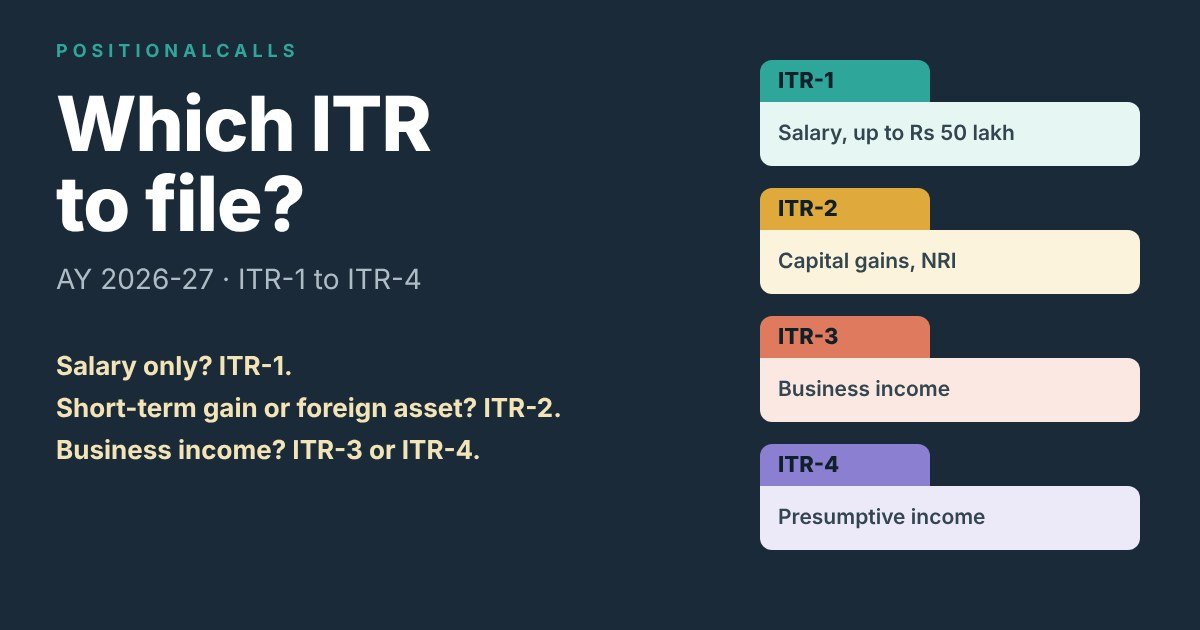
Your income sources decide which ITR to file, not your job. Resident salaried people with income up to Rs 50 lakh use ITR-1, capital gains above Rs 1.25 lakh or foreign assets need ITR-2, business income needs ITR-3, and presumptive income under Section 44AD, 44ADA or 44AE uses ITR-4.
Key takeaways on the ITR form
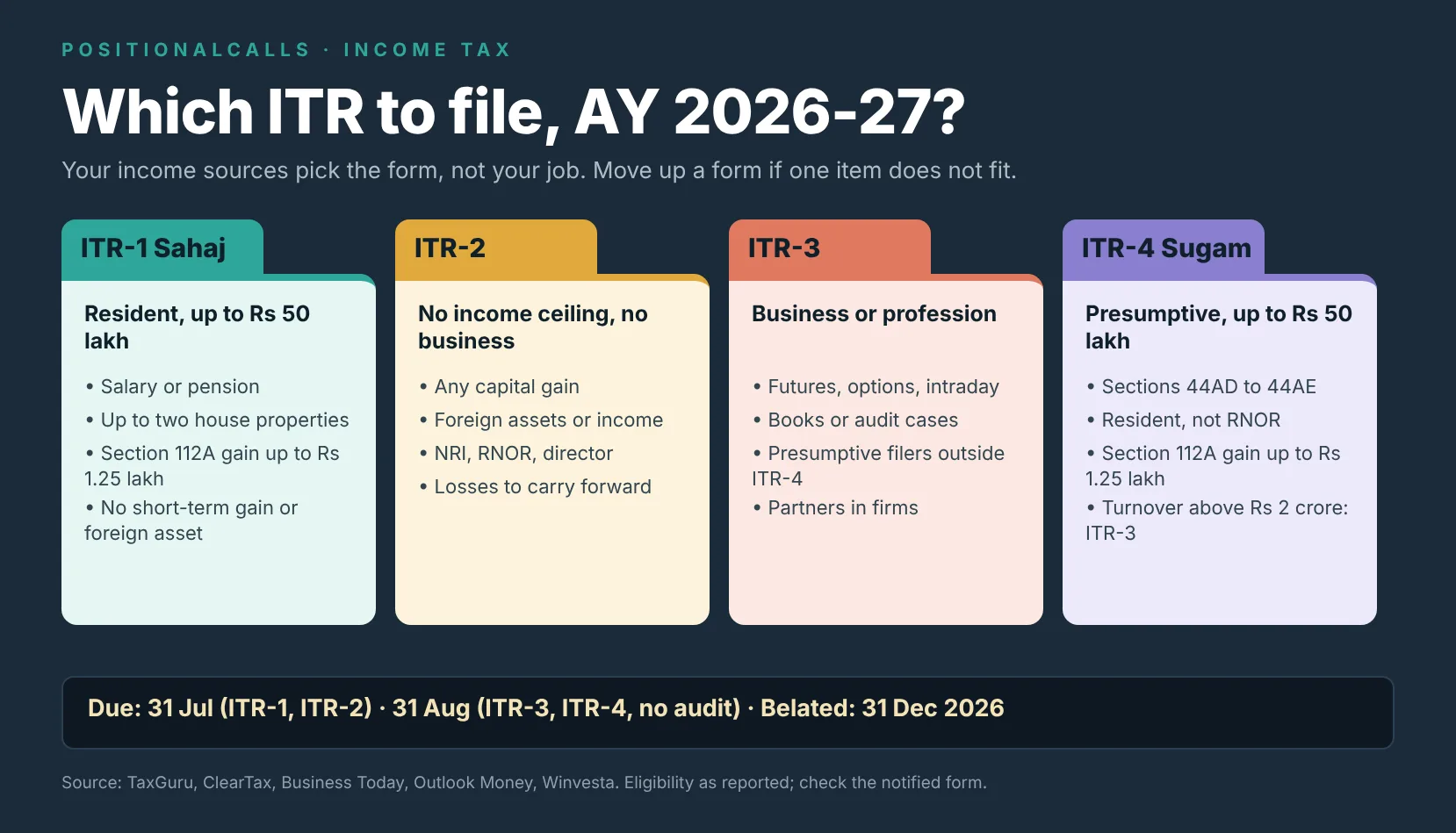
- ITR-1: resident, income up to Rs 50 lakh, salary or pension, up to two house properties, Section 112A gains up to Rs 1.25 lakh.
- ITR-2: no income ceiling and no business income; takes capital gains, foreign assets and non-residents.
- ITR-3 and ITR-4: business or professional income, with ITR-4 only for presumptive income up to Rs 50 lakh.
- Higher form: allowed; a lower form than you qualify for is not.
- Dates: the original dates have passed, and the belated window runs to 31 December 2026.
In plain words: the tax department has several return forms, and each one has a list of what it can carry. You pick the simplest form that can hold every kind of income and asset you had in the year. If even one item does not fit, you move up a form.
Data note: as of Friday, 20 November 2026, 8:15 PM IST. Eligibility, limits and dates come from the pages named in the sources list, read as search extracts, not from the notified forms or the Income-tax Act. Rules for AY 2026-27, the return for the year to 31 March 2026, follow the Income-tax Act, 1961. I did not open the Income Tax Department site, and where sources differ the page says so.
Which ITR to file: how do you pick the right form?
Pick the form by what you earned and owned, in this order: business income first, then residency, then capital gains, house property, foreign assets and total income. Business Today says salary does not decide the form, and that the sources of income do.
There are seven return forms, but individuals and HUFs use four of them, ITR-1 to ITR-4, and Zoho Payroll says the CBDT notified all seven for AY 2026-27 on 30 March 2026. ITR-5, ITR-6 and ITR-7 are for firms, companies and trusts, so they do not matter to most readers of this guide.
| Form | Who it is for | Income ceiling | Source |
|---|---|---|---|
| ITR-1 (Sahaj) | Resident with salary, pension, house property and interest | Rs 50 lakh | TaxGuru, ClearTax |
| ITR-2 | Individual or HUF with no business income, any residency | None | TaxGuru, ClearTax |
| ITR-3 | Individual or HUF with business or professional income | None | ClearTax |
| ITR-4 (Sugam) | Resident with presumptive business income only | Rs 50 lakh | TaxGuru, ClearTax |
Cite this table: Which ITR to file, the four forms for individuals, PositionalCalls, Friday, 20 November 2026, 8:15 PM IST, per TaxGuru, ClearTax and Zoho Payroll.
Which ITR to file if more than one form fits?
Choose the simplest one you qualify for, or a higher one if you prefer. Calcguru says a person eligible for ITR-1 may validly file ITR-2, and an ITR-4 filer may use ITR-3, while the reverse is what causes defective-return notices. TaxGuru says the same of ITR-4, which an eligible person may swap for ITR-3.
Who can file ITR-1 Sahaj for AY 2026-27?
ITR-1 is for a resident, not an RNOR, whose total income is up to Rs 50 lakh from salary or pension, house property, other sources and a small long-term equity gain. TaxGuru lists permitted income as salary, house property, other sources such as interest and dividend, agricultural income up to Rs 5,000 and Section 112A gains up to Rs 1.25 lakh.
The change that matters most for AY 2026-27 is the house property limit. Business Today says ITR-1 can be used for income from up to two house properties, where earlier the simplified return was generally for one. That means a person who lives in one home and rents out another can stay in ITR-1, per 1finance, provided no other exclusion applies.
| ITR-1 allows | ITR-1 does not allow |
|---|---|
| Salary or pension | Director in a company |
| Up to two house properties, per Business Today | Any short-term capital gain |
| Interest, dividend and family pension | Section 112A gain above Rs 1.25 lakh |
| Agricultural income up to Rs 5,000 | Unlisted equity shares held at any time in the year |
| Section 112A long-term gain up to Rs 1.25 lakh | Any asset or income outside India |
| Total income up to Rs 50 lakh | Signing authority in a foreign account |
| Resident status, not RNOR | TDS under Section 194N, deferred ESOP tax or any loss to carry forward |
Cite this table: Which ITR to file, ITR-1 allowed and excluded items, PositionalCalls, Friday, 20 November 2026, 8:15 PM IST, per TaxGuru, ClearTax and Business Today.
What small items quietly disqualify ITR-1?
TaxGuru gives three that catch people. A short-term gain of even Rs 500 under Section 111A rules the return out. A brought-forward capital loss rules out ITR-1 even when your 112A gains are within Rs 1.25 lakh. A single Section 194N entry in Form 26AS, which is TDS on large cash withdrawals, disqualifies the return whatever the amount.
Who must file ITR-2?
ITR-2 is for an individual or HUF with no business or professional income, of any residency, and it has no income ceiling. TaxGuru says it takes total income above Rs 50 lakh, more than one house property, capital gains of any kind, a directorship or unlisted shares, foreign assets, agricultural income above Rs 5,000 and carried-forward losses.
ClearTax adds that ITR-2 is also the form for NRIs and RNORs. The one thing it cannot carry is business or professional income. TaxGuru warns against reporting professional receipts as income from other sources to avoid the business schedules, because the return then misstates the head of income.
| Reason to move to ITR-2 | Why | Source |
|---|---|---|
| Income above Rs 50 lakh | ITR-1 and ITR-4 stop at Rs 50 lakh | TaxGuru |
| More than two house properties | Beyond the ITR-1 limit | ClearTax |
| Short-term capital gain | Not allowed in ITR-1 | TaxGuru |
| Long-term gain above Rs 1.25 lakh | Beyond the 112A allowance | Outlook Money |
| Foreign asset or foreign income | Needs Schedule FA | TaxGuru |
| Director or unlisted shares | Excluded from ITR-1 | TaxGuru |
| Brought-forward loss | Excluded from ITR-1 | TaxGuru |
Cite this table: Which ITR to file, reasons to use ITR-2, PositionalCalls, Friday, 20 November 2026, 8:15 PM IST, per TaxGuru, ClearTax and Outlook Money.
Is ITR-2 harder than ITR-1?
It asks for more schedules, mainly capital gains and foreign assets, but the salary and deduction parts match ITR-1. Legaldev lists the common triggers as capital gains beyond the small equity exemption and more property than ITR-1 allows. If a pre-filled statement shows gains, expect ITR-2.
When is ITR-3 the form to file?
ITR-3 is for an individual or HUF with income from a business or profession, and also for presumptive filers who do not fit ITR-4. ClearTax says it covers business or professional income in presumptive or audit cases, including partners in firms, with salary, house property and other sources allowed alongside.
TaxGuru says ITR-3 is the form for business income not computed under the presumptive scheme, for presumptive filers who want to declare less than the presumptive rate, for presumptive filers with gains outside the ITR-4 window and for those with losses to carry forward. Kanakkupillai says AY 2026-27 brings separate reporting of futures and options and intraday trading income in this form.
Which ITR to file for futures and options trading?
ITR-3, per Kanakkupillai. Trading in futures and options, or intraday trading, is treated as business income, so it cannot sit in ITR-2 even if the amounts are small. Delivery-based share sales are different, because those are capital gains, and the capital gains section below shows where they go.
Who can file ITR-4 Sugam?
ITR-4 is for a resident individual, HUF or resident firm other than an LLP whose business income is taxed under the presumptive rules of Section 44AD, 44ADA or 44AE, with total income up to Rs 50 lakh. TaxGuru lists salary, one house property, other sources, agricultural income up to Rs 5,000 and Section 112A gains up to Rs 1.25 lakh as the other income it allows, while ClearTax says two house properties.
ClearTax says freelancers with gross receipts up to Rs 50 lakh can use the presumptive scheme, and that a business turnover above Rs 2 crore means ITR-3. TaxGuru lists the exclusions as a directorship, any short-term gain, a 112A gain above Rs 1.25 lakh, unlisted shares, foreign assets or income, deferred ESOP tax, brought-forward losses and income above Rs 50 lakh.
| Test | ITR-4 | ITR-1 | Source |
|---|---|---|---|
| Business income | Presumptive only | None | TaxGuru |
| Total income | Up to Rs 50 lakh | Up to Rs 50 lakh | TaxGuru |
| Residency | Resident, not RNOR | Resident, not RNOR | TaxGuru |
| Section 194N TDS | Not listed as an exclusion | Excludes | TaxGuru |
| Short-term gain | Excluded | Excluded | TaxGuru |
| Section 112A gain | Up to Rs 1.25 lakh | Up to Rs 1.25 lakh | TaxGuru, ClearTax |
Cite this table: Which ITR to file, ITR-4 against ITR-1, PositionalCalls, Friday, 20 November 2026, 8:15 PM IST, per TaxGuru and ClearTax.
What extra do ITR-4 filers report for AY 2026-27?
Kanakkupillai says AY 2026-27 asks ITR-4 filers for additional disclosure of investment and bank balance details. The presumptive rates are not stated in the sources I read, so check the Section 44AD, 44ADA and 44AE rates before choosing the scheme.
Which ITR to file with capital gains from shares and mutual funds?
ITR-1 takes only a long-term gain under Section 112A up to Rs 1.25 lakh, and everything else in capital gains goes to ITR-2. Outlook Money says the Rs 1.25 lakh mark is both the exemption threshold for such gains and the upper limit for using ITR-1.
Outlook Money says ITR-1 can be used where eligible gains do not exceed Rs 1.25 lakh, even at exactly Rs 1.25 lakh, but any amount above it needs ITR-2, with the transactions reported in the capital gains schedules. Short-term gains cannot be reported in ITR-1 at all. The rules for tax rates sit in the guides on capital gains tax on shares and mutual fund taxation.
| Your capital gain | Form | Source |
|---|---|---|
| Long-term gain on listed shares, Rs 1,00,000 | ITR-1, if no loss to carry forward | TaxGuru, Outlook Money |
| Long-term gain on listed shares, Rs 1,25,000 | ITR-1, exactly at the limit | Outlook Money |
| Long-term gain on listed shares, Rs 1,50,000 | ITR-2 | Outlook Money |
| Short-term gain of any size on shares | ITR-2 | TaxGuru |
| Brought-forward capital loss, any gain | ITR-2 | TaxGuru |
| Futures and options or intraday income | ITR-3 | Kanakkupillai |
Cite this table: ITR form guide: with capital gains, PositionalCalls, Friday, 20 November 2026, 8:15 PM IST, per TaxGuru, Outlook Money and Kanakkupillai.
Which ITR to file for mutual fund redemptions and ESOPs?
Equity fund redemptions follow the same rule as shares, because Section 112A covers listed equity and equity-oriented funds, per Upstox. Debt fund gains and sales of unlisted shares are not 112A items, so they need ITR-2. Deferred ESOP tax and foreign shares also rule out ITR-1, per TaxGuru.
Upstox adds that the older split of capital gains rates at 10% and 15% has been removed from the ITR-2 schedules for AY 2026-27, and Calcguru says the 23 July 2024 date split is gone, so the whole year follows the new rates. That changes the schedule layout, not which form you choose.
Which ITR to file if you are an NRI, RNOR or resident with foreign assets?
A non-resident or RNOR cannot use ITR-1 or ITR-4 and files ITR-2, or ITR-3 if there is business income. TaxGuru says ITR-1 and ITR-4 are limited to residents who are not RNOR, and that ITR-2 is the form for non-residents and RNORs.
A resident can also be pushed out of ITR-1 by what they own. TaxGuru lists any asset outside India, including a financial interest in an entity, signing authority in an overseas account and any income from outside India as exclusions. ClearTax lists the same for ITR-4. A salaried person with foreign shares from an employer plan therefore files ITR-2.
| Situation | Form | Source |
|---|---|---|
| Non-resident, salary or interest income in India | ITR-2 | TaxGuru |
| RNOR, capital gains and deposit interest | ITR-2 | TaxGuru |
| Resident with a foreign bank account | ITR-2 | TaxGuru |
| Resident with signing authority abroad | ITR-2 | TaxGuru |
| Non-resident with Indian business income | ITR-3 | ClearTax |
Cite this table: ITR form guide: for NRIs and foreign assets, PositionalCalls, Friday, 20 November 2026, 8:15 PM IST, per TaxGuru and ClearTax.
Does residency depend on the form?
No, the form follows residency, not the other way round. Work out your residential status for the year first. The nri investment guide on this site covers how NRIs can invest in Indian shares.
PositionalCalls WhatsApp channel
Get tax and savings explainers on WhatsApp
- Slab and deduction changes, dated
- Calculators explained without tips
- Links to updated tax guides
Which ITR to file in common situations?
Most readers fall into one of about a dozen cases, and the table below maps each to a form using the eligibility rules above. These are my own mapping of the sourced rules to examples, not a statement from any source, so test yours against the exclusion lists.
| Your situation | Likely form | Why |
|---|---|---|
| Salary only, income Rs 18 lakh | ITR-1 | Within Rs 50 lakh, no exclusion |
| Salary plus rent from two flats | ITR-1 | Two house properties allowed |
| Salary plus rent from three flats | ITR-2 | More than two properties |
| Salary and Rs 90,000 long-term equity gain | ITR-1 | Under Rs 1.25 lakh |
| Salary and Rs 2 lakh long-term equity gain | ITR-2 | Above Rs 1.25 lakh |
| Salary and a small short-term gain | ITR-2 | Any short-term gain |
| Salary and income above Rs 50 lakh | ITR-2 | Over the ceiling |
| Salary and a director role | ITR-2 | Directorship excluded |
| Freelancer on presumptive income | ITR-4 | Section 44ADA, up to Rs 50 lakh |
| Freelancer with a capital gain | ITR-3 | Gain outside the ITR-4 window |
| Futures and options trader | ITR-3 | Business income |
| Senior citizen with pension and interest | ITR-1 | Within limits, if resident |
Cite this table: Which ITR to file, worked situations, PositionalCalls, Friday, 20 November 2026, 8:15 PM IST, my mapping of TaxGuru, ClearTax and Business Today rules.
Which ITR to file for a senior citizen?
Age does not change the form. Upstox says a senior citizen’s form depends on where income comes from. A resident senior with a pension and bank interest, with no capital gains and no foreign assets, fits ITR-1, and the same exclusions apply as for anyone else.
ITR form selector: check which form fits your case
This selector applies the eligibility rules described above to your answers and names the form that fits. It runs in your browser and stores nothing. It is an illustration of the sourced rules, not tax advice.
Which ITR form fits you? (AY 2026-27)
The selector treats Section 194N as an ITR-1 exclusion only, matching TaxGuru, and it points a non-resident with business income to ITR-3. It does not handle firms, trusts or companies, which use other forms, and it cannot see facts you did not enter.
What are the ITR due dates for AY 2026-27 by form?
ITR-1 and ITR-2 were due on 31 July 2026, non-audit ITR-3 and ITR-4 on 31 August 2026, audit cases on 31 October 2026, and a belated return can be filed up to 31 December 2026. TaxGuru lists the full set and adds 30 November 2026 for Section 92E transfer pricing cases.
Winvesta says the Finance Act 2026 amended Section 139(1) itself, moving non-audit ITR-3 and ITR-4 filers from 31 July to 31 August from AY 2026-27, so it is a permanent change and not an extension. TaxGuru adds that audit liability under Section 44AB, not the form, is what drives the date, so two people on the same form can have different dates.
| Category | Original due date | Source |
|---|---|---|
| ITR-1 and ITR-2 | 31 July 2026 | TaxGuru |
| ITR-3 and ITR-4, no audit | 31 August 2026 | TaxGuru, Winvesta |
| Audit cases under Section 44AB | 31 October 2026 | TaxGuru |
| Transfer pricing, Section 92E | 30 November 2026 | TaxGuru, Winvesta |
| Belated return, Section 139(4) | 31 December 2026 | TaxGuru |
| Revised return, Section 139(5) | 31 March 2027, per TaxGuru | TaxGuru |
Cite this table: Which ITR to file, due dates by category, PositionalCalls, Friday, 20 November 2026, 8:15 PM IST, per TaxGuru and Winvesta.
The revised return date is disputed. The belated ITR guide on this site records that some sources give 31 December 2026 for a revised return and others 31 March 2027, so this page repeats the TaxGuru date with its source and does not settle it. The late fee and interest are set out in that guide.
What happens if you file the wrong ITR form?
Using a form you are not eligible for can make the return defective under Section 139(9), per 1finance, so the department can ask you to correct it. 1finance says if even one exclusion is true, filing ITR-1 would make the return defective, and you must move to the correct form.
Calcguru draws the line clearly: filing a higher form than needed is valid, and the reverse is what draws a defective-return notice. A salaried person with a Rs 3 lakh long-term equity gain who files ITR-1 is in the second group, while the same person filing ITR-2 is fine. Legaldev adds that a wrong form can also expose a late filer to the Section 234I fee.
| Mistake | Result | Source |
|---|---|---|
| ITR-1 when a short-term gain exists | Defective return risk | 1finance, TaxGuru |
| ITR-2 when ITR-1 would do | Valid, longer form | Calcguru |
| ITR-4 with a brought-forward loss | Excluded from ITR-4 | TaxGuru |
| ITR-3 when ITR-4 would do | Valid | TaxGuru |
| Professional receipts as other sources | Misstated head of income | TaxGuru |
Cite this table: Which ITR to file, mistakes and results, PositionalCalls, Friday, 20 November 2026, 8:15 PM IST, per 1finance, Calcguru, TaxGuru and Legaldev.
How do you fix a return filed in the wrong form?
Respond to the notice on the portal, or file a corrected return in the right form if the window is open. I did not find the exact cure period in the sources I read, so use the date on the notice, and see the belated ITR guide for the revised and updated return windows.
What changed in the ITR forms for AY 2026-27?
The CBDT notified the forms on 30 March 2026, and the two changes that matter for most people are two house properties in ITR-1 and Section 112A gains up to Rs 1.25 lakh in ITR-1. Zoho Payroll and Business Today give the notification date, and Upstox lists the same two changes.
| Change | Effect | Source |
|---|---|---|
| Forms notified 30 March 2026 | Filing could start before 31 July | Zoho Payroll, Business Today |
| ITR-1 takes up to two house properties | Fewer people move to ITR-2 | Business Today, Upstox |
| ITR-1 takes 112A gains up to Rs 1.25 lakh | Small equity investors stay in ITR-1 | TaxGuru, Upstox |
| Old 10% and 15% gains rates removed from ITR-2 schedules | Layout change | Upstox |
| Schedule AL only above Rs 1 crore of income | Fewer asset details | Calcguru |
| Separate reporting of futures, options and intraday in ITR-3 | More detail for traders | Kanakkupillai |
| More investment and bank detail in ITR-4 | Extra disclosure | Kanakkupillai |
Cite this table: Which ITR to file, changes in the AY 2026-27 forms, PositionalCalls, Friday, 20 November 2026, 8:15 PM IST, per Zoho Payroll, Business Today, Upstox, Calcguru and Kanakkupillai.
Upstox points out that the Income-tax Act, 2025 does not apply to AY 2026-27. It applies to income earned from 1 April 2026, which is filed as AY 2027-28 in July 2027. For this return, forms under the 1961 Act are used, as TaxGuru also says.
Does your tax regime change which ITR to file?
No, the regime changes what you report inside the form, not the form. Kanakkupillai says the choice of regime does not change the ITR form, and that the new regime is the default for AY 2026-27.
There is one trap for business and professional filers. TaxGuru says a person with business income who wants the old regime must file Form 10-IEA by the Section 139(1) due date, and that re-entry into the new regime is allowed once in a lifetime. Salaried filers without business income can choose in the return. Compare both regimes in the income tax calculator before you choose.
Which ITR to file if you claim HRA, 80C or home loan interest?
The deductions need the old regime, but they do not change the form. A salaried person claiming the HRA exemption, a Section 80C deduction or home loan interest can still file ITR-1 if the other tests are met. The guides on HRA exemption and the Section 80C limit show what each claim is worth.
Which ITR form applies for Tax Year 2026-27 under the new Act?
The return for income earned from 1 April 2026 falls under the Income-tax Act, 2025 and is filed as AY 2027-28 in July 2027, and I found no notified ITR forms for it in the sources I read. Upstox says the Act does not apply to AY 2026-27 and starts for income earned from 1 April 2026.
That means the form names and rules in this guide are for the return you can still file for the year to 31 March 2026. Parts of the framework, such as the salary TDS forms, have already been renumbered, as the guide on TDS on salary shows, so expect new form numbers and section references when the Tax Year 2026-27 returns are notified. This page will be updated then.
Calcguru notes that the governing filing section, Section 139(1) of the 1961 Act, becomes Section 263(1) in the 2025 Act from Tax Year 2026-27. A person reading an old guide should check the Act it is written under.
What documents do you need before you choose the form?
Collect the salary certificate, interest certificates, capital gains statements and the tax credit statement before you decide, because a gain or a foreign asset you forgot is what usually changes the form. 1finance tells ITR-1 filers to verify the pre-filled information on the portal before they submit.
- Salary: Form 16 or the employer’s TDS certificate, see the guide on TDS on salary.
- Investments: broker capital gains statements and mutual fund statements, since any short-term gain rules out ITR-1.
- Property: rent receipts and loan interest certificates, with the number of properties.
- Overseas: statements for any foreign account, share plan or income.
- Business: books or turnover records, and the Form 10-IEA decision if you want the old regime.
Check the annual statement on the portal for Section 194N entries and for gains you did not expect, since both change the form. The advance tax due date guide covers the part of your tax that is paid during the year.
What mistakes do people make when choosing an ITR form?
The common errors are assuming salary means ITR-1, forgetting a small short-term gain, ignoring a foreign share plan and treating trading as capital gains. Each one comes from the exclusion lists above.
- Salary equals ITR-1: Business Today says salary does not decide the form.
- Small gain ignored: TaxGuru says a Rs 500 short-term gain rules out ITR-1.
- Carried-forward loss ignored: it rules out ITR-1 and ITR-4.
- Foreign shares ignored: any asset outside India rules out ITR-1.
- Trading as gains: futures and options and intraday income belong in ITR-3.
What does this guide leave out?
It leaves out firms, companies, trusts, the presumptive rate tables, tax computation and the steps to file on the portal. It covers only the form choice for individuals and HUFs.
- No statute text: I did not open the Income-tax Act or the notified forms, so the limits rest on the sources named.
- No portal check: I did not open the Income Tax Department site or the filing utilities.
- No personal advice: your facts decide your form.
When will this page on which ITR to file be updated?
When the Tax Year 2026-27 forms are notified, and if any source corrects the house property or capital gains limits. The update line at the top shows the last real change.
PositionalCalls WhatsApp channel
Tax updates in one channel
- Budget and notification changes
- Plain-English tax explainers
- Links to new guides
Which ITR to file: frequently asked questions
Which ITR to file for AY 2026-27 if I only have salary?
File ITR-1 if you are a resident with total income up to Rs 50 lakh, no more than two house properties and none of the exclusions, per TaxGuru and ClearTax. File ITR-2 if you are above Rs 50 lakh, have a short-term gain, a foreign asset, a carried-forward loss or a directorship. Salary alone does not decide the form.
Can I file ITR-1 if I have capital gains?
Only in one narrow case. For AY 2026-27, long-term gains under Section 112A, on listed shares and equity funds, are allowed in ITR-1 up to Rs 1.25 lakh, per TaxGuru and Outlook Money. Any short-term gain, any 112A gain above Rs 1.25 lakh or any brought-forward capital loss moves you to ITR-2.
What is the difference between ITR-1 and ITR-2?
ITR-1 is for residents with income up to Rs 50 lakh from salary, pension, house property and other sources. ITR-2 has no income ceiling and also takes capital gains of any kind, foreign assets, a directorship, unlisted shares, agricultural income above Rs 5,000, losses to carry forward and non-resident status, per TaxGuru and ClearTax. Neither takes business income.
Which ITR to file for freelancers and small business owners?
ITR-4 if you opt for presumptive income under Section 44AD, 44ADA or 44AE, are a resident and have total income up to Rs 50 lakh. ITR-3 if you keep full books, want to declare less than the presumptive rate, or have turnover above Rs 2 crore, per ClearTax and TaxGuru. A non-audit return in either form was due by 31 August 2026.
Which ITR to file for share trading, futures and options and intraday income?
ITR-3, because trading income from futures and options and from intraday trades is business income, and Kanakkupillai says AY 2026-27 asks for separate reporting of both in that form. A salaried person who only sold delivery shares reports capital gains, in ITR-1 within the Rs 1.25 lakh long-term limit and in ITR-2 beyond it.
Which ITR to file if I am an NRI or RNOR?
ITR-2 if you have no business income, or ITR-3 if you do. ITR-1 and ITR-4 are limited to residents who are not RNOR, per TaxGuru and ClearTax, so a non-resident or resident-but-not-ordinarily-resident person cannot use them, whatever the income. Foreign assets and foreign income also push a resident into ITR-2.
What happens if I file the wrong ITR form?
1finance says the return becomes defective under Section 139(9) if you use a form you are not eligible for. Calcguru adds that filing a higher form than needed is valid, for example ITR-2 when you qualify for ITR-1, while the reverse causes defective-return notices. I did not find the cure period in the sources I read, so check the notice.
What is the last date to file ITR for AY 2026-27?
The original dates have passed: 31 July 2026 for ITR-1 and ITR-2, and 31 August 2026 for non-audit ITR-3 and ITR-4, per TaxGuru. A belated return under Section 139(4) can be filed up to 31 December 2026 with a late fee and interest, per TaxGuru. See the belated ITR guide on this site for the cost.
Does the tax regime change which ITR to file?
No. Kanakkupillai says your tax regime does not change the form, but it changes what you report inside it, and the new regime is the default for AY 2026-27. Business and professional filers who want the old regime must file Form 10-IEA by the due date, per TaxGuru, so the regime choice must come before filing.
Is this guide to which ITR to file tax advice?
No. PositionalCalls is not a tax practitioner, a SEBI-registered research analyst or an investment adviser. This page explains the form eligibility rules as the named sources describe them, and I did not open the Income Tax Department site or the notified forms. Confirm your form on the e-filing portal or with a chartered accountant before you file.
Sources for this ITR form guide
- ClearTax: which ITR to file for AY 2026-27.
- TaxGuru: ITR-1, ITR-2 and ITR-4 eligibility for AY 2026-27.
- TaxGuru: changes in ITR-1 and ITR-2 for AY 2026-27.
- TaxGuru: Finance Act 2026 due dates for non-audit returns.
- TaxGuru: 31 August 2026 due date and belated return.
- Business Today: what decides ITR-1, ITR-2, ITR-3 or ITR-4.
- Business Today: CBDT releases ITR forms for AY 2026-27.
- Zoho Payroll: ITR forms for FY 2025-26.
- Outlook Money: equity gains above Rs 1.25 lakh and ITR-1.
- Upstox: what changed in ITR-1 and ITR-2.
- 1finance: ITR-1 Sahaj guide for AY 2026-27.
- Calcguru: which ITR form to file selector.
- Calcguru: ITR due dates for AY 2026-27.
- Kanakkupillai: ITR forms and what is new.
- Winvesta: ITR-3 and ITR-4 due 31 August.
- Legaldev: ITR-1 vs ITR-2 for AY 2026-27.

Shubham Chaudhary is the founder of PositionalCalls, an independent Indian stock market research website. He writes company fundamentals, quarterly results analysis, IPO analysis and sector research for NSE and BSE listed companies, with a focus on banking stocks, insurance and long-term value investing. Every article is built from primary sources such as RBI, SEBI, NSE and BSE filings and company annual reports, and states its risks plainly in simple language for retail investors.
Coverage areas Our research standards- Numbers checked against NSE, BSE and SEBI filings
- Risks and limits stated in every article
- No paid promotions or broker tie-ups
- Articles updated when new filings arrive