
Income Tax · HRA guide FY 2026-27
This guide to HRA exemption for FY 2026-27 explains the least-of-three formula, the eight metro cities at 50%, the proofs you need and when the old regime makes the exemption worth claiming, with a free calculator and worked examples.
Quick answer
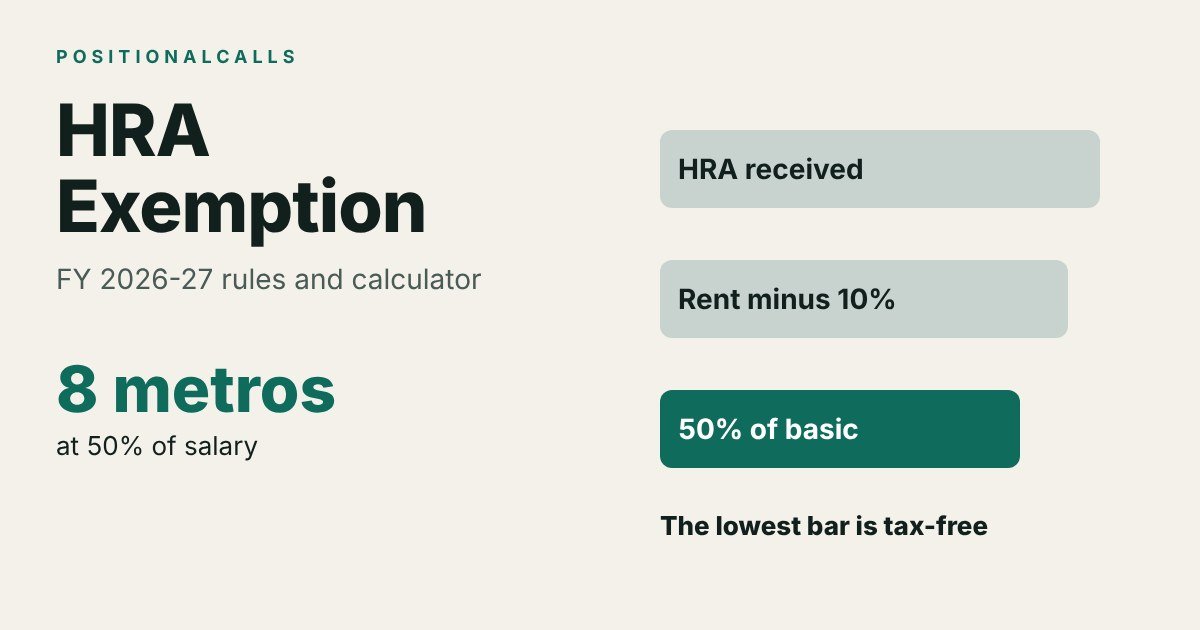
HRA exemption is the least of three amounts: HRA received, rent paid minus 10% of salary, and 50% of salary in the eight metro cities or 40% elsewhere. From 1 April 2026 Bengaluru, Hyderabad, Pune and Ahmedabad join the metros. It works only in the old tax regime.
Key takeaways on HRA
- Formula: unchanged, the least of three limits, per ClearTax.
- Metros: eight cities at 50% from 1 April 2026, per Jiraaf and Finnovate.
- Regime: old regime only, so compare both before you declare.
- Proof: rent receipts, and the landlord PAN above Rs 1 lakh of annual rent.
- No HRA in your pay: Section 80GG gives up to Rs 60,000 a year, per Legal Suvidha.
In plain words: your employer pays you a rent allowance, and the tax office lets part of it go untaxed if you really pay rent. The untaxed part is capped by three tests, and the smallest result wins. Anything above that is taxed like the rest of your salary.
Data note: as of Friday, 20 November 2026, 6:50 PM IST. The metro list, the formula and the proof rules come from the pages named in the sources list, read as search extracts, not from the Income-tax Act 2025 or the Rules themselves. The worked examples use assumed salaries and my own arithmetic, shown line by line. I did not open the Income Tax Department site.
What is HRA exemption and who can claim it?
HRA exemption is the part of the House Rent Allowance in your salary that is not taxed, available only to a salaried person who pays rent and chooses the old tax regime. ClearTax describes it as a partial exemption on the allowance an employer pays, and Patron Accounting says the new regime taxes the whole allowance.
The exemption is not a deduction for rent in general. It starts with the HRA your employer actually pays and limits how much of it escapes tax. If your pay slip has no HRA line, there is nothing to exempt, and Section 80GG is the other route, covered further down. If you live in a house you own, TaxBuddy says HRA exemption cannot be claimed.
Three tests decide the amount, and the exemption is limited to the HRA received, as AmbitionBox notes. Paying more rent than you get as HRA does not raise it. That is why the same rent can give different results for two people with different salary structures.
| Condition | What it means | Source |
|---|---|---|
| HRA in salary | Your employer pays a house rent allowance | ClearTax |
| Rent actually paid | You pay rent for a home you live in | TaxBuddy |
| Own house | No HRA exemption on a house you own and occupy | TaxBuddy |
| Regime | Old regime only; new regime taxes HRA in full | Patron Accounting |
| Proof | Rent receipts, and landlord PAN above Rs 1 lakh a year | ClearTax, Finnovate |
Cite this table: HRA guide: conditions, PositionalCalls, Friday, 20 November 2026, 6:50 PM IST, compiled from ClearTax, TaxBuddy, Patron Accounting and Finnovate.
Who can claim HRA exemption?
Any salaried employee who receives HRA, pays rent and files under the old regime can claim it. Self-employed people and employees without an HRA component cannot, but they may qualify for the Section 80GG deduction. The next section sets out the formula in full.
How is HRA exemption calculated? The least-of-three formula
The exempt amount is the lowest of three figures: the HRA you receive, the rent you pay minus 10% of salary, and 50% or 40% of salary depending on the city. Finnovate and TaxBuddy set out the same three limbs, and ClearTax says the core formula has not changed under the Income-tax Act 2025.
Salary here means basic pay plus dearness allowance. TaxBuddy’s example takes basic plus DA of Rs 50,000 a month, so 10% is Rs 5,000, and with Rs 20,000 rent the second limb is Rs 15,000 a month. Work in annual figures, because the three limbs are tested over the year.
| Limb | Test | Result becomes |
|---|---|---|
| 1 | HRA actually received in the year | Cap at what you were paid |
| 2 | Rent paid in the year minus 10% of basic plus DA | Zero if rent is below 10% of salary |
| 3 | 50% of basic plus DA in a metro, 40% elsewhere | Cap at the city percentage |
| Exempt HRA | The lowest of limbs 1, 2 and 3 | Tax-free amount |
| Taxable HRA | HRA received minus exempt HRA | Added to salary income |
Cite this table: HRA guide: formula, PositionalCalls, Friday, 20 November 2026, 6:50 PM IST, per Finnovate and TaxBuddy.
How do you work out HRA exemption step by step?
- Step 1: add up basic and DA for the months you lived in the rented home.
- Step 2: add up the rent you paid for those months.
- Step 3: compute the three limbs and pick the lowest as the HRA exemption.
- Step 4: subtract it from the HRA received to find the taxable part.
If you moved city or changed rent mid-year, calculate each period separately, using the metro status that applied to that period. The calculator below does one period at a time, so run it once for each.
Which cities are metros for HRA exemption in FY 2026-27?
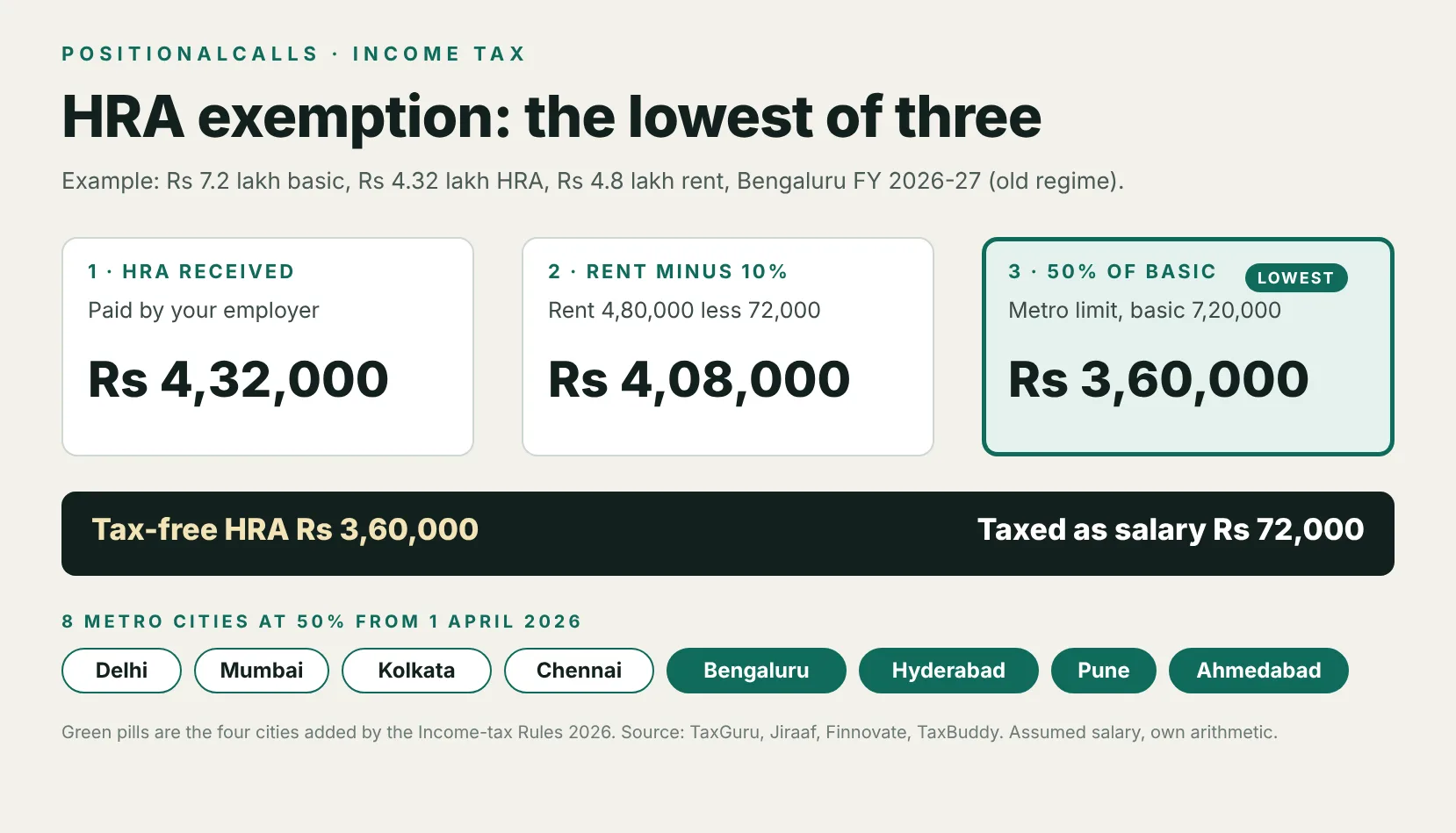
Eight cities count as metros from 1 April 2026: Delhi, Mumbai, Kolkata, Chennai, Bengaluru, Hyderabad, Pune and Ahmedabad. TaxGuru and Jiraaf say the Income-tax Rules 2026 added the last four, and The People’s Board says the Rules were notified on 20 March 2026.
Every other city, including Gurugram, Noida, Jaipur, Surat and Lucknow, stays non-metro with the 40% limit, per Kredily and JM Financial. The change is by city, not by state, and your place of residence for the period decides it, not the location of your employer.
| City | FY 2025-26 (returns due 31 July 2026) | FY 2026-27 onwards | Limit |
|---|---|---|---|
| Delhi | Metro | Metro | 50% |
| Mumbai | Metro | Metro | 50% |
| Kolkata | Metro | Metro | 50% |
| Chennai | Metro | Metro | 50% |
| Bengaluru | Non-metro | Metro | 50% |
| Hyderabad | Non-metro | Metro | 50% |
| Pune | Non-metro | Metro | 50% |
| Ahmedabad | Non-metro | Metro | 50% |
| All other cities | Non-metro | Non-metro | 40% |
Cite this table: HRA guide: metro cities, PositionalCalls, Friday, 20 November 2026, 6:50 PM IST, per TaxGuru, Jiraaf, Finnovate and Tata Capital.
Does the new metro list apply to FY 2025-26 returns?
No. Tata Capital says the expanded eight-metro rule cannot be used while claiming HRA exemption for FY 2025-26, and The People’s Board says returns filed for FY 2025-26 still use the 1961 Act and the four-metro list. Someone living in Pune who files late for FY 2025-26 still uses 40% for that year.
HRA exemption calculator: check your own figure
This HRA exemption calculator applies the least-of-three formula to your monthly figures and shows the tax-free and taxable parts for a year. It runs in your browser and stores nothing.
Free HRA exemption calculator (old regime, annual figures)
Enter basic plus DA, not total pay. Choose metro only if your rented home is in one of the eight cities in the table above. For a part-year, multiply nothing by hand: run the calculator with the monthly amounts that applied and scale the result by the months.
HRA exemption examples: metro, non-metro and the 2026 change
Three worked examples show how the binding limb changes the answer, and why the new metro list matters only for some people. All use assumed salaries and my own arithmetic.
Example 1: Rs 50,000 basic, Rs 30,000 rent
Basic plus DA is Rs 6,00,000 a year, HRA received is Rs 3,00,000 and rent is Rs 3,60,000. In a metro the limbs are Rs 3,00,000, Rs 3,00,000 and Rs 3,00,000, so the HRA exemption is Rs 3,00,000 and nothing is taxable. In a non-metro the third limb falls to Rs 2,40,000, so the exemption is Rs 2,40,000 and Rs 60,000 is taxed.
Example 2: when the metro change does not help
Basic is Rs 4,80,000, HRA received is Rs 2,40,000 and rent is Rs 2,16,000. Rent minus 10% gives Rs 1,68,000, which is lower than the metro limit of Rs 2,40,000 and the non-metro limit of Rs 1,92,000. The HRA exemption is Rs 1,68,000 in both cases and Rs 72,000 stays taxable. TaxGuru makes the same point with its own example.
Example 3: Bengaluru in FY 2025-26 and FY 2026-27
Basic is Rs 7,20,000, HRA received is Rs 4,32,000 and rent is Rs 4,80,000. For FY 2025-26 Bengaluru is non-metro, the limbs are Rs 4,32,000, Rs 4,08,000 and Rs 2,88,000, and the exemption is Rs 2,88,000. For FY 2026-27 the third limb is Rs 3,60,000, so the exemption is Rs 3,60,000, a gain of Rs 72,000. At a 30% slab plus 4% cess that is about Rs 22,464 of tax, and at a 20% slab about Rs 14,976.
| Example | HRA received | Rent paid | Limb 2 | Limb 3 | HRA exemption |
|---|---|---|---|---|---|
| 1 metro | 3,00,000 | 3,60,000 | 3,00,000 | 3,00,000 | 3,00,000 |
| 1 non-metro | 3,00,000 | 3,60,000 | 3,00,000 | 2,40,000 | 2,40,000 |
| 2 metro | 2,40,000 | 2,16,000 | 1,68,000 | 2,40,000 | 1,68,000 |
| 2 non-metro | 2,40,000 | 2,16,000 | 1,68,000 | 1,92,000 | 1,68,000 |
| 3 FY 2025-26 | 4,32,000 | 4,80,000 | 4,08,000 | 2,88,000 | 2,88,000 |
| 3 FY 2026-27 | 4,32,000 | 4,80,000 | 4,08,000 | 3,60,000 | 3,60,000 |
Cite this table: HRA guide: worked examples, PositionalCalls, Friday, 20 November 2026, 6:50 PM IST, assumed salaries, own arithmetic in rupees a year.
How does your pay structure change the HRA exemption?
The basic salary share of your pay sets the third limit, so a salary split with a low basic and high HRA can leave part of the allowance taxable. The 50% and 40% limits are percentages of basic plus DA, not of total pay, as TaxBuddy’s example shows.
Take a gross of Rs 12,00,000 with HRA fixed at half of basic, and rent of Rs 25,000 a month. The table varies only the basic share. A higher basic raises limb 3 and limb 2 falls as 10% of a bigger basic is deducted from rent, so the exemption does not rise forever with basic. The figures are my own arithmetic on an assumed structure for a non-metro city.
| Basic share of gross | Basic a year (Rs) | HRA a year (Rs) | Limb 2 (Rs) | Limb 3 at 40% (Rs) | HRA exemption (Rs) |
|---|---|---|---|---|---|
| 30% | 3,60,000 | 1,80,000 | 2,64,000 | 1,44,000 | 1,44,000 |
| 40% | 4,80,000 | 2,40,000 | 2,52,000 | 1,92,000 | 1,92,000 |
| 50% | 6,00,000 | 3,00,000 | 2,40,000 | 2,40,000 | 2,40,000 |
Cite this table: HRA guide: and pay structure, PositionalCalls, Friday, 20 November 2026, 6:50 PM IST, assumed salary, own arithmetic, non-metro 40% limit.
The lesson is that the exemption is not a free gain from asking for more HRA. It depends on the three tests together, and raising HRA past the point where limb 1 stops binding changes nothing. Ask your payroll team to show the three limbs for your own structure before you request a change, and treat the HRA exemption as one input into the regime choice.
Does a higher HRA always give a bigger HRA exemption?
No. The exemption is capped by the lowest of the three limbs, so once HRA received exceeds the other two, more HRA is simply taxed. In the table the exemption can stay flat or fall as basic rises, because limb 2 shrinks as basic grows.
Is HRA exemption worth it? Old regime or new regime
HRA exemption helps only if the old regime leaves you with less tax than the new regime, so compare both before you declare. Patron Accounting and Corrida Legal both say the new regime allows no the exemption, and the new regime has lower slabs and a Rs 75,000 standard deduction.
The table assumes a salaried resident, Rs 3,60,000 of HRA exemption, Rs 1,50,000 under Section 80C and the Rs 50,000 old-regime standard deduction, with no other deductions. Tax includes 4% cess and uses my model of the FY 2026-27 slabs.
PositionalCalls WhatsApp channel
Get tax and savings explainers on WhatsApp
- Slab and deduction changes, dated
- Calculators explained without tips
- Links to updated tax guides
| Gross salary (Rs) | Old regime tax (Rs) | New regime tax (Rs) | Lower tax | Gap (Rs) |
|---|---|---|---|---|
| 12,00,000 | 42,120 | 0 | New | 42,120 |
| 15,00,000 | 1,04,520 | 97,500 | New | 7,020 |
| 18,00,000 | 1,91,880 | 1,50,800 | New | 41,080 |
| 24,00,000 | 3,79,080 | 2,92,500 | New | 86,580 |
| 30,00,000 | 5,66,280 | 4,75,800 | New | 90,480 |
Cite this table: HRA guide: regime comparison, PositionalCalls, Friday, 20 November 2026, 6:50 PM IST, own model of FY 2026-27 slabs and assumed deductions.
On these assumptions the new regime gives lower tax at every salary shown, even with a Rs 3,60,000 exemption. Rent that is high compared with salary, plus 80C and home-loan interest, is what tips it the other way. Use the income tax calculator to test your own numbers.
When does HRA exemption make the old regime win?
It wins when your total old-regime deductions, HRA exemption included, are large enough to cover the gap between the two sets of slabs. A high exemption, a full 80C claim and an NPS deduction together can do it. See the guide to income tax in India for the regime comparison in full.
How much HRA exemption makes the old regime win?
At higher salaries the old regime needs a large combined deduction to beat the new regime, and HRA exemption plus Rs 1,50,000 under Section 80C may not be enough. The table finds the smallest the exemption, in steps of Rs 1,000, at which old-regime tax is no higher than new-regime tax.
| Gross salary (Rs) | New regime tax (Rs) | HRA exemption needed with Rs 1.5 lakh 80C (Rs) |
|---|---|---|
| 15,00,000 | 97,500 | 3,94,000 |
| 18,00,000 | 1,50,800 | 4,92,000 |
| 24,00,000 | 2,92,500 | 6,38,000 |
| 30,00,000 | 4,75,800 | 6,50,000 |
Cite this table: HRA guide: break-even, PositionalCalls, Friday, 20 November 2026, 6:50 PM IST, own model of FY 2026-27 slabs, 80C of Rs 1,50,000 and the Rs 50,000 old-regime standard deduction, no other deductions.
Read it as a test, not a target. If your computed HRA exemption is below the figure in your row, the new regime is cheaper on these assumptions, and claiming rent proof buys you nothing. If it is above, the old regime wins before counting other deductions such as NPS or home-loan interest.
What else tips the choice toward the old regime?
Home-loan interest, an NPS contribution under the old regime, health insurance under Section 80D and the Section 80C claim itself all add to the HRA exemption. Use the NPS calculator and the income tax calculator together, and keep the exemption proof ready in case you are asked.
What proof do you need for HRA exemption?
You need rent receipts, a rent agreement and proof of payment, and the landlord’s PAN when annual rent exceeds Rs 1 lakh. ClearTax and Finnovate state the PAN rule, and Finnovate adds that receipts are needed unless monthly rent is Rs 3,000 or less.
| Document | When it is needed | Source |
|---|---|---|
| Rent receipts | Monthly rent above Rs 3,000 | Finnovate |
| Landlord PAN | Annual rent above Rs 1 lakh | ClearTax, Finnovate |
| Self-declaration | Landlord has no PAN, per Circular 8/2013 | ClearTax |
| Rent agreement | To support the claim in a query | General practice |
| Bank transfer record | To show rent was actually paid | TaxBuddy, Razorpay |
Cite this table: HRA guide: documents, PositionalCalls, Friday, 20 November 2026, 6:50 PM IST, per ClearTax, Finnovate, TaxBuddy and Razorpay.
How do you claim HRA exemption?
Declare the rent and HRA exemption to your employer so tax is not cut too high through the year. If you did not, claim it in the return: Citizennest says to choose the old regime and enter the exemption under allowances exempt in Schedule S of the ITR. Pay rent by bank transfer, since cash makes the claim harder to defend. If you change jobs mid-year, give the new employer your previous employer’s figures so the exemption is not counted twice, and keep the rent record for both periods together. A short folder with the agreement, twelve receipts and the landlord’s PAN or declaration is enough to answer most queries about the exemption. From Tax Year 2026-27 the declaration to the employer is Form 124, which replaces Form 12BB, and Patron Accounting says it requires a landlord relationship disclosure for HRA. The TDS on salary guide explains Form 124 and how the monthly deduction changes when you file it.
Can you claim HRA exemption on rent paid to parents?
Yes, if you really pay rent to your parents, keep proof, and they declare it as rental income. TaxBuddy lists those conditions, and Razorpay says the rent should be documented at a market rate.
Paying a fixed monthly sum into a parent’s account, with a written agreement and receipts, is the usual way to show it. If your parents’ income is below the tax limit, the rent may cost them little tax. Rent to a spouse is not eligible for HRA exemption, per TaxBuddy.
- Parents’ return: rent received is their income from house property.
- Ownership: the house should belong to the parent, not to you.
- Payment: bank transfer, not cash.
- Landlord PAN: needed once annual rent passes Rs 1 lakh.
What if you get no HRA? Section 80GG
If your pay has no HRA, Section 80GG lets you deduct the least of Rs 5,000 a month, 25% of adjusted total income, and rent minus 10% of adjusted total income. Legal Suvidha and ClearTax give the three limits, and ClearTax says it is available only under the old regime and needs Form 10BA.
| Limit | Amount | Source |
|---|---|---|
| Fixed cap | Rs 5,000 a month, Rs 60,000 a year | Legal Suvidha, ClearTax |
| Income test | 25% of adjusted total income | Legal Suvidha |
| Rent test | Rent minus 10% of adjusted total income | Legal Suvidha |
| Form | Form 10BA before the ITR | eBizFiling |
| Regime | Old regime only | ClearTax |
Cite this table: Section 80GG limits, PositionalCalls, Friday, 20 November 2026, 6:50 PM IST, per Legal Suvidha, ClearTax and eBizFiling.
Legal Suvidha’s example, an adjusted income of Rs 10 lakh with Rs 3 lakh rent, ends at the Rs 60,000 cap. eBizFiling says that from Tax Year 2026-27 the matching provision is Section 134 of the 2025 Act with Form 31, while ClearTax shows Section 84, so check the form name when you file.
Which section and rule cover HRA exemption in FY 2026-27?
For FY 2025-26 it is Section 10(13A) with Rule 2A of the 1961 Act, and for FY 2026-27 the 2025 Act and the 2026 Rules apply, with sources naming different sections. ClearTax says the 1961 Act still governs AY 2026-27 because it covers income earned up to 31 March 2026.
| Item | FY 2025-26 (AY 2026-27) | FY 2026-27 onwards |
|---|---|---|
| Law | Income-tax Act 1961 | Income-tax Act 2025 |
| HRA provision | Section 10(13A) | Section 14(10), or Schedule III and Section 11, per ClearTax |
| Method | Rule 2A, Rules 1962 | Rule 279, Rules 2026, per Jiraaf and greytHR |
| Metro list | Four cities | Eight cities |
| No-HRA relief | Section 80GG, Form 10BA | Section 134, Form 31, per eBizFiling |
Cite this table: HRA guide: legal references, PositionalCalls, Friday, 20 November 2026, 6:50 PM IST, per ClearTax, Jiraaf, greytHR and eBizFiling.
The mismatch among sources is why this guide does not quote a single Section number for the new Act. Your payslip and Form 16 will carry the reference your employer’s payroll uses.
Can you claim HRA exemption and a home-loan deduction together?
Yes, in some cases, such as when you rent in the city where you work and own a house in another city. Qwikfilings says you can claim HRA and a home-loan deduction at the same time, and Finnovate covers the combination as a separate case.
The two claims rest on different facts. HRA exemption needs rent actually paid for a home you live in, and the home-loan deduction needs a loan on a property. The same house cannot support both, because you would not pay rent to yourself. Keep the loan certificate and the rent record separate, and compare the regimes again, since the old regime is the only one that allows both claims.
Does HRA exemption work if you own a house in the same city?
TaxBuddy says a person living in a self-owned house cannot claim HRA exemption. If you own a house but live in a rented one for a reason such as distance from work, your payslip, rent agreement and proof of payment need to show it clearly, and a chartered accountant can advise on the specific case.
HRA exemption timeline: what changed and when
The rules moved in two steps: the Income-tax Rules 2026 were notified on 20 March 2026, and the Income-tax Act 2025 and the eight-metro list took effect from 1 April 2026. The People’s Board gives the notification date, and TaxGuru gives the metro change.
| Date | Event | Source |
|---|---|---|
| 20 March 2026 | Income-tax Rules 2026 notified | The People’s Board |
| 1 April 2026 | Income-tax Act 2025 in force; eight-metro HRA list starts | ClearTax, TaxGuru |
| 31 July 2026 | Due date for FY 2025-26 returns of salaried filers, and Form 10BA for Section 80GG | ClearTax |
| Tax Year 2026-27 | HRA claims follow the 2025 Act and the eight-metro list | Jiraaf, Finnovate |
| 1 February 2027 | Union Budget, the next point at which the rules could change | Planned review |
Cite this table: HRA guide: timeline, PositionalCalls, Friday, 20 November 2026, 6:50 PM IST, per The People’s Board, ClearTax, TaxGuru, Jiraaf and Finnovate.
For a late return on FY 2025-26, see the belated ITR last date page, and for the advance tax dates that apply to other income, the advance tax due date page. The HRA exemption for FY 2025-26 still uses the four-metro list whichever date you file on.
What mistakes do people make with HRA exemption?
The common errors are using total pay instead of basic plus DA, assuming the metro change always helps, claiming it in the new regime, and skipping the landlord PAN. Each follows from the rules above.
- Wrong salary base: use basic plus DA, as in TaxBuddy’s example, not gross pay.
- Metro assumption: if limb 2 or limb 1 is lower, the 50% limit never applies, as in Example 2.
- Wrong year: a FY 2025-26 return uses the four-metro list, per Tata Capital.
- New regime claim: HRA exemption is not allowed there, per Patron Accounting.
- Missing PAN: ClearTax warns you may lose the exemption.
- Rent to spouse: not eligible, per TaxBuddy.
What is a short checklist for HRA exemption?
Confirm basic plus DA and HRA on your payslip, decide the city status for each period, list monthly rent and the landlord PAN, compute the three limbs, and compare both regimes with the income tax calculator before declaring to your employer.
What does this HRA exemption guide leave out?
It leaves out company-provided housing, perquisite valuation, HRA for pensioners and the interaction with a home-loan deduction. It is a guide to the standard salaried claim.
- No statute text: I did not open the Income-tax Act 2025 or the Rules, so the section numbers rest on the sources named.
- No portal check: I did not open the Income Tax Department site.
- No personal advice: your figure depends on your payslip and rent record.
- No employer policy: payroll teams set their own cut-off dates for rent proof, and some ask for receipts monthly while others ask once a year, so follow your employer’s declaration calendar as well as the tax rules.
When will this HRA exemption guide be updated?
After the 1 February 2027 Budget, after any change to the 2026 Rules or the metro list, and when the Income Tax Department publishes new forms for the claim. The update line at the top shows the last real change.
PositionalCalls WhatsApp channel
Tax updates in one channel
- Budget and notification changes
- Plain-English tax explainers
- Links to new guides
HRA exemption: frequently asked questions
What is HRA exemption and who can claim it?
HRA exemption is the tax-free part of the House Rent Allowance your employer pays, under the old regime only. You can claim it if your salary includes HRA, you pay rent for a home you live in, and you hold proof. The exempt amount is the least of three limits, and the rest is taxed as salary, per ClearTax and Patron Accounting.
What are the metro cities for HRA exemption in FY 2026-27?
Eight cities are metros from 1 April 2026 under the Income-tax Rules 2026: Delhi, Mumbai, Kolkata, Chennai, Bengaluru, Hyderabad, Pune and Ahmedabad. They get the 50% of salary limit. Every other city stays at 40%, per Jiraaf and Finnovate. Returns for FY 2025-26 still use the four old metros, per Tata Capital.
How is HRA exemption calculated?
HRA exemption is the least of three amounts: the HRA actually received, the rent paid minus 10% of basic salary plus dearness allowance, and 50% of that salary in a metro or 40% elsewhere. The lowest figure is tax-free and the balance is added to taxable salary, as Finnovate and TaxBuddy set out. Annual figures are used.
Is HRA exemption available in the new tax regime?
No. The new regime does not allow HRA exemption, so the full HRA is taxed as part of salary, per Patron Accounting and Corrida Legal. A salaried person should compare both regimes before declaring, because it only helps when the old regime still leaves you with lower tax than the new one.
Do I need the landlord’s PAN to claim HRA exemption?
Yes, when annual rent exceeds Rs 1 lakh, per ClearTax and Finnovate. ClearTax adds that a landlord without a PAN can give a signed self-declaration under Circular 8/2013. Finnovate says rent receipts are needed unless monthly rent is Rs 3,000 or less. Keep the rent agreement and payment proof in any case.
Can I claim HRA exemption on rent paid to my parents?
Yes, if you really pay the rent, keep proof, and your parents declare it as rental income in their return, per TaxBuddy. Rent paid to a spouse is not eligible, and you cannot claim it for a house you own and live in. A rent agreement and bank transfers support the claim.
What if my salary has no HRA component?
Section 80GG may help if you pay rent and own no house at your place of work. The deduction is the least of Rs 5,000 a month, 25% of adjusted total income, and rent minus 10% of adjusted total income, and it needs Form 10BA, per Legal Suvidha, ClearTax and eBizFiling. It is old regime only.
Which section covers HRA exemption in the Income-tax Act 2025?
Sources disagree. ClearTax gives Section 14(10) on one page and Schedule III with Section 11 on another, while Jiraaf and greytHR point to Schedule III and Rule 279 of the 2026 Rules. The formula itself is unchanged, so cite the section only after checking the Act, and for FY 2025-26 use Section 10(13A).
Does the metro change always raise my HRA exemption?
No. It only lifts the third limit from 40% to 50% of salary. If rent minus 10% of salary or the HRA you receive is lower, that limit still binds and the exemption does not move, as TaxGuru’s worked example shows. It helps most when you pay high rent in Bengaluru, Pune, Hyderabad or Ahmedabad.
Is this HRA exemption guide tax advice?
No. PositionalCalls is not a tax practitioner, a SEBI-registered research analyst or an investment adviser. This page explains the HRA rules as the named sources describe them, with worked examples on assumed salaries. Your payslip, rent agreement and chosen regime decide your own figure, so check with a chartered accountant for a specific case.
Sources for this HRA guide
- TaxGuru: HRA and the new metro cities from 1 April 2026.
- ClearTax: Section 14(10) of the Income Tax Act 2025 and new metros.
- ClearTax: HRA calculation and rules 2026.
- Patron Accounting: HRA calculator.
- Jiraaf: HRA in salary, calculation and exemption.
- The People’s Board: HRA exemption for HR and payroll teams.
- Finnovate: HRA rules and calculation guide.
- Tata Capital: how to claim HRA in ITR.
- greytHR: expanded metro cities, Rule 279.
- TaxBuddy: how HRA is calculated for tax exemption.
- Razorpay Payroll: HRA calculator.
- ClearTax: deduction under Section 80GG.
- Legal Suvidha: Section 80GG for FY 2026-27.
- eBizFiling: Section 80GG, Section 134 and Form 31.
- Citizennest: how to claim HRA tax benefit.
- Qwikfilings: HRA calculator.
- Corrida Legal: HRA calculator.

Shubham Chaudhary is the founder of PositionalCalls, an independent Indian stock market research website. He writes company fundamentals, quarterly results analysis, IPO analysis and sector research for NSE and BSE listed companies, with a focus on banking stocks, insurance and long-term value investing. Every article is built from primary sources such as RBI, SEBI, NSE and BSE filings and company annual reports, and states its risks plainly in simple language for retail investors.
Coverage areas Our research standards- Numbers checked against NSE, BSE and SEBI filings
- Risks and limits stated in every article
- No paid promotions or broker tie-ups
- Articles updated when new filings arrive