IPO basics · Comparison
SME vs mainboard IPO in one place: who can list, what the minimum bid is, how lock-ins and market makers differ, and what SEBI’s October 2026 consultation paper proposes to change. Every comparison is in a table, with the source and the date.
Quick answer
The main differences in SME vs mainboard IPO are size, minimum bid and liquidity. SME IPOs list on NSE Emerge or BSE SME, need two lots above Rs 2 lakh, and use market makers. Mainboard IPOs list on the main boards, allow retail bids up to Rs 2 lakh, and face stricter profit tests.
Latest update (Monday, 16 November 2026, 12:30 PM IST): first version of this guide. The SME rules and the October 2026 proposals come from SEBI’s consultation paper dated 14 October 2026, which I opened on sebi.gov.in. The SME bidding rules come from NSE circular 07/2025 dated 18 June 2025. Mainboard rules come from TaxGuru and Alice Blue summaries. I found no notified final rules, only the proposal.
Key takeaways
- Platform: SME issues list on NSE Emerge or BSE SME; mainboard issues list on the main boards.
- Minimum bid: two lots above Rs 2 lakh for SME; one lot (for example Rs 14,245 in Crystal Crop) for mainboard.
- After listing: SME stocks have compulsory market makers and trade in lots; mainboard stocks trade one share at a time.
- Change ahead: SEBI has proposed tougher SME entry tests, but they are not law yet.
In plain words: an SME IPO is a share sale by a small company onto a separate exchange platform, with its own rules. A mainboard IPO is a share sale by a larger company onto the main board. The rules differ on who may list, how much you must bid, how long insiders are locked in and how easily you can trade afterwards. Nothing here tells you to apply for or avoid any issue.
Data note: as of Monday, 16 November 2026, 12:30 PM IST. SME eligibility, minimum application, lock-ins, OFS limits, quotas, underwriting, market making and migration are quoted from SEBI’s consultation paper of 14 October 2026, where it states the current rule. Bidding mechanics are from NSE circular 07/2025. The hypothetical SME issue in this guide (price Rs 120, lot 1,000 shares) is my own illustration and is not a real IPO.
What is the difference in SME vs mainboard IPO?
An SME IPO is a public issue by a smaller company that lists on a dedicated SME platform, NSE Emerge or BSE SME. A mainboard IPO is a public issue that lists on the main board of the exchange. The two follow different eligibility, bidding, lock-in and trading rules.
Both routes raise money from the public by selling shares, and both go through a prospectus, a price band or fixed price, a bidding window and an allotment. The SME vs mainboard IPO difference lies in the framework around that process. SEBI’s ICDR Regulations treat SME issues under their own chapter, with a size limit based on post-issue paid-up capital, a different profit test, compulsory underwriting, compulsory market making and a different minimum application.
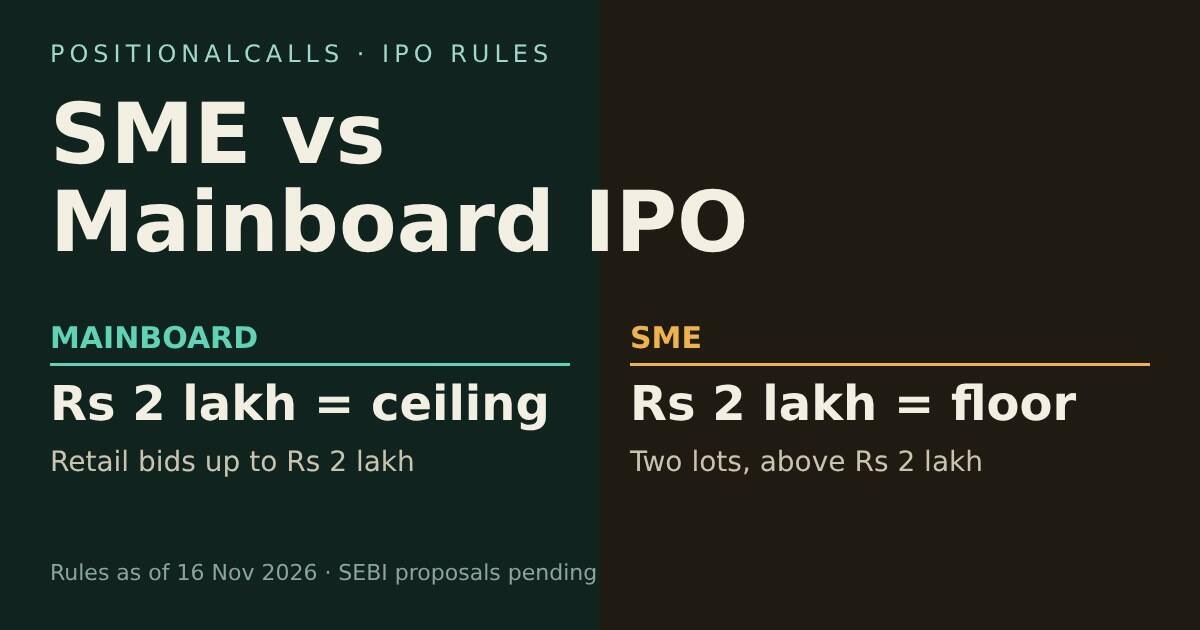
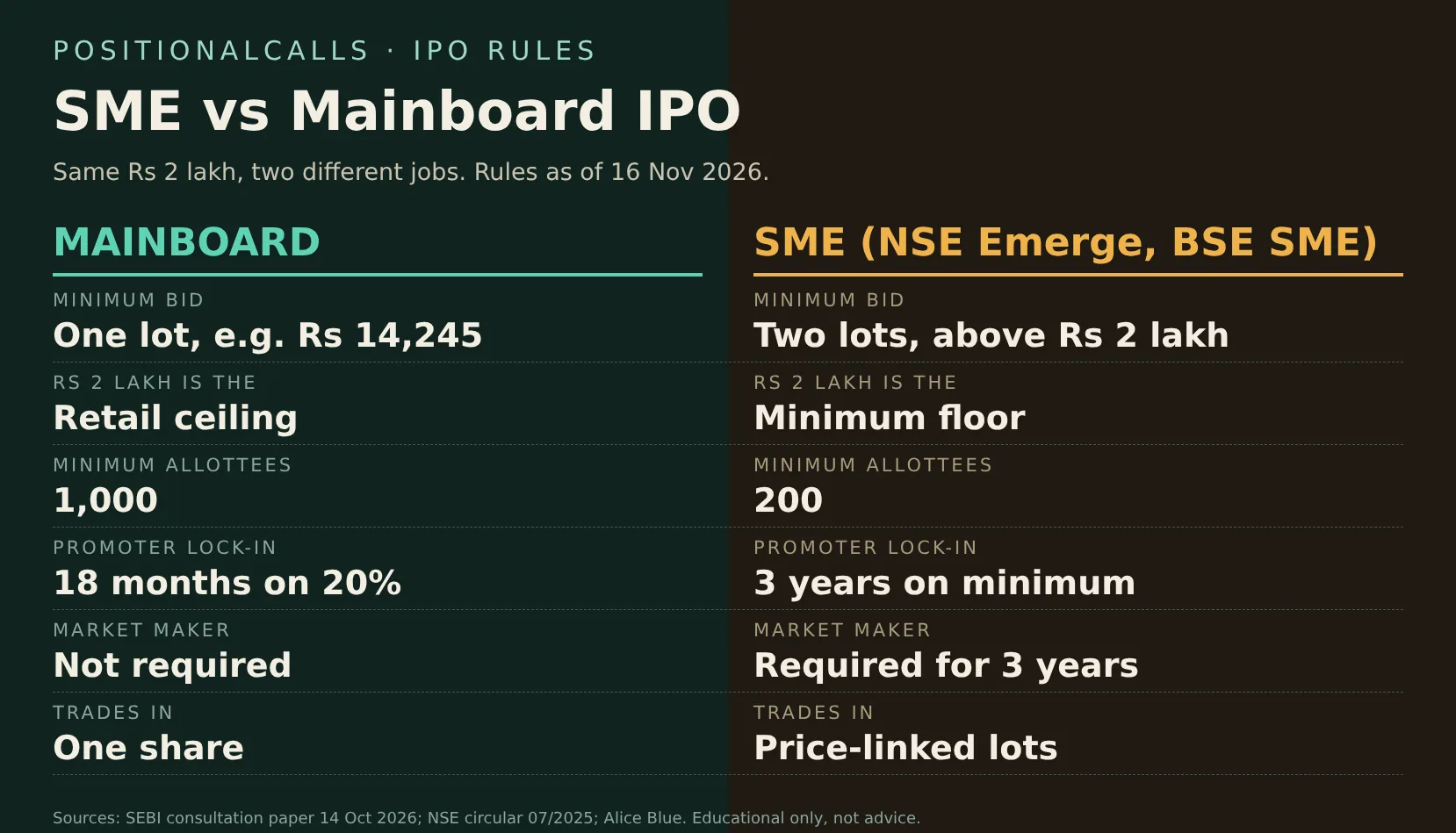
That matters to an investor because the same Rs 2 lakh does different things in each route. In a mainboard IPO, Rs 2 lakh is the ceiling of the retail category. In an SME IPO, Rs 2 lakh is the floor: the individual investor category needs two lots above that amount. This guide sets the two routes side by side, then goes through each rule with its source.
It is educational and uses only published rules. PositionalCalls is not SEBI-registered and does not tell you to apply for an IPO or to skip one. Where sources differ, both versions are shown.
SME vs mainboard IPO side by side
The table compares the two routes on the points that change what you can bid, how long insiders stay locked in and how you can trade afterwards. The SME column is the current rule as stated in SEBI’s October 2026 paper.
| Point | SME IPO | Mainboard IPO | Source |
|---|---|---|---|
| Where it lists | NSE Emerge or BSE SME | Main board of NSE and BSE | Exchange platforms |
| Size limit | Post-issue paid-up capital up to Rs 25 crore (Rs 10 crore SME; Rs 10 to 25 crore under Chapter IX) | No such ceiling | SEBI paper, 14 Oct 2026 |
| Minimum application | Two lots, above Rs 2 lakh | One lot at the lowest band price | SEBI paper; NSE circular 07/2025 |
| Retail ceiling | No Rs 2 lakh ceiling for the individual investor category | Retail up to Rs 2 lakh | NSE circular; Alice Blue |
| Minimum allottees | 200 | 1,000 | SEBI paper; Alice Blue |
| Underwriting | 100% of the issue; lead managers at least 15% themselves | Main Board approach: the unsubscribed portion is underwritten | SEBI paper |
| Market making | Compulsory for 3 years, inventory at least 5% | Not applicable | SEBI paper |
| Trading lot | Price-linked lots from 10,000 shares down to 100 shares | One share | SEBI paper |
| Migration | May move to mainboard with special resolution | Not applicable | SEBI paper |
Cite this table: PositionalCalls, “SME vs Mainboard IPO: Current Rules Side by Side, as of 16 November 2026”; SEBI consultation paper (14 October 2026), NSE circular 07/2025, Alice Blue.
Read the SME vs mainboard IPO table as a map, not as a ranking. A small company with modest profits cannot use the mainboard route, and a company above the SME ceiling cannot use the SME route. The IPO type is therefore set mostly by the issuer, not chosen by the investor, and the investor’s choice is whether to bid at all.
Who can list: SME vs mainboard IPO eligibility rules
SME issuers need post-issue paid-up capital within the SME limit and operating profit of Rs 1 crore in at least two of the last three years. Mainboard issuers face higher net-asset and profit tests, or the 75% QIB route.
| Test | SME IPO (current) | Mainboard IPO |
|---|---|---|
| Capital or size | Post-issue paid-up capital up to Rs 25 crore | No ceiling |
| Profit | Operating profit of Rs 1 crore in at least two of the preceding three years (Reg 229(6)) | Average operating profit Rs 15 crore (TaxGuru) or distributable profits Rs 15 crore in any three of five years (Alice Blue) |
| Net tangible assets | Not a headline test in the SEBI paper | At least Rs 3 crore (TaxGuru; Alice Blue) |
| Net worth | Not a headline test in the SEBI paper | At least Rs 1 crore (both sources) |
| Alternative route | None | Book-building with at least 75% of the net offer to QIBs, with refund if not met |
| Public comment | Draft offer document open for 21 days (Bar & Bench) | Draft offer document filed with SEBI |
Cite this table: PositionalCalls, “SME vs Mainboard IPO Eligibility, as of 16 November 2026”; SEBI paper, TaxGuru, Alice Blue, Bar & Bench.
Why the SEBI paper calls the SME profit test inconsistent
SEBI’s paper describes the SME profit measure as EBIT in one place and EBITDA in the regulation text, and Inc42 reports that the paper itself calls this out for clarification. A reader checking a prospectus should therefore look at which profit measure the issuer used and over which years, and not assume the headline figure is comparable across issues.
SME vs mainboard IPO: the profit-test conflict
The two mainboard summaries differ on how the Rs 15 crore profit test is measured. TaxGuru frames it as an average of pre-tax operating profit over the preceding three full years on restated figures. Alice Blue frames it as distributable profits in any three of the last five years. The ICDR text is the authority, and the offer document states which route the issuer used.
Minimum bid and categories in SME vs mainboard IPO
In an SME IPO the individual investor bids at least two lots above Rs 2 lakh. In a mainboard IPO the retail category covers bids up to Rs 2 lakh, so a retail bid can be as small as one lot.
| Category | SME IPO | Mainboard IPO |
|---|---|---|
| Retail or individual | Individual investor: two lots, application above Rs 2 lakh (NSE circular 07/2025) | Retail individual investor: up to Rs 2 lakh |
| Quota for small bids | At least 35% to individuals applying for the minimum size (SEBI paper) | 35% of the net offer to retail (Alice Blue) |
| Non-institutional | At least 15%, split one-third and two-thirds at Rs 2 lakh and Rs 10 lakh thresholds (SEBI paper) | Small and big NII above Rs 2 lakh |
| QIB and NII bids | More than two lots, above Rs 2 lakh | Above Rs 2 lakh |
| Employee category | Two lots, multiples of lot size, not above Rs 5 lakh | Not covered here |
| Cut-off price bid | Not allowed | Allowed for retail |
Cite this table: PositionalCalls, “SME vs Mainboard IPO Categories and Minimum Bid, as of 16 November 2026”; NSE circular 07/2025, SEBI paper, Alice Blue.
SME vs mainboard IPO: a worked comparison with my own numbers
The Crystal Crop Protection IPO is a mainboard issue with a band of Rs 259 to Rs 272 and a lot of 55 shares, as reported by Chittorgarh and Upstox. One lot at the lowest price is 55 x Rs 259 = Rs 14,245 (my calculation). For an SME comparison I use a hypothetical issue at Rs 120 with a lot of 1,000 shares. One lot is Rs 120,000 and the two-lot minimum is Rs 240,000. That minimum is about 16.8 times the Crystal Crop minimum (my calculation).
| Case | Price | Lot | One lot | Minimum bid |
|---|---|---|---|---|
| Crystal Crop (mainboard, real band) | Rs 259 to Rs 272 | 55 shares | Rs 14,245 to Rs 14,960 | Rs 14,245 (one lot) |
| Hypothetical SME issue (illustration) | Rs 120 | 1,000 shares | Rs 1,20,000 | Rs 2,40,000 (two lots) |
| Same SME issue under SEBI proposal | Rs 120 | Four lots of at least Rs 25,000 each | Not fixed in the paper | Rs 1,00,000 |
Cite this table: PositionalCalls, “Minimum Bid: Mainboard Example vs Hypothetical SME Issue, my calculation, 16 November 2026”; Chittorgarh, Upstox, SEBI paper.
The hypothetical row is not a forecast of any real SME issue. It only shows why the same investor who can bid in a mainboard IPO with about Rs 14,000 needs well above Rs 2 lakh for an SME IPO under the current rule. The lot size and price in a real SME issue are in its prospectus.
How bidding works in an SME IPO compared with mainboard
Since 1 July 2025, SME bids cannot be made at cut-off price and cannot be cancelled or revised downward. Bidding closes at 4 PM, and UPI mandate approval runs to 5 PM on the last day.
NSE circular 07/2025, dated 18 June 2025, replaced the retail individual investor category in SME issues with an individual investor category and set the bidding rules shown below. BSE issued matching changes, as reported by Groww. The old process applied to issues opening on or before 30 June 2025, with spillover issues allowed to run until 11 July 2025.
PositionalCalls WhatsApp channel
Get IPO rule explainers on WhatsApp
- SEBI and exchange rule changes, dated
- SME and mainboard rules explained without tips
- Links to updated IPO guides
| Rule | SME IPO (from 1 July 2025) | Mainboard IPO (retail) |
|---|---|---|
| Cut-off price bid | Not allowed in any category | Allowed for retail |
| Downward revision | Not allowed | Not covered in the sources I read |
| Cancellation | Not allowed in any category | Not covered in the sources I read |
| Last-day bid close | 4:00 PM for all categories | Exchange window; brokers often close earlier |
| UPI mandate approval | Until 5:00 PM on the last day | Until 5:00 PM on the last day (SEBI timetable) |
Cite this table: PositionalCalls, “SME vs Mainboard IPO Bidding Rules, as of 16 November 2026”; NSE circular 07/2025; Taxguru SEBI timetable.
The practical SME vs mainboard IPO point is the lack of an undo. The sources I read do not say how revision and cancellation work in a mainboard retail bid, so check your broker app. In an SME bid, the circular is clear: the bid stands once placed. Decide the lots and the price before you submit, and read our guide on how to apply for an IPO in India for the UPI steps that apply to both routes.
Lock-in periods in SME vs mainboard IPO
Lock-ins stop insiders from selling for a set period after the IPO. SME promoters’ minimum contribution is locked for three years under the current rule, while mainboard promoters’ minimum 20% is locked for 18 months, per the summaries I found.
| Holder | SME IPO (current, SEBI paper) | Mainboard IPO (Alice Blue) |
|---|---|---|
| Promoter minimum contribution | Three years from the later of allotment or commercial production | Up to 20% of post-issue capital: 18 months from allotment |
| Promoter holding above the minimum | 50% for two years and 50% for one year | Above 20%: six months |
| Non-promoter pre-issue shareholders | One year | Not covered in the source |
| Anchor investors | Not covered here | 50% for 30 days, 50% for 90 days |
Cite this table: PositionalCalls, “SME vs Mainboard IPO Lock-in Periods, as of 16 November 2026”; SEBI paper, Alice Blue.
In an SME vs mainboard IPO comparison, the SME promoter lock-in is longer than the mainboard one on paper. That is one reason SEBI’s proposal changes it: the paper would make the minimum contribution three years from allotment only, make the excess holding one year, and cut non-promoter pre-issue capital to six months. The direction of the proposal is mixed, tightening in one place and easing in another. The mainboard figures come from a secondary summary, so confirm them in the prospectus of the issue you are reading.
Why a lock-in end date matters
When a lock-in expires, shares that were barred from sale become tradable, which can add supply to the market. The dates are in the prospectus and exchange disclosures. Mark them as events to read about, not as signals.
Trading after listing: lots, market makers and migration
SME shares trade in fixed lots and have a compulsory market maker for three years, while mainboard shares trade one share at a time. These differences shape how easily you can buy or sell after listing.
SEBI’s paper cites a price-linked trading lot table: 10,000 shares for stocks up to Rs 14, down to 100 shares for stocks above Rs 1,000. The paper also says about 5% of unique PAN-based SME shareholders hold odd lots on average, which are holdings below a full lot. A holding below one lot can be harder to sell, which is why SEBI has proposed trading in single shares.
| Feature | SME platform (current) | Main board |
|---|---|---|
| Trading unit | Price-linked lot | One share |
| Market maker | Compulsory for at least 3 years from listing or migration, inventory at least 5% of listed securities | Not required |
| Underwriting | Issue underwritten for 100%; lead managers at least 15% on own account | Main Board approach: the unsubscribed portion is underwritten |
| Minimum subscription | At least 90% of the offer; refund within four days of closure if not met | 90% minimum subscription under Reg 45 |
| Migration | Paid-up capital above Rs 10 crore and up to Rs 25 crore may migrate; special resolution by postal ballot with non-promoter votes in favour at least twice the votes against | Not applicable |
Cite this table: PositionalCalls, “SME vs Mainboard IPO After Listing, as of 16 November 2026”; SEBI consultation paper, 14 October 2026.
A market maker keeps both buy and sell quotes in the stock so trading does not stall, but the duty is time-limited and tied to inventory. Once the three years end, liquidity depends on ordinary demand. This is the main structural reason an SME stock can behave differently from a mainboard stock of similar size.
Risks to understand in an SME vs mainboard IPO
The risks are structural rather than a verdict on any one issue. Higher minimum bids, lot-based trading and thin volumes make SME issues behave differently, and both routes carry the risk of losing money.
On SME vs mainboard IPO risk, SEBI’s own paper treats SME issues as needing tighter rules, since it proposes a higher profit bar, a market-cap test and longer-lasting disclosure checks. That is a regulator’s view of the framework, not a prediction for any listing. Mainboard IPOs also fall after listing; a larger company does not remove price risk.
What SEBI has proposed for SME IPOs, and what is still only a proposal
SEBI’s 14 October 2026 consultation paper proposes a market-cap test, a higher profit bar, a Rs 1 lakh minimum application, one-share trading and the end of compulsory underwriting and market making. Comments closed on 4 November 2026, and I found no notified final rules.
| Topic | Current rule | Proposed |
|---|---|---|
| Eligibility size | Post-issue paid-up capital up to Rs 25 crore | Market cap up to Rs 1,000 crore SME only; Rs 1,000 to 4,000 crore optional; above Rs 4,000 crore mainboard |
| Profit | Rs 1 crore in two of three years | Average Rs 3 crore a year over three years, restated consolidated |
| Alternative route | None | Book-building with at least 75% to QIBs if the profit test is missed |
| Minimum application | Two lots above Rs 2 lakh | Four lots of Rs 25,000 each, minimum Rs 1 lakh |
| Allottees | 200 | 500 |
| Lock-in | Promoter minimum 3 years from later of allotment or commercial production; non-promoter 1 year | Promoter minimum 3 years from allotment; excess 1 year; non-promoter 6 months; promoter group 1 year |
| Trading lot | Price-linked, 100 to 10,000 shares | One share |
| Underwriting and market making | 100% underwriting; 3-year market making | Neither compulsory |
| Migration | Paid-up capital trigger and special resolution | Board approval; optional from Rs 1,000 crore, compulsory from Rs 4,000 crore |
Cite this table: PositionalCalls, “SEBI SME IPO Proposals vs Current Rules, as of 16 November 2026”; SEBI consultation paper (14 October 2026), Inc42.
Outlook Money reports that the new rules would apply to draft offer documents filed three months after notification in the Official Gazette, and that issues whose RHP or prospectus is already filed would continue under existing rules. That is a secondary report. The final timing depends on SEBI’s board decision and notification, which I have not seen.
What would change for a retail bidder
If adopted as proposed, an SME IPO would have a lower minimum bid, a retail individual category, bigger issues allowed on the SME platform and shares that trade one at a time. It would also have no compulsory market maker. Whether that makes SME issues easier or harder to exit is not settled by the paper. The paper is a proposal, so rely on the rules stated in the prospectus of the issue you are reading, not on the proposal.
How to read an SME vs mainboard IPO prospectus
Read the same six items in either type of prospectus: the objects of the issue, the offer for sale share, the promoter holding after the issue, the lock-in table, the profit history and the risk factors.
- Check the platform. The cover page says whether the shares list on NSE Emerge, BSE SME or the main board. That sets the rules in this guide.
- Find the objects of the issue. See how much is a fresh issue and how much is an offer for sale. For SME issues the OFS cap is 20% of the issue size and 50% of a selling shareholder’s holding, per the SEBI paper.
- Compute the minimum bid. Multiply the lot by the upper band price. For an SME issue, double it for two lots.
- Read the lock-in table. Note when promoter and pre-issue shares become tradable.
- Check the profit history. Look at the profit measure and the years used, since the SEBI paper itself notes an EBIT and EBITDA inconsistency.
- Read the risk factors. Treat the issuer’s own warnings as the starting list of what can go wrong.
For the bidding steps themselves, the UPI mandate and the closing-day deadlines, see how to apply for an IPO in India. After the issue closes, how to check IPO allotment status explains where the result appears.
What most people miss in SME vs mainboard IPO
The points readers most often get wrong are the meaning of the Rs 2 lakh figure, the effect of lot-based trading and the status of SEBI’s proposals.
- Rs 2 lakh means two different things. It is the retail ceiling in a mainboard IPO and the minimum in an SME IPO.
- A proposal is not a rule. The Rs 1 lakh minimum and one-share trading are in a consultation paper, not in force.
- The SME lock-in is not always shorter. The promoter minimum is locked for three years under the current rule.
- GMP does not travel across types. An unofficial premium says little about exit liquidity in an SME stock. See the Jio Platforms IPO GMP tracker for how a premium is reported.
- Secondary summaries differ. The mainboard profit test is described two ways, so the prospectus governs.
Bottom line
SME vs mainboard IPO is a difference of platform, minimum bid, lock-in and liquidity, set by rules that SEBI has proposed to change. Check which rules apply to the issue in front of you, compute the real minimum bid and read the prospectus. This guide is educational and does not recommend any IPO.
PositionalCalls WhatsApp channel
IPO updates in one channel
- Rule and deadline changes, dated
- Plain-English IPO explainers
- Links to new IPO pages
SME vs mainboard IPO: frequently asked questions
What is the main difference between SME and mainboard IPO?
In an SME vs mainboard IPO comparison, the main difference is the platform, size and rules. SME IPOs list on NSE Emerge or BSE SME, are for smaller companies, need a minimum application above Rs 2 lakh in two lots, and use market makers. Mainboard IPOs list on the main exchange boards, face stricter profit tests, and allow retail bids up to Rs 2 lakh.
Is an SME IPO riskier than a mainboard IPO?
In SME vs mainboard IPO risk, both carry risk, but SME issues have structural differences: smaller companies, a larger minimum bid, trading in fixed lots and thinner trading volumes. SEBI’s own October 2026 paper proposes stricter profit tests and lock-ins, which signals regulatory concern. This is general information, not advice, and no IPO type is safe by default.
What is the minimum investment in an SME IPO?
For SME issues opening on or after 1 July 2025, NSE circular 07/2025 says an individual investor bids for two lots with an application size above Rs 2 lakh. SEBI’s paper says the Rs 2 lakh floor came from the 4 March 2025 amendment, up from Rs 1 lakh. SEBI has proposed cutting it back to Rs 1 lakh.
What is the minimum investment in a mainboard IPO?
In the SME vs mainboard IPO comparison, a mainboard IPO needs one lot at the lowest price in the band. In the Crystal Crop Protection IPO that is 55 shares at Rs 259, or Rs 14,245 (my calculation from the reported band and lot). The retail category runs up to Rs 2 lakh, so the minimum is far below an SME minimum.
Can retail investors apply in SME IPOs?
Yes, as the individual investor category. Since NSE and BSE changed bidding on 1 July 2025, the category requires two lots above Rs 2 lakh, and cut-off price bids, downward revisions and cancellations are not allowed. The retail Rs 2 lakh ceiling that defines mainboard retail does not define the SME category.
What is NSE Emerge and BSE SME?
NSE Emerge and BSE SME are the SME platforms of the two exchanges, where smaller companies list after an SME IPO. They are separate from the main boards, trade in fixed lot sizes linked to price, and require a market maker for at least three years after listing under the current rules.
What is a market maker in an SME IPO?
A market maker is a firm that keeps buy and sell quotes in an SME stock so that trading continues. SEBI’s consultation paper says market making is compulsory for at least three years from listing, with inventory of at least 5% of the listed securities, and proposes removing the requirement altogether.
Can an SME company move to the mainboard?
Yes. Under the current rules cited in SEBI’s paper, issuers with post-issue paid-up capital above Rs 10 crore and up to Rs 25 crore may migrate with a special resolution by postal ballot. SEBI has proposed board approval only, optional migration from Rs 1,000 crore market cap and compulsory migration from Rs 4,000 crore.
What did SEBI propose for SME IPOs in October 2026?
SEBI’s 14 October 2026 consultation paper proposes a market-cap test, an average operating profit of Rs 3 crore, a Rs 1 lakh minimum application in four lots, 500 allottees, one-share trading and no mandatory underwriting or market making. Comments closed on 4 November 2026. These are proposals, not notified rules.
Does a higher GMP make an SME IPO safer?
No. GMP is an unofficial grey-market premium, not an exchange price, and it can be wrong or zero. It says nothing about company quality, lock-ins or liquidity. For SME issues, thin trading can make post-listing prices swing more, so a premium before listing is not a guide to what you can sell at.
Sources
- SEBI: consultation paper on the review of SME IPO provisions under the ICDR Regulations, dated 14 October 2026.
- NSE: circular 07/2025 on changes to the bidding process for SME IPOs, dated 18 June 2025.
- Inc42: inside SEBI’s 10 key proposed changes to SME IPO rules, October 2026.
- Outlook Money: SEBI SME IPO rules, Rs 1 lakh minimum and one-share trading, October 2026.
- Groww: NSE and BSE issue new rules for SME IPOs, effective 1 July 2025.
- Bar and Bench: the SME IPO market in 2026, 2026.
- TaxGuru: IPO eligibility criteria, secondary summary.
- Alice Blue: SEBI IPO rules in India, secondary summary.
- Chittorgarh: Crystal Crop Protection IPO, issue details.
- PositionalCalls: how to apply for an IPO in India, Crystal Crop Protection IPO and how to check IPO allotment status.
PositionalCalls.com is an independent research site founded by Shubham Chaudhary. PositionalCalls.com is not a SEBI-registered research analyst or investment adviser. Investments in securities markets are subject to market risks. Read all related documents carefully before investing. Returns are never guaranteed. How this was researched: the rules were read from the sources above on 16 November 2026; the SEBI paper and NSE circular were opened directly, the mainboard summaries were not checked against the ICDR text.

Shubham Chaudhary is the founder of PositionalCalls, an independent Indian stock market research website. He writes company fundamentals, quarterly results analysis, IPO analysis and sector research for NSE and BSE listed companies, with a focus on banking stocks, insurance and long-term value investing. Every article is built from primary sources such as RBI, SEBI, NSE and BSE filings and company annual reports, and states its risks plainly in simple language for retail investors.
Coverage areas Our research standards- Numbers checked against NSE, BSE and SEBI filings
- Risks and limits stated in every article
- No paid promotions or broker tie-ups
- Articles updated when new filings arrive