
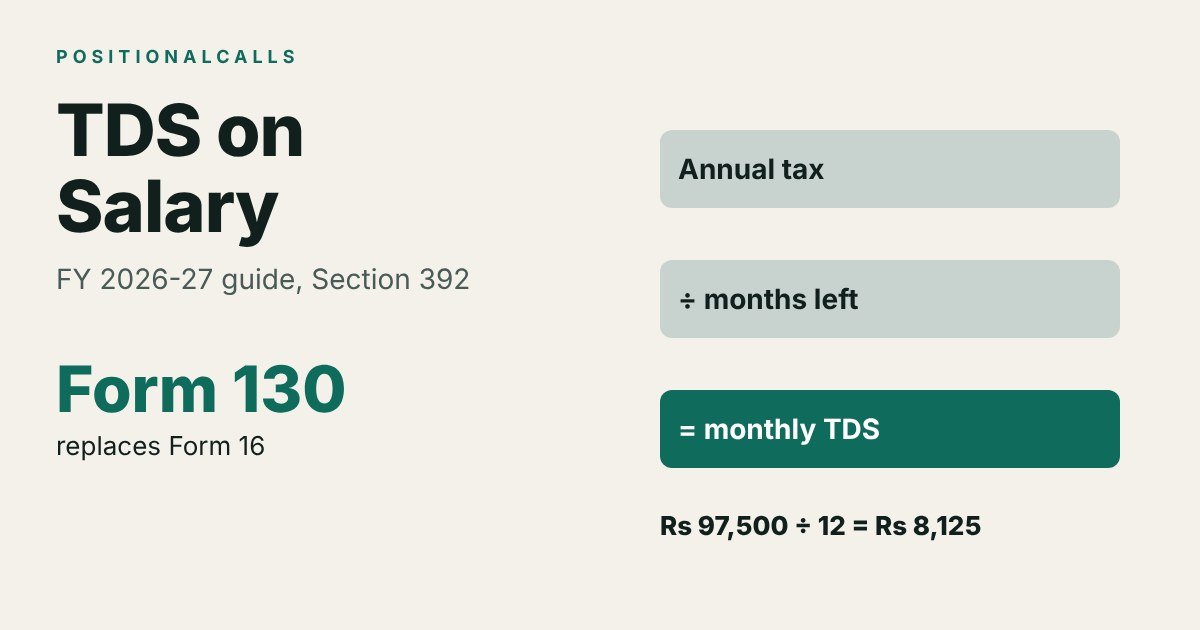
Income Tax · Salary TDS guide FY 2026-27
This guide to TDS on salary for FY 2026-27 explains Section 392, how your employer works out the monthly deduction, the new Form 130 and Form 124, the regime default, and how to claim back any excess, with worked examples.
Quick answer
TDS on salary is the tax your employer deducts each month under Section 392 of the Income-tax Act 2025, worked out as your estimated annual tax divided by the months left. The new regime is the default, Form 124 carries your claims, and Form 130 replaces Form 16 from Tax Year 2026-27.
Key takeaways on salary TDS
- Law: Section 392 of the Income-tax Act 2025 from 1 April 2026, per Patron Accounting.
- Default: the new regime applies unless you declare the old one, per ClearTax.
- Claims: without Form 124 no deduction is allowed, except the standard deduction, per TaxGuru.
- Certificate: Form 130, first due 15 June 2027.
- Excess TDS: claim it back through your return.
In plain words: your employer pays part of your tax to the government for you, a little each month, before the salary reaches your bank. It guesses your tax for the whole year, so what you tell it about rent, loans and savings changes the monthly amount. Anything paid too much comes back through your return.
Data note: as of Friday, 20 November 2026, 6:25 PM IST. The Section 392 mapping, the form numbers, the dates and the declaration rules come from the pages named in the sources list, read as search extracts, not from the Income-tax Act 2025 or the Rules themselves. The worked examples use assumed salaries and my own tax model for FY 2026-27, shown line by line. I did not open the Income Tax Department site.
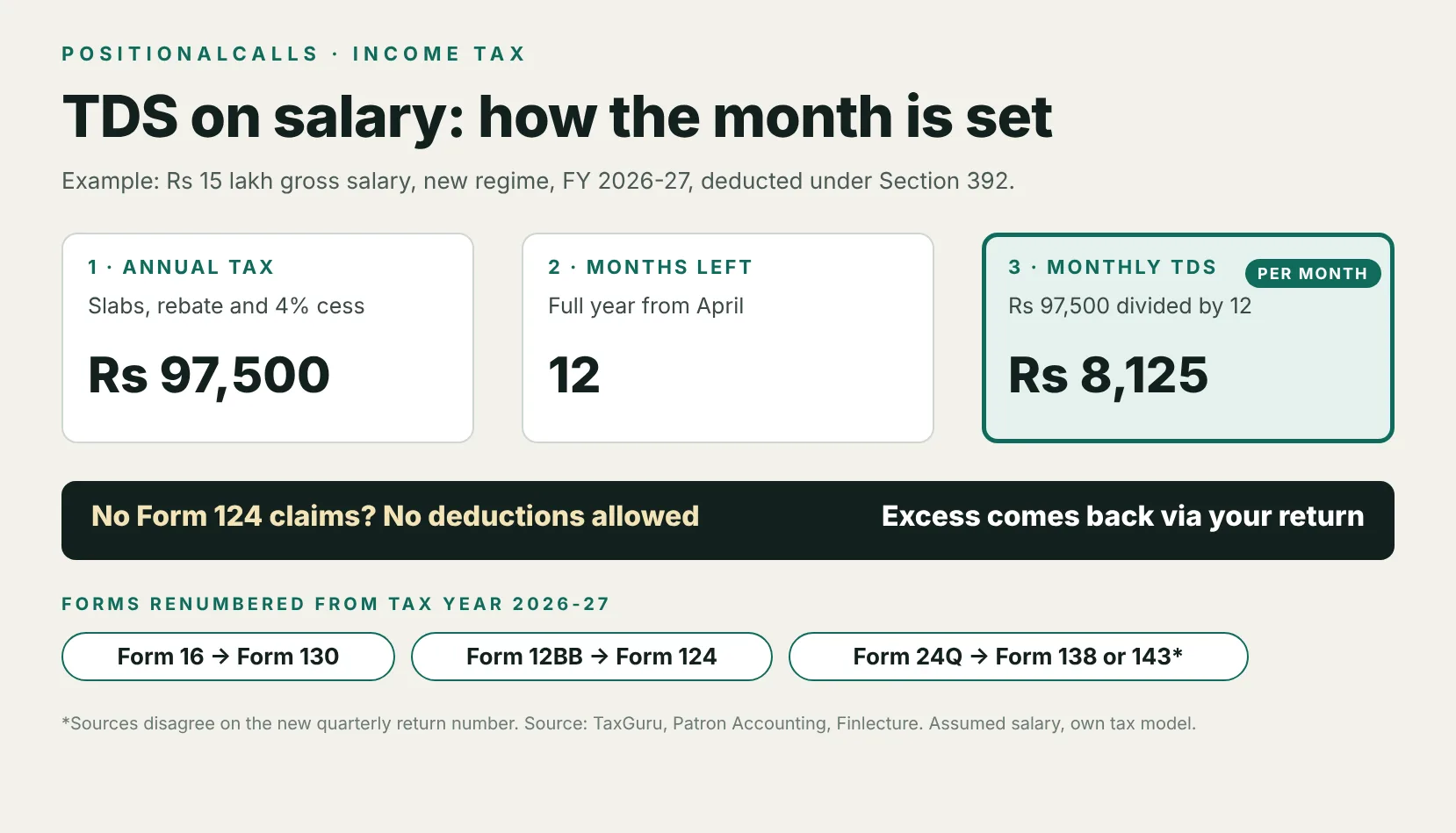 Salary TDS for FY 2026-27: how the monthly deduction is set and which forms carry it.
What is TDS on salary and who deducts it?
TDS on salary is the income tax your employer deducts from your pay before you receive it, and for FY 2026-27 it falls under Section 392 of the Income-tax Act 2025. Patron Accounting calls Section 392 the single section governing salary TDS, replacing Section 192 of the 1961 Act, and Keka says the Act has come into effect with Form 16 replaced by Form 130.
The employer is the deductor. It estimates your annual income, works out the tax under your regime and deducts it month by month, then deposits it with the government. The tax is credited to your PAN, and you claim credit for it when you file your return. TDS is not an extra tax. It is a prepayment of the tax you owe for the year.
| Question | Short answer | Source |
|---|---|---|
| Who deducts it? | The employer, under Section 392 | Patron Accounting |
| What is deducted? | Estimated annual tax divided over the months | Finlecture, Patron Accounting |
| Which regime? | New regime unless you choose the old one | ClearTax |
| Which form shows it? | Form 130 from Tax Year 2026-27 | TaxGuru, India Briefing |
| What do I give the employer? | Form 124 for claims, Form 122 for a past employer | Patron Accounting, TaxGuru |
Cite this table: Salary TDS guide: basics, PositionalCalls, Friday, 20 November 2026, 6:25 PM IST, compiled from Patron Accounting, Finlecture, ClearTax, TaxGuru and India Briefing.
Who is covered by TDS on salary?
Every employer that pays salary or pension and deducts tax under Section 392 must issue Form 130, per TaxGuru, whether a company, firm, individual, trust or government department. TaxGuru adds that Form 130 also covers pensioners and specified senior citizens with interest income. If your tax is nil after claims, no TDS is deducted, as ClearTax shows in its pension example.
How is TDS on salary calculated each month?
The employer estimates your annual salary, subtracts the allowed deductions, applies the slab rates of your regime, and divides the annual tax by the months left in the year. Finlecture gives the formula as annual tax liability divided by remaining months, and Patron Accounting lists the same steps.
- Step 1: estimate annual salary, including basic, HRA, allowances, bonus and perquisites, per AboutAll.
- Step 2: include salary from an earlier employer if you filed Form 122, per Patron Accounting.
- Step 3: apply the standard deduction, Rs 75,000 in the new regime and Rs 50,000 in the old, per ClearTax.
- Step 4: allow claims from Form 124, if the old regime applies.
- Step 5: apply the slabs, the rebate, surcharge and 4% cess, then divide by the remaining months.
Because the estimate is for the full year, a bonus, an increment or a new declaration changes the monthly figure from the next payroll. The employer recomputes and spreads the remaining tax over the remaining months, so a late declaration does not cut earlier deductions but can cut later ones.
| Step | What the employer uses | Result |
|---|---|---|
| Gross salary estimate | Pay slip heads for the year | Annual gross |
| Standard deduction | Rs 75,000 new, Rs 50,000 old | Net salary |
| Claims | Form 124 proofs, old regime only | Taxable income |
| Slab tax and cess | Slabs of the chosen regime | Annual tax |
| Monthly TDS | Annual tax divided by months left | Deduction per month |
Cite this table: Salary TDS guide: calculation steps, PositionalCalls, Friday, 20 November 2026, 6:25 PM IST, per Finlecture, Patron Accounting, ClearTax and AboutAll.
Does the standard deduction need a declaration for TDS on salary?
No. TaxGuru says the standard deduction is allowed in every case and needs no separate declaration in Form 124 or any other form. Everything else, such as rent, home-loan interest and 80C savings, needs a declaration and proof, as the later sections explain.
What counts as salary for TDS on salary?
The employer counts the whole pay package for the year, not just basic pay, and the estimate includes basic, HRA, LTA, special allowances, bonus and perquisites. AboutAll lists those heads as the first step, and Patron Accounting says salary from a previous employer is added when you file Form 122.
That is why a variable bonus can raise the monthly deduction well before it is paid. If the payroll system projects the bonus into the annual estimate, the tax on it is spread across the remaining months. If it is added only when paid, the whole tax on it lands in that month. Ask payroll which method it uses, because it explains a sudden jump on the payslip.
| Pay head | Included in the estimate? | Note |
|---|---|---|
| Basic and dearness allowance | Yes | Base of most calculations |
| House rent allowance | Yes, then exempt in part | Old regime and Form 124, see the HRA guide |
| Special allowances and LTA | Yes | Per AboutAll |
| Bonus and incentives | Yes | Projected or added when paid |
| Perquisites | Yes | Valued under the Rules, per Keka |
| Earlier employer salary | Yes, with Form 122 | Per Patron Accounting |
Cite this table: Salary TDS guide: pay heads, PositionalCalls, Friday, 20 November 2026, 6:25 PM IST, per AboutAll, Patron Accounting and Keka.
Does employer NPS reduce TDS on salary?
Patron Accounting says that under the new regime only the Rs 75,000 standard deduction and the employer NPS contribution, up to 14% of salary, are subtracted. If your employer pays into NPS, the deduction lowers the base for TDS without a separate claim. See the NPS calculator for the contribution itself.
How do the rebate, surcharge and cess enter TDS on salary?
The employer applies the slab rates, then the Section 87A rebate if your income qualifies, then any surcharge and the 4% health and education cess, so the monthly deduction already includes them. Legal Suvidha lists the surcharge and cess as steps in the salary computation under the CBDT circular.
For a salaried resident in the new regime, the rebate makes tax nil up to Rs 12 lakh of taxable income, and the Rs 75,000 standard deduction takes the salary figure to Rs 12.75 lakh, as the income tax guide on this site explains. Above that, the tax rises quickly, so the monthly deduction can jump when a raise crosses the line. At Rs 15 lakh the model gives Rs 97,500 a year.
Legal Suvidha warns about one payroll error: if an employee discloses capital gains in the declaration, the computation should exclude those gains from the rebate calculation. A payroll team that ignores the rule can give a rebate that the return later withdraws.
Why does the first month after a raise look odd in TDS on salary?
Because the annual estimate jumps and the employer spreads the extra tax over fewer months. A raise in January raises the estimate for the whole year, and the added tax falls on the last three payslips. That is normal, and it is not an error in the TDS on salary unless the estimate itself is wrong.
What does Section 392 say about provident fund withdrawals?
TaxGuru’s mapping puts Section 192A, the accumulated provident fund balance, inside Section 392, with a rate of 10% above Rs 50,000. The same table gives the rate and threshold for FY 2026-27.
That row matters for people who withdraw an EPF balance early. A withdrawal below Rs 50,000 carries no TDS in the table, and a larger one is cut at 10% where the rules apply. Whether TDS applies at all depends on the length of service and the exemptions in the Act, which this guide does not cover.
| Item | 1961 Act | 2025 Act | Rate and threshold |
|---|---|---|---|
| Accumulated PF balance | Section 192A | Section 392 (part) | 10% above Rs 50,000 |
| Salary | Section 192 | Section 392(1) | Average rate on taxable income |
Cite this table: Salary TDS guide: and provident fund, PositionalCalls, Friday, 20 November 2026, 6:25 PM IST, per TaxGuru.
TDS on salary examples: monthly deduction at different salaries
The same salary can give very different monthly deductions depending on the regime and on whether you filed Form 124. These examples use my own FY 2026-27 model for a salaried resident, with 4% cess and no surcharge at these levels.
Example 1: the new regime at three salaries
At a gross salary of Rs 15,00,000 the new regime tax is Rs 97,500 a year, so about Rs 8,125 a month. At Rs 18,00,000 it is Rs 1,50,800, about Rs 12,567 a month, and at Rs 24,00,000 it is Rs 2,92,500, about Rs 24,375 a month. At Rs 12,75,000 or less the tax is nil, so no salary TDS is deducted. The model applies the Rs 75,000 standard deduction and the Section 87A rebate.
Example 2: old regime, with and without Form 124
Take a Rs 15,00,000 salary and an old regime choice with Rs 3,75,000 of claims beyond the standard deduction, such as 80C, health insurance and home-loan interest. With Form 124 and proof the annual tax is Rs 1,40,400, about Rs 11,700 a month. If the employer holds no declaration, it allows only the standard deduction, the tax is Rs 2,57,400 and the deduction is about Rs 21,450 a month.
The gap of Rs 1,17,000 is the excess TDS. It is not lost, because you recover it as a refund when you file the return, but it sits with the government until then. The new regime would have cost Rs 97,500 on the same salary, which is why the comparison matters before you declare.
| Case (gross Rs 15,00,000) | Annual tax (Rs) | Monthly TDS (Rs) |
|---|---|---|
| New regime, default | 97,500 | 8,125 |
| Old regime, Rs 3.75 lakh of claims declared | 1,40,400 | 11,700 |
| Old regime chosen, no Form 124 | 2,57,400 | 21,450 |
Cite this table: Salary TDS guide: monthly examples, PositionalCalls, Friday, 20 November 2026, 6:25 PM IST, own model of FY 2026-27 slabs, assumed deductions, rounded to the nearest rupee.
Why does the monthly TDS on salary change during the year?
It changes whenever your estimated annual income or claims change: a bonus, a pay rise, a late declaration or a new job. The tax for the year is re-estimated and divided by the months left, so the same year can show different deductions in April, October and March. Check the payslip each time the payroll team confirms a change.
How does your regime choice change TDS on salary?
Your employer uses the new regime unless you tell it to use the old one, and the choice for TDS is made at the start of the tax year. ClearTax says an employee who wants the old regime must tell the employer when giving the investment declaration, and Taxheal says the option is exercised at the start of the tax year.
The choice for TDS is not the final choice. Patron Accounting says without a declaration TDS is computed under the new regime by default, and your return can still use the other regime, subject to the rules that apply to your income. What the choice does is set how much the employer holds back each month.
| Item | New regime TDS | Old regime TDS |
|---|---|---|
| Default | Yes | Only if you declare it |
| Standard deduction | Rs 75,000 | Rs 50,000 |
| Rent, loans, 80C and similar | Not allowed | Allowed with Form 124 |
| Employer NPS | Allowed up to 14% of salary, per Patron Accounting | Allowed |
| Needs proof | No | Yes |
Cite this table: Salary TDS guide: regime effect, PositionalCalls, Friday, 20 November 2026, 6:25 PM IST, per ClearTax, Patron Accounting and Taxheal.
Which regime should you declare for TDS on salary?
Declare the old regime only if your claims are large enough to beat the new regime, which the income tax calculator shows in both columns. Use the HRA exemption guide for the rent claim, and see income tax in India for the slabs behind each regime.
PositionalCalls WhatsApp channel
Get tax and savings explainers on WhatsApp
- Slab and deduction changes, dated
- Calculators explained without tips
- Links to updated tax guides
Which forms replace the old salary TDS forms?
From Tax Year 2026-27 the salary TDS forms are renumbered: Form 16 becomes Form 130, Form 12BB becomes Form 124, and the quarterly return changes from Form 24Q to a new form. Zoho Payroll and TaxGuru list the same mappings, and sources disagree only on the number of the new return.
| Old form (1961 Act) | New form (2025 Act) | Purpose | Source |
|---|---|---|---|
| Form 16 | Form 130 | Annual salary TDS certificate | TaxGuru, Zoho Payroll |
| Form 12BB | Form 124 | Employee claims for TDS | Patron Accounting, efiletax |
| Form 24Q | Form 138 per TaxGuru, Form 143 per Finlecture | Quarterly salary TDS return | TaxGuru, ClearTax, Finlecture |
| Form 16A | Form 131 | Certificate for non-salary TDS | India Briefing, mnco |
| Form 26Q | Form 140 | Quarterly return for non-salary TDS | mnco |
| None | Form 122 | Declaration of earlier employer income and TDS | Patron Accounting |
Cite this table: Salary TDS guide: form changes, PositionalCalls, Friday, 20 November 2026, 6:25 PM IST, per TaxGuru, Zoho Payroll, Patron Accounting, Finlecture, India Briefing and mnco.
Zoho Payroll says Form 16 for FY 2025-26 will still be issued under the old name and the old Act, and that the switch to Form 130 applies to the certificate for FY 2026-27. ClearTax goes further and says a certificate issued as Form 16 for Tax Year 2026-27 will be technically non-compliant.
Why does the TDS on salary form number matter to you?
It matters when you read old advice. A guide telling you to submit Form 12BB or to expect Form 16 in June 2027 is out of date for FY 2026-27. For FY 2025-26 the old names still apply, so check the year before you act on any form number.
What is Form 124 and what can you claim through it?
Form 124 is the declaration you give your employer to claim deductions, exemptions and allowances that reduce your salary TDS, and it replaces Form 12BB. TaxGuru describes it that way, and efiletax says it applies from 1 April 2026 under the Income-tax Rules 2026.
Patron Accounting says Form 124 is where you claim HRA, LTC and home-loan interest, and that it requires a landlord relationship disclosure for HRA. Efiletax says it is not mandatory for every employee, only when you want the employer to allow a claim in TDS on salary. If you file nothing, TaxGuru says the employer allows no deduction or exemption.
| Claim | Declared in Form 124? | Note |
|---|---|---|
| Standard deduction | No | Allowed in every case, per TaxGuru |
| HRA exemption | Yes | Landlord relationship disclosure needed, per Patron Accounting |
| Home-loan interest | Yes | Old regime |
| Section 80C savings | Yes | Up to Rs 1,50,000, per Finlecture |
| Health insurance, Section 80D | Yes | Rs 25,000 to Rs 1,00,000, per Finlecture |
| Previous employer income | No, use Form 122 | Per TaxGuru |
Cite this table: Salary TDS guide: Form 124 claims, PositionalCalls, Friday, 20 November 2026, 6:25 PM IST, per TaxGuru, Patron Accounting, efiletax and Finlecture.
When should you file Form 124 for TDS on salary?
File it at the start of the tax year, with proof when the employer asks for it, so the monthly deduction is right from April. Onsurity says that without the declaration the employer deducts on your full salary and you wait for a refund after filing. If your rent or loan starts later, file an updated declaration then.
What is Form 130 and when do you get it?
Form 130 is the annual certificate that shows your salary, the deductions allowed and the tax your employer deducted and deposited, and it is due by 15 June after the tax year. TaxGuru gives the due date, and says that for Tax Year 2026-27 the employer must issue it by 15 June 2027.
| Year | Certificate | Due date | Source |
|---|---|---|---|
| FY 2025-26 (salary to 31 March 2026) | Form 16 | 15 June 2026 | greytHR, Patron Accounting |
| Tax Year 2026-27 (from 1 April 2026) | Form 130 | 15 June 2027 | TaxGuru, greytHR |
Cite this table: Salary TDS guide: certificate dates, PositionalCalls, Friday, 20 November 2026, 6:25 PM IST, per TaxGuru, greytHR and Patron Accounting.
India Briefing says Form 130 is issued under the 2026 Rules and certifies that tax was deducted and deposited, like Form 16. TaxGuru adds that it has three parts plus an annexure for senior citizens, and that it covers pensioners as well. It is the document to read before you file, because the return is checked against it.
How do you check Form 130 against your return?
Match the gross salary, the deductions and the total tax deducted in Form 130 with your payslips and the tax credit statement on the portal. If a figure is missing or wrong, ask the employer to correct and reissue it before you file, because the credit for TDS follows what the employer reported.
What happens to TDS on salary when you change jobs?
Give the new employer your income and TDS details from the old one in Form 122, and file Form 124 again, so the new employer can estimate the full year correctly. TaxGuru and Patron Accounting both describe Form 122 as the declaration that carries earlier income and TDS forward.
Without it, the new employer may deduct as if you earned only its own pay for the year, and the tax can come out too low. The shortfall then appears as tax to pay when you file. The earlier employer issues Form 130 for the months it paid, and the new one issues its own, so you may hold two certificates for the same tax year.
- Form 122: earlier employer salary and TDS, per Patron Accounting.
- Form 124: file again with the new employer, per indianpaycalculator, so claims do not stay with the job you left.
- Two certificates: add both Form 130 figures in your return.
What if too much TDS on salary was deducted?
Claim the excess as a refund by filing your return, because the return shows your real tax and credits all the TDS deducted. The usual cause is a missing or late declaration, since without Form 124 the employer allows no deduction, as TaxGuru notes.
- Declare early: Onsurity advises submitting the rent and investment declaration early so eligible claims reach the monthly deduction.
- Compare regimes: declaring the old regime with small claims can raise TDS above the new regime tax.
- Keep proof: rent receipts, premium receipts and loan certificates.
- File the return: see the belated ITR last date page if the due date has passed.
The refund is paid after the return is processed, and timing varies. It is better to fix the declaration so the monthly figure is right than to rely on a refund. The same applies to a bonus or capital gains that the employer does not see, which may need advance tax on your side.
How do you check the TDS line on your payslip?
Compare the TDS line with the annual tax divided by the months left, using your own salary and claims, and ask payroll to explain any gap. The figure should follow the formula in the calculation section, so a large difference points to a missing declaration or a wrong regime.
- Regime: confirm the payslip or tax statement shows the regime you chose.
- Claims: check that the HRA, loan and 80C claims from Form 124 appear in the tax statement.
- Estimate: check the annual gross against your own total pay.
- Months left: divide the remaining tax by the months left to see if it matches.
- Earlier job: confirm Form 122 figures were added.
If the monthly figure is higher than the formula gives, the usual fix is a corrected declaration, and the employer can spread the lower tax over the remaining months. If it is lower, you may owe tax when you file, so keep a margin and look at advance tax if you also have other income.
What should you ask payroll about TDS on salary?
Ask which regime is applied, what annual income is estimated, which claims are allowed, and whether bonus is projected. Four short answers let you rebuild the number yourself and decide whether a new declaration is worth filing.
Key dates for TDS on salary in FY 2026-27
The dates that matter to an employee are the declaration at the start of the year, Form 130 by 15 June 2027, and the return due dates. The employer also files quarterly returns, which incorpx lists as 30 July, 30 October, 30 January and 30 May.
| Date | Event | Source |
|---|---|---|
| 20 March 2026 | Income-tax Rules 2026 notified | TaxGuru |
| 1 April 2026 | Income-tax Act 2025 and Section 392 in force | Patron Accounting, Zoho Payroll |
| April 2026 | Start-of-year Form 124 and regime declaration | ClearTax, Taxheal |
| 15 June 2026 | Form 16 for FY 2025-26 | greytHR |
| 30 July, 30 October, 30 January, 30 May | Quarterly TDS returns for FY 2026-27, single source | incorpx |
| 15 June 2027 | First Form 130 for Tax Year 2026-27 | TaxGuru, greytHR |
Cite this table: Salary TDS guide: key dates, PositionalCalls, Friday, 20 November 2026, 6:25 PM IST, per TaxGuru, Patron Accounting, Zoho Payroll, greytHR, ClearTax, Taxheal and incorpx.
The quarterly return dates come from a single source and I could not check them against the Rules, so treat them as the employer’s side of the calendar rather than a date you act on. Your own dates are the declaration and the Form 130 check.
Which section covers TDS on salary in the 2025 Act?
Section 392 covers TDS on salary from 1 April 2026, replacing Section 192, and Section 393 covers most other TDS. ClearTax says Sections 392, 393 and 394 replace the old scattered TDS sections, and TaxGuru maps Section 192 to Section 392(1) and Section 192A to part of Section 392.
| Item | 1961 Act | 2025 Act | Source |
|---|---|---|---|
| TDS on salary | Section 192 | Section 392(1) | TaxGuru, ClearTax |
| Provident fund withdrawal | Section 192A | Section 392 (part), 10% above Rs 50,000 | TaxGuru |
| Salary certificate | Form 16, Rule 31 | Form 130, Rule 215 or 215(1) | TaxGuru, Patron Accounting |
| Certificate section | Section 203 | Section 395(4), per TaxGuru | TaxGuru |
Cite this table: Salary TDS guide: legal references, PositionalCalls, Friday, 20 November 2026, 6:25 PM IST, per TaxGuru, ClearTax and Patron Accounting.
Sources differ on small details, such as whether Form 130 is under Rule 215 or Rule 215(1). ClearTax’s section page also shows a stray reference to Section 329 of the Income Tax Act 2026, which I did not use. Your payslip and Form 130 will carry whatever reference your payroll uses.
What mistakes do people make with TDS on salary?
The common errors are skipping Form 124, declaring the old regime with small claims, forgetting Form 122 after a job change and following guides that still use Form 16 and Form 12BB. Each follows from the rules above.
- No declaration: TDS on salary is computed with no deductions, per TaxGuru, so it is higher than needed.
- Old regime by habit: declaring it without enough claims raises TDS above the new regime tax.
- No Form 122: the new employer undercounts income after a job change.
- Old form names: Form 124 and Form 130 apply from Tax Year 2026-27.
- Waiting for a refund: a refund is slower than a correct monthly deduction.
What is a short checklist for TDS on salary?
At the start of the year choose your regime with the income tax calculator, file Form 124 with proof if you chose the old regime, give Form 122 if you changed jobs, check the monthly deduction on the payslip, and match Form 130 against your return when it arrives.
What does this TDS on salary guide leave out?
It leaves out perquisite valuation, salary from several employers, foreign-currency salary, NRI rules and the employer’s own compliance penalties. It is a guide for the employee, with the employer’s side only where it changes your deduction.
- No statute text: I did not open the Income-tax Act 2025 or the Rules, so the section and form numbers rest on the sources named.
- No portal check: I did not open the Income Tax Department site.
- No personal advice: your deduction depends on your payslip and declaration.
When will this TDS on salary guide be updated?
After any change to the Income-tax Rules 2026, after the 1 February 2027 Budget, and when the Income Tax Department confirms the number of the quarterly return form. The update line at the top shows the last real change.
PositionalCalls WhatsApp channel
Tax updates in one channel
- Budget and notification changes
- Plain-English tax explainers
- Links to new guides
TDS on salary: frequently asked questions
What is TDS on salary and who deducts it?
TDS on salary is income tax your employer deducts from your pay each month, based on an estimate of your tax for the year. Under the Income-tax Act 2025 the provision is Section 392, which replaced Section 192, per Patron Accounting and Keka. The employer deposits the tax with the government and certifies it to you in Form 130.
How is TDS on salary calculated each month?
The employer estimates your annual salary, applies the standard deduction and any allowed claims, works out the annual tax under your regime, and divides it by the months left in the year, per Finlecture and Patron Accounting. The new regime is the default unless you tell your employer otherwise, so a declaration changes the monthly figure.
Is Form 16 replaced by Form 130?
Yes, from Tax Year 2026-27. TaxGuru and India Briefing say Form 130 replaces Form 16 as the annual salary TDS certificate. For FY 2025-26 employers still issue Form 16 by 15 June 2026, and the first Form 130 is due by 15 June 2027, per greytHR and Patron Accounting.
What is Form 124 and do I have to file it?
Form 124 replaces Form 12BB and is the declaration through which you tell your employer about rent, home-loan interest and similar claims, per TaxGuru and efiletax. It is not needed for the standard deduction. If you file nothing, TaxGuru says the employer deducts TDS on salary without allowing any deduction or exemption.
Which regime does my employer use for TDS on salary?
The new regime, unless you choose the old one. ClearTax and Patron Accounting say the new regime is the default, and an employee who wants the old regime must tell the employer at the time of the investment declaration. Taxheal adds that the option is exercised at the start of the tax year.
What if I change jobs during the year?
Give the new employer your earlier income and TDS details in Form 122, and file Form 124 again with the new employer, per TaxGuru and Patron Accounting. If you do not, the new employer may compute TDS on salary on its own payments only, and the difference can surface as extra tax when you file your return.
What is the due date for Form 130?
Form 130 must be issued on or before 15 June of the financial year after the tax year, per TaxGuru. For Tax Year 2026-27 that is 15 June 2027. It carries the salary, deductions and TDS that your return is checked against, and it acts as the main reference document, as Form 16 did.
What if TDS on salary was more than my actual tax?
Claim the excess as a refund by filing your return. The return shows your real tax, the TDS credited in Form 26AS or the annual statement, and the balance returned. A late or missing declaration is the common cause, because without Form 124 the employer allows no deduction, per TaxGuru. Compare regimes first.
Which form replaces Form 24Q for salary TDS returns?
Sources disagree. TaxGuru, ClearTax and mnco say Form 138 replaces Form 24Q for the employer’s quarterly salary return, while Finlecture says Form 143. The employer files it, not you. Check the form named on your employer’s payroll notice or the portal before relying on either number in any document you prepare.
Is this TDS on salary guide tax advice?
No. PositionalCalls is not a tax practitioner, a SEBI-registered research analyst or an investment adviser. This page explains TDS on salary rules as the named sources describe them, with worked examples on assumed salaries and my own arithmetic. Your payslip, declaration and regime decide your actual deduction, so ask your payroll team or a chartered accountant.
Sources for this salary TDS guide
- TaxGuru: Form 130 replaces Form 16 from 1 April 2026.
- TaxGuru: Form 130 TDS certificate for salary, FAQs.
- TaxGuru: Form 130 and Form 138 from Tax Year 2026-27.
- TaxGuru: Form 124 employee statement for salary TDS.
- TaxGuru: TDS rate chart and section mapping for FY 2026-27.
- ClearTax: TDS and TCS changes from April 2026.
- ClearTax: Section 392 of the Income Tax Act 2025.
- ClearTax: TDS on salary, Section 192.
- Patron Accounting: TDS on salary 2026.
- Patron Accounting: Form 130 vs Form 16.
- Keka: TDS on salary 2026 rate chart and guide.
- India Briefing: Form 130 due by 15 June.
- greytHR: payroll and compliance highlights, Form 130.
- Zoho Payroll: Income Tax Act 2025 and Rules 2026.
- efiletax: Form 124 salary TDS declaration.
- Finlecture: TDS on salary complete guide FY 2026-27.
- Taxheal: TDS on salary under Section 392.
- mnco: TDS rate chart FY 2026-27.
- incorpx: quarterly TDS returns under the new Act.
- Onsurity: TDS on salary and how to reduce it.
- AboutAll: how salary TDS works.
- indianpaycalculator: Form 12BB renumbered as Form 124.

Shubham Chaudhary is the founder of PositionalCalls, an independent Indian stock market research website. He writes company fundamentals, quarterly results analysis, IPO analysis and sector research for NSE and BSE listed companies, with a focus on banking stocks, insurance and long-term value investing. Every article is built from primary sources such as RBI, SEBI, NSE and BSE filings and company annual reports, and states its risks plainly in simple language for retail investors.
Coverage areas Our research standards- Numbers checked against NSE, BSE and SEBI filings
- Risks and limits stated in every article
- No paid promotions or broker tie-ups
- Articles updated when new filings arrive