
Learning · Tax on Investments
Your SIP is not taxed as one lump. Every monthly instalment has its own purchase date and its own tax clock. Here is how to work it out, with rupee examples, then three details worth double-checking: the new section numbers, the IDCW TDS threshold and FIFO.
Quick answer
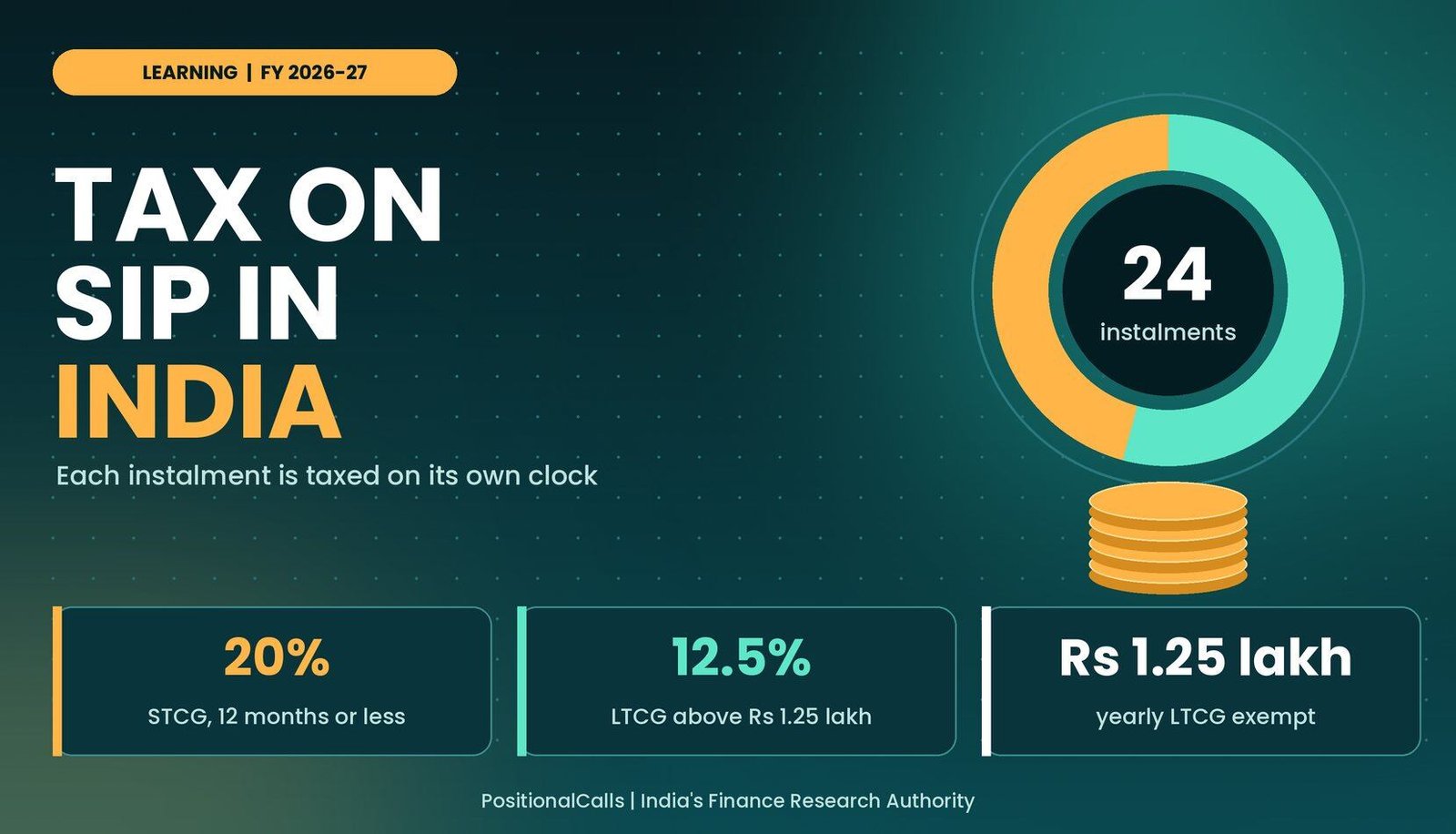
Tax on SIP in India for FY 2026-27 is worked out instalment by instalment. In equity funds, units held 12 months or less pay 20% STCG; units held longer pay 12.5% LTCG on gains above Rs 1.25 lakh a year. Debt-fund SIP gains are taxed at your slab rate. Budget 2026 changed none of these rates.
Latest update (Tuesday, 27 October 2026, 7:00 PM IST): Section numbers for capital gains (196, 197, 198) checked on the Income Tax Department site. AMFI September 2026 SIP data, released on 12 October 2026, is included. Next: this page is updated on any new rule.
Key takeaways
- Unit of tax: each SIP instalment is a separate purchase with its own date; tax arises only on redemption, switch or withdrawal.
- Equity funds: 20% STCG up to 12 months; 12.5% LTCG above Rs 1.25 lakh a year after that, plus 4% cess.
- Debt funds bought on or after 1 April 2023: slab rate, with no long-term benefit.
- New section numbers: sections 111A, 112 and 112A of the 1961 Act became 196, 197 and 198 from 1 April 2026.
- IDCW: residents face 10% TDS when payouts from one fund house exceed Rs 10,000 in a year; NRIs face 20% from the first rupee.
In plain words: a SIP (systematic investment plan) buys fund units every month. STCG is short-term capital gain and LTCG is long-term capital gain: the profit when you sell. FIFO means the oldest units are sold first. Cess is a 4% add-on to the tax.
Data note: as of 27 October 2026. Capital gains rates and section numbers were checked on Section 210 of the Income-tax Act, 2025 (Income Tax Department). Fund-level rules are cross-read from fund-house tax reckoners. SIP figures are AMFI data as reported on 12 October 2026. Rupee examples use assumed gains and are labelled illustrations.
What are the key numbers for SIP tax?
Four tax numbers and three AMFI numbers frame the topic: 20%, 12.5%, Rs 1.25 lakh, 12 months, and Rs 32,490 crore of monthly SIP money.
| Number | Value | Why it matters |
|---|---|---|
| Equity STCG rate | 20% | Applies to units held 12 months or less; flat, whatever your slab |
| Equity LTCG rate | 12.5% | Applies only to gains above Rs 1.25 lakh in the year |
| SIP contributions, Sep 2026 | Rs 32,490 crore | Record month; up from Rs 32,297 crore in August 2026 and Rs 29,361 crore in September 2025 |
| Year-on-year growth | 10.7% | My calculation: (32,490 – 29,361) / 29,361 |
| Contributing SIP accounts | 10.06 crore | Accounts that paid in during the month, not unique investors |
| Stoppage ratio | 78.5% | My calculation: 49.68 lakh stopped or completed / 63.26 lakh new registrations |
The 78.5% ratio compares SIPs that stopped or ended with SIPs newly registered in the same month. It is a flow measure. It does not mean 78.5% of all SIPs are failing.
How is tax on SIP in India calculated?
Tax on SIP is calculated per instalment: each monthly purchase is a separate holding with its own date, and tax arises only when you redeem, switch or withdraw units.
Many people think a SIP has one purchase date, the day it started. It does not. A Rs 10,000 SIP running for 24 months is 24 separate purchases. Five steps give you the tax:
- Identify the fund type: a fund with more than 65% in Indian equities is equity-oriented. Others follow different rules (see the debt section).
- Match sold units oldest first (FIFO): the fund house assigns the units you redeem to the earliest instalments.
- Count the holding period per instalment: from the allotment date to the sale date. For equity funds, more than 12 months is long-term.
- Work out the gain per instalment: sale value less purchase cost for those units.
- Apply the rate and add cess: 20% on short-term, 12.5% on long-term above Rs 1.25 lakh, then 4% cess. Surcharge may apply at higher incomes; the examples here ignore it.
A SIP into the growth option creates no tax while it runs. The fund reinvests gains inside the scheme and you are taxed only when units are sold. Only IDCW payouts are taxed earlier.
What are the SIP tax rates for FY 2026-27?
For FY 2026-27, equity SIP gains pay 20% if short-term and 12.5% above Rs 1.25 lakh if long-term; debt and other funds follow slab-based rules.
PositionalCalls SIP Tax Rate Table (as of 27 October 2026)
| Fund type | Short-term gain | Long-term gain | Long-term after | Yearly exemption |
|---|---|---|---|---|
| Equity-oriented (over 65% Indian equity), including ELSS and equity-oriented hybrids | 20% | 12.5% on gains above Rs 1.25 lakh | More than 12 months | Rs 1.25 lakh |
| Debt funds bought on or after 1 April 2023 | Slab rate | Slab rate (no long-term benefit) | Not applicable | None |
| Debt funds bought before 1 April 2023 | Slab rate | 12.5% without indexation, as reported by fund-house guides | 24 months, as reported | None |
| Hybrid funds with 35% to 65% equity | Slab rate | 12.5% without exemption, as reported by one source | 24 months, as reported | None |
| International fund of funds | Slab rate | 12.5%, as reported by Kotak Mutual Fund | 24 months | None |
Cite this table: PositionalCalls SIP Tax Rate Table, 27 October 2026, positionalcalls.com/tax-on-sip-india/
For the first row, Section 210 of the Income-tax Act, 2025 on the Income Tax Department site shows the same 20% and 12.5% rates and the Rs 1,25,000 threshold, in the table that applies to foreign institutional investors. For residents, fund-house tax reckoners for FY 2026-27 carry the same rates. Rows two to five vary by fund category, so check your fund house tax reckoner or a tax adviser before relying on them.
What changed and when?
Rates have not changed since 23 July 2024, but section numbers moved on 1 April 2026 and the IDCW TDS threshold rose on 1 April 2025.
PositionalCalls SIP Tax Timeline (as of 27 October 2026)
| Date | What changed | Why it matters |
|---|---|---|
| 23 Jul 2024 | Equity STCG rose from 15% to 20%, LTCG from 10% to 12.5%, and the exemption from Rs 1 lakh to Rs 1.25 lakh (Finance (No. 2) Act, 2024) | These are the rates in force now |
| 1 Apr 2025 | TDS threshold on mutual fund income for residents raised to Rs 10,000 a year, as per Kotak Mutual Fund | Some pages still quote the older Rs 5,000 |
| 1 Feb 2026 | Union Budget 2026 left mutual fund capital gains rates unchanged, as reported by several fund-house and media guides | Rates carry into FY 2026-27 |
| 1 Apr 2026 | The Income-tax Act, 2025 replaced the 1961 Act; sections 111A, 112 and 112A became 196, 197 and 198 | Forms and statements use new numbers from Tax Year 2026-27 |
Cite this table: PositionalCalls SIP Tax Timeline, 27 October 2026, positionalcalls.com/tax-on-sip-india/
PositionalCalls SIP Section Number Map (as of 27 October 2026)
| Topic | Income-tax Act, 1961 | Income-tax Act, 2025 |
|---|---|---|
| STCG on equity shares and equity fund units (STT paid) | Section 111A | Section 196 |
| Long-term capital gains, general | Section 112 | Section 197 |
| LTCG on equity shares and equity fund units above Rs 1.25 lakh | Section 112A | Section 198 |
| TDS on mutual fund income (IDCW) | Section 194K | Section 393(1), as per a TDS section guide |
Cite this table: PositionalCalls SIP Section Number Map, 27 October 2026, positionalcalls.com/tax-on-sip-india/
Under the 2025 Act the word “tax year” replaces “previous year” and “assessment year”. Tax Year 2026-27 is the same period as FY 2026-27. Gains from units sold up to 31 March 2026 are still reported under the old numbers. A section-mapping guide says returns for Tax Year 2026-27, filed in 2027, will use the new numbers. Expect your fund house statement to show both for a while.
Read the headline carefully. Rates did not rise or fall in Budget 2026. A page that says “new SIP tax rules 2026” usually means the renumbering, not a new rate.
How much tax will I pay on a SIP? Worked examples
Three illustrations show how tax on SIP redemption splits by instalment, how the Rs 1.25 lakh exemption works and how losses reduce tax; all gains are assumed.
Example 1: a 24-month equity SIP redeemed in full
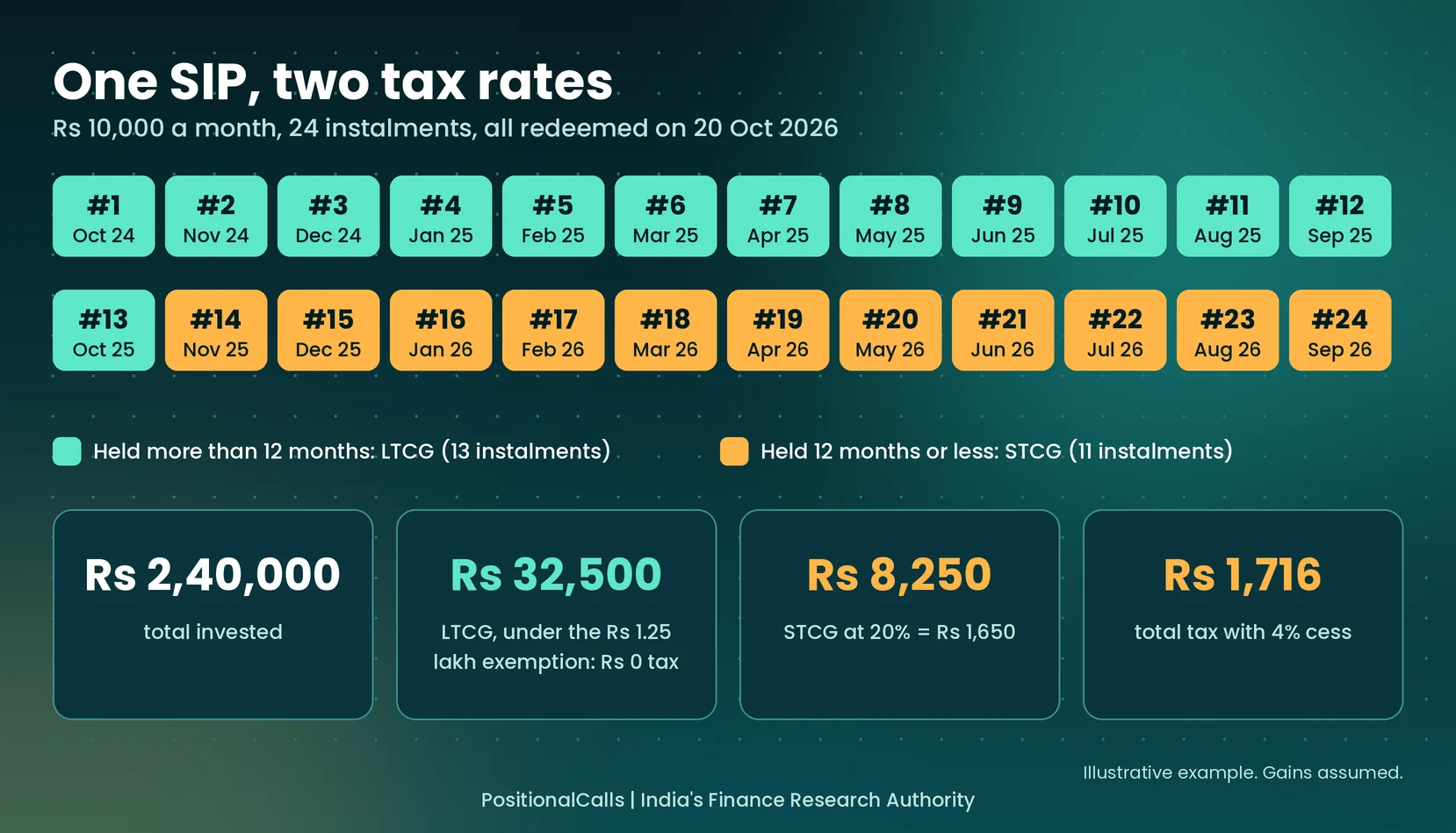
Rs 10,000 is invested on the 5th of each month from October 2024 to September 2026, and everything is redeemed on 20 October 2026. The 13 instalments from October 2024 to October 2025 are held more than 12 months. The 11 from November 2025 to September 2026 are not. Assume the older units gained Rs 2,500 on average and the newer ones Rs 750.
PositionalCalls SIP Instalment Example (as of 27 October 2026)
| Group | Instalments | Invested | Assumed gain | Type | Tax |
|---|---|---|---|---|---|
| Oct 2024 to Oct 2025 | 13 | Rs 1,30,000 | Rs 32,500 (13 x Rs 2,500) | LTCG | Rs 0, as it is below Rs 1.25 lakh |
| Nov 2025 to Sep 2026 | 11 | Rs 1,10,000 | Rs 8,250 (11 x Rs 750) | STCG | 20% = Rs 1,650 |
| Total | 24 | Rs 2,40,000 | Rs 40,750 | Rs 1,650 + 4% cess Rs 66 = Rs 1,716 |
Cite this table: PositionalCalls SIP Instalment Example, 27 October 2026, positionalcalls.com/tax-on-sip-india/
My calculation: Rs 1,716 divided by the total gain of Rs 40,750 is 4.21%. The tax is low because the long-term gains fit inside the exemption. This is an illustration, and your actual gains depend on market movement.
Example 2: SIP capital gains tax calculation above the exemption
In one financial year an investor books Rs 2,10,000 of equity fund LTCG and Rs 50,000 of STCG. My calculation: taxable LTCG is Rs 2,10,000 less Rs 1,25,000 = Rs 85,000, and 12.5% of that is Rs 10,625. STCG tax is 20% of Rs 50,000 = Rs 10,000. Together that is Rs 20,625. Cess at 4% is Rs 825. Total tax is Rs 21,450.
The exemption is applied once to the combined long-term gains from all listed shares and equity funds. If you also sold shares at a long-term profit, they share the same Rs 1.25 lakh. See capital gains tax on shares for the share-trading side.
Example 3: using a loss to cut the tax
Fund A gives a short-term gain of Rs 60,000 and fund B gives a short-term loss of Rs 25,000 in the same year. A short-term loss can be set off against short-term or long-term gains. Net STCG is Rs 35,000, so tax is 20% = Rs 7,000, plus cess Rs 280, total Rs 7,280. Without the loss it would have been Rs 12,480. A long-term loss can be set off only against long-term gains. Unabsorbed losses can usually be carried forward for eight years if the return is filed on time; check the conditions with a tax adviser.
Example 4: what waiting one more day can change
Take one instalment with a Rs 3,000 gain. If it is sold as short-term, tax is 20% = Rs 600. If it is sold as long-term and your Rs 1.25 lakh exemption is already used, tax is 12.5% = Rs 375. The difference is Rs 225 on that one instalment. Units complete 12 months on the anniversary of their allotment date, and “more than 12 months” means selling on the next day or later. Allotment can be a day or more after the instalment date, so read the capital gains statement before you press redeem.
How to check your own numbers: list each instalment date and units from the statement, mark which are older than 12 months, and add the gains in two buckets. Then apply Rs 1.25 lakh to the long-term bucket only, 20% to the short-term bucket, and 4% cess on the total tax. If any figure on your statement differs from your own sheet, ask the fund house to explain it before you file.
Which SIP units are sold first, and what triggers tax?
Fund houses sell the oldest units first (FIFO), and tax is triggered by redemption, a switch or an SWP withdrawal, not by stopping the SIP.
- Part redemption: Rs 1,00,000 of units sold in October 2026 would draw first on the oldest instalments, which are mostly long-term.
- Stopping or pausing a SIP: not a taxable event. The existing units simply stay invested.
- Switching between schemes: treated as a sale from one scheme and a purchase in the other, so it can trigger tax.
- Regular to direct plan: generally also treated as a transfer, so confirm the tax effect with your fund house before switching.
- SWP (systematic withdrawal): every withdrawal is a redemption and is taxed by the same FIFO rules.
Units bought before 1 February 2018 have a special rule. Their cost for the Rs 1.25 lakh calculation is the higher of actual cost and the lower of the 31 January 2018 value and the sale value. Your fund house statement usually does this for you.
PositionalCalls WhatsApp channel
Tax on SIP: rule changes, explained in plain English
- A dated note when a SIP or capital gains tax rule changes
- Worked rupee examples after every tax update
- Reminders ahead of ITR and advance tax dates
How are debt, hybrid and gold fund SIPs taxed?
Debt fund SIP units bought on or after 1 April 2023 are taxed at your slab rate with no long-term benefit; hybrids and gold funds depend on their category.
A SIP in a debt fund bought after that date is simple but costly for high earners: the whole gain is added to income. Example: a Rs 40,000 gain for someone in the 30% slab is taxed at Rs 12,000, plus cess Rs 480, total Rs 12,480 (my calculation, ignoring surcharge). The same Rs 40,000 gain in an equity fund held over a year, within the exemption, would be tax free.
- Hybrid funds with over 65% equity (aggressive hybrids) are treated like equity funds.
- Hybrid funds with 35% to 65% equity follow different rules; one fund-house guide reports 12.5% without exemption after 24 months.
- Gold ETFs: one source reports long-term status after 12 months at 12.5%, and gold fund of funds after 24 months.
- Fund category can change the answer. Always read the “taxation” line in your scheme document or the fund house tax reckoner for FY 2026-27.
This matters for planning. Debt fund returns are often compared with fixed deposit rates, and both are now taxed at slab rates. The old advantage of indexation is gone for units bought on or after 1 April 2023.
Is IDCW from a SIP taxed, and is TDS cut?
IDCW payouts are added to your income and taxed at your slab rate, and residents face 10% TDS once payouts from one fund house exceed Rs 10,000 in a year.
IDCW (income distribution cum capital withdrawal) is the new name for the dividend option. There is no dividend distribution tax at fund level any more; the tax falls on you. Example: Rs 14,000 is paid by one fund house, so TDS is 10% = Rs 1,400 and Rs 12,600 reaches your bank. If you are in the 30% slab, the tax is Rs 4,200 plus cess Rs 168 = Rs 4,368, so about Rs 2,968 more is due when you file (my calculation, ignoring surcharge). The TDS is credited against your tax.
For NRIs the TDS on IDCW is 20% plus surcharge and cess from the first rupee, with no Rs 10,000 threshold, per fund-house tax reckoners. A SIP into the growth option avoids IDCW altogether.
How is an ELSS SIP taxed?
An ELSS SIP is taxed like other equity funds, but every instalment is locked in for three years.
A Rs 5,000 ELSS SIP started in January 2026 can first be redeemed, instalment by instalment, from January 2029. The January 2026 units unlock first; the February 2026 units a month later. Gains after the lock-in follow the same 12.5% above Rs 1.25 lakh rule, because three years is more than 12 months.
The deduction for ELSS investments (an 80C-type deduction, up to Rs 1.5 lakh) is available only under the old tax regime. The default new regime does not offer it. If you choose the new regime, an ELSS SIP is just an equity fund with a lock-in. Other tax-saving routes under the old regime include life insurance premiums; see best term insurance plans in India for how those compare.
How is a SIP taxed for an NRI?
NRIs pay the same capital gains rates, but TDS is deducted at the time of redemption, and treaty relief may lower the final tax.
- Equity funds: about 20% TDS on short-term gains and 12.5% on long-term gains, plus surcharge and cess, as per fund-house reckoners for FY 2026-27.
- Treaty relief: some reckoners say TDS can be at the treaty rate if lower. This depends on your country and on documents such as a tax residency certificate.
- Account route: investments are made through an NRE or NRO account. See NRI investment in the Indian stock market for the rules on accounts and repatriation.
- US and Canada: many Indian fund houses restrict or limit fresh investments from these countries because of local rules and FATCA. Ask your fund house before you start a SIP.
- Gulf countries: a country with no personal income tax does not remove Indian tax on Indian gains. Check the treaty with a tax adviser.
A full guide to NRI mutual fund investing and FATCA limits is a planned follow-up on this site.
How do I report SIP gains in my ITR?
Download the capital gains statement from your fund house or its registrar, total the short-term and long-term gains, and report them in the capital gains schedule of your ITR.
- Download the statement: from the fund house website or its registrar (CAMS or KFintech) for the financial year.
- Check the dates: match the sale date and each purchase date to your records.
- Total the gains: add short-term and long-term separately, and apply the Rs 1.25 lakh exemption to long-term equity gains.
- Set off losses: use short-term and long-term losses within the allowed rules.
- Cross-check with the Annual Information Statement: it lists your mutual fund transactions, so a missing entry is easy to spot.
- Pay any balance: as advance tax or self-assessment tax, and claim credit for any TDS.
Use the section numbers that match the year of sale. Units sold up to 31 March 2026 are reported under the 1961 Act; for later sales the 2025 Act applies, so check the return form instructions of the relevant year.
How can I lower tax on SIP gains legally?
Legal ways to lower tax on SIP gains are timing, using the Rs 1.25 lakh exemption each year, setting off losses and choosing the growth option; none changes the underlying risk.
- Hold past 12 months: an equity instalment sold as long-term pays 12.5%, not 20%, and may fall inside the exemption.
- Spread redemptions across financial years: the exemption resets every April, so a large sale can be split.
- Gain harvesting: some investors sell units with up to Rs 1.25 lakh of long-term gain and reinvest, which raises the purchase cost. My calculation: if that Rs 1.25 lakh would otherwise be taxed later, it saves Rs 15,625 plus Rs 625 cess, or Rs 16,250. That depends on future gains, and on exit loads and costs.
- Loss harvesting: realised losses can reduce taxable gains, within the set-off rules.
- Growth over IDCW: growth defers tax until you sell and avoids slab-rate IDCW income.
These are general tax facts, not a recommendation. Selling just to save tax can backfire if you sell a good fund at the wrong time. Ask a tax adviser before using any of them.
SIP tax in practice: what you need and what it costs
You need PAN, KYC and a bank account to start a SIP; the real costs are expense ratio, any exit load and the tax on gains.
- What you need: PAN, completed KYC, a bank account for the mandate and a folio with the fund house or a platform.
- What it costs: every fund charges an expense ratio, and direct plans charge less than regular plans. An exit load may apply if you redeem early; check the scheme document. A small securities transaction tax applies on equity fund redemptions and is deducted by the fund house. Your broker charges apply only if you buy units through a demat account, so see demat account charges in India.
- Tax angle: check the current rules or ask a tax adviser, and see STCG and LTCG rates for FY 2026-27 for shares.
- Safer alternatives: fixed deposits, PPF or term insurance serve different needs. Compare them on stated criteria, not on advertised returns.
- Scam warning: fake tax-refund or KYC pages, “guaranteed SIP return” schemes and OTP requests are common. Never share an OTP.
What are the common mistakes, and what do most people miss?
The most common SIP tax mistakes are selling too early, assuming one purchase date and using old section numbers.
What most people miss:
- AMFI separates contributing SIP accounts (10.06 crore in September 2026) from outstanding accounts (10.75 crore in August 2026). Some pages quote higher “active SIP” totals that mix definitions, and none of them equals the number of unique investors.
- A switch inside the same fund house can create a taxable sale even though no money leaves your account.
- Debt fund investors who compare with fixed deposits should compare after-tax returns, since both are taxed at slab rates.
What is the SIP tax checklist?
- Confirm the fund type: equity-oriented, debt or hybrid.
- Find each instalment’s allotment date on the statement.
- Check which instalments pass 12 months before you redeem.
- Add other long-term gains from shares to use the Rs 1.25 lakh exemption once.
- Note any realised losses and carry-forward balances.
- Check TDS on IDCW or NRI redemptions.
- Use section numbers matching the year of sale.
- Keep the capital gains statement and match it with the Annual Information Statement.
Analyst’s note
- What stands out: the exemption is the biggest lever. A moderate SIP can leave long-term gains well under Rs 1.25 lakh for years, as Example 1 shows.
- Easy to miss: short-term and long-term gains can sit in the same SIP, so there is no single “SIP tax rate”.
- What would change the picture: a Budget change to rates or the exemption limit, or new CBDT rules under the 2025 Act.
- Plain caution: tax saving is a side effect, not a reason to buy or sell a fund.
- Reader action: download your capital gains statement before you redeem.
Reasoning from the data above.
Bottom line
Tax on SIP is an instalment-by-instalment calculation: 20% on short-term and 12.5% above Rs 1.25 lakh on long-term gains for equity funds, slab rates for most debt funds, and new section numbers 196 to 198 from 1 April 2026. Check each instalment’s date before you redeem.
Next read: Capital gains tax on shares
Part of the Personal finance and tax series by Shubham Chaudhary.
PositionalCalls WhatsApp channel
Never miss a tax rule change that touches your SIP
- Plain-English notes on Budget and CBDT changes
- Worked examples with the arithmetic shown
- Calendars for ITR and advance tax dates
Frequently asked questions
How is tax on SIP in India calculated?
Tax on SIP is calculated instalment by instalment. Each monthly purchase has its own date, so units sold are matched oldest first (FIFO), the gain is worked out per unit, and 20% STCG or 12.5% LTCG applies for equity funds. Tax arises only when you redeem, switch or withdraw.
Is a SIP taxed every month while it runs?
No. Buying units through a SIP is not a taxable event. Tax arises on redemption, switch or SWP withdrawal. The exception is IDCW payouts, which are taxed as income in the year you receive them, and may have TDS deducted.
How is SIP taxed in FY 2026-27, and at what rate?
For equity-oriented funds, 20% on short-term gains (12 months or less) and 12.5% on long-term gains above Rs 1.25 lakh a year, plus 4% cess. Debt fund SIP units bought on or after 1 April 2023 are taxed at your slab rate.
How much tax on SIP gains is exempt each year?
Rs 1.25 lakh of long-term capital gain in a financial year is exempt. It is one limit per taxpayer across all listed equity shares and equity-oriented fund units combined, not a separate Rs 1.25 lakh for each fund.
How does tax on SIP redemption work for a part withdrawal?
The fund house treats the oldest units as sold first (FIFO). So a part withdrawal usually draws on the oldest instalments, which are more likely to be long-term. Your capital gains statement shows which purchase dates were matched to the sale.
Is there tax on SIP redemption after one year?
For equity funds, units held more than 12 months are long-term, taxed at 12.5% only on gains above Rs 1.25 lakh in the year. Recent instalments in the same SIP may still be short-term and taxed at 20%.
How are debt fund SIPs taxed?
Gains on debt fund units bought on or after 1 April 2023 are added to your income and taxed at your slab rate, whatever the holding period. There is no indexation and no separate long-term rate for these units.
Which Income-tax Act sections apply to SIP gains now?
From 1 April 2026 the Income-tax Act, 2025 applies. Sections 111A, 112 and 112A of the 1961 Act correspond to sections 196, 197 and 198. The rates stay the same; only the numbers on forms and statements change.
Is TDS deducted when a resident sells SIP units?
Fund houses generally do not deduct TDS on capital gains of resident investors in equity or debt funds. NRIs face TDS on redemptions: about 20% on equity STCG and 12.5% on equity LTCG, plus surcharge and cess.
Is an ELSS SIP taxed differently?
Gains are taxed like other equity funds. The difference is the 3-year lock-in, which applies to each instalment separately. The tax deduction for ELSS is available only under the old tax regime, not the default new regime.
Sources
- Income Tax Department: Section 210, Income-tax Act, 2025 (opened)
- Income Tax Department: Income-tax Act, 2025
- Income Tax Department: Finance (No. 2) Act, 2024, section 21 (amendment of section 50AA)
- Income Tax Department: Finance Act, 2025, section 22 (amendment of section 112A)
- Secondary, not linked: AMFI monthly data for August and September 2026 as reported by FinTech BizNews, Business India, Telangana Today (IANS) and Kotak Neo; Tata Mutual Fund and HSBC Mutual Fund tax reckoners 2026-27; Kotak Mutual Fund, DSP Mutual Fund and JM Financial tax guides; Arthgyaan and Tax Garden explainers
PositionalCalls.com is an independent Indian stock market research and education site founded by Shubham Chaudhary. PositionalCalls.com is not a SEBI-registered research analyst or investment adviser. Investments in securities markets are subject to market risks. Read all related documents carefully before investing. Returns are never guaranteed. Content is for information and education and is not personal tax advice. How I researched this: I opened Section 210 of the Income-tax Act, 2025 on the Income Tax Department site. Fund-level rules and AMFI figures are cross-read from fund-house tax reckoners and news reports of the AMFI release. I did not open the AMFI release or the text of sections 196 to 198 themselves, so confirm each figure with your fund house or a tax adviser.

Shubham Chaudhary is the founder of PositionalCalls, an independent Indian stock market research website. He writes company fundamentals, quarterly results analysis, IPO analysis and sector research for NSE and BSE listed companies, with a focus on banking stocks, insurance and long-term value investing. Every article is built from primary sources such as RBI, SEBI, NSE and BSE filings and company annual reports, and states its risks plainly in simple language for retail investors.
Coverage areas Our research standards- Numbers checked against NSE, BSE and SEBI filings
- Risks and limits stated in every article
- No paid promotions or broker tie-ups
- Articles updated when new filings arrive