

News · Market Calendar
Muhurat trading 2026 falls on Sunday, 8 November, with a one-hour Diwali session on NSE and BSE. Here are the confirmed timings, the market holiday that follows and what to check before you trade.
Quick answer
Muhurat trading 2026 will be held on Sunday, 8 November 2026, for Diwali Laxmi Pujan. NSE’s circular of 19 October sets normal trading from 2:20 pm to 3:30 pm IST, after a pre-open from 2:05 pm. BSE is reported to follow the same schedule. Regular markets stay closed on Tuesday, 10 November 2026.
Latest update (25 October 2026): NSE announced the Muhurat trading 2026 schedule in a circular dated 19 October 2026, as reported by Outlook Money, Kotak Neo and Business Today. The exact BSE circular was not opened for this guide.
Key takeaways
- Date: Sunday, 8 November 2026 (Diwali Laxmi Pujan).
- Main session: 2:20 pm to 3:30 pm IST on NSE; closing auction securities stop at 3:15 pm.
- Next holiday: Tuesday, 10 November 2026 (Diwali Balipratipada).
- Settlement: trades in the session create settlement obligations.
In plain words: Muhurat means an auspicious time. On Diwali, the exchanges open for one special hour of trading to mark the start of the new Hindu calendar year, called Samvat.
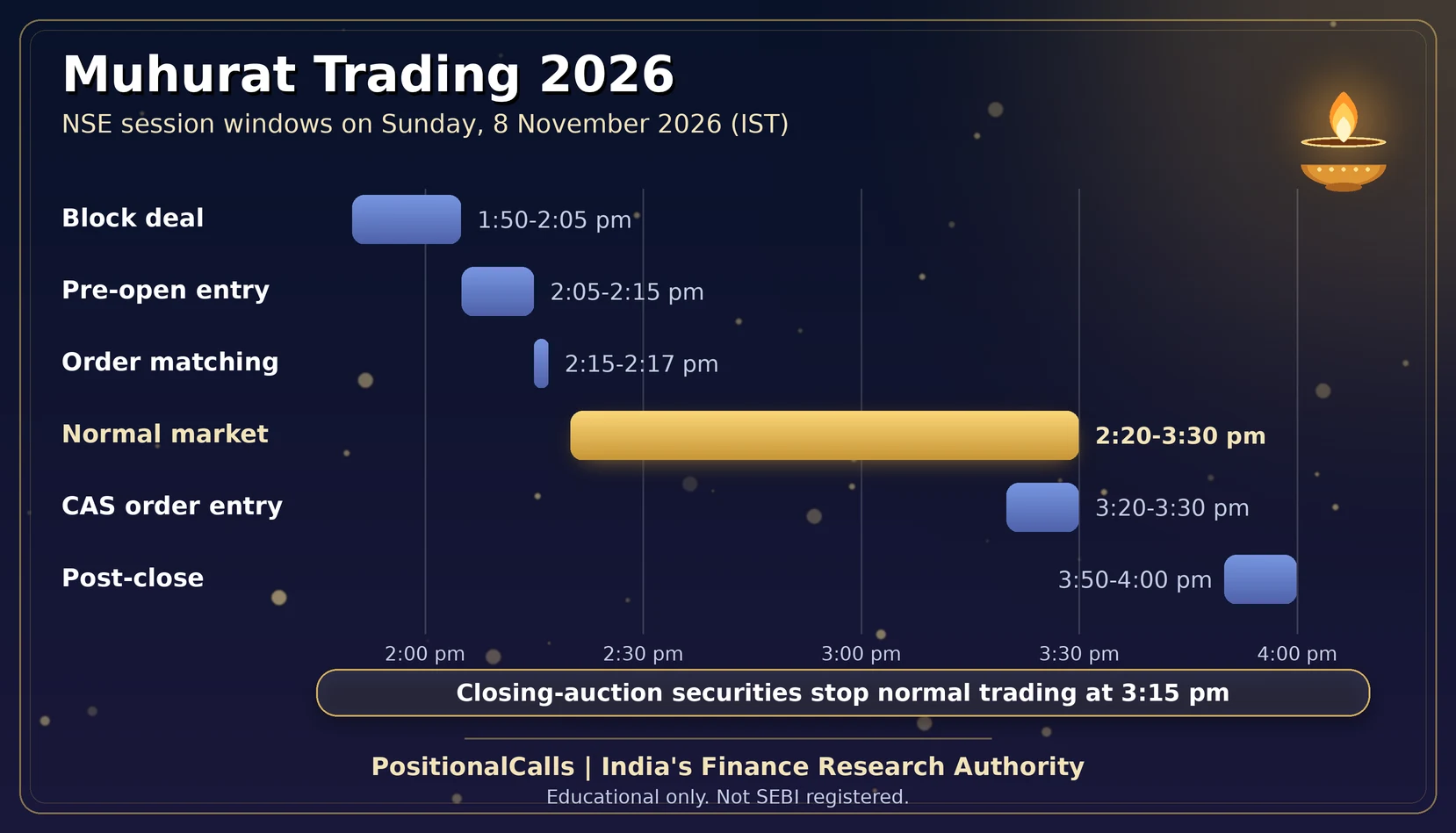
When is Muhurat trading 2026?
Muhurat trading 2026 is on Sunday, 8 November 2026, the day of Diwali Laxmi Pujan. NSE lists the date in its holiday calendar, and the schedule was set in an NSE circular dated 19 October 2026, as reported.
| Item | Detail | Status as of 25 October 2026 |
|---|---|---|
| Muhurat session date | Sunday, 8 November 2026 | Confirmed by NSE circular, as reported |
| Occasion | Diwali Laxmi Pujan, start of Samvat 2083 | Reported |
| Next regular holiday | Tuesday, 10 November 2026, Diwali Balipratipada | Listed in the 2026 holiday calendar |
| Exchanges | NSE and BSE | BSE reported identical |
What are the Muhurat trading 2026 timings?
On NSE, normal market trading runs from 2:20 pm to 3:30 pm IST. The session is preceded by a pre-open window and followed by a closing auction. Securities covered by the closing auction session (CAS) stop normal trading at 3:15 pm.
| Window | Time (IST) | What happens |
|---|---|---|
| Block deal | 1:50 pm to 2:05 pm | Large negotiated trades |
| Pre-open order entry | 2:05 pm to 2:15 pm | Orders collected before the open |
| Order matching | 2:15 pm to 2:17 pm | Opening price discovery; buffer until 2:20 pm |
| Normal market | 2:20 pm to 3:30 pm | Regular trading (CAS securities until 3:15 pm) |
| CAS order entry | 3:20 pm to 3:30 pm | Closing auction orders; matching until 3:35 pm |
| Post-close | 3:50 pm to 4:00 pm | Trades at the closing price |
| Trade modification cut-off | 4:15 pm | Last time to modify trades |
NSE also set a special pre-open for IPO and relisted securities from 2:05 pm to 2:50 pm, with normal trading for them from 3:05 pm to 3:30 pm, and a call auction for illiquid securities from 2:25 pm to 3:10 pm. These timings are as published by NSE and reported by Kotak Neo on 19 October 2026.
What is Muhurat trading?
Muhurat trading is a special one-hour trading session held on Diwali to mark the start of Samvat, the traditional Hindu calendar year. Reports date the tradition to 1957 on BSE and 1992 on NSE.
It is a custom, not a market signal. Prices in the session move like any other session, and liquidity can differ from a normal weekday.
How is Muhurat trading different from a normal session?
| Point | Normal session | Muhurat trading 2026 |
|---|---|---|
| Day | Monday to Friday, unless a holiday | Sunday, 8 November 2026 |
| Length | Full trading day | About one hour of normal trading |
| Settlement | Per exchange rules | Trades create settlement obligations, per NSE |
| Closing auction | Applies to listed securities | Applies; separate timings on the day |
Listings fit around this period too. As reported, the Jio Platforms IPO lists on 28 October, ahead of Diwali; see our Jio IPO allotment and listing guide and how to check IPO allotment status.
PositionalCalls WhatsApp channel
Get the Muhurat session reminder before 8 November
- A message with the confirmed timings on session day
- Market holiday and results calendars around Diwali
- Plain-language explainers on how sessions work
Updates and explainers only. No tips, no buy or sell calls, no payments. Leave the channel any time.
What do you need to trade in Muhurat trading 2026?
What you need: a demat account and trading account with completed KYC, and funds or shares available as required for settlement. What it costs: brokerage, statutory charges and taxes apply as in any session, so check your broker’s current schedule. Tax angle: gains on listed shares follow capital gains rules, so check the current rules or ask a tax adviser.
- Confirm your broker supports the session. Check the app or the broker notice for the 8 November schedule.
- Check funds and holdings. Trades create settlement obligations.
- Read the exchange circular. Use the NSE and BSE websites for the final timings.
- Decide your plan first. Do not act on tips from messages or groups.
Does Muhurat trading predict the year ahead?
No. This guide found no sourced evidence that a one-hour ceremonial session predicts the next twelve months, and it does not claim any pattern. Treat the session as a tradition.
Market holidays around Diwali 2026
| Date | Day | Event | Market status |
|---|---|---|---|
| 20 October 2026 | Tuesday | Dussehra | Closed |
| 8 November 2026 | Sunday | Diwali Laxmi Pujan | Special Muhurat session only |
| 10 November 2026 | Tuesday | Diwali Balipratipada | Closed |
| 24 November 2026 | Tuesday | Guru Nanak Jayanti | Closed |
Results season continues across this window; see our guides to Reliance, Infosys, Eternal and Bajaj Finance Q2 results, and the stock market category for market news.
- Note the date: Sunday, 8 November 2026.
- Note the main window: 2:20 pm to 3:30 pm IST.
- Check your broker for session support and settlement needs.
- Plan around the closure on 10 November 2026.
Analyst’s note
- Reasoning, not first-hand experience: the special pre-open and auction windows matter more to order placement than the ceremony does.
- Easy to miss: closing-auction securities stop normal trading at 3:15 pm, not 3:30 pm.
- Decide your plan before 8 November, and ignore Muhurat tips.
Bottom line
Muhurat trading 2026 is a one-hour tradition on Sunday, 8 November 2026, with a normal window from 2:20 pm to 3:30 pm IST on NSE. This guide is educational and is not a call to buy or sell.
Next read: term insurance and family health insurance guides, because many readers review cover around Diwali.
Part of the market news and calendar series.
PositionalCalls WhatsApp channel
Never miss a market holiday or special session
- Muhurat and Diwali holiday reminders
- Results and IPO date notices
- A note when this guide changes
Updates and explainers only. No tips, no buy or sell calls, no payments. Leave the channel any time.
FAQs on Muhurat trading 2026
When is Muhurat trading 2026?
Muhurat trading 2026 is on Sunday, 8 November 2026, for Diwali Laxmi Pujan. NSE and BSE hold a special live session that day, as set out in the NSE circular of 19 October 2026.
What are the Muhurat trading 2026 timings?
NSE sets normal trading from 2:20 pm to 3:30 pm IST, with pre-open order entry from 2:05 pm to 2:15 pm. Securities in the closing auction session stop normal trading at 3:15 pm. BSE is reported to follow the same schedule.
Is the stock market open on Diwali 2026?
Only for the special session. Regular trading does not happen on Sunday, 8 November 2026, but NSE and BSE hold Muhurat trading in the afternoon. Both exchanges are closed on Tuesday, 10 November 2026 for Diwali Balipratipada.
Do Muhurat trading 2026 trades create settlement obligations?
Yes. NSE has stated that trades in the Muhurat session create settlement obligations, so keep funds or shares ready as required. Check your broker and the exchange circular for the exact settlement details.
What is Samvat 2083?
Samvat is the Hindu calendar year that traditionally begins around Diwali. Muhurat trading marks the start of Samvat 2083, as reported. It is a tradition, and it does not signal how markets will move.
This site gives no buy or sell calls. Muhurat trading is a one-hour special session, and the tradition does not predict returns. Decide using your own plan and risk, and avoid anyone selling Muhurat stock tips.
What is the difference between NSE and BSE Muhurat trading timings?
Reports say both exchanges follow identical equity timings on 8 November 2026. Confirm the BSE circular on the BSE website before you trade, because this guide’s detailed schedule is taken from the NSE circular.
Sources
- NSE India: circulars and holiday calendar
- BSE India: circulars and holiday list
- Outlook Money, Kotak Neo, Business Today, Arihant Capital and DSIJ: Muhurat trading 2026 schedule reports, 19 October 2026 (secondary, not linked)
PositionalCalls.com is an independent research site founded by Shubham Chaudhary. It is not SEBI registered. Content is educational only, with no buy or sell calls, targets or guarantees. How this was researched: the schedule was read from published reports of the NSE circular on 25 October 2026.

Shubham Chaudhary is the founder of PositionalCalls, an independent Indian stock market research website. He writes company fundamentals, quarterly results analysis, IPO analysis and sector research for NSE and BSE listed companies, with a focus on banking stocks, insurance and long-term value investing. Every article is built from primary sources such as RBI, SEBI, NSE and BSE filings and company annual reports, and states its risks plainly in simple language for retail investors.
Coverage areas Our research standards- Numbers checked against NSE, BSE and SEBI filings
- Risks and limits stated in every article
- No paid promotions or broker tie-ups
- Articles updated when new filings arrive