
Learning · Tax and tool
An income tax calculator turns a salary, an age and a set of deductions into a tax bill, but the choice between the old and the new regime is what changes it. This income tax calculator for FY 2026-27 compares both, shows the deductions that make the old regime win and lists where the sources disagree.
Quick answer
An income tax calculator for FY 2026-27 applies the new regime slabs of nil to Rs 4 lakh up to 30% above Rs 24 lakh, a Rs 60,000 rebate and a Rs 75,000 standard deduction, so a salary of Rs 12.75 lakh pays no tax. On my calculation, Rs 15 lakh pays Rs 97,500 in the new regime.
Income tax calculator: key takeaways
- Slabs: unchanged for FY 2026-27 in both regimes, per Business Today, Upstox and TaxGuru.
- Tax-free: Rs 12 lakh taxable in the new regime, Rs 12.75 lakh for salary, after the Rs 60,000 rebate and Rs 75,000 standard deduction.
- Break-even: about Rs 5,44,000 of old regime deductions at Rs 15 lakh, Rs 7,08,000 at Rs 20 lakh and Rs 8 lakh above Rs 24 lakh, on my calculation.
- Limits: the calculator covers slab income only, not capital gains.
In plain words: India taxes the same salary in two different ways. The new regime has lower rates and almost no deductions, and the old regime has higher rates and many deductions. The new one is the default. The right choice is a sum, and this page does the sum for you.
Data note: as of Friday, 20 November 2026, 5:45 PM IST. Slabs, rebate and surcharge statements come from Business Today, Upstox, ClearTax, TaxGuru, Tata Capital, BankBazaar, Bhatt and Joshi Associates and the other pages in the sources list. I opened the TaxGuru page; the rest I read as search extracts. I did not open the Income-tax Act 2025 or the Income Tax Department calculator. Tax figures are my calculation from the slabs and are labelled so. Analysis only, not a tax filing.
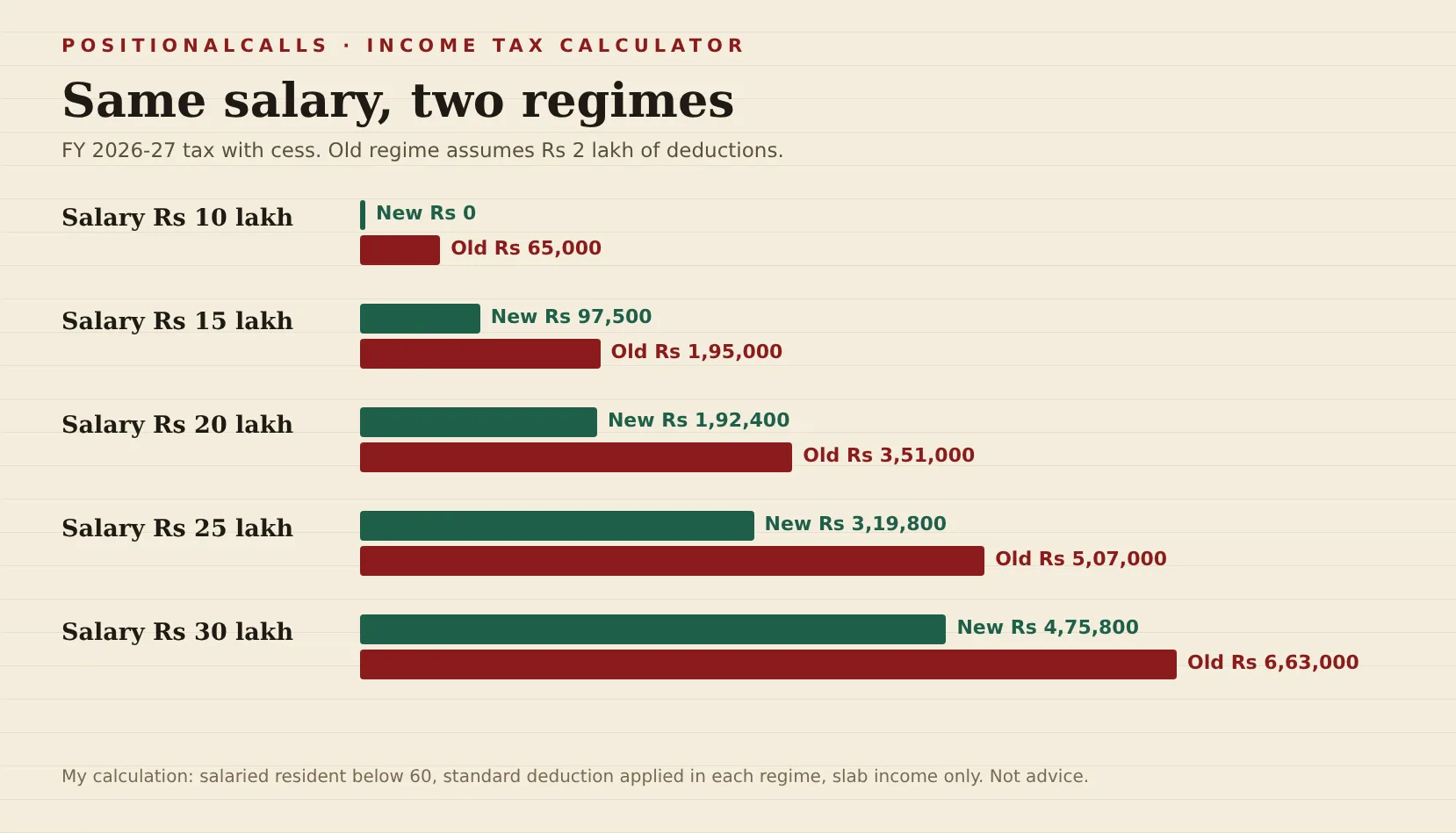 Tax on a salary under both regimes, my calculation from the FY 2026-27 slabs.
Use this income tax calculator to compare the old and new regime for FY 2026-27
Enter your gross income, your age, the old regime deductions and any employer NPS contribution, and the income tax calculator shows the taxable income, the tax with surcharge and 4% cess under each regime, the lower one and the deductions needed for the old regime to match. The defaults are a Rs 15 lakh salary with Rs 2 lakh of deductions, which gives Rs 97,500 in the new regime and Rs 1,95,000 in the old.
Add up 80C (up to Rs 1,50,000), 80D, home loan interest, HRA exemption, 80CCD(1B) and similar items. The new regime ignores this field.
Allowed in both regimes up to the limits explained on this page. Leave at 0 if unsure.
How does this income tax calculator work out the tax?
It subtracts the standard deduction, which is Rs 75,000 in the new regime and Rs 50,000 in the old for salary and pension, then your deductions in the old regime and the employer NPS amount in both. It applies the slab rates, the Section 87A rebate and marginal relief, adds any surcharge with its own marginal relief, and then adds 4% cess. The slabs and rebate are those Tata Capital, TaxGuru and ClearTax print for FY 2026-27.
How do I use this income tax calculator in four steps?
First, enter your annual gross salary before any deduction, from your payslip or Form 16. Second, pick your age band, because only the old regime has higher basic limits for seniors. Third, add up the old regime deductions you expect to claim, such as 80C, 80D, home loan interest and the HRA exemption, but not the standard deduction. Fourth, read the lower-tax row and the break-even figure.
What does this income tax calculator not include?
It does not model capital gains, dividends, business income, agricultural income, rent from property, perquisites, the tax credit for TDS already paid or advance tax interest. It does not apply Section 87A to special-rate income, which Bajaj Finserv says is excluded. It assumes a resident individual. For those cases use the capital gains tax calculator and the Income Tax Department tools.
What are the income tax slabs for FY 2026-27 in an income tax calculator?
Budget 2026 made no change to slabs, so the new regime runs from nil up to Rs 4 lakh to 30% above Rs 24 lakh, and the old regime runs from nil up to Rs 2.5 lakh to 30% above Rs 10 lakh. Business Today, Upstox and TaxGuru all say the slab structure from Budget 2025 continues for FY 2026-27, which is AY 2027-28.
| New regime taxable income | Rate | Tax on the band, my calculation |
|---|---|---|
| Up to Rs 4,00,000 | Nil | Rs 0 |
| Rs 4,00,001 to Rs 8,00,000 | 5% | Rs 20,000 |
| Rs 8,00,001 to Rs 12,00,000 | 10% | Rs 40,000 |
| Rs 12,00,001 to Rs 16,00,000 | 15% | Rs 60,000 |
| Rs 16,00,001 to Rs 20,00,000 | 20% | Rs 80,000 |
| Rs 20,00,001 to Rs 24,00,000 | 25% | Rs 1,00,000 |
| Above Rs 24,00,000 | 30% | On the excess |
Cite this table: PositionalCalls, “Income tax FY 2026-27”; rates as printed by ClearTax, Tata Capital and PB Partners for FY 2026-27; band tax is my calculation.
| Old regime taxable income | Below 60 | 60 to 79 | 80 and above |
|---|---|---|---|
| Up to Rs 2,50,000 | Nil | Nil | Nil |
| Rs 2,50,001 to Rs 3,00,000 | 5% | Nil | Nil |
| Rs 3,00,001 to Rs 5,00,000 | 5% | 5% | Nil |
| Rs 5,00,001 to Rs 10,00,000 | 20% | 20% | 20% |
| Above Rs 10,00,000 | 30% | 30% | 30% |
Cite this table: PositionalCalls, “Income tax FY 2026-27”; below-60 rates from ClearTax and TaxGuru; the senior limits of Rs 3 lakh and Rs 5 lakh are the long-standing old regime limits and the Act 2025 text was not opened.
The two regimes differ most in the middle. A taxable income of Rs 10 lakh bears Rs 1,12,500 before cess in the old regime and Rs 40,000 before rebate in the new, on my calculation, which is why the new regime needs far fewer deductions to win. The new regime has the same slabs for every age, so seniors keep the higher basic limit only in the old regime.
What changed in the Budget 2026 income tax calculator rules?
The slabs, the rebate and the standard deduction stayed. TaxGuru lists three changes from 1 April 2026: the Income-tax Act 2025 replaced the 1961 Act with renumbered sections, the 50% HRA exemption was extended to Bengaluru, Pune, Hyderabad and Ahmedabad, and landlord details became mandatory for an HRA claim. Business Today also says the Budget changed return filing timelines, which I did not open, so confirm dates on the Income Tax Department site. See the Union Budget 2027 hub for the February 2027 Budget.
Does the income tax calculator treat the tax year or the financial year?
Both names appear. Under the 2025 Act, Upstox calls it Tax Year 2026-27, and older pages call it FY 2026-27 or AY 2027-28. They describe the same income earned from 1 April 2026 to 31 March 2027, with the return filed in 2027. This page uses FY 2026-27, and the guide to income tax in India explains the Tax Year terms in full.
How does the Section 87A rebate make Rs 12.75 lakh tax-free in an income tax calculator?
The new regime gives a rebate of up to Rs 60,000 when taxable income is Rs 12 lakh or less, and the Rs 75,000 standard deduction takes the tax-free salary to Rs 12.75 lakh. Upstox puts the rebate at Rs 60,000 for taxable income up to Rs 12 lakh, and 1Finance says the standard deduction lifts the tax-free salary to Rs 12.75 lakh. The old regime rebate is Rs 12,500 for taxable income up to Rs 5 lakh, per BankBazaar and TaxGuru.
| Gross salary | Taxable income, new regime | Tax before relief | Tax payable with 4% cess |
|---|---|---|---|
| Rs 12,00,000 | Rs 11,25,000 | Rs 52,500 | Rs 0 |
| Rs 12,75,000 | Rs 12,00,000 | Rs 60,000 | Rs 0 |
| Rs 12,80,000 | Rs 12,05,000 | Rs 60,750 | Rs 5,200 |
| Rs 13,00,000 | Rs 12,25,000 | Rs 63,750 | Rs 26,000 |
| Rs 13,50,000 | Rs 12,75,000 | Rs 71,250 | Rs 74,100 |
| Rs 14,00,000 | Rs 13,25,000 | Rs 78,750 | Rs 81,900 |
| Rs 15,00,000 | Rs 14,25,000 | Rs 93,750 | Rs 97,500 |
Cite this table: PositionalCalls, “Income tax FY 2026-27”; my calculation for a salaried resident with no other deduction; relief caps the tax at the income above Rs 12 lakh.
Without marginal relief the tax would jump by about Rs 62,400 when taxable income crosses Rs 12 lakh, as PushDraft explains. With it, a salary of Rs 13 lakh, which is Rs 12.25 lakh taxable, pays Rs 26,000 with cess. Relief ends where the normal tax falls below the income above Rs 12 lakh, which on my calculation is a taxable income of about Rs 12.71 lakh and a salary of about Rs 13.46 lakh. After that the full slab tax applies.
Does the Section 87A rebate apply to capital gains?
No. Bajaj Finserv says the rebate is not available on income taxed at special rates such as certain capital gains, and Bhatt and Joshi Associates say the rebate applies only to the part of income that is not special-rate. If your total income includes such gains, this income tax calculator gives only an approximation for the slab part, so use the capital gains tax calculator for the gains.
Is there marginal relief for the old regime rebate?
No. An investmentyogi BankBazaar page says that in the old regime the full rebate is lost if income is even slightly above Rs 5 lakh, with no marginal relief. So a taxable income of Rs 5,00,001 bears tax of Rs 12,500 plus Rs 0.20 on the extra rupee in the old regime, on my calculation, before cess.
Which regime is better in the income tax calculator, and how many deductions do you need?
On my calculation the old regime needs about Rs 5,44,000 of deductions beyond the standard deduction to match the new regime on a Rs 15 lakh salary, about Rs 7,08,000 at Rs 20 lakh and about Rs 8 lakh at Rs 25 lakh and above. Below a salary of about Rs 12.75 lakh the new regime pays no tax, so the old regime cannot match it unless deductions bring the old tax to nil as well.
| Gross salary | New regime tax | Old regime tax, no deductions | Old regime tax, Rs 1.5 lakh 80C | Deductions to match, besides standard |
|---|---|---|---|---|
| Rs 7,50,000 | Rs 0 | Rs 54,600 | Rs 23,400 | Rs 2,00,000 |
| Rs 10,00,000 | Rs 0 | Rs 1,06,600 | Rs 75,400 | Rs 4,50,000 |
| Rs 12,75,000 | Rs 0 | Rs 1,87,200 | Rs 1,40,400 | Rs 7,25,000 |
| Rs 15,00,000 | Rs 97,500 | Rs 2,57,400 | Rs 2,10,600 | Rs 5,44,000 |
| Rs 20,00,000 | Rs 1,92,400 | Rs 4,13,400 | Rs 3,66,600 | Rs 7,08,000 |
| Rs 25,00,000 | Rs 3,19,800 | Rs 5,69,400 | Rs 5,22,600 | Rs 8,00,000 |
| Rs 30,00,000 | Rs 4,75,800 | Rs 7,25,400 | Rs 6,78,600 | Rs 8,00,000 |
Cite this table: PositionalCalls, “Income tax FY 2026-27”; my calculation for a salaried resident below 60; break-even rounded to the nearest Rs 1,000; surcharge not relevant at these levels.
The break-even is the old regime deduction total, on top of the Rs 50,000 standard deduction, at which the two taxes are equal. A typical set of old regime claims is Rs 1.5 lakh under 80C, Rs 25,000 for health insurance and perhaps Rs 2 lakh of home loan interest, which is about Rs 3.75 lakh. At Rs 15 lakh that falls well short of the Rs 5,44,000 needed, so the new regime wins. At Rs 20 lakh the old regime needs about Rs 7,08,000, which takes 80C, home loan interest, 80D, NPS and a large HRA exemption together.
Why do the sources give different break-even figures?
PositionalCalls WhatsApp channel
Get tax and savings explainers on WhatsApp
- Slab and deduction changes, dated
- Calculators explained without tips
- Links to updated tax guides
| Salary | TaxGuru break-even, besides standard | This page, my calculation | Check |
|---|---|---|---|
| Rs 10 lakh | About Rs 2 lakh | Rs 4,50,000 | Old taxable income must fall to Rs 5 lakh for nil tax |
| Rs 15 lakh | About Rs 3.25 lakh | Rs 5,44,000 | New tax Rs 97,500 is Rs 93,750 before cess; the old regime reaches that at taxable income of about Rs 9.06 lakh |
| Rs 20 lakh | About Rs 3.75 lakh | Rs 7,08,000 | New tax Rs 1,92,400 matches old taxable income of about Rs 12.42 lakh |
| Rs 25 lakh | About Rs 4 lakh | Rs 8,00,000 | Both regimes tax the excess over Rs 24 lakh at 30%, so the gap is constant |
Cite this table: PositionalCalls, “Income tax FY 2026-27”; TaxGuru figures from its FY 2026-27 optimisation checklist; the check column is my calculation.
TaxGuru quotes a tax of Rs 97,500 at Rs 15 lakh in the new regime, which agrees with my figure, but its break-even of about Rs 3.25 lakh would give an old regime tax of about Rs 1,56,000, not Rs 97,500, on the same slabs. I treat the figures as inconsistent and use my own. Older rules of thumb of Rs 3.75 lakh to Rs 4 lakh also pre-date the Rs 12 lakh rebate, so they understate the break-even.
Which deductions does the income tax calculator allow in each regime?
The new regime allows only the Rs 75,000 standard deduction, the employer NPS contribution under Section 80CCD(2) up to 14% of basic plus DA, the Rs 25,000 family pension deduction and the Agniveer corpus deduction, while the old regime allows the full Chapter VI-A list. CalcGuru and Taxbuddy give the new regime list, and incorpx describes the old regime as Sections 123 to 134 plus a Rs 50,000 standard deduction under the 2025 Act.
| Item | Old regime | New regime | Source |
|---|---|---|---|
| Standard deduction, salary and pension | Rs 50,000 | Rs 75,000 | TaxGuru, Tata Capital |
| Section 80C and similar, up to Rs 1.5 lakh | Yes | No | Pazcare, Holistic Investment |
| Employee NPS, 80CCD(1B) extra Rs 50,000 | Yes | No | Pazcare |
| Employer NPS, 80CCD(2) | Up to 10% of basic plus DA, 14% for government | Up to 14% of basic plus DA for all | Protean, TaxGuru |
| Health insurance, 80D | Yes | No | Legal Suvidha, CalcGuru |
| HRA exemption | Yes, 50% limit in eight cities | No | TaxGuru |
| Home loan interest on a self-occupied house | Yes, up to Rs 2 lakh | No | Basunivesh |
| Family pension deduction | Yes | Rs 25,000 or a third of the pension, whichever is lower | Taxheal |
Cite this table: PositionalCalls, “Income tax FY 2026-27”; statements as the sources named describe them; the Act 2025 text was not opened.
Employer NPS is the one deduction that helps in both regimes. TaxGuru and Protean say the limit is 14% of basic plus DA for every employee in the new regime from FY 2025-26, while private-sector employees in the old regime stay at 10%. A sample on Taxheal shows a Rs 12 lakh salary with a 14% employer contribution cutting taxable income to Rs 9.57 lakh after the standard deduction. The calculator has a field for it. See the NPS calculator and the Section 80C limit page for the old regime items.
What counts toward the old regime deduction field?
Add 80C items such as PF, PPF, ELSS and tax saver FDs up to Rs 1.5 lakh; 80D premiums; interest on a self-occupied home loan up to Rs 2 lakh; the HRA exemption actually allowed, which is the lowest of three amounts; the extra Rs 50,000 for NPS; and similar claims. Do not add the standard deduction, because the calculator applies it. If you are unsure, leave the field at 0 to see the floor.
Which cities count for the 50% HRA limit from April 2026?
TaxGuru says the 50% limit covers eight cities from 1 April 2026: Delhi, Mumbai, Kolkata, Chennai, Bengaluru, Pune, Hyderabad and Ahmedabad. Other cities use 40%. It also says disclosing the landlord relationship is mandatory for the claim. HRA applies only in the old regime, so it raises the old regime deduction total for people who pay rent. The HRA exemption guide has the formula, worked examples and its own calculator.
How do surcharge and cess change the income tax calculator result?
Surcharge is 10% above Rs 50 lakh, 15% above Rs 1 crore and 25% above Rs 2 crore, with a 37% rate above Rs 5 crore only in the old regime, and cess is 4% on the total. 1Finance gives the first three bands, and Bhatt and Joshi Associates and Taxheal say the new regime caps the rate at 25%.
| Total income | Surcharge on tax | Old regime | New regime |
|---|---|---|---|
| Up to Rs 50 lakh | Nil | Nil | Nil |
| Above Rs 50 lakh to Rs 1 crore | 10% | Applies | Applies |
| Above Rs 1 crore to Rs 2 crore | 15% | Applies | Applies |
| Above Rs 2 crore to Rs 5 crore | 25% | Applies | Applies |
| Above Rs 5 crore | 37% old, 25% new | 37% | 25%, capped |
Cite this table: PositionalCalls, “Income tax FY 2026-27”; rates from 1Finance, Bhatt and Joshi Associates and Taxheal; capital gains and dividend income carry a lower cap of 15% per BankBazaar.
| Gross income, salaried | New regime tax | Old regime tax, Rs 1.5 lakh 80C |
|---|---|---|
| Rs 45,00,000 | Rs 9,43,800 | Rs 11,46,600 |
| Rs 55,00,000 | Rs 13,81,380 | Rs 16,04,460 |
| Rs 1,20,00,000 | Rs 37,76,370 | Rs 40,09,590 |
| Rs 2,50,00,000 | Rs 91,74,750 | Rs 94,28,250 |
Cite this table: PositionalCalls, “Income tax FY 2026-27”; my calculation including surcharge with marginal relief and 4% cess; income is all at slab rates.
Marginal relief at each surcharge threshold means the extra tax from crossing a line cannot exceed the extra income earned, per Tax2win. On my calculation Rs 55 lakh of salary pays about Rs 13,81,380 in the new regime, against about Rs 9,43,800 at Rs 45 lakh; that gap of Rs 4,37,580 on Rs 10 lakh more salary includes the 10% surcharge. Companies and other entities have different surcharge rules, per BankBazaar, and this page does not cover them.
What do worked examples from the income tax calculator show?
A Rs 10 lakh salary pays no tax in the new regime and Rs 1,06,600 in the old without deductions, and a Rs 30 lakh salary pays Rs 4,75,800 in the new regime and Rs 6,78,600 in the old regime with Rs 1.5 lakh of 80C. The table uses the same method as the calculator.
| Gross salary | New regime tax | Old regime, no deductions | Old regime, Rs 2 lakh | Old regime, Rs 5 lakh | Lower tax |
|---|---|---|---|---|---|
| Rs 8,00,000 | Rs 0 | Rs 65,000 | Rs 23,400 | Rs 0 | New, tie at nil with Rs 5 lakh |
| Rs 10,00,000 | Rs 0 | Rs 1,06,600 | Rs 65,000 | Rs 0 | New, tie at nil with Rs 5 lakh |
| Rs 15,00,000 | Rs 97,500 | Rs 2,57,400 | Rs 1,95,000 | Rs 1,06,600 | New |
| Rs 20,00,000 | Rs 1,92,400 | Rs 4,13,400 | Rs 3,51,000 | Rs 2,57,400 | New |
| Rs 30,00,000 | Rs 4,75,800 | Rs 7,25,400 | Rs 6,63,000 | Rs 5,69,400 | New |
| Rs 50,00,000 | Rs 10,99,800 | Rs 13,49,400 | Rs 12,87,000 | Rs 11,93,400 | New |
Cite this table: PositionalCalls, “Income tax FY 2026-27”; my calculation for a salaried resident below 60; the last column compares the new regime with the better old regime case.
The new regime pays the same or less in every row, even against Rs 5 lakh of old regime deductions, which only ties it at Rs 8 lakh and Rs 10 lakh where both taxes are nil. The old regime wins only past the break-even, about Rs 5,44,000 at Rs 15 lakh and Rs 7,08,000 at Rs 20 lakh. For most salaried people with only 80C and health insurance, the new regime saves tax.
How much tax does a Rs 15 lakh salary pay in each regime?
In the new regime, taxable income is Rs 14,25,000 after the standard deduction. The slab tax is Rs 93,750 before cess, which is Rs 97,500 with cess, so the effective rate is 6.5% of gross salary. In the old regime with Rs 2 lakh of deductions, taxable income is Rs 12,50,000, and the tax is Rs 1,87,500 before cess, which is Rs 1,95,000 with cess, on my calculation.
How much monthly TDS does that mean?
Rs 97,500 a year is Rs 8,125 a month in the new regime and Rs 16,250 in the old regime with Rs 2 lakh of deductions. Employers estimate TDS from the declaration you give, so the regime you declare in April sets the monthly deduction. A difference can be settled as a refund when you file, per TaxGuru, so a wrong guess is not final. The TDS on salary guide shows how the monthly figure is set and how Form 124 changes it.
Which sections does the income tax calculator mean after the Income-tax Act 2025?
The Income-tax Act 2025 replaced the 1961 Act from 1 April 2026 and renumbered the sections, so the rebate, the regime and the deductions have new numbers that sources do not all give the same way. The table lists the readings.
| Provision | 1961 Act | 2025 Act, reading one | 2025 Act, reading two |
|---|---|---|---|
| Rebate | Section 87A | Section 156, Upstox | Section 157, TaxGuru |
| New regime | Section 115BAC | Section 202, TaxGuru | Not found elsewhere |
| Employer NPS deduction | Section 80CCD(2) | Section 124, Basunivesh | Section 124(2), incorpx |
| Section 80C deduction | Section 80C | Section 123, PositionalCalls 80C page and incorpx | Not found elsewhere |
| Old regime deduction block | Chapter VI-A | Sections 123 to 134, incorpx | Not found elsewhere |
Cite this table: PositionalCalls, “Income tax FY 2026-27”; each reading from the page named; Act 2025 text was not opened.
The rule has not changed even where the number has. Where the sources disagree, this page uses the 1961 Act name that people search for and notes the 2025 number as reported. If a form or a payslip uses a 2025 Act section, confirm it against the Act text.
Can you switch regimes, and what does the income tax calculator mean for TDS?
A salaried taxpayer with no business income can pick either regime each year at filing, while business or professional income allows only one return to the new regime after opting out. TaxGuru says the salaried choice needs no Form 10-IEA, and the old regime must be selected explicitly because the new regime is the default.
| Taxpayer | Choice | Form | Source |
|---|---|---|---|
| Salaried, no business income | Either regime each year | No Form 10-IEA | TaxGuru |
| Business or professional income | Opt out once, return once, then stay in the new regime | Form 10-IEA by the due date | TaxGuru |
| Employer TDS | Based on the regime declared to the employer | Investment declaration | TaxGuru |
| Wrong declaration | Settled as refund or extra payment at filing | ITR | TaxGuru |
Cite this table: PositionalCalls, “Income tax FY 2026-27”; TaxGuru FY 2026-27 checklist; confirm with a chartered accountant for business income.
The practical step is to run the income tax calculator in April with expected deductions and again in December when proofs are due. Late filing carries its own rules, covered in the belated ITR last date guide, and advance tax in the advance tax guide.
What mistakes do people make with an income tax calculator?
The common errors are adding the standard deduction twice, counting 80C in the new regime, treating Rs 12 lakh as the salary limit, forgetting that capital gains sit outside the rebate and using a figure from a page written for FY 2025-26 without checking it. Each follows from the rules above.
- Double standard deduction: enter gross income and let the calculator subtract Rs 75,000 or Rs 50,000.
- 80C in the new regime: it is not allowed, so a Rs 1.5 lakh claim only helps in the old regime.
- Rs 12 lakh as salary: the tax-free limit is Rs 12 lakh of taxable income, which is Rs 12.75 lakh of salary.
- Special-rate income: capital gains and dividends are taxed apart, so a total above Rs 12 lakh can lose the rebate on that part.
- Stale pages: many calculator pages still say FY 2025-26, although the slabs are the same, per Finnovate.
What is a quick checklist before you use an income tax calculator?
First, take gross income from Form 16 or the payslip. Second, list old regime claims with proofs. Third, add the employer NPS amount from the payslip. Fourth, run the calculator and read the break-even row. Fifth, if the two taxes are close, pick the new regime for its simplicity, as the choice also saves paperwork.
What does this income tax calculator page leave out?
It leaves out capital gains, business income, perquisites, TDS credits, advance tax interest, the tax on income of companies and firms, and any view on which investment to buy. It explains the arithmetic and shows the tax rules as the sources describe them.
- No Act 2025 text: slab and rebate statements come from news and tax pages, not the statute.
- No official calculator: I did not open the Income Tax Department calculator to compare results.
- No personal advice: a chartered accountant should confirm your own case.
Will this income tax calculator page be updated?
Yes, when a Budget, a notification or the Rules under the 2025 Act change a slab, a rebate or a deduction, and after the February 2027 Budget. See the Union Budget 2027 hub for what is expected. A change would also change the calculator and this page.
PositionalCalls WhatsApp channel
Tax updates in one channel
- Budget and notification changes
- Plain-English tax explainers
- Links to new guides
Income tax calculator: frequently asked questions
What is an income tax calculator?
An income tax calculator estimates your tax for a year from your income, your age and your deductions under both the old and the new regime. This income tax calculator for FY 2026-27 applies the slabs, the Section 87A rebate, the surcharge and the 4% cess, then shows which regime gives the lower tax and the deductions needed for the old regime to match.
Which income tax calculator slabs apply in FY 2026-27?
Budget 2026 left the slabs unchanged, per Business Today and Upstox. The new regime is nil to Rs 4 lakh, then 5%, 10%, 15%, 20%, 25% and 30% above Rs 24 lakh. The old regime is nil to Rs 2.5 lakh, then 5%, 20% and 30% above Rs 10 lakh, with higher limits for seniors.
Is income up to Rs 12.75 lakh tax-free in an income tax calculator?
For a salaried resident in the new regime, yes. The Section 87A rebate of up to Rs 60,000 makes taxable income up to Rs 12 lakh tax-free, and the Rs 75,000 standard deduction lifts the salary limit to Rs 12.75 lakh, per Upstox and 1Finance. The rebate does not cover income taxed at special rates.
Is the old or the new regime better in an income tax calculator?
It depends on your deductions. On my calculation, a Rs 15 lakh salary needs about Rs 5.4 lakh of old regime deductions, besides the Rs 50,000 standard deduction, to match the new regime tax of Rs 97,500. Below about Rs 12.75 lakh the new regime usually wins, per TaxGuru.
Can salaried people switch regimes every year?
Yes. TaxGuru says a salaried taxpayer with no business income can choose either regime each year, with no Form 10-IEA. The new regime is the default, so the old regime must be chosen explicitly. Business or professional income is different, with a one-time return to the new regime after opting out.
Which deductions work in the new regime?
Only a short list: the Rs 75,000 standard deduction for salary and pension, the employer NPS contribution under Section 80CCD(2) up to 14% of basic plus DA, the Rs 25,000 family pension deduction and the Agniveer corpus deduction, per CalcGuru and Taxbuddy. Section 80C, 80D and HRA are not available.
How does marginal relief work above Rs 12 lakh?
If taxable income is just above Rs 12 lakh, the tax is capped at the income above Rs 12 lakh, so the full Rs 60,000 rebate is not lost in one step. On my calculation a salary of Rs 13 lakh pays Rs 26,000, against about Rs 62,400 without relief, as described by PushDraft.
What surcharge does this income tax calculator apply?
It applies 10% above Rs 50 lakh, 15% above Rs 1 crore and 25% above Rs 2 crore of income, plus 4% cess. Bhatt and Joshi Associates say the new regime caps the surcharge at 25%, while the old regime has a 37% rate above Rs 5 crore. The calculator also applies marginal relief at each threshold.
Does the income tax calculator include capital gains?
No. It handles income taxed at slab rates, so salary, pension and similar income. Capital gains and dividends have special rates, and Bajaj Finserv says the Section 87A rebate is not available on income taxed at special rates. Use the PositionalCalls capital gains tax calculator for share and fund gains.
Is this income tax calculator page tax advice?
No. PositionalCalls is not a SEBI-registered research analyst or investment adviser and is not a tax practitioner. This page shows arithmetic on the rules as the sources describe them, with the Income-tax Act 2025 text not opened. Confirm figures with the Income Tax Department or a chartered accountant before you file.
Sources for the income tax calculator page
- Business Today: tax slabs FY 2026-27.
- Business Today: income tax calculator.
- Upstox: tax on Rs 4 lakh to Rs 5 crore.
- TaxGuru: old regime vs new regime for FY 2026-27.
- Tata Capital: income tax slabs FY 2026-27.
- ClearTax: income tax calculator FY 2026-27.
- Finnovate: income tax calculator.
- EnKash: income tax calculator.
- BankBazaar: income tax slabs FY 2026-27.
- PB Partners: tax-free up to Rs 12.75 lakh.
- 1Finance: new tax regime slabs.
- Tax2win: surcharge and marginal relief.
- PushDraft: Section 87A marginal relief.
- Bhatt and Joshi: Union Budget 2026-27 changes.
- Taxheal: income tax slabs.
- Bajaj Finserv: income tax calculator.
- Pazcare: new vs old regime.
- Taxbuddy: 80CCD(2) in the new regime.
- Protean: corporate NPS tax regime 2026.
- Basunivesh: deductions old vs new regime.
- CalcGuru: deductions in the new regime.
- Incorpx: deductions under the 2025 Act.
- Taxheal: deductions in the new regime.
- Legal Suvidha: Chapter VI-A deductions.

Shubham Chaudhary is the founder of PositionalCalls, an independent Indian stock market research website. He writes company fundamentals, quarterly results analysis, IPO analysis and sector research for NSE and BSE listed companies, with a focus on banking stocks, insurance and long-term value investing. Every article is built from primary sources such as RBI, SEBI, NSE and BSE filings and company annual reports, and states its risks plainly in simple language for retail investors.
Coverage areas Our research standards- Numbers checked against NSE, BSE and SEBI filings
- Risks and limits stated in every article
- No paid promotions or broker tie-ups
- Articles updated when new filings arrive