
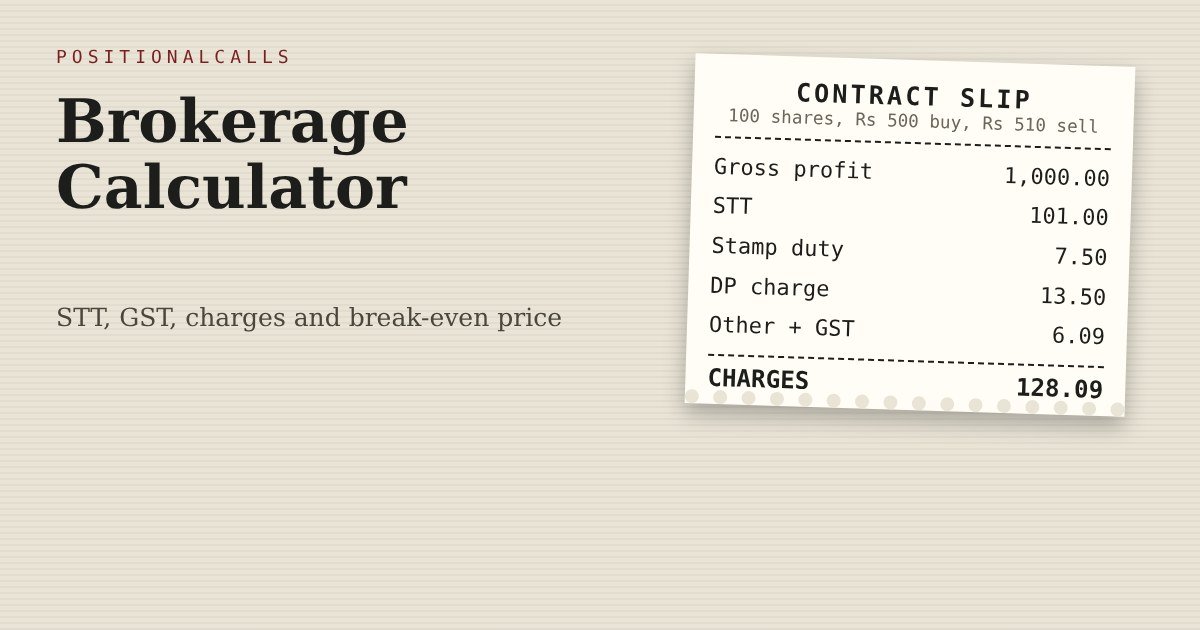
Trading costs · Tool
This brokerage calculator adds brokerage, STT, exchange charges, the SEBI fee, stamp duty, the DP charge and GST for an NSE delivery or intraday trade, then shows the net profit, the share of turnover paid in charges and the break-even sell price.
Quick answer
Enter the quantity, buy price and sell price in the brokerage calculator below. It adds brokerage, STT, exchange charges, SEBI fee, stamp duty, DP charge and 18% GST. A Rs 500 buy and Rs 510 sell on 100 delivery shares leaves Rs 871.91 after Rs 128.09 of charges, my calculation.
Brokerage calculator: key takeaways
- Brokerage is only one line: STT, exchange charges, SEBI fee, stamp duty, DP charge and GST come on top.
- Delivery: STT is 0.1% on both sides, so it is the largest charge when brokerage is zero.
- Intraday: STT is 0.025% on the sell side and the stamp duty rate is lower.
- Break-even: the sell price must clear all charges before a trade makes money.
- Scope: arithmetic for education. It gives no stock, broker or trade view.
In plain words: when you buy and sell a share, you pay more than the broker’s fee. The government takes STT and stamp duty, the exchange takes a small fee, SEBI takes a tiny fee, GST is added, and selling delivery shares from a demat account adds a DP charge. These costs reduce your profit, and on a small gain they can remove most of it.
Data note: as of Wednesday, 18 November 2026, 6:30 PM IST. The rates come from the broker and calculator pages named in the sources, and the STT rates match the STT in India page on this site. Figures marked as my calculation come from those rates and match the tool on this page. The trades are round-number examples and no real company is used. Exchange circulars and contract notes were not opened.
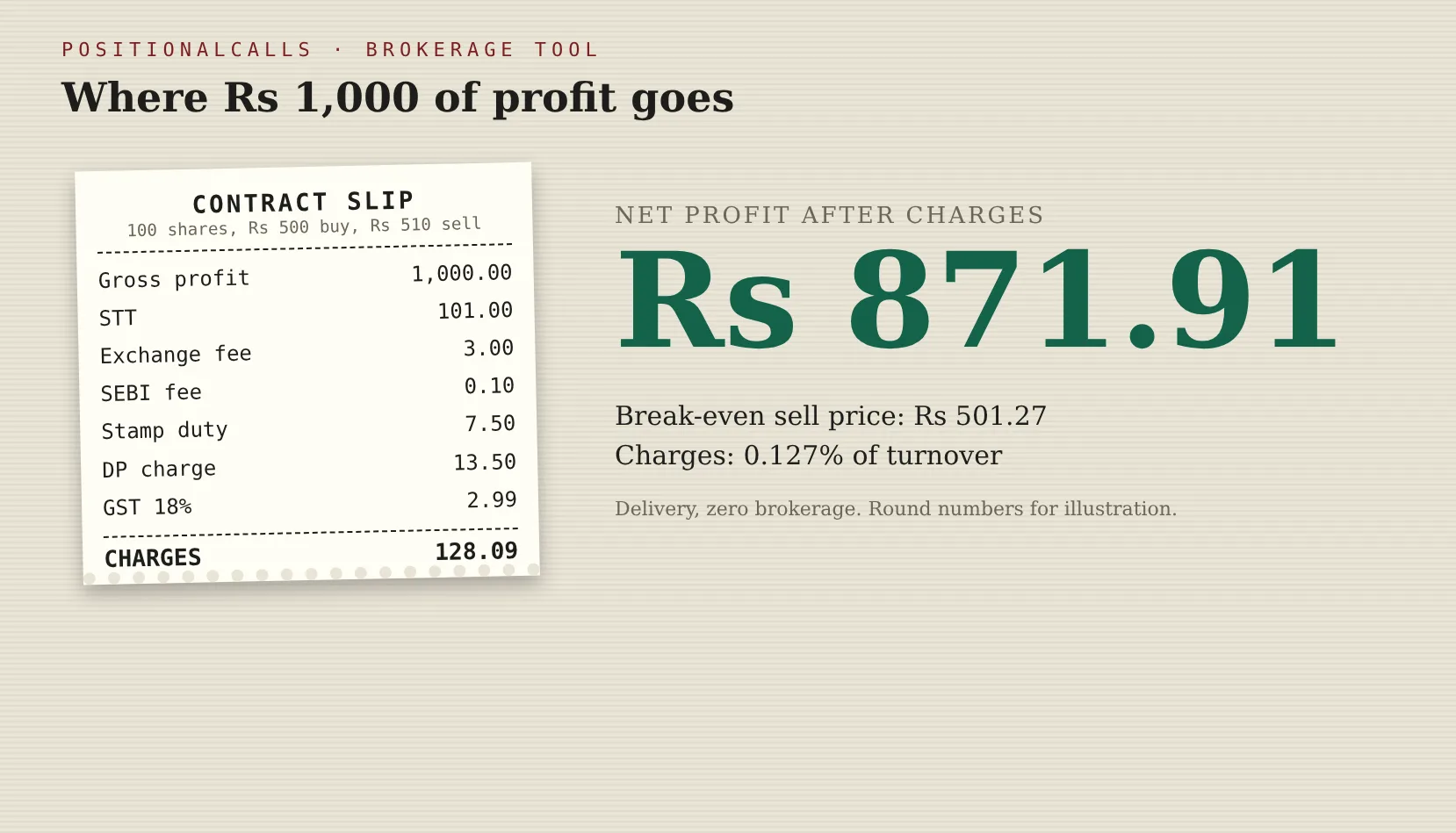
A brokerage calculator example: where the charges go on a Rs 1,000 delivery gain. Source: PositionalCalls calculation using listed rates.
Use this brokerage calculator to see the full cost of a trade
Enter the trade type, quantity, buy price and sell price, add your broker’s brokerage if it charges any, and the brokerage calculator shows every charge, the net profit and the break-even sell price. The defaults are 100 delivery shares bought at Rs 500 and sold at Rs 510 with zero brokerage, a 0.00297% exchange rate and a Rs 13.50 DP charge. Nothing you type leaves your browser.
Both 0 means no brokerage. With a % and a Rs amount, the lower of the two is charged on each order, as in Rs 20 or 0.03%, whichever is lower.
Brokers quote slightly different NSE rates, so edit this to match your broker.
How do I enter my broker’s brokerage in the calculator?
Use the percentage box for a charge based on order value and the rupee box for a flat amount. If you fill both, the tool charges the lower of the two on each order, which matches a plan such as Rs 20 or 0.03%, whichever is lower. Fill only the rupee box for a flat fee per order, and leave both at zero for free delivery.
How do I read the brokerage calculator result?
Gross profit is the price difference times the quantity. Each charge follows, then the total, and the net profit is gross profit minus the total. The percentage line shows charges as a share of the combined buy and sell value. For the defaults it is 0.13%, and the break-even line is the sell price that makes net profit zero.
What rates and formulas does a brokerage calculator use?
Net profit = (sell price − buy price) × quantity − (brokerage + STT + exchange charge + SEBI fee + stamp duty + DP charge + GST). Sharpely and Choice give this structure. The table lists the rates this brokerage calculator applies to NSE equity trades.
| Charge | Equity delivery | Equity intraday | Source |
|---|---|---|---|
| Brokerage | Set by the broker; often Rs 0 | Often Rs 20 or 0.03%, lower of the two | Zerodha, Upstox |
| STT | 0.1% on buy and sell | 0.025% on sell | Choice, Vestai |
| Exchange charge (NSE) | 0.00297% of turnover | 0.00297% of turnover | Zerodha, Choice |
| SEBI turnover fee | Rs 10 per crore | Rs 10 per crore | Upstox, Zerodha |
| Stamp duty | 0.015% on buy | 0.003% on buy | Upstox, Rupeezy |
| DP charge | Rs 13.50 per scrip sold, plus GST | None | Zerodha (per OneTradeJournal) |
| GST | 18% on brokerage, exchange charge, SEBI fee and DP charge | 18% on brokerage, exchange charge and SEBI fee | Zerodha, Choice |
Cite this table: PositionalCalls, “Rates used by the brokerage calculator”; rates from Zerodha, Choice, Upstox, Vestai, Rupeezy and OneTradeJournal as named; exchange circulars not opened.
Why is stamp duty only on the buy side?
Stamp duty is a state levy charged on the buyer, so it applies to the buy value and not to the sell. Rupeezy notes the rate can differ as per your state, which is why a broker’s figure may vary slightly from the standard 0.015% for delivery used here.
Why does the DP charge in a brokerage calculator apply only to delivery sales?
A DP charge is levied when shares move out of your demat account, so it applies on delivery sells and not on intraday trades that never reach the account. The Rs 13.50 figure becomes Rs 15.93 with GST, which is the Rs 15.93 that sum.money lists. The demat account charges in India page explains how it fits with other account costs.
What do two worked examples of the brokerage calculator show?
The same Rs 500 to Rs 510 move on 100 shares costs Rs 128.09 as a delivery trade and Rs 53.66 as an intraday trade at 0.03% or Rs 20. The first table is the delivery case, with zero brokerage and a DP charge.
| Line | Delivery example | How it is worked out |
|---|---|---|
| Buy value and sell value | Rs 50,000.00 and Rs 51,000.00 | 100 × Rs 500 and 100 × Rs 510 |
| Gross profit | Rs 1,000.00 | Rs 51,000 − Rs 50,000 |
| STT | Rs 101.00 | 0.1% × Rs 1,01,000 turnover |
| Exchange charge | Rs 3.00 | 0.00297% × Rs 1,01,000 |
| SEBI fee | Rs 0.10 | Rs 10 per crore × Rs 1,01,000 |
| Stamp duty | Rs 7.50 | 0.015% × Rs 50,000 buy |
| DP charge | Rs 13.50 | Flat, on the sale |
| GST | Rs 2.99 | 18% × (Rs 3.00 + Rs 0.10 + Rs 13.50) |
| Total charges and net profit | Rs 128.09 and Rs 871.91 | Net = Rs 1,000 − Rs 128.09 |
Cite this table: PositionalCalls, “Delivery worked example”; arithmetic by PositionalCalls; rates as in the rates table.
What does the same trade cost in a brokerage calculator when done intraday?
Intraday, the brokerage becomes Rs 15.00 on the Rs 50,000 buy and Rs 15.30 on the Rs 51,000 sell, which is Rs 30.30 in total. STT falls to Rs 12.75 and stamp duty to Rs 1.50, and there is no DP charge.
| Line | Intraday example | How it is worked out |
|---|---|---|
| Brokerage | Rs 30.30 | 0.03% of each order, below the Rs 20 cap |
| STT | Rs 12.75 | 0.025% × Rs 51,000 sell |
| Exchange charge and SEBI fee | Rs 3.00 and Rs 0.10 | Same rates as delivery |
| Stamp duty | Rs 1.50 | 0.003% × Rs 50,000 buy |
| GST | Rs 6.01 | 18% × (Rs 30.30 + Rs 3.00 + Rs 0.10) |
| Total charges and net profit | Rs 53.66 and Rs 946.34 | Net = Rs 1,000 − Rs 53.66 |
Cite this table: PositionalCalls, “Intraday worked example”; arithmetic by PositionalCalls; brokerage assumed at 0.03% or Rs 20.
Does this brokerage calculator match a published broker example?
Yes. Choice shows 100 shares bought at Rs 500 and sold at Rs 510 with brokerage of Rs 202, total charges of Rs 350.52 and net profit of Rs 649.48. Entering a 0.2% brokerage with no DP charge in this brokerage calculator gives Rs 350.52 and Rs 649.48, which is the same.
How is the break-even price worked out in a brokerage calculator?
The break-even price is the sell price at which net profit after all charges is zero, and it sits above your buy price. Choice shows a break-even of Rs 503.51 for its example. Dividing total charges by the quantity gives that figure, while this brokerage calculator solves for the sell price, because the charges on the sell side move with the price, and gets Rs 503.48. The gap is Rs 0.03 per share.
| Buy price | Charges at that price (delivery) | Break-even sell price | Gap above buy price |
|---|---|---|---|
| Rs 100 | Rs 38.15 | Rs 100.38 | 0.38% |
| Rs 250 | Rs 71.49 | Rs 250.72 | 0.29% |
| Rs 500 | Rs 127.05 | Rs 501.27 | 0.25% |
| Rs 1000 | Rs 238.18 | Rs 1,002.38 | 0.24% |
| Rs 2000 | Rs 460.42 | Rs 2,004.61 | 0.23% |
Cite this table: PositionalCalls, “Delivery break-even by price”; arithmetic by PositionalCalls for 100 shares, zero brokerage and a Rs 13.50 DP charge.
Why is the break-even gap larger for cheaper shares?
Because the DP charge is a flat amount, it takes a bigger share of a small trade. At Rs 100 per share the gap is 0.38%, at Rs 500 it is 0.25% and at Rs 2,000 it is 0.23%. The percentage-based charges are nearly the same at every price, so the flat charge is what moves the gap.
What is the break-even gap for intraday trades?
| Buy price | Charges at that price (intraday) | Break-even sell price | Gap above buy price |
|---|---|---|---|
| Rs 100 | Rs 10.60 | Rs 100.11 | 0.11% |
| Rs 250 | Rs 26.51 | Rs 250.27 | 0.11% |
| Rs 500 | Rs 53.02 | Rs 500.53 | 0.11% |
| Rs 1000 | Rs 82.45 | Rs 1,000.82 | 0.08% |
| Rs 2000 | Rs 117.69 | Rs 2,001.18 | 0.06% |
Cite this table: PositionalCalls, “Intraday break-even by price”; arithmetic by PositionalCalls for 100 shares at 0.03% or Rs 20 brokerage.
Intraday gaps are smaller in percentage terms, around 0.11% at Rs 100 to Rs 500, and fall to 0.06% at Rs 2,000 once the Rs 20 cap applies. That is the lower STT and stamp duty at work, not a view that intraday is better. Intraday also carries its own risks, which a cost table does not measure.
How does trade size change the share of profit lost to charges?
Charges take a larger share of a small gain than of a large one, because some charges do not scale with the trade. The table keeps the Rs 500 to Rs 510 move and changes only the quantity.
PositionalCalls WhatsApp channel
Get trading-cost tools on WhatsApp
- Charge and rate changes, dated
- Plain-English cost tools, no tips
- Links to updated tool pages
| Quantity | Total charges | Net profit | Charges as % of gross profit |
|---|---|---|---|
| 10 | Rs 27.15 | Rs 72.85 | 27.15% |
| 100 | Rs 128.09 | Rs 871.91 | 12.81% |
| 1000 | Rs 1,137.52 | Rs 8,862.48 | 11.38% |
Cite this table: PositionalCalls, “Quantity and charges, delivery”; arithmetic by PositionalCalls with zero brokerage and a Rs 13.50 DP charge.
What does the brokerage calculator say about very small trades?
With 10 shares the gross profit is Rs 100, and charges take Rs 27.15 of it, 27.15%. The DP charge alone is Rs 13.50 plus GST. With 100 shares the share falls to 12.81% and with 1,000 shares to 11.38%, where STT dominates. The brokerage calculator makes this visible before you place the order.
Does a larger trade always mean lower costs?
Per rupee of turnover, mostly. STT, stamp duty and the exchange charge scale with the value, so they stay at roughly the same percentage. Only the flat items fall as a share. A bigger trade also puts more money at risk, and this tool is silent on whether any trade is wise.
Which brokerage models does the calculator handle?
The brokerage boxes cover the three common models: zero, a flat fee per order and a percentage with a rupee cap. Zerodha lists zero for delivery and the lower of 0.03% or Rs 20 per order for intraday, while Upstox lists Rs 20 per order for delivery and Rs 20 or 0.1% for intraday. Check your own contract before relying on either.
| Order value | 0.03% of value | Flat Rs 20 | Lower of 0.03% and Rs 20 |
|---|---|---|---|
| Rs 10,000 | Rs 3 | Rs 20 | Rs 3 |
| Rs 50,000 | Rs 15 | Rs 20 | Rs 15 |
| Rs 100,000 | Rs 30 | Rs 20 | Rs 20 |
| Rs 500,000 | Rs 150 | Rs 20 | Rs 20 |
Cite this table: PositionalCalls, “Brokerage models by order value”; arithmetic by PositionalCalls; plan shapes from Zerodha and Upstox pages.
When does the Rs 20 cap start to matter?
At 0.03%, the charge reaches Rs 20 on an order of about Rs 66,667. Below that the percentage is lower, and above it the cap holds the brokerage at Rs 20. On a Rs 5 lakh order the percentage would be Rs 150, so the cap saves Rs 130 on that order.
Why compare plans with the whole charge, not the brokerage alone?
Because STT, stamp duty and exchange charges are the same whichever broker you use, apart from small rate differences. Only brokerage and the DP charge differ. Run the brokerage calculator twice with each plan’s brokerage to compare the net result for your own trade size, and read this as arithmetic and not a recommendation of any broker.
What does the brokerage calculator show for many trades?
Charges are paid on every round trip, so frequent trading multiplies them even when each trade looks cheap. The table repeats the intraday example, with Rs 53.66 of charges per round trip, and assumes every trade has the same Rs 1,000 gross profit.
| Round trips | Total charges | Gross profit if each earns Rs 1,000 | Net profit |
|---|---|---|---|
| 1 | Rs 53.66 | Rs 1,000.00 | Rs 946.34 |
| 5 | Rs 268.31 | Rs 5,000.00 | Rs 4,731.69 |
| 20 | Rs 1,073.26 | Rs 20,000.00 | Rs 18,926.74 |
Cite this table: PositionalCalls, “Repeated intraday round trips”; arithmetic by PositionalCalls; every trade assumed identical, which real trades are not.
Is that a realistic pattern?
No. Real trades differ, and many lose. The table only shows how the cost accumulates: 20 round trips cost over Rs 1,000 in charges. The brokerage calculator cannot say whether a series of trades will earn anything, only what each one costs to place.
Why does this matter for a small account?
With a small trade size, a fixed cost per round trip is a larger share of the gain. A strategy that needs a gain of 0.11% just to break even at every trade has less room for error than one that trades less often. The tool puts a rupee figure on that.
What does the brokerage calculator show when a trade loses money?
Charges are paid whether a trade gains or loses, so a loss is larger than the price drop alone. A delivery trade bought at Rs 500 and sold at Rs 490 on 100 shares loses Rs 1,000 on price, pays Rs 126.02 in charges and ends with a net loss of Rs 1,126.02, my calculation.
| Outcome | Price move | Gross result | Charges | Net result |
|---|---|---|---|---|
| Sell at Rs 510 | +Rs 10 | +Rs 1,000.00 | Rs 128.09 | Rs 871.91 |
| Sell at Rs 501.27 | +Rs 1.27 | +Rs 127.00 | Rs 127.18 | Rs -0.18 |
| Sell at Rs 500 | No change | Rs 0.00 | Rs 127.05 | Rs -127.05 |
| Sell at Rs 490 | −Rs 10 | −Rs 1,000.00 | Rs 126.02 | Rs -1,126.02 |
Cite this table: PositionalCalls, “Gain and loss after charges”; arithmetic by PositionalCalls for 100 delivery shares bought at Rs 500.
Why are the charges lower on a losing sale?
STT, the exchange charge and the SEBI fee are based on the sell value, and a lower sell price means a lower value. The difference is small, Rs 126.02 against Rs 128.09. The brokerage calculator keeps the trade’s own value in every line, so each number follows the prices you enter.
Can a flat sell at the buy price still lose money?
Yes. At a sell of Rs 500 the gross result is zero, but charges of Rs 127.05 make the net result a loss of the same amount. That is the reason the break-even price is above the buy price in every case above.
How do income tax and other costs fit with a brokerage calculator?
The brokerage calculator stops at trade charges, and income tax on the profit is a separate step. Gains on listed shares are taxed as capital gains, and the rate depends on how long you held them. The capital gains tax on shares page and the capital gains tax calculator cover that part, and the STT in India page covers the STT rates used here.
| Cost | In this tool | Where to look |
|---|---|---|
| Brokerage, STT, exchange fee, SEBI fee, stamp duty, DP charge, GST | Yes | This page |
| Income tax on profit | No | Capital gains tax calculator |
| Annual demat maintenance fee | No | Demat account charges in India |
| Margin interest or pledge charges | No | Your broker |
| Clearing or other exchange-specific fees | No | Your contract note |
Cite this table: PositionalCalls, “What each tool covers”; scope set by PositionalCalls.
Can I deduct brokerage calculator charges when I file tax?
The rules on what you can deduct depend on whether the income is a capital gain or business income, and on your own facts. I am not a chartered accountant and have not researched that point here. Ask a qualified professional before you rely on any treatment.
What does a brokerage calculator leave out?
The calculator applies listed rates to one trade, so it leaves out the items that depend on your broker, your state and your tax position. The table lists them.
| Left out | Why it matters |
|---|---|
| Futures and options | They have different STT, exchange and stamp rates, covered on the STT page |
| BSE rates | Exchange charges differ slightly from NSE; edit the exchange box |
| State-specific stamp duty | Rates can differ by state |
| Price changes between order and fill | The price you enter is the price assumed |
| Rate changes during the year | STT and fees are revised from time to time |
Cite this table: PositionalCalls, “What the tool leaves out”; points from Rupeezy, Equitiesindia and the STT in India page as named.
Can I use the brokerage calculator for futures and options?
No. It covers equity delivery and equity intraday only. Futures and options have their own rates, and STT on them was revised from 1 April 2026, as the STT in India page explains. Use your broker’s own calculator for those segments.
Where do sources differ on brokerage and charges?
The structure is the same everywhere, and the sources differ on the exchange rate, the GST base, intraday STT wording and the break-even method. The table lists the differences and how this page treats each.
| Item | View A | View B | What the page does |
|---|---|---|---|
| NSE exchange charge | 0.00297% (Zerodha, Choice, Vestai) | 0.00345% (Upstox) or 0.00322% (StockCalc) | Defaults to 0.00297% and lets you edit it |
| GST base | Brokerage, exchange charge and SEBI fee (Zerodha, Choice) | Excludes the SEBI fee (Fyers, StockCalc) | Includes the SEBI fee; difference about Rs 0.02 |
| Intraday STT | 0.025% on sell (Choice, Vestai, Zerodha) | Wording of 0.1% on both sides in an Upstox page | Uses 0.025% on sell, matching the STT in India page |
| Break-even | Total charges ÷ quantity (Choice, Rs 503.51) | Solved for the sell price (this tool, Rs 503.48) | Solves for the sell price |
Cite this table: PositionalCalls, “Brokerage source conflicts”; sources as named; exchange circulars not opened.
What should I check before relying on the numbers?
- Your broker’s own brokerage plan for the segment and order size.
- The NSE exchange rate on your contract note.
- Whether your state changes the stamp duty.
- The DP charge your broker lists, with GST.
- Whether any rate changed since this page’s date.
What is this page not for?
This brokerage calculator does not tell you which broker to use, what to trade or whether a trade will earn. PositionalCalls is not a SEBI-registered research analyst or investment adviser, and I am not a chartered accountant. The tool applies listed rates to numbers you supply, and investments are subject to market risks.
PositionalCalls WhatsApp channel
Trading-cost tools in one channel
- Rule changes, dated
- Tools without tips
- Links to new guides
Brokerage calculator: frequently asked questions
How does a brokerage calculator work?
A brokerage calculator takes the quantity, buy price and sell price, then adds brokerage, STT, exchange charges, the SEBI fee, stamp duty, any DP charge and 18% GST. For 100 delivery shares bought at Rs 500 and sold at Rs 510, the charges are Rs 128.09 and the net profit is Rs 871.91, my calculation.
What charges does a brokerage calculator include?
A full brokerage calculator includes brokerage, STT, exchange transaction charges, the SEBI turnover fee, stamp duty on the buy side and GST, per Upstox and Choice. Delivery trades also carry a DP charge when you sell. Income tax on the profit is separate and is not part of these trade charges.
How is STT charged on delivery and intraday trades?
STT on delivery is 0.1% of the value on both the buy and the sell, while intraday STT is 0.025% on the sell side only, per Choice and Vestai. On a Rs 51,000 intraday sell that is Rs 12.75. The STT in India page on this site explains the rates in more detail.
What is the break-even price and how does it differ from my buy price?
The break-even price is the sell price at which net profit after all charges is zero. For 100 delivery shares bought at Rs 500 with no brokerage and a Rs 13.50 DP charge, it is Rs 501.27, my calculation. Below that sell price the trade loses money even if the price rose.
Why is brokerage zero but my net profit still lower than the price gain?
Most discount brokers charge nothing for delivery, yet STT, exchange charges, stamp duty, the SEBI fee, GST and the DP charge still apply, per Zerodha. On the default trade a Rs 1,000 gain becomes Rs 871.91 after Rs 128.09. This brokerage calculator shows each line so the difference is visible.
How is GST charged on brokerage?
GST is 18% of brokerage plus exchange charges plus the SEBI fee, per Zerodha and Choice, and it is not charged on STT or stamp duty. Fyers describes the base without the SEBI fee, a difference of about Rs 0.02 on the default trade. Enter your broker’s own brokerage in the tool for the closest match.
Does the brokerage calculator include income tax on profit?
No. It covers only trade charges. Gains on shares are taxed separately as short-term or long-term capital gains, with rates that depend on the holding period. For that, use the capital gains tax calculator on this site after you know your net profit from this brokerage calculator.
Why do my broker’s numbers differ slightly from the calculator?
Brokers quote different NSE exchange rates, such as 0.00297% at Zerodha and Choice, 0.00345% at Upstox and 0.00322% at StockCalc, and stamp duty can vary by state. The exchange box in the tool is editable, so you can match your broker. Differences are usually a few rupees on a Rs 1 lakh turnover.
Do small trades pay a higher percentage in charges?
Yes, because the DP charge and any flat brokerage do not shrink with the trade. A Rs 5,000 delivery buy of 10 shares at Rs 500 carries Rs 27.15 of charges on a Rs 100 gain, which is 27.15% of the gain, my calculation. A 100-share trade pays 12.81% of its gain.
Is this brokerage calculator advice to trade or to choose a broker?
No. PositionalCalls is not a SEBI-registered research analyst or investment adviser, and I am not a chartered accountant. The tool applies listed rates to numbers you enter and recommends no broker, stock or trade. Charges and rates change, so confirm them with your broker. Investments are subject to market risks.
Sources for the brokerage calculator
- Upstox: brokerage calculator, broker.
- Choice: brokerage calculator, broker.
- Choice: brokerage charges, broker.
- Zerodha: charges, broker.
- Fyers: statutory charges, broker.
- Rupeezy: NSE transaction and, broker.
- Sharpely: brokerage calculator, tool.
- Vestai: brokerage calculator, tool.
- StockCalc: Zerodha brokerage calculator, tool.
- Equitiesindia: brokerage calculator, tool.
- Sum.money: brokerage calculator, tool.
- OneTradeJournal: how to calculate, industry.
- Navia: brokerage calculator, broker.
- Not opened: contract notes, exchange circulars and the Income-tax Act; the formula and statements are from the sources above.
PositionalCalls.com is an independent research site founded by Shubham Chaudhary. PositionalCalls.com is not a SEBI-registered research analyst or investment adviser. Investments in securities markets are subject to market risks. Read all related documents carefully before investing. Returns are never guaranteed. This page is educational and publishes no subscribe, avoid, buy, sell, rating or target calls. Sources: calculator, broker and tax pages as named; no contract note or Income-tax Act text opened; no fund, buy, sell or avoid view given. I am not a chartered accountant.

Shubham Chaudhary is the founder of PositionalCalls, an independent Indian stock market research website. He writes company fundamentals, quarterly results analysis, IPO analysis and sector research for NSE and BSE listed companies, with a focus on banking stocks, insurance and long-term value investing. Every article is built from primary sources such as RBI, SEBI, NSE and BSE filings and company annual reports, and states its risks plainly in simple language for retail investors.
Coverage areas Our research standards- Numbers checked against NSE, BSE and SEBI filings
- Risks and limits stated in every article
- No paid promotions or broker tie-ups
- Articles updated when new filings arrive