
IPO · Tool
This IPO profit calculator works out the amount you apply with, the shares allotted, the refund, the gain or loss on selling and an estimated tax for any IPO, using the price, lot size, lots applied and allotted and your selling price, with worked examples from the Crystal Crop Protection and Mahanadi Coalfields issues.
Quick answer
Enter the price, lot size, lots applied and allotted, and your selling price in the IPO profit calculator below. One lot of Crystal Crop Protection costs Rs 14,960 (55 × Rs 272). Sold at Rs 300, the gain would be Rs 1,540 before tax and charges.
IPO profit calculator: key takeaways
- Amount to apply: price × lot size × lots, blocked until allotment.
- Gain: (selling price − issue price) × shares allotted, before charges and tax.
- Retail limit: bids up to Rs 2 lakh are retail; 13 lots at Rs 14,960 is Rs 1,94,480.
- Tax: 20% within 12 months, 12.5% above Rs 1.25 lakh after that, plus 4% cess.
- Scope: arithmetic for education. It gives no apply, avoid or price view.
In plain words: in an IPO you bid for a bundle of shares called a lot, and your bank blocks the money until the shares are allotted. If you receive shares, you pay for them. If not, the money is released. When the shares list, you can sell them at the market price. The difference between what you paid and what you sold for is your profit or loss.
Data note: as of Wednesday, 18 November 2026, 4:00 PM IST. Prices, lot sizes and dates come from Chittorgarh, IPO Guru, Upstox, Anand Rathi and other trackers named in the sources, and I did not open the red herring prospectuses or the exchange notices. Tax rates come from TaxGuru, Sahi and Bigul guides. Figures marked as my calculation are plain arithmetic. The selling prices in the examples are illustrations, not forecasts.
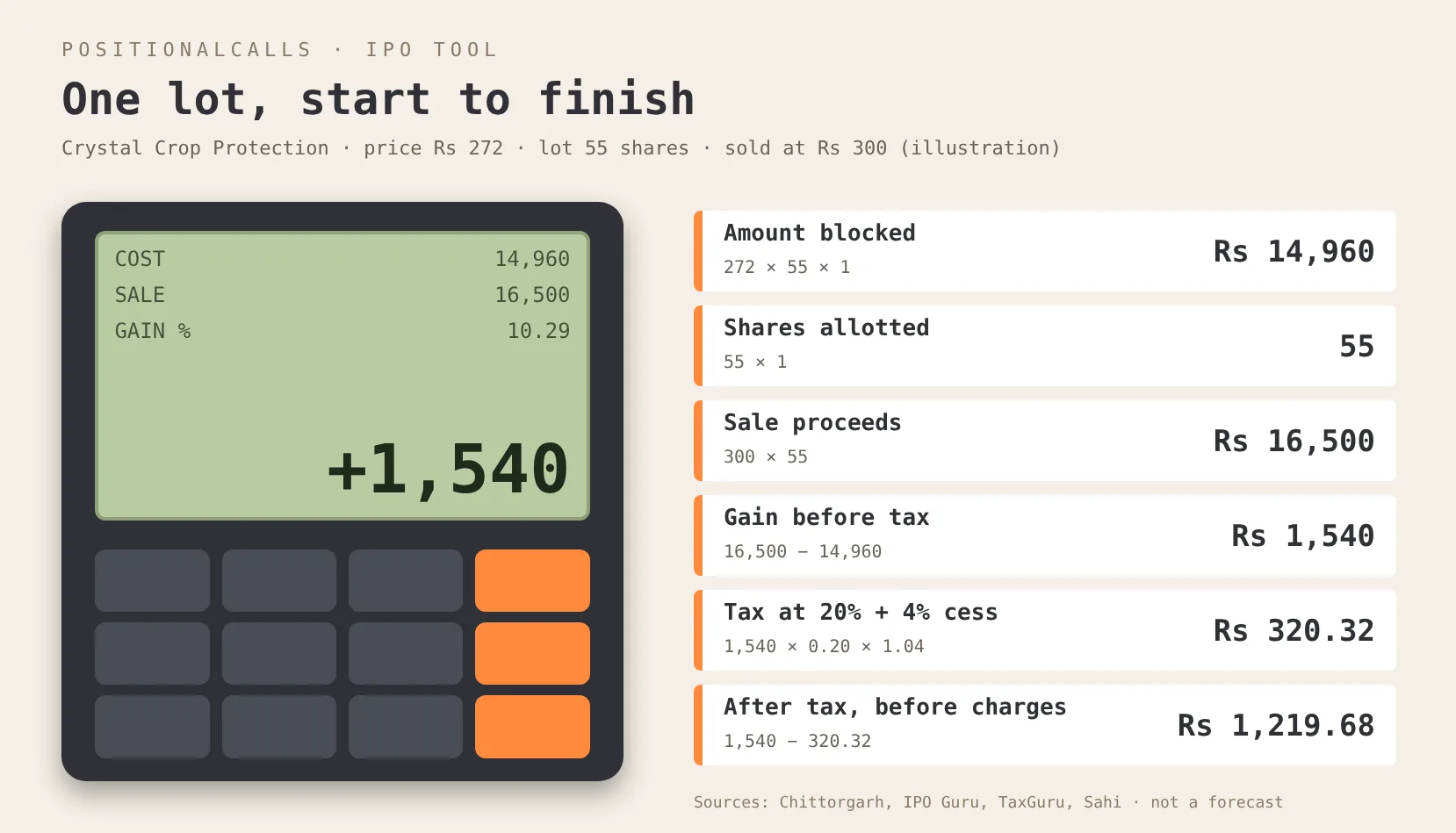
An IPO profit calculator example using the Crystal Crop Protection lot. Source: PositionalCalls from Chittorgarh and IPO Guru figures.
Use the IPO profit calculator for an upcoming or listed issue
Enter the issue price, the lot size, the lots you applied for and were allotted, your selling price and the months you held, and the IPO profit calculator shows the cost, refund, gain and estimated tax. The defaults show one lot of Crystal Crop Protection sold at Rs 300, an illustrative price. Nothing you type leaves your browser.
Use the top of the price band for the amount to block.
Enter 0 if you were not allotted shares.
What should I enter in each box?
The issue price is the final price per share, or the top of the band while you are still applying, as the calculator uses it for the amount to block. The lot size is the number of shares in one lot, shown on the issue page. Lots allotted is what the registrar tells you after the basis of allotment, and it can be zero. The selling price is the price you assume or achieved on listing.
How do I read the result?
The first line is the amount blocked when you applied. Cost of allotted shares is the issue price times the shares you received. The unblocked line is the money released for lots you did not get. Sale proceeds, gain and gain as a percentage follow, and the tax line shows an estimate with 4% cess. The last line is the gain after that estimated tax and before charges.
Which formulas does the IPO profit calculator use?
The IPO profit calculator uses six simple formulas, and each can be checked by hand. The table lists them with an example from Crystal Crop Protection: price Rs 272, lot 55 shares, one lot applied and allotted, sold at Rs 300.
| Item | Formula | Crystal Crop example |
|---|---|---|
| Amount blocked | Price × lot size × lots applied | 272 × 55 × 1 = Rs 14,960 |
| Shares allotted | Lot size × lots allotted | 55 × 1 = 55 shares |
| Cost of allotted shares | Price × lot size × lots allotted | Rs 14,960 |
| Unblocked or refunded | Price × lot size × (lots applied − lots allotted) | Rs 0 |
| Sale proceeds | Selling price × shares allotted | 300 × 55 = Rs 16,500 |
| Gain or loss | Sale proceeds − cost | Rs 1,540, or 10.29% of cost |
Cite this table: PositionalCalls, “IPO profit calculator formulas”; arithmetic by PositionalCalls on Chittorgarh and IPO Guru figures.
Why separate the amount blocked from the cost?
Because you may apply for more lots than you are allotted. Your bank blocks the full amount for the lots you applied for, but you pay only for the lots allotted. The rest is released, so the blocked amount and the cost are different numbers whenever the issue is oversubscribed and your application is not fully allotted.
What does ASBA mean for the amount you see?
ASBA, or application supported by blocked amount, means your money stays in your bank account and is blocked, not paid, until allotment. That is why the calculator shows an amount blocked and a separate unblocked line. Your bank account shows a block during the issue, and the unused part is released after the allotment is finalised. Details of the application are on the how to apply for an IPO page.
How does the final issue price get set, and why does it matter for the IPO profit calculator?
The final issue price is set after bidding closes, inside the price band, so the price you enter while applying may not be the price you pay. In book building, the company and its bankers collect bids at different prices within the band and then decide the final price, as one IPO glossary describes it. The calculator therefore uses the top of the band for the amount to block, and the final price for the cost.
| Term | What it means for the numbers | Example |
|---|---|---|
| Price band | The range you may bid within | Rs 259 to Rs 272 for Crystal Crop Protection |
| Cap price | The top of the band, used for the amount blocked | Rs 272 |
| Floor price | The bottom of the band | Rs 259 |
| Cut-off price | A bid that accepts the final price within the band | Often used by retail bidders |
| Final issue price | Set after the book is built; the cost is based on it | Announced with the basis of allotment |
Cite this table: PositionalCalls, “Price terms behind the numbers”; Chittorgarh, IPO Guru, IPO glossaries; see the glossary page for definitions.
What if the final price is lower than the top of the band?
Then your cost for each allotted share is lower and the unblocked amount is higher than the calculator shows with the top of the band. To see that case, enter the final price as the issue price after it is announced. Before that, treat the output as the amount at the top of the band, which is the highest the cost could be.
Does the issue price decide whether I make a gain?
It sets the starting point. A gain or loss is the difference between your selling price and your cost, so a lower issue price makes the same selling price look better and a higher one makes it look worse. The calculator shows both sides because the sign of the result flips around the issue price, as cases 1 and 2 show.
What are common mistakes when working out an IPO profit?
- Using the shares applied for instead of the shares allotted to compute the gain.
- Treating the amount blocked as the amount paid.
- Using the top of the band after the final price is announced.
- Ignoring brokerage and other charges, which reduce a small gain.
- Using a grey market premium as if it were a price.
What do five worked examples of the IPO profit calculator show?
Five worked examples show a gain, a loss, a partial allotment, no allotment and a long holding, and each matches the calculator. The selling prices are illustrations, not forecasts, and tax is shown with 4% cess where the gain is positive.
| Case | Inputs | Result |
|---|---|---|
| 1. Gain on listing | Crystal Crop: Rs 272, lot 55, 1 lot allotted, sold at Rs 300 | Gain Rs 1,540 (10.29%); tax Rs 320.32; after tax Rs 1,219.68 |
| 2. Loss on listing | Same issue, sold at Rs 250 | Loss Rs 1,210 (−8.09%); no tax on a loss |
| 3. Mahanadi lot | Rs 136, lot 110, 1 lot allotted, sold at Rs 150 | Gain Rs 1,540 (10.29%); tax Rs 320.32 |
| 4. Partial allotment | Crystal Crop: applied for 13 lots (Rs 1,94,480), 1 lot allotted | Cost Rs 14,960; Rs 1,79,520 released |
| 5. No allotment | Applied for 1 lot, 0 allotted | Cost Rs 0; Rs 14,960 released |
Cite this table: PositionalCalls, “IPO profit calculator worked examples”; arithmetic by PositionalCalls on Chittorgarh, IPO Guru and Upstox figures.
How is case 1 worked out?
One lot is 55 shares at Rs 272, so the cost is Rs 14,960. Sold at Rs 300, the 55 shares bring Rs 16,500. The gain is Rs 1,540, which is 10.29% of the cost. If the shares are sold within 12 months, the gain is taxed at 20%, which is Rs 308, and 4% cess adds Rs 12.32, so the estimated tax is Rs 320.32. That leaves Rs 1,219.68 after tax and before charges, my calculation.
Why does case 4 matter?
It shows that applying for many lots does not mean paying for many lots. Applying for 13 lots blocks Rs 1,94,480, but only the allotted lot costs Rs 14,960, and Rs 1,79,520 is released. It also shows why a large application does not raise the gain on a one-lot allotment: the gain depends on shares allotted, not on shares applied for.
What does a long holding change?
If the shares are held for more than 12 months, a gain is taxed at 12.5% above the Rs 1.25 lakh yearly exemption, per TaxGuru and Sahi. A Rs 2,00,000 gain would have Rs 75,000 taxable, which is Rs 9,375, and Rs 9,750 with cess, my calculation. The calculator assumes none of the exemption is already used, which the capital gains tax calculator lets you change.
PositionalCalls WhatsApp channel
Get IPO updates on WhatsApp
- Dates and price bands, dated
- Plain-English IPO tools, no tips
- Links to updated IPO pages
What is the lot cost of the current issues in the IPO profit calculator?
One lot costs Rs 14,960 at the top of the band in both mainboard issues open in the week of 16 November 2026. The SME issue is different and has a source conflict on lot size.
| Issue | Price band | Lot | Cost of one lot at the top of the band | Listing (expected) |
|---|---|---|---|---|
| Crystal Crop Protection | Rs 259 to Rs 272 | 55 shares | Rs 14,960 | 26 Nov 2026 |
| Mahanadi Coalfields | Rs 129 to Rs 136 | 110 shares | Rs 14,960 | 27 Nov 2026 |
| Watrana Rentals (SME) | Rs 232 to Rs 245 | 600 or 1,200 shares (sources differ) | Rs 1,47,000 or Rs 2,94,000 | 27 Nov 2026 |
Cite this table: PositionalCalls, “Lot cost of current IPOs”; Chittorgarh, IPO Guru, Upstox, Anand Rathi, INDmoney; arithmetic by PositionalCalls.
Why are the Crystal Crop and Mahanadi lot costs the same?
Both work out to Rs 14,960 by coincidence of lot size and price: 55 shares at Rs 272 and 110 shares at Rs 136. Companies and bankers choose lot sizes so that the minimum bid falls near a target amount, which is why many issues have a similar minimum. The price per share and the shares per lot differ, so the gain per rupee moved will differ too.
Why does the Watrana Rentals lot size matter?
Because the minimum amount changes from Rs 1,47,000 to Rs 2,94,000 depending on whether the lot is 600 or 1,200 shares. The sources disagree, and I did not open the prospectus. Check the exchange notice before entering a lot size, and see SME vs mainboard IPO for how SME rules differ.
What is the Rs 2 lakh retail limit in an IPO profit calculator?
Retail individual investors bid up to Rs 2 lakh in an IPO, and a bid above that falls in a different category. The BSE booklet states the Rs 2 lakh figure as the UPI limit for retail individual investors in IPO applications, and the retail definition is the same amount in other glossaries. The table shows what it means for a Rs 14,960 lot.
| Lots applied | Amount blocked | Within Rs 2 lakh? |
|---|---|---|
| 1 | Rs 14,960 | Yes |
| 5 | Rs 74,800 | Yes |
| 13 | Rs 1,94,480 | Yes |
| 14 | Rs 2,09,440 | No: above the retail limit |
Cite this table: PositionalCalls, “Retail limit in lots”; BSE Common Booklet on Securities Market; arithmetic by PositionalCalls.
Why does the tool warn above Rs 2 lakh?
Because the category changes, and the rules of allotment differ by category. The calculator shows a note when the amount blocked is above Rs 2 lakh. The categories are explained on the IPO investor categories page, and the terms QIB, NII and RII are defined on the stock market terms in India page.
Does applying for more lots raise the chance of allotment?
That depends on how the issue is allotted, and I do not give a view here. The calculator treats lots allotted as an input you enter after the basis of allotment, because the number applied for does not decide the number allotted.
How is the grey market premium different from the price in an IPO profit calculator?
The grey market premium is an unofficial quote and not a listing price, so the IPO profit calculator never uses it. It is a number quoted in an informal market that has no exchange and no regulator, and trackers show different values for the same issue.
| Quote | Date | Source note | As % of Rs 272 (my calculation) |
|---|---|---|---|
| Rs 45 | 13 Nov 2026 | Tracker quote on the Crystal Crop page | 16.54% |
| Rs 27 | 14 or 15 Nov 2026 | Date differs by source | 9.93% |
| Rs 15 | 15 Nov 2026, 9:15 PM | Latest dated quote on the page | 5.51% |
Cite this table: PositionalCalls, “Grey market quotes for Crystal Crop Protection”; trackers as named on the issue page; arithmetic by PositionalCalls.
Can I use a premium as the selling price?
You can type any price you like, including issue price plus a premium, to see what the arithmetic would be. That is a what-if and not a prediction. The premium can fall to zero or turn negative before listing, and the final listing price is set by trading on the exchange. How the premium works and who publishes it are explained on the IPO GMP meaning page.
What does the quote table show?
It shows that the same issue had quotes from Rs 45 to Rs 15 within three days, which is a spread of 11 percentage points of the issue price. A tool built on such a number would give a wide range of answers, which is the reason the calculator takes your own selling price.
What is the timeline from issue close to listing in the IPO profit calculator?
The money is blocked from the day you apply until allotment, and a sale is only possible after the shares are credited and listed. The Crystal Crop Protection issue closed on 20 November, and 24 November was an exchange holiday, so listing is expected on 26 November.
| Date (2026) | Event for Crystal Crop Protection | Source |
|---|---|---|
| 18 to 20 Nov | Bidding window, amount blocked | Chittorgarh, Upstox |
| 23 Nov | Basis of allotment | Chittorgarh |
| 24 Nov | NSE and BSE closed for Guru Nanak Jayanti | Kotak Neo, Upstox, Angel One |
| 25 Nov | Refunds and credit of shares | Angel One, Chittorgarh |
| 26 Nov | Listing; shares can be sold | Chittorgarh, IPO Guru |
Cite this table: PositionalCalls, “Crystal Crop Protection timeline”; Chittorgarh, Upstox, Kotak Neo, Angel One, IPO Guru.
When can I sell shares after an IPO?
Once the shares are credited to your demat account and the issue lists on the exchange, you can sell them like any listed share. For Crystal Crop Protection, that is expected on 26 November. The full calendar for all open issues is on the upcoming IPO in India page, and listing rules are on the IPO listing day rules page.
How do I check whether I was allotted shares?
The registrar publishes the basis of allotment, and you can check it by application number or PAN. The steps are on the how to check IPO allotment status page. Enter the lots allotted from that result into the calculator.
What does the IPO profit calculator leave out?
The IPO profit calculator is a quick estimate, so it leaves out items that change the net result. The table lists them.
| Item left out | Why it matters |
|---|---|
| Brokerage, STT and depository charges | Reduce the net gain on every sale |
| Surcharge | Applies at higher income levels |
| Capital losses and other income | Change the tax on the gain |
| Employee, shareholder or other discounts | Change the price some bidders pay |
| Partial sales and several selling prices | The calculator takes one selling price for all allotted shares |
| Allotment probability | The calculator does not estimate it |
Cite this table: PositionalCalls, “IPO profit calculator limits”; general practice.
Why does the tool not estimate allotment?
Because allotment depends on the number of bids in your category, and I cannot know it. Subscription figures are reported by category once the issue closes. A tool that guessed would suggest a precision that does not exist.
Does it work for SME IPOs?
It does the same arithmetic, but SME issues have larger lots and different rules, and the lot size for Watrana Rentals is disputed. Confirm the lot size and the minimum application from the exchange notice before you rely on any result.
Where do sources disagree on the numbers used in the IPO profit calculator?
The sources agree on the mainboard price bands and lot sizes and differ on three points. The table lists them and how the calculator treats each.
| Item | View A | View B | What the page does |
|---|---|---|---|
| Watrana Rentals lot size | 600 shares | 1,200 shares | Shows both amounts |
| Mahanadi Coalfields issue size | Rs 8,981.12 crore (Chittorgarh, Angel One) | Rs 5,012 crore (Upstox); about Rs 9,500 crore (IPO Guru) | Uses about Rs 9,000 crore from price × shares, my calculation, and does not use it in the calculator |
| Crystal Crop grey market quotes | Rs 45 (13 Nov) | Rs 15 (15 Nov) | Not used in the calculator |
Cite this table: PositionalCalls, “IPO profit calculator source conflicts”; sources as named.
What should I check before relying on the result?
- The final issue price, which is set after the book is built and can be below the top of the band.
- The lot size on the exchange notice.
- The lots allotted in the registrar result.
- Your own selling price, since listing prices are set by trading.
- Charges and tax on your contract note and return.
What is this page not for?
It does not tell you whether to apply for an IPO, and it does not predict listing prices. PositionalCalls is not a SEBI-registered research analyst or investment adviser, and I am not a chartered accountant. The IPO profit calculator shows arithmetic on numbers you supply.
PositionalCalls WhatsApp channel
IPO dates in one channel
- Listings and tools, dated
- Data pages without tips
- Links to new IPO pages
IPO profit calculator: frequently asked questions
How does an IPO profit calculator work?
An IPO profit calculator multiplies the lot size by the issue price to get the amount you apply with, then uses the lots allotted to get the cost, and compares it with the sale proceeds. The difference is the gain or loss. A good IPO profit calculator also shows the refund and an estimate of tax.
How do I calculate the amount to apply for in an IPO?
Multiply the top of the price band by the lot size and by the lots you apply for. For Crystal Crop Protection, one lot is 55 shares at Rs 272, so one lot is Rs 14,960, my calculation from the Chittorgarh and IPO Guru figures. The amount is blocked in your bank account until allotment.
What is the maximum a retail investor can bid in an IPO?
Retail individual investors bid up to Rs 2 lakh. At Rs 14,960 a lot, 13 lots cost Rs 1,94,480 and 14 lots cost Rs 2,09,440, which is above the limit, my calculation. An IPO profit calculator can flag an amount above Rs 2 lakh, which would fall in a different investor category.
What happens to my money if I am not allotted shares?
The amount blocked for the application is released, and any part not used for allotted lots is unblocked or refunded. In the IPO profit calculator, enter 0 lots allotted and the whole amount appears as unblocked. If you applied for 13 lots and got 1, Rs 1,79,520 is released, my calculation.
How is listing gain calculated in an IPO profit calculator?
Listing gain is the selling price minus the issue price, multiplied by the shares allotted. For one lot of 55 shares at an issue price of Rs 272 sold at Rs 300, the gain is Rs 1,540 or 10.29% of cost, my calculation. Sold at Rs 250, the result is a loss of Rs 1,210.
Does the IPO profit calculator use the grey market premium?
No. The grey market premium is an unofficial quote, not a price, and it differs between trackers. You enter your own selling price. A premium of Rs 15 on Rs 272 is 5.51%, my calculation, but it does not predict the listing price. See the IPO GMP page for how the premium works.
How is tax on an IPO gain estimated in the calculator?
If you sell within 12 months of allotment, the gain is taxed at 20%, and after more than 12 months at 12.5% above the Rs 1.25 lakh yearly exemption, per TaxGuru and Sahi. Cess of 4% is added. The calculator ignores surcharge, losses and charges, so check your own return.
Which charges does the IPO profit calculator leave out?
It leaves out brokerage, securities transaction tax, depository charges and any other fee your broker applies, as well as surcharge and capital losses. These reduce the net gain. Check your contract note for the actual charges on a sale, because the IPO profit calculator shows only the gain before them.
Is this IPO profit calculator advice to apply for or avoid an IPO?
No. PositionalCalls is not a SEBI-registered research analyst or investment adviser and I am not a chartered accountant. The IPO profit calculator applies arithmetic to the numbers you enter, publishes no subscribe, avoid, buy, sell, rating or target calls and does not predict listing prices.
Which IPOs can I test in the IPO profit calculator?
Any issue where you know the price, lot size and your selling price. The upcoming IPO in India page lists the open issues with price bands and lot sizes, including Crystal Crop Protection at Rs 259 to Rs 272 for 55 shares and Mahanadi Coalfields at Rs 129 to Rs 136 for 110 shares.
Sources for the IPO profit calculator
- Chittorgarh: IPO dashboard, tracker.
- IPO Guru: upcoming IPOs, 16, tracker.
- Upstox: Mahanadi Coalfields IPO, broker.
- Angel One: upcoming IPO list, broker.
- Kotak Neo: upcoming IPO list, broker.
- Anand Rathi: Watrana Rentals IPO, broker.
- INDmoney: Watrana Rentals IPO, broker.
- BSE: Common Booklet on, exchange.
- TaxGuru: equity STCG and, tax.
- Sahi: LTCG tax on, broker.
- Bigul: capital gains tax, broker.
- Angel One: stock market holidays,, broker.
- Not opened: the red herring prospectuses, the exchange notices, the registrar pages and the Income-tax Act; figures are from the sources above.
PositionalCalls.com is an independent research site founded by Shubham Chaudhary. PositionalCalls.com is not a SEBI-registered research analyst or investment adviser. Investments in securities markets are subject to market risks. Read all related documents carefully before investing. Returns are never guaranteed. This page is educational and publishes no subscribe, avoid, buy, sell, rating or target calls. Sources: IPO trackers, broker pages and tax guides as named; no prospectus or exchange notice opened; no apply or avoid view given. I am not a chartered accountant.

Shubham Chaudhary is the founder of PositionalCalls, an independent Indian stock market research website. He writes company fundamentals, quarterly results analysis, IPO analysis and sector research for NSE and BSE listed companies, with a focus on banking stocks, insurance and long-term value investing. Every article is built from primary sources such as RBI, SEBI, NSE and BSE filings and company annual reports, and states its risks plainly in simple language for retail investors.
Coverage areas Our research standards- Numbers checked against NSE, BSE and SEBI filings
- Risks and limits stated in every article
- No paid promotions or broker tie-ups
- Articles updated when new filings arrive