
Learning · Glossary
This guide to stock market terms in India explains more than 50 words you meet in market news, broker apps, IPO pages and results reports, in plain English, grouped by what you are trying to do, with examples drawn from public data and a pointer to the page on this site that goes deeper.
Quick answer
The stock market terms in India that matter first are demat account, trading account, T+1 settlement, circuit limit, price band, lot, EPS and P/E. This guide defines more than 50 terms in eight groups, each with an example and a link to a deeper page.
Stock market terms in India: key takeaways
- Accounts first: a demat account holds shares and a trading account places orders; you need both to trade, per NSE.
- Limits protect you: circuit limits cap daily moves, and index circuit breakers can halt the whole market.
- IPO words are practical: price band, lot, cut-off price and listing decide what you pay and when.
- Ratios need context: EPS and P/E change with the basis used, so two sites can differ.
- Scope: this is education. It is not advice and carries no ratings.
In plain words: the stock market is a place where pieces of companies, called shares, are bought and sold. Most of the jargon describes four things: where the trade happens, how it settles, what an offer or a result is called and how gains are taxed. Once you can place a term in one of those four boxes, it stops sounding technical.
Data note: as of Wednesday, 18 November 2026, 1:00 PM IST. Definitions are general explanations, not legal text. Rules quoted from NSE and BSE come from their investor education documents, and the BSE booklet is dated 2020, so I use it only for definitions that do not change. Examples come from pages on this site. Check the exchange, SEBI or your broker for the rule that applies to you.
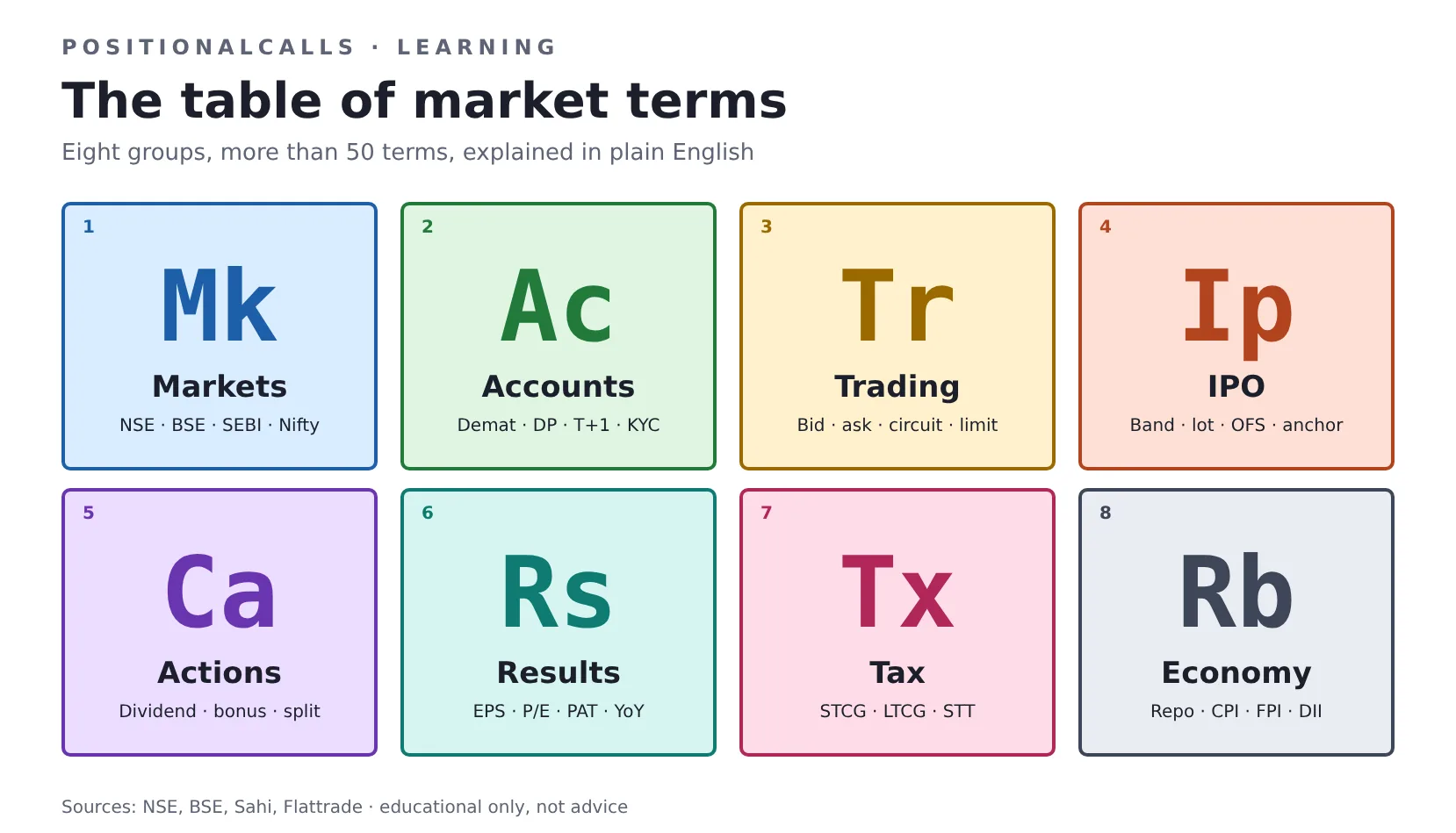 The eight groups of stock market terms in India used in this guide. Source: PositionalCalls.
What are the basic stock market terms in India for exchanges, indices and regulators?
The basic stock market terms in India name the places, the rule-maker and the scoreboards. India has two main stock exchanges, NSE and BSE, a regulator called SEBI, and indices such as the Nifty 50 and the Sensex that summarise how a group of shares is moving. The table defines seven terms you will see in nearly every market report.
| Term | Plain meaning | Where you see it |
|---|---|---|
| Stock exchange | A regulated marketplace where shares are bought and sold. NSE and BSE are the two main ones; NSE handles the majority of equity trading volume, per Sahi. | Every share quote and IPO listing |
| SEBI | The Securities and Exchange Board of India, the regulator that issues the rules and circulars for the market. Stockbrokers must be SEBI-registered, per NSE. | Disclaimers, IPO approvals, new rules |
| Primary market | Where companies raise capital by issuing new securities, such as an IPO, rights issue or bonus issue, per BSE. | IPO pages and listings |
| Secondary market | Trading in securities that are already listed on an exchange, through brokers, per BSE. | Daily buying and selling |
| Index | A number that shows how a specified basket of share prices is moving, per NSE. | News headlines |
| Nifty 50 | NSE’s benchmark index of 50 large companies. To qualify, a stock must reliably have market impact cost below 0.50% on Rs 2 crore Nifty trades, per NSE. | Market closing reports |
| Sensex | BSE’s benchmark index, the counterpart of the Nifty 50, per Sahi. | Market closing reports |
Cite this table: PositionalCalls, “Glossary: markets and regulators”; NSE Basic FAQs on Secondary Market, BSE Common Booklet on Securities Market, Sahi.
What is the difference between the primary and the secondary market?
The primary market is where a company sells shares for the first time, and the money goes to the company or to the selling shareholders. The secondary market is where those shares then trade between investors, and the company receives nothing from each trade. An IPO is a primary market event, and the day the shares list is the day they enter the secondary market. The upcoming IPO in India page shows both sides of that line.
Why do bull and bear markets matter in market news?
A bull market is one where prices are generally rising and a bear market is one where they are generally falling, as Kotak’s investor guide describes. News reports use the words to describe the mood of the whole market, not of one share. Neither label predicts the next month, so treat them as a description of what has already happened.
Which stock market terms in India describe accounts, settlement and documents?
You need a demat account and a trading account to buy and sell shares, and trades settle one business day later. These terms explain who holds your shares, who places your orders and how long a trade takes to complete.
| Term | Plain meaning | Where you see it |
|---|---|---|
| Demat account | An account opened with a SEBI-registered depository participant to hold and transfer securities electronically, per NSE. | Broker sign-up, IPO applications |
| Trading account | An account opened with a SEBI-registered stockbroker in your name to record the transactions you execute, per NSE. Each account gets a Unique Client Code. | Broker app |
| Depository participant (DP) | The SEBI-registered entity, usually a broker or bank, through which the demat account is opened, per NSE. | Demat statements |
| NSDL and CDSL | The two depositories in India that hold securities in electronic form, per Sahi and equities guides. | Demat account number format |
| T+1 settlement | A trade settles one business day after the trade date, so bought shares reach your demat account and sale money reaches your bank the next working day, per Sahi and Flattrade. | Contract notes |
| KYC and nomination | KYC is the identity check done when you open the account. NSE says investors must give nomination details during KYC and link PAN with Aadhaar. | Account opening |
| Contract note | The document your broker issues after you trade. The BSE booklet says it must be issued within 24 hours of execution. | Broker email |
Cite this table: PositionalCalls, “Glossary: accounts and settlement”; NSE Basic FAQs on Secondary Market, BSE Common Booklet, Sahi, Flattrade.
Do I need both a demat account and a trading account for stock market terms in India?
For buying and selling shares on the exchange, yes: the trading account places the order and the demat account holds the shares. NSE notes that a trading account is not mandatory for an IPO application, which is why some investors open only a demat account first. How an application works is on the how to apply for an IPO page.
What does T+1 change for a normal investor?
Shares bought on a Monday appear in your demat account on Tuesday, a business day later, and exchange holidays push the date forward. The shorter cycle means money is tied up for a shorter time. Older guides, including the 2020 BSE booklet, describe a T+2 cycle, which is why the booklet is used here only for definitions that have not changed.
What do the main trading terms in India mean when you place an order?
Trading terms describe how an order is priced, how far a price can move and how long you hold. The table groups the nine terms that decide how an order behaves once you press the button.
| Term | Plain meaning | Example |
|---|---|---|
| Bid and ask | The bid is the highest price a buyer offers; the ask is the lowest price a seller wants. NSE’s example has bids at 99 and asks at 101. | A gap of Rs 2 between 99 and 101 |
| Market order | An order to buy or sell immediately at the best available price. | Fast, but the price can differ from the last quote |
| Limit order | An order to buy or sell only at your price or better. | May not execute if the price never reaches it |
| Stop-loss order | An order that triggers when the price reaches a level you set, to close a position. | Used to cap a loss |
| Circuit filter or price band | A cap on how far a share can move in a day from the previous close. NSE says daily bands are 2%, 5% or 10%, 20% on remaining shares and none for shares with derivatives. | A 10% band on a Rs 100 close allows Rs 90 to Rs 110 |
| Index circuit breaker | A halt for the whole market if the Nifty 50 or Sensex falls or rises sharply: 10%, 15% or 20% triggers with different halt times, per NSE. | A 10% move before 1 PM halts trading for 45 minutes |
| Intraday trade | A trade opened and closed on the same day, so no shares are delivered to your demat account. | Buy and sell by the close |
| Delivery trade | Holding shares in your demat account beyond the trading day, per SBI Securities. | Buy and hold for months |
| Short selling | Selling shares you do not own, expecting to buy them back cheaper. | A bet on a fall; losses can exceed the amount put in |
Cite this table: PositionalCalls, “Glossary: trading terms”; NSE Basic FAQs on Secondary Market, SBI Securities glossary.
What is a circuit limit and what happens at the limit?
When a share reaches its band, trading in that share stops at that price for the day, as Sahi explains for upper and lower circuits. The share can be locked at the upper limit with buyers but no sellers, or at the lower limit with sellers but no buyers. The limit applies to each exchange separately, so Kotak notes the circuit filter can differ between NSE and BSE for the same share.
How do index circuit breakers differ from share circuit limits?
A share circuit limit affects one share. An index circuit breaker stops the whole market. NSE says a 10% move halts trading for 45 minutes before 1 PM and 15 minutes between 1 PM and 2:30 PM, a 15% move halts for an hour before 1 PM and closes the market for the day at or after 2 PM, and a 20% move closes the market for the day at any time.
Why does the bid-ask gap matter?
The gap between bid and ask is a cost you pay every time you trade. In a heavily traded share the gap is tiny. In a thinly traded share it can be wide, so a market order can fill at a poor price. That is why many investors use limit orders in shares with low volumes.
Which IPO terms do you need among the stock market terms in India?
An IPO has its own vocabulary, and the same dozen words appear on every issue page. An IPO, or initial public offer, is the first time a company offers shares to the public, per BSE. The table uses the Crystal Crop Protection and Mahanadi Coalfields issues as examples where a number helps.
| Term | Plain meaning | Example |
|---|---|---|
| IPO | The first public offer of a company’s shares, per BSE. | Mahanadi Coalfields, bids 19 to 23 November 2026 |
| DRHP | Draft red herring prospectus: the offer document filed with SEBI before the issue, covering the business, promoters, financials, risks and the purpose of the issue, per BSE. | Avaada Electro filed an updated draft in 2026 |
| Price band | The range within which you may bid. | Rs 259 to Rs 272 for Crystal Crop Protection |
| Lot | The smallest number of shares you can bid for. | 55 shares for Crystal Crop; 110 for Mahanadi |
| Minimum bid | Lot size × the top of the band. | 55 × Rs 272 = Rs 14,960 (my calculation) |
| Cut-off price | A bid option that accepts whatever final price is set within the band. | Used by retail bidders |
| Fresh issue and OFS | A fresh issue creates new shares and the money goes to the company; an offer for sale (OFS) is existing holders selling and the company receives nothing. | Mahanadi is 100% OFS |
| Anchor investors | Institutions that bid the day before the issue opens. | Anchor bidding on 17 and 18 November |
| QIB, NII, RII | Qualified institutional buyers (mutual funds and other institutions), non-institutional investors and retail individual investors bidding up to Rs 2 lakh. | The three subscription categories |
| Subscription | How many times the shares on offer were bid for, such as 2x for twice the number of shares. | Reported by category each day |
| Basis of allotment | The process that decides who gets shares when the issue is oversubscribed. | Day after the issue closes |
| ASBA | Application supported by blocked amount: your money stays in your bank account and is blocked until allotment. | How IPO applications are paid |
| Listing | The day shares start trading on the exchange. | Crystal Crop on 26 November 2026 |
| GMP | Grey market premium: an unofficial price in an off-exchange market. It is not an official price. | Explained on the IPO GMP page |
Cite this table: PositionalCalls, “Glossary: IPO terms”; BSE Common Booklet, IPO Guru, Chittorgarh, Upstox.
PositionalCalls WhatsApp channel
Get market explainers on WhatsApp
- Plain-English market terms
- Explainers without tips
- Links to updated guides
How do price band, lot and minimum bid fit together?
The price band sets the price per share. The lot sets the number of shares in one bid. Multiply the top of the band by the lot to get the minimum amount you must be ready to commit. For Crystal Crop Protection that is 55 × Rs 272 = Rs 14,960, and for Mahanadi Coalfields it is 110 × Rs 136 = Rs 14,960, both my calculation. The full list of issues is on the upcoming IPO in India page.
What is the difference between a fresh issue and an offer for sale in stock market terms in India?
In a fresh issue, the company creates new shares and receives the money, often to repay debt or fund growth. In an offer for sale, existing shareholders such as promoters sell some of their shares and the company receives nothing. Many issues combine both. Crystal Crop Protection had a fresh issue and an offer for sale, while Mahanadi Coalfields is entirely an offer for sale, per IPO Guru.
What do QIB, NII and retail mean in an IPO?
QIBs are institutions such as mutual funds. NIIs are other investors bidding above Rs 2 lakh. Retail individual investors bid up to Rs 2 lakh. Each group has its own share of the issue and its own subscription figure, which is why one issue can be subscribed several times in one category and below one time in another. The IPO investor categories page explains the split.
Why is the grey market premium not an official price?
The GMP is a quote in an informal market that is not run by an exchange and has no regulator. It can change by the hour and it can differ between websites, so it is a rumour about demand and not a measure of listing price. See IPO GMP meaning. Listing rules are on the IPO listing day rules page.
What are corporate actions in stock market terms in India?
Corporate actions are decisions by a company that change what shareholders hold or receive. The table explains the eight you will meet most often, including the dates that decide who gets a dividend.
| Term | Plain meaning | Why it matters |
|---|---|---|
| Dividend | A share of profit paid to shareholders, out of the company’s profits, per BSE. | Income from holding the share |
| Record date | The date on which the company checks who is on its shareholder list. | Decides who is eligible for a dividend |
| Ex-date | The first day the share trades without the right to the dividend. | The price often adjusts for the payout |
| Bonus issue | Existing shareholders receive extra shares in proportion to their holding, without extra cost, per BSE. | More shares, same value in total |
| Stock split | Dividing one share into several of lower face value. | More shares, lower price per share |
| Rights issue | Existing shareholders get the right to subscribe to new shares in proportion to their holding, per BSE. | Raises money from current owners |
| Buyback | The company buys back its own shares from shareholders. | Reduces the number of shares |
| Face value | The nominal value printed on a share, unrelated to the market price. | Used in splits and dividends |
Cite this table: PositionalCalls, “Glossary: corporate actions”; BSE Common Booklet on Securities Market.
Do bonus shares and splits create value?
On their own they do not. After a bonus or split, the number of shares rises and the price per share falls in proportion, so the total value of your holding stays about the same on the day. What changes is how many shares you hold and how easy they are to trade. Any later price move comes from the market, not from the action itself. Our bonus shares vs stock split calculator shows how the share count, price and average cost change.
Why do the record date and ex-date matter for dividends?
Because you must own the share before the ex-date to be on the list on the record date. Buying on or after the ex-date does not entitle you to that dividend. Our ex-dividend date calculator finds the last day to buy. How dividends are taxed is covered on the dividend tax in India page.
Which results and ratio terms appear in stock market terms in India reports?
Results reports use a fixed set of words for revenue, profit and ratios. The table explains ten of them, with one example where a number helps. They appear in every quarterly result, listed on the earnings calendar.
| Term | Plain meaning | Example or note |
|---|---|---|
| Revenue | The money a company earns from selling its products or services before costs. | Also called sales or turnover |
| EBITDA | Earnings before interest, tax, depreciation and amortisation: a measure of operating profit. | Margin is EBITDA divided by revenue |
| PAT | Profit after tax, also called net profit: what is left after all costs and tax. | The headline profit number |
| EPS | Earnings per share: profit divided by the number of shares. | Used to compute P/E |
| P/E ratio | Share price divided by EPS: the rupees paid for each rupee of profit. | Depends on which EPS and date are used |
| Market capitalisation | Share price multiplied by the number of shares. | A way to size a company |
| Book value and P/B | Book value is assets minus liabilities per share; P/B divides price by it. | Often used for banks |
| YoY and QoQ | Year-on-year compares with the same period a year ago; quarter-on-quarter with the previous quarter. | Both appear in results headlines |
| Consolidated and standalone | Standalone covers the parent only; consolidated includes subsidiaries. | Hero MotoCorp: Rs 1,456 crore standalone, Rs 1,861 crore consolidated |
| One-off item | A gain or cost that is not expected to repeat. | Hero’s consolidated figure included a Rs 397 crore one-off |
Cite this table: PositionalCalls, “Glossary: results and ratios”; company results pages on this site.
Why do P/E ratios differ between websites?
Because the EPS can be standalone or consolidated, trailing or forward, and diluted or basic, and the share price can be from different dates. A P/E for the same company can therefore differ across pages. For example, two IPO trackers showed 28.2 times and about 24.6 times for the same issue on different bases. Check the basis before comparing.
What is the difference between revenue growth and profit growth?
Revenue is the top line and profit is the bottom line. A company can grow revenue while profit falls if costs rise faster, which is what a falling margin shows. Maruti Suzuki’s September 2026 quarter is an example covered on its results page, where revenue rose while profit fell.
Which tax and cost terms are part of the stock market terms in India?
Tax and cost terms decide what you keep after a trade. The table defines six terms. The rates change with the Union Budget, so the table points to the pages that carry the current rates instead of repeating them.
| Term | Plain meaning | Where to read more |
|---|---|---|
| STCG | Short-term capital gain: profit on shares sold after a short holding period, taxed at its own rate. | Capital gains tax on shares |
| LTCG | Long-term capital gain: profit on shares held longer, taxed at a different rate with an exemption limit. | Capital gains tax on shares |
| STT | Securities transaction tax, charged on trades on the exchange. | Charges section of your contract note |
| Brokerage | The fee your broker charges for executing a trade. | Broker fee page |
| DP charges | A flat fee charged when shares are sold from your demat account. | Broker charge list |
| TDS on dividend | Tax deducted at source by the company before paying a dividend. | Dividend tax in India |
Cite this table: PositionalCalls, “Glossary: tax and costs”; pages on this site.
How are IPO gains taxed?
Shares sold after listing are taxed as capital gains like any other listed shares, and the holding period starts from the allotment date. The IPO tax page lists the current short-term and long-term rates with examples; see IPO tax in India.
Why do charges matter for small trades?
Fixed charges take a bigger bite out of a small gain. A fee of a few rupees on a trade worth thousands is small; the same fee on a trade with a small profit can erase it. Read the charge list on your contract note, which the BSE booklet says must be issued within 24 hours of a trade.
Which RBI and economy terms appear in stock market terms in India news?
Market news often leans on a few economy terms because interest rates, inflation and foreign flows move share prices. The table defines six of them in plain language.
| Term | Plain meaning | Why markets watch it |
|---|---|---|
| Repo rate | The rate at which the RBI lends money to banks. See RBI repo rate. | Affects loan costs and bank margins |
| MPC | The Monetary Policy Committee that decides the repo rate at scheduled meetings. | Its decision is a market event |
| CPI inflation | The rise in the prices of a basket of goods and services paid by consumers. | Guides RBI rate decisions |
| FPI or FII | Foreign portfolio investors or foreign institutional investors who buy and sell Indian shares. | Their flows can move the market |
| DII | Domestic institutional investors, such as mutual funds and insurers. | Often offset foreign selling |
| Volatility | How sharply prices move up and down over a period. | Higher volatility means bigger swings |
Cite this table: PositionalCalls, “Glossary: RBI and economy terms”; RBI, NSE.
Why does the repo rate affect shares?
Because it changes the cost of borrowing for companies and households and the interest banks earn and pay. A change can alter profit expectations for banks, housing and auto companies. The effect on a share is never automatic and depends on what was already expected.
How can you learn stock market terms in India without memorising them?
Learn the terms in context, using real pages, and not as a list. A glossary approach, where you meet a term in a news item or a result and then look it up, is often more effective than memorising definitions in isolation, as one equities guide puts it.
What is a simple order to learn stock market terms in India?
- First the accounts and settlement terms, so you understand what you own and when.
- Then trading terms, so you understand how an order behaves.
- Then IPO and corporate action terms, which appear in news every week.
- Then results and ratio terms, which appear each quarter.
- Last the tax and economy terms, which change with rules and policy.
How should I use this page with live market news?
Open a news item, underline each unfamiliar word and look it up here. When you read an IPO page such as upcoming IPO in India or a result such as Maruti Suzuki Q2 results FY27, the terms in these tables are the ones you will meet. Return to this page when a word is new.
What is this page not for?
It does not tell you what to buy or sell and it does not predict prices. PositionalCalls is not a SEBI-registered research analyst or investment adviser. These stock market terms in India are explained so that you can read sources more easily and ask better questions.
PositionalCalls WhatsApp channel
Market explainers in one channel
- Terms and rules, dated
- Learning pages without tips
- Links to new guides
Stock market terms in India: frequently asked questions
What are the most important stock market terms in India for a beginner?
Start with the demat account, trading account, NSE, BSE and SEBI, then learn how orders, circuit limits and T+1 settlement work. After that, the IPO terms matter: price band, lot, cut-off price and listing. These stock market terms in India appear in almost every news report, so learning them first makes everything else easier to follow.
What is the difference between a demat account and a trading account?
A demat account holds your shares electronically and is opened with a SEBI-registered depository participant, per NSE. A trading account is opened with a SEBI-registered stockbroker and records the buy and sell transactions you place. You need both to trade shares, and the pair is one of the first stock market terms in India people ask about.
What does T+1 settlement mean in the Indian stock market?
T+1 means a trade settles one business day after the trade date, so shares you buy reach your demat account and money from a sale reaches your bank account the next working day. Broker guides from Sahi and Kotak describe it as the standard cycle for equity in India. It is a core item among stock market terms in India.
What is a circuit limit and why do stocks hit it?
A circuit limit, or price band, caps how far a share can move in one day from the previous close. NSE says daily bands are 2%, 5% or 10%, with 20% on remaining shares and none on shares that have derivatives. A stock hits it when buying or selling pressure is strong enough to reach the limit.
What is a price band and a lot in an IPO?
The price band is the range in which you may bid, and the lot is the smallest number of shares you can bid for. In the Crystal Crop Protection issue the band was Rs 259 to Rs 272 and the lot 55 shares, so one lot at the top of the band cost Rs 14,960, my calculation.
What is the difference between EPS and P/E?
EPS, or earnings per share, is a company’s profit divided by its number of shares. The P/E ratio is the share price divided by EPS, so it shows how many rupees the market pays for each rupee of profit. A P/E depends on which EPS and which date are used, so two sites can show different values.
What do consolidated and standalone results mean?
Standalone results cover only the parent company. Consolidated results add its subsidiaries, so the numbers can differ sharply. For example, Hero MotoCorp reported standalone profit of Rs 1,456 crore and consolidated profit of Rs 1,861 crore for the September 2026 quarter, which included a one-off of Rs 397 crore. Always check which one a headline uses.
What is the difference between STCG and LTCG?
STCG is short-term capital gain and LTCG is long-term capital gain on shares, and they are taxed at different rates depending on how long you held. The holding period and the current rates are explained with worked examples on the capital gains tax page of this site.
Is this glossary investment advice?
No. PositionalCalls is not a SEBI-registered research analyst or investment adviser and publishes no subscribe, buy, sell, rating or target calls. This guide to stock market terms in India explains words and gives examples from public data, with sources named, so that you can read market news and company documents more easily.
How often is this guide to stock market terms in India updated?
It is dated and revised when a rule, a term or an example changes, such as a new settlement cycle, a price band rule or an IPO example that has aged. The updated stamp at the top shows the last revision. Definitions are general explanations, so check the exchange or SEBI for the rule that applies to you.
Sources for stock market terms in India
- NSE: Basic FAQs on Secondary Market, exchange.
- BSE: Common Booklet on Securities Market (2020), exchange.
- NSE: Pragati, Basics of Capital Markets, exchange.
- Sahi: stock market full forms and key terms, broker.
- Flattrade: what is SEBI, broker.
- Kotak Securities: investing guide, broker.
- Equities India: stock market terminology overview, tracker.
- SBI Securities: stock market glossary, broker.
- IPO Guru: upcoming IPOs, 16 to 20 November 2026, tracker.
- Chittorgarh: IPO dashboard, tracker.
- Not opened: SEBI circulars and the exchange rulebooks; definitions follow the exchange education documents and broker guides above.
PositionalCalls.com is an independent research site founded by Shubham Chaudhary. PositionalCalls.com is not a SEBI-registered research analyst or investment adviser. Investments in securities markets are subject to market risks. Read all related documents carefully before investing. Returns are never guaranteed. This page is educational and publishes no subscribe, avoid, buy, sell, rating or target calls. How this page on stock market terms in India was researched: exchange education documents and broker glossaries as named in the sources, no SEBI circular opened, and no investment view given.

Shubham Chaudhary is the founder of PositionalCalls, an independent Indian stock market research website. He writes company fundamentals, quarterly results analysis, IPO analysis and sector research for NSE and BSE listed companies, with a focus on banking stocks, insurance and long-term value investing. Every article is built from primary sources such as RBI, SEBI, NSE and BSE filings and company annual reports, and states its risks plainly in simple language for retail investors.
Coverage areas Our research standards- Numbers checked against NSE, BSE and SEBI filings
- Risks and limits stated in every article
- No paid promotions or broker tie-ups
- Articles updated when new filings arrive