
Tax Guide · Dividends
Dividend tax in India changed on 1 April 2026: a new Income-tax Act, Form 121 in place of 15G and 15H, and no interest deduction. This guide gives the current rates, the Rs 10,000 TDS limit, worked rupee examples and the NRI rules, with sources and dates.
Quick answer
Dividend tax in India for FY 2026-27: dividends are taxed at your slab rate. A company deducts 10% TDS from a resident individual once dividends from it pass Rs 10,000 in the year. NRIs face 20% plus surcharge and cess, or a lower treaty rate. TDS is not final tax.
Latest update (Friday, 6 November 2026, 3:30 PM IST): This guide was first published today. It reflects the Income-tax Act, 2025 (in force from 1 April 2026), the Rs 10,000 TDS limit, Form 121, and the Budget 2026 removal of the interest deduction on dividends. Note one future date: from 1 April 2027 a single declaration can also go to a depository.
Key takeaways
- Rate: dividend tax in India follows your slab rate; there is no flat dividend tax for residents and no deduction for interest.
- TDS: 10% above Rs 10,000 a year per company for resident individuals; 20% without a valid PAN.
- Not tax-free: the Rs 10,000 limit exempts only TDS, not the tax.
- Form 121: replaces Forms 15G and 15H; file it before the company’s cut-off date, not the record date.
- NRIs: 20% plus surcharge and cess unless a tax residency certificate and Form 41 earn a treaty rate.
In plain words: Dividend tax in India works like this. A company pays you a dividend and, above a small limit, keeps 10% back as tax and sends it to the government. That 10% is an advance payment. At the end of the year you work out your real tax at your slab rate. If your real tax is lower, you get the difference back. If it is higher, you pay the rest.
Data note: Figures and rules are as of Friday, 6 November 2026, 3:30 PM IST. I read the Income Tax Department’s Form 121 page and FAQ, the Budget 2026 speech document on PIB, company TDS notices (Infosys, Oil India, Mindteck) and several compliance guides through search results. I did not open the Income-tax Act, 2025 itself, so section numbers come from those sources. Treaty rates differ across secondary sources, and I flag where. Derived numbers are my calculation. This is general information, not tax advice.
How does dividend tax in India work in FY 2026-27?
Dividend tax in India falls on the shareholder: dividend is taxed as income from other sources at the slab rate for residents, with TDS as an advance payment. There is no company-level dividend distribution tax since 1 April 2020.
Before 2020 the company paid a dividend distribution tax and the shareholder received dividends tax-free. That ended on 1 April 2020, and dividend tax in India has been charged in the shareholder’s hands since. The rules here apply to tax year 2026-27 (1 April 2026 to 31 March 2027) under the Income-tax Act, 2025, which replaced the 1961 Act from 1 April 2026.
| Who receives the dividend | Tax on the dividend | TDS by the company | Section (Income-tax Act, 2025) |
|---|---|---|---|
| Resident individual, valid PAN | Slab rate (new regime 0% to 30%) | 10% above Rs 10,000 a year per company | 393(1), Table Sl. 7 |
| Resident individual, no valid PAN | Slab rate | 20% | Rate for no PAN, per company notices |
| Resident HUF, firm, company, trust | Own rates | 10% on the whole dividend; no Rs 10,000 limit | 393(1), Table Sl. 7 |
| Non-resident (including NRI) | 20% plus surcharge and cess, or treaty rate | 20% plus surcharge and cess; no Rs 10,000 limit | 393(2); section 207(1) |
| Mutual fund investor (IDCW) | Slab rate | 10% above Rs 10,000 a year per fund | 393(1), Table Sl. 4(i) |
| Foreign portfolio investor | Separate rule, 20% | 20% | 393(2), Table Sl. 15 |
Cite this table: PositionalCalls, “Dividend Tax at a Glance, as of 5 November 2026”.
For dividend tax in India the new regime is the default for individuals. Under it, the slabs for 2026-27 are nil to Rs 4 lakh, then 5%, 10%, 15%, 20%, 25% and 30% in steps of Rs 4 lakh above that, with the top rate above Rs 24 lakh (several compliance sources, consistent with Budget 2025). The old regime keeps its own slabs for those who opt for it.
Under dividend tax in India rules, a company deducts 10% TDS from a resident individual’s dividend once the total from that company in the year exceeds Rs 10,000, and 20% if the PAN is missing or invalid. The limit is per company, per year.
Under section 393(4) of the Income-tax Act, 2025, no TDS is deducted from an individual’s dividend if the total from that company during the tax year does not exceed Rs 10,000 and it is paid other than in cash. This limit was raised from Rs 5,000 from 1 April 2025, so older articles quoting Rs 5,000 are out of date.
The per-company rule and the crossing trap
The test is applied company by company. If you receive Rs 8,000 from Company A and Rs 9,000 from Company B, neither deducts TDS (Tax Garden’s worked example). But once one company’s dividends in the year pass Rs 10,000, the relief is lost and TDS applies to the whole amount, not just the excess, according to the same guide. Check your company’s own notice, because payers describe the mechanics differently.
| Payment month (Company A) | Dividend paid | Cumulative in the year | TDS (10%) |
|---|---|---|---|
| June 2026 (final) | Rs 4,000 | Rs 4,000 | Nil |
| October 2026 (interim) | Rs 5,000 | Rs 9,000 | Nil |
| February 2027 (special) | Rs 3,000 | Rs 12,000 | Rs 1,200 (10% of Rs 12,000) |
| Same shareholder, Company B | Rs 9,000 all year | Rs 9,000 | Nil |
Cite this table: PositionalCalls, “Dividend TDS Crossing Example, as of 5 November 2026”.
Worked example (my calculation). A company pays Rs 22 final and Rs 19 interim in the same tax year, Rs 41 per share. You cross Rs 10,000 at 244 shares (10,000 divided by 41 is 243.9). At 200 shares you receive Rs 8,200 and no TDS; at 250 shares you receive Rs 10,250 and TDS of 10% applies. A 50-share difference changes the TDS from nil to about Rs 1,025.
Who gets no limit at all?
The Rs 10,000 limit is for individuals. HUFs, firms, companies and other non-individuals are subject to 10% TDS on the entire dividend, per the company notices I read. It also does not carry over to non-residents, because section 393(4) ties it to the resident table.
What changed and when? Dividend tax in India timeline from 2020 to 2027
Five changes matter for dividend tax in India: dividend tax moved to shareholders in 2020, the TDS limit doubled in 2025, the new Act started on 1 April 2026, the interest deduction ended the same day, and a depository declaration arrives on 1 April 2027.
| Date | What changed | Effect on you | Source |
|---|---|---|---|
| 1 April 2020 | Dividend distribution tax abolished | Dividend taxed at your slab rate | Compliance guides |
| 1 April 2025 | TDS limit raised from Rs 5,000 to Rs 10,000 | Fewer small shareholders face TDS | Finance Act 2025, via guides |
| 1 April 2026 | Income-tax Act, 2025 in force; section 194 becomes 393(1); Form 121 replaces 15G and 15H | New section and form numbers; rates unchanged | Income Tax Department; company notices |
| 1 April 2026 | No deduction for interest or other expenses against dividend or mutual fund income | Tax on gross dividend; the old 20% interest deduction is gone | Budget 2026 speech (PIB); Finance Act 2026 |
| 1 April 2027 | Declaration for nil TDS may also be given electronically to a depository | One Form 121 for all holdings | Form 121 note, Income Tax Department |
Cite this table: PositionalCalls, “Dividend Tax Timeline, as of 5 November 2026”.
Old section to new section map
| Item | Income-tax Act, 1961 | Income-tax Act, 2025 (from 1 April 2026) |
|---|---|---|
| TDS on dividend, residents | Section 194 | Section 393(1), Table Sl. 7 |
| TDS on dividend, non-residents | Section 195 | Section 393(2) |
| Nil-TDS declaration | Form 15G and Form 15H (section 197A) | Form 121 (section 393(6)) |
| Treaty declaration by non-resident | Form 10F | Form 41 |
| Deductions from other income | Section 57 | Section 93 (no deduction against dividend) |
| Slab rebate | Section 87A | Rebate section in the new Act (one source says section 157) |
Cite this table: PositionalCalls, “Dividend Tax Section Map, as of 5 November 2026”.
How much dividend tax in India will you pay? Worked examples on Rs 1 lakh
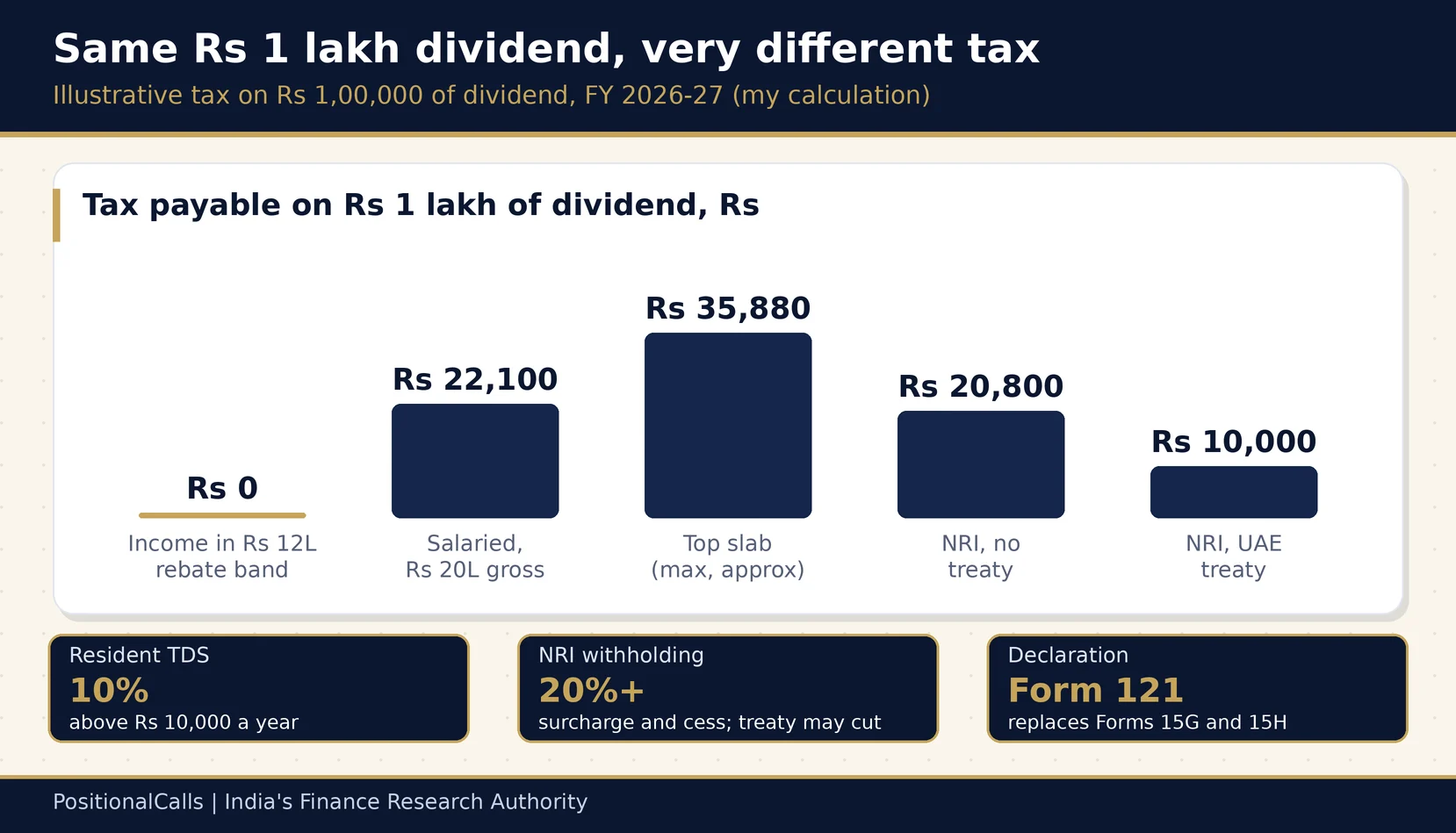
On a Rs 1 lakh dividend, dividend tax in India can be nil, about Rs 22,100 or up to about Rs 35,880 for a resident, depending on where your total income falls, because dividend is added to your other income.
Assumptions: new regime, tax year 2026-27, resident individual; slabs of nil to Rs 4 lakh, 5% to Rs 8 lakh, 10% to Rs 12 lakh, 15% to Rs 16 lakh, 20% to Rs 20 lakh, 25% to Rs 24 lakh, 30% above; standard deduction of Rs 75,000 for salary; rebate of up to Rs 60,000 when taxable income is within Rs 12 lakh; 4% cess; surcharge ignored below Rs 50 lakh.
Example 1: income within the Rs 12 lakh rebate band
A salaried resident has gross salary of Rs 10 lakh and dividends of Rs 50,000. Taxable salary is Rs 9.25 lakh (after Rs 75,000), and total taxable income Rs 9.75 lakh. Slab tax is Rs 20,000 on the Rs 4 lakh to Rs 8 lakh band plus Rs 17,500 (10% of Rs 1.75 lakh), so Rs 37,500. That is less than the Rs 60,000 rebate, so final tax is nil (my calculation). Yet the company may still have deducted Rs 5,000 as TDS, which you claim back in your return.
Example 2: gross salary of Rs 20 lakh
Taxable salary is Rs 19.25 lakh. Slab tax on that is Rs 1,85,000 (Rs 20,000 plus Rs 40,000 plus Rs 60,000 plus 20% of Rs 3.25 lakh). Adding Rs 1 lakh of dividends makes income Rs 20.25 lakh and tax Rs 2,06,250. The dividend added Rs 21,250 (Rs 75,000 taxed at 20% and Rs 25,000 at 25%), or Rs 22,100 with cess, an effective 22.1% (my calculation). TDS of Rs 10,000 covers less than half, so you owe about Rs 12,100 more.
Example 3: the top of the scale
At the 30% slab, with surcharge on dividend income capped at 15% and 4% cess, the highest effective rate on a dividend is about 35.88% (30% times 1.15 times 1.04, my calculation). The surcharge cap on dividend income comes from a compliance guide; confirm it for your income with a tax adviser. Marginal relief at surcharge thresholds is ignored here.
| Profile (Rs 1 lakh dividend) | Rate on the dividend | Tax | TDS deducted | Settle at filing |
|---|---|---|---|---|
| Taxable income within Rs 12 lakh | 0% after rebate | Rs 0 | Rs 10,000 if over the limit | Refund of Rs 10,000 |
| Salaried, Rs 20 lakh gross | 25% and 20% slabs plus cess | Rs 22,100 | Rs 10,000 | Pay about Rs 12,100 |
| Top slab, surcharge capped | About 35.88% | About Rs 35,880 | Rs 10,000 | Pay about Rs 25,880 |
| NRI, no treaty relief | 20% plus cess (no surcharge below Rs 50 lakh) | Rs 20,800 | Rs 20,800 | Usually settled at source |
| NRI, UAE resident with treaty documents | 10% treaty rate | Rs 10,000 before any surcharge or cess a payer adds | Rs 10,000 | Usually settled at source |
Cite this table: PositionalCalls, “Tax on Rs 1 Lakh of Dividend, FY 2026-27, as of 5 November 2026”.
The rebate point matters most for small investors paying dividend tax in India. Dividend is ordinary income, so for a resident whose total taxable income stays within Rs 12 lakh the rebate can wipe out the tax, as in Example 1. That rebate does not apply to special-rate income such as capital gains taxed at 12.5% or 20%; see our guide to capital gains tax on shares for that side.
What is Form 121 and how do you submit it?
For dividend tax in India, Form 121 is the single declaration that replaced Forms 15G and 15H from 1 April 2026. A resident individual whose estimated tax for the year is nil submits it so the company deducts no TDS on dividend.
The Income Tax Department describes Form 121 as a declaration under section 393(6) of the Income-tax Act, 2025 that tax on the estimated total income for the year is nil. One form now covers all ages, replacing the age-based pair. It applies to dividends, interest on securities and mutual fund income. Companies, partnership firms and LLPs cannot file it, and nobody with tax payable should.
Submit it before the cut-off, not the record date
Companies set a document cut-off date that falls before the record date. Infosys’s interim dividend for 2026-27, for example, had a record date of 3 November 2026 and a document cut-off of 28 October 2026, per its shareholder notice. A form filed after the cut-off may not be applied to that payment, and the company will deduct TDS that you must then claim back.
| Step | What to do | Where |
|---|---|---|
| 1 | Check your estimated tax for the year is nil, including dividends and all other income | Your own calculation |
| 2 | Confirm PAN is valid and updated with your depository participant | Demat account or NSDL/CDSL |
| 3 | Fill Form 121 Part A with PAN, income details and the estimate | Company or registrar portal |
| 4 | Or submit through NSDL SPEED-e or IDeAS, or the CDSL form portal, for all your holdings | NSDL / CDSL |
| 5 | Submit before the company’s document cut-off date | Company notice |
| 6 | Keep a copy and match it with the dividend credit and Form 26AS |
Cite this table: PositionalCalls, “How to Submit Form 121, as of 5 November 2026”.
Several company notices say NSDL and CDSL already accept Form 121 electronically. Separately, a note on the Income Tax Department’s Form 121 page says that from 1 April 2027 the law also allows the declaration to go to a depository for all payers. Until then, follow each company’s notice.
PositionalCalls WhatsApp channel
Dividend dates and tax rules, in one channel
- Record dates and Form 121 cut-offs for large dividends
- Tax-rule changes explained in plain words
- Links to the results pages that carry dividend news
Dividend tax in India for NRIs: rates, DTAA and Form 41
Dividend tax in India for NRIs is withholding of 20% plus surcharge and cess, with no Rs 10,000 limit. A tax residency certificate and Form 41 can reduce it to the treaty rate of the country where you live.
The company FAQs I read state a withholding rate of 20% plus applicable surcharge and cess under section 207(1) of the Income-tax Act, 2025, with the deduction made under section 393(2). To claim a treaty rate the non-resident must give the company a tax residency certificate from the home country, Form 41 (the successor to Form 10F) and usually a beneficial-ownership declaration.
Treaty rates for individuals who hold shares as portfolio investors. These come from compliance guides, not from the treaty texts, and they conflict in places, so read the treaty and ask the registrar before relying on one.
| Country of residence | Dividend treaty rate (indicative) | Note |
|---|---|---|
| United Arab Emirates | 10% | Consistent across sources |
| Singapore | 15% (10% if holding at least 25%) | Higher-holding rate does not apply to small investors |
| Canada | 25% (15% if holding at least 10%) | Portfolio investors fall in the higher rate |
| United States | 25% (15% if a company holds at least 10% of the votes) | One source reverses the two rates; confirm in the treaty |
| United Kingdom | 10% or 15% | Sources disagree; confirm in the treaty |
| No treaty or no documents | 20% plus surcharge and cess | Domestic rate |
Cite this table: PositionalCalls, “NRI Dividend Treaty Rates (Indicative), as of 5 November 2026”.
Worked example (my calculation). An NRI in Dubai receives Rs 1 lakh of dividend. Without a residency certificate and Form 41 the payer deducts 20% plus 4% cess, Rs 20,800 if no surcharge applies. With the documents at a 10% treaty rate, withholding is Rs 10,000 before any surcharge or cess a payer may add. The saving is about Rs 10,800, so the paperwork is worth doing before the record date.
Your country of residence may tax the dividend too and give a credit for Indian tax; the UAE has no personal income tax, while the United States and the United Kingdom do. For accounts, limits and remittance rules, see our NRI investment in the Indian stock market guide.
How do you claim a refund if TDS on dividend is more than your dividend tax in India?
Report the dividend in your income tax return, claim the TDS credit that appears in Form 26AS and the Annual Information Statement, and the excess is refunded after processing.
| Step | What to do | Check |
|---|---|---|
| 1 | Download Form 26AS and the Annual Information Statement after the dividend is paid | Does the TDS match what the company deducted? |
| 2 | Add all dividends from all companies to income from other sources | Total dividend and total TDS |
| 3 | Compute tax at your slab rate on total income | Is the rebate available? |
| 4 | Claim the TDS credit in the return and file | Correct bank account for the refund |
| 5 | Track the refund and match the credit if it is missing | Company’s quarterly TDS statement |
Cite this table: PositionalCalls, “How to Claim Dividend TDS Refund, as of 5 November 2026”.
If the TDS is wrong or missing in your tax credit statement, ask the company or its registrar to correct its TDS statement, because the credit follows what the payer reports. A frequent cause is a PAN that is invalid in the depository records. Keep the dividend advice and the bank credit as backup.
Dividend tax in India: mutual fund dividends, buy-backs and special cases
Mutual fund dividends are taxed at slab rates like share dividends, and the fund deducts 10% TDS once income from units passes Rs 10,000 in the year. The interest deduction has also gone for mutual fund income.
| Case | How it is treated | What to check |
|---|---|---|
| Mutual fund IDCW (dividend option) | Slab rate; 10% TDS above Rs 10,000 per fund in the year, section 393(1), Table Sl. 4(i) | The scheme’s own TDS note |
| Interest on a loan used to buy shares | No deduction against dividend from 1 April 2026 | Previously up to 20% of dividend |
| Dividend from a foreign company | Taxable in India at slab rates; foreign tax credit may help | Residency rules and credit claim |
| Shares sold before the record date | No dividend, so no dividend tax | Settlement and the ex-date |
| Buy-back of shares | Rules changed in recent budgets; not covered here | Check the current provision before relying on this guide |
| Dividend reinvested | Still taxable as dividend in the year paid | Report the gross amount |
Cite this table: PositionalCalls, “Dividend Special Cases, as of 5 November 2026”.
For dividend tax in India, the Budget 2026 speech document on PIB lists the removal of the interest deduction against dividend and mutual fund income among its direct-tax proposals, and the Finance Act 2026 makes it law from tax year 2026-27, according to tax-law summaries. Before that change a leveraged investor could deduct interest up to 20% of the dividend. That route is closed.
Dividend timeline: record date, T+1, Form 121 cut-off and payment
A dividend moves through four dates: the board declaration, the company’s Form 121 cut-off, the record date that decides eligibility, and the payment date. Under T+1 the ex-date and record date are normally the same day.
| Stage | What happens | What you do |
|---|---|---|
| Board declaration | Amount and record date announced | Read the exchange intimation |
| Form 121 cut-off | Company stops accepting nil-TDS declarations | Submit Form 121 before this date, if eligible |
| Last day to buy | The trading day before the record date under T+1 | Own the shares before the record date |
| Record date and ex-date | Register fixed; shares trade without the dividend | Confirm on the NSE circular |
| Payment date | Dividend credited, TDS deducted | Check the amount against your holding |
| After the quarter | Company files its TDS statement | Verify Form 26AS |
Cite this table: PositionalCalls, “Dividend Date Ladder, as of 5 November 2026”.
Recent dividends on our pages show how dividend tax in India works in practice: HUL reported a Rs 19 interim dividend with a record date of Thursday, 12 November 2026 and payment on Wednesday, 25 November, and Power Grid reported Rs 3 with a record date of Friday, 6 November. Those figures come from our results pages, which note that the filings were not opened. They are examples of timing, not recommendations.
How to check your dividend tax in India in 10 minutes
Check six things in order: your total income against the Rs 12 lakh rebate band, the dividend per company against Rs 10,000, your PAN, your Form 121 eligibility, your residency and the TDS in Form 26AS.
| Check | Mark to compare | If it fails |
|---|---|---|
| Total taxable income | Rs 12 lakh (new regime rebate band) | Dividend is taxed at your slab rate |
| Dividend from one company | Rs 10,000 a year | TDS of 10% applies |
| PAN | Valid and updated with your depository participant | TDS at 20% |
| Estimated tax for the year | Nil for Form 121 | Do not file Form 121 |
| Residency | Resident or non-resident for the year | NRI rates apply |
| Form 26AS credit | Matches the dividend advice | Ask the registrar to correct |
Cite this table: PositionalCalls, “Dividend Tax 10-Minute Decoder, as of 5 November 2026”.
- List every dividend and the TDS on it for the tax year.
- Add the dividends to your other income before applying slabs.
- Check the Rs 10,000 limit company by company.
- Update your PAN with your depository participant.
- File Form 121 before the cut-off if your tax is nil.
- NRIs: arrange the residency certificate and Form 41 early.
- Download Form 26AS after each payment.
What it costs: filing Form 121 and reading Form 26AS are free; a tax adviser’s fee is your choice. Scam warning: callers who promise a “dividend refund” for an upfront fee, or ask for an OTP, are frauds. The Income Tax Department refunds only through your filed return, to your bank account.
What do most people miss about dividend tax in India?
- Rs 10,000 is not tax-free income. It only switches off TDS; the dividend is still taxed.
- The limit is per company. Ten companies paying Rs 9,000 each trigger no TDS, but you still owe tax on all of it.
- Crossing the limit costs more than the excess. TDS can apply to the whole year’s dividend from that company.
- The cut-off comes before the record date. A Form 121 filed on the record date is often too late.
- Older articles on dividend tax in India are stale. Rs 5,000, Form 15G and section 194 are all out of date for FY 2026-27.
- Interest on a loan is no longer deductible. Leveraged dividend strategies lose their tax shield.
Analyst’s note: how to think about dividend tax in India
- What stands out (reasoning): dividend tax in India is mostly a cash-flow and paperwork issue for small investors, because TDS of 10% is often more than the tax they owe.
- Easy to miss: for incomes within the rebate band a dividend can be tax-free in the end, yet the 10% is still deducted first.
- What would change the view: Budget 2027 changes to the TDS limit, the rebate or the dividend rules.
- Caution: this guide gives no stock recommendation. A high dividend yield does not decide the after-tax return.
- Reader action: total your dividends per company and compare with Rs 10,000 before every record date.
Bottom line
Known: dividend tax in India works at slab rates; residents see 10% TDS above Rs 10,000 per company; Form 121 replaced 15G and 15H; NRIs face 20% plus surcharge and cess unless a treaty applies.
Check yourself: your total income, your PAN, the cut-off date and the TDS in Form 26AS.
Next read: capital gains tax on shares, which covers the tax when you sell the shares.
PositionalCalls WhatsApp channel
Never miss a dividend date or tax change
- Record dates and cut-offs stamped and sourced
- Tax-rule changes explained in plain words
- Results pages with dividend news
Dividend tax in India: frequently asked questions
How does dividend tax in India work in FY 2026-27?
Dividend is taxed in the shareholder’s hands as “income from other sources” at slab rates. The company deducts 10% TDS from a resident individual once dividends from it exceed Rs 10,000 in the year. TDS is not the final tax; you settle the difference in your return.
What is the TDS on dividend rate in FY 2026-27?
For a resident with a valid PAN the rate is 10% under section 393(1), Table Sl. 7 of the Income-tax Act, 2025, the successor to section 194. Without a valid PAN it is 20%. Non-residents face 20% plus surcharge and cess, unless a treaty rate applies.
Is dividend up to Rs 10,000 tax-free?
No. The Rs 10,000 limit is only a TDS exemption for resident individuals, per company, per year, when paid other than in cash. The dividend itself is still taxable at your slab rate, and you must report it. It was raised from Rs 5,000 from 1 April 2025.
What is Form 121 and who can file it for TDS on dividend?
Form 121 replaced Forms 15G and 15H from 1 April 2026. A resident individual whose estimated tax for the year is nil can file it so the company deducts no TDS. Companies, firms and LLPs cannot, and nobody with tax payable should file it.
How is dividend tax in India applied to NRIs?
NRIs face withholding of 20% plus surcharge and cess under section 207(1) of the Income-tax Act, 2025, and the Rs 10,000 no-TDS limit does not apply. A tax residency certificate and Form 41 can bring the rate down to the treaty rate, for example 10% for the UAE.
Can I deduct interest or expenses from dividend income?
No, not from 1 April 2026. Budget 2026 and the Finance Act 2026 removed the interest deduction that allowed up to 20% of dividend income, so dividend and mutual fund income is taxed on the gross amount, with no deduction for interest or other expenses.
How do I get a refund if TDS on dividend is more than my tax?
Report the dividend in your return, claim the TDS credit shown in Form 26AS and the Annual Information Statement, and the excess comes back as a refund. If your tax is nil, filing Form 121 in advance avoids the TDS in the first place.
What happens if my PAN is invalid or not linked for dividend TDS?
The company deducts TDS at 20%, not 10%, for a resident without a valid PAN, according to company TDS notices. Check that your PAN is updated with your depository participant before the record date, and do not rely on a refund as a plan.
Is dividend tax in India the same for mutual fund dividends (IDCW)?
The slab-rate taxation is the same, and the fund deducts 10% TDS once income from units crosses Rs 10,000 in the year, under section 393(1), Table Sl. 4(i). The interest deduction is also gone. The share-dividend limit sits in a separate table entry.
Which section replaces section 194 for TDS on dividend?
Section 194 of the 1961 Act is now section 393(1), Table Sl. 7 of the Income-tax Act, 2025, with the Rs 10,000 individual limit in section 393(4). Dividends to non-residents fall under section 393(2). The Act came into force on 1 April 2026.
Sources
- Income Tax Department: Form No. 121 (declaration under section 393(6)) (Income Tax Department).
- Income Tax Department: Form No. 121 FAQs (Income Tax Department).
- PIB: Budget 2026-27 speech document, 1 February 2026 (Government of India).
- Infosys: interim dividend 2026-27 TDS communication (Company notice).
- Oil India: FAQs on TDS on dividend (Company notice).
- Mindteck: FAQs on TDS on dividend, tax year 2026-27 (Company notice).
- Also read and named, not linked: PRS Legislative Research (Union Budget Analysis 2026-27), TaxGuru, Tax Garden, Bajaj Finserv, Beacon Filing and ATB Corporate (treaty rates), KMG & Co (treaty rates), BankBazaar (slabs and surcharge cap), TeamLease RegTech (NSDL circular).
Disclosure: PositionalCalls.com is not a SEBI-registered research analyst or investment adviser. Investments in securities markets are subject to market risks. Read all related documents carefully before investing. Returns are never guaranteed. PositionalCalls is an independent research and education site founded by Shubham Chaudhary. Nothing here is a recommendation, target, investment advice or tax advice; consult a chartered accountant for your own case. How I researched this: I read the Income Tax Department’s Form 121 documents, the Budget 2026 speech document, company TDS notices and compliance guides through search results, noted where sources differ, and marked every derived number as my calculation. I did not open the Income-tax Act, 2025 itself. Figures are as of Friday, 6 November 2026, 3:30 PM IST.

Shubham Chaudhary is the founder of PositionalCalls, an independent Indian stock market research website. He writes company fundamentals, quarterly results analysis, IPO analysis and sector research for NSE and BSE listed companies, with a focus on banking stocks, insurance and long-term value investing. Every article is built from primary sources such as RBI, SEBI, NSE and BSE filings and company annual reports, and states its risks plainly in simple language for retail investors.
Coverage areas Our research standards- Numbers checked against NSE, BSE and SEBI filings
- Risks and limits stated in every article
- No paid promotions or broker tie-ups
- Articles updated when new filings arrive