
Learning · Corporate actions and tool
Bonus shares vs stock split is a question of what changes and what does not: both raise your share count and cut the price, but the cost, the holding period and the dates are treated differently. This page compares them, shows where Indian sources disagree on the ex-date and the tax lots, and adds a calculator.
Quick answer
Bonus shares are free extra shares funded from reserves, while a stock split divides each share into more shares of lower face value. Both multiply your share count and cut the price by the same factor. The difference is tax: bonus shares carry nil cost and a new holding period, a split keeps your cost and date.
Bonus shares vs stock split: key takeaways
- Price: both cut the reference price by the adjustment factor, so a holding keeps its value.
- Bonus: free shares from reserves; face value is unchanged; the bonus lot has nil cost.
- Split: face value falls; your cost is divided over more shares; the holding period carries over.
- Dates: buy by the trading day before the ex-date; check the exchange date.
- Neither adds value: the change is in count, price and tax lots, not in the business.
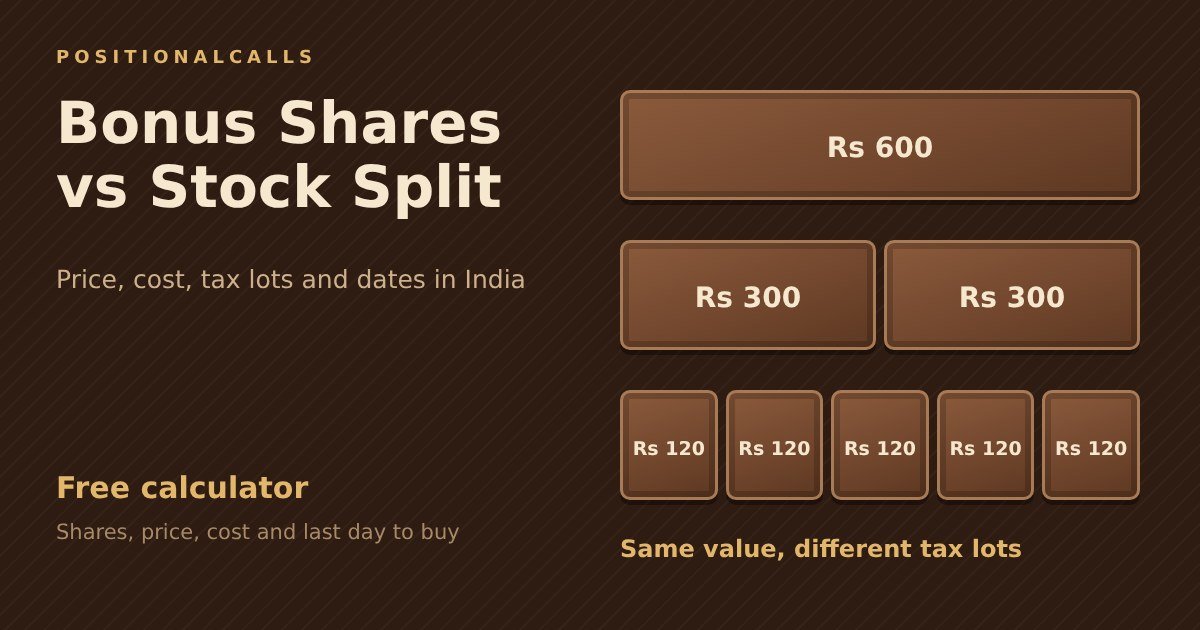
In plain words: think of a Rs 600 note being swapped for two Rs 300 notes. You hold more pieces and each is worth less, but the total is the same. A bonus issue and a stock split both do this to a share. The difference is what the tax office sees: the extra pieces from a bonus are treated as free, while a split simply divides what you paid.
Data note: as of Wednesday, 18 November 2026, 5:15 PM IST. Definitions and examples come from NSE’s investor material, Zerodha Varsity, Sahi, Upstox, Share.market, TaxGuru, EquitiesIndia, OneTradeJournal and the other pages named in the sources. Figures marked as my calculation apply those rules to round numbers. The Income-tax Act, the SEBI circulars and the NSE and BSE ex-date notices were not opened.
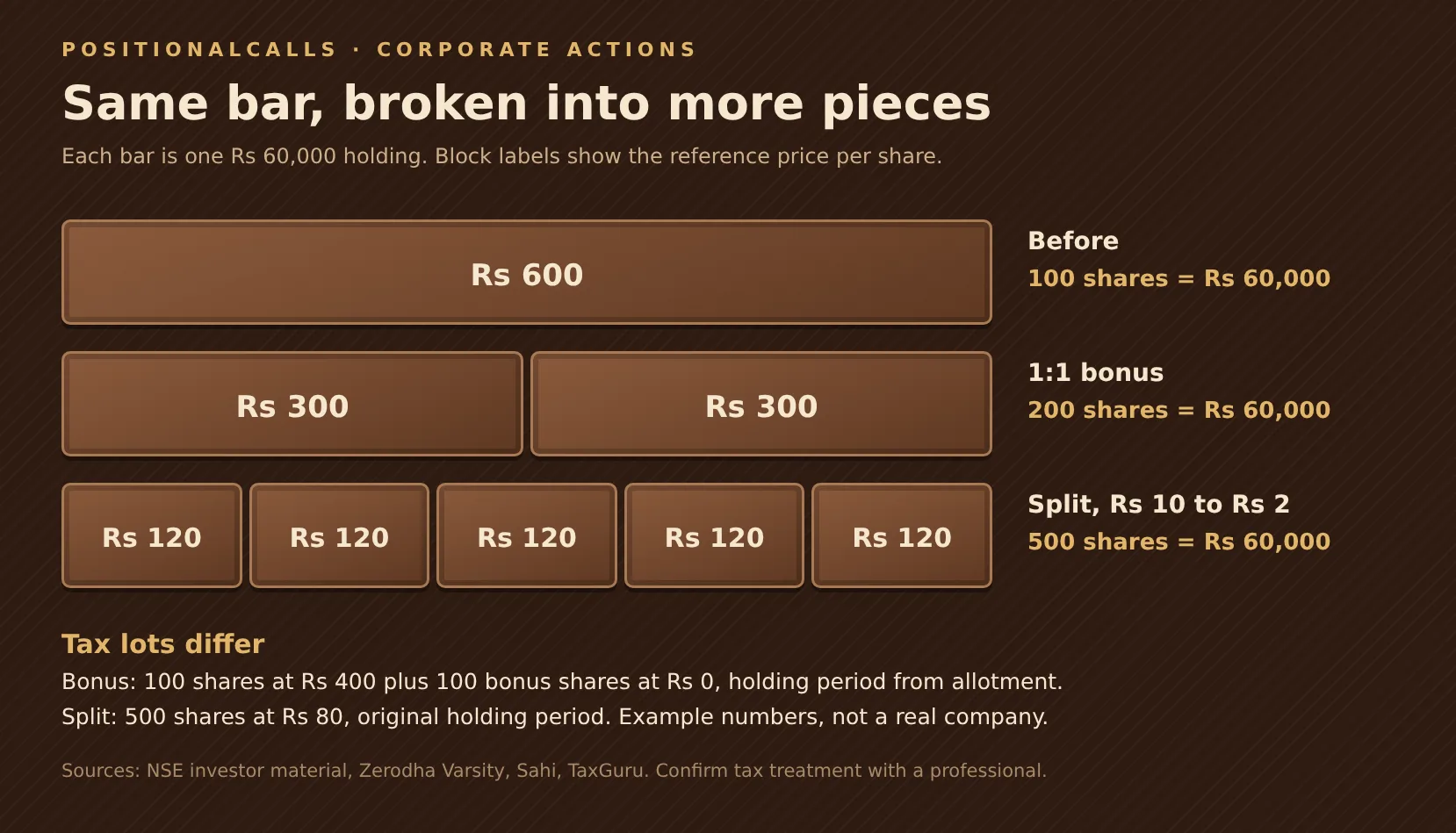 Same Rs 60,000 holding after a 1:1 bonus or a 5-for-1 split. Source: PositionalCalls, from the sources named.
Use this calculator to compare bonus shares vs stock split on your holding
Choose bonus or split, enter your shares, average cost and the market price, and the calculator shows the new share count, the reference price, your average cost and the tax lots. The defaults are 100 shares bought at Rs 400, a market price of Rs 600 and a 1:1 bonus, not a real company. Nothing you type leaves your browser.
A 1:1 bonus is 1 bonus share for every 1 share held. Companies write ratios differently, so read the announcement.
The default is an example date, not a real company. The last day to buy uses the 2026 NSE closures and assumes the ex-date is the record date under T+1; the exchange date decides.
How does the calculator treat a bonus ratio?
A ratio of 1:1 means 1 bonus share for every 1 held, so the adjustment factor is 2. A ratio of 1 for every 3 held gives a factor of 1.33 and, for 100 shares, 33 bonus shares, because the calculator rounds fractions down. NSE’s own example works the same way: a 2:1 bonus is 2 free shares for 1 held, a factor of 3.
What does the calculator not include?
It does not work out tax, charges or futures and options adjustments, and it cannot know how a company treats fractional entitlements. The last-day-to-buy line assumes the ex-date equals the record date under T+1 and uses only the 2026 NSE closures. Use the exchange notice as the final word.
What are bonus shares and a stock split?
Bonus shares are free shares issued to existing holders in a set ratio, and a stock split divides each share into smaller shares of lower face value. NSE’s investor material says bonus shares are issued only to existing shareholders in a certain proportion, and holders pay nothing for them. Sahi and Zerodha Varsity describe the split in the same way.
Where do bonus shares come from?
NSE says the company either moves money from free reserves and surplus into share capital or adds fresh capital and issues new equity shares to eligible holders. That is why Zerodha Varsity calls a bonus a stock dividend: shares are paid out instead of cash. The money stays inside the company, only in a different line of the balance sheet.
What happens in a stock split?
Each share is divided, so a Rs 10 face value share can become five shares of Rs 2, as IRCTC did with a record date of 29 October 2021, per OneTradeJournal. One share became five and the market price was adjusted down by a factor of five. Reserves and share capital are unchanged.
How do bonus shares vs stock split compare side by side?
They match on count and price but differ on face value, reserves and the tax lots. NSE’s table sets out the accounting difference, and Sahi, Upstox and Share.market add the tax side. The table puts the points together.
| Point | Bonus issue | Stock split | Source |
|---|---|---|---|
| New shares | Free, from reserves, in a set ratio | Existing shares divided into smaller ones | NSE, Sahi |
| Face value | Remains the same | Falls in proportion to the split | NSE |
| Reserves and capital | Reserves reduced; share capital rises | No impact | NSE |
| Share count and price | More shares, lower price | More shares, lower price | NSE, Zerodha Varsity |
| Value of your holding | Unchanged on the reference price | Unchanged on the reference price | Alice Blue, Interactive Brokers |
| Cost of acquisition | Nil for the bonus lot; original lot keeps its cost | Original cost divided over more shares | Sahi, TaxGuru, EquitiesIndia |
| Holding period | Bonus lot starts at allotment | Carries over from the original purchase | Sahi, TaxGuru |
Cite this table: PositionalCalls, “Bonus shares vs stock split”; accounting points from NSE’s investor material; tax points from Sahi, TaxGuru and EquitiesIndia as named.
Why do companies pick bonus shares vs stock split?
Zerodha Varsity says a bonus or split lowers the price per share to encourage retail participation, and Stocko says the same of a split. A bonus issue also signals that a company holds large free reserves. Neither action changes the profit or the business, which is why the next section looks at the price.
Does a stock split change earnings per share?
Yes, mechanically. Alice Blue says EPS falls by the ratio while the company value stays the same, and warns that this can mislead beginners about company health. A bonus does the same. The profit is shared over more shares, so per-share figures change while total profit does not.
How much does the price change in bonus shares vs stock split?
The reference price falls by the adjustment factor, which is (bonus + held) divided by held for a bonus and old face value divided by new face value for a split. NSE, Zerodha Varsity and the calculator use the same rule. The table shows five cases, with the last one worked on the calculator defaults.
| Case | Before | Factor | After | Value before and after |
|---|---|---|---|---|
| NSE 2:1 bonus | 1 share at Rs 15 | 3 | 3 shares at Rs 5 | Rs 15 |
| NSE 2:1 split, face value Rs 10 to Rs 5 | 1 share at Rs 15 | 2 | 2 shares at Rs 7.50 | Rs 15 |
| Varsity 1:1 bonus | 100 shares at Rs 75 | 2 | 200 shares at Rs 37.50 | Rs 7,500 |
| Varsity 3:1 bonus | 30 shares at Rs 550 | 4 | 120 shares at Rs 137.50 | Rs 16,500 |
| Calculator default, 1:1 bonus | 100 shares at Rs 600 | 2 | 200 shares at Rs 300 | Rs 60,000 |
| Calculator, split Rs 10 to Rs 2 | 100 shares at Rs 600 | 5 | 500 shares at Rs 120 | Rs 60,000 |
Cite this table: PositionalCalls, “Price examples”; first four rows from NSE’s investor material and Zerodha Varsity; last two rows my calculation.
Is the price fall in bonus shares vs stock split a loss?
Zerodha Varsity says the decline in a bonus issue should not be mistaken for a correction or a fall. Your value on the reference price is the same before and after. The market can still move on the day, which is why the calculator calls the price after a reference price.
Does a Rs 600 share at Rs 300 mean the stock is cheaper?
No. It has twice as many shares, each worth half as much. Compare valuation measures such as price to earnings only on a per-share basis adjusted for the action. This page makes no cheap or expensive call, and the average cost line in the calculator shows why: it falls to Rs 200 only because the same Rs 40,000 is spread over 200 shares.
Which dates matter, and where do sources disagree on the ex-date?
The record date fixes who is eligible, and under T+1 you must buy by the trading day before the ex-date; sources split three ways on how the ex-date relates to the record date. Share.market says that under India’s T+1 cycle the ex-date and record date fall on the same day, and that buying on that day makes you ineligible because the shares are credited a day later.
| Reading | What it says | Sources |
|---|---|---|
| Same day | Under T+1 the ex-date and record date fall on the same day | Share.market, Zerodha Varsity, Sensexiq (for splits) |
| One trading day before | The ex-bonus date is one trading day before the record date | Sahi, NSE investor PDF (for dividends) |
| One or two sessions before | The ex-bonus date is set one or two trading sessions before the record date | Groww, IIFL |
| T+2 wording | The ex-date is two business days before the record date, or the record date falls two days after the ex-date | Angel One (IRCTC page), Indmoney, Kotak Neo, 5paisa, Loansjagat |
Cite this table: PositionalCalls, “Ex-date and record date for bonus and split”; statements from the sources named; exchange ex-date notices were not opened.
Why does even the NSE material say one day before?
Its investor PDF says the ex-dividend date is one working day before the record date and that shares are credited two days after purchase. That describes the older T+2 cycle, which an NSE Clearing circular on the January 2023 calendar replaced with compulsory T+1 from 27 January 2023. I did not find a newer version of the PDF.
What is the last day to buy for a bonus or split?
A purchase settles one working day later, so to hold the shares on the record date you must buy by the trading day before it. For a Monday 28 December 2026 record date, that is Thursday 24 December, because Friday 25 December is a closure, my calculation. The method matches the ex dividend date guide, which also holds a last-day-to-buy calculator.
Does the dividend 5-day gap apply to bonus shares?
NSE’s PDF states a minimum gap of five clear working days between the declaration and the record date, but it gives the rule under the dividend dates. I did not find the same figure for bonus issues in these sources, so check the company announcement for the dates.
How long do bonus shares take to arrive in the demat account?
I found no official credit timeline in the sources, only a forum answer of up to 15 days from the record date. NSE’s investor PDF gives no bonus-specific period, and Share.market says a SEBI circular of September 2024 streamlined the process without giving the period in the text I saw.
| Source | What it says about credit | Type |
|---|---|---|
| NSE investor PDF | No bonus-specific credit timeline | Exchange material |
| Share.market | A SEBI circular of September 2024 streamlined the process | Broker article |
| TradingQ&A thread | Bonus shares can take up to 15 days from the record date | Community forum |
| Shabbir.in | A seller who sold on the ex-split date sold at the ex-split price before the bonus shares were credited | Personal account |
Cite this table: PositionalCalls, “Credit of bonus shares”; sources as named; no SEBI circular was opened.
PositionalCalls WhatsApp channel
Get corporate action explainers on WhatsApp
- Bonus and split rule changes, dated
- Plain-English guides, no tips
- Links to updated tax pages
What should you do if the shares do not arrive?
NSE’s PDF says to contact the registrar and the company first and, if the problem is not resolved, to file a complaint with SEBI through the SCORES website or mobile app. Keep the announcement and your holding statement from the record date.
Can you sell the original shares before the bonus is credited?
The price moves on the ex-date, not the credit date. A personal account on Shabbir.in describes selling on the ex-split date at the new price before the extra shares arrived. Because I cannot verify the account, treat it as an example of the timing gap, not a rule.
How are cost and holding period set in bonus shares vs stock split?
A bonus lot has nil cost and its own holding period from allotment, while a split divides your original cost over more shares and keeps your original holding period. Sahi, Upstox, Flattrade and TaxGuru agree on this for bonus shares, and TaxGuru and EquitiesIndia agree for splits. Nothing is taxed at receipt.
| View (calculator default) | Bonus 1:1 | Split Rs 10 to Rs 2 |
|---|---|---|
| Shares after | 200 | 500 |
| Total cost | Rs 40,000 | Rs 40,000 |
| Average cost per share | Rs 200.00 | Rs 80.00 |
| Tax lot 1 | 100 shares at Rs 400 | 500 shares at Rs 80 |
| Tax lot 2 | 100 shares at Rs 0, holding period from allotment | None; holding period carries over |
Cite this table: PositionalCalls, “Cost lots after a bonus or split”; my calculation applying the rules from Sahi, TaxGuru, Upstox and EquitiesIndia.
Why does the average cost differ from the tax cost?
Flattrade shows the average view: Rs 50,000 spread over 200 shares gives Rs 250 a share. The same page then says the bonus shares themselves have a cost of acquisition of nil. Both are true for different purposes. The average is a record-keeping view, and the tax computation treats the bonus lot separately.
What does a nil-cost bonus lot mean in rupees?
If the 100 bonus shares in the example are sold at Rs 300 within 12 months, the lot shows Rs 30,000 of gain at nil cost. At the 20% short-term rate OneTradeJournal cites, that is Rs 6,000 before cess, my calculation. Whether a loss on the original lot offsets it depends on that lot’s holding period; see capital gains tax on shares and the capital gains tax calculator.
Can a bonus issue be a tax disadvantage?
DSIJ says a bonus can be tax-disadvantageous in some cases even though it feels like free shares, because the new shares carry nil cost and a fresh holding period. A split only reduces the per-share cost base. This describes how the lots are computed, not whether to hold or sell.
Where do the tax sources differ in bonus shares vs stock split?
Sources agree on nil cost and the allotment-date holding period, but differ on the date from which nil cost applies and on how the average view fits. The table lists the points I could not settle without the Act.
| Point | One reading | Another reading | Sources |
|---|---|---|---|
| Nil cost start date | Bonus shares issued on or after 1 April 2018 have nil cost | Post-1 April 2001 bonus shares generally have nil cost; earlier ones use fair value on 1 April 2001 | OneTradeJournal; macmyths, StudyCafe |
| Where the rule sits | A named section of the old Act is cited | FY 2026-27 is the first tax year under the Income-tax Act, 2025, so section numbers changed | EquitiesIndia; Talentd |
| Cost view | Nil cost for the bonus lot | Average cost Rs 250 on 200 shares | Sahi; Flattrade |
| Holding period of split shares | Same as the original shares | Not stated | TaxGuru, EquitiesIndia |
Cite this table: PositionalCalls, “Tax conflicts for bonus and split”; sources as named; the Income-tax Act was not opened.
Why not give one tax rule?
Because the pages do not match and I did not open the Act. EZTax says bonus-share rules have changed over time and that you should keep the corporate-action records and separate the bonus lot from the original shares. This page follows that advice and shows both readings.
What records help with bonus shares vs stock split taxes?
EZTax lists the original contract note, the bonus announcement or corporate-action statement and the post-action holding statement. Add the allotment date, because it starts the holding period of a bonus lot. The stock average calculator handles the average view, not the tax lots.
How do rights issues and buybacks differ from bonus shares and splits?
In bonus shares vs stock split, the company acts and you receive; rights and buybacks ask you to choose and, for rights, to pay. 5paisa says voluntary actions such as rights issues and buyback offers require shareholders to decide whether to take part. Angel One says rights entitlements are credited to the demat account and are not rights shares.
| Action | Your action | Cost to you | Source |
|---|---|---|---|
| Bonus issue | None; shares are credited | Nil | NSE, 5paisa |
| Stock split | None; shares are credited | Nil | NSE |
| Rights issue | Apply, using the entitlement | You pay for new shares, usually at a discount | 5paisa, Angel One |
| Buyback | Choose whether to tender | None to take part; you receive cash if accepted | 5paisa, Angel One |
Cite this table: PositionalCalls, “Corporate actions compared”; sources as named.
Do bonus shares vs stock split and rights use the same ex-date logic?
Zerodha Varsity says the dates and timeline for a stock split, such as the announcement date, ex-date and record date, are similar to dividends and bonus issues. The ex-date is the cut-off for each, so the ex dividend date reasoning carries over.
How should you read an announcement about bonus shares vs stock split?
Look for the ratio, the record date and the ex-date column, because brokers label the same event in different ways. Angel One’s corporate action pages list a record date and an “Ex-Bonus basis from Date” for bonus issues, and a record date and an “Ex-split Date” for splits.
| Wording in the notice | What it means | Source |
|---|---|---|
| Bonus 1:1 | 1 free share for every 1 held; factor 2 | Zerodha Varsity |
| Bonus 2:1 (NSE wording) | 2 free shares for every 1 held; factor 3 | NSE |
| Sub-division from Rs 10 to Rs 2 | A split with factor 5 | OneTradeJournal |
| Ex-Bonus basis from Date | First day the share trades without the bonus entitlement | Angel One, Upstox |
| Ex-split Date | First day the share trades at the split price | Angel One, Pocketful |
Cite this table: PositionalCalls, “Reading a corporate action notice”; wording from the sources named.
Why does the wording of bonus shares vs stock split ratios cause errors?
Because one company writes a bonus as 1:2 for one free share per two held, and NSE’s example writes 2:1 for two free shares per one held. The calculator asks for the shares given and the shares held, so there is no ambiguity. Check the announcement against the arithmetic before you rely on a page.
What does the notice say about bonus shares vs stock split fractions?
Often nothing in a broker article. If your holding does not divide evenly by the ratio, the entitlement has a fraction. The calculator rounds it down, but each company states its own treatment in the announcement, and I did not find a rule in these sources.
Where do bonus shares vs stock split notices appear first?
On the exchange announcement for the company, which brokers then repeat. Angel One and Groww publish calendars of bonus issues and splits, while the exchange pages remain the source. A calendar that lags the exchange can show a date a day out, so treat it as a pointer, not the notice.
What mistakes do investors make with bonus shares vs stock split?
The common errors are buying on the record date, treating the price fall as a loss, mixing up the ratio wording and forgetting the bonus lot’s separate holding period. The sources above describe each, and the list turns them into checks.
- Buying on the record date: Share.market says shares bought on the ex-date, which it says is also the record date, are credited on T+1 and do not qualify.
- Reading the fall as a loss: Zerodha Varsity says it should not be mistaken for a correction.
- Misreading the ratio: a 1:2 bonus is 1 free share for 2 held in most announcements, but NSE’s example writes 2:1 for 2 free shares per 1 held. Read the wording.
- Using the average cost for tax: the bonus lot is treated separately from the original shares.
- Trusting a T+2 page: an older article may tell you to buy two days earlier than needed.
What is a quick checklist before the record date?
First, read the company announcement for the ratio and the record date. Second, run the calculator with your holding. Third, check the trading day before the ex-date is not a weekend or closure. Fourth, note your allotment date once the shares arrive. Fifth, keep the corporate-action statement for tax records. None of this says whether a share is worth owning, and this page gives no such view.
What does this bonus shares vs stock split page leave out?
It leaves out company-specific actions, tax calculation, futures and options adjustments, reverse splits and any view on whether a bonus or split is good news. It explains the mechanics and shows arithmetic.
- No company lists: the exchange pages are the source for upcoming bonus and split dates.
- No tax computation: the calculator shows lots, not tax; the rates and the nil-cost start date were not checked against the Act.
- No exchange notices: NSE and BSE ex-date rules for bonus and splits were not opened; the NSE investor PDF was read.
- No reverse splits: Interactive Brokers describes them, but they are outside this page.
- No calls: there is no subscribe, buy, sell, avoid or rating view here.
Will this bonus shares vs stock split page be updated?
Yes, when the exchange or SEBI confirms the ex-date relationship for bonus and splits, or when the nil-cost start date is settled. It will also pick up the 2027 holiday list once NSE publishes it, because the calculator needs the new closures.
PositionalCalls WhatsApp channel
Corporate actions in one channel
- Rule changes, dated
- Tools without tips
- Links to new guides
Bonus shares vs stock split: frequently asked questions
What is the difference between bonus shares vs stock split?
Bonus shares are free extra shares funded from reserves, and the face value stays the same. A stock split divides each share into more shares with a lower face value, and reserves are unchanged, per the NSE investor material. Both raise your share count and cut the price by the same factor. The tax treatment of the new shares differs.
Does the share price fall after bonus shares or a stock split?
Yes, by the adjustment factor. NSE’s example shows a 2:1 bonus at Rs 15 giving a factor of 3 and a Rs 5 price, while a 2:1 split gives Rs 7.50. Zerodha Varsity says the fall should not be mistaken for a correction. Your holding value stays the same on the reference price, though the market can move.
Is tax charged when I receive bonus shares or split shares?
Not on receipt. Sahi and TaxGuru say bonus shares carry no tax when allotted and capital gains arise on sale, and EquitiesIndia says a split is not a taxable event. The tax lots differ, though, because a bonus lot has nil cost while a split keeps your cost, spread over more shares.
What is the cost and holding period of bonus shares?
Sahi, Upstox and Flattrade say bonus shares have a cost of acquisition of zero and a holding period counted from the allotment date. A split keeps the original holding period and divides the cost across the new shares, per TaxGuru and EquitiesIndia. Sources differ on the date from which nil cost applies, so check the rule for your allotment.
What is the last day to buy to get bonus shares?
It is the trading day before the ex-date. If the ex-date and record date are both Monday 28 December 2026, the last day to buy is Thursday 24 December, because Friday 25 December is a closure, my calculation. Many broker pages still describe the older T+2 rule, so confirm the date on the exchange before relying on any page.
Is the ex-date the same as the record date for bonus shares?
Sources disagree. Share.market and Zerodha Varsity say the two fall on the same day under T+1, Sahi says the ex-bonus date is one trading day before the record date, and Angel One, Indmoney and Kotak Neo pages still describe T+2. NSE’s investor PDF also says one working day before. The exchange notice decides.
How long does it take for bonus shares to be credited?
I found no official timeline. NSE’s investor PDF gives no bonus-specific credit period, and a TradingQ&A thread says credit can take up to 15 days from the record date, which is a community answer, not an exchange rule. Share.market says a SEBI circular of September 2024 streamlined the process, but I did not open it.
Does a stock split or bonus issue change the value of the company?
No. Alice Blue and Interactive Brokers say market value stays the same, because the share count rises while the price falls by the same factor. A split leaves reserves unchanged, and a bonus issue moves money from reserves into share capital, per NSE. Earnings per share fall by the ratio, which can mislead beginners about company health.
Which is better, bonus shares vs stock split?
Neither creates value on its own, because the price adjusts. The difference is in the tax lots: a bonus lot has nil cost and a new holding period, while a split keeps your cost and date. DSIJ notes a bonus can be tax-disadvantageous in some cases. This page gives no buy, sell or avoid view.
Is this bonus shares vs stock split page investment advice?
No. PositionalCalls is not a SEBI-registered research analyst or investment adviser. The page explains ratios, dates and tax lots from the sources named, and the calculator shows arithmetic, not tax. I did not open the Income-tax Act or the NSE ex-date circulars, so confirm tax treatment with a qualified professional.
Sources for the bonus shares vs stock split page
- NSE: corporate actions investor, exchange.
- Zerodha Varsity: corporate actions and, broker.
- Zerodha Varsity: corporate actions chapter, broker.
- Sahi: bonus shares meaning, broker.
- Sahi: stock split and, broker.
- Upstox: what are bonus, broker.
- Share.market: bonus shares, broker.
- Groww: bonus shares, broker.
- IIFL: what are bonus, broker.
- Angel One: IRCTC share split, broker.
- Indmoney: bonus shares meaning, broker.
- Kotak Neo: bonus shares, broker.
- 5paisa: bonus shares, broker.
- 5paisa: corporate actions, broker.
- LoansJagat: bonus share, tool.
- TradingQ&A: split vs bonus, tool.
- SensexIQ: split and bonus, tool.
- OneTradeJournal: stock splits, tool.
- OneTradeJournal: bonus shares, tool.
- Alice Blue: bonus vs split, broker.
- Shabbir: bonus and stock, tool.
- Flattrade: what is a, broker.
- TaxGuru: capital gains on, tax.
- EquitiesIndia: tax on bonus, tool.
- EquitiesIndia: tax on stock, tool.
- DSIJ: bonus and split, industry.
- StudyCafe: taxability of bonus, tax.
- Macmyths: dividends and bonus, tool.
- EZTax: bonus shares and, tax.
- Interactive Brokers: corporate actions, broker.
- Angel One: rights and buyback, broker.
- Stocko: bonus, split, rights, broker.
- Pocketful: stock split vs, broker.
- Not opened: the Income-tax Act, SEBI circulars and the NSE and BSE ex-date notices; the NSE investor PDF was read; statements are from the sources above.
PositionalCalls.com is an independent research site founded by Shubham Chaudhary. PositionalCalls.com is not a SEBI-registered research analyst or investment adviser. Investments in securities markets are subject to market risks. Read all related documents carefully before investing. Returns are never guaranteed. This page is educational and publishes no subscribe, avoid, buy, sell, rating or target calls. Sources: broker, tax and exchange investor-material pages as named; no Income-tax Act or SEBI circular opened; no company, buy, sell or avoid view given.

Shubham Chaudhary is the founder of PositionalCalls, an independent Indian stock market research website. He writes company fundamentals, quarterly results analysis, IPO analysis and sector research for NSE and BSE listed companies, with a focus on banking stocks, insurance and long-term value investing. Every article is built from primary sources such as RBI, SEBI, NSE and BSE filings and company annual reports, and states its risks plainly in simple language for retail investors.
Coverage areas Our research standards- Numbers checked against NSE, BSE and SEBI filings
- Risks and limits stated in every article
- No paid promotions or broker tie-ups
- Articles updated when new filings arrive