
Tax · Dates and tool
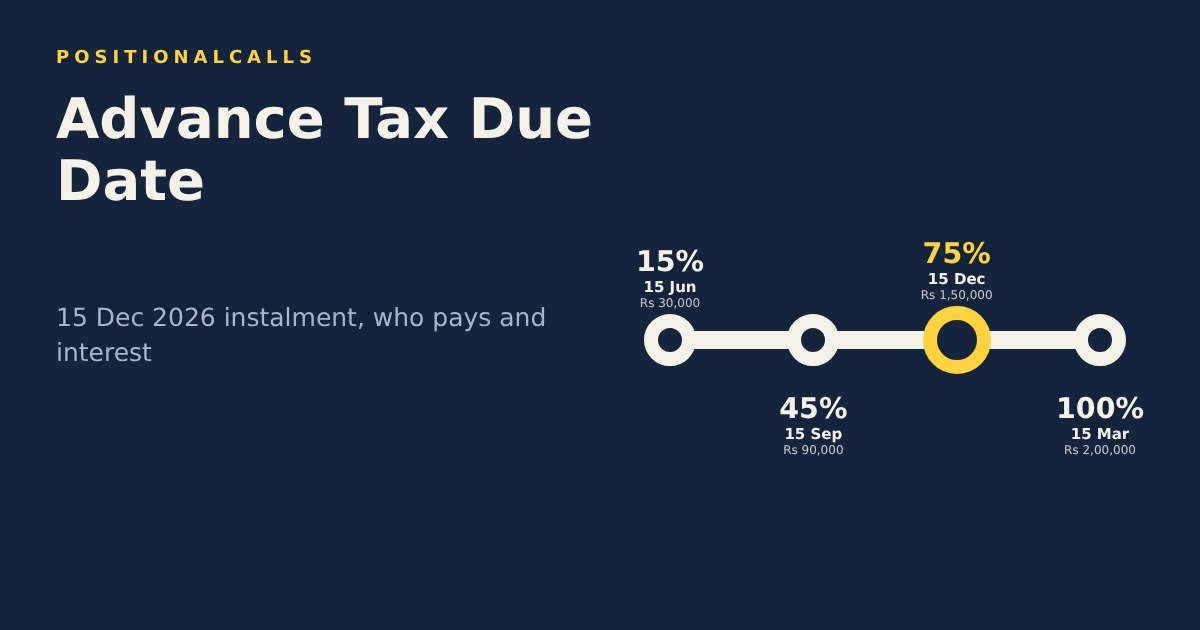
The next advance tax due date is Tuesday 15 December 2026, when cumulative payments should reach 75% of the estimated tax for Tax Year 2026-27. This page lists the instalments, who must pay, who is exempt, the interest for missing them and a small instalment calculator.
Quick answer
The next advance tax due date is 15 December 2026, 27 days after 18 November, and by then the total paid should reach 75% of the year’s estimated tax. It applies if that tax after TDS and TCS is Rs 10,000 or more. The last instalment is 15 March 2027. Resident senior citizens with no business income are exempt.
Advance tax due date: key takeaways
- Dates: 15 June 15%, 15 September 45%, 15 December 75%, 15 March 100%, all cumulative.
- Who: tax after TDS and TCS of Rs 10,000 or more.
- Exempt: resident seniors with no business income; presumptive taxpayers pay once by 15 March.
- Interest: 1% a month, simple, on the shortfall.
- Investors: capital gains and dividends can count, with interest relief if paid in time.
In plain words: the tax office wants income tax as you earn, not all at once after the year. If your tax for the year will be Rs 10,000 or more after what has already been cut at source, you pay it in up to four parts. The part due on 15 December brings your total to three quarters of the year’s estimate.
Data note: as of Wednesday, 18 November 2026, 7:00 PM IST. Dates, percentages and interest rules come from the TaxGuru, ClearTax, Treelife, Sahi, JM Financial and Calcguru pages named in the sources. Figures marked as my calculation apply those rules to round numbers. The Income-tax Act, 2025, the Income-tax Rules, 2026 and the portal were not opened, so section numbers are as the sources give them.
Use this calculator to see what to pay by the advance tax due date
Enter your estimated tax after TDS and TCS and what you have already paid, and the calculator shows the amount due at each advance tax due date. The defaults are an estimate of Rs 2,00,000 with nothing paid yet. It does not work out your tax from your income, so use your own estimate. Nothing you type leaves your browser.
Your own estimate, including cess. This tool does not work out your tax from your income.
How do I estimate my tax for the year?
Estimate your total income for the year, work out the tax under the regime you use, add cess, and subtract TDS and TCS you expect to be credited. For share profits, the capital gains tax calculator gives the tax on the gain. The advance tax due date rules then apply to what is left.
What does the calculator not do?
It does not include interest on instalments you have already missed, surcharge, or any relief that applies to your own income. It also assumes the estimate is right. If your income changes later in the year, re-run the calculator with the new figure.
What are the advance tax due dates for Tax Year 2026-27?
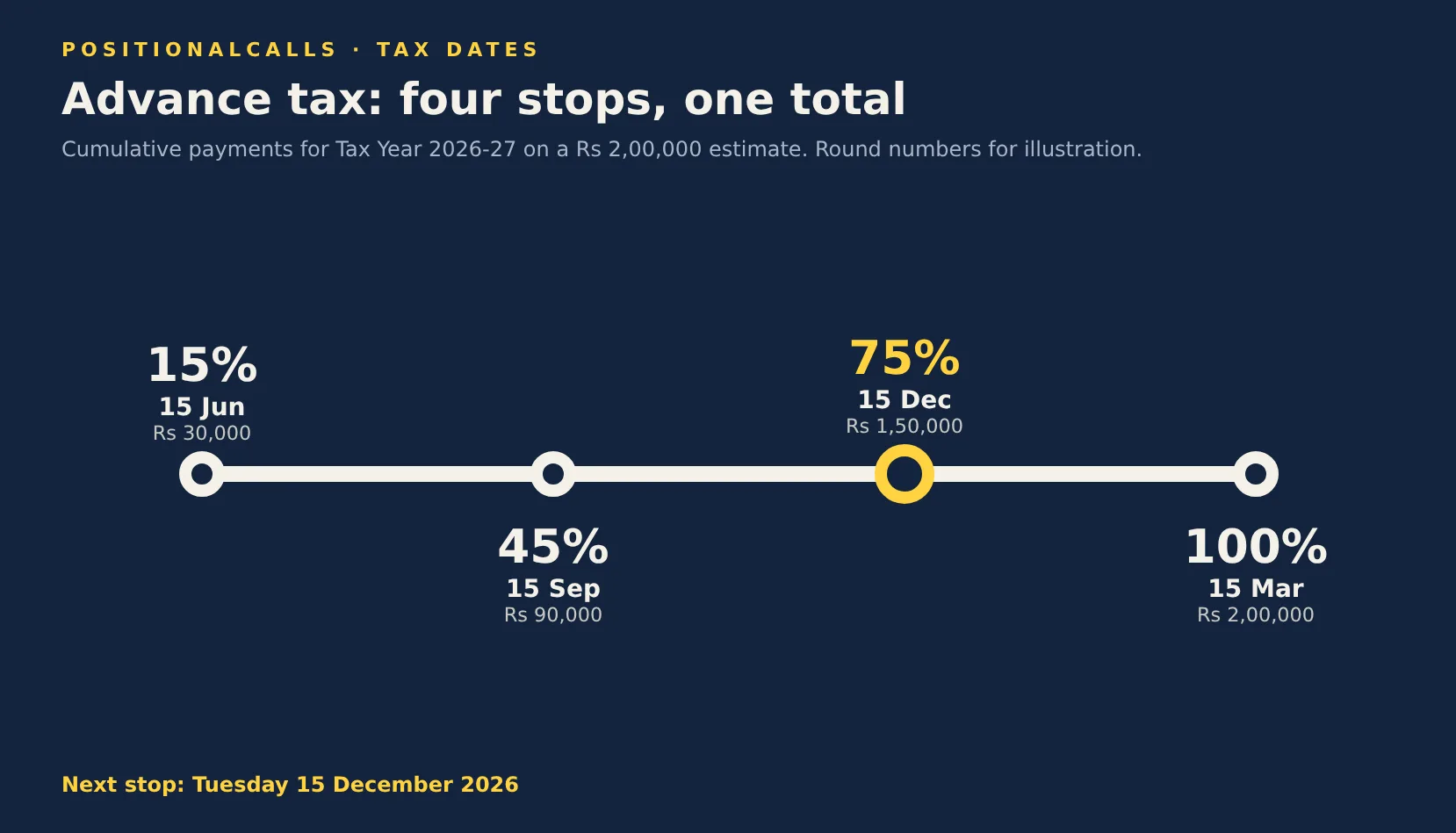
The four dates are 15 June, 15 September, 15 December and 15 March, and each percentage is cumulative. ClearTax and TaxGuru give the same schedule, and Treelife says the instalment schedule is unchanged from the prior regime. After 18 November 2026 two instalments are left.
| Instalment | Due date | Cumulative payable | Status after 18 Nov 2026 |
|---|---|---|---|
| First | 15 June 2026 | At least 15% | Passed |
| Second | 15 September 2026 | At least 45% | Passed |
| Third | 15 December 2026 (Tuesday) | At least 75% | Upcoming, 27 days away |
| Fourth | 15 March 2027 (Monday) | 100% | Upcoming |
| Presumptive taxpayers | 15 March 2027 | 100% in one instalment | Upcoming |
Cite this table: PositionalCalls, “Advance tax instalment dates”; schedule from TaxGuru, ClearTax, Treelife and Qwikfilings; weekdays by PositionalCalls.
Does the due date move if it falls on a holiday?
I have not found a source on this point, so this page does not say. Both remaining dates fall on weekdays, and the share market holidays 2026 list covers exchange holidays only, which are separate from tax deadlines. Pay a few days early.
Is a payment after the due date still advance tax?
The Income Tax Department’s advance tax note says payments made by 31 March are treated as advance tax. Interest can still apply for the delay, as the interest section explains, so the earlier date matters.
Who must pay by the advance tax due date, and who need not?
Anyone whose estimated tax after TDS and TCS reaches Rs 10,000 must pay in instalments, whatever the kind of income. TaxGuru places the threshold in Section 404 of the Income-tax Act, 2025. The table shows how the rule applies to common cases.
| Case | Advance tax needed? | Basis |
|---|---|---|
| Tax after TDS and TCS is Rs 10,000 or more | Yes | Section 404 threshold, per TaxGuru |
| Tax after TDS and TCS is below Rs 10,000 | No | Threshold not reached |
| Salaried, with TDS covering the tax | Usually no | TDS is deducted before the threshold test |
| Freelancer, consultant or professional | Yes, if over the threshold | JM Financial |
| Investor with capital gains, dividends or rent | Yes, if over the threshold | CA Rajput, JM Financial |
| Presumptive taxpayer | Yes, in one instalment by 15 March | TaxGuru, JM Financial |
| Resident senior citizen with no business income | No | TaxGuru, JM Financial |
Cite this table: PositionalCalls, “Who must pay advance tax”; rules from TaxGuru, JM Financial and CA Rajput as named; Act text not opened.
Is the limit above Rs 10,000 or Rs 10,000 and more?
Sources word it two ways. Some say liability that exceeds Rs 10,000, and others say Rs 10,000 or more, as AllIndiaITR does. The calculator treats Rs 10,000 itself as liable. A tax estimate that lands exactly on the line is rare, so for most people this does not matter.
Why can a salaried person still owe it?
Because the test looks at tax left after TDS. A large capital gain, dividend, interest or rent can leave tax that TDS did not cover. In that case the advance tax due date rules apply to that part, as the investor section below explains.
What does a worked example of the advance tax due date schedule look like?
On an estimated tax of Rs 2,00,000, the cumulative amounts are Rs 30,000, Rs 90,000, Rs 1,50,000 and Rs 2,00,000. The instalments themselves are Rs 30,000, Rs 60,000, Rs 60,000 and Rs 50,000. This is my calculation from the stated percentages, and Sahi and Taxaj show the same pattern on Rs 1,00,000.
| Date | Cumulative percentage | Cumulative amount | Instalment in that period |
|---|---|---|---|
| 15 June 2026 | 15% | Rs 30,000 | Rs 30,000 |
| 15 September 2026 | 45% | Rs 90,000 | Rs 60,000 |
| 15 December 2026 | 75% | Rs 150,000 | Rs 60,000 |
| 15 March 2027 | 100% | Rs 200,000 | Rs 50,000 |
Cite this table: PositionalCalls, “Advance tax on a Rs 2,00,000 estimate”; arithmetic by PositionalCalls; the estimate is a round number, not a forecast.
What if I have paid nothing so far?
Then the amount to reach by 15 December is Rs 1,50,000, and the calculator shows it as the gap. Interest for the earlier instalments you missed is not included in that gap. Interest rules are in the next sections, and the advance tax due date schedule still applies to the rest of the year.
What if my income changes during the year?
The percentages apply to your estimate, so a rise in the estimate raises the cumulative amount due. The law gives relief in some cases where the income could not be known, such as a capital gain that arises after an instalment date. The investor section covers that point.
What is the 12% and 36% rule for advance tax?
No interest applies for the June and September instalments if you pay at least 12% by 15 June and at least 36% by 15 September. TaxGuru places this tolerance in Section 425, and Bajaj Finserv and Patron Accounting describe the same 12% and 36% limits for earlier years. The December and March instalments have no tolerance.
| Date | Normal cumulative | Lowest cumulative with no interest | On Rs 2,00,000 |
|---|---|---|---|
| 15 June | 15% | 12% | Rs 30,000 against Rs 24,000 |
| 15 September | 45% | 36% | Rs 90,000 against Rs 72,000 |
| 15 December | 75% | 75% | Rs 150,000 |
| 15 March | 100% | 100% | Rs 200,000 |
Cite this table: PositionalCalls, “Tolerance bands”; rule from TaxGuru and Patron Accounting; arithmetic by PositionalCalls.
Why does this rule matter for the 15 December payment?
Because the December test has no tolerance, a person who paid only the lower June and September amounts must still reach the full 75% by 15 December. In the example that means Rs 1,50,000 in total, so the gap grows if the earlier payments were at the lowest level.
What interest applies if I miss the advance tax due date?
Interest is simple, at 1% a month, under two provisions that were Sections 234B and 234C and are Sections 424 and 425 in the new Act. TaxGuru says Section 425 charges 3 months for each of the first three instalments and 1 month for the 15 March instalment, and Section 424 applies where advance tax paid is below 90% of assessed tax, running from 1 April after the tax year.
| Provision | Old section | What it covers | Rate and period |
|---|---|---|---|
| Section 425 | 234C | Shortfall at an instalment | 1% a month; 3 months for the first three, 1 month for 15 March |
| Section 424 | 234B | Advance tax below 90% of assessed tax | 1% a month or part, from 1 April to payment |
| Section 423 | 234A | Late return | 1% a month |
Cite this table: PositionalCalls, “Interest provisions”; sections and rates from TaxGuru (page 1048485); Act text not opened.
What does the interest cost in rupees?
The table applies the 1% rule to round numbers, and each result is my calculation. Sahi shows the first line for the June date.
| Situation | Shortfall | Interest | Working |
|---|---|---|---|
| June shortfall on a Rs 1,00,000 estimate, nothing paid | Rs 15,000 | Rs 450 | 15,000 × 1% × 3 |
| 15 December shortfall: Rs 45,000 paid against Rs 75,000 | Rs 30,000 | Rs 900 | 30,000 × 1% × 3 |
| 15 March shortfall: Rs 75,000 paid against Rs 1,00,000 | Rs 25,000 | Rs 250 | 25,000 × 1% × 1 |
| Assessed tax Rs 1,00,000, Rs 50,000 paid, balance paid after 4 months | Rs 50,000 | Rs 2,000 | 50,000 × 1% × 4 |
Cite this table: PositionalCalls, “Interest on round-number shortfalls”; arithmetic by PositionalCalls; the first line matches Sahi.
PositionalCalls WhatsApp channel
Get tax date alerts on WhatsApp
- Tax date and rule changes, dated
- Plain-English tax guides, no tips
- Links to updated tax pages
Is the interest a tax deduction or a penalty?
It is interest charged on the delay, not a fixed penalty. I have not researched whether it can be claimed against income, so this page does not say. Ask a qualified professional. The simplest way to avoid the cost is to reach each cumulative level by its advance tax due date.
How do capital gains and dividends fit with the advance tax due date?
Gains and dividends can create advance tax, and the law gives interest relief when they arise after an instalment date. TaxGuru lists capital gains, casual income, first-time business income and dividends as special incomes. No Section 425 interest is charged on that part if the tax is paid in the instalments falling due after the income arises, and if it arises after the last instalment, by 31 March.
| When the gain or dividend arises | What to do about advance tax | Source |
|---|---|---|
| Before 15 June | Include it in the first estimate | Normal schedule |
| Between instalment dates | Pay its tax in the instalments that fall due afterwards | TaxGuru |
| After 15 December | Pay its tax by 15 March | TaxGuru |
| After 15 March | Pay its tax by 31 March | TaxGuru |
| Part of a larger liability | Relief covers only that income; the rest stays on the normal schedule | TaxGuru |
Cite this table: PositionalCalls, “Relief for gains and dividends”; rule from TaxGuru; Act text not opened.
How do I work out the tax on a share profit?
Short-term and long-term gains are taxed at different rates, which the capital gains tax on shares page explains, and the calculator on this site applies them to your trade. Dividends are taxed at your slab rate, as dividend tax in India shows, and TDS may already have been deducted.
Does TDS on a dividend count?
Yes. Advance tax is the tax left after TDS and TCS, so tax deducted on a dividend is subtracted first. Check the amounts in your tax credit statement before you estimate. Mutual fund gains follow their own rules, set out on mutual fund taxation in India.
How do presumptive taxpayers and senior citizens deal with the advance tax due date?
Presumptive taxpayers pay 100% in one instalment by 15 March, and resident senior citizens with no business income are exempt. The Income Tax Department’s note and TaxGuru both give the single instalment, and JM Financial lists seniors without business income among the exempt.
| Taxpayer | Rule | Source |
|---|---|---|
| Presumptive scheme (old 44AD, 44ADA, 44AE) | 100% in one instalment by 15 March | Income Tax Department, TaxGuru |
| Resident senior citizen, no business income | Exempt; pay when filing | TaxGuru, JM Financial |
| Senior citizen with business income | Normal four instalments | Calcguru |
| Turns 60 during the tax year | Covered for the whole year | Calcguru |
| Non-resident or other taxpayer | Normal rules; not researched here | This page |
Cite this table: PositionalCalls, “Special cases”; rules from the Income Tax Department note, TaxGuru, JM Financial and Calcguru as named.
Do capital gains make a senior citizen liable?
Calcguru’s senior citizen page answers No, although the part I read was cut off before its reasoning, so I do not rely on it for the details. The exemption turns on being resident and having no business income, so check the conditions against your own facts.
Can a presumptive taxpayer pay in four instalments?
The sources describe a single instalment by 15 March, and TaxGuru says a payment after 15 March, up to 31 March, can carry a short spell of Section 425 interest. The calculator’s presumptive option shows the one date and the amount outstanding.
How do I pay advance tax online?
Pay through e-Pay Tax on the income-tax portal, choosing the Income-tax Act, 2025, Tax Year 2026-27 and the Advance Tax (100) payment type. TaxGuru lists the steps below, and ClearTax Advisors says the payment type code is unchanged.
- Open e-Pay Tax on the income-tax portal.
- Select Income Tax, then Income Tax Act, 2025, for Tax Year 2026-27.
- Choose the minor head Advance Tax (100), not Self-Assessment Tax (300).
- Enter tax, surcharge, cess and interest separately.
- Pay by net banking, NEFT or RTGS, card or UPI.
- Save the challan, since its CRN, BSR code and serial number go in the return.
What if I choose the wrong tax type?
TaxGuru says the Challan Correction facility can fix a tax year within 7 days and the major or minor head within 30 days. Paying the wrong head can delay the credit, so check before you submit the payment.
Where do I enter the payment in my return?
The challan details, which are the CRN, BSR code and serial number, are needed when you file. Keep the payment record with your return papers. The filing steps themselves are not covered on this page.
What changed with the Income-tax Act, 2025?
The mechanism is the same, and the labels and section numbers changed. Qwikfilings says the Rs 10,000 threshold and four instalments stay, and the interest sections move from 234B and 234C to 424 and 425. TaxGuru says the Act replaced the 1961 framework from 1 April 2026.
| Item | Earlier | Tax Year 2026-27 |
|---|---|---|
| Year label | Financial year and assessment year | Tax Year 2026-27 |
| Liability | Section 207 | Section 403 |
| Threshold of Rs 10,000 | Section 208 | Section 404 |
| Instalments and due dates | Section 211 | Section 408 |
| Interest on instalment shortfall | Section 234C | Section 425 |
| Interest on overall default | Section 234B | Section 424 |
Cite this table: PositionalCalls, “Section map”; mapping from TaxGuru (page 1048485), which marks some numbers to be checked against the Act; Treelife gives Sections 403 to 408.
Why do some pages still say 234B and 234C?
Practitioners still use the old numbers, and Calcguru says so directly. Several older pages describe FY 2025-26, for instance Bajaj Finserv’s with the 15 March 2026 final date. For this tax year, read dates from pages written for 2026-27 and treat old pages as background only.
What does this advance tax due date page leave out?
It gives dates, rules and round-number arithmetic, and it leaves out everything that depends on your own return. The table lists the main gaps.
| Left out | Why it matters |
|---|---|
| Your tax calculation | Slabs, regime, deductions and surcharge decide the estimate |
| Interest on instalments already missed | It depends on exactly what was paid and when |
| Companies and firms | Different taxpayer types were not researched here |
| Non-residents | Rules were not researched here |
| The Act text itself | Section numbers are as sources give them |
| Late return interest | A separate provision, mentioned but not worked out |
Cite this table: PositionalCalls, “What the page leaves out”; scope set by PositionalCalls.
Does this page cover ITR filing dates?
No. It covers advance tax only. Filing deadlines, forms and late-fee rules are a separate subject, and a tax year page for them may follow. Use the income-tax portal or a qualified professional for filing questions.
Should I set a reminder before 15 December?
Many people find a reminder a week before each instalment useful, because the payment must reach the department by the date and a bank transfer can take a day. That is a practical point and not a rule from the sources. The calculator above gives the amount to reach, and your own estimate should be reviewed whenever a large gain, dividend or other income arises during the year.
Where do sources differ on advance tax?
The dates and percentages agree across sources, and the differences are in section numbers, the threshold wording and the treatment of 31 March. The table lists them and says what the page does.
| Item | View A | View B | What the page does |
|---|---|---|---|
| Threshold wording | Exceeds Rs 10,000 (Legal Suvidha, Bajaj Finserv) | Rs 10,000 or more (AllIndiaITR) | Calculator treats Rs 10,000 as liable |
| Section numbers | Sections 403 to 408 (Treelife) | Sections 403 to 410 (ClearTax Advisors) | Uses TaxGuru’s table and flags it |
| Exemption section | Conditions in Section 404 (TaxGuru) | Section 264 named in another TaxGuru piece | Gives no section number for it |
| Payment after 15 March | Treated as advance tax up to 31 March (Income Tax Department) | Short spell of Section 425 interest (TaxGuru) | States both |
| Year described | Tax Year 2026-27 (TaxGuru, Treelife) | FY 2025-26 dates (Bajaj Finserv) | Uses 2026-27 pages only |
Cite this table: PositionalCalls, “Advance tax source conflicts”; sources as named; Act text not opened.
What should I check before relying on this page?
- That your estimate is for Tax Year 2026-27 and after TDS and TCS.
- The section numbers against the Act, if you need to cite them.
- Whether any special-income relief applies to your gains.
- The due date in the income-tax portal calendar.
- Your own facts with a qualified professional.
What is this page not for?
It does not tell you how much tax you owe or what to do with your investments. PositionalCalls is not a SEBI-registered research analyst or investment adviser, and I am not a chartered accountant. The calculator applies stated percentages to a number you enter.
PositionalCalls WhatsApp channel
Tax dates in one channel
- Rule changes, dated
- Tools without tips
- Links to new guides
Advance tax due date: frequently asked questions
What is the advance tax due date after 18 November 2026?
The next advance tax due date is Tuesday 15 December 2026, when the cumulative payment should reach 75% of the estimated tax, per ClearTax and TaxGuru. The final instalment of 100% falls on 15 March 2027. Presumptive taxpayers pay everything once, by 15 March 2027, instead of in four instalments.
Who has to pay advance tax in FY 2026-27?
Anyone whose estimated tax for the year, after TDS and TCS, reaches Rs 10,000 or more, per TaxGuru and Section 404 of the Income-tax Act, 2025. That includes salaried people with large capital gains, dividends, rent or interest, and freelancers. Resident senior citizens with no business income are exempt.
What happens if I miss the advance tax due date?
Interest at 1% a month applies. TaxGuru puts the deferment interest under Section 425 at 3 months for each of the first three instalments and 1 month for the March one. Sahi shows Rs 450 on a Rs 15,000 shortfall at the June date. Use the instalment calculator on this page for your own gap.
Is advance tax payable on share market profits and dividends?
Yes, if your total tax after TDS and TCS reaches Rs 10,000 or more. Capital gains and dividends are listed among the incomes that attract advance tax, per CA Rajput and JM Financial. Relief from interest applies if the tax is paid in the instalments after the gain or dividend arises, or by 31 March.
Do I need to pay advance tax if I only earn salary?
Usually not, because TDS on salary is counted. Advance tax applies only to what is left after TDS and TCS, and only if that is Rs 10,000 or more, per TaxGuru. A salaried person with a large capital gain or rent may still owe it. This advance tax due date page is general information, not advice.
Are senior citizens exempt from advance tax?
A resident senior citizen with no income from business or profession is exempt, per TaxGuru and JM Financial. They can pay the tax when filing, without interest for missed instalments. If you turn 60 at any time in the tax year you are covered for that whole year, per Calcguru. Business income removes the exemption.
What is the 12% and 36% rule for the June and September instalments?
TaxGuru says no interest applies under Section 425 if you pay at least 12% by 15 June and at least 36% by 15 September, in place of 15% and 45%. For a Rs 2,00,000 estimate that is Rs 24,000 and Rs 72,000. The 15 December instalment has no such tolerance, so it must reach 75%.
Did the new Income-tax Act change the advance tax due date?
No. The instalments of 15%, 45%, 75% and 100% on 15 June, 15 September, 15 December and 15 March are unchanged, per TaxGuru and Qwikfilings. The sections were renumbered, with the Rs 10,000 threshold in Section 404 and interest in Sections 424 and 425. Sources differ on some section numbers.
How do I pay advance tax online?
Open e-Pay Tax on the income-tax portal, choose Income Tax Act, 2025 for Tax Year 2026-27, pick Advance Tax (100), enter tax, surcharge, cess and interest, and pay by net banking, UPI or card, per TaxGuru. Save the challan, because its CRN and BSR code go in your return.
Is this advance tax due date page tax advice?
No. PositionalCalls is not a SEBI-registered research analyst or investment adviser, and I am not a chartered accountant. The page gives dates, rules and arithmetic from the sources named, and the calculator does not work out your tax. Section numbers were not checked against the Act, so confirm the figures with a qualified professional.
Sources for the advance tax due date page
- TaxGuru: advance tax under, tax.
- TaxGuru: tax calendar 2026-27, tax.
- TaxGuru: senior citizens and, tax.
- TaxGuru: advance tax exemptions, tax.
- ClearTax: advance tax FY, tax.
- ClearTax Advisors: advance tax FY, tax.
- Treelife: advance tax due, tax.
- Sahi: advance tax for, broker.
- JM Financial: who is exempt, broker.
- Calcguru: advance tax FY, tool.
- Calcguru: senior citizens and, tool.
- CA Rajput: advance tax under, tax.
- Qwikfilings: advance tax due, tax.
- Income Tax Department: advance tax note, official.
- AllIndiaITR: advance tax calculator, tool.
- Bajaj Finserv: advance tax FY, broker.
- TaxGuru: business income under, tax.
- TaxGuru: advance tax exemptions, tax.
- Taxaj: advance tax payment, tax.
- Not opened: the Income-tax Act, 2025, the Income-tax Rules, 2026 and the e-filing portal; the formula and statements are from the sources above.
PositionalCalls.com is an independent research site founded by Shubham Chaudhary. PositionalCalls.com is not a SEBI-registered research analyst or investment adviser. Investments in securities markets are subject to market risks. Read all related documents carefully before investing. Returns are never guaranteed. This page is educational and publishes no subscribe, avoid, buy, sell, rating or target calls. Sources: calculator, broker and tax pages as named; no Income-tax Act text opened; no fund, buy, sell or avoid view given. I am not a chartered accountant.

Shubham Chaudhary is the founder of PositionalCalls, an independent Indian stock market research website. He writes company fundamentals, quarterly results analysis, IPO analysis and sector research for NSE and BSE listed companies, with a focus on banking stocks, insurance and long-term value investing. Every article is built from primary sources such as RBI, SEBI, NSE and BSE filings and company annual reports, and states its risks plainly in simple language for retail investors.
Coverage areas Our research standards- Numbers checked against NSE, BSE and SEBI filings
- Risks and limits stated in every article
- No paid promotions or broker tie-ups
- Articles updated when new filings arrive