IPO · Mainboard · Agrochemicals
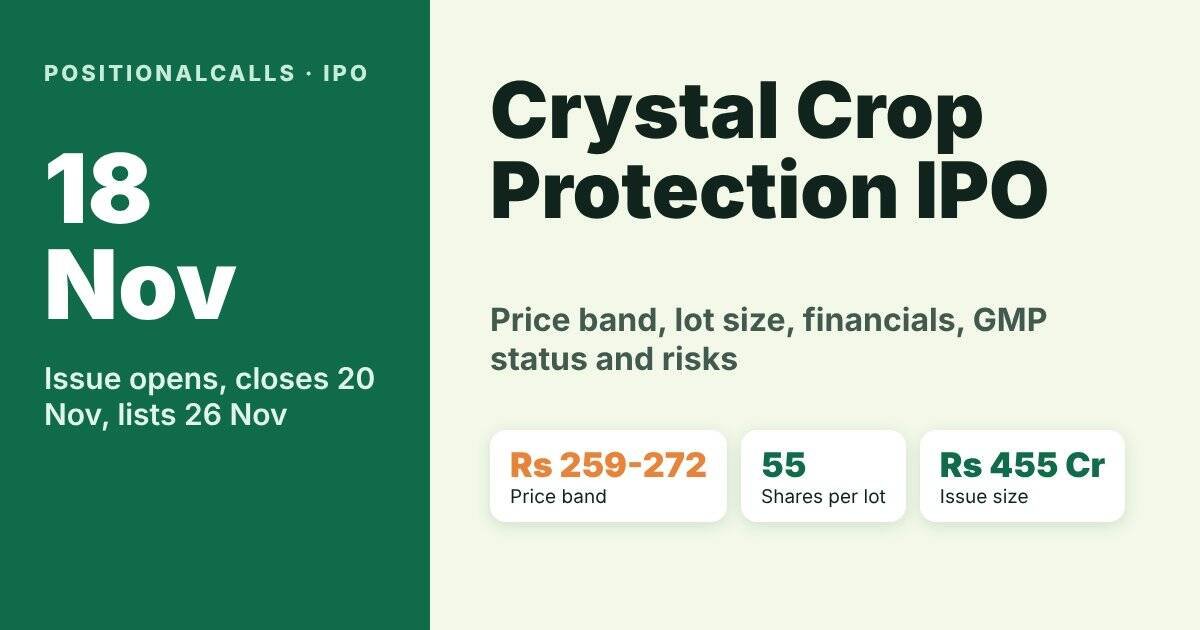
The Crystal Crop Protection IPO opens on 18 November 2026. This page has the dates, price band, lot size, issue structure, financials, GMP status and risks, with every figure sourced and every unknown marked.
Quick answer
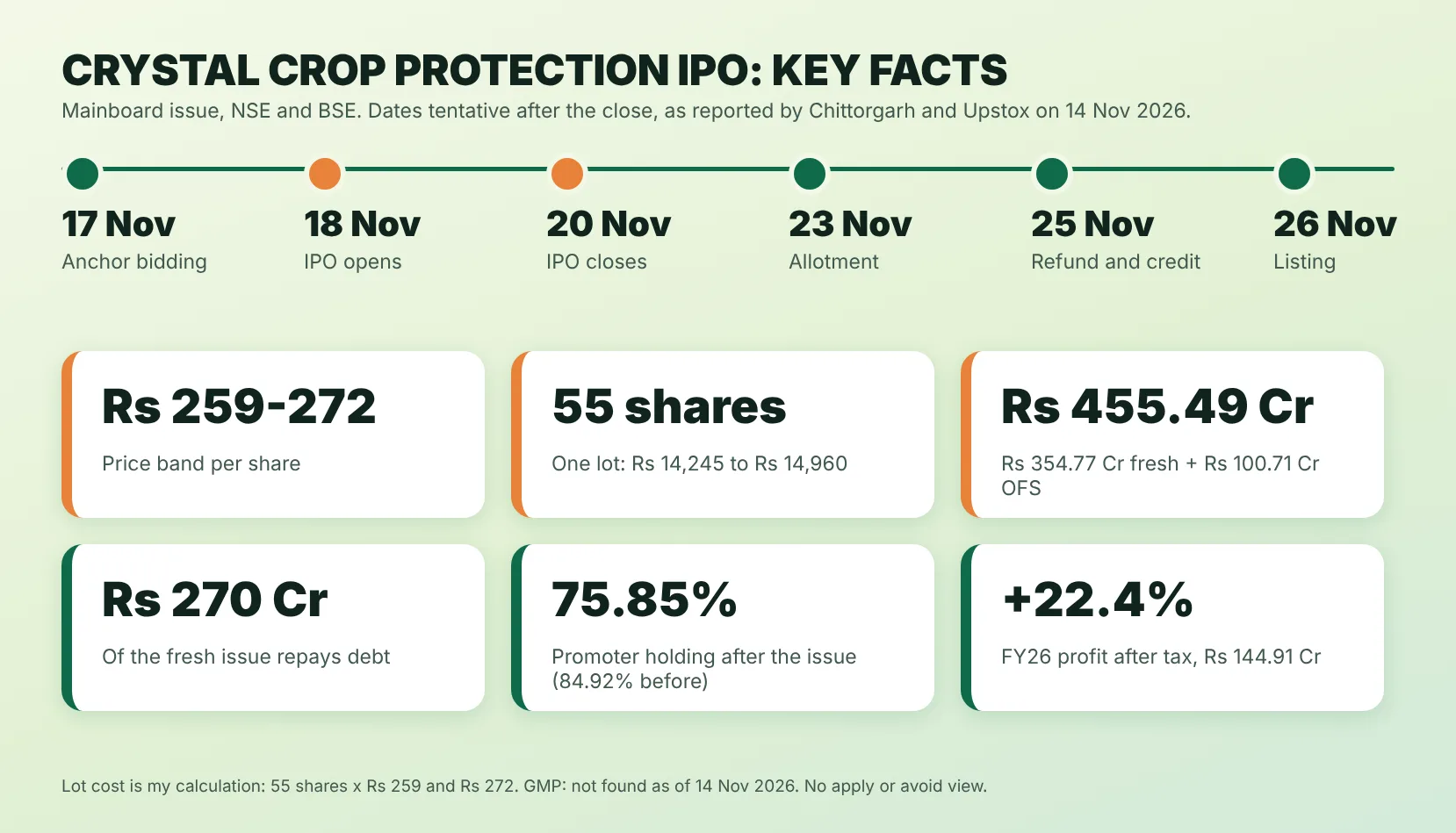
The Crystal Crop Protection IPO opens on 18 November 2026 and closes on 20 November, with a price band of Rs 259 to Rs 272, a lot of 55 shares and an issue size of up to Rs 455.49 crore. Allotment is expected on 23 November and listing on 26 November.
Latest update (Saturday, 14 November 2026, 3:00 PM IST): first version of this page, written four days before the issue opens. The price band, lot, dates and size come from Chittorgarh and Upstox. Anchor allocation, subscription and GMP are not out yet and are marked as such.
Key takeaways
- Dates: the Crystal Crop Protection IPO is open 18 to 20 November 2026; allotment about 23 November; listing 26 November.
- Price and lot: Rs 259 to Rs 272 and 55 shares, so one lot costs Rs 14,245 to Rs 14,960 (my calculation).
- Structure: about 78% fresh issue and 22% offer for sale by value (my calculation); the promoter sells in the offer for sale.
- Use of money: Rs 270 crore of the fresh issue goes to repaying borrowings, as per Chittorgarh.
- Financials: FY26 profit after tax was Rs 144.91 crore, up 22.4%; borrowings were Rs 820.04 crore at March 2026.
- GMP: none found, and GMP is unofficial in any case.
In plain words: Crystal Crop Protection is selling new shares to repay debt and grow, and its promoter is selling some existing shares too. You bid between Rs 259 and Rs 272 a share, in lots of 55, for three days from 18 November. Whether you get shares depends on how many people bid. Nothing on this page tells you to apply or to skip.
Data note: as of Saturday, 14 November 2026, 3:00 PM IST. Issue details, restated financials, objects and promoter holding come from Chittorgarh. Dates, anchor date, business description and quota split also come from Upstox. Peers, strengths and risks listed by ipomarket.in are marked as single-source. Mainboard bids are allotted by lottery in most categories, and I have no allotment or subscription data yet. I did not open the red herring prospectus, the NSE or BSE notices or the registrar page. PositionalCalls is not SEBI-registered and gives no apply or avoid view.
What is the Crystal Crop Protection IPO?
The Crystal Crop Protection IPO is an initial public offering of up to Rs 455.49 crore by Crystal Crop Protection Limited, a crop solutions company, that combines a fresh issue of up to Rs 354.77 crore with an offer for sale of up to Rs 100.71 crore. It is a mainboard issue, so the shares are proposed to list on both the NSE and the BSE.
An initial public offering is the first time a company sells shares to the public. In a fresh issue the company creates new shares and keeps the money. In an offer for sale an existing shareholder sells shares it already owns, and the company receives nothing. The IPO has both, which matters for how you read the use of money later on this page. Upstox names promoter Ankur Aggarwal as the seller in the offer for sale.
The issue is led by IIFL Capital Services as book running lead manager, with DAM Capital Advisors and Motilal Oswal Investment Advisors, and the registrar is MUFG Intime India, as per Chittorgarh. For the IPO, retail investors are reserved not less than 35% of the net issue, non-institutional investors not less than 15% and qualified institutional buyers not more than 50%.
This page was written on 14 November, four days before the issue opens. Subscription figures, the anchor allocation and the grey-market premium do not exist yet, so I have not guessed them. I will update the page at each stage, from the price band announcement to listing.
What are the Crystal Crop Protection IPO dates?
The Crystal Crop Protection IPO opens on Wednesday, 18 November 2026, closes on Friday, 20 November, and is expected to list on Thursday, 26 November. Anchor investors bid on Tuesday, 17 November, a day before the public issue, as per Upstox.
| Event | Date | Day | Source |
|---|---|---|---|
| Anchor bidding | 17 November 2026 | Tuesday | Upstox |
| IPO opens | 18 November 2026 | Wednesday | Chittorgarh, Upstox |
| IPO closes | 20 November 2026 | Friday | Chittorgarh, Upstox |
| Basis of allotment | 23 November 2026 | Monday | Chittorgarh (tentative), Upstox |
| Refund initiation and share credit | 25 November 2026 | Wednesday | Chittorgarh (tentative), Upstox |
| Listing on NSE and BSE | 26 November 2026 | Thursday | Chittorgarh (tentative), Upstox |
Cite this table: PositionalCalls, “Issue timetable, as of 14 November 2026, 3:00 PM IST”; Chittorgarh and Upstox, tentative dates.
Chittorgarh marks the allotment, refund and listing dates as tentative. Exchanges and registrars can move them, so check the final notice before you plan around them. The listing date follows the usual three working days after the issue closes, which is a general feature of the process and not something I confirmed in the prospectus.
One practical point on the IPO dates: the issue closes on a Friday, so any UPI mandate you have not approved by the cut-off will lapse and your bid can be rejected over the weekend. The exact cut-off times differ by broker and bank, so check them in your app on the opening day and not on the last day.
What are the Crystal Crop Protection IPO price band, lot size and minimum investment?
The Crystal Crop Protection IPO price band is Rs 259 to Rs 272 per share, the lot size is 55 shares, and one lot costs Rs 14,245 at the lower band or Rs 14,960 at the upper band. The face value is Rs 10 a share. The amounts below are my calculation from the band and the lot.
| Category | Lots | Shares | Amount at Rs 272 |
|---|---|---|---|
| Retail, minimum | 1 | 55 | Rs 14,960 |
| Retail, maximum (up to Rs 2 lakh) | 13 | 715 | Rs 194,480 |
| Small non-institutional, minimum | 14 | 770 | Rs 209,440 |
| Small non-institutional, maximum (below Rs 10 lakh) | 66 | 3,630 | Rs 987,360 |
| Big non-institutional, minimum | 67 | 3,685 | Rs 1,002,320 |
Cite this table: PositionalCalls, “Bid amounts by category, my calculation at Rs 272, as of 14 November 2026”; assumes the usual retail limit of Rs 2 lakh and the usual small and big non-institutional split at Rs 10 lakh.
The lot size of the IPO is fixed, so you buy in multiples of 55 shares. A retail bid cannot exceed Rs 2 lakh at the cut-off price, which at the upper band means 13 lots, or 715 shares, for Rs 1,94,480. A 14th lot would take the bid to Rs 2,09,440, which puts it in the non-institutional category. The Rs 2 lakh retail ceiling and the Rs 10 lakh split between small and big non-institutional bids are the standard SEBI limits; I did not check them in the prospectus.
Two cautions on the IPO price band. First, the price you finally pay is the issue price, which is set after bidding closes and can be anywhere in the band. If you bid at the cut-off you accept whatever price is fixed, and the excess amount blocked is released. Second, the lot size does not change with the price, so the cost of one lot moves only between Rs 14,245 and Rs 14,960.
How is the Crystal Crop Protection IPO structured?
The Crystal Crop Protection IPO offers 1,67,54,274 shares in all: 1,30,51,580 new shares in a fresh issue and 37,02,694 existing shares in an offer for sale, as per Chittorgarh. The fresh issue is about 78% of the shares, and the offer for sale about 22% (my calculation).
| Part | Shares | Value (up to) | Who receives the money |
|---|---|---|---|
| Fresh issue | 1,30,51,580 | Rs 354.77 crore | The company |
| Offer for sale | 37,02,694 | Rs 100.71 crore | The selling promoter |
| Total issue | 1,67,54,274 | Rs 455.49 crore | Split as above |
Cite this table: PositionalCalls, “Fresh issue and offer for sale, as of 14 November 2026, 3:00 PM IST”; Chittorgarh.
The promoter holds 84.92% before the IPO and is expected to hold 75.85% after it, as per Chittorgarh. That is a fall of 9.07 percentage points (my calculation), part of it from the offer for sale and part from the new shares added by the fresh issue. A promoter holding above 75% after the issue is still a majority, which keeps control with the founders.
The reservation for the IPO is as follows, using Chittorgarh and Upstox: not more than 50% of the net offer to qualified institutional buyers, not less than 35% to retail investors and not less than 15% to non-institutional investors. If the net issue equals the whole issue, the retail share would be about 58.6 lakh shares, or roughly 1.07 lakh lots (my calculation). That is only a ceiling on the maths, because I do not know whether any shares are set aside for employees, which would shrink the net issue.
The retail quota matters because mainboard retail bids are allotted by lottery when the category is oversubscribed. If retail demand is five times the quota, roughly one application in five can win one lot, though the actual ratio depends on the final subscription. I will add the real numbers once the exchanges publish them on 20 November.
What will the Crystal Crop Protection IPO money be used for?
As per Chittorgarh, Rs 247.94 crore of the fresh issue is for repaying borrowings and Rs 22.06 crore is for investing in subsidiary Saffire Crop Science Private Limited to repay its debt, a total of Rs 270.00 crore on debt. The rest of the fresh issue is for inorganic growth and general corporate purposes.
| Object of the fresh issue | Amount (Rs crore) | Source |
|---|---|---|
| Repayment or pre-payment of certain borrowings of the company | 247.94 | Chittorgarh |
| Investment in Saffire Crop Science to repay its borrowings | 22.06 | Chittorgarh |
| Subtotal for debt | 270.00 | Chittorgarh |
| Inorganic growth and general corporate purposes | Not shown on the page; about 84.77 if the whole fresh issue of 354.77 is used (my calculation) | Chittorgarh leaves this blank |
Cite this table: PositionalCalls, “Objects of the fresh issue, as of 14 November 2026, 3:00 PM IST”; Chittorgarh, one line inferred by me.
About 76% of the fresh issue, Rs 270 crore of Rs 354.77 crore, goes to repaying debt (my calculation). Upstox adds that the inorganic growth part is for unidentified acquisitions. That means the company has not named what it will buy, so investors cannot judge the price or the fit in advance.
When an IPO mainly repays debt, the money reduces interest cost and strengthens the balance sheet but does not directly add capacity or products. At March 2026 total borrowings were Rs 820.04 crore, so Rs 270 crore of repayment would cover about a third of them (my calculation). For a reader of the Crystal Crop Protection IPO, the test is whether lower interest costs show up in later profits, and that is something only future results can answer.
Note that the offer for sale, Rs 100.71 crore, is separate. That money goes to the selling promoter and not to the company, so it does not repay debt or fund growth. Some investors read a large offer for sale as the promoter taking money off the table; others see it as normal. This page does not take a view.
What does Crystal Crop Protection do?
Crystal Crop Protection was set up in 1994 and, as per Upstox, is a crop solutions company with seeds and agrochemicals at the core of its offering. Its crop protection range includes herbicides, insecticides and fungicides.
Beyond those, Upstox lists natural crop solutions: bio-protectants, bio-stimulants, liquid fertilisers, plant growth regulators and micronutrients. The seeds business sells for field crops, vegetable crops and flowers. The company has a material subsidiary, Saffire Crop Science Private Limited, which is also a recipient of IPO money to repay its debt.
ipomarket.in describes the business as a fully integrated agri-solutions platform with three verticals: agrochemicals, natural crop protection and hybrid seeds. It also lists, as strengths, backing from the International Finance Corporation, in-house research, a pan-India distribution network and positioning for exports as buyers diversify away from China. This is a single source, and I could not confirm these claims in the prospectus, so treat them as the company’s story, not as verified facts.
What I could not find for the Crystal Crop Protection IPO is the split of revenue by segment, the location and capacity of plants, the share of exports and the names of key brands. Those are the things to look for in the prospectus, because an agrochemical business depends on how much of its sales come from products with strong brands and how much from low-margin generics.
PositionalCalls WhatsApp channel
Get IPO dates and allotment updates on WhatsApp
- Dates, price band and listing day
- Allotment steps explained simply
- No tips, no calls, only sourced facts
What do the Crystal Crop Protection IPO financials show?
On a restated consolidated basis, Crystal Crop Protection grew total income from Rs 2,271.71 crore in FY24 to Rs 3,180.98 crore in FY26, and profit after tax from Rs 87.24 crore to Rs 144.91 crore, as per Chittorgarh. Profit grew faster than income, so margins widened.
| Rs crore | FY24 | FY25 | FY26 | Quarter to June 2026 |
|---|---|---|---|---|
| Total income | 2,271.71 | 2,731.94 | 3,180.98 | 1,209.21 |
| Growth in total income | – | 20.3% | 16.4% | not comparable |
| EBITDA | 209.06 | 315.28 | 456.23 | 241.78 |
| EBITDA margin (my calculation) | 9.2% | 11.5% | 14.3% | 20.0% |
| Profit after tax | 87.24 | 118.39 | 144.91 | 135.78 |
| Growth in profit after tax | – | 35.7% | 22.4% | not comparable |
| Profit margin (my calculation) | 3.8% | 4.3% | 4.6% | 11.2% |
Cite this table: PositionalCalls, “Restated consolidated financials, as of 14 November 2026, 3:00 PM IST”; Chittorgarh for reported lines, growth and margins by me.
The page on Chittorgarh does not label a revenue line, only total income, and states that revenue rose 16% and profit 22% from FY25 to FY26. That matches the total income and profit after tax lines above (16.4% and 22.4%). EBITDA rose 50.8% in FY25 and 44.7% in FY26, which pushed the EBITDA margin from 9.2% to 14.3% over two years (my calculation).
Do not annualise the June quarter. Profit after tax for the quarter to June 2026 was Rs 135.78 crore, which is about 94% of the whole of FY26 profit (my calculation). The EBITDA margin that quarter was 20.0% and the profit margin 11.2%, both far above the full-year figures. That pattern is likely to reflect the timing of the crop season, when sales of crop protection products and seeds are concentrated, but I could not confirm that from the prospectus. The sensible reading is that one quarter says little about a full year, and a quarter cannot be multiplied by four.
| Rs crore | 31 Mar 2024 | 31 Mar 2025 | 31 Mar 2026 | 30 Jun 2026 |
|---|---|---|---|---|
| Net worth | 1,488.39 | 1,600.10 | 2,039.76 | Not shown |
| Total borrowing | 577.29 | 947.02 | 820.04 | 952.02 |
| Total assets | 2,541.92 | 3,538.43 | 3,927.24 | 4,498.27 |
| Borrowing to net worth (my calculation) | 0.39 | 0.59 | 0.40 | Not available |
| Profit after tax to year-end net worth (my calculation) | 5.9% | 7.4% | 7.1% | Not available |
Cite this table: PositionalCalls, “Balance sheet lines, as of 14 November 2026, 3:00 PM IST”; Chittorgarh for reported lines, ratios by me.
Two things stand out on the balance sheet. Borrowings jumped from Rs 577.29 crore to Rs 947.02 crore in FY25 and fell to Rs 820.04 crore in FY26, and they rose again to Rs 952.02 crore by June 2026, which is the season when working capital is needed. Net worth rose by Rs 439.66 crore in FY26 while profit after tax was only Rs 144.91 crore (my calculation), so most of the increase did not come from earnings. I could not find the reason in the sources I read, and it is the sort of line to check in the prospectus, since it could be a share issue or a restructuring.
Profit after tax divided by year-end net worth was about 7.1% in FY26 (my calculation), which is modest for a business that is growing at this pace. A higher borrowing load and large working-capital needs are normal in agrochemicals, where dealers buy on credit, but they make the figure worth watching.
How does the Crystal Crop Protection IPO valuation compare with peers?
I cannot give a valuation for the Crystal Crop Protection IPO yet, because the sources I read do not show the number of shares after the issue, so the market value and the price-to-earnings ratio cannot be worked out. I have not guessed them.
The calculation is simple once the figure is known: the post-issue share count times the issue price gives the market value, and the price divided by earnings per share gives the multiple. The earnings per share has to be the restated figure from the prospectus for the same period. Since the June quarter is seasonally strong, compare on the full FY26 profit of Rs 144.91 crore and not on an annualised quarter.
ipomarket.in lists these listed companies as peers: UPL, PI Industries, Dhanuka Agritech, Sumitomo Chemical India, Bharat Rasayan, Heranba Industries and Insecticides India. That list comes from one source and gives no multiples. The prospectus carries its own peer table, and it is the list to use, because the choice of peers shapes how cheap or expensive an issue looks. These companies differ widely in size, export share and product mix, so a direct comparison needs care.
I will add the price-to-earnings ratio, the market value and the peer comparison to this page when the share count is disclosed, labelled as my calculation. Until then, any claim that the IPO is cheap or expensive is a guess.
What is the Crystal Crop Protection IPO GMP?
As of 14 November 2026 I found no reported Crystal Crop Protection IPO GMP, so this page shows not found. ipomarket.in says a GMP is only quoted once an IPO is officially priced, and Chittorgarh shows no value on its page.
GMP stands for grey market premium. It is the unofficial price at which people trade a share before it lists. It is not set by the exchange, it is not regulated, and it can be wrong, zero or manipulated. A premium on the day before listing has often failed to match the actual listing price. For that reason, treat the Crystal Crop Protection IPO GMP as a rumour and not as a forecast.
| Date | GMP (Rs) | Source | Note |
|---|---|---|---|
| 14 Nov 2026 | Not found | Chittorgarh, ipomarket.in | No premium reported before the price band is final |
Cite this table: PositionalCalls, “GMP history, as of 14 November 2026, 3:00 PM IST”; no source reported a value.
I will log any GMP I find with its date and source, and I will never present it as a promise. A listing gain is not guaranteed even when a premium exists, and a zero GMP does not mean the shares cannot list higher. If you see a paid group promising a sure gain on this or any IPO, it is a warning sign.
How do you apply for the Crystal Crop Protection IPO?
You apply for the Crystal Crop Protection IPO through a broker app or your bank using UPI or ASBA, between 18 and 20 November, from a demat account linked to your PAN. Your money stays in your bank account and is only blocked until allotment.
- Make sure your demat account is active and your PAN, bank account and UPI ID are linked and working.
- Open the IPO section of your broker app on or after 18 November and pick the IPO.
- Choose the category, the number of lots and the price. Most retail investors bid at the cut-off price.
- Enter your UPI ID and submit. A mandate request goes to your UPI app.
- Approve the mandate in your UPI app before the cut-off. A bid with an unapproved mandate is rejected.
- Keep the application number. You need it to check allotment.
Only one application per PAN is valid in each category, so several applications on one PAN can be rejected. Applying from family members’ demat accounts uses their own PANs and is a separate matter. Cost-wise, applying does not usually carry a brokerage charge, but check your own broker. For ongoing demat costs, see our guide to demat account charges in India.
How do you check the Crystal Crop Protection IPO allotment status, and when does it list?
The basis of allotment is expected on 23 November, and you can check the Crystal Crop Protection IPO allotment status on the registrar MUFG Intime India using your PAN, application number or demat details. Refunds and share credit are expected on 25 November and listing on 26 November.
The exchanges, NSE and BSE, also have IPO allotment pages. Your broker app usually shows the status as well, but the registrar is the source. If you do not get an allotment, the blocked amount is released, usually within the refund date. If you do, the shares appear in your demat account by the credit date, and you can sell from the listing day.
Our step-by-step guide on how to check IPO allotment status covers the registrar pages, the status messages and what to do if the status is not found. As a worked example of an IPO page I update through each stage, see the Jio Platforms IPO allotment status page.
| Step | What happens | Expected date |
|---|---|---|
| Basis of allotment | Registrar finalises who gets shares | 23 Nov 2026 |
| Refund | Money released for unsuccessful bids | 25 Nov 2026 |
| Credit | Shares reach demat accounts | 25 Nov 2026 |
| Listing | Trading starts on NSE and BSE | 26 Nov 2026 |
Cite this table: PositionalCalls, “Steps after the issue closes, as of 14 November 2026, 3:00 PM IST”; Chittorgarh, tentative.
What is the tax on Crystal Crop Protection IPO listing gains?
If you sell the shares on listing day or within 12 months, the gain is a short-term capital gain taxed at 20% on listed equity, and after 12 months the gain above Rs 1.25 lakh a year is taxed at 12.5%, as reported for FY 2026-27. Add 4% cess.
Securities transaction tax of 0.1% applies on a delivery sale, and it is not deductible against capital gains, as reported by secondary sources. Our guides explain each rule: see capital gains tax on shares for the rates and STT in India for the transaction tax.
An illustration (my calculation): if you bought one lot of 55 shares at Rs 272, Rs 14,960, and sold it at Rs 300 on listing day, the gain would be Rs 1,540 and the short-term tax at 20% would be Rs 308, plus 4% cess of Rs 12.32, ignoring brokerage and STT. The price is invented for the example and is not a forecast. Check your own position with a chartered accountant.
What are the risks in the Crystal Crop Protection IPO?
These are risks to read about, not reasons to apply or skip. The prospectus has a full risk-factor section, and it is long for good reason. Pay extra attention to pending legal cases, dependence on a few products or distributors, and related-party dealings, which I could not check for this page.
What should you check before the Crystal Crop Protection IPO closes?
- Is the final price band and lot the same as above in the exchange notice?
- What is the post-issue share count, so you can work out the market value and the price-to-earnings ratio?
- How much of the revenue comes from the top products, and how much is exported?
- Why did net worth rise by Rs 439.66 crore in FY26 when profit was Rs 144.91 crore?
- What are the unidentified acquisitions, and is there a limit on the amount?
- Does your UPI mandate have enough limit, and will you approve it before the cut-off?
- Are you comfortable if the shares list below the issue price and you have to wait?
- Have you read the red herring prospectus, not just a summary?
This checklist is educational and is not a recommendation. If you are unsure, a SEBI-registered investment adviser can look at your own money and goals, which a general page cannot.
Analyst’s note and bottom line
- What stands out: profit and margins grew fast for two years, and about three quarters of the fresh issue pays down debt.
- Easy to miss: one quarter, June 2026, earned about 94% of full-year FY26 profit, so do not multiply it.
- What is missing: the post-issue share count, so the price-to-earnings ratio and the market value cannot be worked out yet.
- Unexplained: net worth rose Rs 439.66 crore in FY26 against profit of Rs 144.91 crore.
- What will update this page: the anchor allocation on 17 November, subscription on 18 to 20 November, allotment on 23 November and listing on 26 November.
Bottom line
The issue opens on 18 November 2026 at Rs 259 to Rs 272 a share in lots of 55, for up to Rs 455.49 crore, with listing expected on 26 November. The financials show growth and widening margins, offset by high borrowings and strong seasonality. Valuation and GMP are not available yet. This page gives no view on whether to apply.
PositionalCalls WhatsApp channel
Follow IPO updates in one channel
- Subscription and allotment updates
- New IPO pages as they go live
- Plain-English explainers
Crystal Crop Protection IPO: frequently asked questions
What are the Crystal Crop Protection IPO dates?
The issue opens on Wednesday, 18 November 2026 and closes on Friday, 20 November 2026, with anchor bidding on 17 November. Allotment is expected on 23 November, refunds and share credit on 25 November, and listing on NSE and BSE on 26 November, as per Chittorgarh and Upstox.
What is the Crystal Crop Protection IPO price band?
The price band is Rs 259 to Rs 272 per share, with a face value of Rs 10. Bids can be placed at any price in the band, or at the cut-off price. The final issue price is fixed after bidding closes and is usually announced with the basis of allotment.
What is the Crystal Crop Protection IPO lot size and minimum investment?
The lot size is 55 shares. At the upper band of Rs 272 one lot costs Rs 14,960, and at the lower band of Rs 259 it costs Rs 14,245 (my calculation). Retail investors can bid for up to Rs 2 lakh, which is 13 lots at the upper band.
How big is the issue and what is fresh versus OFS?
The issue is worth up to Rs 455.49 crore: a fresh issue of up to Rs 354.77 crore and an offer for sale of up to Rs 100.71 crore, as per Chittorgarh. The sale comes from the promoter. Money from the fresh issue goes to the company; money from the offer for sale does not.
What is the Crystal Crop Protection IPO GMP?
I did not find a reported GMP for this issue as of 14 November 2026. GMP is an unofficial grey-market premium, not an exchange price, and can be wrong, zero or change by the hour. Treat it as a rumour, never as a listing forecast. This page shows not found until a source reports one.
How do I check the Crystal Crop Protection IPO allotment status?
After the basis of allotment on about 23 November, check the allotment status on the registrar’s site, MUFG Intime India, using your PAN, application number or demat details. You can also check on the NSE or BSE IPO page. See our allotment guide for the steps and what the result means.
Who is the registrar and who are the lead managers?
The registrar to the issue is MUFG Intime India Private Limited. The book running lead manager is IIFL Capital Services, with DAM Capital Advisors and Motilal Oswal Investment Advisors, as per Chittorgarh. The shares are proposed to list on both the BSE and the NSE on 26 November 2026.
What does Crystal Crop Protection do?
Crystal Crop Protection is a crop solutions company set up in 1994, selling agrochemicals such as herbicides, insecticides and fungicides, natural crop solutions such as bio-stimulants, and seeds for field crops, vegetables and flowers, as per Upstox. It has a material subsidiary, Saffire Crop Science. Business details here are from press summaries, not the prospectus.
What are the Crystal Crop Protection IPO financials?
On a restated consolidated basis, total income was Rs 3,180.98 crore and profit after tax Rs 144.91 crore in FY26, up 16.4% and 22.4% on FY25, as per Chittorgarh. For the quarter to June 2026 total income was Rs 1,209.21 crore and profit Rs 135.78 crore. Do not annualise that quarter.
Is this IPO a good one to apply for?
This site gives no apply or avoid advice and is not SEBI-registered. Read the red herring prospectus, check what the money is for, note that borrowings repayment takes most of the fresh issue, and compare the valuation with peers once it is disclosed. Decide on your own goals or ask a SEBI-registered adviser.
Sources
- Chittorgarh: issue details, read 14 November 2026.
- Upstox: issue opens Nov 18, price band, lot size and key dates.
- Zeebiz: IPO next week, Rs 455-crore mainboard issue to open on November 18 (headline only; the page did not load for me).
- ipomarket.in: issue page (business, peers and risks; single source).
- PositionalCalls: how to check IPO allotment status, capital gains tax on shares, STT in India and demat account charges in India.

Shubham Chaudhary is the founder of PositionalCalls, an independent Indian stock market research website. He writes company fundamentals, quarterly results analysis, IPO analysis and sector research for NSE and BSE listed companies, with a focus on banking stocks, insurance and long-term value investing. Every article is built from primary sources such as RBI, SEBI, NSE and BSE filings and company annual reports, and states its risks plainly in simple language for retail investors.
Coverage areas Our research standards- Numbers checked against NSE, BSE and SEBI filings
- Risks and limits stated in every article
- No paid promotions or broker tie-ups
- Articles updated when new filings arrive