
IPO Research · Live Timeline
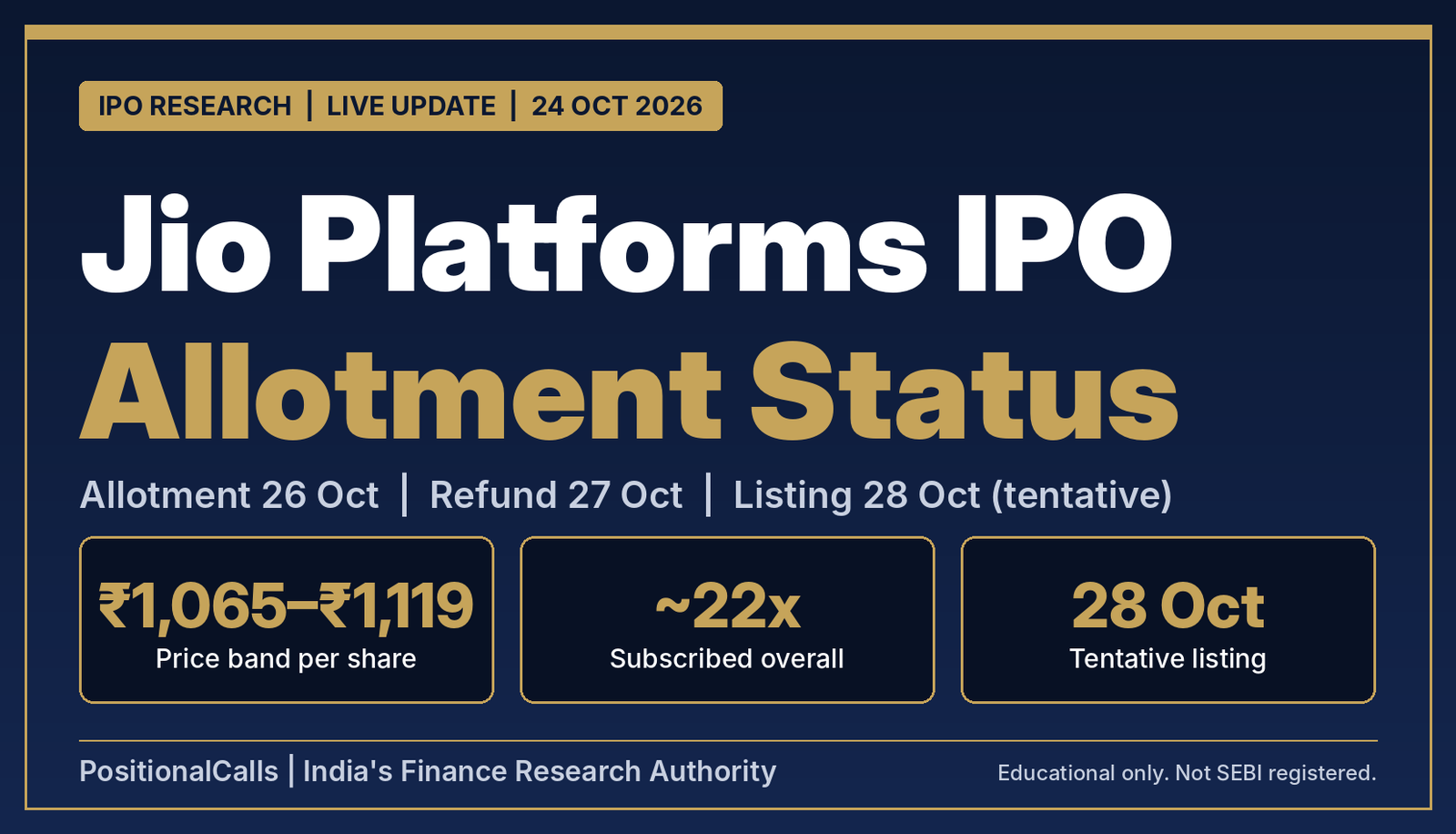
Jio Platforms IPO allotment status will be finalised on Monday, 26 October 2026, after India’s largest IPO closed about 22 times subscribed. This guide gives you the dates, three ways to check your result, what a 2.7x retail subscription means for your chances, and what to watch on listing day.
Quick answer
Jio Platforms IPO allotment is expected on Monday, 26 October 2026. The issue closed on 23 October at about 22x overall (QIB ~70x, NII ~14x, retail ~2.7x). Refunds and share credit are scheduled for 27 October, and listing is tentatively set for Wednesday, 28 October on NSE and BSE.
Key takeaways
- Allotment date: Monday, 26 October 2026. Check the status on KFin, NSE or BSE after the basis of allotment is approved.
- Subscription: about 22x overall. Retail was about 2.7x, so a lottery for the 12-share lot is possible.
- Price band: ₹1,065 to ₹1,119. One lot costs ₹13,428 at the upper band.
- Refund and share credit: Tuesday, 27 October 2026.
- Listing: tentatively Wednesday, 28 October 2026 on NSE and BSE.
- GMP: roughly ₹245 to ₹280 in the last three days. It is unofficial and not a promise.
In plain words: QIB means qualified institutional buyers, such as mutual funds, insurers and foreign funds. NII means non-institutional investors who bid more than ₹2 lakh. Retail means bids up to ₹2 lakh. GMP, or grey market premium, is an unofficial price gap traded before listing. “x” means times: 22x means investors bid for 22 times the shares on offer.
Data note: Figures are as of 24 October 2026, 10:00 AM IST. They come from Jio Platforms’ red herring prospectus (RHP, the final offer document) as summarised by filing-based reports, from exchange bid data, and from news outlets. Final-day subscription is provisional: one tracker shows 22.19x and another 21.33x. Jio Platforms IPO allotment status has not been declared yet.
What are the key numbers for the Jio Platforms IPO?
Jio Platforms Limited is the telecom and digital-services subsidiary of Reliance Industries Limited (RIL). Its IPO is the largest in India so far, ahead of Hyundai Motor India’s ₹27,859 crore issue in 2024. The numbers below are as of 24 October 2026, 10:00 AM IST.
| Metric | Figure | Why it matters |
|---|---|---|
| Price band | ₹1,065 to ₹1,119 per share | Anchors were allotted shares at ₹1,119, the upper end, so the final issue price is expected there. Confirm it in your allotment notice. |
| Lot size and bid limits | 12 shares. Minimum ₹13,428. Retail maximum 14 lots (168 shares, ₹1,87,992) | Retail bids are capped at ₹2 lakh. Each lot is the smallest unit the allotment lottery hands out. |
| Issue structure | Up to 27 crore fresh shares. About ₹30,213 crore at the upper band (some trackers show ₹30,187.6 crore) | No offer for sale. RIL, Meta and Google are not selling in this IPO, so all the money goes to the company. |
| Implied valuation | About ₹10.3 lakh crore at the upper band | Reuters reports a successful listing would make Jio one of India’s top four listed companies by market value. |
| Subscription (23 Oct, 7:00 PM IST) | Overall 22.19x. QIB 70.55x. NII 14.00x. Retail 2.72x | Institutions drove the demand. Retail covered its quota 2.7 times, so a lottery is possible. |
| Anchor book | ₹8,109.85 crore. 7,24,74,066 shares at ₹1,119. Demand reportedly above ₹2.5 lakh crore | Anchors are long-term institutions whose shares are locked in for a period, which limits early selling. |
| Use of proceeds | Up to ₹27,500 crore to repay borrowings of Reliance Jio Infocomm | About 91% of the issue (my calculation) pays down debt rather than funding new capacity. |
| Reservations | RIL shareholders up to ₹2,500 crore. Employees up to ₹500 crore, with a ₹54 per share discount. Retail at least 35% of the net issue | Eligible RIL shareholders can bid in a separate quota in addition to a normal retail bid. |
When is the Jio IPO allotment date and the Jio Platforms IPO listing date?
The Jio Platforms IPO allotment date is Monday, 26 October 2026. Allotment means the registrar decides who receives shares and how many. The “basis of allotment” is the document that explains the method used. The registrar for this issue is KFin Technologies. The exchanges are NSE (National Stock Exchange) and BSE (Bombay Stock Exchange). SEBI, the Securities and Exchange Board of India, is the market regulator. Your Jio Platforms IPO allotment status depends on the basis of allotment approved on that day.
| Date | Event | What it means for you |
|---|---|---|
| Mon, 19 Oct | Anchor bidding | ₹8,110 crore raised from 212 institutions before the public issue. |
| Wed, 21 Oct | Issue opens | Tuesday, 20 October was a market holiday, so bidding started on Wednesday. |
| Fri, 23 Oct | Issue closes | Last day to bid. UPI mandates had to be approved by the cut-off. |
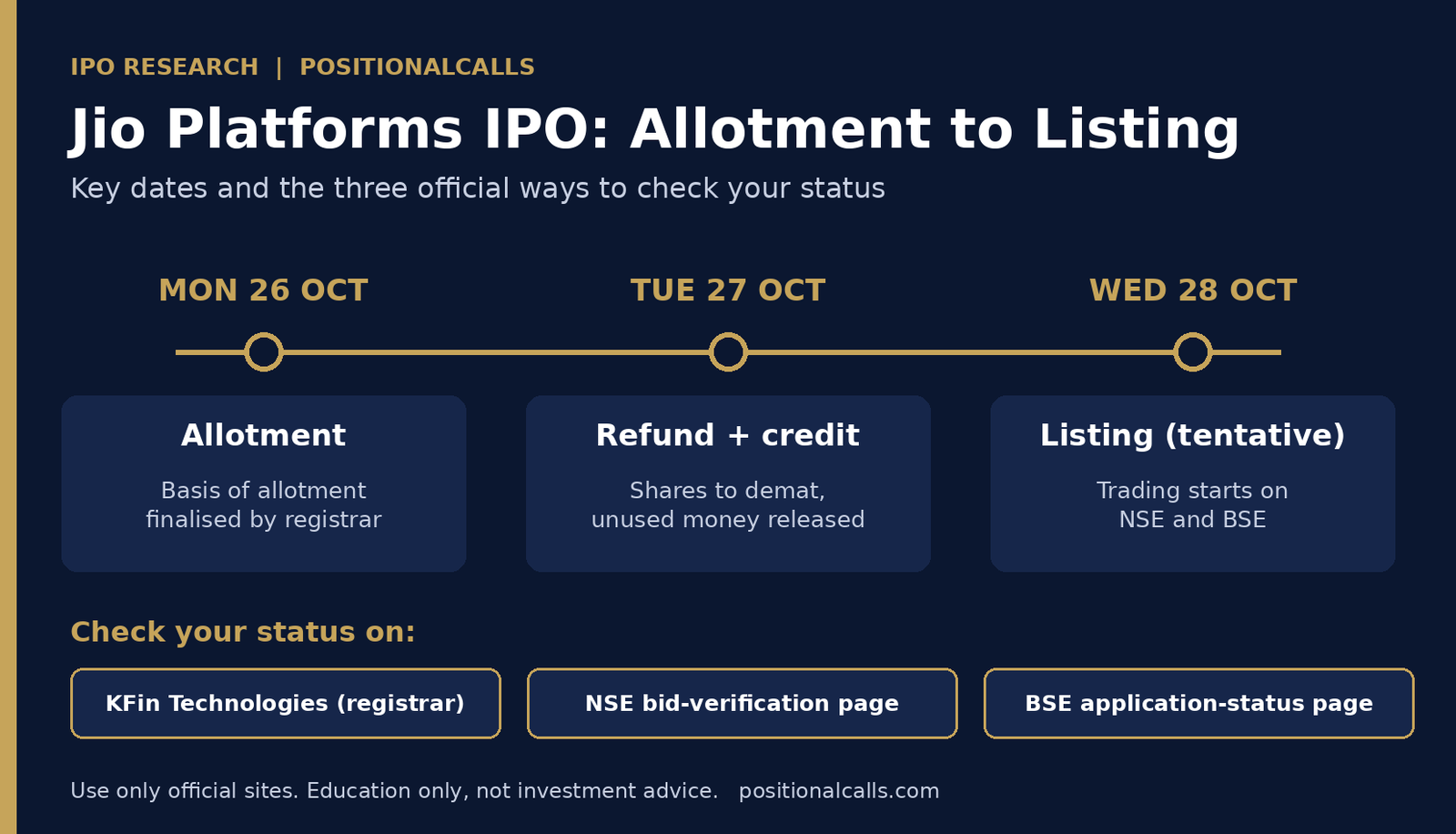
| Mon, 26 Oct | Basis of allotment | Registrar finalises who gets shares. Status pages go live after this. |
| Tue, 27 Oct | Refunds start and shares are credited | Unused blocked money is released. Allotted shares appear in your demat account. |
| Wed, 28 Oct | Tentative listing on NSE and BSE | Trading starts after the exchanges’ special pre-open price discovery. |
Why is the listing date still tentative?
SEBI’s timeline asks issuers to list within three working days of the issue closing. The issue closed on Friday, 23 October. Counting Monday, Tuesday and Wednesday gives 28 October (my calculation). The exchanges confirm the exact date in a listing circular, so treat 28 October as tentative until that notice appears. A sudden market holiday or exchange notice could shift it.
How to check Jio Platforms IPO allotment status online?
You can check Jio Platforms IPO allotment status on the registrar’s website, on NSE or on BSE. Use only these official pages. The status will not show anything useful before the basis of allotment is finalised on 26 October 2026.
- Wait for the basis of allotment: The registrar finalises allotment on Monday, 26 October 2026. Status pages show nothing useful before that.
- Open the registrar page: Go to the KFin Technologies IPO status page, choose Jio Platforms Ltd from the IPO list, then pick PAN, application number or demat account as the search type.
- Enter your details and submit: Type your PAN, application number or demat ID, complete the captcha if shown, and submit. The page shows shares applied for, shares allotted and any refund amount.
- Cross-check on NSE or BSE: On the NSE bid-verification page choose Equity and SME IPO bid details, select the Jio Platforms symbol (JPL), and enter your PAN and application number. On BSE, choose Equity, select Jio Platforms and enter the same details.
- Confirm refund or share credit on 27 October: Shares should be credited to your demat account and unused blocked amounts released on 27 October 2026. Check your broker app and bank statement.
How to check Jio IPO allotment on KFin
Here is how to check Jio IPO allotment on KFin in a minute. KFin Technologies is the registrar for this issue, so its page is the quickest place to see your result. Select Jio Platforms Ltd from the IPO list, pick PAN, application number or demat account, enter the details and submit. Before the basis of allotment is approved on 26 October, the page may not show a result, so do not worry if it is blank on Sunday. If you applied through a broker, your application number is in the broker app or the UPI mandate message.
Official pages to use
- Registrar: KFin Technologies IPO status page. Pick “Jio Platforms Ltd” from the IPO list.
- NSE: NSE bid-verification page. Choose “Equity & SME IPO bid details” and the symbol JPL.
- BSE: BSE application-status page. Select Equity, then Jio Platforms.
How do you read the result?
Your Jio Platforms IPO allotment status will show one of two outcomes. An “allotted” result shows how many shares you received and your refund, if any. A “not allotted” result means your blocked money will be released. If you bid through UPI, the bank mandate is cancelled and no money leaves your account for shares you did not get.
Be careful with scams. Nobody can guarantee allotment, and the registrar never asks for payment, an OTP or your banking password. Fake “status” sites that ask for fees are common around big IPOs.
What does 22x subscription mean for your Jio Platforms IPO allotment status?
Overall subscription hides how each group bid. Institutions bid heavily. Retail investors bid for about 2.7 times their quota. The table shows each category at the close on 23 October 2026, 7:00 PM IST.
| Category | Share of the issue | Subscription | Plain-language meaning |
|---|---|---|---|
| QIB (institutions) | 50% of the net issue | 70.55x (another tracker: 67.15x) | Funds bid about 70 times their quota. Institutions often bid late, so this number grows fast on the last day. |
| NII (above ₹2 lakh) | 15% | 14.00x | Wealthy individuals and firms bid 14 times their quota. Many use borrowed money, so this group can sell quickly on listing. |
| Retail (up to ₹2 lakh) | At least 35% | 2.72x | Supply covers about 37% of retail demand by share count (1 divided by 2.72, my calculation). |
| RIL shareholders (reserved) | Up to ₹2,500 crore | About 7.6x | A separate quota for eligible Reliance shareholders. It does not reduce the normal retail quota. |
| Employees (reserved) | Up to ₹500 crore | About 2.93x | Small quota with a ₹54 per share discount. |
How does retail allotment work?
Under SEBI’s allotment rules, every valid retail applicant is meant to receive at least the minimum lot if enough shares are available. Here, that lot is 12 shares. If valid applications are more than the lots available, a lottery decides who gets one lot. If lots are enough for everyone, extra shares are shared in proportion. The exact formula sits in the “Basis of Allotment” section of the RHP.
| If this is true | Likely result for a retail bidder |
|---|---|
| Valid applications are fewer than the retail lots available | Everyone gets at least one lot. Bids for more lots may get more, in proportion. |
| Valid applications are more than the retail lots available | A computer lottery picks who gets one lot. Nobody gets more than one lot. |
| You bid below the final issue price or your UPI mandate was not approved | The bid is invalid and cannot be allotted. |
| You bid twice on the same PAN in the retail category | Duplicate bids on the same PAN are rejected under the rules. |
Sources disagree on which row applies. One tracker quotes retail applications at about 1.42x and also says almost every application may be allotted. Those two statements do not fit together. A UAE-based analyst quoted by Khaleej Times expects most retail applicants to receive only one lot. Treat every odds estimate as unconfirmed until the basis of allotment is published on 26 October.
What is the Jio Platforms IPO GMP today, and can you trust it?
GMP, or grey market premium, is the extra amount traders in an unofficial market pay for an IPO share before it lists. The grey market is unregulated. It is not run by the exchanges or SEBI, and its quotes can change within hours. GMP has no effect on your Jio Platforms IPO allotment status. It only reflects mood. For the latest daily quote, see our live page on Jio Platforms IPO GMP today.
| Date (2026) | GMP per share | Implied listing price (₹1,119 + GMP) | Tracker |
|---|---|---|---|
| 4 Oct | ₹148 | ₹1,267 | IIFL |
| 8 Oct | ₹167 | ₹1,286 | IIFL |
| 12 Oct | ₹182 | ₹1,301 | IIFL |
| 15 Oct | ₹221 | ₹1,340 | IIFL |
| 19 Oct | ₹245 | ₹1,364 | IIFL |
| 21 Oct | ₹265 (10:37 AM) | ₹1,384 | IIFL (IPO Watch logged a ₹280 high that day) |
| 23 Oct | ₹260 (evening) | ₹1,379 | IPO Watch |
The premium rose from ₹148 to about ₹260 in three weeks, then eased slightly into the close. Across trackers in the last three days it ranged between roughly ₹245 and ₹280, or about 22% to 25% over ₹1,119. Different sites quote different numbers for the same day, so use the range, not one figure.
Why can GMP mislead you?
GMP reflects a small number of private trades. It does not set your allotment price and it does not forecast the listing price. Recent listings this month show it can miss in both directions.
| Company (listed in Oct 2026) | Final GMP | Actual listing gain |
|---|---|---|
| HD Fire Protect (21 Oct) | +30.26% | +23.62% |
| Fusion CX (22 Oct) | +3.46% | +5.54% |
| Vaibhav Vyapaar (21 Oct) | +3.70% | -2.04% |
Source: IPO Market GMP tracker, as of 23 October 2026 (secondary source). Smaller issues behave differently from a ₹30,213 crore mega-issue, so use this only as a reminder that GMP is not a promise.
What does Jio Platforms do and how does it make money?
Jio Platforms Limited was incorporated in 2019. It owns Reliance Jio Infocomm Limited (RJIL), the mobile and broadband operator, and builds digital, cloud and AI services. RJIL still drives almost everything. In FY26 (April 2025 to March 2026) it contributed 87.74% of consolidated revenue, 94.88% of EBITDA and 93.76% of profit after tax (PAT).
Here are the terms in plain language. EBITDA is operating profit before interest, tax, depreciation and amortisation. PAT is the profit left after all costs and tax. ARPU is average revenue per user per month. Churn is the share of customers who leave in a period.
- Customers: 524.4 million at 31 March 2026, including 268.5 million on 5G and 27.1 million fixed broadband users. One report puts subscribers at about 533 million at 30 June 2026.
- Monthly ARPU: ₹181.7 in FY24, ₹206.2 in FY25, ₹214.0 in FY26 and ₹215.6 in Q1 FY27.
- Churn: 1.67% in FY26, against 1.81% in FY25.
- Distribution: Reliance Retail is the sole distributor of Jio’s prepaid services. Prepaid made up about 77.08% of FY26 consolidated revenue.
The business is powerful and concentrated. That is why the same facts appear later under risks.
What do Jio Platforms’ financials show?
The RHP reports restated consolidated numbers. The table converts the filing’s rupee-million units into crore.
| ₹ crore | FY24 | FY25 | FY26 | Q1 FY27 (Apr-Jun 2026) |
|---|---|---|---|---|
| Revenue from operations | 1,09,558 | 1,28,218 | 1,46,885 | 39,173 |
| EBITDA | 54,958 | 64,170 | 76,255 | 20,865 |
| Profit after tax | 21,423 | 26,109 | 30,049 | 7,764 |
| Revenue growth (my calculation) | – | 17.0% | 14.6% | 11.8% year on year |
| PAT growth (my calculation) | – | 21.9% | 15.1% | about 9% year on year |
| EBITDA margin | about 50.2% | 50.05% | 51.91% | – |
Two patterns stand out. First, profit is high: FY26 profit after tax crossed ₹30,000 crore on a margin of about 20%. Second, growth is slowing. Revenue growth fell from 17.0% in FY25 to 14.6% in FY26 and 11.8% in Q1 FY27. Profit growth fell from 21.9% to 15.1% and then to about 9%.
Why do old Jio numbers not match the RHP?
Do not mix the RHP’s restated table with Jio’s earlier quarterly releases. For example, the July 2025 release reported Q1 FY26 revenue of ₹41,054 crore. The RHP’s restated figure for the same quarter is ₹35,032 crore. Profit matches at about ₹7,110 crore. The gap likely comes from restatement or presentation changes. Always use one consistent source when you compare growth.
How does Jio compare with Bharti Airtel?
| FY26 metric | Jio Platforms | Bharti Airtel |
|---|---|---|
| Monthly ARPU | ₹214 | about ₹257 |
| EBITDA margin | 51.91% | 57.48% |
| Return on capital employed (ROCE) | 10.76%, down from 12.5% | Not confirmed here |
ARPU is only an average, and a lower figure can reflect a different customer mix. Still, an analyst quoted by Khaleej Times argues Jio’s growth leans on tariff increases expected after listing. ROCE, or return on capital employed, shows how much operating profit each rupee of capital earns.
Jio buys and sells services with other Reliance Group companies. The RHP shows ₹6,330.3 crore of related-party revenue and other income in FY26 and ₹13,726.1 crore of related-party expenses, including donations. The expenses equal about 9.3% of FY26 revenue (my calculation). Related-party dealings are normal for a group, but they deserve a closer look because prices are set inside the group.
Is the Jio Platforms IPO valuation expensive?
This site does not say whether to buy or sell. It shows how to measure the price so you can decide. At the upper band, the IPO values Jio Platforms at about ₹10.3 lakh crore. P/E, or price-to-earnings, divides the share price by earnings per share (EPS). It tells you how many years of current profit you pay for.
| Measure | Working (my calculation) | Result |
|---|---|---|
| P/E on RHP diluted EPS | ₹1,119 divided by FY26 EPS of ₹33.59 | about 33.3x |
| Market value to FY26 profit | ₹10.3 lakh crore divided by ₹30,049 crore | about 34.3x |
| Market value to FY26 revenue | ₹10.3 lakh crore divided by ₹1,46,885 crore | about 7.0x |
| Market value to FY26 EBITDA | ₹10.3 lakh crore divided by ₹76,255 crore (equity value, not enterprise value) | about 13.5x |
The two profit-based figures differ because EPS uses shares before the new issue, while market value uses shares after it. The new 27 crore shares are about 2.9% of post-issue equity, which fits the ₹10.3 lakh crore figure (₹10.3 lakh crore divided by ₹1,119 gives about 92 crore shares, my calculation).
Five questions to ask before you judge the price
- Growth: Profit grew 15.1% in FY26 and revenue growth is slowing. Is 15% enough for a 33x to 34x multiple?
- Margin: EBITDA margin is already about 52%. How much more can it rise?
- ARPU path: ARPU is about ₹215 against Airtel’s roughly ₹257. Will tariffs rise, and by how much?
- Capital needs: ROCE slipped to 10.76%. Will 5G and AI spending keep it low?
- Concentration: One subsidiary and one distributor drive most of the numbers. Is that priced in?
Where will the ₹30,213 crore from the Jio Platforms IPO go?
Jio plans to use up to ₹27,500 crore to repay or prepay borrowings of its subsidiary, Reliance Jio Infocomm. That is about 91% of the issue. The rest, about ₹2,700 crore before issue expenses (my calculation), is for general corporate purposes. Reports say the loans funded 5G rollout and spectrum, with repayments scheduled between March and June 2028.
This is a fresh issue, so existing owners are not cashing out. Before the issue, RIL held 66.43%, Meta 9.98% and Google 7.73%. If RIL does not buy new shares, its stake falls to about 64.5% after the issue (66.43% multiplied by 1 minus 2.9%, my calculation). One report says Reliance keeps about 66.4%, which is the pre-issue figure. RIL remains the majority holder, so claims that Jio leaves the Reliance group after listing do not match the numbers. For more on the group, see our energy and Reliance coverage.
Reliance Industries shareholders do not get Jio shares automatically. This is an IPO, not a demerger. Eligible RIL shareholders could only use the reserved quota.
What could happen on Jio listing day? Scenarios, not forecasts
Nobody can predict the listing price. The table shows reference levels and what each outcome would suggest. Gains and losses are measured against the issue price of ₹1,119, not against the grey market. Track the premium on our Jio IPO GMP today page until the listing circular is out.
| Scenario | Reference level | What it would suggest | What to watch |
|---|---|---|---|
| A. Lists below the issue price | Under ₹1,119 | The market judged the price full, or selling outweighed demand despite the strong book. | Foreign fund flows, crude oil and the Nifty trend. |
| B. Flat listing | Close to ₹1,119 | Fair price discovery. Big-issue supply may have absorbed the demand. | Volume in the first hour and institutional buying. |
| C. Premium below the grey market | Between ₹1,119 and about ₹1,360 | Positive sentiment, but less than the grey market implied. | Whether profit booking starts early. |
| D. Premium near the grey market | About ₹1,364 to ₹1,399 | Sentiment matched the grey market range seen in the last three days. | Whether the price holds after the opening spike. |
What is one lot worth at different listing prices?
This is arithmetic, not a forecast. It ignores brokerage, taxes and charges. One lot costs ₹13,428 at ₹1,119 per share.
| Listing price per share | Value of 1 lot (12 shares) | Difference from cost |
|---|---|---|
| ₹1,000 | ₹12,000 | -₹1,428 |
| ₹1,119 | ₹13,428 | ₹0 |
| ₹1,250 | ₹15,000 | +₹1,572 |
| ₹1,384 | ₹16,608 | +₹3,180 |
What is the anchor lock-in, and why does it matter?
Anchor investors bought ₹8,110 crore worth of shares before the public issue. Under SEBI norms, half of an anchor’s shares are normally locked in for 30 days and the rest for 90 days after allotment. Counting from 26 October, those dates fall around 25 November 2026 and 24 January 2027 (my calculation). Lock-in expiries can add supply, so they are worth noting in your calendar. Our stock market research tracks such events.
How does the first trading session work?
New listings start with a special pre-open session, where the exchanges collect orders and discover an opening price. After that, normal trading begins. The exchanges publish the listing-day price band in a circular, so check it on 28 October.
Analyst’s note: how to read the order book
- Institutions voted on quality; retail voted on price. A 70x institutional book says large funds believe in the business. A 2.7x retail book in a falling market suggests interest, but not frenzy.
- Size changes the maths. A ₹30,213 crore issue needs far more cash than a ₹500 crore issue to move the same percentage, which is one reason GMP rules of thumb from small IPOs may not transfer.
- The late dip in GMP is worth noting. Trackers showed a peak around 21 October and a slight ease by 23 October. It is a small move, but it shows sentiment was not rising into the close.
- Decide before the screen decides for you. A written plan made before 28 October (what you will do if the stock lists below, near or above the issue price) usually beats a decision made in the first five minutes.
What is the allotment-day and listing-day checklist?
- Note your application number, PAN and the broker or bank used.
- Check that your UPI mandate was approved and the amount was blocked.
- On Monday, 26 October, check your Jio Platforms IPO allotment status on the registrar, NSE or BSE page, not on a link from a message.
- On Tuesday, 27 October, confirm the refund or mandate release and look for the shares in your demat account.
- Write your plan for 28 October before the market opens, based on your goals and not on the GMP. Our Jio Platforms IPO GMP today page explains how to read the premium.
- Remember brokerage, taxes and charges when you compare gains. Ask a tax adviser about the current capital gains rules.
- Avoid borrowing to buy more on listing day.
- Read other guides in our IPO research section before the next issue opens.
What are the main risks of the Jio Platforms IPO?
What is the bottom line on Jio Platforms IPO allotment status and listing?
Bottom line
Known: The IPO closed about 22x subscribed. Allotment is due on 26 October, refunds and share credit on 27 October, and listing tentatively on 28 October. Jio earned ₹30,049 crore profit in FY26 on ₹1,46,885 crore revenue.
Not known yet: Your own Jio Platforms IPO allotment status, the final issue price, the listing price and how markets react.
Your move: Check the status on official pages, understand the price you paid, and make your own plan. This is education, not advice.
If you missed out on shares, remember that a listing is only the start. More Jio Platforms IPO allotment status updates and listing-day notes will appear here, and you can browse every issue in our IPO category.
Get Jio IPO allotment and listing alerts on WhatsApp
Join the PositionalCalls channel for short updates when the basis of allotment and the listing circular come out.
Jio Platforms IPO allotment status: frequently asked questions
When will Jio Platforms IPO allotment status be available?
Jio Platforms IPO allotment is expected to be finalised on Monday, 26 October 2026. Status pages normally go live after the registrar approves the basis of allotment on that day. Refunds and share credit to demat accounts are scheduled for 27 October, and listing is tentatively set for 28 October.
How can I check Jio Platforms IPO allotment status online?
Open the KFin Technologies IPO status page, the NSE bid-verification page or the BSE application-status page. Select Jio Platforms, enter your PAN or application number, and submit. Use only these official sites, and never share OTPs or pay anyone for guaranteed allotment.
How do I check Jio IPO allotment on KFin?
Open the KFin Technologies IPO status page and select Jio Platforms Ltd from the IPO list. Choose PAN, application number or demat account, enter the details and submit. The page shows shares applied for, shares allotted and any refund, but only after the basis of allotment is finalised on 26 October 2026.
What is the Jio Platforms IPO listing date?
Listing is tentatively set for Wednesday, 28 October 2026 on NSE and BSE. It follows allotment on 26 October and refunds on 27 October. Treat the date as tentative until the exchanges publish their listing circular.
What is the Jio Platforms IPO price band and lot size?
The price band is ₹1,065 to ₹1,119 per share, and one lot is 12 shares. At the upper band, the minimum retail bid is ₹13,428. The maximum retail bid is 14 lots, or 168 shares, which comes to ₹1,87,992.
How many times was the Jio Platforms IPO subscribed?
The issue was subscribed about 22 times overall at the close on 23 October 2026, according to provisional data. Qualified institutions bid about 70 times, non-institutional investors 14 times and retail investors about 2.7 times. Another tracker shows 21.33 times, so final exchange data may differ slightly.
What is the Jio Platforms IPO GMP today?
Trackers showed a grey market premium of roughly ₹245 to ₹280 per share over the last three days, about 22% to 25% above ₹1,119. GMP is unofficial and unregulated, so it can differ from the actual listing price. It is not a forecast or a promise.
How does Jio Platforms IPO allotment status work for retail investors?
Retail demand was about 2.7 times the shares reserved. If valid applications exceed the lots available, a lottery decides who gets the minimum lot of 12 shares. Your result depends on the basis of allotment published on 26 October, so check the status then, not before.
Is the Jio Platforms IPO a fresh issue or an offer for sale?
It is a 100% fresh issue of up to 27 crore equity shares. Reliance Industries, Meta, Google and other existing shareholders are not selling shares. About ₹27,500 crore of the proceeds is planned to repay borrowings of Reliance Jio Infocomm.
What happens if I do not get an allotment in the Jio Platforms IPO?
The money blocked for your bid is released after allotment is finalised, with refunds scheduled to start on 27 October 2026. If you applied through UPI, the mandate is unblocked in your bank account. No money is debited for shares you are not allotted.
This site does not give buy or sell calls. Your decision depends on your goals, time horizon, tax position and risk appetite, not on the grey market premium alone. Write your plan before listing day, and consult a SEBI-registered adviser if you are unsure.
What are the sources behind this guide?
Official pages are linked below. Other sources used for this guide are listed after them. All figures are as of 24 October 2026, 10:00 AM IST.
Primary and official sources
- SEBI filings and public issue documents (find the Jio Platforms RHP and prospectus)
- NSE IPO bid-verification page
- BSE IPO application-status page
- KFin Technologies IPO status page
- RBI monetary policy statements (repo rate of 5.50% on 7 October 2026)
- Reliance Industries stock exchange filings dated 14 October 2026 (RHP and price band)
Other reference sources
- HDFC Sky, “Jio IPO subscribed 22.19x on final day” (23 October 2026)
- IPOji, Jio Platforms IPO subscription page (23 October 2026)
- Trendlyne, Jio Platforms IPO details (23 October 2026)
- Inc42, “Jio Platforms Sets Stage For India’s Largest IPO At ₹10.3 Lakh Cr Valuation”
- Business Today and Free Press Journal on the anchor book (20 October 2026)
- Reuters via The Star, anchor bids of about $25 billion (19 October 2026)
- TechCrunch on the price band and June-quarter results
- TaxGuru, JM Financial and Univest summaries of the RHP financials and risks
- CMA Knowledge and StockBox analysis of Jio versus Airtel
- Khaleej Times on NRI participation and analyst comments (16 October 2026)
- Bajaj Broking and Free Press Journal on lot sizes and quotas
- IIFL and IPO Watch GMP trackers; IPO Market GMP list (23 October 2026)
- Business Standard market close for 23 October 2026
- Upstox on how to check allotment, including the NSE symbol JPL
Editorial disclosure: PositionalCalls is an independent Indian stock market research site founded by Shubham Chaudhary. We are not SEBI registered. This article is for education only and is not investment advice, a recommendation, or an offer to buy or sell any security. We do not give targets or guarantee returns. IPO and stock investments carry risk, including loss of capital. Research for this article was done with AI assistance, and the draft was reviewed by the editor before publication. Read the RHP and consult a SEBI-registered adviser before you invest.

Shubham Chaudhary is the founder of PositionalCalls, an independent Indian stock market research website. He writes company fundamentals, quarterly results analysis, IPO analysis and sector research for NSE and BSE listed companies, with a focus on banking stocks, insurance and long-term value investing. Every article is built from primary sources such as RBI, SEBI, NSE and BSE filings and company annual reports, and states its risks plainly in simple language for retail investors.
Coverage areas Our research standards- Numbers checked against NSE, BSE and SEBI filings
- Risks and limits stated in every article
- No paid promotions or broker tie-ups
- Articles updated when new filings arrive