IPO · Mainboard · Listed Jan 2026
This Shadowfax IPO review covers the issue terms, subscription, the grey market that missed the debut, the discount listing and what the shares and the first listed results have shown since.
Quick answer
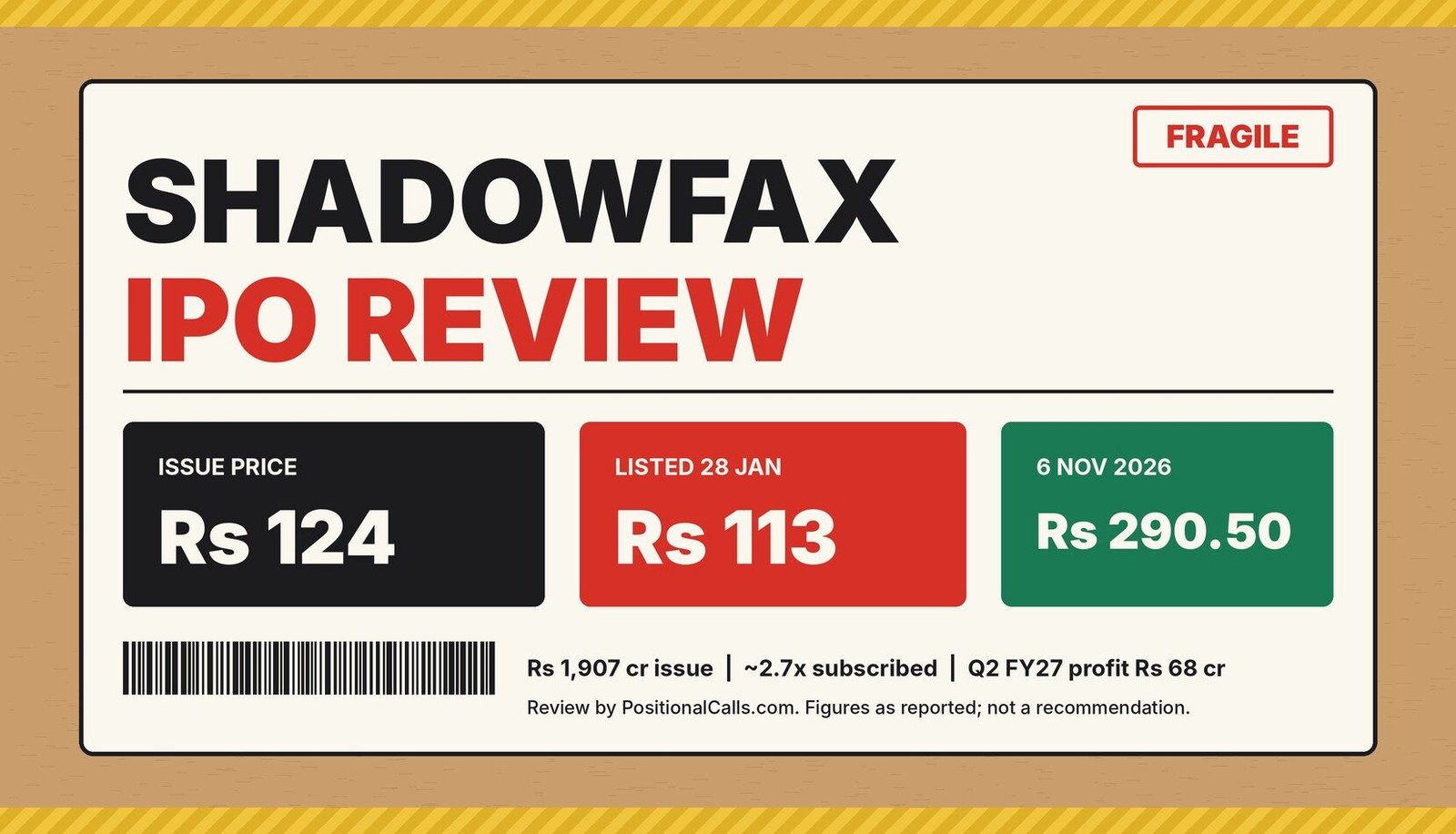
Shadowfax IPO review: the Rs 1,907 crore issue (20 to 22 January 2026, Rs 124 upper band) was subscribed about 2.7 to 2.9 times and listed on 28 January at Rs 113, an 8.87% discount. By 6 November 2026 the shares were Rs 290.50, 134% above the issue price (my calculation), after Q2 FY27 profit of Rs 68 crore.
Latest update (Wednesday, 11 November 2026, 8:30 PM IST): The IPO closed and listed in January 2026. The newest price I could verify is Rs 290.50 on 6 November 2026 (3:29 PM, Upstox). Q2 FY27 results were filed on 29 October 2026. I found no broker target for the stock, so none is shown.
Key takeaways
- Issue: 20 to 22 January 2026, price band Rs 118 to Rs 124, lot of 120 shares (Rs 14,880 at the upper band), Rs 1,000 crore fresh issue plus a Rs 907 crore offer for sale.
- Subscription: about 2.72 times (Sahi) or 2.86 times (5paisa) overall; QIB about 3.8 to 4.0 times, retail about 2.3 to 2.4 times, non-institutional below 1 time.
- Listing: 28 January 2026 at Rs 113 on BSE (Rs 112.60 on NSE per one report), 8.87% below Rs 124; NSE close Rs 109.18, down 11.95% from the issue price (my calculation).
- GMP: the grey market peaked at Rs 16 on 16 January and fell to Rs 1.50 by 22 January; the actual debut was Rs 11 below the issue price.
- Results: Q2 FY27 revenue Rs 1,538 crore (+56.6%), profit Rs 68 crore (+421.9%), as reported; H1 FY27 profit Rs 133.35 crore against Rs 21.03 crore.
- Price: Rs 290.50 on 6 November 2026 against the Rs 124 issue price; the 52-week range is Rs 98.55 to Rs 302.35 (Upstox).
In plain words: Shadowfax Technologies is a logistics company that delivers parcels and hyperlocal orders for online sellers. It sold shares to the public in January 2026 at Rs 124, was priced down on listing day, and has since traded far above the issue price.
Data note: Figures are as of 11 November 2026, 8:30 PM IST. They follow Sahi, 5paisa, IPOWatch, Business Standard, Outlook Business, Kotak Neo, Inc42, Angel One, Upstox and the Upstox price page. I did not open the prospectus or the filings. Where sources differ, both numbers are shown. Derived numbers are my calculation. GMP is an unofficial grey-market estimate.
In this post
What were the Shadowfax IPO dates, price band and lot size?
The Shadowfax IPO opened on 20 January 2026 and closed on 22 January 2026 with a price band of Rs 118 to Rs 124 and a lot of 120 shares. One lot cost Rs 14,880 at the upper band (my calculation). Allotment was on 23 January and listing on 28 January 2026.
The issue was a book-built mainboard offer on NSE and BSE, with a fresh issue of Rs 1,000 crore and an offer for sale of about Rs 907 crore, a total of Rs 1,907 crore. The registrar was KFin Technologies. The lead managers were ICICI Securities, Morgan Stanley India and JM Financial, per Business Standard.
Shadowfax IPO review: the key dates table
| Event | Date | Note | Source |
|---|---|---|---|
| Issue opens | 20 Jan 2026 | Tuesday | Business Standard, Sahi |
| Issue closes | 22 Jan 2026 | Thursday | Business Standard, Sahi |
| Basis of allotment | 23 Jan 2026 | Friday | Business Standard, IPOWatch |
| Listing | 28 Jan 2026 | Wednesday; NSE and BSE | Sahi, 5paisa, IPOWatch |
| Anchor round | Rs 856 crore at Rs 124 | 6.9 crore shares | Sahi |
Cite this table: Shadowfax IPO key dates, as of 11 November 2026, 8:30 PM IST, PositionalCalls.
Business Standard’s price-band article names the listing date as “Wednesday, 23 January 2026”, but 23 January 2026 is a Friday and the other sources give 28 January, a Wednesday. I treat 28 January as the listing date. I did not open the exchange notice, so the dates are as reported.
Shadowfax IPO review: price band, lot and the cost of one lot
| Item | Figure | How it is derived |
|---|---|---|
| Price band | Rs 118 to Rs 124 | Business Standard |
| Issue price | Rs 124 | Upper band; Sahi, 5paisa |
| Lot size | 120 shares | Business Standard |
| One lot at the lower band | Rs 14,160 | My calculation: 120 x 118 |
| One lot at the upper band | Rs 14,880 | My calculation: 120 x 124; matches Business Standard |
Cite this table: Shadowfax IPO price band and lot, Business Standard and Sahi, as of 11 November 2026, 8:30 PM IST.
In this Shadowfax IPO review the anchor round is a useful check. It raised Rs 856 crore at Rs 124 for 6.9 crore shares, which ties: 6.9 crore times Rs 124 is Rs 855.6 crore (my calculation). An anchor round at the top of the band signals that institutions accepted the price before the public issue opened, though it did not protect the listing.
How was the Shadowfax issue structured, and what was the money for?
The Shadowfax IPO was a Rs 1,000 crore fresh issue of about 8.06 crore shares and an offer for sale of up to 7.32 crore shares worth about Rs 907 crore. Selling shareholders included Flipkart India, IFC, Qualcomm Asia Pacific and Nokia Growth Partners.
| Part of the issue | Size | Note |
|---|---|---|
| Fresh issue | Rs 1,000 crore (80.6 million shares) | Money goes to the company; ties to Rs 999.4 crore at Rs 124 (my calculation) |
| Offer for sale | Up to Rs 907.27 crore (73.2 million shares) | Money goes to selling shareholders; Rs 907.7 crore at Rs 124 (my calculation) |
| Total | Rs 1,907 crore | Fresh plus OFS |
Cite this table: Shadowfax IPO structure, Business Standard, as of 11 November 2026, 8:30 PM IST.
The selling shareholders named by Business Standard are Flipkart India, Eight Roads Investments Mauritius II, International Finance Corporation, Qualcomm Asia Pacific, Nokia Growth Partners, NewQuest Asia Fund and Miare Asset. About 48% of the issue was an exit for existing investors, which is why the company received only the Rs 1,000 crore fresh portion (my calculation: 907 / 1,907).
Shadowfax IPO review: use of the fresh issue, and a figure that conflicts
| Object of the issue | Sahi | Business Standard |
|---|---|---|
| Network infrastructure and automation | Rs 423 crore | Rs 42.34 crore |
| Lease payments for first-mile, last-mile and sort centres | Rs 139 crore | Rs 13.86 crore |
| Branding, marketing and communication | Rs 89 crore | Rs 8.85 crore |
| Balance | Acquisitions and general corporate purposes | Unidentified acquisitions and general corporate purposes |
Cite this table: Shadowfax IPO objects of the issue, Sahi and Business Standard, as of 11 November 2026, 8:30 PM IST. The two sources differ by a factor of ten.
The two sources differ by exactly a factor of ten on all three lines. The Sahi figures add to Rs 651 crore of a Rs 1,000 crore fresh issue, which is plausible, while Business Standard’s add to about Rs 65 crore. A decimal slip in one source is the likely reason (my reading), but I could not open the prospectus, so I show both.
How many times was the Shadowfax IPO subscribed?
The Shadowfax IPO was subscribed about 2.72 times by Sahi’s count and 2.86 times by 5paisa’s. Qualified institutions bid 3.8 to 4.0 times, retail investors 2.3 to 2.4 times and non-institutional investors less than once.
| Category | Sahi | 5paisa | Comment |
|---|---|---|---|
| Overall | About 2.72x | 2.86x | Different snapshots |
| QIB | 3.81x | 4.00x | Institutions |
| Non-institutional | 0.84x | 0.88x | Undersubscribed |
| Retail | 2.31x | 2.43x | Retail investors |
| Employees | 2.07x | 2.17x | Employee quota |
Cite this table: Shadowfax IPO subscription by source, as of 11 November 2026, 8:30 PM IST. I did not open exchange bid data.
Non-institutional investors, the high-net-worth bucket, did not fill their quota, which is unusual and a sign that the larger private investors were cautious about the price. 5paisa also reports 2,25,616 applications and calls the demand tepid.
Shadowfax IPO review: how to read a 2.7 times subscription
For a Shadowfax IPO review, a 2.7 times overall subscription is moderate for a Rs 1,907 crore issue. With retail at about 2.3 to 2.4 times, an average retail applicant had roughly a 40% to 43% chance of an allotment (my illustration: 1 / 2.43 and 1 / 2.31), not a probability for any one applicant. The weak non-institutional response, and a GMP that fell during the bidding, were the clearest warning signs before the debut.
- Open the KFin Technologies IPO status page and select Shadowfax Technologies Limited, if the page is still listed.
- Enter your PAN, application number or demat account number.
- Or use the NSE or BSE bid-check pages while they are active.
- Check your demat account; credit followed the 23 January allotment, ahead of listing.
- If you did not receive shares, confirm that your bank released the UPI mandate.
For a walk-through that applies to any issue, see how to check IPO allotment status.
What did the Shadowfax IPO GMP show, and how did it compare with the listing?
The Shadowfax IPO GMP was Rs 16 on 16 and 17 January, fell to Rs 1 on 21 January and was Rs 1.50 on 22 January, per IPOWatch. The shares listed at Rs 113, Rs 11 below the issue price, so the grey market missed by about Rs 12.50 a share (my calculation).
| Date (2026) | GMP, Rs | Implied premium on Rs 124 |
|---|---|---|
| 16 Jan | 16 | 12.90% |
| 17 Jan | 16 | 12.90% |
| 19 Jan | 9 | 7.26% |
| 20 Jan | 6 | 4.84% |
| 21 Jan | 1 | 0.81% |
| 22 Jan | 1.5 | 1.21% |
Cite this table: Shadowfax IPO GMP history, IPOWatch. Unofficial grey-market estimates; no figures were shown after 22 January.
The trend in the Shadowfax IPO review was the signal: the grey market halved before bidding opened and fell almost to zero by the last day, while the issue price stayed fixed. Sahi also reports a GMP of about Rs 4 on 25 January, though its explanation implies a discount, so that figure is internally inconsistent; I show only the IPOWatch series.
Shadowfax IPO review: the listing-day record
| Item | Figure | Source or note |
|---|---|---|
| Issue price | Rs 124 | Upper band |
| Listing price, BSE and 5paisa | Rs 113.00 | 8.87% below Rs 124 (my calculation) |
| Listing price, NSE | About Rs 112.60 | Outlook Business; 9.19% below |
| Day high | Rs 119.55 | 5paisa; 3.59% below issue |
| Close, NSE | Rs 109.18 | Outlook Business; 11.95% below issue (my calculation) |
| Close, BSE | Rs 109.10 | Outlook Business |
| Market value at listing | Rs 6,712.13 crore | 5paisa; against Rs 7,168.85 crore at the issue price |
Cite this table: Shadowfax listing-day figures, 5paisa and Outlook Business, as of 11 November 2026, 8:30 PM IST.
The debut ended below the opening price, about 12% under the issue price. At the close of the first session, an allottee holding one lot of 120 shares was down about Rs 1,778 on Rs 14,880 invested (my calculation: (124 – 109.18) x 120).
Shadowfax IPO review: broker views
I found no published broker rating or target price for Shadowfax in the sources I opened for this Shadowfax IPO review, so none is shown. PositionalCalls gives no targets of its own.
What do the Shadowfax financials and valuation show?
Revenue grew from Rs 1,415 crore in FY23 to Rs 2,485 crore in FY25, and profit moved from a Rs 143 crore loss to a Rs 6.4 crore profit. The issue price valued the company at about Rs 7,169 crore, more than 1,000 times FY25 profit.
| Rs crore | FY23 | FY24 | FY25 | H1 FY26 |
|---|---|---|---|---|
| Revenue | 1,415 | 1,885 | 2,485 | 1,819.80 (total income) |
| Profit after tax | -143 | -12 | 6.4 | 21.03 |
| Revenue growth (my calculation) | n/a | 33.2% | 31.8% | n/a |
Cite this table: Shadowfax financials, Sahi and Angel One; H1 FY26 from the year-ago column of the Q2 FY27 results; calculations by PositionalCalls.
In this Shadowfax IPO review the financial picture is simple: the company moved to a profit only in FY25, and the profit was small. The half-year to September 2025 total income of Rs 1,819.80 crore and profit of Rs 21.03 crore tie to the year-ago figures in the later Q2 FY27 results, which is a useful check that the IPO-era numbers were consistent.
Shadowfax IPO review: valuation at the issue price
| Metric | Figure | Comment |
|---|---|---|
| Market value at Rs 124 | About Rs 7,169 crore | Sahi; 5paisa shows Rs 7,168.85 crore |
| Price to sales, FY25 | About 2.9 times | My calculation: 7,168.85 / 2,485 |
| Price to sales per Sahi | About 2.2 times | Conflicts with my calculation |
| Price to earnings, FY25 | Above 1,000 times | My calculation: about 1,120 times on Rs 6.4 crore |
Cite this table: Shadowfax IPO valuation, Sahi, 5paisa and my calculation, as of 11 November 2026, 8:30 PM IST.
PositionalCalls WhatsApp channel
IPO updates in plain words
- Dates and price bands when companies confirm them
- Subscription and allotment checks without tips
- Listing outcomes against the grey market
Sahi’s 2.2 times price to sales does not tie to Rs 7,169 crore over Rs 2,485 crore, which is about 2.9 times, so I show both. A price to earnings above 1,000 times says that the IPO valued growth and margin potential, not current profit.
What does the business behind this Shadowfax IPO review do, and how big is it?
Shadowfax runs a nationwide delivery network for e-commerce parcels and hyperlocal orders. At 30 September 2025 it had 4,299 touchpoints covering 14,758 pin codes, per Business Standard, and in Q2 FY27 it handled 27.1 crore orders, of which 21.7 crore were express parcels and 5.4 crore hyperlocal, per Inc42.
| Operating figure | Reported | Source |
|---|---|---|
| Touchpoints | 4,299 (30 Sep 2025) | Business Standard, from the RHP |
| Pin codes covered | 14,758 (30 Sep 2025) | Business Standard |
| Orders, Q2 FY27 | 27.1 crore (+69.7%) | Kotak Neo, Inc42 |
| Express parcel orders | 21.7 crore | Inc42; about 80% of orders (my calculation) |
| Hyperlocal orders | 5.4 crore | Inc42; about 20% of orders (my calculation) |
| Hyperlocal revenue growth | +87.7% year on year | Angel One |
Cite this table: Shadowfax operating figures, Business Standard, Inc42, Kotak Neo and Angel One, as of 11 November 2026, 8:30 PM IST. Split ties: 21.7 + 5.4 = 27.1.
The order split ties: 21.7 crore plus 5.4 crore is 27.1 crore (my calculation). Express parcels are about four-fifths of volume, and the faster-growing hyperlocal business is about one-fifth. That mix matters for this Shadowfax IPO review because the fresh issue proceeds were meant to fund network capacity, automation and leases.
Shadowfax IPO review: guidance, and a conflict between sources
Upstox and Inc42 both say the company gave no numeric guidance with its Q1 and Q2 FY27 results, quoting only the chief executive’s comments that Q1 was the most profitable quarter in its history and that it expects to remain India’s fastest-growing third-party logistics company. A Sahi headline from the Q1 coverage says the company raised its FY27 revenue growth forecast to 38% to 40%. I opened only the headline, not the article, so I cannot say which statement is right; the filing and the investor presentation would settle it.
| Check | What to compare | Mark |
|---|---|---|
| FY27 revenue growth | Q2 FY27 growth against any stated forecast | Q2 revenue growth was 56.6% as reported; the Sahi headline cites 38% to 40% for the year |
| Margin | Ind AS EBITDA margin each quarter | 6.77% in Q1; 6.7% in Q2 |
| Orders | Orders per quarter and growth | 27.1 crore, +69.7% in Q2 |
Cite this table: Shadowfax guidance check, Sahi headline, Upstox and Inc42, as of 11 November 2026, 8:30 PM IST. Not verified against the filing.
If the 38% to 40% forecast is correct, the Q2 growth of 56.6% is well above the full-year figure, which would imply slower growth later in the year. That is an arithmetic observation, not a forecast, and it depends on a statement I could not confirm. Anyone reading this Shadowfax IPO review for the later price move should keep that uncertainty in view.
A short timeline of the Shadowfax IPO review period
| Date | Event | Source |
|---|---|---|
| 20 to 22 Jan 2026 | IPO bidding; GMP fell from Rs 16 on 16 Jan to Rs 1.50 | IPOWatch, Business Standard |
| 28 Jan 2026 | Listing at Rs 113; NSE close Rs 109.18 | 5paisa, Outlook Business |
| 31 Jul 2026 | Q1 FY27 results: revenue Rs 1,358 crore, profit Rs 65 crore | Upstox |
| 29 Oct 2026 | Q2 FY27 results: revenue Rs 1,538 crore, profit Rs 68 crore | Kotak Neo, Inc42 |
| 6 Nov 2026 | Price Rs 290.50; market value Rs 16,397.62 crore | Upstox |
Cite this table: Shadowfax IPO review timeline, as of 11 November 2026, 8:30 PM IST, PositionalCalls.
What did one lot of the Shadowfax IPO do after listing?
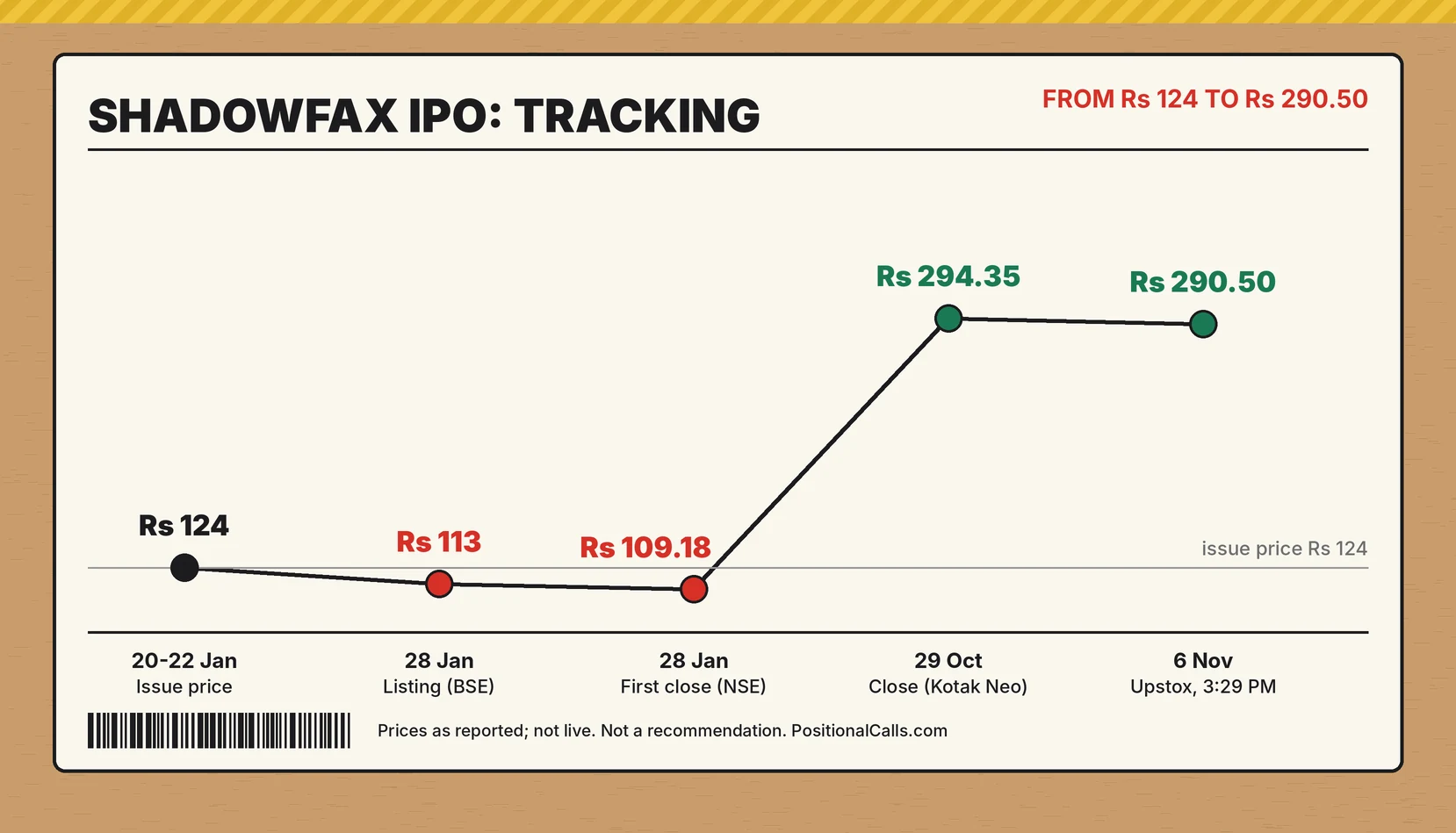
One lot of 120 shares cost Rs 14,880. It was worth Rs 13,560 at the Rs 113 listing price and about Rs 13,102 at the Rs 109.18 first close. At Rs 290.50 on 6 November 2026 it was worth about Rs 34,860, a gain of Rs 19,980 on the issue price (my calculation).
| Price point | Price per share | Change vs Rs 124 | Value of one lot (120) | Gain or loss |
|---|---|---|---|---|
| Issue price | Rs 124 | 0% | Rs 14,880 | Rs 0 |
| Listing, 28 Jan | Rs 113 | -8.87% | Rs 13,560 | -Rs 1,320 |
| First close, NSE | Rs 109.18 | -11.95% | Rs 13,102 | -Rs 1,778 |
| 52-week low | Rs 98.55 | -20.5% | Rs 11,826 | -Rs 3,054 |
| Close, 29 Oct (Kotak Neo) | Rs 294.35 | +137.4% | Rs 35,322 | +Rs 20,442 |
| 6 Nov, 3:29 PM | Rs 290.50 | +134.3% | Rs 34,860 | +Rs 19,980 |
Cite this table: Shadowfax one-lot outcome, my calculation from published prices; before charges and tax. Not a recommendation.
These figures apply only to an applicant who received a lot. The 52-week low of Rs 98.55 shows that the shares fell about 20% below the issue price at some point before the later rise. Gains and losses on listed shares are taxable, and the rules are covered in capital gains tax on shares.
Shadowfax IPO review: five lessons from the debut
- The grey market warned early: GMP fell from Rs 16 to Rs 1.50 during the offer.
- Read non-institutional demand: it was below 1 time.
- A bad debut is not the final result: the shares were up 134% from the issue price by 6 November.
- A good outcome does not prove the GMP was wrong or right: the issue and the later price are different questions.
- Price to earnings above 1,000 times meant the story was growth: later results are what tested it.
None of this predicts any other IPO, and the Shadowfax IPO review is one case. For a contrasting listing, see Jio Platforms IPO GMP versus listing.
What have Shadowfax’s Q1 and Q2 FY27 results shown since listing?
Shadowfax reported Q2 FY27 revenue of Rs 1,538 crore, up 56.6%, and profit of Rs 68 crore, up 421.9%, on 29 October 2026. Q1 FY27 revenue was Rs 1,358 crore and profit Rs 65 crore. Half-year profit was Rs 133.35 crore against Rs 21.03 crore a year earlier.
| Rs crore | Q2 FY27 | Year earlier | Change | Q1 FY27 |
|---|---|---|---|---|
| Revenue from operations | 1,537.7 | 982 | +56.6% | 1,358 |
| Total income | 1,558.14 | 988.06 | +57.7% | 1,379.18 |
| Profit after tax | 67.95 | 13.02 | +421.9% | 65.40 |
| Adjusted EBITDA | 77 (5.0% margin) | 28 (2.8%) | +177.4% as reported | Not found |
| Ind AS EBITDA | 104 (6.7%) | Not found | n/a | 92 (6.77%) |
| Orders (crore) | 27.1 | 16 | +69.7% | Not found |
Cite this table: Shadowfax Q2 FY27 results, Kotak Neo, Inc42 and Angel One (29 Oct 2026), as of 11 November 2026, 8:30 PM IST. Not checked against the filing.
| Half-year, Rs crore | H1 FY27 | H1 FY26 | Change | Check |
|---|---|---|---|---|
| Total income | 2,937.32 | 1,819.80 | +61.4% | Q1 1,379.18 + Q2 1,558.14 ties (my calculation) |
| Profit after tax | 133.35 | 21.03 | +534.1% | Q1 65.40 + Q2 67.95 ties (my calculation) |
Cite this table: Shadowfax H1 FY27, Angel One and my calculation, as of 11 November 2026, 8:30 PM IST.
For the Shadowfax IPO review the half-year figures tie to the quarters, and year-on-year growth stayed above 55% for six quarters, per Angel One. Revenue rose about 13% from Q1 to Q2 (my calculation: 1,538 / 1,358), while profit rose 3.9%, so margins did not expand.
Shadowfax IPO review: margin and the two EBITDA figures
Two EBITDA measures appear. Q2 adjusted EBITDA of Rs 77 crore is 5.0% of revenue, and Ind AS EBITDA of Rs 104 crore is 6.7%. The Q1 figure of Rs 92 crore at 6.77% matches the Ind AS basis, so on that basis the margin was flat from Q1 to Q2 (my reading). The adjusted figure for Q1 is not in the pages I opened, so I do not compare it.
The profit margin on revenue was 4.4% in Q2 and 4.8% in Q1 (my calculation: 67.95 / 1,537.7 and 65.4 / 1,358). A 4% to 5% net margin is thin for a company valued at about 60 times annualised profit on Upstox data.
What to track after this Shadowfax IPO review
- Whether profit growth keeps pace with revenue as the company expands its network.
- Hyperlocal growth, which Angel One reports at 87.7% year on year in Q2.
- Orders per quarter, 27.1 crore in Q2.
- Anchor and pre-IPO lock-in expiries, which I did not find and which should be checked on the exchanges.
- Any broker coverage, which I could not find.
| Price and valuation, 6 Nov 2026 | Figure | Source or note |
|---|---|---|
| Price | Rs 290.50 | Upstox, 3:29 PM |
| Market capitalisation | Rs 16,397.62 crore | Upstox |
| 52-week range | Rs 98.55 to Rs 302.35 | Upstox |
| Price to earnings | 76.16 | Upstox |
| Price to book | 9.05 | Upstox |
| Price below the 52-week high | 3.9% | My calculation |
| Market value vs the issue-price value | +128.7% | My calculation: 16,397.62 / 7,168.85 |
Cite this table: Shadowfax price snapshot, Upstox and my calculation; not live.
How do I verify Shadowfax IPO details and avoid fake alerts?
Verify Shadowfax figures on the NSE and BSE announcement pages and the company filings, not through a message link. No genuine allotment or results page asks for money, an OTP or a login.
- Open the NSE or BSE website directly and search for Shadowfax Technologies Limited.
- Read the prospectus summary for the price band, reservation and objects of the issue.
- Open the Q2 FY27 results filed on 29 October 2026 and compare revenue, profit and EBITDA with this page.
- Cross-check the price on the exchange, not on a single website.
- Ignore any message that promises a guaranteed listing gain, a paid GMP group or an allotment for a fee.
Fake IPO links and paid tip groups multiply around every issue, including any Shadowfax IPO review shared on messaging apps. PositionalCalls is not SEBI-registered, gives no buy or sell calls and never asks for payment.
What do most people miss about the Shadowfax IPO?
In this Shadowfax IPO review, most readers miss the weak non-institutional demand, the fall of the grey market during bidding, the source conflicts and the fact that a poor listing was followed by a very large later gain.
Analyst’s note. What stands out: a discount listing, a falling grey market and weak non-institutional demand all came before a strong run in the listed results. What is easy to miss: the shares traded about 20% below the issue price at their low and about 134% above it by November. What would change the picture: a margin that falls from the Q1 and Q2 level. Caution: I did not open the prospectus or the filings, and I found no broker view. Reader action: verify on the exchange and treat GMP as sentiment only.
Bottom line
This Shadowfax IPO review shows a Rs 1,907 crore issue that was subscribed about 2.7 times, listed 8.87% below Rs 124 and traded at Rs 290.50 by 6 November 2026, with Q2 FY27 profit of Rs 68 crore as reported. For other listings, see IPO listing gains in November 2026.
PositionalCalls WhatsApp channel
Never miss an IPO update
- Upcoming IPO dates
- GMP explained, never promised
- Updated posts as they go live
Shadowfax IPO review: frequently asked questions
What was the Shadowfax IPO price band and lot size?
The Shadowfax IPO price band was Rs 118 to Rs 124 a share with a lot of 120 shares. One lot cost Rs 14,880 at the upper band (my calculation). The issue ran from 20 to 22 January 2026, with allotment on 23 January and listing on 28 January 2026.
What was the Shadowfax IPO GMP?
In this Shadowfax IPO review, the grey market premium was Rs 16 on 16 and 17 January, Rs 9 on 19 January, Rs 1 on 21 January and Rs 1.50 on 22 January, per IPOWatch. It is an unofficial estimate. The shares listed Rs 11 below the issue price.
What was the Shadowfax listing price?
Shadowfax listed on 28 January 2026 at Rs 113 on BSE, 8.87% below the Rs 124 issue price (my calculation). Outlook Business puts the NSE opening near Rs 112.60. The NSE close was Rs 109.18, about 11.95% below the issue price.
How many times was the Shadowfax IPO subscribed?
The Shadowfax IPO review sources differ: Sahi gives about 2.72 times overall and 5paisa gives 2.86 times. Qualified institutions bid 3.8 to 4.0 times, retail 2.3 to 2.4 times and non-institutional investors 0.84 to 0.88 times. I did not open exchange bid data.
What was the Shadowfax IPO issue structure?
The Shadowfax IPO was a Rs 1,907 crore issue made up of a Rs 1,000 crore fresh issue and an offer for sale of about Rs 907 crore. Sellers included Flipkart India, IFC, Qualcomm Asia Pacific and Nokia Growth Partners. The anchor round raised Rs 856 crore at Rs 124.
What is the Shadowfax share price after listing?
Upstox shows Rs 290.50 on 6 November 2026 at 3:29 PM, with a market value of Rs 16,397.62 crore and a 52-week range of Rs 98.55 to Rs 302.35. That is 134% above the Rs 124 issue price (my calculation). I could not verify a later price.
What were Shadowfax Q2 FY27 results?
Shadowfax reported Q2 FY27 revenue of Rs 1,538 crore, up 56.6%, and profit of Rs 68 crore, up 421.9%, on 29 October 2026, per Kotak Neo and Inc42. Adjusted EBITDA was Rs 77 crore, a 5.0% margin. Half-year profit was Rs 133.35 crore against Rs 21.03 crore.
Why did the Shadowfax IPO list at a discount?
Several signals preceded the Shadowfax IPO discount listing: the grey market fell from Rs 16 to Rs 1.50 during bidding, non-institutional demand was below 1 time, and profit was small. These are observations from published data, not a verified cause, and the shares later traded far above the issue price.
Who was the Shadowfax IPO registrar and how did I check allotment?
KFin Technologies was the registrar. Allotment could be checked on the KFin IPO status page, or on the NSE or BSE bid-check pages, with a PAN, application number or demat account. Shares were credited after the 23 January allotment, ahead of the 28 January listing.
Is this a recommendation to buy Shadowfax shares?
No. This Shadowfax IPO review is not a recommendation, and PositionalCalls is not SEBI-registered. It gives no buy, sell or hold view and no price target, and I found no broker target to report. Verify on the exchange and consult a registered adviser before investing.
Sources
- Business Standard: Shadowfax sets IPO price band at Rs 118-124, January 2026.
- Sahi: Shadowfax IPO listing review, published 28 January 2026.
- 5paisa: Shadowfax IPO weak debut, 28 January 2026.
- IPOWatch: Shadowfax IPO GMP, January 2026.
- Outlook Business: Shadowfax shares end debut session in red, 28 January 2026.
- Kotak Neo: Shadowfax Q2 FY27 results, 29 October 2026.
- Inc42: Shadowfax Q2 profit zooms over 5x, October 2026.
- Angel One: Shadowfax share price in focus after Q2 FY27, 29 October 2026.
- Upstox: Shadowfax Q1 FY27 results, 31 July 2026.
- Upstox: Shadowfax share price, snapshot 6 November 2026.
Disclosure: PositionalCalls.com is not a SEBI-registered research analyst or investment adviser. Investments in securities markets are subject to market risks. Read all related documents carefully before investing. Returns are never guaranteed. PositionalCalls is an independent research and education site founded by Shubham Chaudhary. Nothing here is a recommendation, target or investment advice. How I researched this: for the Shadowfax IPO review I read Business Standard, Sahi, 5paisa, IPOWatch, Outlook Business, Kotak Neo, Inc42, Angel One and Upstox, noted where sources differ, and marked every derived number as my calculation. I did not open any company filing or exchange document. Figures are as of 11 November 2026, 8:30 PM IST.

Shubham Chaudhary is the founder of PositionalCalls, an independent Indian stock market research website. He writes company fundamentals, quarterly results analysis, IPO analysis and sector research for NSE and BSE listed companies, with a focus on banking stocks, insurance and long-term value investing. Every article is built from primary sources such as RBI, SEBI, NSE and BSE filings and company annual reports, and states its risks plainly in simple language for retail investors.
Coverage areas Our research standards- Numbers checked against NSE, BSE and SEBI filings
- Risks and limits stated in every article
- No paid promotions or broker tie-ups
- Articles updated when new filings arrive