

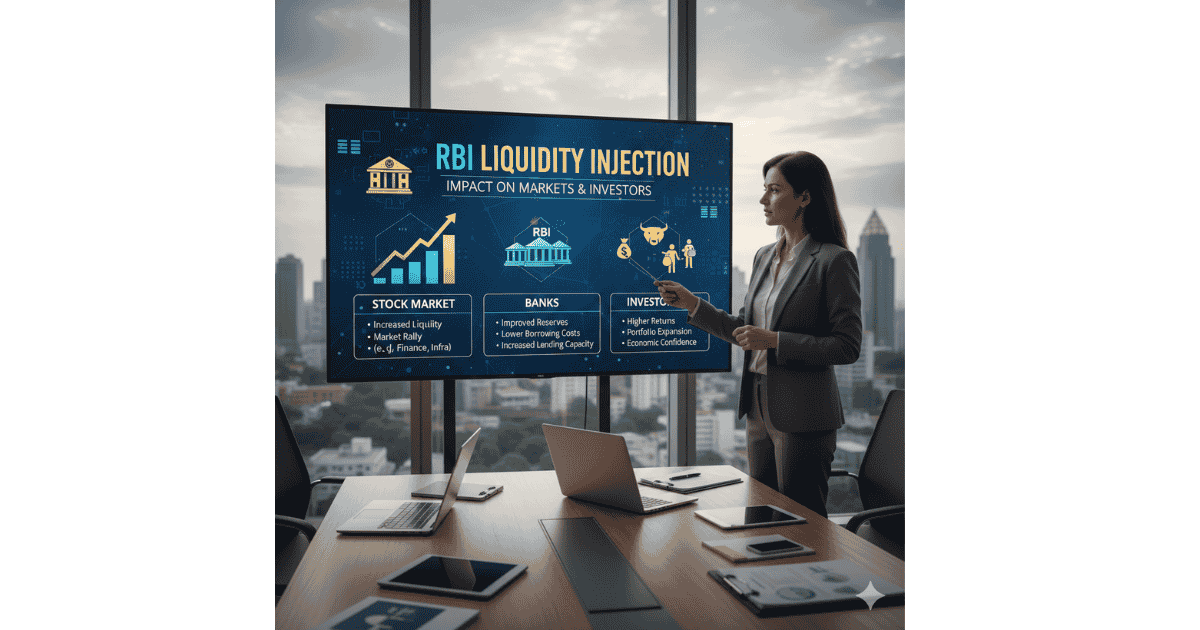
RBI Liquidity Injection: ₹2 Lakh Crore Boost to Banks, Rupee Pressure & Stock Market Impact
RBI liquidity injection into banks explained. This report covers reasons behind RBI’s ₹2 lakh crore liquidity boost, impact on bank stocks, rupee volatility, bond yields, stock market reaction, investor sentiment and future outlook.
• Banking system liquidity deficit narrowed from ~₹2.3 lakh crore to ~₹0.9–₹1.2 lakh crore
• USD/INR trading near ₹83.0–₹83.7 range (volatile)
• 10Y G-Sec yield hovering near 7.20%–7.35%
• Bank stocks showing mixed reaction (support + volatility)
• Market sentiment: Cautiously supportive, not bullish
📊 RBI Liquidity Injection: Market Impact Dashboard
| Indicator | Current Status | Impact Level |
|---|---|---|
| Banking System Liquidity | Deficit narrowing 📉→📈 | High |
| USD/INR | ₹83.0–₹83.7 (Volatile) ⚠️ | Medium-High |
| 10Y Bond Yield | 7.20%–7.35% 📊 | Medium |
| Nifty Bank Index | 46,500–48,800 Range | Medium-High |
| FPI Flows | Net Outflows (₹3,000–₹8,000 Cr) | Medium |
| Bank Stocks Sentiment | Neutral | Moderate |
| Market Volatility | High | High |
🏦 RBI Liquidity Injection: Tools & Breakdown
| RBI Instrument | Approx Amount | Purpose |
|---|---|---|
| OMO (Bond Purchases) | ₹60,000 – ₹80,000 Cr | Lower yields & inject liquidity |
| Forex Swap Auctions | ₹80,000 – ₹1,00,000 Cr | Ease dollar liquidity & rupee pressure |
| Repo / VRR Operations | ₹30,000 – ₹50,000 Cr | Short-term liquidity support |
| MSF / Standing Facility | ₹10,000 – ₹20,000 Cr | Emergency liquidity buffer |
| Total Liquidity Injection | ₹2,00,000 Cr+ | System-wide support |
🤖 RBI Market Intelligence Engine
🧾 Why Did RBI Inject Massive Liquidity into Banks?
RBI announced liquidity injection amid rupee weakness, rising bond yields, tight banking liquidity and global risk aversion.
- 📉 Rupee weakness due to strong US dollar
- 📊 Rising government bond yields
- 🏦 Liquidity deficit in interbank markets
- 🌍 Global monetary tightening cycle
- 📉 Persistent FPI outflows
⏳ RBI Liquidity Injection Timeline
| Phase | Event |
|---|---|
| Phase 1 | USD/INR weakens & bond yields rise |
| Phase 2 | Liquidity deficit crosses ₹2 lakh crore |
| Phase 3 | RBI announces ₹2 lakh crore liquidity measures |
| Phase 4 | Bank stocks react & markets partially stabilise |
🏭 Sector-wise Impact
| Sector | Impact | Outlook |
|---|---|---|
| Banking | Positive but volatile | Cautiously supportive |
| NBFCs | Moderate positive | Neutral |
| IT & Exporters | Mixed (rupee benefit) | Stock-specific |
| Infra & Metals | Limited impact | Neutral |
⚖️ Risks vs Opportunities for Investors
| Opportunities | Risks |
|---|---|
| Short-term rally in bank stocks | Rupee depreciation risk |
| Improved credit growth | Global risk-off sentiment |
| Lower systemic liquidity stress | Inflation & rate uncertainty |
🧠 Investor Psychology: What Markets Are Pricing In
- 📊 Liquidity support = short-term relief
- ⚠️ Rupee weakness keeps volatility elevated
- 🏦 Bank stocks outperform only if credit growth accelerates
- 💣 Long-term outlook depends on inflation & global rates
🔮 What Happens Next? (Scenario Analysis)
| Scenario | Rupee | Bank Stocks | Market Impact |
|---|---|---|---|
| Bullish | Stabilises | Rally | Positive |
| Base Case | Range-bound | Sideways | Neutral |
| Bearish | Weakens | Correction | Negative |
🧾 RBI Liquidity Injection: Quick News Summary
• Rupee remains under pressure amid global volatility.
• Bank stocks in focus after RBI intervention.
• Bond yields remain elevated.
• Investors track inflation, FPI flows and RBI policy stance.
🏆 Final Market Verdict
RBI’s liquidity injection is a strong short-term stabiliser for Indian markets and banking stocks. However, rupee pressure and global uncertainty mean volatility will remain elevated.
Current Market Sentiment:
Market Stability Index: /10
Conclusion: This policy move reflects both stress and support in India’s financial system.

Shubham Chaudhary is the founder of PositionalCalls, an independent Indian stock market research website. He writes company fundamentals, quarterly results analysis, IPO analysis and sector research for NSE and BSE listed companies, with a focus on banking stocks, insurance and long-term value investing. Every article is built from primary sources such as RBI, SEBI, NSE and BSE filings and company annual reports, and states its risks plainly in simple language for retail investors.
Coverage areas Our research standards- Numbers checked against NSE, BSE and SEBI filings
- Risks and limits stated in every article
- No paid promotions or broker tie-ups
- Articles updated when new filings arrive