
IPO basics · Explainer
The IPO GMP meaning explained: what grey market premium is, how it is calculated, how kostak rate and subject to sauda differ, why the figure can be wrong, whether it is legal, and what SEBI’s when-listed proposal could change, with a worked example.
Quick answer
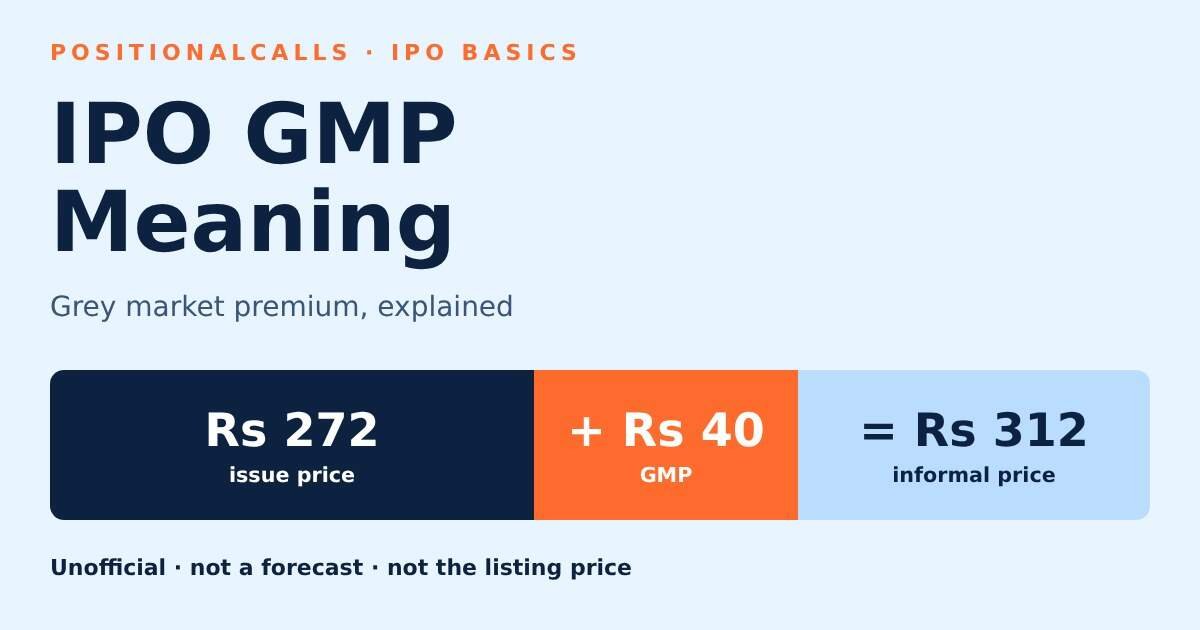
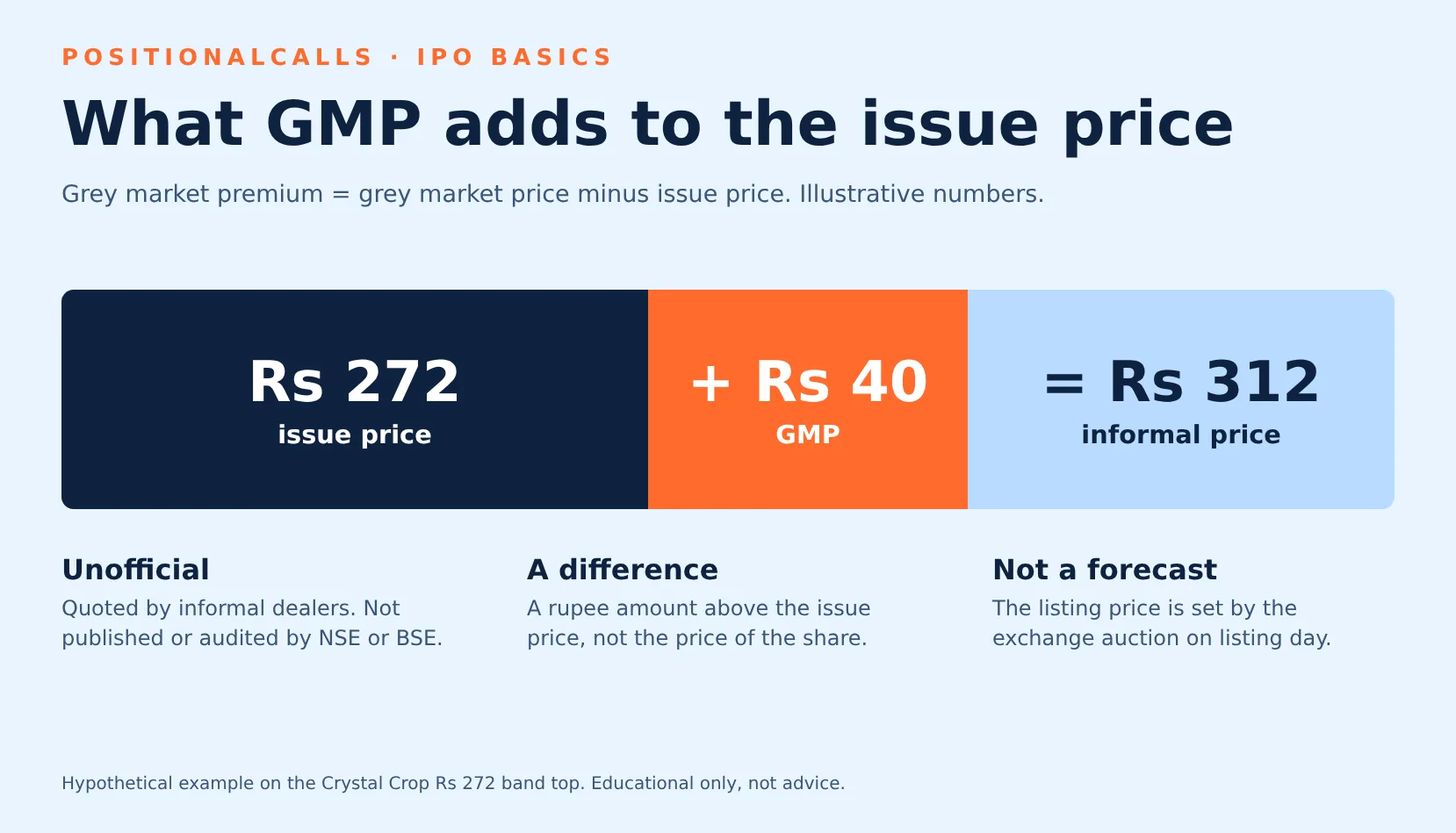
GMP full form in IPO: Grey Market Premium. The IPO GMP meaning is the unofficial extra price buyers pay for IPO shares above the issue price before listing. Informal dealers quote it, not NSE or BSE, and no regulator audits it. A premium of Rs 40 on a Rs 272 issue implies Rs 312.
Latest update (Wednesday, 18 November 2026, 8:05 PM IST): this guide replaces the older short page at this address. The 18 November edit adds a live example of two trackers disagreeing, links to the upcoming IPO hub, and one more report on the status of SEBI’s proposal. All sources are secondary (brokers, a law-school note, trackers and news reports). No SEBI or exchange document defines GMP, and I did not open SEBI’s own statements on the when-listed platform. The legal-status and SEBI sections rest on the reports cited.
Key takeaways
- GMP is a difference: grey market price minus issue price, in rupees.
- It is unofficial: quoted by dealers, not published or audited by any exchange.
- It is not the listing price: the exchange finds that in the listing-day auction.
- It can be wrong: trades are not enforceable and a small group sets the quote.
In plain words: before a new share lists, some people trade it informally at a price above the issue price. That extra amount is the GMP. It tells you what a few dealers were quoting, not what the exchange will do. Nothing on this page tells you to buy, sell or trade any share in the grey market.
Data note: as of Wednesday, 18 November 2026, 8:05 PM IST. The Rs 272 issue price and the 55-share lot in the worked example are the Crystal Crop Protection top of band and lot as reported by Chittorgarh and Upstox. The premiums in the example are hypothetical, not quotes and not forecasts.
What is GMP in IPO? Full form and IPO GMP meaning
IPO GMP stands for grey market premium. It is the extra amount people are willing to pay for an IPO share, above the issue price, in an unofficial market before the share lists on NSE or BSE.
5paisa describes the grey market as an informal, parallel market where shares and IPO applications are bought and sold before they are officially listed. It says the market operates without oversight from SEBI or any stock exchange, and that trading typically happens offline, in person and in cash. The IPO GMP meaning follows from that: the premium is the price of enthusiasm in a market nobody supervises.
GMP full form and what each letter means
The GMP full form is grey market premium. Grey describes the market, which sits between a regulated exchange and an illegal one, as Alice Blue puts it. Market is the informal place where the trades happen. Premium is the amount above the issue price. Some pages expand the abbreviation with extra words, but the full form of GMP in an IPO is simply those three.
The IPO GMP meaning in one line
The IPO GMP meaning is a rupee difference between an informal price and the official issue price. It is not a stock exchange price, not a forecast and not a recommendation. PositionalCalls is not SEBI-registered, and this guide explains the term. It does not suggest that you trade in the grey market or that any issue will list at a premium.
How the IPO GMP is calculated
GMP equals the grey market price minus the IPO issue price. If an issue is priced at Rs 700 and its shares change hands informally at Rs 850, the GMP is Rs 150, as 5paisa explains.
| Issue price | Informal grey market price | GMP | GMP as % of issue price (my calculation) | Source |
|---|---|---|---|---|
| Rs 700 | Rs 850 | Rs 150 | 21.43% | 5paisa |
| Rs 500 | Rs 580 | Rs 80 | 16.0% | Sahi |
| Rs 100 | Rs 150 | Rs 50 | 50.0% | India TV News |
Cite this table: PositionalCalls, “How the IPO GMP Is Calculated: Three Published Examples, as of 17 November 2026”; 5paisa, Sahi, India TV News.
The three examples of the IPO GMP meaning use the same arithmetic. The premium is a rupee amount, and the percentage column is my own calculation so that you can compare issues of different sizes. The sources quote the premium in rupees, and the percentage is not a number anyone in the grey market publishes.
Which price does the IPO GMP use as its base?
Sahi says the premium is what informal buyers pay above the IPO’s upper price band. That matters because a band such as Rs 255 to Rs 272 has two possible bases. For the IPO GMP meaning to make sense, you compare the grey market price with the upper end of the band, which is also the price most applicants bid at. If a page does not say which price it used, the premium cannot be checked.
The IPO GMP meaning is a difference, not a price
A common slip is reading a GMP of Rs 40 as the price of the share. It is not. The informal price in the grey market is the issue price plus Rs 40, and the exchange price after listing can be anything. SBI’s published example makes the same point: a band of Rs 500 with a GMP of Rs 150 implies an expected listing near Rs 650, which is an inference from the premium and not a guarantee.
How the grey market works before an IPO lists
The grey market starts after the IPO date and price band are announced, works through informal dealers, and has no exchange, clearing house or regulator behind it. Premiums rise and fall as demand builds or fades.
India TV News says the premium starts forming in the unregulated market after the issue dates and price band are announced. Angel One describes the market as unofficial and unauthorised, working through dealers based on mutual trust, with no legal protection for participants. Business Standard reported in January 2025 that grey market trading is concentrated in select cities in Gujarat and Mumbai and run by a small group of people.
The timing is not always so tidy. Tracker pages showed a premium of Rs 12 for the Foodlink IPO on 19 and 20 November 2026 while its price band was still to be announced, per IPO Guru. Upstox reported the band of Rs 181 to Rs 191 later, and Rs 12 is about 6.3% of the Rs 191 upper band (my calculation). Until a band exists, a premium has no percentage to be measured against.
Who publishes the GMP you see online
No exchange publishes the premium. Websites and apps collect quotes from dealers and show them as a rupee figure. ipomarket.in says the grey market premium is not calculated through any formal or audited process. That means two sites can show different numbers for the same issue, which follows from there being no official source (my reading). A live case: on 13 November, IPO Guru showed Rs 25 for the Mahanadi Coalfields IPO while IPOGyani’s history lists Rs 0 for that date, as the Mahanadi Coalfields IPO guide records. A second case: Stockgro showed Rs 22 on 16 November and Rs 67 on 19 November for the Watrana Rentals IPO while IPO Ji and IPO Central showed no quote, as the Watrana Rentals IPO guide records. This site’s Jio Platforms IPO GMP page shows premiums as reported by third-party trackers, with the same caveat, and the upcoming IPO hub lists each open issue’s quotes with their sources and times.
How GMP moves during an issue
When an issue opens, the IPO GMP meaning becomes a daily talking point as people watch subscription numbers across categories, the stock market and news. The premium changes as those change. A strong day-one subscription can lift the quote and a weak one can lower it. Our IPO investor categories guide explains the QIB, NII and retail buckets whose subscription figures dealers and readers follow.
Kostak rate, subject to sauda and GMP: three grey market terms
GMP is the per-share premium. A kostak rate is a fixed amount paid for your IPO application whether or not it is allotted. Subject to sauda is a deal that is valid only if the seller is allotted shares.
| Term | What it is | Who is paid and when | Source |
|---|---|---|---|
| GMP | Premium per share over the issue price | Reflects the price buyers would pay for the shares, quoted as a rupee amount | 5paisa |
| Kostak rate | Amount for selling the whole IPO application | A fixed amount whether or not the application is allotted | 5paisa; Sahi |
| Subject to sauda | A deal on the shares or application that holds only if allotment happens | Paid only if the seller is allotted shares | India TV News; Alice Blue |
Cite this table: PositionalCalls, “Kostak Rate vs Subject to Sauda vs GMP, as of 17 November 2026”; 5paisa, Sahi, India TV News, Alice Blue.
Sahi describes the two broad forms: share trading, where buyers acquire the right to receive allotted shares at an agreed premium, and application trading, where the whole application is sold for a fixed fee regardless of the allotment outcome. The kostak rate belongs to the second form and subject to sauda sits between them.
Why the three terms are different even though they move together
The IPO GMP meaning concerns the price of the share. Kostak and subject to sauda concern what happens to an application. A high GMP usually goes with a higher kostak rate and a higher subject to sauda rate because all three reflect the same expected demand, but the three have different payoffs. Under a kostak deal the seller is paid even if the application is not allotted. Under subject to sauda the seller is paid only if it is.
None of the three is enforceable
ipomarket.in says the grey market operates outside the formal system, with no official exchanges, no SEBI oversight and no legal contracts, so trades are not enforceable. If a counterparty does not pay or does not deliver, there is no exchange or clearing house to turn to. That is the practical reason this guide explains the terms and does not tell readers to use them.
How to read the premium: what the numbers suggest
A rising premium suggests strong expected demand, and a falling or negative one suggests a flat or discounted listing is expected, according to 5paisa. The numbers describe sentiment and do not set the listing price.
| What the premium does | What the sources say it suggests | Caveat |
|---|---|---|
| Positive | Informal buyers expect the stock to list above the issue price (Sahi) | Unofficial and unaudited |
| Rising | Strong demand and optimism (5paisa) | Can reverse before listing |
| Falling | A flat or discounted listing may be expected (5paisa) | Can recover before listing |
| Negative | Informal buyers price the shares below the issue price (5paisa) | Still not the exchange price |
Cite this table: PositionalCalls, “Reading a Grey Market Premium, as of 17 November 2026”; 5paisa, Sahi.
The table shows how brokers describe the signals behind the IPO GMP meaning. It does not show how often the signals turn out right. None of the sources I read gives a hit rate for GMP versus actual listing prices, so I do not claim one.
The IPO GMP meaning is sentiment, not a forecast
Sahi calls GMP an informal sentiment signal, not a guaranteed predictor of listing performance, and says it is not a reliable indicator. Angel One says the premium reflects demand and investor sentiment but does not guarantee the listing price. The practical reading is that GMP shows what a small informal market thought on a given day.
IPO GMP meaning: the terms you will see on tracker sites
Tracker sites use a small set of terms around the IPO GMP meaning: GMP, grey market price, kostak rate, subject to sauda and estimated listing price. Only the first four appear in the sources; the last is a calculation from them.
| Term | Plain meaning | Where it comes from |
|---|---|---|
| GMP | Grey market premium, the rupee amount above the issue price | 5paisa |
| Grey market price | The informal price, which equals the issue price plus the GMP | 5paisa formula |
| Kostak rate | A fixed amount for selling the application, whether or not it is allotted | 5paisa; Sahi |
| Subject to sauda | A deal that holds only if the seller is allotted shares | India TV News |
| Negative GMP | The informal price is below the issue price | 5paisa |
| Estimated listing price | Issue price plus GMP, the figure some sites show as a likely listing level | SBI example; my calculation |
| Upper band | The top of the price band, the base the premium is measured from | Sahi |
Cite this table: PositionalCalls, “Terms Around the IPO GMP Meaning, as of 17 November 2026”; 5paisa, Sahi, India TV News.
The estimated listing price is the one to be careful with. It is only an addition, issue price plus premium, and it carries all the weaknesses of the premium. The IPO GMP meaning does not become more reliable because a site converts it into a price.
How to read an IPO GMP figure on a tracker site, step by step
- Find the issue price. Use the upper band from the issue page or the exchange notice.
- Note the quoted premium and its time. The IPO GMP meaning is a snapshot, so an old figure tells you little.
- Add the two. Issue price plus premium gives the informal price, such as Rs 272 plus Rs 40 equals Rs 312.
- Convert to a percentage. Divide the premium by the issue price, as in the Rs 40 on Rs 272 example, which is 14.71%.
- Compare with subscription data. The exchanges publish subscription by category, which is official.
- Check a second source. With no official figure, a different tracker may show a different premium.
These steps help you read the IPO GMP meaning in a number. They do not make the number official or predictive.
A worked IPO GMP example
Take one lot of the Crystal Crop Protection IPO: 55 shares at the Rs 272 top of the band. The table shows what hypothetical premiums would imply per lot, as simple arithmetic.
PositionalCalls WhatsApp channel
Get IPO explainers on WhatsApp
- Rule and deadline changes, dated
- Plain-English IPO terms, no tips
- Links to updated IPO guides
| Hypothetical GMP | Implied grey market price (my calculation) | Difference from issue price (my calculation) | Implied gain or loss on one lot (my calculation) |
|---|---|---|---|
| Rs -20 | Rs 252 | Minus 7.35% | Implied loss of Rs 1,100 |
| Rs 0 | Rs 272 | No difference | No implied gain or loss |
| Rs 20 | Rs 292 | Plus 7.35% | Implied gain of Rs 1,100 |
| Rs 40 | Rs 312 | Plus 14.71% | Implied gain of Rs 2,200 |
| Rs 80 | Rs 352 | Plus 29.41% | Implied gain of Rs 4,400 |
Cite this table: PositionalCalls, “Implied Value of One Crystal Crop Lot at Hypothetical Grey Market Premiums, my calculation, 17 November 2026”; Chittorgarh, Upstox.
The premiums are made up to show the arithmetic and are not quotes or forecasts. The cost of one lot at the top of the band is Rs 14,960 (55 shares times Rs 272, my calculation). A premium of Rs 40 multiplied by 55 shares is Rs 2,200, which is 14.71% of the issue price (my calculation).
What the IPO GMP meaning example leaves out
The table assumes you are allotted a full lot. Allotment is not guaranteed, and the allotment status guide shows how to check the result. It also ignores brokerage, STT and tax on any gain, which IPO tax in India explains. The implied gain is a description of a grey market quote, not a figure you can bank.
Is IPO GMP legal in India?
Sources say grey market trading is not explicitly illegal, because no securities law defines or bans it, but it is unregulated and gives participants no legal protection.
| Question | What the sources say | Source |
|---|---|---|
| Is it explicitly banned? | No specific law bans it | ipomarket.in; Alice Blue |
| Is it defined or regulated? | Neither the SEBI Act, the SCRA nor any other securities law defines the grey market or lays down rules for it | NLU Assam note, 7 Oct 2025; ipomarket.in |
| Is there legal protection? | No; trades are not enforceable and no regulator backs them | Angel One; ipomarket.in |
| Is it recognised by SEBI? | Not recognised or sanctioned | 5paisa; Sahi |
Cite this table: PositionalCalls, “Legal Status of the IPO Grey Market, as of 17 November 2026”; ipomarket.in, NLU Assam, Alice Blue, Angel One, 5paisa, Sahi.
ipomarket.in calls this a regulatory gap, not an outright ban. Alice Blue says the grey market sits between white, which means legal and regulated, and black, which means illegal. That is why the sources use the word grey. Not banned does not mean approved or safe.
Grey market versus dabba trading
SEBI said in July 2025 that dabba trading, meaning off-market trading outside recognised exchanges, is illegal. According to PTI, the statement said it violates provisions of the SCRA, the SEBI Act and the Bharatiya Nyaya Sanhita. Dabba trading is not the same thing as quoting a GMP, and I do not say the two are identical. The point is that off-exchange trading is the area where SEBI has been explicit about illegality, so readers should not send money to anyone offering unregulated trading.
You do not need the grey market to apply
An IPO application goes through your broker or bank UPI, as the how to apply for an IPO guide shows. The IPO GMP meaning is optional background and plays no part in the application or allotment.
Why the IPO GMP can be wrong
The premium is not audited, trades are not enforceable, a small group of dealers sets it, and the gap between the close of an issue and listing leaves room for sentiment to change.
| Reason | What the sources say | Source |
|---|---|---|
| Not audited | The premium is not calculated through any formal or audited process | ipomarket.in |
| Not enforceable | No exchange, no SEBI oversight and no legal contracts | ipomarket.in |
| A small group | Trading is concentrated in select cities in Gujarat and Mumbai and run by a small group | Business Standard, 21 Jan 2025 |
| Starts early | Much grey market activity happens before an IPO opens, so quotes can run ahead of subscription data | Business Standard, 21 Jan 2025 |
| A time gap | Listing follows three working days after the IPO closes, time in which sentiment can change | Business Standard, 21 Jan 2025 |
| Sentiment, not a promise | GMP does not guarantee the listing price | Angel One; Sahi |
Cite this table: PositionalCalls, “Why the IPO GMP Can Be Wrong, as of 17 November 2026”; ipomarket.in, Business Standard, Angel One, Sahi.
The first four rows show how the IPO GMP meaning gets distorted by the way the number is made. The last two are about what the number can and cannot tell you.
High and low premiums both fail to guarantee outcomes
The IPO GMP meaning is about expectation. A high premium means the informal market expected a strong listing, and a low or negative one means it did not. Sources say the figure does not guarantee the listing price, so either can be wrong. The exchange’s own auction, described in our IPO listing day rules guide, decides the opening price.
IPO GMP vs listing price and fundamentals
GMP is an unofficial quote from before listing. The listing price is the equilibrium price from the exchange’s special pre-open auction on listing day. Fundamentals come from the company’s official offer documents.
| Point | IPO GMP | Listing price | IPO fundamentals |
|---|---|---|---|
| Who sets it | Informal dealers | The exchange, in a call auction | The company’s disclosures |
| When | Before listing | From 9:00 to 10:00 AM on listing day | In the offer documents |
| Official? | No | Yes | Yes |
| What it tells you | Mood in an informal market | The first traded price | The business and its numbers |
| Can it change? | Yes, within a day | Set once, then trading moves it | Updated in later filings |
Cite this table: PositionalCalls, “IPO GMP vs Listing Price vs Fundamentals, as of 17 November 2026”; 5paisa, NSE FAQ as summarised in our listing-day guide.
The listing price is found by the exchange from limit orders, as our IPO listing day rules guide explains. The premium never enters that auction. That is why an IPO can list well above or below its GMP, whatever the IPO GMP meaning suggests.
What the IPO GMP meaning cannot replace
The offer document is the official source on the business, the risks, the use of proceeds and the price band. GMP says nothing about any of those. Reading the premium without the prospectus is like reading a rumour without the report. The premium is optional context at best, and no substitute for the facts.
How subscription data and the IPO GMP meaning relate
Subscription figures come from the exchanges and are official. The premium comes from informal dealers and is not. Outlook Money reports that primary market investors often check the grey market premium of unlisted shares, so the two influence each other.
| Signal | Who publishes it | Official? |
|---|---|---|
| Subscription by category | The exchanges, during the issue | Yes |
| Price band and lot size | The company and the exchanges | Yes |
| Allotment result | The registrar and the exchanges | Yes |
| Listing price | The exchange, from the pre-open auction | Yes |
| GMP | Informal dealers, relayed by trackers | No |
Cite this table: PositionalCalls, “Which IPO Signals Are Official, as of 17 November 2026”; Outlook Money, PositionalCalls guides.
The table separates what you can verify from what you cannot. The IPO GMP meaning places the premium in the second group. When the premium and the subscription data disagree, the subscription data is the one with an official source behind it.
Subscription categories and the IPO GMP meaning
Subscription is reported for qualified institutional buyers, non-institutional investors and retail investors, as our IPO investor categories guide explains. A premium that rises while the retail portion is barely subscribed, or the reverse, is a reminder that the grey market and the exchange data can tell different stories. Neither tells you what the listing price will be.
Why the IPO GMP meaning matters to retail applicants
Applicants see the premium on news sites and apps and may treat it as a verdict. The sources say it is a sentiment signal. Whether you apply is a decision about the offer document, your risk and the amount at stake, and the grey market quote is an optional input. PositionalCalls does not tell you whether to apply or whether to trade in the grey market.
SEBI and the proposed when-listed platform
SEBI has discussed a regulated when-listed platform for trading between IPO allotment and listing, to replace informal grey market trading in that window. Reports I found describe it as proposed and not launched.
| Date | What was reported | Source |
|---|---|---|
| 21 Jan 2025 | SEBI’s chair said SEBI is developing a way for investors to trade IPO shares before listing, in talks with both exchanges | Business Standard |
| 21 Jan 2025 | The platform would let investors trade entitlements immediately after allotment; listing follows three working days after close | Business Standard |
| 22 May 2026 | SEBI intends to launch a transparent, regulated pre-IPO share trading platform for the days between allotment and listing | Kotak Neo |
| Reported limit | Much grey market activity happens before an IPO opens, so a platform that starts at allotment may not cover it | Business Standard |
Cite this table: PositionalCalls, “SEBI When-Listed Platform Reports, as of 17 November 2026”; Business Standard, Kotak Neo.
Business Standard also reported that SEBI does not play a role in determining IPO pricing. The when-listed idea is about regulated trading in a short window, not about setting the price band.
What would change if the platform launches
If a when-listed market opened, exchange-supervised prices between allotment and listing could sit beside the informal GMP, and trades would have legal backing. That is my reading of the proposal, not a SEBI statement. The IPO GMP meaning would still describe an informal premium for the period before that window. I did not find a launch date, and Outlook Business quotes SEBI’s chair calling the idea “only in-principle” (the report is undated in my read), so treat the platform as a proposal.
Checklist before you look at any IPO GMP
Treat the premium as unofficial sentiment, check where the figure came from and how old it is, read the offer document, and do not send money to anyone promising grey market profits.
- Remember the IPO GMP meaning: an unofficial premium, not a price and not a forecast.
- Check who published the number and when, because no exchange publishes it.
- Look at subscription numbers by category, which come from the exchanges.
- Read the offer document for the business, risks and price band.
- Remember that allotment is not guaranteed, even when the premium is high.
- Do not send money to anyone offering unregulated trading or guaranteed returns.
- Remember that the listing price comes from the exchange auction, not from the premium.
The checklist organises what to look at when you meet the IPO GMP meaning in a headline. It is not advice to trade in the grey market, and it does not say whether any issue will list at a premium.
What most people miss about the IPO GMP meaning
The points readers most often get wrong are treating the premium as a price, as a promise or as an official number.
- It is a difference. A premium of Rs 40 is an amount above the issue price, not the price of the share.
- It is unofficial. No exchange or regulator publishes or audits it.
- It does not set the listing price. The exchange’s auction does.
- It can differ by source. With no official number, sites can show different premiums.
- A regulated alternative is only proposed. SEBI’s when-listed platform has not been reported as launched.
Bottom line
The IPO GMP meaning is grey market premium: an unofficial rupee premium over the issue price that informal dealers quote before listing. It reflects sentiment, it is not audited or enforceable, and it does not decide the listing price. Use it, if at all, as context beside the offer document.
PositionalCalls WhatsApp channel
IPO updates in one channel
- SEBI and exchange changes, dated
- Plain-English IPO explainers
- Links to new IPO pages
IPO GMP meaning: frequently asked questions
What is the IPO GMP meaning?
The IPO GMP meaning is grey market premium: the unofficial extra amount buyers pay for an IPO share above its issue price before it lists. Sources such as 5paisa say it comes from an informal market outside SEBI and exchange oversight. It is a rupee difference quoted by dealers, not a price published on NSE or BSE.
What is the full form of GMP in IPO?
GMP stands for grey market premium. The grey market is the informal, parallel market where IPO shares and applications change hands before listing, and the premium is the amount above the issue price. The letters stand for grey, market and premium, and the figure is unofficial. No exchange or regulator publishes it or checks how it was reached.
How is IPO GMP calculated?
GMP is the grey market price minus the IPO issue price, per 5paisa. If an issue is priced at Rs 700 and the shares trade informally at Rs 850, the GMP is Rs 150. Sahi says the premium is measured above the upper price band. The IPO GMP meaning is therefore a simple difference, quoted in rupees per share.
Is IPO GMP legal in India?
Sources say grey market trading is not explicitly illegal, because no securities law defines or bans it, but it is unregulated and offers no legal protection. SEBI has separately said dabba trading is illegal. PositionalCalls is not SEBI-registered and does not tell anyone to trade in the grey market; you do not need it to apply for an IPO.
Is GMP the same as the listing price?
No. The listing price is found by the exchange in the special pre-open call auction on listing day, from limit orders, and the equilibrium price becomes the opening price. GMP is an unofficial quote from before listing. The two can differ, and a high or low premium does not fix where an IPO opens.
What is the difference between kostak rate and subject to sauda?
A kostak rate is a fixed amount paid for your IPO application whether or not it is allotted, per 5paisa and Sahi. Subject to sauda is a deal that holds only if the seller is allotted shares, per India TV. Both are informal, and neither is backed by an exchange, a clearing house or a legal contract.
Why does IPO GMP change?
The premium moves with demand, subscription data, the stock market and news, and no exchange sets it. Because dealers quote it informally, it can move within a day. Sahi says it is a sentiment signal and not a guaranteed predictor of listing performance, which is why the IPO GMP meaning should be read as mood, not forecast.
Can IPO GMP be negative?
Yes. 5paisa says a falling or negative GMP might suggest investors expect a flat or discounted listing. A negative premium means the grey market price is below the issue price, so the implied difference is a loss. It is still an unofficial quote and does not decide the exchange listing price or the day-one move.
Is IPO GMP reliable?
Not as a forecast. Sahi calls it an informal sentiment signal, not a guaranteed predictor, and Angel One says it does not guarantee the listing price. The premium is not audited, trades are not enforceable and a small group of dealers sets it, according to the sources. The IPO GMP meaning is a snapshot of mood.
Does SEBI regulate the grey market?
Not currently, according to the sources. Neither the SEBI Act nor the SCRA defines the grey market. In January 2025 SEBI’s chair said a regulated when-listed platform was being discussed with the exchanges, and Kotak Neo reported SEBI’s intent in May 2026. I did not find a report that it has launched, so treat it as proposed.
Sources
- 5paisa: What is IPO GMP?, brokerage explainer, undated, secondary.
- 5paisa: What is the grey market? (kostak rate and subject to sauda), brokerage explainer, undated, secondary.
- Sahi: IPO GMP, what grey market premium means and how to read it, brokerage explainer, undated, secondary.
- Angel One: What is the grey market?, brokerage explainer, undated, secondary.
- Alice Blue: IPO grey market, kostak rate and subject to sauda, 28 August 2026, secondary.
- India TV News: Grey market and grey market premium explained, 16 May 2022, secondary.
- ipomarket.in: Is the IPO grey market legal in India?, last reviewed 22 October 2026, secondary.
- ipomarket.in: Grey market premium explained, 13 June 2026, secondary.
- National Law University and Judicial Academy, Assam: Grey market IPO trading in India, regulatory gaps, 7 October 2025, academic note.
- Business Standard: Sebi plans steps to curb grey market trading in IPOs, 21 January 2025, news report.
- Kotak Neo: Pre-listing trading in shares and SEBI’s proposal, updated 22 May 2026, secondary.
- The Week (PTI): Sebi again terms dabba trading illegal, 21 July 2025, news report.
- Outlook Money: SEBI chief hints at regulating the IPO grey market, secondary.
- Chittorgarh: Crystal Crop Protection IPO, issue details used in the example.
- Upstox: Crystal Crop Protection IPO opens 18 Nov, issue details used in the example.
- PositionalCalls: IPO listing day rules, IPO tax in India and Crystal Crop Protection IPO and Watrana Rentals IPO.
PositionalCalls.com is an independent research site founded by Shubham Chaudhary. PositionalCalls.com is not a SEBI-registered research analyst or investment adviser. Investments in securities markets are subject to market risks. Read all related documents carefully before investing. Returns are never guaranteed. We do not recommend or encourage trading in the grey market. How this was researched: every source above is secondary. No SEBI or exchange document defining GMP was found, and the SEBI when-listed reports were read as news coverage only.

Shubham Chaudhary is the founder of PositionalCalls, an independent Indian stock market research website. He writes company fundamentals, quarterly results analysis, IPO analysis and sector research for NSE and BSE listed companies, with a focus on banking stocks, insurance and long-term value investing. Every article is built from primary sources such as RBI, SEBI, NSE and BSE filings and company annual reports, and states its risks plainly in simple language for retail investors.
Coverage areas Our research standards- Numbers checked against NSE, BSE and SEBI filings
- Risks and limits stated in every article
- No paid promotions or broker tie-ups
- Articles updated when new filings arrive