IPO · Mainboard · Tyres and rubber
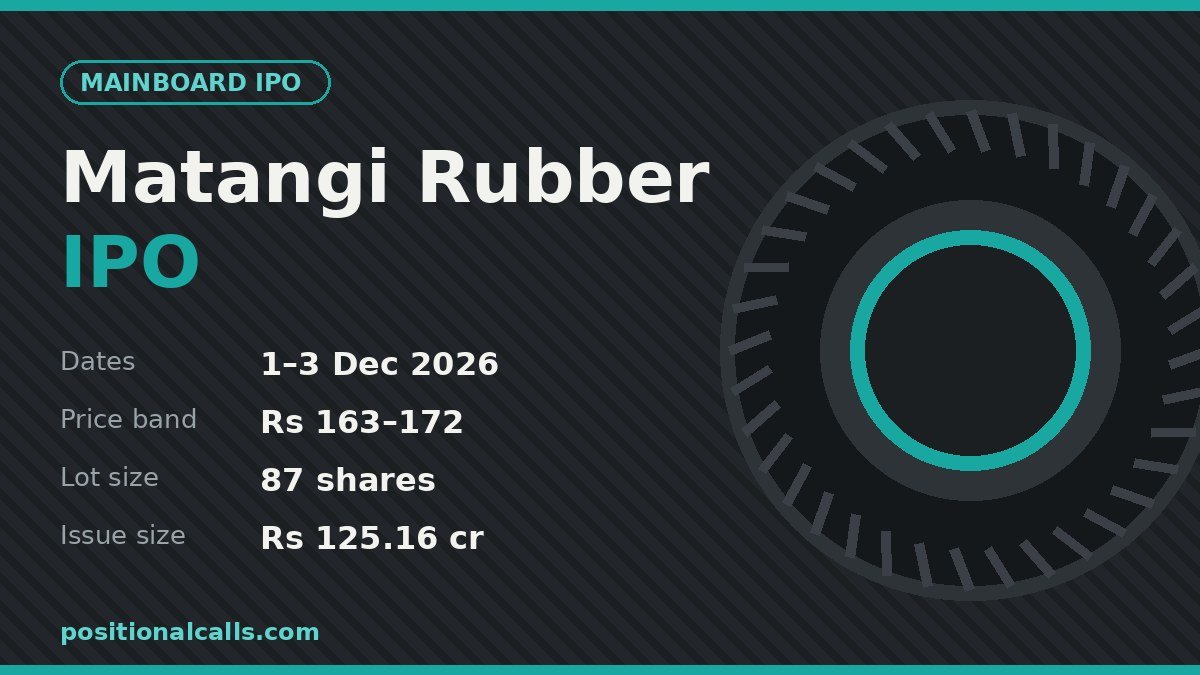
The Matangi Rubber IPO opens on 1 December 2026 at a price band of Rs 163 to Rs 172, with a lot of 87 shares. It is a Rs 125.16 crore mainboard issue from a maker of tyre flaps, tubes, small tyres and rubber compound, and about four-fifths of it is fresh money for the company.
Quick answer
Matangi Rubber IPO: opens 1 December and closes 3 December 2026, price band Rs 163 to Rs 172, lot of 87 shares. The Rs 125.16 crore issue has a Rs 99.10 crore fresh issue and a Rs 26.06 crore promoter sale. Allotment is expected on 4 December and listing on NSE and BSE on 8 December.
Key takeaways on the Matangi Rubber IPO
- Terms are set: the issue runs 1 to 3 December at Rs 163 to Rs 172, with an 87-share lot.
- Mostly fresh money: about 79% of the issue is a fresh issue, my calculation; the rest is a sale by promoters.
- Debt is the largest use: Rs 45 crore of the fresh issue goes to repaying loans, and Rs 27.50 crore to two new plants at Bhind.
- Profit grew slower than sales: FY26 income rose about 24% and profit about 11%, my calculation from the reported figures.
- One buyer dominates: one customer gave 88.67% of revenue in the latest period, per Multibagg’s reading of the RHP.
- GMP is unofficial: Rs 21 to Rs 21.5 was quoted before bidding, about 12% of the upper band.
In plain words: Matangi Rubber makes rubber parts that go into tyres, such as flaps and tubes, plus small tyres for two- and three-wheelers. Most of what it makes is sold to tyre companies. It wants to raise money to cut its loans and build two new plants, and its promoters are also selling a small part of their shares.
Data note: as of Tuesday, 24 November 2026, 8:23 PM IST. The terms come from Chittorgarh, Multibagg, Chanakya Nipothi and an Economic Times-based brief, all read on 24 November 2026. The financials are restated figures as relayed by Multibagg and Chanakya Nipothi from the red herring prospectus (RHP). I did not open the RHP, the exchange notice or the registrar page, so check each figure there. Derived figures are labelled my calculation. This page is analysis only.
Latest update (Tuesday, 24 November 2026, 8:23 PM IST): first version, written after the price band and lot were announced. Anchor allocation, subscription by category, the allotment result and the listing price are added here as they are reported, each with its own time stamp.
Matangi Rubber IPO dates: when does it open, close and list?
The Matangi Rubber IPO opens on Tuesday, 1 December 2026, closes on Thursday, 3 December and is set to list on Tuesday, 8 December on NSE and BSE. The dates after the close are tentative and follow the usual T+3 listing timetable.
| Event | Date | Source and note |
|---|---|---|
| Anchor bidding | Monday, 30 November 2026 | Economic Times-based brief; not on the trackers |
| Issue opens | Tuesday, 1 December 2026 | Chittorgarh, Multibagg, Chanakya Nipothi |
| Issue closes | Thursday, 3 December 2026 | Same sources; UPI mandate cut-off is usually 5:00 PM on the closing day |
| Basis of allotment | Friday, 4 December 2026 | Chittorgarh, Multibagg; tentative |
| Refunds | Monday, 7 December 2026 | Multibagg; tentative. Demat credit is normally on the same day |
| Listing | Tuesday, 8 December 2026 | Chittorgarh, Multibagg, IPO Guru; NSE and BSE |
Cite this table: Key dates, Chittorgarh, Multibagg, Chanakya Nipothi, PositionalCalls, Tuesday, 24 November 2026, 8:23 PM IST
The weekend of 5 and 6 December sits between allotment and refunds, which is why the refund date is a Monday. A UPI mandate that is not approved before the cut-off can lead to a rejected bid; the UPI mandate guide explains the approval step, and listing-day price rules are in the listing day rules guide.
Two other mainboard issues close in the days before this one opens: the Foodlink IPO (26 to 30 November) and the Integris Medtech IPO (reported for 27 November to 1 December). The full list is on the upcoming IPO in India page.
Matangi Rubber IPO price band, lot size and minimum investment
The price band is Rs 163 to Rs 172 per share, and the Matangi Rubber IPO lot size is 87 shares, so one lot costs Rs 14,181 to Rs 14,964. The amounts below are my calculation from the band and lot, using the standard SEBI limits for a mainboard issue.
| Category | Lots | Shares | Amount at Rs 163 | Amount at Rs 172 |
|---|---|---|---|---|
| Retail minimum | 1 | 87 | Rs 14,181 | Rs 14,964 |
| Retail maximum (up to Rs 2 lakh) | 13 | 1,131 | Rs 1,84,353 | Rs 1,94,532 |
| Small non-institutional minimum | 14 | 1,218 | Rs 1,98,534 | Rs 2,09,496 |
| Small non-institutional maximum (up to Rs 10 lakh) | 66 | 5,742 | Rs 9,35,946 | Rs 9,87,624 |
| Big non-institutional minimum | 67 | 5,829 | Rs 9,50,127 | Rs 10,02,588 |
Cite this table: Application amounts, my calculation, PositionalCalls, Tuesday, 24 November 2026, 8:23 PM IST
Fourteen lots cost Rs 1,98,534 at the lower band, under Rs 2 lakh, but a cut-off bid is blocked at the upper band, where 14 lots cost Rs 2,09,496. That moves the bid out of the retail category, so 13 lots is the retail ceiling. The IPO investor categories guide explains the limits, and the how to apply for an IPO guide covers the bidding steps. Matangi Rubber is a mainboard issue, not an SME one; the difference is set out in the SME vs mainboard IPO page.
How is the Matangi Rubber IPO structured: fresh issue, OFS and reservation?
The Matangi Rubber IPO is 72,76,981 shares worth Rs 125.16 crore at the upper band, split into a fresh issue of 57,61,831 shares and an offer for sale of 15,15,150 shares. Both share counts multiply out to the stated rupee amounts at Rs 172, my calculation.
| Part | Shares | Amount at Rs 172 | Share of issue, my calculation | Who gets the money |
|---|---|---|---|---|
| Fresh issue | 57,61,831 | Rs 99.10 crore | 79.2% | The company |
| Offer for sale | 15,15,150 | Rs 26.06 crore | 20.8% | The selling promoters |
| Total issue | 72,76,981 | Rs 125.16 crore | 100% | Split as above |
Cite this table: Issue structure, Chanakya Nipothi and Multibagg with my calculation of shares, PositionalCalls, Tuesday, 24 November 2026, 8:23 PM IST
Who is selling in the Matangi Rubber IPO offer for sale?
The Economic Times-based brief says the offer for sale is by promoters. None of the sources I read names each seller or the shares each one offers. By my calculation the 15,15,150 shares on sale are about 5.3% of the roughly 2.86 crore shares after the issue. Multibagg headlines say the promoters keep about 60% after the issue, but I could not check that against the article text, so treat it as unconfirmed.
How is the Matangi Rubber IPO reserved by investor category?
| Category | Share of the issue | Approx. amount, my calculation |
|---|---|---|
| Qualified institutional buyers | Up to 50% | Up to Rs 62.58 crore |
| Non-institutional investors | At least 15% | At least Rs 18.77 crore |
| Retail investors | At least 35% | At least Rs 43.81 crore |
Cite this table: Reservation by category, Chanakya Nipothi and Multibagg percentages with my calculation of amounts, PositionalCalls, Tuesday, 24 November 2026, 8:23 PM IST
Up to 60% of the institutional portion can go to anchor investors, with a third of that kept for domestic mutual funds, per Multibagg; that is the standard SEBI rule. The amounts assume no employee quota, and none of the sources mentions one.
What will the Matangi Rubber IPO fresh issue fund?
Rs 45 crore of the Rs 99.10 crore fresh issue goes to repaying loans, and Rs 27.50 crore goes to two new plants at Bhind in Madhya Pradesh. The offer for sale money goes to the promoters, not to the company.
| Object | Amount | Share of fresh issue, my calculation |
|---|---|---|
| Repay or prepay certain loans, in full or in part | Rs 45.00 crore | 45.4% |
| Greenfield rubber recycling products plant, Bhind | Rs 19.06 crore | 19.2% |
| Greenfield solid tyre plant, Bhind | Rs 8.44 crore | 8.5% |
| General corporate purposes and issue costs | About Rs 26.60 crore, my calculation | 26.8% |
Cite this table: Objects of the issue, Multibagg and Chanakya Nipothi; balance is my calculation, PositionalCalls, Tuesday, 24 November 2026, 8:23 PM IST
The Rs 26.60 crore balance is simply what remains after the three named objects; the sources do not split it between general corporate purposes and issue expenses. The debt repayment is the part most likely to show up quickly in the accounts, because lower loans mean lower interest cost. The two plants carry the usual risk that construction or ramp-up takes longer than planned.
What does Matangi Rubber do, and who buys from it?
Matangi Rubber makes tyre flaps, tyre tubes, two- and three-wheeler tyres and rubber compound, and sells mostly to tyre companies. Per Multibagg’s reading of the RHP, the business is largely business-to-business supply, contract manufacturing and job work, including for JK Tyre, with some branded sales under the EMGEE name.
- Plants: Selaqui near Dehradun in Uttarakhand, Gummidipoondi near Chennai in Tamil Nadu, and Bhind in Madhya Pradesh, some of them run through its subsidiary MG Industries.
- History: set up as a private company in 2004, converted to a public company in 2024, and acquired MG Industries Limited as a material subsidiary in 2024.
- Customers: one customer gave 88.67% of revenue in the latest period and the top five more than 91% of FY26 revenue, per Multibagg; Chanakya Nipothi puts the top ten at 96.04% of FY26 operating revenue.
- Lead manager and registrar: Sarthi Capital Advisors manages the issue and Bigshare Services is the registrar, per Chanakya Nipothi and IPOPlatform.
Because one buyer takes almost nine-tenths of sales, the business moves with that customer’s orders and pricing. The sources do not name the customer in the extracts I read; the RHP will.
Matangi Rubber IPO financials: revenue, profit and margin
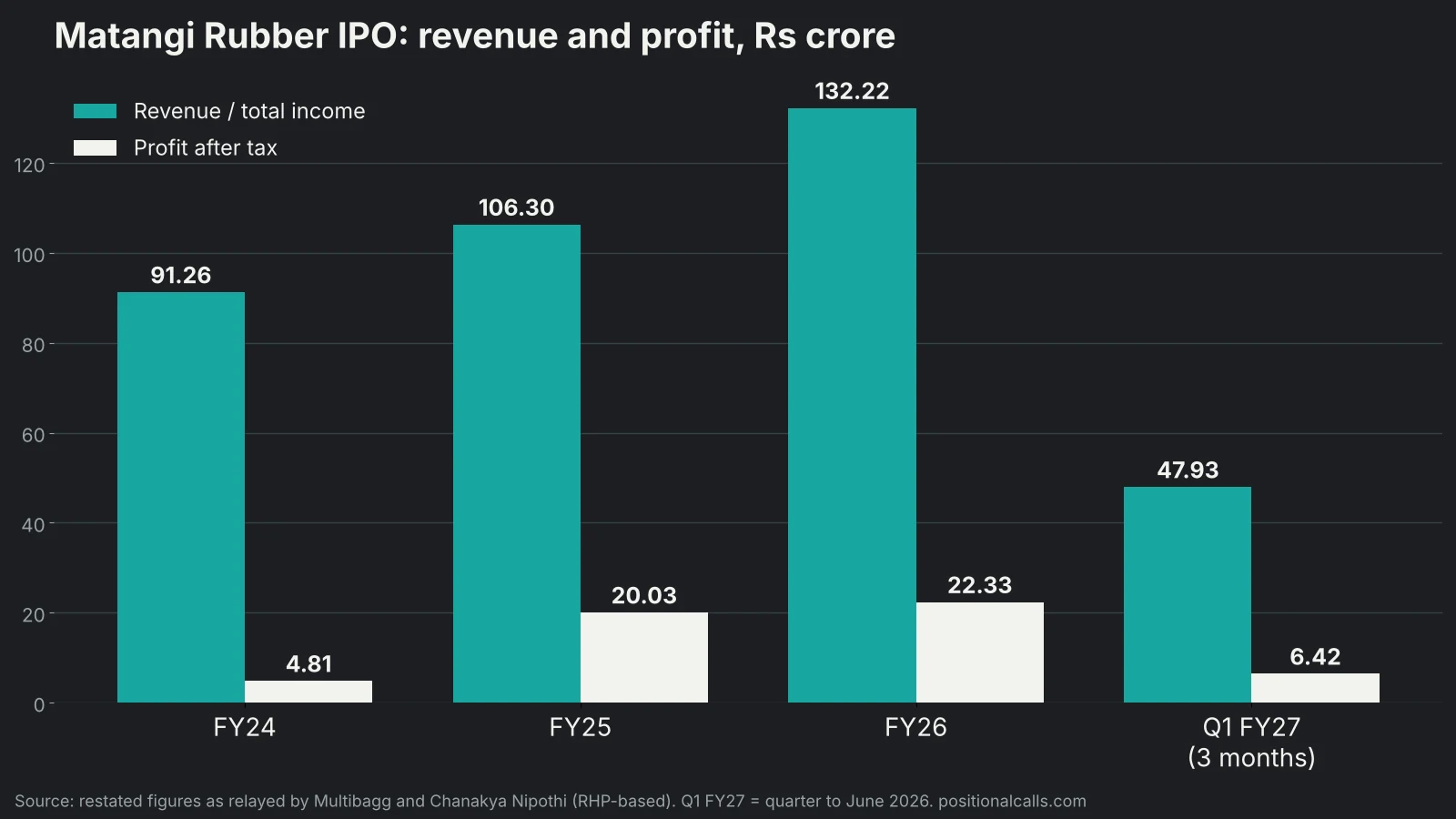
Matangi Rubber earned Rs 132.22 crore and a profit of Rs 22.33 crore in FY26, up from Rs 106.30 crore and Rs 20.03 crore in FY25. The figures are restated and consolidated, as relayed by Multibagg and Chanakya Nipothi from the RHP.
| Period | Revenue / total income | EBITDA | Profit after tax | PAT margin, my calculation | Net worth | Debt to equity |
|---|---|---|---|---|---|---|
| FY24 | Rs 91.26 crore | Not given | Rs 4.81 crore | 5.3% | Not given | Not given |
| FY25 | Rs 106.30 crore | Rs 30.89 crore | Rs 20.03 crore | 18.8% | Rs 85.16 crore | 1.10 |
| FY26 | Rs 132.22 crore | Rs 35.06 crore | Rs 22.33 crore | 16.9% | Rs 127.75 crore | 0.85 |
| Q1 FY27 (three months to June 2026) | Rs 47.93 crore | Rs 10.71 crore | Rs 6.42 crore | 13.4% | Rs 134.12 crore | 0.80 |
Cite this table: Financials, Multibagg and Chanakya Nipothi (RHP-based); margins my calculation, PositionalCalls, Tuesday, 24 November 2026, 8:23 PM IST
How fast did Matangi Rubber’s revenue and profit grow?
Revenue grew about 16.5% in FY25 and 24.4% in FY26, my calculation, or about 20% a year over the two years. Profit grew about 11.5% in FY26, slower than revenue, so the profit margin narrowed from 18.8% to 16.9%. The large jump in profit from FY24 to FY25 is not explained in the extracts I read; the 2024 acquisition of MG Industries is one change to check in the RHP.
What does the June 2026 quarter show?
The June 2026 quarter brought Rs 47.93 crore of income, more than a third of the whole FY26 figure in three months. The margins were lower: an EBITDA margin of about 22% against about 27% for FY26, and a profit margin of 13.4%, my calculation. A single quarter can be lumpy, so the full-year trend matters more than one period.
How much debt does Matangi Rubber carry?
The sources give a debt-to-equity ratio, not the loan amount. Multiplying the ratio by net worth gives about Rs 108.6 crore at FY26 and about Rs 107.3 crore at June 2026, my calculation, if the ratio uses total borrowings. On that basis the Rs 45 crore repayment would cut debt by roughly two-fifths.
Matangi Rubber IPO valuation inputs: what the numbers imply at Rs 172
At the Rs 172 upper band, Matangi Rubber’s post-issue market value is Rs 492.22 crore, per Chanakya Nipothi. The rows below are inputs, not a view on whether that price is high or low.
| Measure | Value | Basis |
|---|---|---|
| Market value after the issue | Rs 492.22 crore | Chanakya Nipothi |
| Shares after the issue | About 2.86 crore | My calculation: Rs 492.22 crore ÷ Rs 172 |
| Shares before the issue | About 2.29 crore | My calculation: post-issue shares less 57,61,831 fresh shares |
| FY26 EPS, pre-issue | Rs 9.77 | Multibagg; matches Rs 22.33 crore ÷ 2.29 crore shares, my calculation |
| Price to FY26 earnings, pre-issue | 17.6 times | Multibagg; Rs 172 ÷ Rs 9.77 |
| Price to FY26 earnings, post-issue | About 22.0 times | My calculation; Chanakya Nipothi states 22.6 times |
| Price to book, pre-issue | 2.93 times | Multibagg; matches June 2026 net worth, my calculation |
| Price to book, post-issue | About 2.1 times | My calculation: adds the Rs 99.10 crore fresh issue to June 2026 net worth |
Cite this table: Valuation inputs, Chanakya Nipothi and Multibagg with my calculation, PositionalCalls, Tuesday, 24 November 2026, 8:23 PM IST
The post-issue figure is the one that matches what a buyer pays for after listing, because the fresh shares dilute earnings. Multibagg’s return ratios of about 4.9% on equity and 4.3% on capital appear to be for the June quarter alone and not annualised, so they are not comparable with full-year figures. Chanakya Nipothi gives a FY26 return on capital of 15.41%, down from 18.22%.
IPOPlatform lists Tolins Tyres and Somi Conveyor as listed peers. Neither is a close match: Tolins makes tyres and tread rubber, and Somi Conveyor makes conveyor belts. The RHP’s own peer list is the one to use.
What is the Matangi Rubber IPO GMP, and how reliable is it?
The Matangi Rubber IPO GMP was Rs 21 per Chanakya Nipothi (note updated 24 November) and Rs 21.5 per Multibagg, before bidding opened. By my calculation Rs 21 is about 12.2% of the Rs 172 upper band.
The same Chanakya Nipothi note also carries a table that says no GMP was recorded as of 23 November, so the Rs 21 quote is a day old at most. GMP is an unofficial grey-market quote, not an exchange price, and it often moves sharply with subscription numbers. The IPO GMP meaning guide explains why it is not a forecast. This page will log each GMP reading with its time and source during the bidding days.
Matangi Rubber IPO source conflicts: where the figures disagreed
Four figures differ between sources; the RHP settles each one.
| Item | Version A | Version B | What this page uses |
|---|---|---|---|
| Reservation | 50% QIB, 15% NII, 35% retail (Chanakya Nipothi, Multibagg) | 75% QIB, 15% NII, 10% retail (ipowatch, draft-stage page) | Version A, the current trackers |
| Lot size | 87 shares (Chittorgarh, Multibagg, Chanakya Nipothi) | Not announced (IPO Guru) | 87 shares |
| Revenue and profit | Rs 132.22 crore and Rs 22.33 crore for FY26 (Multibagg, Chanakya Nipothi) | Rs 115.52 crore and Rs 22.40 crore, period not stated (IPOPlatform) | Version A; B looks like a different period |
| Post-issue P/E | About 22.0 times (my calculation from Rs 492.22 crore ÷ Rs 22.33 crore) | 22.6 times (Chanakya Nipothi) | Both shown; the gap may be profit attributable to owners |
Cite this table: Source conflicts, as read on 24 November 2026, PositionalCalls, Tuesday, 24 November 2026, 8:23 PM IST
How do I bid in the Matangi Rubber IPO and check allotment?
Bid through your broker’s IPO section or your bank’s ASBA facility between 1 and 3 December, then check the result with Bigshare Services from 4 December.
- Open the IPO section in your broker app or net banking on or after 1 December and pick Matangi Rubber.
- Enter the quantity in multiples of 87 shares and tick cut-off price to bid at the final price.
- Approve the UPI mandate in your UPI app before the cut-off on 3 December.
- On 4 December, check the result on Bigshare Services with your PAN or application number, or on the NSE and BSE status pages.
- If shares are allotted, they should reach your demat account before listing on 8 December; if not, the blocked amount is released.
The IPO allotment status guide walks through each registrar screen, and the IPO tax guide covers how listing gains are taxed.
What are the main risks to check in the Matangi Rubber IPO?
Six points need checking in the RHP before reading anything into these numbers.
Bottom line
The issue has its terms set for 1 to 3 December, a growing but customer-concentrated business and a fresh issue aimed mostly at debt and two new plants. This page reports those facts and the conflicts between sources. It gives no view on whether to bid, and the RHP is the document that decides the details.
Matangi Rubber IPO in Hinglish: short summary
Matangi Rubber IPO 1 December se 3 December 2026 tak khulega, price band Rs 163 se Rs 172 hai aur lot 87 shares ka hai. Ek lot ke liye upper band par Rs 14,964 lagenge. Issue Rs 125.16 crore ka hai, jisme Rs 99.10 crore fresh issue aur Rs 26.06 crore promoters ka offer for sale hai.
FY26 mein revenue Rs 132.22 crore aur profit Rs 22.33 crore tha. Ek customer se 88.67% revenue aata hai, yeh sabse bada risk hai. Allotment 4 December ko Bigshare Services par aur listing 8 December ko NSE aur BSE par expected hai. GMP Rs 21 ke aas-paas bataya gaya, par yeh unofficial hai. Yeh page sirf analysis hai, koi stock call ya target nahi deta.
Related pages: IPO guides and other issues
These pages cover the same process and the other issues in the same fortnight.
Sources for the Matangi Rubber IPO page
Every figure comes from the sources below, read on 24 November 2026. I opened the Multibagg article, the Chanakya Nipothi review and the Economic Times-based brief in full, and read the others as search extracts. I did not open the RHP, the exchange notice or the registrar page.
- Chittorgarh: Matangi Rubber IPO dates, price and lot
- Multibagg: Matangi Rubber Rs 125.16 crore mainboard issue
- Multibagg: Matangi Rubber IPO overview and GMP
- Chanakya Nipothi: Matangi Rubber IPO review
- Indian Opinion (Economic Times-based): issue opens 1 December
- IPOPlatform: lead manager, registrar and peers
- IPO Guru: Matangi Rubber IPO details
- ipowatch: Matangi Rubber IPO (draft-stage reservation)
- Indira Trade: open and upcoming IPO list
PositionalCalls WhatsApp channel
Keep IPO pages together
- Subscription and allotment updates
- Plain-English IPO guides
- Links to new pages
Matangi Rubber IPO: frequently asked questions
What are the Matangi Rubber IPO dates?
The Matangi Rubber IPO opens on Tuesday, 1 December 2026 and closes on Thursday, 3 December 2026. Anchor bidding is reported for 30 November. The basis of allotment is expected on 4 December, refunds on 7 December and listing on NSE and BSE on Tuesday, 8 December 2026. The post-issue dates are tentative.
What is the Matangi Rubber IPO price band and lot size?
The price band is Rs 163 to Rs 172 per equity share, and one lot is 87 shares. By my calculation a lot costs Rs 14,181 at the lower band and Rs 14,964 at the upper band. Bids can be made in multiples of 87 shares after the first lot.
How much is the minimum investment in the Matangi Rubber IPO?
The minimum is one lot of 87 shares, which costs Rs 14,964 at the Rs 172 upper band. A retail bid is capped at Rs 2 lakh, which allows 13 lots or 1,131 shares, about Rs 1.95 lakh at the upper band, my calculation. A larger bid falls in the non-institutional category.
How big is the Matangi Rubber IPO and what is fresh versus OFS?
The issue is Rs 125.16 crore, or 72,76,981 shares, at the upper band. The fresh issue is 57,61,831 shares worth Rs 99.10 crore and goes to the company. The offer for sale is 15,15,150 shares worth Rs 26.06 crore and goes to the selling promoters. By my calculation the fresh issue is about 79% of the total.
What will Matangi Rubber do with the IPO money?
Per Multibagg and Chanakya Nipothi, Rs 45 crore of the fresh issue goes to repaying loans, Rs 19.06 crore to a rubber recycling plant at Bhind and Rs 8.44 crore to a solid tyre plant at Bhind, in Madhya Pradesh. The balance, about Rs 26.6 crore before issue costs by my calculation, covers general corporate purposes.
What are the Matangi Rubber IPO financials?
Per figures relayed from the RHP, Matangi Rubber reported revenue of Rs 132.22 crore and profit after tax of Rs 22.33 crore in FY26, against Rs 106.30 crore and Rs 20.03 crore in FY25 and Rs 91.26 crore and Rs 4.81 crore in FY24. The June 2026 quarter showed Rs 47.93 crore income and Rs 6.42 crore profit.
What is the Matangi Rubber IPO GMP?
Chanakya Nipothi quoted a GMP of Rs 21 in a note updated on 24 November, and Multibagg showed Rs 21.5. By my calculation Rs 21 is about 12% of the Rs 172 upper band. GMP is an unofficial grey-market quote, not an exchange price, and it can fall to zero before listing.
What is the Matangi Rubber IPO valuation at the upper band?
At Rs 172 the post-issue market value is Rs 492.22 crore, per Chanakya Nipothi. By my calculation that is about 22 times FY26 profit after the new shares, and about 17.6 times on pre-issue shares, matching the Rs 9.77 pre-issue EPS reported by Multibagg. Chanakya states 22.6 times, so a small gap remains.
How do I check Matangi Rubber IPO allotment status?
Check the allotment on the website of Bigshare Services, the registrar, after the basis of allotment is expected on 4 December 2026. Enter your PAN, application number or DP and client ID. The NSE and BSE application status pages also show the result. Allotment is by lottery in an oversubscribed retail category.
Does this page say whether to apply for the Matangi Rubber IPO?
No. This page reports the terms, the financials and the points where sources disagree, and it labels every derived figure as my calculation. It gives no view on whether to apply and no listing target. The red herring prospectus is the document to read before bidding, and GMP is unofficial.

Shubham Chaudhary is the founder of PositionalCalls, an independent Indian stock market research website. He writes company fundamentals, quarterly results analysis, IPO analysis and sector research for NSE and BSE listed companies, with a focus on banking stocks, insurance and long-term value investing. Every article is built from primary sources such as RBI, SEBI, NSE and BSE filings and company annual reports, and states its risks plainly in simple language for retail investors.
Coverage areas Our research standards- Numbers checked against NSE, BSE and SEBI filings
- Risks and limits stated in every article
- No paid promotions or broker tie-ups
- Articles updated when new filings arrive