
Learning · Dividend dates and tool
The ex dividend date is the cut-off that decides who gets a declared dividend. This page shows how to find the last day to buy under T+1 settlement, where sources disagree on the ex-date and the record date, how holidays shift the deadline and what happens to the share price, with a last-day-to-buy calculator.
Quick answer
The ex dividend date is the first trading day a share trades without the declared dividend. To receive it, buy by the trading day before that date, because Indian trades settle one working day later under T+1. Sources disagree on whether the ex-date equals the record date, so confirm it on NSE or BSE.
Ex dividend date: key takeaways
- Deadline: buy by the trading day before the ex-date to be eligible.
- Ex-date on or after: a purchase on that day or later does not get the dividend.
- Record date: the company’s list date; under T+1 most sources put it on the same day as the ex-date.
- Holidays: only trading days count, so closures move the last day to buy.
- Price: the reference price falls by about the dividend on the ex-date, so the dividend alone is not a gain.
In plain words: when a company declares a dividend, it needs a cut-off to decide who gets paid. The ex dividend date is the first day a new buyer is too late. If you buy before that day, you are paid. If you buy on it or after it, the seller keeps the dividend, and the share price usually opens lower by about the same amount.
Data note: as of Wednesday, 18 November 2026, 4:30 PM IST. Rules and examples come from Fyers, Jainam, Kotak, Upstox, Tradejini, MNCL, OneTradeJournal, EquitiesIndia, HDFC Sky, Zerodha and the other pages named in the sources. Figures marked as my calculation apply those rules to the dates and prices shown. The NSE and BSE circulars on ex-dates were not opened; only a search snippet of the NSE T+1 settlement circular was seen.
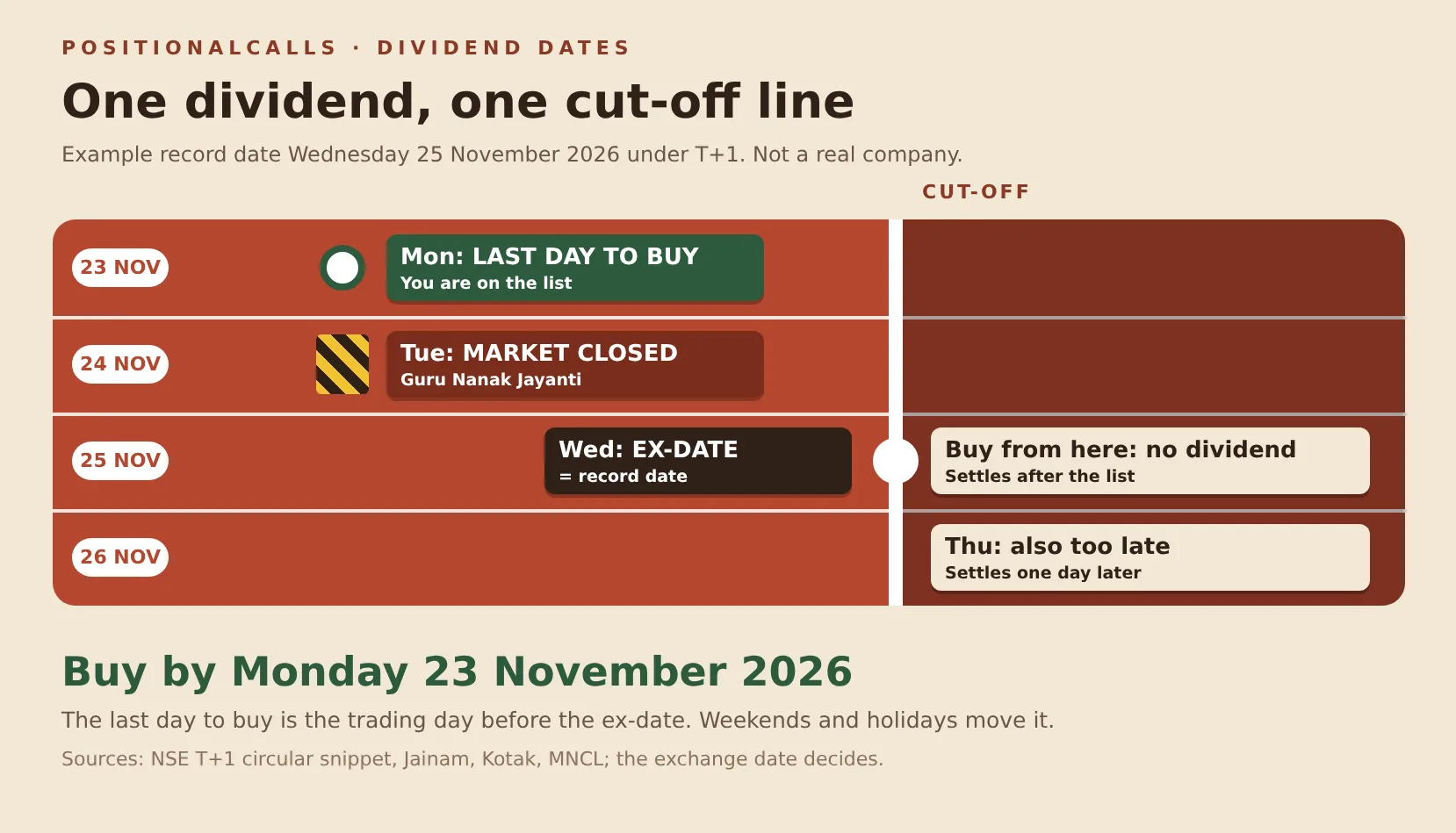 One dividend on a timeline: the last day to buy, the ex-date and the record date for an example date. Source: PositionalCalls, from the sources named.
Use this calculator to find the last day to buy before the ex dividend date
Pick the date you have, enter it, and the calculator shows the ex-dividend date, the last day to buy and the reference price after the dividend. The default is an example record date of Wednesday 25 November 2026, a Rs 10 dividend and a Rs 500 closing price, not a real company. Nothing you type leaves your browser.
The default is an example date, not a real company. Dates in 2026 use the NSE and BSE holiday list for that year. For later years only weekends are skipped.
How does the calculator find the last day to buy?
It takes the date you give and steps back to the previous trading day, skipping weekends and the 15 weekday closures on the 2026 NSE list. If you enter a record date, it treats the ex dividend date as the same day under T+1. If you enter the ex-date shown by the exchange, it uses that date directly. Both routes end on the same rule: the last day to buy is the trading day before the ex-date.
What does the calculator not include?
It does not know which companies have declared a dividend, it does not check the exchange, and it only knows the 2026 holiday list. For later years it skips weekends only, so a holiday could move the date by a day. It also does not work out tax or charges. Use the exchange date as the final word, and treat the result as arithmetic, not advice.
What are the four dividend dates, and where does the ex dividend date fit?
A dividend has four dates: declaration, ex-dividend, record and payment, and only the ex-dividend date decides whether a new buyer is paid. Fyers, ICICI Direct and Kotak describe the same sequence. The table sets out who fixes each date and what it means for a buyer.
| Date | What it is | Who fixes it | What it means for you |
|---|---|---|---|
| Declaration date | The company announces the dividend and its dates | Company board | Start of the timeline; no cut-off yet |
| Ex-dividend date | First day the share trades without the dividend | Stock exchange | Buy on or after it and the seller keeps the dividend |
| Record date | Day the company checks its list of shareholders | Company | You must be on the list; settlement timing matters |
| Payment date | Day the dividend is credited to eligible holders | Company | Cash arrives in your linked bank account |
Cite this table: PositionalCalls, “The four dividend dates”; definitions from Fyers, ICICI Direct, Kotak and Bajaj AMC as named.
Why does the ex dividend date matter more than the record date?
Because settlement is not instant. Bajaj AMC says that while both dates are administrative, only the ex-dividend date directly changes how a trade is treated for eligibility. A buyer who looks only at the record date can be a day late, which is the most common mistake the sources describe.
Does the company or the exchange set the ex dividend date?
The company fixes the record date and the exchange works out the ex-date from it. Bajaj AMC says that once a company announces a record date, exchanges usually calculate the corresponding ex-date. That is why two sources can state the same record date and still disagree on the ex-date, which the conflict section covers.
How does T+1 settlement decide the last day to buy before the ex dividend date?
Under T+1 a trade settles one working day after it is made, so shares bought on the last day to buy reach your demat account on the record date. An NSE Clearing circular on the January 2023 settlement calendar describes compulsory T+1 settlement for all securities from trade date 27 January 2023. MNCL gives the same date. The timeline below uses an example record date.
| Date (example) | Event | Settles on | Dividend? |
|---|---|---|---|
| Monday 23 November 2026 | Buy shares; last day to buy | Wednesday 25 November | Yes, you are on the list |
| Tuesday 24 November 2026 | Exchange closed for Guru Nanak Jayanti | No trading | Not applicable |
| Wednesday 25 November 2026 | Ex-date and record date; buy shares | Thursday 26 November | No, settles after the list is taken |
| Thursday 26 November 2026 | Buy shares | Friday 27 November | No |
Cite this table: PositionalCalls, “T+1 timeline for an example record date”; settlement rule from the NSE Clearing circular and MNCL; holiday from Upstox and PL India; the settlement dates are my calculation and the exchange settlement calendar was not opened.
What did the old T+2 cycle change?
Jainam says that under the old T+2 system the ex-date was one trading day before the record date, so a buyer needed to purchase at least two trading days before the record date. Under T+1, it says the ex dividend date and the record date fall on the same day, and a buyer needs to buy one trading day before it.
Why did the ex dividend date rule change with settlement?
The ex-date exists to cut off buyers whose shares will not settle in time. When settlement shortened from two days to one, the cut-off moved a day closer to the record date. Older guides still repeat the T+2 relationship, and MNCL warns that many older guides are outdated for this reason.
Ex dividend date vs record date: where do Indian sources disagree?
Broker pages split into two camps on whether the ex-date is the same day as the record date or one trading day before it, and one page reverses the order. The table groups what each source says. The calculator on this page accepts either date, so the last day to buy does not depend on which camp is right.
| Reading | What it says | Sources |
|---|---|---|
| Same day | Under T+1, the ex-date and record date fall on the same day | Jainam, Kotak, Tradejini, MNCL, OneTradeJournal, Tapetide |
| One trading day before | The ex-date is usually one trading day before the record date | Upstox, Bajaj AMC, Bajaj Broking, Sahi, EquitiesIndia, ipomarket |
| Record date after ex-date | The record day is one day after the ex-dividend day | ICICI Direct |
| Self-contradiction | Explainer says one day before; news table lists Thomas Cook with both dates on 27 August 2026 | Angel One |
| Cum-dividend day | The cum-dividend date is one trading day before the ex-dividend date | Upstox, Kotak |
Cite this table: PositionalCalls, “Ex-date vs record date in India”; statements from the sources named; the NSE and BSE circulars on ex-dates were not opened.
Which reading does the arithmetic support?
A purchase made on a day settles one working day later. For the shares to be in your account on the record date, you must buy by the trading day before it. A purchase on the record date settles after it. That makes the ex dividend date and the record date the same day under T+1, which matches Jainam, Kotak and MNCL, and it matches Angel One’s own table. This is my reasoning from the settlement rule, not an exchange statement.
Why do so many pages still say one day before?
Because that was the correct relationship under T+2, and older articles were edited rather than rewritten. A page can also be technically consistent if it treats the ex-date as the last cum day. Whichever wording you read, the action is the same: confirm the ex dividend date on NSE or BSE and buy by the trading day before it.
What if the exchange shows an ex-date one day before the record date?
Use the exchange date. Choose the ex-dividend date option in the calculator and enter that date, and the last day to buy becomes the trading day before it. The exchange notification decides eligibility, and the broker pages only describe it.
How do weekends and holidays shift the last day to buy before the ex dividend date?
Only trading days count, so a Monday ex-date moves the last day to buy back to the previous Friday, and a holiday moves it further. The 2026 NSE list has 15 weekday closures, including Tuesday 24 November and Friday 25 December. The table shows three example record dates, all my calculation.
| Example record date | Weekday | Last day to buy | Why it moves |
|---|---|---|---|
| 11 November 2026 | Wednesday | Monday 9 November | Tuesday 10 November was a Diwali-Balipratipada closure |
| 25 November 2026 | Wednesday | Monday 23 November | Tuesday 24 November is a Guru Nanak Jayanti closure |
| 28 December 2026 | Monday | Thursday 24 December | Friday 25 December is a Christmas closure, then the weekend |
Cite this table: PositionalCalls, “Last day to buy around 2026 holidays”; holiday dates from Upstox and PL India as used on the share market holidays 2026 page; the dates are my calculation.
Does the exchange adjust for its own holidays?
Yes, the exchange sets the ex-date on trading days, so a holiday only affects you through the previous trading day. The full list is on the share market holidays 2026 page, which also shows the two weekday closures left after 18 November: 24 November and 25 December.
Is a Saturday session a trading day for the ex dividend date?
The calculator treats every weekend day as closed, because regular trading does not take place then. A special weekend session is rare and the exchange would announce it separately. If one falls near your date, rely on the exchange’s own ex-date rather than the calculator.
What happens to the share price on the ex dividend date?
The exchange adjusts the reference price down by about the dividend, so a Rs 500 share with a Rs 10 dividend gets a Rs 490 reference price. EquitiesIndia and Ventura describe this adjustment, and Upstox adds that the price does not always fall by exactly the amount because buying and selling continue.
PositionalCalls WhatsApp channel
Get dividend date explainers on WhatsApp
- Settlement and date changes, dated
- Plain-English market guides, no tips
- Links to updated dividend pages
| Case | Close before ex-date | Dividend | Dividend as % of close | Reference price |
|---|---|---|---|---|
| Illustration (calculator default) | Rs 500.00 | Rs 10.00 | 2.00% | Rs 490.00 |
| Castrol India, 23 March 2026 | Rs 187.34 (my calculation) | Rs 5.25 | 2.80% | Rs 182.09 (my calculation) |
Cite this table: PositionalCalls, “Reference price on the ex-date”; Castrol India figures from an HDFC Sky report, with the previous close worked back from the price and fall it states; the reference price is my calculation.
Did Castrol India fall by more than the dividend?
HDFC Sky reported that at 9:34 AM on 23 March 2026 the share stood at Rs 180.62, down Rs 6.72, or 3.59%, against a Rs 5.25 dividend. Working back from those figures gives a previous close near Rs 187.34, so the dividend was 2.80% of it. The extra Rs 1.47 was ordinary market movement, my calculation.
Why is the fall not a loss?
Equities India and Jainam both say the fall is an adjustment for cash leaving the company, not news about the business. A holder on the last day to buy still receives the dividend. That is why the ex dividend date price drop and the dividend roughly cancel, which the next section puts in numbers.
Do futures and options adjust for dividends?
For ordinary dividends of less than 2% of the price, 5paisa says the exchange makes no contract adjustment and the dividend is absorbed in the market price. Larger, extraordinary dividends are adjusted: Zerodha’s bulletin says the full Rs 10.25 dividend was deducted from Coal India strike prices, with 3 November 2026 as the last cum-dividend date.
Is buying before the ex dividend date a gain?
No. The dividend you receive is offset by the fall in the reference price, and tax and charges then reduce the result. The table works one case for 100 shares with a Rs 10 dividend, assuming the price follows the adjustment exactly. It is arithmetic, not advice.
| Item (100 shares) | No tax on dividend | Tax at 31.2% on dividend |
|---|---|---|
| Dividend received | Rs 1,000 | Rs 1,000 |
| Tax on the dividend | Rs 0 | Rs 312 |
| Dividend after tax | Rs 1,000 | Rs 688 |
| Fall in reference price (100 x Rs 10) | Rs 1,000 | Rs 1,000 |
| Net before brokerage and other charges | Rs 0 | Rs 312 loss |
Cite this table: PositionalCalls, “Dividend vs price adjustment”; the 31.2% rate is the 30% slab plus 4% cess used in the example on the dividend yield calculator page; my calculation.
What costs reduce an ex dividend date trade further?
Buying and selling carries brokerage, STT, exchange charges, stamp duty and GST. The brokerage calculator shows how those add up for a delivery trade, and securities transaction tax explains the largest one. Tax on the dividend is covered in dividend tax in India.
Does the dividend still matter for a long-term holder?
For someone who already owns the shares, the dividend is part of the return, and the dividend yield calculator shows its size against the price. The point here is narrower: timing a purchase for the ex dividend date does not create the dividend out of nothing, because the price adjusts.
What if you sell before or on the ex dividend date?
The holder at the close of the last day before the ex-date is on the company’s list, so selling on the ex-date does not remove the dividend, but selling earlier does. This is my reading of the T+1 rules. Jainam says investors can avoid selling just before the ex-date and inadvertently handing the dividend to a new buyer.
| Your action | Ex-date reading | Dividend? |
|---|---|---|
| Hold through the last day to buy, sell on the ex-date | Held at the close of the cum day | Yes, my reading |
| Sell on or before the last day to buy | Not held at the close of the cum day | No; the new buyer gets it |
| Buy on the ex-date | Settles after the list is taken | No |
Cite this table: PositionalCalls, “Buy and sell around the ex-date”; reasoning from the T+1 rule; Jainam and Tradejini as named; confirm with your broker.
Does the ex dividend date apply to a share bought earlier but held in a different account?
The dividend goes to whoever the depository records as the holder on the record date, which is why the demat account matters. A share still in transit, such as a purchase made on the ex-date, will not be there. Check your holdings statement if you are unsure which account holds the shares.
Do interim, final and special dividends change the ex dividend date?
The ex-date rule is the same for each type; what differs is who approves the dividend and how large it is. Choice India says interim dividends need only board approval, while final dividends need shareholder approval at the AGM. Both appear in the same upcoming dividend lists.
| Type | Approval | Effect on the ex dividend date |
|---|---|---|
| Interim dividend | Board of directors | Same rule: buy by the trading day before the ex-date |
| Final dividend | Shareholders at the AGM | Same rule; the date follows the AGM or the stated record date |
| Special or extraordinary | Board or shareholders | Same rule; very large amounts can also adjust option strikes |
Cite this table: PositionalCalls, “Dividend types”; approval rules from Choice India; option adjustment from 5paisa and Zerodha as named.
Do bonus issues, splits and rights use an ex-date too?
Yes. MNCL lists bonus issues, stock splits and rights issues beside dividends as corporate actions that use the same ex-date logic, and Business Standard’s December 2025 corporate-action roundup lists ex-dates and record dates for bonus, buyback and rights issues. Price adjustments for a bonus or split are proportionally larger than for a dividend, per EquitiesIndia.
Where can you check the ex dividend date of a company?
The NSE and BSE corporate actions pages and the company’s own announcement are the primary places to check an ex-date. Religare, Sahi and OneTradeJournal all point to the exchange pages, and OneTradeJournal says to always confirm the exact ex-date and record date there before trading.
| Place | What you get | Caution |
|---|---|---|
| NSE and BSE corporate actions | Ex-date, record date and purpose for each company | Primary source; use it as the final word |
| Company announcement | The declaration and the record date | The ex-date is fixed by the exchange, not the company |
| Broker calendars (Upstox, Indmoney, Dhan, Choice) | Lists of upcoming dates in one table | Check the date against the exchange; some mix estimates |
| Data sites (Tapetide, ipomarket) | Counts and trackers by month | Descriptive only; not a record of eligibility |
Cite this table: PositionalCalls, “Where to check an ex-date”; sources as named.
How many ex-dates fall in a busy week?
Indmoney counted 37 companies going ex-dividend between 31 October and 6 November 2026, and Tapetide counted 34 ex-dates in the 30 days from 29 October. That is why a calendar is useful, and why it should be checked against the exchange. This page lists no company, because it makes no buy or avoid call.
Can an estimated ex dividend date be wrong?
Yes. One tracker page in the search results labels a December 2026 dividend as estimated and says the company has not announced it, so treat any date marked as estimated as a guess until the company declares the dividend and the exchange lists the ex-date.
What mistakes do buyers make around the ex dividend date?
The common errors are buying on the record date, trusting an old T+2 rule, ignoring a holiday and treating the price drop as news. The sources above describe each of them, and the checklist below turns them into steps you can run before any purchase.
- Buying on the record date: Upstox calls this the common mistake. Under T+1 the purchase settles after the list is taken, so the dividend goes to the seller.
- Using a T+2 guide: an older article may say to buy two trading days before the record date. That was correct before 27 January 2023 and is stricter than T+1 needs.
- Skipping the holiday check: a closure on the day before the ex-date moves the last day to buy back again, as the 25 November and 28 December examples show.
- Reading the drop as bad news: the price adjustment is mechanical, and Jainam says it should not be read as a negative signal about the company.
- Relying on an estimated date: a tracker date marked as estimated is a guess until the exchange lists it.
What is a quick checklist before the last day to buy?
First, find the declared record date and the exchange ex-date on the NSE or BSE page. Second, run the calculator with whichever date you have. Third, check that the trading day before it is not a weekend or a closure. Fourth, compare the dividend with the share price, using the dividend yield calculator for the percentage. Fifth, remember that tax and charges apply. None of these steps says whether a share is worth owning, and this page does not give that view.
Does a bigger dividend change the rule?
No. A Rs 50 dividend and a Rs 1 dividend use the same cut-off. What changes is the size of the price adjustment and, for very large payouts, the way option contracts are adjusted, as the Coal India example from Zerodha showed. The timing rule stays the same for every amount.
What does this ex dividend date page leave out?
It leaves out company-specific dates, tax rules beyond the example, mutual fund payouts and any view on whether a dividend stock is worth holding. It explains the cut-off and shows the arithmetic, nothing more.
- No company dates: I did not list upcoming ex-dates, because the exchange page is the source and a list on this page would date quickly.
- No exchange circular: the NSE and BSE rules on ex-dates were not opened; only a search snippet of the NSE Clearing T+1 settlement circular was seen.
- No tax advice: the 31.2% rate in the table is an example from the dividend yield page, and your own tax depends on your income. See dividend tax in India.
- No mutual funds: IDCW payouts and ETFs follow their own record dates, which this page did not check.
- No calls: there is no subscribe, buy, sell, avoid or rating view here.
Will this ex dividend date page be updated?
Yes, when NSE publishes the 2027 holiday list, because the calculator then needs the new closures. It will also be updated if the exchange changes the ex-date rule. The 2026 closures on the page were taken from the NSE list as reported by Upstox, PL India and others, and were not opened on the exchange site.
PositionalCalls WhatsApp channel
Dividend dates in one channel
- Settlement changes, dated
- Tools without tips
- Links to new guides
Ex dividend date: frequently asked questions
What is the ex dividend date?
The ex dividend date is the first trading day on which a share trades without the right to the declared dividend. Buy on or after it and the dividend goes to the previous holder, per Fyers and Tradejini. Under India’s T+1 settlement, most sources say your real deadline is the trading day before this date. The exchange sets it.
Is the ex dividend date the same as the record date in India?
Sources disagree. Jainam, Kotak, Tradejini and MNCL say the two dates fall on the same day under T+1, while Upstox, Bajaj AMC and Sahi say the ex-date is one trading day earlier. Angel One’s own table shows Thomas Cook with both dates on 27 August 2026. Check the exchange date, because the last day to buy is the trading day before the ex-date either way.
What is the last day to buy shares to get the dividend?
It is the trading day before the ex-date, also called the cum-dividend day. If the ex-date and record date are both Wednesday 25 November 2026, the last day to buy is Monday 23 November, because Tuesday 24 November is a closure, my calculation from the NSE holiday list. The calculator above does this with any date.
Can I buy on the ex dividend date and still get the dividend?
No. Tradejini says that if you buy on or after the ex dividend date, the dividend is paid to the previous shareholder, and Kotak says a share bought on the ex-date will not be in your demat account on the record date. The purchase settles one working day later, after the company has taken its list of holders.
Does the share price fall on the ex dividend date?
The exchange adjusts the reference price down by about the dividend. A Rs 500 share with a Rs 10 dividend gets a Rs 490 reference price, per EquitiesIndia. Castrol India fell 3.59% on 23 March 2026 against a dividend worth 2.80% of its close, my calculation from the HDFC Sky report, so market moves add to the adjustment.
Can I sell on the ex dividend date and still get the dividend?
Generally yes, if you held the shares at the close of the last day before the ex-date, because you are then on the company’s list. This is my reading of the T+1 rules, and Jainam warns that selling before the ex-date hands the dividend to the new buyer. Confirm with your broker before you act, because this page is not advice.
Do holidays and weekends change the last day to buy for a dividend?
Yes, because only trading days count. A Monday 28 December 2026 date moves the last day to buy back to Thursday 24 December, since Friday 25 December is a Christmas closure and the weekend follows, my calculation from the 2026 NSE holiday list. The calculator skips weekends and the 15 weekday closures of 2026.
How long after the record date is the dividend paid?
Sources differ. MNCL says payment is usually made within 30 days of declaration under the Companies Act, 2013, while ipomarket says within 30 days of the record date. The announcement states the payment date, so use that. Interim dividends need only board approval and final dividends need AGM approval, per Choice India.
Where can I check the ex dividend date of a company?
The NSE and BSE corporate actions pages and the company’s own announcement are the primary places, per Religare, Sahi and OneTradeJournal. Broker calendars from Upstox, Indmoney, Dhan and Choice India list upcoming dates, and Indmoney counted 37 companies going ex-dividend between 31 October and 6 November 2026. Confirm each date on the exchange.
Is this ex dividend date page investment advice?
No. PositionalCalls is not a SEBI-registered research analyst or investment adviser. The page explains dates, settlement and arithmetic from the sources named, and the calculator finds a date, not a stock. It gives no subscribe, buy, sell, avoid or rating view, and I did not open the NSE or BSE circulars on ex-dates, so confirm with the exchange.
Sources for the ex dividend date page
- Fyers: ex-dividend date meaning, broker.
- ICICI Direct: what is the, broker.
- Bajaj AMC: ex-dividend date vs, industry.
- Bajaj Broking: ex date vs, broker.
- Jainam: ex-date vs record, broker.
- Kotak Securities: ex date and, broker.
- Angel One: dividend date vs, broker.
- Angel One: dividend dates explainer, broker.
- Angel One: ex-date list for, broker.
- Upstox: ex-dividend date vs, broker.
- Tradejini: how dividends are, broker.
- MNCL: ex-dividend date vs, broker.
- OneTradeJournal: ex-dividend date in, tool.
- EquitiesIndia: ex-date glossary, tool.
- Sahi: stock split and, broker.
- Religare: finding ex-date and, broker.
- Tapetide: upcoming dividends report, tool.
- Indmoney: dividend calendar, broker.
- Choice India: upcoming dividend stocks, broker.
- ipomarket: dividend tracker, tool.
- HDFC Sky: Castrol India ex-dividend, broker.
- Zerodha: Coal India F&O, broker.
- 5paisa: F&O dividend adjustment, broker.
- NSE Clearing: January 2023 T+1, exchange.
- Not opened: the NSE and BSE ex-date circulars and corporate actions pages; only a search snippet of the NSE Clearing T+1 circular was seen; statements are from the sources above.
PositionalCalls.com is an independent research site founded by Shubham Chaudhary. PositionalCalls.com is not a SEBI-registered research analyst or investment adviser. Investments in securities markets are subject to market risks. Read all related documents carefully before investing. Returns are never guaranteed. This page is educational and publishes no subscribe, avoid, buy, sell, rating or target calls. Sources: broker, exchange-circular snippet and data pages as named; no exchange ex-date circular opened; no company, buy, sell or avoid view given.

Shubham Chaudhary is the founder of PositionalCalls, an independent Indian stock market research website. He writes company fundamentals, quarterly results analysis, IPO analysis and sector research for NSE and BSE listed companies, with a focus on banking stocks, insurance and long-term value investing. Every article is built from primary sources such as RBI, SEBI, NSE and BSE filings and company annual reports, and states its risks plainly in simple language for retail investors.
Coverage areas Our research standards- Numbers checked against NSE, BSE and SEBI filings
- Risks and limits stated in every article
- No paid promotions or broker tie-ups
- Articles updated when new filings arrive