
Learning · Demat and Brokerage
Demat account charges in India explained: AMC, DP charges, BSDA and the taxes on every trade, with a rupee-by-rupee example.
Quick answer
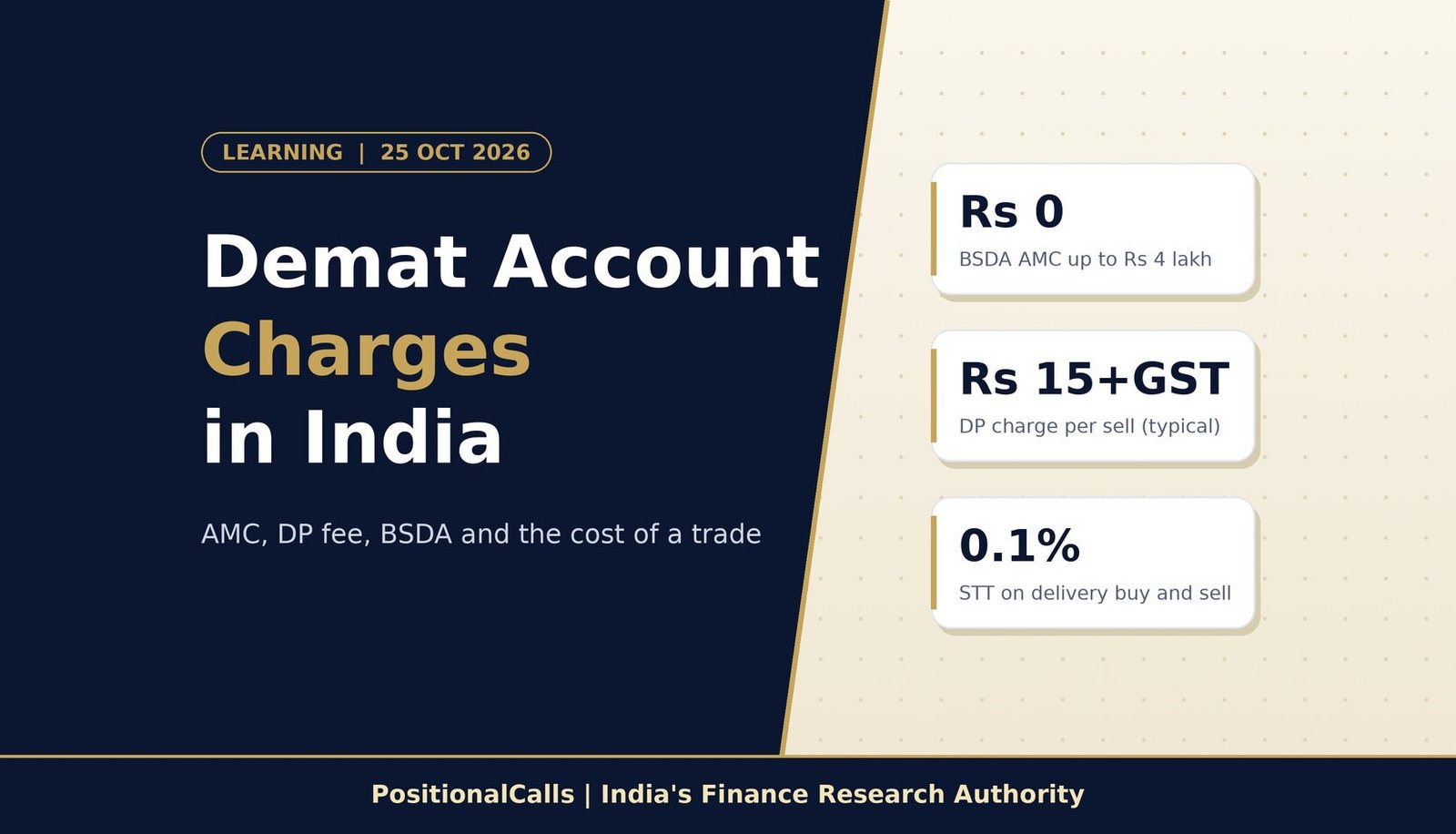
Demat account charges in India have four parts: account opening (usually free), annual maintenance charge (AMC) of nil to about Rs 750 a year, a depository (DP) charge of roughly Rs 13-20 plus GST on each sell, and trading taxes. A Basic Services Demat Account (BSDA) has nil AMC up to Rs 4 lakh of holdings.
Latest update (25 October 2026, 8:00 PM IST): BSDA rules revised by SEBI from 31 March 2026 are included: eligibility is reviewed every quarter, and delisted, suspended and ZCZP bonds are left out of the Rs 10 lakh test. Next: update on any SEBI or depository charge change.
Key takeaways
- AMC: not capped by SEBI for regular accounts; nil to Rs 750 a year is common, so check your broker’s tariff.
- BSDA: nil AMC up to Rs 4 lakh of holdings and a maximum of Rs 100 a year from Rs 4 lakh to Rs 10 lakh.
- DP charge: a flat fee per share name sold on a day, typically Rs 13-20 plus 18% GST, whatever the quantity.
- Trading charges: STT 0.1% on delivery buy and sell, stamp duty 0.015% on buys, NSE transaction charge 0.00297%.
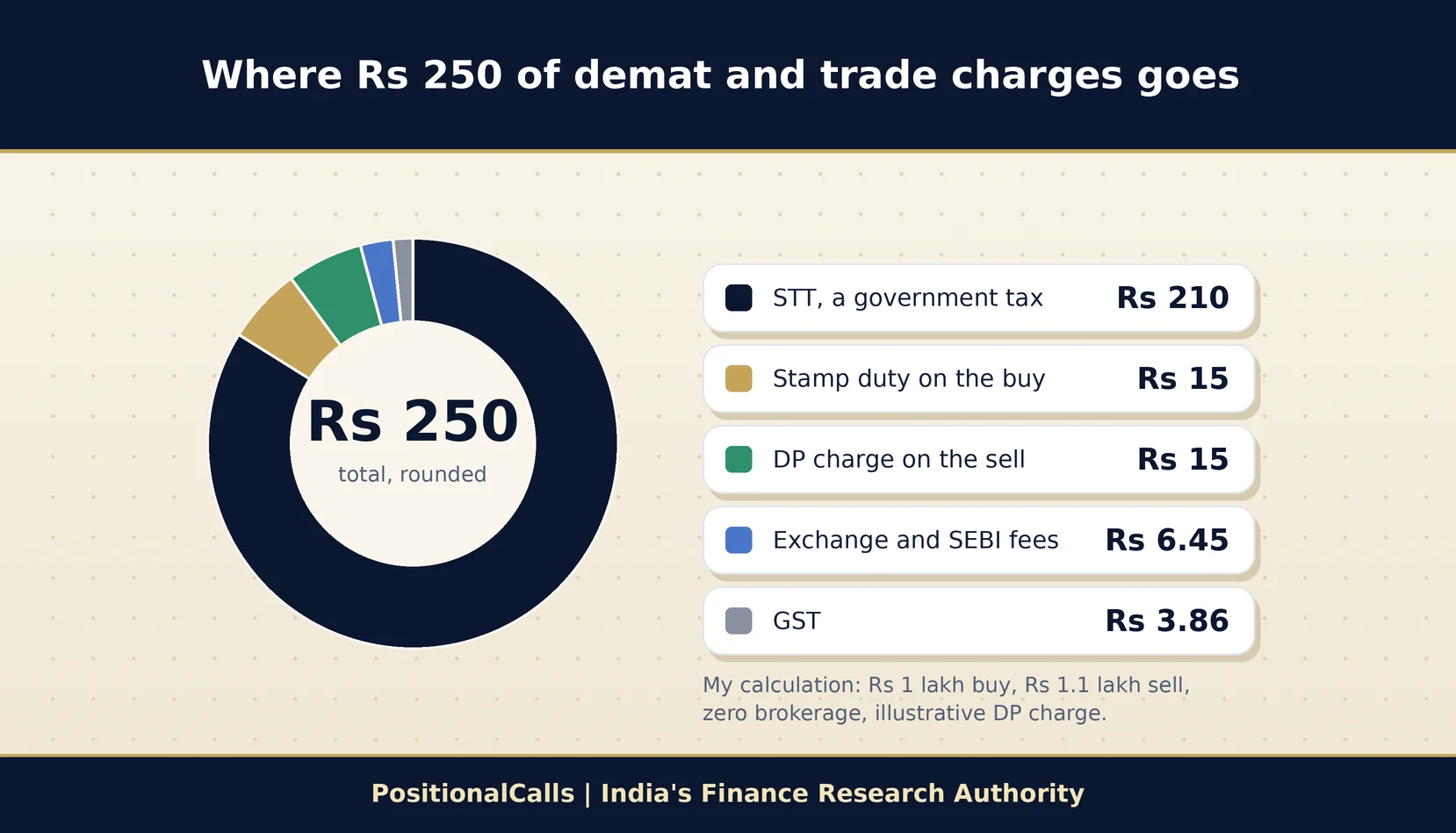
- Own example: a Rs 1 lakh buy and Rs 1.1 lakh sale cost about Rs 250 in total charges at zero brokerage.
- Small sells: a flat DP fee is about 0.35% of a Rs 5,000 sale, so selling small lots often costs more.
In plain words: a demat account holds your shares in electronic form, like a bank account holds money. The account itself can cost little, but each sale and each trade carries small charges and taxes that add up.
Data note: as of 25 October 2026, 8:00 PM IST. Broker fees vary and change, so figures are typical ranges from published tariffs and a SEBI circular, not a quote from any one broker. Regulatory rates are cross-checked across several broker pricing pages.
1. What are demat account charges?
Demat account charges are the fees you pay to a depository participant (DP), usually your broker, for holding and moving shares in electronic form. They are separate from brokerage, which is the fee for placing a trade, and from taxes such as STT. Many first-time investors see a small deduction after a sale and are surprised by demat account charges, because a “zero fee” account usually means zero account opening or zero delivery brokerage, not zero demat charges.
Your shares sit with one of two depositories, NSDL or CDSL, through a DP. The depository charges the DP, and the DP passes the cost on to you, often with a markup. SEBI caps charges only where it has said so, mainly for the Basic Services Demat Account. For regular accounts the DP sets its own tariff, but it must disclose it. Read our capital gains tax on shares guide for how the gain itself is taxed once you sell.
Who regulates demat charges?
SEBI regulates DPs and depositories, and every DP must hold a valid SEBI registration. Check the registration before you open an account. The relevant rule on small-investor charges is the SEBI circular of 28 June 2024 on the Basic Services Demat Account, and a later circular dated 24 December 2025 revised it from 31 March 2026, as reported by SEBI-circular summaries. The rest of the cost comes from exchange rates and government taxes, which brokers collect.
Why do demat account charges matter?
A Rs 750 yearly AMC on a Rs 50,000 portfolio is 1.5% of the portfolio every year (my calculation), which is a large drag on a small account. A flat Rs 17.70 DP charge on a Rs 5,000 sale is 0.35%. The percentage falls as the amount rises, so demat account charges hurt small and frequent sellers the most.
These demat account charges apply whether you invest in shares, ETFs or bonds. If you bought shares in an IPO, the same account holds them after allotment; see our IPO allotment status guide for the process before listing.
2. What is the difference between a demat, trading and bank account?
A demat account holds your shares, a trading account places your buy and sell orders, and a bank account holds your money; you need all three to invest in listed shares. Most brokers open the demat and trading account together, which is why people mix them up. Demat account charges apply to the demat account, while brokerage applies to the trading account.
| Account | What it does | Typical charges | Where it matters |
|---|---|---|---|
| Demat account | Holds shares and units in electronic form | Opening fee, AMC, DP debit charge | Charged every year and on each sale |
| Trading account | Lets you place orders on NSE and BSE | Brokerage, plus taxes and exchange fees on each trade | Charged on each trade |
| Bank account | Holds money and links to UPI or ASBA | Bank rules apply | Needed to pay for shares and receive sale money |
Can you have a demat account without a trading account?
Yes. You can hold shares in a demat account and trade through a different broker, but most investors use one broker for both. Some people hold a demat account with a bank or a depository participant that is not their trading broker, which can mean separate demat account charges on top of brokerage. Check both tariffs.
Is a mutual fund account the same as a demat account?
No. A fund house keeps a folio for your units in a statement of account. A demat account is optional for mutual funds but needed for ETFs and for shares. Folios carry no AMC.
3. What are the demat account charges, one by one?
The main demat account charges are account opening, annual maintenance (AMC), debit or DP charges, and a set of occasional fees for pledging, conversion and paper services. Here is each of the demat account charges, with a typical range as of 25 October 2026, 8:00 PM IST.
| Charge | What it is | Typical range | Who sets it | Why it matters |
|---|---|---|---|---|
| Account opening | One-time fee to open the account | Nil at most online brokers; higher at some full-service brokers | DP | Compare, but do not choose only on this |
| AMC (annual maintenance) | Yearly fee to keep the account | Nil to about Rs 750 a year; one published tariff shows Rs 750 for a regular account | DP, not capped for regular accounts | The biggest fixed cost for small portfolios |
| DP debit charge | Fee when shares leave your account, usually on a sell | About Rs 13-20 plus 18% GST per share name per day | DP plus depository (about Rs 3.50-4.50 of it) | Flat, so small sells pay more in percentage terms |
| Pledge or unpledge | Fee when you pledge shares as margin | Around Rs 30 plus GST per request at some brokers | DP | Matters if you use margin |
| Demat or remat request | Converting paper to electronic or back | Per certificate or per 100 securities; set by DP | DP | Rare for most investors |
| Statements and slips | Physical statements, replacement slips | E-statements are free; physical copies are charged (up to Rs 25 for BSDA) | DP / SEBI cap for BSDA | Use e-statements |
The depository part of the DP charge is small. Published broker tariffs list it at about Rs 3.50 for CDSL and Rs 4 to Rs 4.50 for NSDL, as reported by broker pages that differ slightly. One broker also gives female first holders a discount of Rs 0.25 per transaction on the CDSL fee. The rest of the DP charge is the broker’s own markup, which is why it differs from one broker to another.
It is charged per share name (ISIN) per day, not per share and not per order. Selling 1 share or 1,000 shares of the same company on the same day costs the same. Selling shares of three companies on one day triggers three DP charges. Buying shares usually carries no DP charge, because the shares are credited to you rather than debited.
Are mutual fund units charged the same way?
Mutual fund units bought directly from a fund house are held in a statement of account with no demat charge. Units held in a demat account follow the DP charge rules, and one broker lists a small extra discount on CDSL fees for debits of funds and bonds. Check the tariff of your own DP.
4. What is a Basic Services Demat Account (BSDA)?
A BSDA is a low-cost demat account for small investors, with nil AMC when holdings are up to Rs 4 lakh and a maximum AMC of Rs 100 a year when holdings are between Rs 4 lakh and Rs 10 lakh. Above Rs 10 lakh, regular account charges apply. SEBI raised the holdings limit from Rs 2 lakh to Rs 10 lakh in its circular of 28 June 2024, effective 1 September 2024.
| Holdings value | BSDA AMC | Source type |
|---|---|---|
| Up to Rs 4 lakh | Nil | SEBI framework, as summarised by brokers |
| Rs 4 lakh to Rs 10 lakh | Maximum Rs 100 a year | SEBI framework, as summarised by brokers |
| Above Rs 10 lakh | Regular account charges | SEBI circular, as reported |
Who is eligible for a BSDA?
You must be an individual with only one demat account in which you are the sole or first holder, and only one BSDA across both depositories. The Rs 10 lakh value is checked across your holdings, not per account. Your account holds only securities of your own, and you should register your mobile number for SMS alerts on debits.
What changed from 31 March 2026?
A SEBI circular dated 24 December 2025 took effect on 31 March 2026. As reported by several summaries, depository participants must now reassess BSDA eligibility every quarter, and Zero Coupon Zero Principal bonds, delisted securities and suspended securities are excluded when the Rs 10 lakh limit is tested. Ask your DP to confirm how your account is classified if you think you qualify.
Does a BSDA also remove other demat account charges?
No. A BSDA reduces the AMC only. DP debit charges when you sell still apply, as do brokerage and taxes. Some brokers advertise “zero AMC” for everyone; read the conditions, because the waiver may be time-limited or tied to holdings.
Muhurat and festive-season trading often brings new investors to the market. If you plan to start then, read our Muhurat trading 2026 guide and check your account type first.
5. How have BSDA rules changed over time?
SEBI introduced the BSDA in 2012, raised its holdings limit from Rs 2 lakh to Rs 10 lakh from 1 September 2024, and tightened the review process from 31 March 2026. Knowing the dates helps you spot old articles that quote outdated demat account charges.
Why does the date matter for demat account charges?
Before 1 September 2024, a holder with Rs 3 lakh of shares did not qualify for the lower BSDA slabs, because the cap was Rs 2 lakh. As of 25 October 2026 that investor can qualify. Many blogs and broker pages still show the old limit, so always check the date on the page you read and the SEBI circular behind it.
The December 2025 change also means eligibility is no longer checked only once. If your holdings grow past Rs 10 lakh, the DP can apply regular demat account charges, and if they fall back, a later quarterly review can restore BSDA treatment. Ask your DP how and when it notifies you.
PositionalCalls WhatsApp channel
Hear when demat charges or rules change
- Alerts on SEBI changes to BSDA and charges
- Plain-language explainers on brokerage, STT and taxes
- A message when this guide is updated
6. What does one trade really cost? Worked examples
On a Rs 1 lakh delivery buy and a Rs 1.1 lakh sale with zero brokerage, total charges come to about Rs 250, and almost all of it is STT. These are my own illustrations using the rates below and an illustrative DP charge of Rs 15 plus 18% GST. Brokerage, DP fees and exchange rates change, so check your broker’s current schedule.
| Charge | Rate used | How it is applied |
|---|---|---|
| STT | 0.1% on buy and on sell | On the full trade value, both sides |
| NSE transaction charge | 0.00297% | On trade value, both sides (BSE rate is 0.00375%) |
| SEBI turnover fee | Rs 10 per crore | On trade value, both sides |
| Stamp duty | 0.015% on the buy side | On buys only |
| GST | 18% | On brokerage, transaction charges and SEBI fee (not on STT or stamp duty) |
| DP charge | Rs 15 plus 18% GST | Per share name on a sale (illustrative) |
Example 1: zero brokerage, buy Rs 1,00,000 and sell Rs 1,10,000
| Item | Buy Rs 1,00,000 | Sell Rs 1,10,000 |
|---|---|---|
| STT | Rs 100.00 | Rs 110.00 |
| NSE transaction charge | Rs 2.97 | Rs 3.27 |
| SEBI fee | Rs 0.10 | Rs 0.11 |
| Stamp duty | Rs 15.00 | Nil |
| DP charge | Nil | Rs 15.00 |
| GST | Rs 0.55 | Rs 3.31 |
| Total | Rs 118.62 | Rs 131.68 |
The round-trip total is Rs 118.62 plus Rs 131.68, about Rs 250. On a gain of Rs 10,000 that is 2.5% of the profit (my calculation). STT alone is Rs 210 of the Rs 250. A cheaper account cannot remove STT.
Example 2: the same trade at 0.3% brokerage
| Item | Buy | Sell |
|---|---|---|
| STT | Rs 100.00 | Rs 110.00 |
| Brokerage at 0.3% | Rs 300.00 | Rs 330.00 |
| NSE transaction and SEBI fee | Rs 3.07 | Rs 3.38 |
| Stamp duty | Rs 15.00 | Nil |
| DP charge | Nil | Rs 15.00 |
| GST | Rs 54.55 | Rs 62.71 |
| Total | Rs 472.62 | Rs 521.08 |
The round trip is about Rs 994, nearly four times Example 1. The brokerage and its GST account for the difference. This is why the brokerage plan matters more for frequent trades than the AMC does.
Example 3: a small sale
If you sell Rs 5,000 of one share, the DP charge of Rs 15 plus 18% GST is Rs 17.70, which is 0.35% of the sale. STT on Rs 5,000 is Rs 5. Selling the same Rs 5,000 as part of a Rs 50,000 sale of the same share on the same day still costs Rs 17.70, which is 0.035%. Batching sales of the same share into one day reduces the percentage (my calculation, an educational observation, not advice).
7. How do demat account charges differ for a small investor and an active investor?
A small, long-term investor mostly pays AMC and the DP charge on each sale, while an active investor pays mostly STT and brokerage. The comparison below uses my own simple assumptions.
| Profile | Typical charges that matter | Rough yearly cost, my illustration | What to compare |
|---|---|---|---|
| Rs 50,000 portfolio, 2 sells a year, regular AMC Rs 750 | AMC, DP charge | Rs 750 plus 2 x Rs 17.70 = Rs 785.40, about 1.6% of the portfolio | AMC and BSDA eligibility |
| Same portfolio on a BSDA | DP charge only | 2 x Rs 17.70 = Rs 35.40, about 0.07% | BSDA conditions |
| Rs 6 lakh portfolio on a BSDA | BSDA AMC up to Rs 100 | Rs 100, about 0.017% | Check the quarterly review |
| Rs 15 lakh portfolio, regular account | Regular AMC, DP charges | AMC as per tariff | Compare AMC and DP markup |
| Active delivery trader | STT, brokerage, DP | Often several thousand rupees | Brokerage plan first |
These rows show that the cheapest set of demat account charges depends on how you invest. An investor who buys and holds for years cares most about AMC. A frequent trader cares most about brokerage and STT. NRIs and those with joint accounts should read the account terms carefully, because the BSDA is limited to one account in the sole or first holder’s name.
For how the profit from selling is taxed, see the capital gains tax on shares guide, which shows how STCG and LTCG are calculated after these charges.
8. How can you reduce demat account charges?
You can reduce demat account charges by checking BSDA eligibility, comparing the full tariff and not only the opening fee, avoiding unnecessary sells, and using e-statements. None of these is a recommendation of a broker; they are checks to run.
- Check eligibility: if you hold one demat account and under Rs 10 lakh, ask your DP whether the account is classified as BSDA.
- Read the tariff: compare AMC, DP charge, brokerage, pledge fee and any conditions on a “zero” offer.
- Batch sells: sell the same share once, not in several small lots on different days.
- Use e-statements: physical statements and slip books are charged.
- Review yearly: a waiver in the first year can end, so recheck the AMC after it expires.
Can you close an account that charges too much?
Yes, but you must clear dues and transfer or sell holdings first, and an account cannot be closed with unpaid charges. Shares can be moved to another demat account through an off-market transfer, which itself carries a DP charge. Compare that cost with the savings first.
9. What do you need, what does it cost and what is the tax angle?
To open an account you need PAN, Aadhaar, a bank account and a mobile number; the cost is the charges above; the tax angle is that STT is a tax and brokerage is a deductible cost in some cases.
What you need
- PAN linked to Aadhaar and a bank account in your name.
- A mobile number and email for e-KYC and alerts.
- Nomination details, which you can add or opt out of as the form allows.
What it costs
Use the charge table and the worked examples to estimate your own demat account charges, then check your broker’s current tariff and your contract notes. Charges can change, and brokers can revise their plans.
Tax angle
STT is a tax collected on each trade. For capital gains, brokerage and eligible transfer costs may be deducted when you compute the gain, but STT, stamp duty and the AMC generally are not treated the same way, so ask a tax adviser how to claim. Rules differ for traders whose income is business income.
Some investors hold mutual funds through a fund house or an app, which avoids demat charges for those units. Others use a BSDA for a small share portfolio. Neither is a recommendation. If you are weighing where to put your next rupee, our insurance stocks guide shows how one sector is analysed.
NRI note
NRIs usually need a designated bank account and, for trading, a specific demat arrangement. Rules on NRE and NRO accounts and on repatriation are detailed, so confirm with your DP and bank before you open.
Scam warning
Fake apps and messages ask you to “update KYC” or pay a “demat activation fee” through a link. Open accounts only through the broker’s official website or app, check the broker’s SEBI registration, and never share an OTP or your demat login.
10. What should you check before you open or switch your demat account?
Before you open or switch, check demat account charges: SEBI registration, AMC, DP charge, brokerage plan, BSDA eligibility and the conditions on any free offer. This is a checklist, not an endorsement of any broker.
- Is the broker a SEBI-registered depository participant?
- What is the AMC, and does it change after the first year?
- What is the total DP charge on a sale, including GST?
- What is the brokerage on delivery and intraday trades?
- Does the account qualify for BSDA, and how is it reviewed?
- Are there pledge, call-and-trade, or paper-statement fees?
- Can I switch or close without penalty?
- Are the broker’s charges published on its own site and in my contract notes?
What are the key numbers to remember?
| Number | Meaning | Where to check |
|---|---|---|
| Rs 4 lakh | Holdings up to which BSDA AMC is nil | SEBI circular and your DP |
| Rs 10 lakh | BSDA holdings limit | SEBI circular and your DP |
| 0.1% | STT on delivery buy and sell | Broker pricing page and contract note |
| 0.015% | Stamp duty on delivery buys | Broker pricing page and contract note |
| 0.00297% | NSE transaction charge | Broker pricing page, exchange |
| Rs 10 per crore | SEBI turnover fee | Broker pricing page |
If you are trading on a special day, check settlement and holiday timings. Our IPO section lists IPO guides, and an IPO application also needs a demat account.
11. How do you read your charge statement?
Read your contract note and ledger line by line: brokerage, STT, exchange charge, SEBI fee, stamp duty, GST and DP charge each appear as a separate line. A contract note is issued for every trading day, and a bill or ledger entry shows the AMC.
- Open the contract note: find the trade value and the list of charges for that day.
- Match STT: for delivery, it should be 0.1% of the value on both buy and sell.
- Match stamp duty: it applies on buys only, at 0.015% for delivery.
- Find the DP charge: it is billed separately on your ledger on the day of the sell.
- Check the AMC: it appears once or quarterly in your ledger or bill.
If a number looks different from the rates in this guide, ask your broker for the line-by-line basis. Brokers can charge more or less than the typical ranges here, and exchange rates differ between NSE and BSE, so a small gap is not necessarily an error. A large gap is worth a question.
What if you spot a wrong charge?
Write to your broker’s support first, keeping the contract note and ledger. If it is not resolved, investors can use the complaint route that SEBI provides through its investor grievance system. Check the broker’s investor charter for the steps.
12. What are the risks and common mistakes with demat account charges?
What are the most common mistakes?
Choosing only on the opening fee. The yearly AMC and DP charges matter more over time.
Assuming STT is a broker charge. STT is a government tax; no broker can waive it.
Selling small lots on many days. Each day and each share name triggers a separate DP charge.
Holding several demat accounts. More than one account in your first or sole name can make you ineligible for BSDA.
Ignoring the quarterly review. Since 31 March 2026 your DP reassesses BSDA eligibility every quarter, so ask for your classification occasionally.
Falling for fake KYC links. Official brokers do not ask for a payment through a message link.
13. Analyst’s note and bottom line
- What stands out: in the example, STT is Rs 210 of Rs 250. The demat account charges people compare most are the smallest part for a delivery investor.
- Easy to miss: a flat DP charge is a percentage that falls as the sale gets larger, so it hurts small sells most.
- What would change the view: a SEBI change to BSDA limits, a depository fee revision, or an STT change in a Budget.
- Caution: a lower charge is not a reason to over-trade. Cost matters less than the decision to trade.
- Action for the reader: open your broker’s tariff page and your last contract note and match each line to this guide.
Bottom line
Demat account charges are small but regular: AMC, a flat DP charge on each sale, and trade-level taxes. A BSDA gives nil AMC up to Rs 4 lakh. For a Rs 1 lakh buy and Rs 1.1 lakh sale at zero brokerage, my calculation puts total charges near Rs 250. Compare the full tariff, not the headline offer. This guide is educational and recommends no broker.
Next read: see how the profit is taxed in our capital gains tax on shares guide.
Part of the Personal Finance and Tax series on PositionalCalls.
PositionalCalls WhatsApp channel
Check your account costs before the next trade
- Reminders to review AMC and DP charges each year
- IPO and listing explainers that need a demat account
- New cost breakdowns as rates change
FAQs on demat account charges
What are demat account charges in India?
Demat account charges are fees for holding and moving shares: account opening, annual maintenance (AMC), a DP debit charge on sells, and occasional fees for pledging or paper services. Brokerage and STT are separate. Check your broker’s tariff.
What is the AMC on a demat account?
AMC is a yearly fee to keep the account. It is not capped by SEBI for regular accounts, so it varies from nil to about Rs 750 a year. A Basic Services Demat Account has nil AMC up to Rs 4 lakh of holdings.
DP charges are usually about Rs 13-20 plus 18% GST per share name per day, whatever the quantity. Part of it, roughly Rs 3.50-4.50, goes to the depository. Buying normally carries no DP charge.
What is a BSDA and who can open it?
A BSDA is a low-cost demat account. It needs one demat account as sole or first holder and holdings up to Rs 10 lakh. AMC is nil to Rs 4 lakh and a maximum of Rs 100 a year from Rs 4 lakh to Rs 10 lakh.
Are demat account charges the same as brokerage?
No. Brokerage is the fee to place a trade. Demat account charges are for holding and moving shares. Taxes such as STT of 0.1% on delivery are separate again. A zero-brokerage plan can still carry demat account charges.
In my illustration, a Rs 1 lakh buy and Rs 1.1 lakh sale cost about Rs 250 at zero brokerage, mostly STT. At 0.3% brokerage the total is about Rs 994. Rates change, so check your broker.
Can I have more than one demat account?
Yes, but a BSDA is allowed only if you have one demat account as sole or first holder across both depositories. Holding several regular accounts means paying demat account charges on each, so keep only the ones you use.
Usually no. The DP charge applies when shares are debited from your account, which happens on a sale or a transfer out. Taxes and brokerage still apply on a buy. Confirm in your broker’s tariff.
Do I need a demat account for an IPO?
Yes. You apply through UPI or ASBA and shares are credited to your demat account after allotment. Your demat account must be active and linked to your PAN. See our IPO allotment guide for the steps.
Should I switch my demat account to save charges?
This site gives no broker advice. Compare the demat account charges (AMC, DP charge) and brokerage on your own tariff, and check that the savings exceed the transfer cost. Ask your DP whether your account qualifies as a BSDA first.
Sources
- SEBI: Facility for Basic Services Demat Account (BSDA), circular of 28 June 2024 (primary)
- NSDL: circular enclosing the SEBI BSDA circular, 3 July 2024 (primary)
- HDFC Securities published tariff sheet (one broker, used as an example only)
- SEBI circular of 24 December 2025 on enhancing the BSDA facility, as reported by Taxmann and PTI (named, not linked). Broker pricing pages for statutory rates: Zerodha, Upstox, HDFC Sky, Share India (named, not linked), as of 25 October 2026, 8:00 PM IST.
Editorial disclosure: PositionalCalls.com is an independent Indian stock market research and education site founded by Shubham Chaudhary. It is not SEBI registered. This guide is educational only and is not investment or tax advice. It names no broker as better than another and gives no targets or guarantees. How I researched this demat account charges guide: I read the SEBI BSDA circular and depository circular and cross-checked statutory rates across several broker pricing pages as of 25 October 2026, 8:00 PM IST. Check your broker’s current tariff before you act.

Shubham Chaudhary is the founder of PositionalCalls, an independent Indian stock market research website. He writes company fundamentals, quarterly results analysis, IPO analysis and sector research for NSE and BSE listed companies, with a focus on banking stocks, insurance and long-term value investing. Every article is built from primary sources such as RBI, SEBI, NSE and BSE filings and company annual reports, and states its risks plainly in simple language for retail investors.
Coverage areas Our research standards- Numbers checked against NSE, BSE and SEBI filings
- Risks and limits stated in every article
- No paid promotions or broker tie-ups
- Articles updated when new filings arrive