IPO Research · Live Update
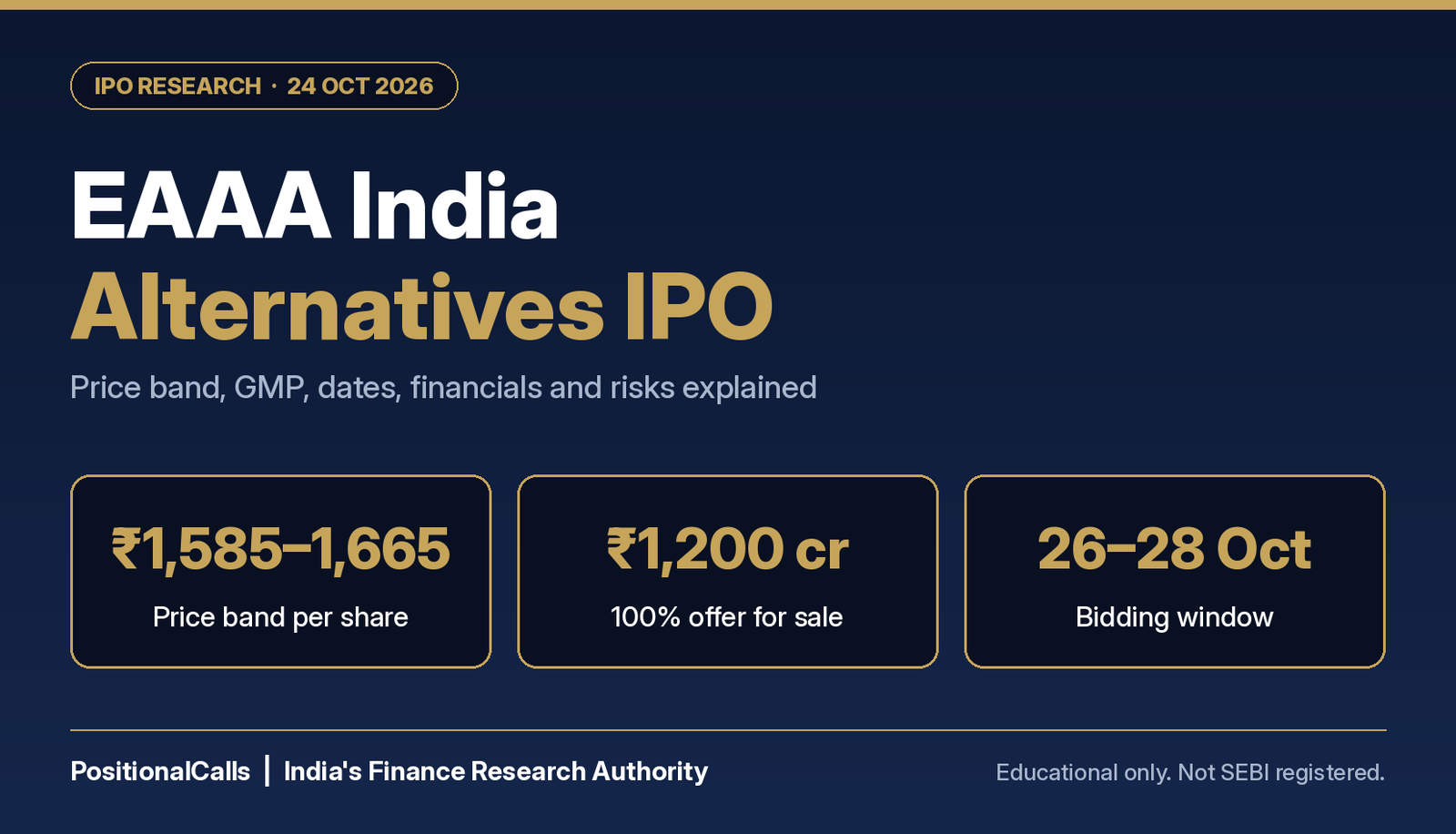
The EAAA India Alternatives IPO opens for bidding on Monday, 26 October 2026, with a price band of ₹1,585 to ₹1,665 and a ₹1,200 crore issue that is entirely an offer for sale. This guide gives you the dates, lot size, grey market premium, financials, peer valuation, allotment odds and the risks, in plain words.
Quick answer
The EAAA India Alternatives IPO opens on Monday, 26 October 2026 and closes on 28 October. The price band is ₹1,585 to ₹1,665, one lot is 9 shares (₹14,985), and the ₹1,200 crore issue is 100% offer for sale. GMP was about ₹101 to ₹121. Allotment is expected on 29 October, with listing tentatively on 2 November.
Key takeaways
- Bidding window: Monday, 26 October to Wednesday, 28 October 2026. Anchor investors bid on 23 October.
- Price and lot: ₹1,585 to ₹1,665 per share. One lot of 9 shares costs ₹14,985 at the upper band.
- Issue type: 100% offer for sale of up to 72.07 lakh shares. The company gets no money, and Edelweiss Securities and Investments receives the proceeds.
- Valuation: about ₹10,765 crore at the upper band, or roughly 40 times FY26 earnings per share (my calculation).
- GMP: about ₹101 to ₹121 on 23 and 24 October, roughly 6% to 7%. It is unofficial and not a promise.
- Next dates: allotment on 29 October, refunds and share credit on 30 October, tentative listing on 2 November 2026.
In plain words: An IPO is the first time a company sells shares to the public. An offer for sale (OFS) means existing owners sell their shares, so the company itself raises nothing. GMP, or grey market premium, is an unofficial price gap traded before listing. A lot is the smallest bid you can place, here 9 shares.
Data note: Figures are as of 24 October 2026, 2:00 PM IST. They come from the red herring prospectus (RHP, the final offer document) as summarised by IPO data sites, from news reports on the anchor round, and from GMP trackers. Subscription data is not available yet because bidding has not opened. GMP quotes differ by tracker, and a few trackers still show ₹0 because they have not updated.
What are the key numbers for the EAAA India Alternatives IPO?
EAAA India Alternatives Limited is the alternative asset management arm of the Edelweiss Group. It was incorporated in 2008 as Edelweiss Alternative Asset Advisors Limited and was renamed in 2024, as reported by IPO Premium. Its IPO is a book-built issue, which means investors bid within a price range and the final price is set after bidding ends. The numbers below are as of 24 October 2026, 2:00 PM IST.
| Metric | Figure | Why it matters |
|---|---|---|
| Issue size | 72,07,207 shares, up to ₹1,200 crore | All shares are existing shares. Nothing new is created, so the company’s share count stays at 6,46,55,246. |
| Price band | ₹1,585 to ₹1,665 | Anchors were allotted shares at ₹1,665, the upper end, so the final price is expected there. Confirm it in your allotment notice. |
| Lot size and bid limits | 9 shares. Minimum ₹14,985. Retail maximum 13 lots (117 shares, ₹1,94,805) | Retail bids are capped at ₹2 lakh. A lot is the unit the allotment lottery hands out. |
| Valuation at the upper band | About ₹10,765 crore | My calculation: 6,46,55,246 shares multiplied by ₹1,665. |
| Stake on offer | About 11.15% of post-issue equity | The promoter group holds 95.03% before the issue and 83.88% after it, as reported by Anand Rathi. |
| Assets under management (30 Jun 2026) | ₹95,344.8 crore | AUM is the total money the firm manages. It drives fee income. |
| Registrar and lead managers | MUFG Intime India. Axis Capital, Jefferies India, Motilal Oswal Investment Advisors, Nuvama | You will check your allotment on the registrar page, NSE or BSE. |
One detail worth noting: the preliminary offer document filed in January 2026 pointed to an issue of about ₹1,500 crore, as reported by IPO Index. The final issue is ₹1,200 crore, so the sellers chose a smaller sale than first indicated. The reason is not stated in the sources I checked.
When does the EAAA India Alternatives IPO open, close and list?
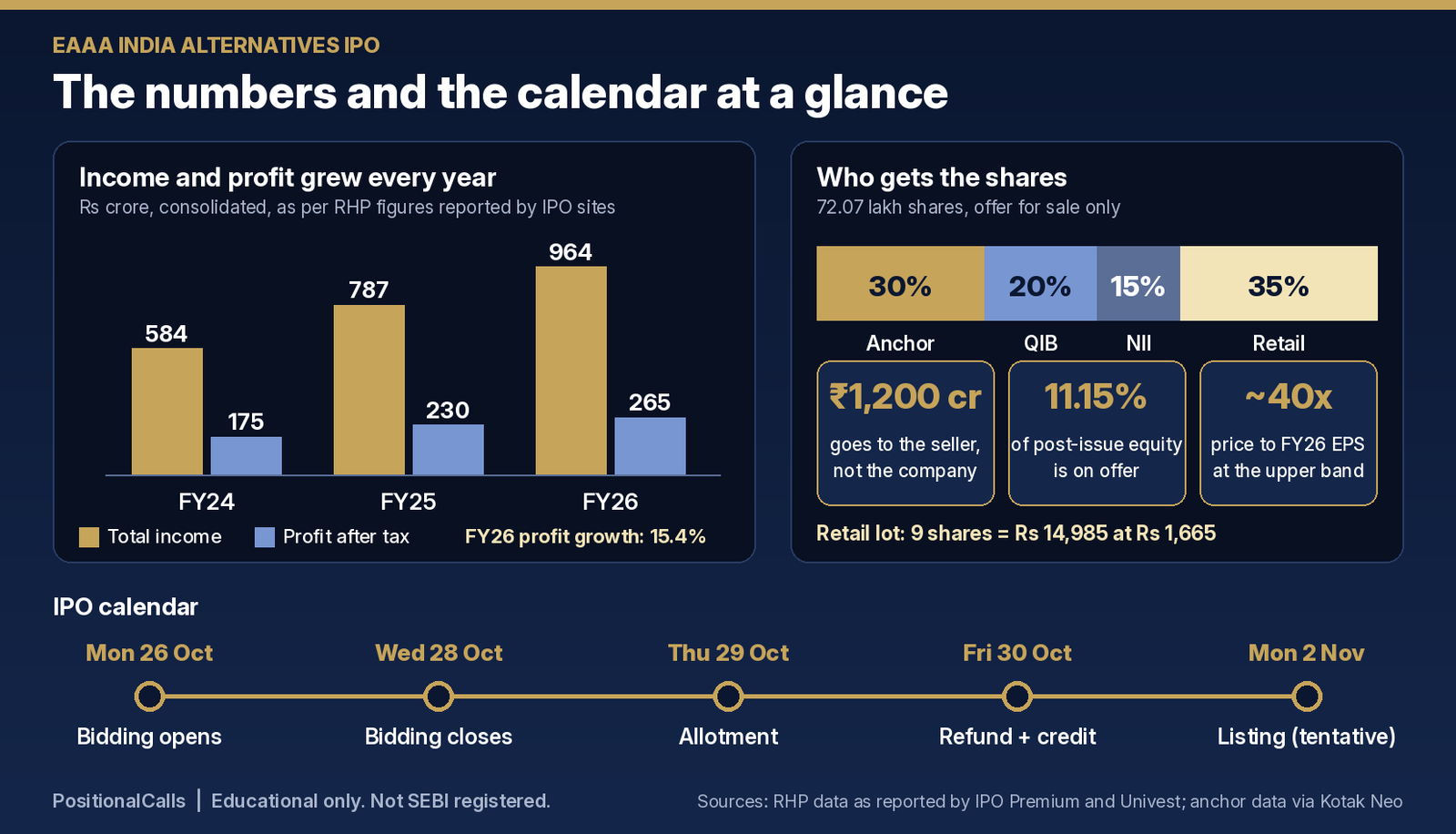
The EAAA India Alternatives IPO opens on Monday, 26 October 2026 and closes on Wednesday, 28 October 2026. Allotment is expected on Thursday, 29 October, and listing is tentatively set for Monday, 2 November. Allotment means the registrar, MUFG Intime India, decides who receives shares. Listing is the day the shares start trading on NSE (National Stock Exchange) and BSE (Bombay Stock Exchange).
| Date | Event | What it means for you |
|---|---|---|
| Fri, 23 Oct | Anchor bidding | About ₹360 crore raised from institutions before the public issue opened. |
| Mon, 26 Oct | IPO opens | You can place a bid from this day. |
| Wed, 28 Oct | IPO closes | UPI mandates must be approved before the cut-off. Institutions often bid late, so the final-day numbers can jump. |
| Thu, 29 Oct | Basis of allotment | The registrar finalises who gets shares. Check status after this. |
| Fri, 30 Oct | Refunds and share credit | Unused blocked money is released and allotted shares reach your demat account. |
| Mon, 2 Nov | Tentative listing | Trading begins on NSE and BSE after the special pre-open session. |
Why is the listing date tentative?
SEBI, the Securities and Exchange Board of India, asks issuers to list within three working days of the issue closing. The issue closes on Wednesday, 28 October. Counting Thursday, Friday and Monday gives 2 November (my calculation). The exchanges confirm the exact date in a listing circular, so treat 2 November as tentative until that notice appears.
What else is happening in the IPO market this week?
This is a busy week, and your attention and funds may be split across issues. As reported by Angel One and IPO Watch, Paras Healthcare closed its issue on 23 October with allotment due on 26 October and listing on 28 October. The Jio Platforms IPO also has allotment on 26 October and listing on 28 October. You can follow those two events in our Jio Platforms IPO allotment status guide and our Jio IPO GMP tracker.
| Date | Allotment and listing events | Money impact |
|---|---|---|
| Mon, 26 Oct | Jio Platforms and Paras Healthcare allotment. EAAA bidding opens. | Money blocked for those two issues is released from 27 October if you were not allotted shares. |
| Tue, 27 Oct | Refunds and share credit for Jio Platforms and Paras Healthcare | Funds freed here can be used to bid in the EAAA issue before it closes on 28 October. |
| Wed, 28 Oct | Jio Platforms and Paras Healthcare listings. EAAA bidding closes. | Keep enough balance in the bank account linked to your UPI ID. |
What are the EAAA India Alternatives IPO price band and lot size?
The price band is ₹1,585 to ₹1,665 per share, and one lot is 9 shares. At the upper band, the minimum retail bid is ₹14,985. The maximum retail bid is 13 lots, or 117 shares, which comes to ₹1,94,805. Retail bids cannot go above ₹2 lakh.
| Investor category | Bid size | Lots and shares | Amount at ₹1,665 |
|---|---|---|---|
| Retail individual investor (minimum) | 1 lot | 9 shares | ₹14,985 |
| Retail individual investor (maximum) | 13 lots | 117 shares | ₹1,94,805 |
| Small non-institutional investor (minimum) | 14 lots | 126 shares | ₹2,09,790 |
| Small non-institutional investor (maximum) | 66 lots | 594 shares | ₹9,89,010 (my calculation) |
| Big non-institutional investor (minimum) | 67 lots | 603 shares | ₹10,03,995 |
Non-institutional investors (NII) are those who bid more than ₹2 lakh. Qualified institutional buyers (QIB) are large institutions such as mutual funds, insurers and foreign funds. The lot limits above come from IPO Premium and IPO Watch, and the 66-lot upper limit for small NII bids is my calculation from the ₹10 lakh dividing line.
The sources I checked did not report a retail discount or an employee quota. One tracker, Pocketly, says there is no separate quota for shareholders of Edelweiss Financial Services. That matters because some large issues, such as the Jio Platforms IPO, reserved shares for parent-company shareholders, and this one does not appear to.
How do you apply for the EAAA IPO?
You can apply through any broker or bank app that supports IPO bids using UPI (Unified Payments Interface). Bidding is open only from 26 to 28 October 2026, so complete the steps before the cut-off on the last day.
- Open your broker or bank app: Log in to a broker or UPI-enabled bank app that lists IPOs, and open the EAAA issue between 26 and 28 October 2026.
- Choose the retail category and your lots: Pick the retail individual investor category. One lot is 9 shares, and retail bids can go up to 13 lots, or 117 shares, which is ₹1,94,805 at the upper band.
- Bid at the cut-off price or a price in the band: Select the cut-off price or a price between ₹1,585 and ₹1,665. A bid at the cut-off price means you accept whatever final issue price is set within the band.
- Enter your UPI ID and submit: Type your UPI ID, submit the bid and approve the mandate request in your UPI app before the cut-off time on 28 October. An unapproved mandate means the bid is not valid.
- Keep the amount in your account and check the result: Your bank blocks the bid amount but does not debit it. Check your allotment on 29 October, and look for share credit or an unblocked amount on 30 October.
Two common reasons for rejected bids are an unapproved UPI mandate and a bid below the final issue price. Duplicate bids on the same PAN in the retail category are also rejected under the rules. After allotment, our guide to checking IPO allotment on KFin, NSE and BSE shows the same process, with MUFG Intime India as the registrar for this issue.
Is the EAAA India Alternatives IPO a fresh issue or an offer for sale?
It is a pure offer for sale. Edelweiss Securities and Investments, a subsidiary of Edelweiss Financial Services, is the selling shareholder, so all ₹1,200 crore goes to the seller and the company receives nothing, as reported by Kotak Neo and Univest. There is no fresh issue.
| Item | Before the IPO | After the IPO |
|---|---|---|
| Total shares | 6,46,55,246 | 6,46,55,246 (no new shares) |
| Promoter group holding | 95.03% | 83.88% (as reported by Anand Rathi) |
| Public holding added | – | About 11.15% (my calculation: 72,07,207 divided by 6,46,55,246) |
| Money received by the company | – | Nil |
What does an offer for sale mean for you?
An offer for sale does not mean the business is weak. It does mean the IPO adds no growth money to the company’s balance sheet. The company’s growth then depends on its existing capital, its fund-raising from clients and its earnings. A promoter group that keeps over 83% after the sale also stays firmly in control, which can be reassuring for some investors and limiting for others.
What does EAAA India Alternatives do and how does it earn?
EAAA India Alternatives is an alternative asset manager. It collects money from institutions and wealthy families into long-term funds and invests that money in assets that are not ordinary listed shares. It then charges fees. It runs two main businesses, plus portfolio management services, as per the RHP summary reported by IPO Premium.
- Real assets: invests in infrastructure and commercial real estate through equity, quasi-equity and debt.
- Private credit: provides loans and financing across performing credit, special situations, real estate credit and investment-grade credit.
- Portfolio management and co-investment: separate solutions for clients, with a wholly owned subsidiary, Sekura India Management, supporting the real assets portfolio.
| Business metric (30 June 2026) | Figure | Plain-language meaning |
|---|---|---|
| Assets under management (AUM) | ₹95,344.8 crore | Total client money the firm manages. |
| Fee-paying AUM (FPAUM) | About ₹48,623 crore | The part of AUM that pays fees. It is about 51% of AUM (my calculation). |
| Client relationships | 11,009 | Institutions and individuals across India, North America and Europe. |
| Repeat clients | 1,493 | About 13.6% of client relationships by count (my calculation). |
| Three-year FPAUM growth | About 23.43% a year | Compound annual growth over the last three financial years, as stated in the RHP risk section. |
A different summary quotes a 77% repeat-client figure, which does not match 1,493 of 11,009. The two numbers probably measure different things, such as repeat clients by money rather than by count, but the sources I checked do not say so. Read the RHP for the exact definition.
How does the company make money?
The company earns income from three streams, as listed in the RHP and reported by IPO Premium. Management and advisory fees are charged on assets managed and are steady. GP income is the return the firm earns on its own money invested in the funds it manages. Variable additional return is a performance-linked payment whose size and timing are uncertain. The RHP shows that this variable return ranged from 16.19% to 32.41% of total income across the five periods it presents, which is a wide range for something investors may treat as regular income.
What do the EAAA India Alternatives financials show?
Income and profit grew in each of the last three financial years, but growth slowed in FY26 before picking up in the June 2026 quarter. The table below uses figures from the RHP as reported by IPO Premium and Univest, in ₹ crore.
| ₹ crore unless stated | FY24 | FY25 | FY26 |
|---|---|---|---|
| Total income | 584.25 | 786.54 | 963.76 |
| EBITDA | 162.9 | 228.4 | 313.4 |
| Profit after tax (PAT) | 175.16 | 229.78 | 265.20 |
| Income growth (my calculation) | – | 34.6% | 22.5% |
| PAT growth (my calculation) | – | 31.2% | 15.4% |
| PAT as a share of total income (my calculation) | 30.0% | 29.2% | 27.5% |
| Earnings per share (EPS, ₹) | 27.25 | 35.75 | 41.26 |
| Return on net worth (RoNW) | 27.30% | 27.10% | 25.97% |
| Total borrowing | 444.83 | 507.49 | 441.03 |
Here are the terms in plain language. EBITDA is operating profit before interest, tax, depreciation and amortisation. PAT is the profit left after all costs and tax. RoNW shows how much profit the company earns on each rupee of shareholders’ money.
What do the June 2026 quarter numbers say?
| Q1 FY27 (April to June 2026) | Figure | Comment |
|---|---|---|
| Total income | ₹336.13 crore | Includes other income. Revenue from operations alone was ₹275.5 crore, up 44.4% from ₹190.8 crore, as reported by Univest. |
| Profit after tax | ₹80.71 crore | Up about 45% from ₹55.7 crore a year earlier, as reported by Univest. |
| EPS (quarter) | ₹12.56 | Multiplying by four gives about ₹50.2 (my calculation, a rough guide only). |
| Return on net worth | 28.96% | Higher than FY26, as reported. |
| Net worth and borrowing | ₹1,160.38 crore and ₹399.20 crore | Debt to equity of about 0.34 (my calculation). |
Three patterns stand out. First, profit growth halved from 31.2% in FY25 to 15.4% in FY26 even though income still grew 22.5%. Second, profit as a share of income has drifted down from about 30% to 27.5%, and was about 24% in the June 2026 quarter (my calculation). Third, one strong quarter is not a trend, because performance-linked income can swing from quarter to quarter.
One more point for careful readers: in FY24 and FY25 the reported profit after tax was slightly higher than EBITDA. That usually means other income or tax effects played a role, though the sources I checked do not explain it. The RHP’s profit reconciliation is the place to look.
Is the EAAA India Alternatives IPO expensive compared with peers?
At the upper band of ₹1,665, the issue is priced at about 40 times FY26 earnings per share. This site does not tell you to buy or avoid. It shows how to measure the price so you can decide. The P/E ratio, or price-to-earnings ratio, divides the share price by earnings per share and tells you how many years of current profit you pay for.
| Measure | Working (my calculation) | Result |
|---|---|---|
| P/E on FY26 EPS | ₹1,665 divided by ₹41.26 | About 40.4x (38.4x at the lower band) |
| P/E on annualised Q1 EPS | ₹1,665 divided by (₹12.56 multiplied by 4) | About 33.1x (a rough guide) |
| Price to book (P/B) | ₹1,665 divided by June 2026 net asset value of ₹176.67 per share | About 9.4x |
| Market value to AUM | ₹10,765 crore divided by ₹95,344.8 crore | About 11.3% |
| Market value to fee-paying AUM | ₹10,765 crore divided by about ₹48,623 crore | About 22.1% |
How does that compare with listed peers?
The RHP compares EAAA with nine listed companies. The peer P/E uses NSE closing prices on 8 October 2026 divided by FY26 diluted EPS, as reported by IPO Premium. EAAA’s P/E in the table is my calculation at the upper band, so the dates differ slightly.
| Company | P/E (x) | RoNW | EPS (₹) |
|---|---|---|---|
| EAAA India Alternatives (at ₹1,665) | 40.4 | 25.97% | 41.26 |
| 360 One WAM | 35.67 | 14.39% | 30.16 |
| Aditya Birla Sun Life AMC | 29.84 | 25.10% | 33.76 |
| Anand Rathi Wealth | 90.69 | 47.54% | 47.87 |
| HDFC Asset Management Company | 33.76 | 32.93% | 66.77 |
| Gaja Alternative Asset Management | 16.47 | 16.47% | 7.17 |
| Nippon Life India AMC | 43.99 | 34.48% | 24.05 |
| Nuvama Wealth Management | 30.99 | 27.34% | 57.59 |
| UTI Asset Management Company | 27.93 | 10.38% | 31.51 |
| ICICI Prudential AMC | 45.95 | 85.80% | 66.73 |
The nine peers range from 16.5 to 90.7 times earnings, with a median of about 33.8 times and an average of about 39.5 times (my calculation). EAAA’s 40.4 times sits above the median and close to the average. Its return on net worth of 25.97% is higher than four of the nine peers and lower than five (my count). Nuvama is both a peer in this table and one of the lead managers of the issue, which is worth knowing when you read peer comparisons.
Five questions to ask before you judge the price
- Growth: PAT grew 15.4% in FY26. Is that enough for about 40 times earnings, or does the 45% June quarter jump matter more?
- Quality of income: Variable additional return was between 16% and 32% of income. How much of it will repeat?
- Margin: Profit as a share of income has slipped. What stops it falling further?
- Comparability: Large listed asset managers run different businesses, so peer P/E is a guide, not a verdict.
- Use of money: The company receives nothing, so growth must come from its own cash flows and new funds.
What is the EAAA India Alternatives IPO GMP today?
The EAAA India Alternatives IPO GMP was about ₹101 to ₹121 per share between 23 and 24 October 2026, a premium of roughly 6% to 7% over ₹1,665. GMP, or grey market premium, is the extra amount traders in an unofficial market pay for an IPO share before it lists. The grey market is unregulated. It is not run by the exchanges or SEBI, and its quotes can change within hours. For a live feel of how GMP moves in a big issue, see our Jio Platforms IPO GMP today tracker.
| Snapshot (2026) | GMP per share | Implied price (₹1,665 + GMP) | Tracker |
|---|---|---|---|
| 23 Oct, 10:48 PM IST | ₹101 (6.1%) | ₹1,766 | IPO Guru |
| Earlier snapshot, time not stated | ₹107 (6.4%) | ₹1,772 | IPO Premium |
| 24 Oct, 1:45 PM IST | ₹121 (7.3%) | ₹1,786 | IPO Market |
Some trackers still show a premium of ₹0, which most likely means they have not updated since the price band was announced, so use the range and not a single figure. GMP does not affect your allotment or the price you pay. It only reflects mood among a small number of private traders. It can miss in both directions, and a mid-sized issue like this one may trade differently from a large one.
Who invested in the EAAA anchor round?
EAAA India Alternatives raised about ₹360 crore from anchor investors on 23 October 2026. Anchor investors are large institutions that are given shares a day before the public issue, to show confidence in the pricing. They received 21,62,161 equity shares at ₹1,665, the upper end of the band, as reported by Kotak Neo and Whalesbook.
| Anchor detail | Reported figure | Note |
|---|---|---|
| Amount raised | About ₹360 crore | 21,62,161 shares at ₹1,665 (my check: about ₹360.0 crore). |
| Share of the offer | 30% | Anchor shares come out of the QIB portion. |
| Domestic mutual funds | 14.14 lakh shares across 10 funds | About 65% of anchor shares by count (my calculation). Funds named include HDFC AMC, SBI Mutual Fund, ICICI Prudential AMC, Nippon Life India, Kotak Mahindra AMC, Abakkus, HSBC Mutual Fund and Bandhan Mutual Fund. |
| International investors named | Government Pension Fund Global, Schroder International, Hornbill Capital Advisors, Goldman Sachs, BNP Paribas Financial Markets | Individual allocations were not reported in the sources I checked. |
What is the anchor lock-in, and why does it matter?
Under SEBI norms as commonly described, half of an anchor investor’s shares are locked in for 30 days after allotment and the rest for 90 days. Counting from 29 October, those dates fall around 28 November 2026 and 27 January 2027 (my calculation). Lock-in expiries can add shares to the market, so they are worth a note in your calendar. The exchanges publish exact lock-in details after allotment.
How likely is allotment in the EAAA IPO?
Your chance depends on how many retail investors bid. At least 35% of the offer, or 25,22,523 shares, is reserved for retail. That is about 2,80,280 lots of 9 shares (my calculation). If valid retail applications are fewer than the lots available, everyone is meant to receive at least one lot. If applications are more, a lottery decides who receives one lot.
| Offer split | Shares | Share of the offer |
|---|---|---|
| Anchor investors | 21,62,161 | 30% |
| QIB (excluding anchors) | 14,41,443 | 20% |
| Non-institutional investors | 10,81,081 | 15% |
| Retail individual investors | 25,22,523 | 35% |
One tracker, IPO Watch, shows the retail quota as 15% in one line and 35% in another. The 35% figure matches the RHP wording (not less than 35% of the net offer) and the share count above, so I use 35%.
What might the odds look like at different retail subscription levels?
This is arithmetic, not a forecast. It assumes every retail applicant bids for exactly one lot and that all bids are valid. Real odds differ because some people bid for several lots and some bids are rejected.
| If retail is subscribed | Applicants (approx.) | Chance of one lot (my calculation) |
|---|---|---|
| 0.8 times | 2.2 lakh | Everyone is allotted |
| 2 times | 5.6 lakh | About 1 in 2 (50%) |
| 3 times | 8.4 lakh | About 1 in 3 (33%) |
| 5 times | 14 lakh | About 1 in 5 (20%) |
| 10 times | 28 lakh | About 1 in 10 (10%) |
Bidding for more lots does not improve lottery odds in an oversubscribed retail category. It only raises the amount blocked in your account. The final basis of allotment on 29 October is the only source for the real outcome.
What could happen on EAAA listing day? Scenarios, not forecasts
Nobody can predict the listing price. The table shows reference levels and what each outcome would suggest. Gains and losses are measured against the issue price, not against the grey market. The market backdrop also matters. Indian indices have been choppy this month, and the Nifty 50 fell 1.11% on 19 October 2026, as reported by Ventura Securities. See our stock market research for daily context.
| Scenario | Reference level | What it would suggest | What to watch |
|---|---|---|---|
| A. Lists below the issue price | Under ₹1,665 | Buyers judged the price full, or selling outweighed demand. | Final subscription, foreign fund flows and the Nifty trend. |
| B. Flat listing | Close to ₹1,665 | Fair price discovery for a first-of-its-kind listed stock. | Volume in the first hour and institutional buying. |
| C. Premium below the GMP level | ₹1,665 to about ₹1,766 | Positive sentiment, but less than the grey market implied. | Whether profit booking starts early. |
| D. Premium near or above the GMP level | About ₹1,766 to ₹1,786 and above | Sentiment matched the grey market range seen on 23 and 24 October. | Whether the price holds after the opening spike. |
What is one lot worth at different listing prices?
This is arithmetic only. It ignores brokerage, taxes and charges. One lot of 9 shares costs ₹14,985 at ₹1,665 per share.
| Listing price per share | Value of 1 lot (9 shares) | Difference from cost |
|---|---|---|
| ₹1,500 | ₹13,500 | -₹1,485 |
| ₹1,665 | ₹14,985 | ₹0 |
| ₹1,766 | ₹15,894 | +₹909 |
| ₹1,786 | ₹16,074 | +₹1,089 |
| ₹1,900 | ₹17,100 | +₹2,115 |
New listings start with a special pre-open session, where the exchanges collect orders and discover an opening price. Normal trading begins after that. The exchanges publish the listing-day price band in a circular, so check it on the day.
Analyst’s note: how to read this IPO
- This is a business that is hard to compare. Listed asset managers mostly run mutual funds, while EAAA runs closed-ended real asset and credit funds. Peer P/E is a starting point, not a verdict.
- The quality of earnings matters more than the multiple. Fee income from assets managed is steady. Performance-linked income is not. Check how much of the profit comes from each stream in the RHP.
- The sellers are the promoters. An offer for sale is a normal way for a promoter to sell part of its stake, but it means the issue funds no growth.
- The anchor book is a good sign, not a guarantee. Long-term funds paid the top of the band, which says they accept the price, but anchors have lock-ins and different time horizons from retail investors.
- Decide before the screen decides for you. A written plan made before 2 November, covering what you will do if the stock lists below, near or above the issue price, usually beats a decision made in the first five minutes.
What is the bidding-day and listing-day checklist?
- Check your bank balance and UPI limit before 26 October. Many UPI apps cap a single mandate, so confirm yours.
- Read the RHP sections on risk factors, variable additional return and related-party dealings.
- Decide your maximum bid in lots before you place it, and do not bid more than you can leave blocked for a week.
- Approve the UPI mandate on your phone before the 28 October cut-off.
- On 29 October, check your allotment on the MUFG Intime India page, NSE or BSE, not on a link from a message.
- On 30 October, confirm the refund or the share credit in your demat account.
- Write your plan for 2 November before the market opens, based on your goals and not on GMP.
- Remember brokerage, taxes and charges when you compare gains. Ask a tax adviser about the current capital gains rules.
- Avoid borrowing money to bid or to buy more on listing day.
If you are new to IPO investing, our IPO research section has more guides on how bids, GMP and allotment work.
What are the main risks of the EAAA IPO?
What is the bottom line on the EAAA IPO?
Bottom line
Known: Bidding runs from 26 to 28 October at ₹1,585 to ₹1,665. The ₹1,200 crore issue is entirely an offer for sale, anchors put in about ₹360 crore, and FY26 profit after tax was ₹265.2 crore on total income of ₹963.76 crore.
Not known yet: The subscription numbers, the final issue price, your allotment, the listing price and how the market reacts.
Your move: Read the RHP, understand the price you would pay, and make your own plan. This is education, not advice.
This guide is part of the IPO Research series. Browse every guide in our IPO category and follow the other big issue of the week in the related research below.
Get EAAA IPO subscription and allotment alerts on WhatsApp
Join the PositionalCalls channel for short updates on day-wise subscription, allotment and the listing circular.
EAAA India Alternatives IPO: frequently asked questions
When does the EAAA India Alternatives IPO open and close?
The EAAA India Alternatives IPO opens on Monday, 26 October 2026 and closes on Wednesday, 28 October 2026. Anchor bidding took place on 23 October. Allotment is expected on 29 October, and listing is tentatively set for 2 November on NSE and BSE.
What is the EAAA India Alternatives IPO price band and lot size?
The price band is ₹1,585 to ₹1,665 per share, with a face value of ₹5. One lot is 9 shares, so the minimum bid is ₹14,985 at the upper band. The maximum retail bid is 13 lots, or 117 shares, which comes to ₹1,94,805.
What is the EAAA India Alternatives IPO GMP today?
Trackers showed a grey market premium of about ₹101 to ₹121 per share between 23 and 24 October 2026, roughly 6% to 7% above ₹1,665. GMP is unofficial and changes quickly, so it is not a forecast of the listing price.
Is the EAAA India Alternatives IPO a fresh issue or an offer for sale?
It is a 100% offer for sale of up to 72.07 lakh shares worth ₹1,200 crore. Edelweiss Securities and Investments is the selling shareholder, so EAAA India Alternatives receives no money from the issue. Existing investors are selling part of their stake.
At least 35% of the offer, about 25.2 lakh shares, is reserved for retail investors. That equals roughly 2.8 lakh lots of 9 shares. If valid bids exceed the lots available, a lottery decides who receives a lot.
When is the EAAA India Alternatives IPO allotment date, and how do I check it?
Allotment is expected on Thursday, 29 October 2026. Check the status on the MUFG Intime India registrar page, NSE or BSE using your PAN or application number. Status pages show a result only after the basis of allotment is approved.
What is the EAAA IPO listing date?
Listing is tentatively set for Monday, 2 November 2026 on NSE and BSE. It follows allotment on 29 October and refunds or share credit on 30 October. Treat the date as tentative until the exchanges publish their listing circular.
What happens if I do not get an allotment in the EAAA India Alternatives IPO?
The amount blocked for your bid is released after allotment is finalised, expected on 30 October 2026. If you applied through UPI, the mandate is unblocked in your bank account. No money is debited for shares you are not allotted.
Is the EAAA IPO expensive compared with peers?
At ₹1,665 the issue is about 40 times FY26 earnings per share (my calculation). Nine listed peers in the offer document trade between about 16 and 91 times earnings, with a median of 33.8 times. Weigh the multiple against growth and risks, not in isolation.
What does EAAA India Alternatives do?
EAAA India Alternatives Limited is the alternative asset manager of the Edelweiss Group. It managed about ₹95,345 crore of assets across real assets and private credit on 30 June 2026, and it earns fees for managing money for institutions and wealthy families.
What are the sources behind this guide?
Official pages are linked below. Other sources used for this guide are named after them. All figures are as of 24 October 2026, 2:00 PM IST.
Primary and official sources
- SEBI filings and public issue documents (find the EAAA India Alternatives RHP)
- EAAA India Alternatives company website
- MUFG Intime India public issues page (registrar, for allotment status)
- NSE IPO bid-verification page
- BSE IPO application-status page
Other reference sources
- IPO Premium, EAAA India Alternatives IPO page (24 October 2026), for RHP-based financials, peer table and quota
- Univest, “EAAA India Alternatives IPO to Open on 26 Oct” (23 October 2026), for business metrics and quarterly results
- Kotak Neo, anchor book report (24 October 2026)
- Whalesbook and Daily Excelsior on the anchor round (24 October 2026)
- IPO Watch and Anand Rathi on dates, quota and promoter holding
- IPO Guru and IPO Market GMP trackers (23 and 24 October 2026)
- IPO Index on the January 2026 preliminary offer document
- Pocketly on the shareholder quota
- Angel One on the Paras Healthcare IPO schedule
- Ventura Securities on the market fall of 19 October 2026
Editorial disclosure: PositionalCalls is an independent Indian stock market research site founded by Shubham Chaudhary. We are not SEBI registered. This article is for education only and is not investment advice, a recommendation, or an offer to buy or sell any security. We do not give targets or guarantee returns. IPO and stock investments carry risk, including loss of capital. Research for this article was done with AI assistance, and the article was reviewed by the editor before publication. Read the RHP and consult a SEBI-registered adviser before you invest.

Shubham Chaudhary is the founder of PositionalCalls, an independent Indian stock market research website. He writes company fundamentals, quarterly results analysis, IPO analysis and sector research for NSE and BSE listed companies, with a focus on banking stocks, insurance and long-term value investing. Every article is built from primary sources such as RBI, SEBI, NSE and BSE filings and company annual reports, and states its risks plainly in simple language for retail investors.
Coverage areas Our research standards- Numbers checked against NSE, BSE and SEBI filings
- Risks and limits stated in every article
- No paid promotions or broker tie-ups
- Articles updated when new filings arrive