

PositionalCalls • Quarterly Results Preview • FY27
The Infosys Q2 results FY27 arrive today after market hours with the Street expecting about ₹7,904 crore of profit, a possible trim to FY27 revenue guidance and a fresh debate on AI-led deflation. TCS and HCLTech have already reported. Here is exactly what to read first.
Editorial verification note: This is a pre-results research preview. Estimates come from brokerage previews reported in the financial press and may differ from the final filing in definition or rounding. Reconcile every figure with Infosys’s exchange filing before acting. Educational content only, not investment advice.
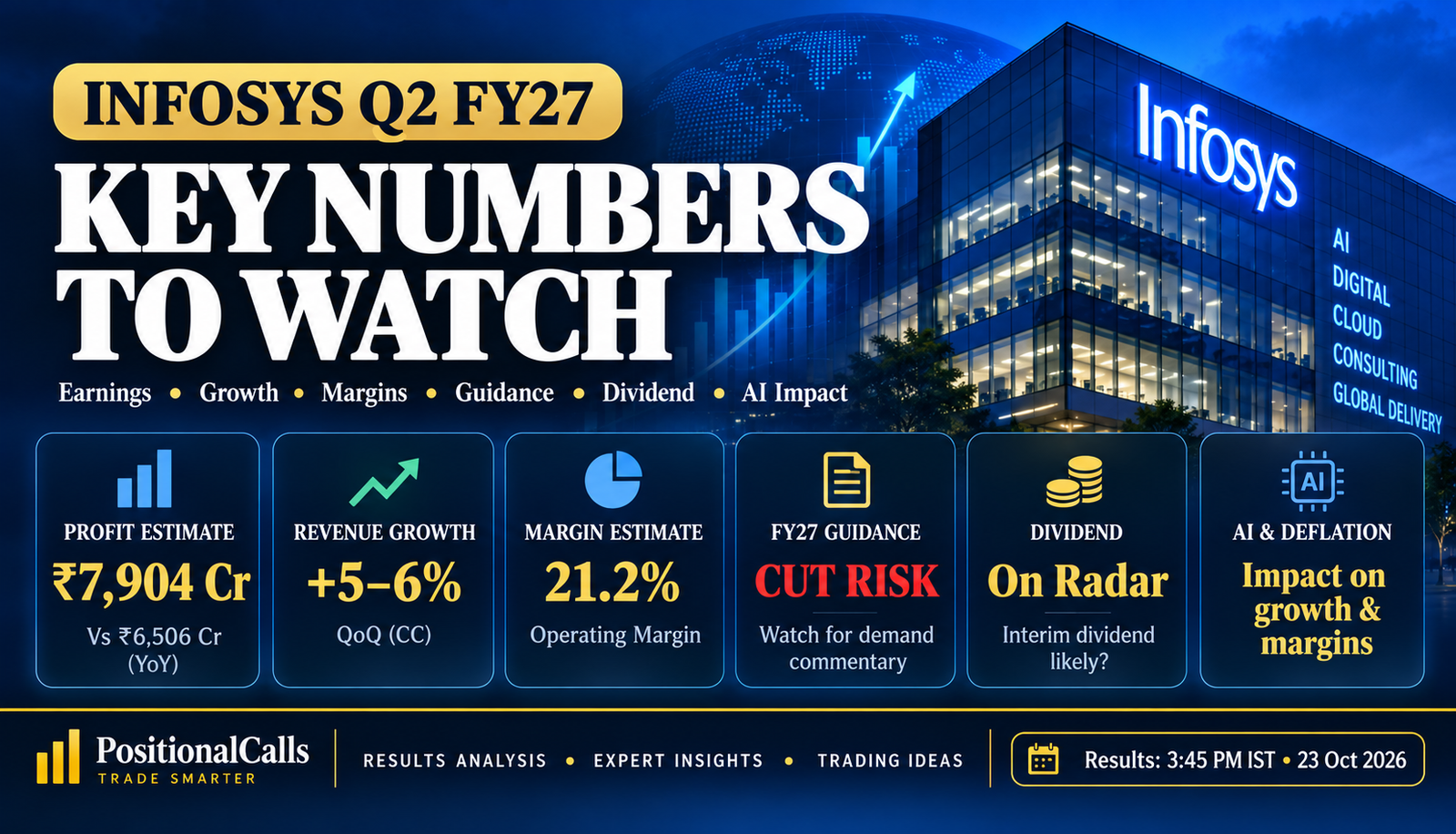
Infosys Q2 Results FY27 at a Glance
Infosys is India’s second-largest IT services company and the sector’s most closely watched guidance setter. Unlike a conglomerate, its quarterly print is simple to read: revenue growth in constant currency, EBIT margin, large-deal wins and the guidance range. That simplicity is why the Infosys Q2 results FY27 move the whole Nifty IT index, not just one stock.
This quarter has extra weight. Press previews describe Q2 as another subdued quarter for Indian IT, with FY27 on track to be a fourth straight year of weak growth. Infosys also faces a leadership transition, an AI-driven pricing debate and two acquisitions that complicate the organic growth picture. Our companion Reliance Q2 results FY27 preview covers the other big earnings event of the season.
| Reference point | Figure | Why it matters |
|---|---|---|
| Q2 FY26 net profit | About ₹7,364 crore | The year-ago base for the YoY headline |
| Q1 FY27 net profit | About ₹7,769 crore | Sequential base; profit fell 8.6% QoQ |
| Q1 FY27 revenue | About ₹48,211 crore (+3.9% QoQ) | Sequential revenue base |
| FY27 CC revenue guidance | 1.5%–3% (as cited by brokerages) | Most likely line to change |
| FY27 EBIT margin guidance | 20%–22% | Expected to be retained |
| Expected large-deal wins | $2–3 billion (HDFC Institutional) | Tests future revenue visibility |
| Share price (morning, 23 Oct) | About ₹1,153 | Bloomberg consensus 12-month target: ₹1,186 |
Treat all rupee figures as approximate. Infosys reports in IFRS and Ind AS formats and in rupees and dollars, and previews round differently. The company’s own press release is the final reference.
1. Infosys Q2 Results FY27: Date, Time and How to Follow
Infosys is scheduled to announce its September-quarter results on Friday, 23 October 2026, after market hours, at around 3:45 pm IST. The board will also consider an interim dividend, if any. The leadership team is due to address a press conference at 4:30 pm IST, followed by a 60-minute analyst conference call at 6 pm IST.
The sequence matters because the first headline at about 3:45 pm only shows the numbers. The guidance explanation, the demand commentary and the answers on deal renewals come in the press conference and, above all, the analyst call. Many stocks reverse their first reaction once the call starts, so the more careful approach is to read the filing first and the commentary second.
For the primary documents, check the filing under the symbol INFY on NSE and BSE, the press release, the fact sheet and the investor page on infosys.com. The market reaction normally appears in the next trading session, which here is Monday, 26 October. The timing also sits between two large events for the broader market, which we cover in our note on the Jio Platforms IPO GMP today, with the Jio listing expected on 28 October.
2. The Base: Q2 FY26 and Q1 FY27
Every comparison in the Infosys Q2 results FY27 uses two bases. The year-ago base is Q2 FY26 net profit of about ₹7,364 crore. The sequential base is Q1 FY27: net profit of about ₹7,769 crore on revenue of about ₹48,211 crore, which was up 3.9% quarter on quarter.
Q1 FY27 profit was weaker than it looks in isolation. It fell about 8.6% from ₹8,501 crore in Q4 FY26, even as revenue rose. Brokerage previews point to several moving parts behind that: a revenue reversal of about 50 basis points, a provision for post-sales client support, and the cost of acquisitions. Kotak notes the reversal headwind should not repeat in Q2, which adds roughly 50 basis points to sequential growth, while a swing in provisions takes about the same amount away.
This is why the consensus profit of ₹7,904 crore, only about 1.7% above Q1, is a modest bar. If the quarter lands in line, the story is stability. The risk is not the profit number. It is the forward guidance that goes with it.
3. What the Street Expects From the Infosys Q2 Results FY27
Estimates are tightly clustered, which means a miss or beat of even 1–2% on revenue can move the stock. The table below compares published brokerage and consensus views. Treat it as a range, not a forecast.
| Source | Net profit estimate | Revenue estimate | Key view |
|---|---|---|---|
| Bloomberg consensus | ₹7,904 crore | ₹49,108 crore | Operating margin 21.2% |
| Emkay Global | ₹8,027 crore (+9% YoY) | ₹49,323 crore | Buy, target ₹1,300; EBIT margin +50 bps QoQ |
| Kotak Institutional Equities | ₹7,689 crore (+4.4% YoY) | Organic CC growth about 1.1% | Margins stable; rupee gain offset by weak growth |
| HDFC Institutional Equities | ₹8,038 crore | ₹49,090 crore | Target ₹1,250; deal wins $2–3 billion |
| Jefferies | Pre-tax profit ₹7,920 crore (+7.5% YoY) | ₹49,144 crore (+10.5% YoY) | EBITDA ₹11,820 crore (+12.2% YoY) |
| Deven Choksey Research | Adjusted ₹8,094 crore (+9.9% YoY) | ₹49,211 crore (+10.6% YoY) | In-line quarter expected |
The spread between the lowest profit estimate (₹7,689 crore) and the highest (₹8,094 crore) is about 5%. A reading above ₹8,000 crore would be seen as a beat, while a reading under ₹7,700 crore would be a clear miss. Another point: rupee revenue growth of about 10% YoY looks strong only because of currency. Dollar and constant-currency growth is far lower, in the low single digits, which is what the guidance tracks.
4. FY27 Guidance: The Real Event in the Infosys Q2 Results FY27
For IT services stocks, guidance matters more than the quarterly profit. Brokerages expect Infosys to trim its FY27 constant-currency revenue growth range. Emkay expects a cut to 1.5%–2.5% from 1.5%–3%, which lowers the midpoint by 25 basis points to about 2%, excluding the Versent acquisition. A Business Standard preview cites a brokerage expecting 1%–2.5%. In both cases, EBIT margin guidance of 20%–22% is expected to be retained.
Why does a small trim matter? Because the market has already priced a weak year, and the question is whether the weakness is bottoming or widening. A guidance cut of 25 basis points would be read as in line with expectations. A cut that lowers the upper end by 100 basis points or more would suggest the second half is deteriorating. Holding the range unchanged would be a positive surprise.
How to read the guidance line
Three details change the interpretation. First, whether the range is for organic growth or includes acquisitions. Second, the implied second-half growth, which you can compute from the first-half actuals and the full-year range. Third, the tone on 2027 client budgets. A company that cuts guidance but says budget discussions are improving is in a different position from one that cuts guidance and warns of further delays.
Because Indian IT guidance is expressed in constant currency, rupee depreciation does not help the guided number, though it does lift reported rupee profit. That is why reported profit growth of 8–10% can sit alongside guided revenue growth near 2%.
5. Deal Wins and Mega-Deal Renewals
Large-deal total contract value (TCV) is the closest thing to a forward order book in IT services. HDFC Institutional Equities expects Infosys deal wins in the $2–3 billion range. A figure near the top of that range would reassure investors that revenue visibility is intact despite soft discretionary spending. A figure below $2 billion would raise questions about pipeline conversion.
Two nuances are easy to miss. First, TCV is not the same as annual revenue. A $2 billion deal spread over five years adds about $400 million a year. Second, the share of net new work versus renewals matters. Analysts are asking about the renewal of mega-deals won over the past few years. If a renewal is signed at lower prices because of AI-based productivity, the TCV headline can look fine while revenue per deal shrinks.
Look for the management’s description of the pipeline, the number of clients above $100 million in annual revenue, and any commentary on vendor consolidation, where clients reduce the number of IT suppliers. Vendor consolidation can benefit a scaled player such as Infosys, but it can also compress prices.
6. Margin: The Levers Behind the 21.2% Estimate
The Bloomberg estimate of a 21.2% operating margin sits in the upper half of the 20%–22% guidance band. Emkay expects about 50 basis points of sequential expansion. Kotak expects stable margins, because tailwinds and headwinds roughly cancel. The levers are straightforward.
Tailwinds: rupee depreciation against the dollar boosts rupee realisation while most costs are in rupees; higher utilisation improves productivity; and staggered wage hikes spread the cost across quarters rather than hitting one. Headwinds: pricing pressure on renewals, the cost of acquisitions, subcontractor costs and a provision swing of roughly 50 basis points flagged by Kotak.
The practical test is simple: compare the reported EBIT margin with 21.2% and with Q1. A margin above 21.5% with a guidance cut would mean profit is being protected through cost levers while growth slows. A margin near 20.5% would mean those levers are running out. Infosys also reports free-cash-flow conversion, which is worth checking because strong cash conversion supports dividends and buybacks.
7. AI-Led Deflation: Why It Dominates the Infosys Q2 Results FY27 Debate
AI-led deflation is the most important phrase in this earnings season. It describes a simple mechanism: when AI tools let engineers write, test and maintain software faster, clients expect to pay for fewer hours. If the price per project falls, revenue can shrink even if the volume of work is stable.
Kotak frames the investor questions clearly. How much of the revenue underperformance in FY27 is due to macro weakness and how much to AI deflation? Are generative AI programmes moving from pilots to scaled deployments? And is that AI work net-new revenue or just a replacement for existing revenue? Those three questions explain why a small revenue number can carry a big valuation debate.
What would be a good answer from management
A convincing response would include named client examples of scaled AI deployments, a share of revenue from AI-linked services that is growing faster than the company average, and evidence that productivity gains are being shared with clients in exchange for larger scope rather than pure price cuts. A weak response would be generic, with no numbers, or one that admits renewals are being re-priced downward.
The deflation theme also affects headcount. Hiring, utilisation and attrition are a real-time signal of how much work the company expects. TCS reported a workforce of 598,056 employees in its Q2. Compare Infosys’s headcount trend with that figure and with its own revenue growth to see whether productivity is improving.
8. What TCS and HCLTech Already Told Us
Infosys is not reporting in a vacuum. TCS announced its Q2 FY27 results on 8 October: revenue of ₹73,188 crore, up 11.2% YoY and 1.3% QoQ, and net profit of ₹13,884 crore, up about 15% YoY and 4% QoQ, with a second interim dividend of ₹12 per share. Reported profit growth needs a caveat, because the year-ago quarter included restructuring charges of ₹1,135 crore before tax, so the underlying improvement was smaller. One data aggregator shows core profit before tax (excluding other income and exceptional items) up 5.9% YoY.
HCLTech reported on 12 October. An aggregator shows revenue of about ₹35,620 crore, up 11.5% YoY, and net profit of about ₹5,132 crore, up 21.2% (verify against the company’s filing). Business Today’s preview notes that the Q2 results of a few major IT firms eased concerns a little, and that TCS, HCLTech and Tech Mahindra showed strength in the sector outlook.
| Company | Q2 FY27 result date | Revenue (₹ crore) | Net profit (₹ crore) |
|---|---|---|---|
| TCS | 8 October 2026 | 73,188 (+11.2% YoY) | 13,884 (+15% YoY) |
| HCLTech | 12 October 2026 | About 35,620 (+11.5% YoY; verify) | About 5,132 (+21.2% YoY; verify) |
| Infosys | 23 October 2026 | Estimate 49,108 | Estimate 7,904 |
The peer read-through is mixed. The sector’s reported numbers look decent in rupee terms, helped by currency, while underlying growth in constant currency stays in low single digits. This explains why investors compare Infosys on guidance rather than on headline growth.
9. Three Ways the Infosys Q2 Results FY27 Could Read
Instead of guessing a number, define in advance what each outcome would mean. These are qualitative frameworks, not forecasts.
| Scenario | What the filing would show | How investors may interpret it |
|---|---|---|
| In line, guidance trimmed slightly | Profit near ₹7,900 crore, margin about 21%, CC guidance cut by about 25 bps | Largely priced in; attention shifts to deal wins and 2027 budget commentary |
| Beat with stable guidance | Profit above ₹8,050 crore, deal wins at the top of the range, guidance unchanged | Positive surprise; supports the case that demand is stabilising |
| Soft print with a deeper cut | Revenue short of estimate, margin below 21%, upper end of guidance lowered sharply | Second-half worries grow; AI-deflation concerns intensify |
A fair caution: stocks often move on the gap between the result and what was already priced in, not on the quality of the result. With the share price near its recent range and consensus targets only slightly above, small surprises can matter more than usual.
On the morning of 23 October the stock traded around ₹1,153, close to Thursday’s close of ₹1,156. The Bloomberg consensus 12-month target price is ₹1,186, which implies upside of only about 3%. Individual targets differ: Emkay has a Buy with ₹1,300 and HDFC Institutional has ₹1,250. These are third-party views, not recommendations from us, and they are only as current as the day they were published.
For valuation, compare the P/E ratio with Infosys’s own history and with TCS, HCLTech and Wipro using live data, since multiples change daily. Remember that IT services valuations rest on a view of long-term growth and margin, not just this quarter’s profit. If AI deflation proves bigger than expected, the market may accept a lower multiple. If deal wins and AI-linked revenue show scale, it may hold or rise. We do not state a target price.
Interim dividend: what to check
The board will consider an interim dividend for FY27. The numbers to note are the amount per share, the record date and the payment date. Dividends are paid from profit, so also check payout relative to free cash flow rather than headline profit alone. A dividend has a limited effect on valuation, because the share price adjusts on the ex-dividend date.
Acquisitions and leadership
Two acquisitions complicate organic growth. Kotak expects the Optimum Healthcare acquisition to add about 50 basis points to growth through a full-quarter consolidation, and brokerages refer to guidance excluding the Versent acquisition. Always separate organic constant-currency growth from acquired growth, because organic growth shows the underlying demand. Press previews also note that management commentary will be watched as the company prepares for a leadership transition. Look for continuity signals on strategy and capital allocation.
11. Results-Day Checklist and Key Risks
Infosys results scorecard
| Metric | Q2 FY26 / Q1 FY27 | Consensus | Reported |
|---|---|---|---|
| Net profit | ₹7,364 Cr / ₹7,769 Cr | ₹7,904 Cr | Awaiting filing |
| Revenue | — / ₹48,211 Cr | ₹49,108 Cr | Awaiting filing |
| Operating (EBIT) margin | — / verify in Q1 release | 21.2% | Awaiting filing |
| Large-deal TCV | Verify in Q1 release | $2–3 billion | Awaiting filing |
| FY27 CC revenue guidance | 1.5%–3% (as cited) | Trim to 1.5%–2.5% or 1%–2.5% | Awaiting filing |
| FY27 EBIT margin guidance | 20%–22% | Unchanged | Awaiting filing |
Results-day checklist
- ☐ Download the filing and press release from NSE, BSE or infosys.com.
- ☐ Compare net profit with ₹7,904 crore (consensus), ₹7,769 crore (Q1) and ₹7,364 crore (year ago).
- ☐ Separate constant-currency organic growth from acquired growth.
- ☐ Check the FY27 revenue and margin guidance against the previous range.
- ☐ Note large-deal TCV and the share of net new work.
- ☐ Compare EBIT margin with 21.2% and read the margin bridge.
- ☐ Check attrition, utilisation and headcount.
- ☐ Check free-cash-flow conversion and the interim dividend details.
- ☐ Listen for AI-deflation, renewal pricing and 2027 budget commentary on the 6 pm call.
- ☐ Reassess valuation with the live share price, not older headlines.
Key risks to monitor
Infosys Q2 Results FY27: Verdict
The Infosys Q2 results FY27 are less about profit and more about direction. Profit is expected to be near ₹7,900 crore, helped by the rupee, and the margin is expected to hold inside guidance. What can change the narrative is the guidance range, the strength of deal wins and a credible explanation of how AI will add net revenue instead of removing it.
What would strengthen the bullish case? Guidance held or trimmed only slightly, deal wins near $3 billion, a margin at or above 21.2% and concrete evidence of scaled AI programmes. What would weaken it? A deeper guidance cut, a margin slip, weak organic growth hidden behind acquisitions or vague answers on renewals. None of this is a prediction, and the filing settles the facts.
Get research-led market updates on WhatsApp
Follow the Positional Calls WhatsApp Channel for company results, IPO developments and sector insights. Channel updates are informational; verify time-sensitive claims against official disclosures.
Frequently asked questions about the Infosys Q2 results FY27
When will Infosys announce Q2 results FY27?
On Friday, 23 October 2026, around 3:45 pm IST. The press conference is at 4:30 pm IST and the analyst call at 6 pm IST. The board will also consider an interim dividend.
What is the Infosys Q2 FY27 net profit estimate?
Bloomberg consensus is about ₹7,904 crore on revenue of about ₹49,108 crore and a 21.2% operating margin. Brokerage estimates range from about ₹7,689 crore to ₹8,094 crore.
What was Infosys net profit in Q1 FY27 and Q2 FY26?
About ₹7,769 crore in Q1 FY27 on revenue of about ₹48,211 crore, and about ₹7,364 crore in the year-ago Q2 FY26.
What is Infosys FY27 revenue guidance?
Brokerages cite constant-currency revenue growth of 1.5%–3% and an EBIT margin of 20%–22%. Analysts expect the revenue range to be trimmed while the margin range is retained.
Will Infosys declare an interim dividend with Q2 results?
The board will consider it at the results meeting. The amount, record date and payment date will be confirmed in the exchange filing.
What is AI-led deflation?
It is the pressure on IT services pricing as AI tools reduce the hours needed for a task. Analysts are checking whether AI work is net-new revenue or replaces existing revenue.
How did TCS and HCLTech perform in Q2 FY27?
TCS reported revenue of ₹73,188 crore (+11.2% YoY) and net profit of ₹13,884 crore (about +15% YoY, helped by a year-ago exceptional charge). HCLTech’s reported figures are cited at about ₹35,620 crore revenue and ₹5,132 crore profit; verify in its filing.
Is Infosys a buy before Q2 results?
This article makes no buy or sell recommendation. Review the filing, current valuation, risks and your own circumstances, or consult a SEBI-registered adviser.
Where can I verify the numbers?
Use the results filing on NSE and BSE, the press release and fact sheet, and the investor page on infosys.com.
Sources and verification
Use Infosys’s own filings as the primary verification point. Secondary reports help with context but should not replace the exchange filing.
- Infosys — investor relations and results
- Business Today — Infosys Q2 results preview, guidance and AI-led deflation
- Business Today — Infosys Q2 results timing and consensus
- Business Standard — Infosys Q2 results preview
- Upstox — Infosys Q2 expectations and Q2 FY26 base
- Kotak Neo — IT Q2 FY27 results dates
- Sarkaritel — TCS Q2 FY27 results
- Craytheon — Infosys and peer quarterly results (verify)
Editorial disclosure: This article is for informational and educational purposes only. It is not investment advice, a recommendation or a guarantee of returns. Investments are subject to market risks. Figures must be reconciled with official filings before publication or use.
Shubham Chaudhary is the founder of PositionalCalls, an independent Indian stock market research website. He writes company fundamentals, quarterly results analysis, IPO analysis and sector research for NSE and BSE listed companies, with a focus on banking stocks, insurance and long-term value investing. Every article is built from primary sources such as exchange filings, SEBI offer documents and annual reports, and states its risks plainly, in simple language for retail investors.
Coverage areas
Our research standards
- Numbers checked against NSE, BSE and SEBI filings
- Risks and limits stated in every article
- No paid promotions or broker tie-ups
- Articles updated when new filings arrive
Disclosure: The author is not a SEBI-registered investment adviser. Content is for education and information only and is not investment advice or a recommendation to buy or sell any security. Investments are subject to market risks; consult a SEBI-registered adviser before investing.