
IPO basics · Explainer
The UPI mandate for IPO explained: what the block request is, the Rs 5 lakh limit, the steps to approve it, the cut-off time, why mandates fail and when blocked money is released, with a worked example on the Crystal Crop Protection lot.
Quick answer
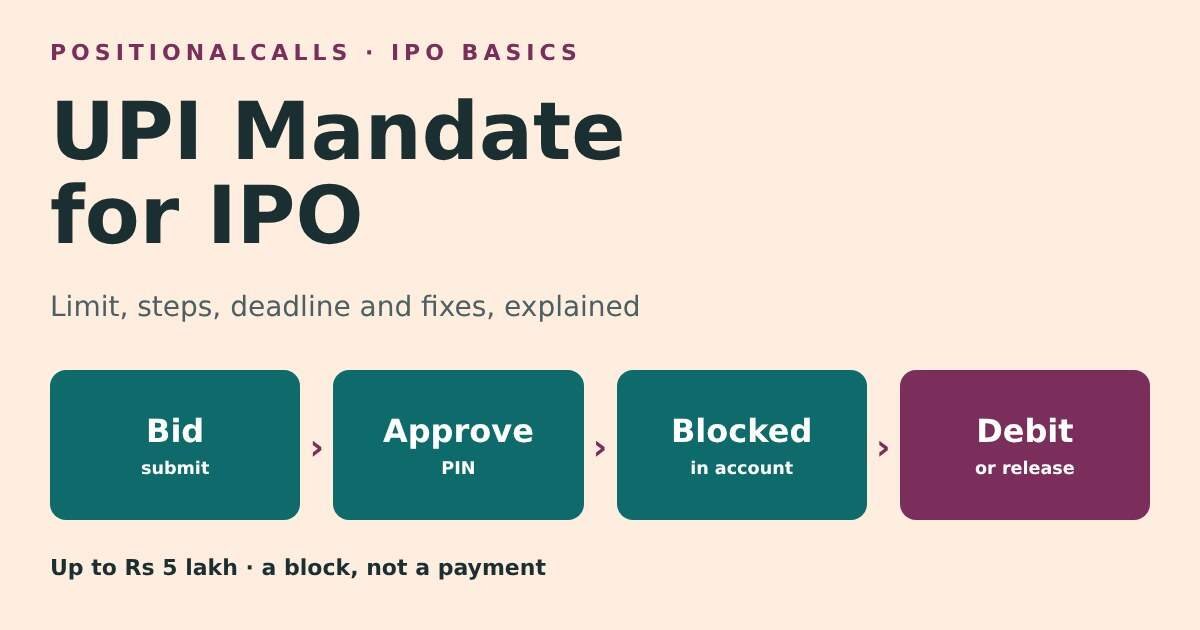
A UPI mandate for IPO is a block request your bank sends to your UPI app after you submit a bid. Approving it with your UPI PIN blocks the bid amount in your own account, up to Rs 5 lakh per application. Money is debited only for allotted shares. An unapproved mandate means a rejected application.
Latest update (Tuesday, 17 November 2026, 10:00 AM IST): first version of this guide. The limit comes from SEBI’s April 2022 circular as reported by Union Bank, Outlook Business and Taxmann. The mechanics come from NPCI’s FAQ page, which I opened, and from broker help pages. I did not open the current SEBI master circular, and the cut-off times are the least settled point.
Key takeaways
- It is a block, not a payment: money stays in your account until allotment.
- Up to Rs 5 lakh: the UPI limit per application since 1 May 2022.
- Approve early: an unapproved request means a rejected application.
- Own UPI ID only: the bank must be eligible and the ID must be yours.
In plain words: when you bid in an IPO through a broker, your bank asks you to approve a hold on the bid amount. You approve it with your UPI PIN. The money does not leave your account. If you get shares, that amount is taken. If not, the hold is lifted. If you never approve, the bid does not count.
Data note: as of Tuesday, 17 November 2026, 10:00 AM IST. The example uses the Crystal Crop Protection lot of 55 shares and the Rs 272 top of the band, as reported by Business Standard, Chittorgarh and Upstox. The amounts are arithmetic, not advice.
What is a UPI mandate for IPO?
A UPI mandate for IPO is a block request sent to your UPI app after you submit an IPO bid through a broker. When you approve it with your UPI PIN, the bank blocks the bid amount in your account until allotment is finalised.
NPCI’s FAQ describes the request as a collect request on your UPI-enabled app. You accept it by entering your UPI PIN, which blocks the bid amount in your account until allotment is finalised. Angel One describes the same step as money blocked or reserved in case you are allotted shares. The mandate is therefore a hold, which is the UPI version of ASBA, meaning Application Supported by Blocked Amount.
A UPI mandate for IPO is not a payment
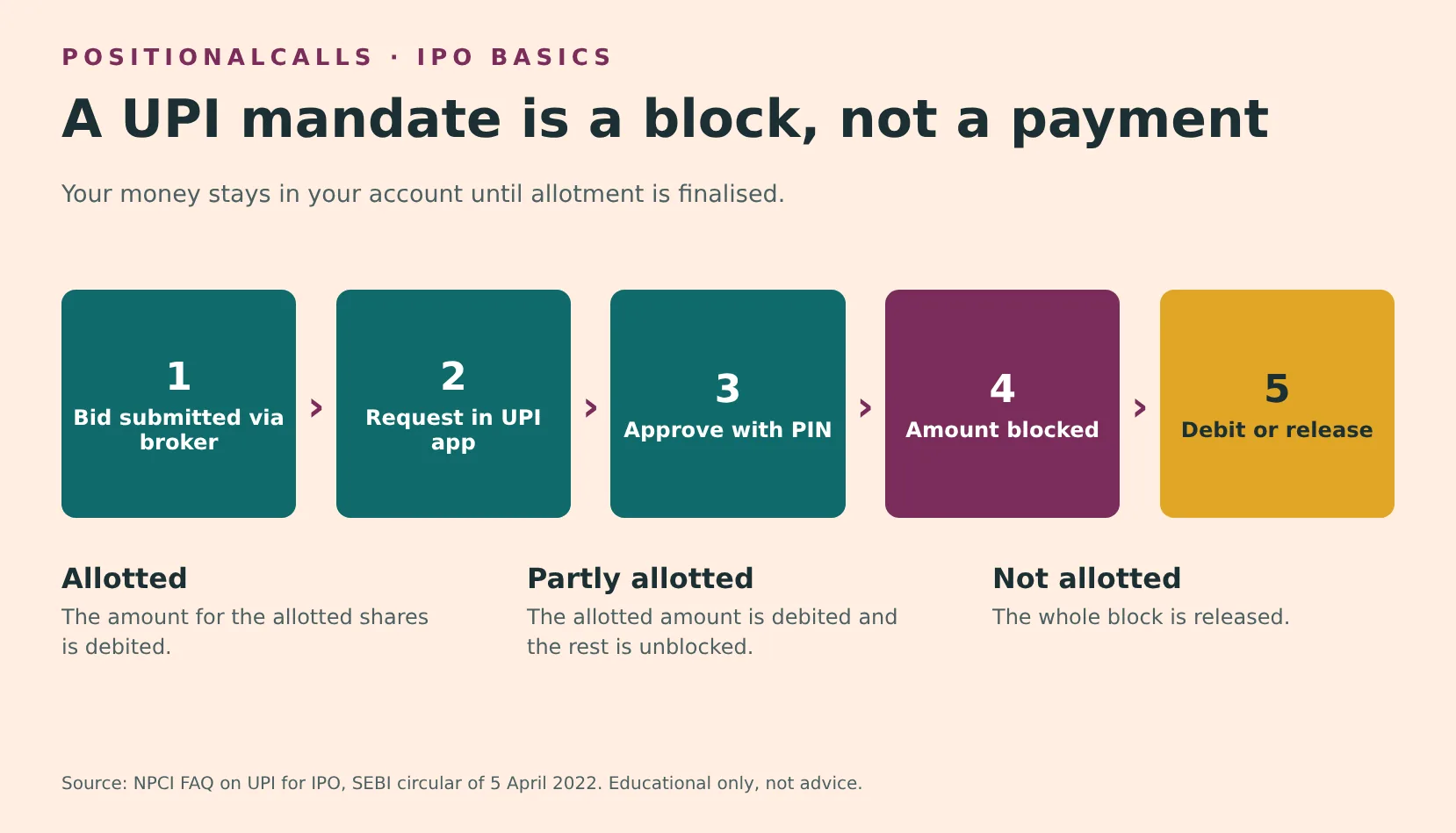
The distinction matters, because many first-time applicants think the money has left their account. It has not. NPCI says the amount is blocked until allotment is finalised, after which the amount for the allotted shares is debited and any balance from a partial allotment is unblocked. Angel One says that if you receive allotment the money is debited, and if not the amount is unblocked and shows again in your balance.
Why the IPO UPI mandate exists
Before ASBA, applicants paid by cheque or demand draft and waited for refunds. SEBI mandated UPI for retail applications submitted through intermediaries from 1 July 2019, according to the TaxGuru copy of the later circular. The block means the money earns its usual bank interest until the debit and returns without a refund process. PositionalCalls is not SEBI-registered, and this guide explains the process. It does not say whether to apply for any issue.
The UPI limit for IPO applications
SEBI’s circular of 5 April 2022 raised the UPI limit for IPO applications from Rs 2 lakh to Rs 5 lakh per application, effective 1 May 2022, after NPCI’s circular of 9 December 2021.
| Item | What the sources say | Source |
|---|---|---|
| NPCI circular | Raised the per-transaction UPI limit for IPO ASBA from Rs 2 lakh to Rs 5 lakh, dated 9 December 2021 | Taxmann; Union Bank |
| SEBI circular | SEBI/HO/CFD/DIL2/CIR/P/2022/45 of 5 April 2022 revised the UPI limit to Rs 5 lakh | Union Bank; Outlook Business |
| Effective date | 1 May 2022 | Outlook Business |
| Retail bid cap | A retail bid cannot exceed Rs 2 lakh in value, so UPI covers it | Lemonn; Calcguru |
| Older figure | NPCI’s FAQ page still shows a Rs 2 lakh limit | NPCI FAQ |
Cite this table: PositionalCalls, “UPI Limit for IPO Applications, as of 17 November 2026”; Taxmann, Union Bank, Outlook Business, Lemonn, Calcguru, NPCI.
The higher limit matters mainly for individuals bidding above Rs 2 lakh and up to Rs 5 lakh in the non-institutional category, as Lemonn explains. Our IPO investor categories guide shows where those bids fall. For a retail bid, Rs 2 lakh is the cap, so the mandate never needs more than that.
Which investors can use the UPI mandate for IPO
Calcguru says UPI is the mandatory payment mode where an individual applies through an intermediary, meaning a broker, depository participant or registrar, for Rs 5 lakh or less. NPCI’s older FAQ says only retail individual investors may use UPI, which no longer matches the higher limit. Above Rs 5 lakh, Calcguru says to use net-banking ASBA through a self-certified syndicate bank.
How to approve a UPI mandate for IPO, step by step
Submit the bid through your broker with your own UPI ID, wait for the mandate request in your UPI app, check the company name and amount, enter your PIN, and confirm the block in your bank account.
- Check the issue. Note the dates, the price band, the lot size and the final time for the bid and the mandate.
- Submit the bid. Choose the lots and the price or cut-off in your broker’s app and enter your own UPI ID.
- Look for the request. The mandate arrives in your UPI app, often under mandates or autopay, as Motilal Oswal describes.
- Review it. Check the company name and the amount before approving.
- Approve. Enter your UPI PIN. The bid amount is blocked in your account.
- Confirm. Check the status in your broker’s app and the block in your bank statement.
The steps follow the NPCI FAQ and broker help pages. Our how to apply for an IPO in India guide shows the application itself, and this page covers the mandate that follows it.
How long the UPI mandate for IPO request takes to arrive
Multibagg says the status in the broker’s app can take up to a day to update, because it changes only after the exchange confirms the application. That lag can look like a failed mandate even when the bank has already blocked the funds. If the request has not arrived, check the app’s mandates section and the broker’s status before applying again.
The cut-off time for a UPI mandate for IPO
Approve the request as soon as it arrives and well before the closing-day cut-off. Most sources, including SEBI’s timetable as reproduced by Taxguru, say 5 PM on the closing day. NPCI’s older FAQ says 12 noon on T+1, and one broker says 5 PM on T+1.
| Source | What it says | Type |
|---|---|---|
| Motilal Oswal | On the final day approve the mandate before 5:00 PM; at 5:01 PM the application is dead | Broker |
| Investorgain | Retail bids and the UPI mandate must both be approved by 5 PM on the closing date | Tracker |
| Bajaj Finserv | Approve the request by 5:00 PM on the day after the issue closes (T+1) | Broker |
| SEBI timetable | UPI mandate acceptance until 5 PM on the closing day (T), per SEBI’s circular of 9 August 2023 as reproduced by Taxguru and used in our apply guide | Regulator, secondary copy |
| NPCI FAQ | Block requests not acted on by 12:00 p.m. on T+1 lapse | Payments body, older page |
| Calcguru | UPI-ASBA and net-banking windows at many banks close at 4 PM on the last day; 5 PM is the mandate acceptance time | Explainer |
Cite this table: PositionalCalls, “UPI Mandate Cut-Off Times, Sources Compared, as of 17 November 2026”; Motilal Oswal, Investorgain, Bajaj Finserv, NPCI, Calcguru.
The weight of the sources, including SEBI’s timetable as reproduced by Taxguru, points to 5 PM on the closing day, but one older source and one broker differ, so I treat it as a ceiling and not a target. The safe reading is to approve the mandate the moment it arrives, and never leave it to the last hour. Our SME vs mainboard IPO guide covers the separate 4 PM close and 5 PM UPI time for SME issues under NSE’s circular 07/2025.
Why early approval matters for an IPO UPI mandate
Investorgain advises submitting an application an hour before the cut-off to avoid last-minute rejection. Rupeezy says a mandate not approved in time is the most common reason for rejection. Because the request must also reach your app, an hour is a minimum. Applying a day before the close leaves time to retry if the first request fails.
What happens to the blocked amount after a UPI mandate for IPO
The amount stays blocked until allotment is finalised. You are then debited for the allotted shares and any balance is unblocked. With no allotment, the full amount is released.
| Outcome | What happens to the block | Source |
|---|---|---|
| Full allotment | The amount for the allotted shares is debited | NPCI FAQ |
| Partial allotment | The allotted amount is debited and the balance is unblocked | NPCI FAQ |
| No allotment | The whole block is released, in some banks only when the mandate expires | NPCI FAQ; Angel One |
| Revocation | The bid amount is immediately unblocked | NPCI FAQ |
| Release time | Usually 3 to 10 working days after allotment, per a broker | Groww |
Cite this table: PositionalCalls, “What Happens to the Blocked Amount, as of 17 November 2026”; NPCI, Angel One, Groww.
Rupeezy says the debit after allotment almost never fails because the money has been blocked since you approved the request. Multibagg adds that a failed debit due to a low balance can cost you the allotment, so do not spend the blocked money. Our allotment status guide shows where the result appears.
If the money stays blocked after the UPI mandate for IPO
Groww says that if the amount is still blocked 10 working days after allotment you should raise it, and that the broker does not handle blocking and unblocking, which the bank and the registrar do. Check the mandate’s status, ID and expiry in your UPI app and the entry in your bank statement. Lemonn and Calcguru mention a SEBI compensation framework for delayed unblocking, but I did not open it and do not state its amounts.
A worked UPI mandate for IPO example
Take the Crystal Crop Protection IPO: a lot of 55 shares and a top of band of Rs 272, so one lot is Rs 14,960 (my calculation). The table shows the amount an IPO UPI mandate would block for different numbers of lots at that price.
| Lots | Shares | Amount blocked at Rs 272 (my calculation) | What it means |
|---|---|---|---|
| 1 | 55 | Rs 14,960 | One lot, the smallest bid |
| 5 | 275 | Rs 74,800 | Five lots |
| 13 | 715 | Rs 1,94,480 | Largest bid within Rs 2 lakh, so a retail bid |
| 14 | 770 | Rs 2,09,440 | Above Rs 2 lakh, so not a retail bid |
| 33 | 1815 | Rs 4,93,680 | Largest bid within the Rs 5 lakh UPI limit |
| 34 | 1870 | Rs 5,08,640 | Above the Rs 5 lakh UPI limit |
Cite this table: PositionalCalls, “Amount Blocked on Crystal Crop Lots at Rs 272, my calculation, 17 November 2026”; Business Standard, Chittorgarh, Upstox, SEBI circular as reported by Union Bank.
Business Standard lists the band as Rs 259 to Rs 272 with a lot of 55, so one lot at the bottom of the band is Rs 14,245 (my calculation). The issue opens on 18 November and closes on 20 November. The table is arithmetic on a hypothetical bid and does not say how many lots to bid for.
Reading the UPI mandate for IPO example
The largest retail bid at Rs 272 is 13 lots, or Rs 1,94,480, because a 14th lot would take the value above Rs 2 lakh (my calculation). Above that, a bid falls in the non-institutional category. The largest bid within the UPI limit is 33 lots, or Rs 4,93,680. A 34th lot takes the total to Rs 5,08,640, above Rs 5 lakh, so net-banking ASBA is needed.
Why a UPI mandate for IPO fails, and what to do
The usual reasons are approving too late, a wrong PIN, insufficient funds, an invalid or unsupported UPI handle or a bank technical decline. A mandate not approved in time rejects the application and blocks nothing.
| Reason | What happens | What to do | Source |
|---|---|---|---|
| Not approved in time | The application is rejected; nothing is blocked | Apply again only if the issue is still open | Rupeezy; ipomarket.in |
| Wrong UPI PIN | Declined with a wrong-PIN message | Re-initiate and enter the correct PIN | NPCI FAQ |
| Insufficient funds | The request is declined | Keep the full bid amount free in the account | NPCI FAQ; Lemonn |
| Wrong or invalid UPI ID | The request may not start or may go to the wrong ID | Delete the application and re-submit with a valid ID | NPCI FAQ; Upstox |
| Handle not enabled | The handle is not on the approved list for IPO | Use a handle your broker and NPCI list support | Lemonn; Bajaj Finserv |
| Technical decline | The transaction fails at the bank | Re-initiate through the broker where you applied | NPCI FAQ |
Cite this table: PositionalCalls, “Why an IPO UPI Mandate Fails, as of 17 November 2026”; NPCI, Rupeezy, ipomarket.in, Upstox, Lemonn, Bajaj Finserv.
ipomarket.in says that if a bid was rejected for one of these reasons, nothing was blocked, so there is no refund to chase. You simply did not get an application on the table. Rupeezy says the rejected application never entered the allotment draw.
PositionalCalls WhatsApp channel
Get IPO how-to guides on WhatsApp
- Rule and deadline changes, dated
- Plain-English IPO steps, no tips
- Links to updated IPO guides
When the IPO UPI mandate shows failed but money is blocked
Multibagg says the status can take up to a day to update because it follows the exchange’s confirmation, so a failed label can be a false alarm. A forum thread on TradingQnA says the bank, NPCI and the exchange run a three-way reconciliation to confirm applications and blocks. Forum posts are weak evidence, so I use them only to explain the lag, and your bank statement is the check.
When the UPI mandate for IPO fails after allotment
Zerodha’s help page says technical issues at the bank can make the mandate fail even when shares are allotted. Rupeezy says this almost never happens. If your broker or bank reports a debit problem, contact them straight away and keep the amount in the account.
What to do when something goes wrong with an IPO UPI mandate
Check the status in your broker’s app and the mandate in your UPI app, then your bank statement. Re-initiate only if the issue is still open, and raise a block that stays after allotment with your bank and broker.
- Check the status. Look at the application in your broker’s app and the mandate in your UPI app. Multibagg says the status can lag by up to a day.
- Check the bank statement. See whether the amount is blocked or debited.
- Re-initiate if the issue is open. For a technical decline, NPCI says to re-initiate through the intermediary where you applied.
- Fix a wrong UPI ID. Upstox says to delete the application and apply again with a valid handle.
- Accept a late approval as a rejection. ipomarket.in says a mandate left unapproved past the cut-off is a dead application, with nothing blocked.
- Escalate a stuck block. Groww says to raise it if the money is still blocked 10 working days after allotment.
Lemonn says the registrar publishes rejection reasons in the basis of allotment, and that the same handful repeat in every issue: a mandate never approved or approved after the cut-off, and a handle not on the approved list. If your bid is missing from the allotment file, that list is where to look for the reason. Our allotment status guide shows where the registrar’s result sits.
Why a rejected bid is not the same as a stuck block
A rejected application never took your money, so there is nothing to release. A stuck block is the opposite: the money was taken from your balance but not freed after allotment. The first needs a fresh application if the issue is open. The second needs a query to your bank. Mixing them up wastes time, because the broker cannot release a block that the bank and registrar hold.
Which UPI ID and bank you can use for a UPI mandate for IPO
Use your own UPI ID linked to your own bank account, and the bank must be eligible to act as an Issuer Bank. Applications made with a third-party UPI ID are not considered for allocation.
| Question | Answer | Source |
|---|---|---|
| Whose UPI ID? | Your own, linked to your own bank account | NPCI FAQ; SEBI 2019 circular |
| Which bank? | One eligible to act as an Issuer Bank in public issues; SEBI publishes the list | NPCI FAQ; SEBI 2019 circular |
| Which UPI handle? | Only handles on NPCI’s validated list for IPO use; not every app is enabled | Bajaj Finserv; Lemonn |
| Third-party UPI ID? | The application is not considered for allocation | NPCI FAQ |
| Many issues, one ID? | No restriction on the number of issues with the same UPI ID | NPCI FAQ |
Cite this table: PositionalCalls, “Which UPI ID and Bank Work for an IPO, as of 17 November 2026”; NPCI, SEBI circular (July 2019), Bajaj Finserv, Lemonn.
SEBI’s 2019 circular says the investor’s bank account must be linked to the UPI ID, and that a list of applications and handles for UPI in public issues is on SEBI’s website. Check that list if a handle does not work for an IPO. A UPI ID that is wrong or unsupported is also a cause of failed mandates, as Upstox explains.
Changing or cancelling a bid after a UPI mandate for IPO
You cannot edit the amount inside the request. Changes go through the intermediary, which sends a fresh request for your UPI PIN. Retail investors can modify or cancel bids before the cut-off.
NPCI’s FAQ says changes to a block request must go through the intermediary, who sends a new request. Investorgain says retail investors can modify and cancel their bids before the 5 PM cut-off. Multibagg describes a common confusion: after a bid revision the earlier block can remain visible for some time, so funds can look blocked twice. Keep enough balance for the new amount and check the statement.
Cancelling a UPI mandate for IPO
NPCI says that on a revocation the bid amount is immediately unblocked in your bank account. Groww says that if you accept a mandate and then cancel the order, the release usually takes 3 to 10 working days after allotment, and that the bank and the registrar process the block. The two statements differ, so check your own bank’s behaviour.
UPI vs net-banking ASBA for an IPO
UPI works for applications of Rs 5 lakh or less through a broker. Net-banking ASBA through a self-certified syndicate bank has no UPI limit. Both block the money in your account until allotment.
| Point | UPI mandate | Net-banking ASBA | Source |
|---|---|---|---|
| Where you apply | Through a broker, depository participant or registrar | Through your bank’s ASBA facility | Calcguru; Lemonn |
| Limit | Rs 5 lakh per application | No UPI-related cap | Lemonn; Calcguru |
| Approval | A mandate request in your UPI app | Authorisation in the bank’s own process | Lemonn |
| Money | Blocked in your account until allotment | Blocked in your account until allotment | NPCI; SEBI Investor |
| If not allotted | Released | Released | NPCI; Navia |
Cite this table: PositionalCalls, “UPI Mandate vs Net-Banking ASBA, as of 17 November 2026”; Calcguru, Lemonn, NPCI, Navia.
Lemonn calls ASBA the blocking of IPO money in your own bank account instead of transferring it away. The IPO UPI mandate is one way to do that. The IPO UPI mandate and net-banking ASBA differ in how you approve the block, not in what the block does.
Terms around a UPI mandate for IPO: ASBA, issuer bank and T+1
A few terms recur in every IPO UPI guide: ASBA, issuer bank, collect request, block and T+1. They are defined below from the NPCI and SEBI material and broker explainers.
| Term | Plain meaning | Source |
|---|---|---|
| ASBA | Application Supported by Blocked Amount: money to the extent of the share price stays in your account, blocked, until allotment | SEBI Investor, as quoted by Macmyths |
| Issuer bank | The bank your UPI ID is linked to must be eligible to act as one in the public issue process | NPCI FAQ |
| Collect request | The mandate request that reaches your UPI app and is accepted with your PIN | NPCI FAQ |
| Block | The bid amount is held in your account, not paid away | NPCI FAQ; Angel One |
| Sponsor or escrow bank | The bank that sends the block mandate request to the UPI app tied to your ID | Macmyths |
| T+1 | The day after the issue closes, used in some cut-off statements | NPCI FAQ; Bajaj Finserv |
Cite this table: PositionalCalls, “Terms Around a UPI Mandate for IPO, as of 17 November 2026”; NPCI, SEBI Investor via Macmyths, Angel One, Bajaj Finserv.
Macmyths quotes SEBI Investor’s description of ASBA as money to the extent of the price of the shares applied for being blocked, but remaining in the investor’s account until allotment. It also says the blocked amount continues to earn interest, which is an advantage over paying the money away. These definitions explain why the request is a hold and not a transfer.
Why T+1 appears in the cut-off statements
T is the day the issue closes. T+1 is the next working day, which is when NPCI’s older FAQ and Bajaj Finserv place the end of the approval window.
Common mistakes with the IPO UPI mandate
The mistakes that cost applicants most are waiting for the last hour, applying with a short balance, using someone else’s UPI ID and spending the blocked money before allotment.
Missing the request in the app
Some applicants never see the request because they look in the wrong place. Motilal Oswal points to the mandates or autopay section of the UPI app, where the company name and amount appear. If the request is missing, check that section and your broker’s status before concluding that it failed.
Assuming every UPI app works
Lemonn says the handle used must be on the NPCI approved list for IPO applications, and not every UPI app and bank handle is enabled. Bajaj Finserv says only NPCI-validated handles should be used. If your usual handle is not supported, your broker will usually list the handles it accepts, and SEBI’s 2019 circular points to a list of applications and handles on its website.
Checklist before you approve a UPI mandate for IPO
Before you approve, confirm the cut-off, use your own eligible UPI ID, keep the full amount free in your account, and approve the request as soon as it arrives.
- Note the issue’s closing date and the final time for the bid and the mandate.
- Use your own UPI ID linked to your own bank account, on a handle your broker supports.
- Keep the full bid amount, not an approximate amount, free in the account.
- Apply a day early so a failed request can be retried.
- Approve the request as soon as it arrives and check the company name and amount.
- Check the status in the broker’s app and the block in your bank statement.
- Do not spend the blocked money until the allotment is finalised.
The checklist organises the steps for approving the mandate. It is not advice on whether to apply, and the cut-off times in the notice for your own issue come first.
What to keep a record of
Keep a screenshot of the approved request, the application number from your broker and the bank statement entry showing the block. If a block is not released after allotment, or a bid is rejected after you approved, these three records are what your broker and bank will ask for.
What most people miss about the UPI mandate for IPO
The points readers most often get wrong are treating the mandate as a payment, trusting one cut-off time for every issue and ignoring the funds still blocked after allotment.
- It is a block. Money stays in your account until allotment and is debited only for allotted shares.
- Approval is part of the application. An unapproved request means a rejected bid, with nothing blocked.
- The cut-off time differs by source. Approve early, not at the last minute.
- Not every UPI handle works. Use one your broker and NPCI list support.
- Blocked money can take days to release. Brokers cite 3 to 10 working days after allotment.
Bottom line
A UPI mandate for IPO is a block request that you approve with your UPI PIN, up to Rs 5 lakh per application. Approve it early with your own eligible UPI ID, keep the full amount in your account, and expect debit only for allotted shares. The cut-off times differ by source, so read your own issue’s notice.
PositionalCalls WhatsApp channel
IPO updates in one channel
- SEBI and exchange changes, dated
- Plain-English IPO explainers
- Links to new IPO pages
UPI mandate for IPO: frequently asked questions
What is a UPI mandate for IPO?
A UPI mandate for IPO is a request from your bank, sent to your UPI app, asking you to approve a block on the bid amount in your own account. You approve it with your UPI PIN. The money is not paid away. It stays in your account, blocked, until allotment is finalised, per NPCI’s FAQ and Angel One.
What is the UPI limit for IPO applications?
SEBI’s circular of 5 April 2022 raised the UPI limit for IPO applications from Rs 2 lakh to Rs 5 lakh per application, effective 1 May 2022, after NPCI’s December 2021 circular. NPCI’s older FAQ page still says Rs 2 lakh. A retail bid is capped at Rs 2 lakh in value, so UPI comfortably covers it.
When must I approve the UPI mandate for IPO?
Approve it as soon as the request arrives, and always before the cut-off on the closing day. Motilal Oswal and Investorgain say the mandate must be approved by 5 PM on the closing day, while NPCI’s older FAQ gives 12 noon on T+1. Sources differ, so the issue’s own notice and your broker’s app decide.
Is money debited when I approve the UPI mandate for IPO?
No. Approving the request only blocks the amount in your account. NPCI says funds are debited only for the shares allotted, and any balance is unblocked. If you get no allotment, the full amount is released. Angel One adds that some banks release it only when the mandate expires.
Why did my IPO UPI mandate fail?
Common reasons are a wrong UPI PIN, insufficient funds, an invalid or unsupported UPI handle, a bank technical decline or approving after the cut-off, per NPCI’s FAQ, Upstox and Rupeezy. A mandate not approved in time means the application is rejected and nothing is blocked, so there is no refund to claim.
What happens if the UPI mandate fails after allotment?
Zerodha’s help page says technical issues at the bank can make the mandate fail even when shares are allotted. Rupeezy says the debit after allotment almost never fails because the money is already blocked. If a debit problem is reported, contact your broker and bank straight away and check the mandate status in your UPI app.
When is the blocked money released?
If you are not allotted shares, the block is released. If you receive a partial allotment, only the allotted amount is debited and the rest is unblocked, per NPCI. Groww says the release usually takes 3 to 10 working days after allotment. Funds blocked beyond that need a query to your broker and bank.
Can I use any UPI ID for an IPO?
No. The UPI ID must be your own, linked to your own bank account, and the bank must be eligible as an Issuer Bank, per NPCI’s FAQ and SEBI’s 2019 circular. Applications with a third-party UPI ID are not considered for allocation. There is no limit on how many IPOs you can apply to with the same UPI ID.
Can I change or cancel a UPI mandate for IPO?
You cannot edit the amount inside the request. NPCI says changes go through the intermediary, which sends a fresh request for your PIN. Investorgain says retail investors can modify or cancel bids before the cut-off. A revision can leave the earlier block in place for a time, so check your bank statement after you change a bid.
Is UPI the only way to pay for an IPO?
No. You can also use net-banking ASBA through a bank that is a self-certified syndicate bank, which has no UPI cap. Calcguru says that above Rs 5 lakh you must use net-banking ASBA. UPI is mandatory only where an individual applies through a broker, depository participant or registrar for Rs 5 lakh or less.
Sources
- NPCI: FAQs on UPI for IPO, older page, still shows Rs 2 lakh and a 12 noon T+1 time.
- Union Bank of India: SEBI circular of 5 April 2022 on the UPI limit, bank notice.
- Outlook Business: Invest up to Rs 5 lakh in IPOs through UPI, April 2022, news report.
- Taxmann: SEBI hikes UPI limits to Rs 5 lakh, 7 April 2022, secondary.
- TaxGuru: Revision of UPI limits in public issues, circular copy.
- SEBI: circular on UPI in public issues, July 2019, regulator document, snippet read.
- Motilal Oswal: How to apply for an IPO using a UPI ID, August 2023, broker.
- Motilal Oswal: Apply for an IPO through UPI online, broker.
- Investorgain: UPI IPO apply process, tracker, undated.
- Bajaj Finserv: IPO application with UPI, broker, undated.
- Angel One: IPO UPI mandate, broker, undated.
- Groww: when the amount is unblocked after a cancelled order, broker help page.
- Rupeezy: why was my IPO application rejected, broker help page.
- Rupeezy: why did my UPI mandate fail even though my IPO was allotted, broker help page.
- Zerodha: why did the UPI mandate fail even when the IPO was allotted, broker help page.
- Upstox: why did my IPO payment fail, broker help page.
- ipomarket.in: what to do if your IPO application is rejected or the UPI mandate fails, 27 June 2026, tracker.
- Lemonn: ASBA and the UPI mandate for IPO, broker, undated.
- Calcguru: how to apply for an IPO in India, 2026, explainer, secondary.
- Navia: how to apply for an IPO through UPI, broker, undated.
- Multibagg: Zerodha IPO UPI mandate not received, news.
- TradingQnA: UPI mandate issues, forum.
- Business Standard: Crystal Crop Protection IPO, issue details.
- PositionalCalls: how to apply for an IPO in India, IPO listing day rules, IPO GMP meaning, IPO tax in India and Crystal Crop Protection IPO.
PositionalCalls.com is an independent research site founded by Shubham Chaudhary. PositionalCalls.com is not a SEBI-registered research analyst or investment adviser. Investments in securities markets are subject to market risks. Read all related documents carefully before investing. Returns are never guaranteed. How this was researched: the NPCI FAQ page was opened directly on 17 November 2026 and is older than the 2022 limit change. The SEBI circulars and the cut-off times come from secondary summaries and broker pages and were not checked against the current SEBI master circular.

Shubham Chaudhary is the founder of PositionalCalls, an independent Indian stock market research website. He writes company fundamentals, quarterly results analysis, IPO analysis and sector research for NSE and BSE listed companies, with a focus on banking stocks, insurance and long-term value investing. Every article is built from primary sources such as RBI, SEBI, NSE and BSE filings and company annual reports, and states its risks plainly in simple language for retail investors.
Coverage areas Our research standards- Numbers checked against NSE, BSE and SEBI filings
- Risks and limits stated in every article
- No paid promotions or broker tie-ups
- Articles updated when new filings arrive