
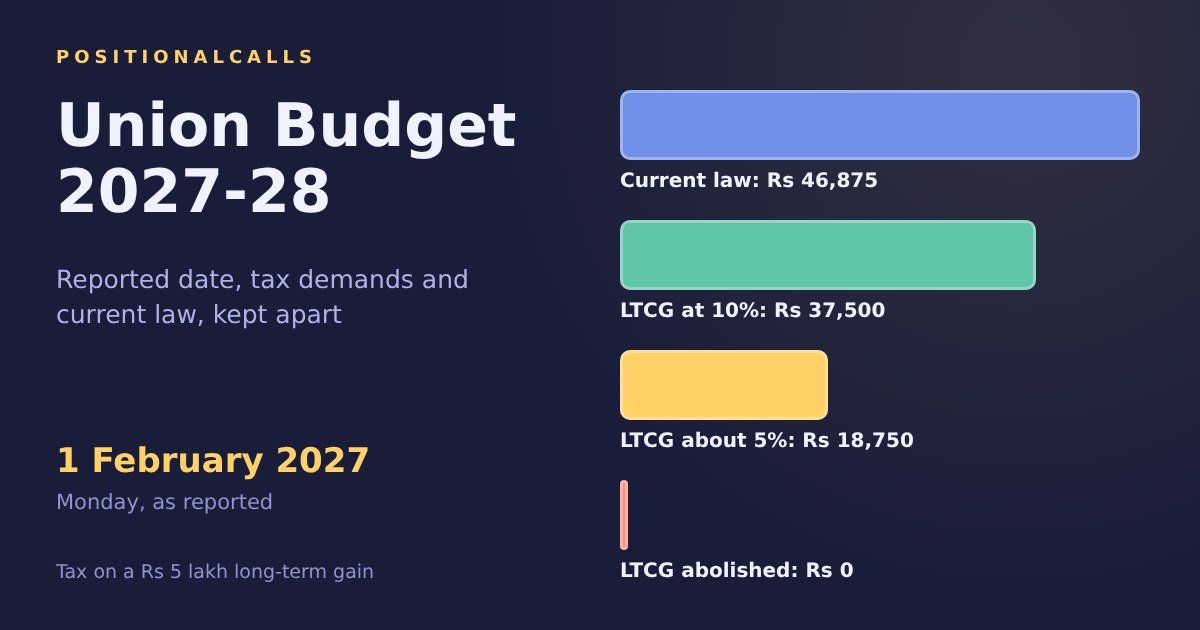
Budget · Union Budget 2027-28 guide
The Union Budget 2027-28 is reported for 1 February 2027, and the question investors ask most is whether capital gains tax and STT will change. This Union Budget 2027 guide separates current law, what industry bodies and SBI Research have asked for, and what the government has actually said, with a calculator for the rate options being discussed.
Quick answer
The Union Budget 2027-28 is reported as scheduled for Monday, 1 February 2027. No change to capital gains tax or STT is confirmed. Industry bodies and SBI Research want LTCG cut or removed, and the CBDT chairman said on 16 November the ministry will consider it. Current law is 12.5% LTCG above Rs 1.25 lakh and 20% STCG.
Union Budget 2027: key takeaways
- Date: 1 February 2027 is reported, a Monday and the 10th Budget by the same Finance Minister; the time and Parliament schedule are not announced.
- Current law: LTCG 12.5% above Rs 1.25 lakh, STCG 20%, STT on futures 0.05% and options premium 0.15%.
- Asked for: FICCI, ASSOCHAM, PHDCCI and SBI Research want lower or no LTCG; PHDCCI wants STCG cut to 10%.
- Said: the CBDT chairman said the ministry is examining capital gains tax and that February 1 will show the decision.
- Track record: the Union Budget 2026 left LTCG and slabs unchanged and raised STT on F&O.
In plain words: the Budget is the government’s yearly statement of how much it will spend and how it will raise the money, and it is also when tax rates are changed. Before it is presented, many groups send wish lists. A wish list is not a plan. Until the Finance Minister speaks, the tax you pay on a share sale stays what the law says at present, and this page keeps the wish lists, the official remarks and the current law in separate boxes.
Data note: as of Wednesday, 18 November 2026, 11:49 PM IST. Schedule points come from Angel One, Free Press Journal, News On AIR and Business Today. Demands come from Upstox, Business Today and Angel One, citing FICCI, ASSOCHAM, PHDCCI and SBI Research. Official remarks come from a PTI report carried by The Federal. Budget 2026 facts come from Moneylife, ClearTax, Bar and Bench, Deccan Chronicle and Business Today. Figures marked my calculation use the rates on this page. I did not open the Budget circular, a ministry release or the Finance Act.
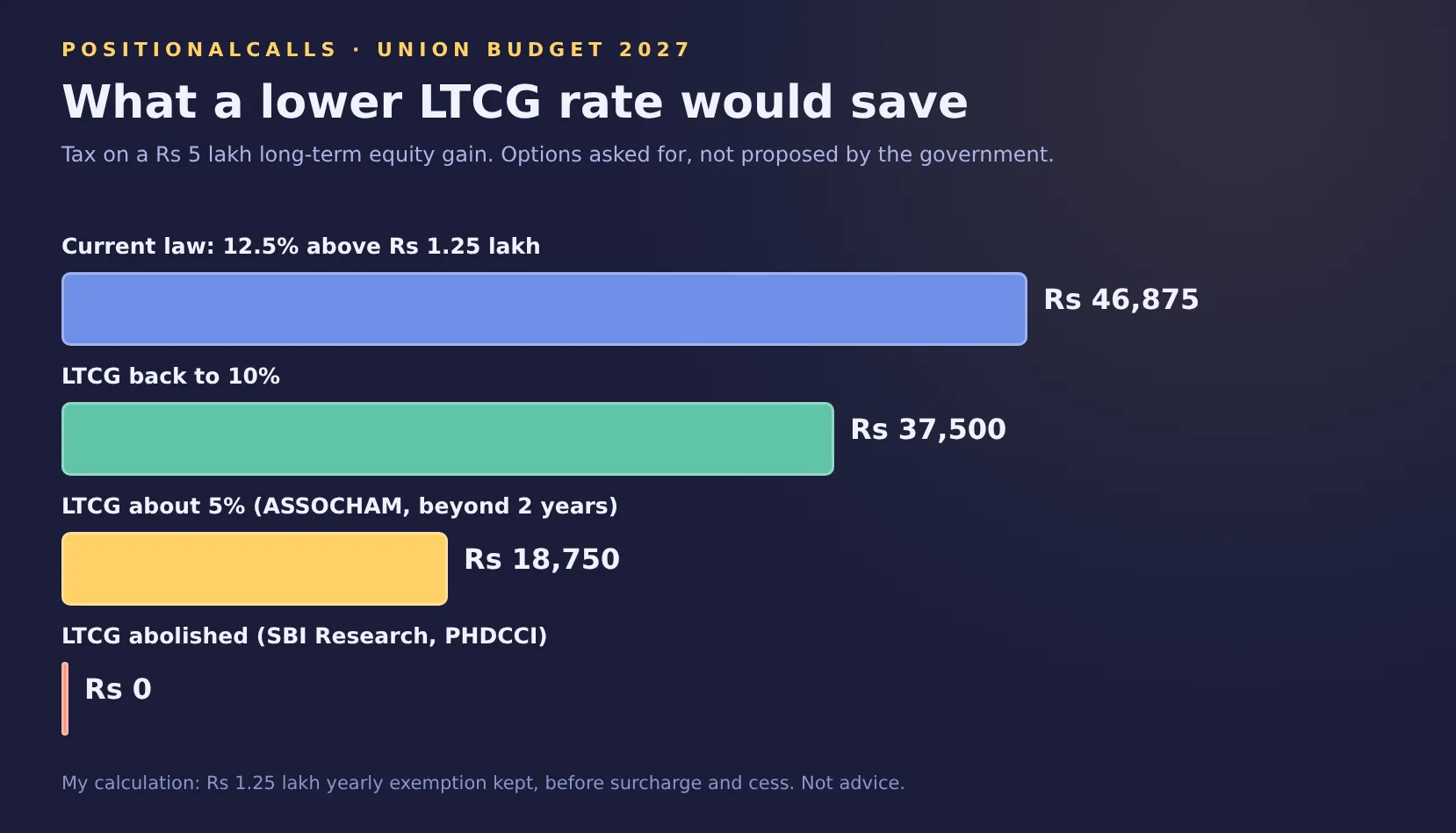 Tax on a Rs 5 lakh long-term equity gain under current law and three options that have been asked for. Source: PositionalCalls calculation, before surcharge and cess.
When is the Union Budget 2027-28 and what is the schedule?
The Union Budget 2027-28 is reported as scheduled for Monday, 1 February 2027, which Business Today says would be Nirmala Sitharaman’s 10th consecutive Budget. Angel One says it is scheduled, while the Free Press Journal and others say it is likely, and I did not find the official Cabinet Committee notice, so treat the date as reported and not yet formally notified.
| Step | Date | Status | Source |
|---|---|---|---|
| Budget circular issued by the Department of Economic Affairs | Reported 29 August 2026 | Done | Business Today; Free Press Journal |
| Department pre-Budget meetings | 12 October to 13 November 2026 | Scheduled period ended | Free Press Journal; Angel One |
| First pre-Budget consultation with economists, chaired by the Finance Minister | Monday, 16 November 2026 | Held; issues not disclosed | News On AIR; Angel One |
| Consultations with industry, trade unions, financial institutions, states and social-sector bodies | No dates given | Pending | Open magazine; Angel One |
| Budget session of Parliament | Not announced in the sources I found; 2026 began on 28 January | Pending | Deccan Herald (2026 date) |
| Economic Survey | Not announced; the 2026 Survey was tabled on 29 January | Pending | Outlook Business (2026 date) |
| Budget presentation | Monday, 1 February 2027; 11 am is the past practice | Reported, 2027 time not confirmed | Angel One; Upstox; Sunday Guardian (2026 time) |
Cite this table: PositionalCalls, “Union Budget 2027”; schedule as reported by the sources named, checked on the date above.
The Budget has been presented on 1 February since 2017, as Business Standard and India TV note, so that Parliament can pass it before the financial year begins on 1 April. In 2026 the date fell on a Sunday and was kept anyway. In 2027 it falls on a Monday, so no weekend question arises. The Union Budget 2027-28 will also be the first full Budget after the Income-tax Act, 2025 came into force, which Outlook Business says takes effect from 1 April.
What is the current law that the Union Budget 2027-28 would change?
The rules in force are LTCG at 12.5% on gains above Rs 1.25 lakh a year, STCG at 20%, a holding period of more than 12 months for long-term status, and STT of 0.05% on futures and 0.15% on option premium. Until the Finance Minister announces otherwise, these stay, and The Federal notes that surcharge and cess are charged on top.
| Item | Rule in force | Source | |
|---|---|---|---|
| LTCG on listed equity and equity funds | 12.5% above Rs 1.25 lakh a year, raised from 10% above Rs 1 lakh in July 2024 | Business Today; Upstox | Capital gains tax on shares |
| STCG on listed equity | 20%, up from 15% in the same Budget | Business Today | Capital gains tax calculator |
| Long-term holding period | More than 12 months | The Federal (PTI) | Stock market terms |
| Specified debt funds bought on or after 1 April 2023 | Taxed at the investor’s slab rate, whatever the holding period | Business Today | Mutual fund taxation |
| STT on futures | 0.05%, up from 0.02% in Budget 2026 | Bar and Bench; ClearTax | STT in India |
| STT on option premium | 0.15% on the premium, raised in Budget 2026 | Bar and Bench; ClearTax | STT in India |
| Share buybacks | Taxed as capital gains; 12.5% for non-promoters | K S and K | Dividend tax in India |
| Personal income tax, new regime | Nil to Rs 4 lakh, 5% to Rs 8 lakh, 10% to Rs 12 lakh, 30% above Rs 24 lakh; standard deduction Rs 75,000; no tax up to Rs 12.75 lakh for a salaried person | Moneylife; Open magazine | Not covered here |
Cite this table: PositionalCalls, “Union Budget 2027”; rates as reported by the sources named; I did not open the Finance Act or the Income-tax Act, 2025.
Upstox says nothing changes for your tax return this year and the current LTCG regime has applied since 23 July 2024. That date is a reminder that a Budget change can take effect on announcement, not only from the next April. Business Today adds that indexation was removed for most assets in July 2024 and that US shares and physical gold do not get the Rs 1.25 lakh exemption.
What are industry bodies and SBI Research asking from the Union Budget 2027?
Four sets of asks have surfaced: FICCI wants the LTCG exemption restored, ASSOCHAM wants a lower rate for longer holdings, PHDCCI wants LTCG removed and STCG halved to 10%, and SBI Research wants LTCG abolished. Upstox says three sets of recommendations converged on easing LTCG within days, and Angel One adds the PHDCCI list.
| Who | What they ask | Type of body | Source |
|---|---|---|---|
| FICCI | Restore the LTCG exemption on listed shares, with a higher STT if needed; lighter TDS, faster appeals | Industry body | Upstox |
| ASSOCHAM | LTCG at 10% for holdings of one to two years, nil or about 5% beyond two years; or allow STT as a credit against LTCG | Industry body | Upstox, citing Business Standard |
| PHDCCI | Remove LTCG on equity, cut STCG from 20% to 10%, lower STT, remove the 2.5% basic customs duty on LNG, naphtha and heavy feedstocks | Industry body | Angel One |
| SBI Research (Ecowrap, 2 November) | Abolish LTCG on equity; an inflation-linked threshold in place of the flat Rs 1.25 lakh; zero LTCG beyond two to three years; defer tax on fund switches reinvested within 90 days | Bank research, not a Budget proposal | Upstox; Business Today |
Cite this table: PositionalCalls, “Union Budget 2027”; requests as reported by the sources named, not government proposals.
Business Today stresses that these are investor demands and that STT and LTCG are separate levies, so a change to one does not automatically change the other. It reports no specific demand to change STCG, although PHDCCI does ask for a cut. The Federal adds items the ministry is reported to be examining: a longer holding period of 18 to 24 months instead of 12, a different treatment for foreign portfolio investors, and computing their gains in US dollar terms. Examining is not adopting. A body that asks for relief also takes no part in the decision.
What has the government actually said about LTCG and STT?
The most direct remark is from CBDT chairman Ravi Agrawal on 16 November: “We will consider it, and I am sure on February 1 you will get to know.” PTI reports he said the ministry is examining different aspects of capital gains taxation and that any changes are likely to be announced in the Union Budget 2027-28.
| Statement | By | Date | Source | What it does not say |
|---|---|---|---|---|
| “We will consider it, and I am sure on February 1 you will get to know.” | CBDT chairman Ravi Agrawal | 16 November 2026 | The Federal (PTI) | That LTCG will be scrapped or cut |
| The ministry is examining stakeholder suggestions and a considered decision will be taken | Same report, in the reporter’s words | 16 November 2026 | The Federal (PTI) | Any change to STCG or STT |
| The government “recognises the changing global circumstances and will take feedback into consideration” | Finance Minister, as quoted by Upstox | Undated in the article | Upstox | Any tax cut or commitment |
| She would “tread cautiously” on taxation | Finance Minister, per a linked Business Today headline | URL dated 13 October 2026, not confirmed in the text | Business Today | What she meant by cautious |
| First pre-Budget consultation held with economists | Finance Ministry post on X | 16 November 2026 | Angel One | Issues discussed or advice given |
Cite this table: PositionalCalls, “Union Budget 2027”; quotes as carried by the sources named; I did not open the original ministry post.
The same PTI report says the FY27 direct tax collection target is Rs 26.97 lakh crore, up 15% from Rs 23.40 lakh crore collected in FY26, and that the CBDT chairman is confident of meeting it. The report does not link the target to any capital gains decision. Business Today says the Finance Minister has not announced a tax cut or committed to changing the current regime, and that is the safest reading of the public record: capital gains tax is under examination, and the decision is reserved for the Budget speech.
What would LTCG relief cost, and how big is the revenue base?
SBI Research estimates LTCG on equity raised about Rs 1 lakh crore in FY26 and about Rs 40,000 to 50,000 crore in FY27, against a direct tax target of Rs 26.97 lakh crore, so abolition would be a small share of the target on that estimate. These are SBI’s numbers as summarised by Upstox, not government figures.
| Figure | Value | Source | Note |
|---|---|---|---|
| LTCG collections, FY25 | About Rs 1.3 lakh crore | SBI Research via Upstox | Estimate |
| LTCG collections, FY26 | About Rs 1 lakh crore | SBI Research via Upstox | Estimate |
| LTCG collections, FY27 | Rs 40,000 to 50,000 crore | SBI Research via Upstox | Estimate, 2 November |
| Shortfall from abolition in FY28 | 0.1% to 0.2% of GDP | SBI Research via Upstox | SBI’s own estimate |
| Extra revenue from a 50% STT hike | About Rs 45,000 crore in FY28 | SBI Research via Upstox | Estimate |
| FY27 direct tax target | Rs 26.97 lakh crore, up 15% from Rs 23.40 lakh crore | The Federal (PTI) | Growth is my calculation: 15.3% |
| SBI’s FY27 LTCG estimate as a share of that target | 1.5% to 1.9% | My calculation | Rs 40,000 and Rs 50,000 crore against Rs 26,97,000 crore |
Cite this table: PositionalCalls, “Union Budget 2027”; SBI Research figures as summarised by Upstox; arithmetic is mine.
The estimates fall year on year, and I did not open the SBI report, so I cannot say what drives the fall. A reader should keep three things apart: what a body estimates, what the government has budgeted, and what the Finance Minister announces. Business Today notes that any reduction would be weighed against the government’s revenue needs, and it gives no revenue figure of its own.
PositionalCalls WhatsApp channel
Get Budget and tax explainers on WhatsApp
- Budget dates and tax changes, dated
- Calculators explained without tips
- Links to updated guides
Use this calculator to compare the capital gains tax options being discussed
Enter a long-term gain and a short-term gain, and the calculator shows the tax under current law and under four options that bodies have asked for, with the saving against current law. For a Rs 5 lakh long-term gain and a Rs 1 lakh short-term gain, current law gives Rs 66,875 and the options give Rs 57,500, Rs 38,750, Rs 20,000 and Rs 56,875.
Tax is shown before surcharge and cess. The Rs 1.25 lakh yearly exemption is kept in every option, and holding-period conditions are not modelled.
Press Compare capital gains tax options to see the result.
How does this Union Budget 2027 calculator work?
It applies each rate to the gain you enter. Current law takes 12.5% of the long-term gain above Rs 1.25 lakh and 20% of the short-term gain. The options replace one rate at a time: LTCG at 10%, LTCG at about 5%, LTCG at nil, or STCG at 10%. The Rs 1.25 lakh exemption is kept in each, which is an assumption of mine, because the bodies do not all state a new threshold.
What does this calculator not include?
It leaves out surcharge and cess, which The Federal says apply on top of the 12.5%. It does not model the holding-period conditions in the ASSOCHAM ask, so the 5% line is a simple rate test, not a full proposal. It also excludes STT, brokerage, the tax on other assets and losses carried forward. Use it to see how sensitive your own tax is to a rate change, not to predict what the Union Budget 2027 will do.
What did the Union Budget 2026 give, against what was expected?
Last year’s record is a caution: investors expected capital gains relief and no STT rise, and the Union Budget 2026 left slabs and LTCG unchanged and raised STT on futures and options. Bar and Bench says many traders had expected relief in capital gains taxes, which made the STT hike more disappointing.
| Item | Expectation before the 2026 Budget | What the 2026 Budget did | Source |
|---|---|---|---|
| Income tax slabs and rates | Experts expected limited direct tax changes; some called for relief | No change in slabs or rates | Outlook Business; Moneylife; ClearTax |
| Standard deduction (new regime) | Widely expected to rise from Rs 75,000 to Rs 1 lakh | Continued at Rs 75,000 | BankBazaar; Bhatt and Joshi |
| LTCG on equity | Relief on LTCG or indexation was expected | Current regime, in force since 23 July 2024, unchanged | PL India; Upstox |
| STT | Confirmation that STT would not be raised | STT on futures 0.02% to 0.05%; options premium to 0.15% | PL India; Bar and Bench |
| Share buybacks | Not in the expectation pieces I read | Taxed as capital gains, not as dividends | K S and K; TaxTMI |
Cite this table: PositionalCalls, “Union Budget 2027”; expectations and outcomes as reported by the sources named.
This does not predict 2027. The ministry is examining capital gains in a different setting, with the CBDT chairman saying a decision comes on February 1, and the 2026 result may have been shaped by different revenue conditions. It does show why a wish list should not be read as an outcome. Avendus also lists the capital gains tax on secondary-market sovereign gold bonds among the 2026 changes, and the Budget withdrew the deduction of interest expenditure against dividend and mutual fund income, per Bar and Bench.
What is the fiscal frame around the Union Budget 2027-28?
The Union Budget 2026 set the FY27 fiscal deficit at 4.3% of GDP, against 4.4% in the revised estimate for FY26, and moved the anchor to debt-to-GDP, targeted at 55.6% for FY27. Any tax relief in the Union Budget 2027-28 has to fit inside that path, which aims for debt of 50% of GDP, plus or minus one point, by FY31.
| Item | Figure | Source |
|---|---|---|
| Fiscal deficit, FY27 budget estimate | 4.3% of GDP | Deccan Chronicle (FM speech) |
| Fiscal deficit, FY26 revised estimate | 4.4% of GDP | Deccan Chronicle (FM speech) |
| Debt-to-GDP, FY27 budget estimate | 55.6%, from 56.1% in FY26 | Business Today; Informist |
| Debt-to-GDP, FY26 outturn on the new GDP series | 58.2% | PolicyCircle |
| Medium-term debt target | 50% of GDP, plus or minus 1 point, by FY31 | DMI Finance; Financial Express |
| Net tax revenue, FY27 budget estimate | Rs 28.66 lakh crore, against Rs 26.74 lakh crore in the FY26 revised estimate | Business Today |
| Capital expenditure, FY27 | Rs 12.2 lakh crore; FY26 lowered to Rs 10.97 lakh crore from Rs 11.21 lakh crore | Business Today |
Cite this table: PositionalCalls, “Union Budget 2027”; figures as reported by the sources named from the Union Budget 2026 documents and later analysis.
PolicyCircle says the FY26 ratio of 58.2% sits above the 56.1% in the Budget because a new GDP series put nominal GDP for FY26 below the figure the Budget used, so the ratio rose without extra borrowing. It adds that the FY27 target of 55.6% was set under the old series. Informist reported that the FY27 fiscal deficit target was the slowest consolidation in six years and above the 4.2% economists had expected. I did not open the Budget documents.
How do markets behave on Budget day, and will there be a special session?
1 February 2027 is a Monday, so a normal weekday session would be expected, but I found no exchange circular, and the NSE and BSE 2027 holiday list is not published. In 2026 the Budget fell on a Sunday and the exchanges held a special live session, announced by circular on 16 and 17 January.
| Year | Budget day | Market arrangement | Reported outcome |
|---|---|---|---|
| 2025 | Saturday, 1 February | Special trading session | India TV confirms the Saturday session; no move quoted here |
| 2026 | Sunday, 1 February | Special live session, full hours, equity, F&O and commodity | Kotak Neo headline: Sensex down 1,546 points, Nifty down 1.96% on Budget day |
| 2027 | Monday, 1 February (reported) | Not announced; no circular found | Not applicable |
Cite this table: PositionalCalls, “Union Budget 2027”; India TV, IANS, Upstox and Kotak Neo as named.
The 2026 session opened flat at 25,333.75 on the Nifty 50 and 82,445.97 on the Sensex, per Deccan Chronicle, before the sell-off Kotak Neo describes. Reports differ on how rare weekend Budget trading is. Free Press Journal and LatestLY say the 2026 session was only the second weekend session in the market’s history after 1999, while India TV reports a special Saturday session for the 2025 Budget. A single day’s move says little about the year, and the page makes no call on the market.
How should you read Union Budget 2027 news without being misled?
Check four things in every Union Budget 2027 headline: whether it quotes an official, whether it reports a demand or a decision, which country and year it means, and from when any change would apply. The checks below come from the examples in this guide.
| Check | Why it matters | Example from this page |
|---|---|---|
| Quote or headline? | A headline can say more than the person quoted | The Federal’s subheadline says “scrapping” LTCG; the CBDT chairman’s quoted words do not |
| Demand or proposal? | Industry asks are not government plans | FICCI, ASSOCHAM, PHDCCI and SBI Research asks are requests, per Business Today |
| Which Budget 2027? | Other countries share the name | Malaysia tabled its Budget 2027 on 9 October and Ireland on 6 October |
| From when? | A change can apply from the announcement date | The 12.5% LTCG regime has applied since 23 July 2024, per Upstox |
| Law or speech? | The speech is followed by the Finance Bill, and details can change | I did not open the Finance Act, so rates here are as reported |
| Which year’s expectation? | Last year’s wish list is often recycled | Calls for a Rs 1 lakh standard deduction in 2026 were not met |
Cite this table: PositionalCalls, “Union Budget 2027”; examples from the sources named on this page.
Pages that rank for Union Budget 2027 expectations often reuse last year’s lists. Several of the 2026 expectation pages still show a Rs 1 lakh standard deduction wish that the Budget did not grant. Prefer pages that carry a date, name the body making a demand, and separate the demand from the law. This page is updated when the Economic Survey and Budget session dates are announced, and again on Budget day.
Where do sources differ on the Union Budget 2027-28?
Sources differ on whether the date is fixed, on what the ministry said about LTCG, on an old STT rate and on the debt ratio, so the table shows each point and how I treated it. None of these changes the current-law figures above, which are consistent across the sources I opened.
| Point | Source A | Source B | How I treated it |
|---|---|---|---|
| Budget date | Angel One: scheduled for 1 February 2027 | Free Press Journal: likely 1 February | Reported, not confirmed; official notice not found |
| LTCG “scrapping” | The Federal subheadline: examining scrapping | Same report: no direct statement from the chairman on scrapping | Used the quoted words only |
| Old STT on option premium | Bar and Bench: 0.10% to 0.15% | TaxTMI: 0.01% to 0.15% | Showed the new rate, 0.15%; old rate disputed |
| FY26 debt-to-GDP | Budget: 56.1% revised estimate | PolicyCircle: 58.2% on the new series | Showed both and the reason |
| Weekend Budget sessions | LatestLY: second since 1999 | India TV: Saturday session in 2025 | Showed both; rarity not settled |
| Capex, FY26 | Deccan Chronicle: Rs 11.2 lakh crore in the 2025-26 budget estimate | Business Today: Rs 11.21 lakh crore, lowered to Rs 10.97 lakh crore | Used Business Today |
Cite this table: PositionalCalls, “Union Budget 2027”; sources as named; no primary Budget document opened.
I did not open the Cabinet Committee notice, a Finance Ministry release, the Budget circular, the SBI Ecowrap report or the Finance Act. Figures from FICCI, ASSOCHAM and PHDCCI come through Upstox and Angel One, so a memorandum may word an ask differently. Where a summary and the original could differ, the original governs.
PositionalCalls WhatsApp channel
Budget and tax updates in one channel
- Budget day tax announcements, dated
- Plain-English explainers
- Links to new guides
Union Budget 2027: frequently asked questions
When is the Union Budget 2027-28?
The Union Budget 2027-28 is reported as scheduled for Monday, 1 February 2027, per Angel One and Upstox, and Business Today says it would be Nirmala Sitharaman’s 10th consecutive Budget. I did not find the official notice, and the 2027 speech time, Economic Survey date and Budget session dates are not announced in the sources I read.
Will LTCG tax be scrapped in the Union Budget 2027?
Nothing is confirmed. FICCI, ASSOCHAM, PHDCCI and SBI Research have asked for LTCG to be cut or removed, but these are requests. CBDT chairman Ravi Agrawal said on 16 November the ministry is examining capital gains taxation and “on February 1 you will get to know”. He did not say the tax will be scrapped.
What are the current LTCG and STCG rates?
Long-term gains on listed equity and equity funds are taxed at 12.5% on gains above Rs 1.25 lakh a year, and short-term gains at 20%, before surcharge and cess. The July 2024 Budget raised these from 10% above Rs 1 lakh and 15%, per Business Today. No change is announced.
Will STT change in the Union Budget 2027-28?
Market bodies want lower STT, and PHDCCI asks for lower rates, while FICCI would accept a higher STT if LTCG relief came with it. SBI Research estimates a 50% STT hike would raise about Rs 45,000 crore in FY28. Budget 2026 raised STT on futures to 0.05% and on options premium to 0.15%. No 2027 decision exists.
Will income tax slabs change in the Union Budget 2027?
I found no sourced list of 2027 slab demands in this check. Budget 2026 left slabs and rates unchanged, with a Rs 75,000 standard deduction and no tax up to Rs 12 lakh of taxable income, or Rs 12.75 lakh for a salaried person, per Moneylife. Calls for a Rs 1 lakh standard deduction in 2026 were not met.
What did the CBDT chairman say about capital gains in November?
PTI reported on 16 November that Ravi Agrawal said the ministry is examining LTCG, STCG, STT, the holding period and foreign portfolio investor treatment, with changes likely to be announced in the Union Budget 2027-28. His quoted words were “We will consider it, and I am sure on February 1 you will get to know.”
Will the stock market be open on Union Budget day in 2027?
1 February 2027 is a Monday, so a normal weekday session would be expected, but I did not find an exchange circular, and the NSE and BSE 2027 holiday list is not out. In 2026 it fell on a Sunday and the exchanges held a special live session, announced by circular in mid-January.
What time is the Union Budget speech and where can it be watched?
By past practice the speech starts at 11 am in the Lok Sabha, and the 2026 speech was shown on Sansad TV, DD News and the PIB and MyGov YouTube channels, per Sunday Guardian. The 2027 time and channels are not announced in the sources I read, so confirm them once the Parliament schedule is issued.
How much revenue would LTCG relief cost the government?
SBI Research, in its 2 November Ecowrap as summarised by Upstox, estimates LTCG collections at about Rs 1 lakh crore in FY26 and Rs 40,000 to 50,000 crore in FY27, and a shortfall from abolition of 0.1% to 0.2% of GDP in FY28. These are SBI’s estimates for the Union Budget 2027 debate. The government has not published its own figure.
Does Union Budget 2027 mean the Indian Budget?
Not always. Search results for Budget 2027 also carry Malaysia, whose Budget 2027 was tabled on 9 October, and Ireland, delivered on 6 October. This page covers India’s Union Budget 2027-28, for the financial year starting 1 April 2027. Check the country and the financial year in any headline before you rely on its numbers.
Sources for the Union Budget 2027 page
- Angel One: pre-Budget consultations.
- Angel One: pre-Budget discussions.
- Free Press Journal: pre-Budget meetings.
- Business Today: Budget 2027-28.
- News On AIR: first pre-Budget.
- Open magazine: FM begins.
- Upstox: Budget 2027.
- Business Today: LTCG tax.
- The Federal: CBDT chief.
- Moneylife: Budget 2026-27.
- ClearTax: Budget 2026.
- Bar and Bench: Budget 2026-27.
- TaxTMI: FY27 Budget.
- K S and K: Union Budget.
- Bhatt and Joshi: Union Budget.
- Outlook Business: Budget expectations.
- Outlook Business: customs overhaul.
- BankBazaar: Union Budget.
- PL India: Union Budget.
- Avendus: Union Budget.
- Deccan Chronicle: fiscal deficit.
- Business Today: Union Budget.
- Informist: Budget retains.
- PolicyCircle: India debt-to-GDP.
- DMI Finance: Union Budget.
- Financial Express: consolidation pace.
- Kotak Neo: Sensex drops.
- IANS: exchanges open.
- India TV: will NSE.
- Deccan Chronicle: Union Budget.
- Free Press Journal: Sunday trading.
- LatestLY: Nifty and.
- Sunday Guardian: Union Budget.
- Business Standard: CCPA proposes.
- Deccan Herald: Union Budget.
- Outlook Business: Economic Survey.
- Business Today Malaysia: Budget 2027.
- Azets: Irish Budget.
- Not opened: the Cabinet Committee notice, the Budget circular, any Finance Ministry release, the SBI Ecowrap report, the FICCI, ASSOCHAM and PHDCCI memoranda, the Finance Act and the Income-tax Act 2025; BankBazaar, PL India, Avendus, Business Standard and LatestLY points rest on search snippets; statements are from the sources above, and calculations are mine.
PositionalCalls.com is an independent research site founded by Shubham Chaudhary. PositionalCalls.com is not a SEBI-registered research analyst or investment adviser. Investments in securities markets are subject to market risks. Read all related documents carefully before investing. Returns are never guaranteed. This page is educational and publishes no subscribe, avoid, buy, sell, rating or target calls. Sources: news, research and broker pages as named; no Budget document, ministry release, circular or Act opened; no view on whether any tax change will happen or suits any person.

Shubham Chaudhary is the founder of PositionalCalls, an independent Indian stock market research website. He writes company fundamentals, quarterly results analysis, IPO analysis and sector research for NSE and BSE listed companies, with a focus on banking stocks, insurance and long-term value investing. Every article is built from primary sources such as RBI, SEBI, NSE and BSE filings and company annual reports, and states its risks plainly in simple language for retail investors.
Coverage areas Our research standards- Numbers checked against NSE, BSE and SEBI filings
- Risks and limits stated in every article
- No paid promotions or broker tie-ups
- Articles updated when new filings arrive