
Learning · Retirement and tool
An NPS calculator turns a monthly contribution, a return and the years to age 60 into a corpus, then splits it into a lump sum and a pension. The split changed in December 2025, and the tax rule did not change with it. This page gives an NPS calculator, the exit bands, the 60% tax limit and the points where sources disagree.
Quick answer
An NPS calculator projects your pension corpus from a monthly contribution, a yearly step-up, a return and the years to age 60. At Rs 10,000 a month rising 5% a year at 10% for 30 years, the corpus is Rs 3,31,87,627. A non-government subscriber can take up to 80% as a lump sum, and only 60% is tax-free.
NPS calculator: key takeaways
- Lump sum: up to 80% for non-government subscribers with a corpus above Rs 12 lakh, at least 20% in an annuity; government subscribers stay at 60:40.
- Tax: only 60% of the corpus is exempt under Section 10(12A), per Protean, Sahi and Business Standard; the extra 20% is taxed at slab.
- Corpus: Rs 10,000 a month for 30 years at 10% reaches Rs 2,07,92,927 with no step-up.
- Pension: annuity amount times the rate divided by 12; rates are quoted at 5.5% to 7.5%.
- Returns: market-linked; Tier I equity averaged 8.44% over 5 years and 11.55% over 10 years to 18 September 2026.
In plain words: NPS is a pension account you fill every month until 60. At 60 you split the pile in two. One part you take as cash, and the other part buys a pension from an insurer for life. After the December 2025 change, a private-sector subscriber can take up to four-fifths as cash. The tax office, on the sources I read, still treats only three-fifths as tax-free. An NPS calculator simply repeats the monthly saving for every month and then applies that split.
Data note: as of Wednesday, 18 November 2026, 10:30 PM IST. Exit rules come from Business Today, Upstox, Angel One, Outlook Money and Value Research. Tax statements come from Protean, Sahi, Business Standard, Nexdigm and 1finance. Return figures are NPS Trust data as shown by 1finance and Pension Bazaar to 18 September 2026. Figures marked my calculation use monthly compounding on round numbers. The PFRDA notification and the Income-tax Act were not opened.
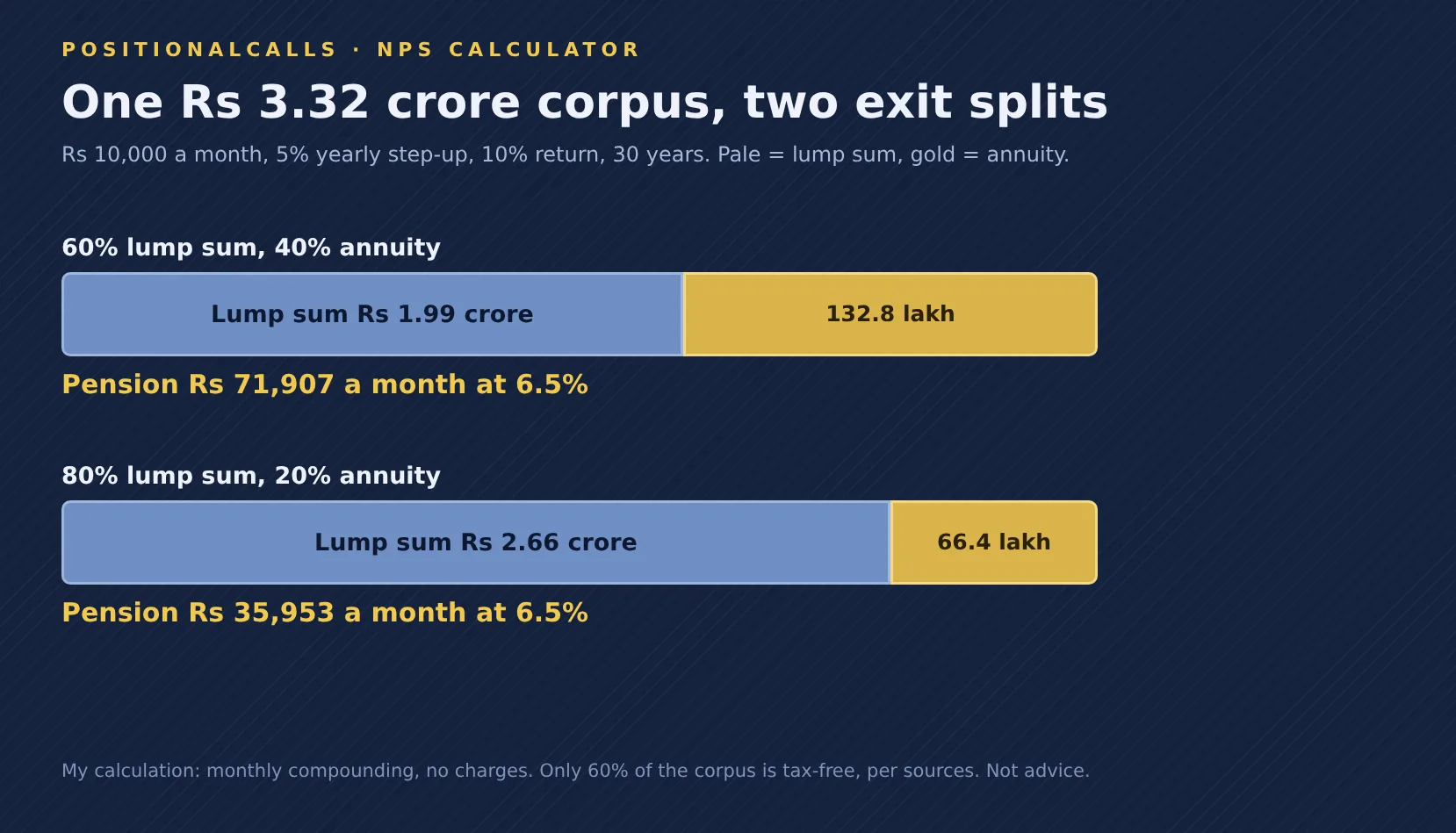
One corpus, two exit splits. Source: PositionalCalls calculation at 10% and a 6.5% annuity.
Use this NPS calculator to estimate your corpus and pension
Enter your age, the monthly contribution, a yearly step-up, an assumed return, the subscriber type, the lump sum you want and an annuity rate, and the NPS calculator shows the corpus at 60, the lump sum, the tax-free part and the monthly pension. The defaults are Rs 10,000 a month rising 5% a year at 10% from age 30, with a 60% lump sum and a 6.5% annuity.
The calculator assumes a normal exit at age 60, so the years of saving are 60 minus this age.
NPS returns are market-linked and are not guaranteed. Test a few rates.
The cap is 80% for non-government and 60% for government subscribers when the corpus is above Rs 12 lakh.
How does this NPS calculator treat the contribution?
It adds each month’s contribution at the start of the month, grows the balance at the monthly equivalent of the yearly return you type, and raises the contribution by the step-up at the start of each year. That is a standard monthly model, and it matches the formula used by the pages I read: the annuity amount times the rate divided by 12 for the pension. It ignores fund charges, which differ by pension fund.
How do I use this NPS calculator in four steps?
First, enter your age and the monthly amount you plan to pay, from Rs 500 upward. Second, choose a return you can defend, since NPS returns are market-linked. Third, pick the subscriber type and the lump sum percentage you want, and the NPS calculator caps it at what the rules allow. Fourth, enter an annuity rate and press the button. The last row is the monthly pension before tax.
What does this NPS calculator not include?
It does not model withdrawal before 60, the deferral of exit to 85, systematic withdrawal plans, charges, the choice between funds, or tax on the lump sum and pension. It treats the Rs 8 lakh to Rs 12 lakh band as a Rs 6 lakh lump sum cap. A real exit depends on the annuity provider and the plan you select, which the NPS calculator cannot know in advance.
What are the NPS exit rules after December 2025?
Non-government subscribers with a corpus above Rs 12 lakh can take up to 80% as a lump sum and must put at least 20% into an annuity. Business Today and Upstox set out the bands, and Angel One and HDFC Bank repeat the 80:20 rule. Government subscribers stay at 60% lump sum and 40% annuity, per Protean and Pension Bazaar.
| Corpus or exit type | Lump sum allowed | Rest of the corpus | Source |
|---|---|---|---|
| Non-government, normal exit, up to Rs 8 lakh | 100% | None required | Business Today, Upstox |
| Non-government, Rs 8 lakh to Rs 12 lakh | Up to Rs 6 lakh | Systematic unit redemption or annuity | Business Today, Angel One |
| Non-government, above Rs 12 lakh | Up to 80% | At least 20% annuity | Business Today, Business Standard |
| Non-government, voluntary exit, up to Rs 5 lakh | 100% | None required | Value Research, Upstox |
| Non-government, voluntary exit, above Rs 5 lakh | 20% | 80% annuity | Value Research |
| Government subscriber, normal exit | Up to 60% | At least 40% annuity | Protean, Pension Bazaar |
| Government subscriber, corpus up to Rs 5 lakh | 100% | None required | Outlook Money |
Cite this table: PositionalCalls, “NPS calculator”; exit bands as the sources named describe the PFRDA amendment of December 2025; the notification itself was not opened.
What else changed with the NPS exit rules?
Outlook Money says the minimum five-year subscription period was removed for non-government subscribers, and that the exit age moved from 75 to 85. GConnect lists deferral of withdrawal or annuity purchase up to 85. Value Research says non-government subscribers can exit at any time. None of this alters the corpus an NPS calculator projects to 60. It changes what you can do after.
Why does the NPS calculator cap the lump sum for government subscribers?
Because the sources say the 80% option is for the non-government sector, meaning the All Citizen and Corporate models. Protean says government employees are limited to a 60% lump sum. If you select the government subscriber type, this NPS calculator limits the lump sum to 60%, and the annuity must be at least 40% of the corpus.
When did the PFRDA change take effect?
Value Research and GConnect say the amendment was notified on 12 December 2025. Outlook Money and Angel One say 16 December. Business Today dated its report 17 December. I did not open the Gazette, so I cannot say which date is the notification and which is the announcement. The rule content is the same in all the pages.
Is the 80% NPS lump sum tax-free?
No. Only 60% of the corpus is exempt under Section 10(12A) as the sources cite it, and the extra 20% is taxed at your slab. Protean says the exemption stays at 60% despite the higher withdrawal limit. Business Standard quotes a tax expert that, unless the tax law is amended, the additional 20% may attract tax at the slab rate.
| On a Rs 1 crore corpus | Lump sum 60%, annuity 40% | Lump sum 80%, annuity 20% |
|---|---|---|
| Lump sum | Rs 60,00,000 | Rs 80,00,000 |
| Tax-free part, up to 60% of corpus | Rs 60,00,000 | Rs 60,00,000 |
| Lump sum taxed at slab | Rs 0 | Rs 20,00,000 |
| Annuity purchase | Rs 40,00,000 | Rs 20,00,000 |
| Monthly pension at 6.5%, before tax | Rs 21,667 | Rs 10,833 |
Cite this table: PositionalCalls, “NPS calculator”; my calculation using the 60% exemption as Protean, Sahi, Business Standard and CalcGuru state it; the pension is the annuity times 6.5% divided by 12.
The table shows the trade. Taking 80% in cash roughly halves the pension, and Rs 20 lakh of the cash is added to income in the year you receive it. This page does not say which split is better, because that depends on your other income, your health and what you do with the cash. It shows the arithmetic the NPS calculator uses.
Did Budget 2026 change the NPS tax limit?
Nexdigm reports that the Finance Minister did not raise the tax-free lump sum limit from 60% to 80% in the Budget 2026 speech on 1 February 2026. Sahi, on its 2026 page, says the extra 20% is taxable at the slab rate until the law catches up. I did not open the Finance Act or the Income-tax Act 2025, which renumbers sections, so check the current provision before you withdraw.
Is the annuity pension taxable?
Sahi and CalcGuru say the pension is taxed as income when received, at slab rates. That is the second stage of the design: the cash is mostly exempt, and the pension is not. The NPS calculator shows the pension before tax for that reason. For how market-linked gains are taxed, see mutual fund taxation in India and the capital gains tax calculator.
How does an NPS calculator work out the corpus?
An NPS calculator compounds each monthly contribution at the monthly equivalent of the yearly return, so Rs 10,000 a month for 30 years at 10% reaches Rs 2,07,92,927 on Rs 36,00,000 contributed. The corpus grows mostly from returns in the later years, which is why the starting age matters so much.
| Monthly contribution | Total contributed, 30 years | Corpus at 8% | Corpus at 10% | Corpus at 12% |
|---|---|---|---|---|
| Rs 5,000 | Rs 18,00,000 | Rs 70,88,066 | Rs 1,03,96,464 | Rs 1,54,04,866 |
| Rs 10,000 | Rs 36,00,000 | Rs 1,41,76,132 | Rs 2,07,92,927 | Rs 3,08,09,732 |
| Rs 25,000 | Rs 90,00,000 | Rs 3,54,40,331 | Rs 5,19,82,318 | Rs 7,70,24,330 |
| Rs 50,000 | Rs 1,80,00,000 | Rs 7,08,80,662 | Rs 10,39,64,636 | Rs 15,40,48,660 |
Cite this table: PositionalCalls, “NPS calculator”; my calculation with the contribution at the start of each month, a constant return, no step-up and no charges; returns are test values, not forecasts.
The table is linear in the contribution: Rs 50,000 a month gives ten times the corpus of Rs 5,000 a month. It is not linear in the return. Moving from 8% to 12% roughly doubles the corpus over 30 years. That is why a single NPS calculator result should be run at several rates, and why plans built on the highest rate carry the most risk.
What does a yearly step-up add in an NPS calculator?
| Yearly step-up | Total contributed, Rs 10,000 a month start | Corpus at 10% |
|---|---|---|
| 0% | Rs 36,00,000 | Rs 2,07,92,927 |
| 5% | Rs 79,72,662 | Rs 3,31,87,627 |
| 10% | Rs 1,97,39,283 | Rs 6,01,55,402 |
Cite this table: PositionalCalls, “NPS calculator”; my calculation for 30 years at 10%, the contribution raised at the start of each year by the percentage shown.
A 10% yearly step-up takes the same starting amount to roughly three times the no-step-up corpus. The step-up is the lever most under your control, since the return is not. A salary that rises 10% a year can fund it without a change in how much of the pay goes to the account.
How much does the starting age change the NPS calculator result?
| Starting age | Years to 60 | Total contributed | Corpus at 10% |
|---|---|---|---|
| 25 | 35 | Rs 42,00,000 | Rs 3,42,58,935 |
| 30 | 30 | Rs 36,00,000 | Rs 2,07,92,927 |
| 35 | 25 | Rs 30,00,000 | Rs 1,24,31,596 |
| 40 | 20 | Rs 24,00,000 | Rs 72,39,867 |
| 45 | 15 | Rs 18,00,000 | Rs 40,16,212 |
| 50 | 10 | Rs 12,00,000 | Rs 20,14,576 |
Cite this table: PositionalCalls, “NPS calculator”; my calculation at Rs 10,000 a month, no step-up, 10% return, no charges, exit at 60.
Starting five years later at 35 cuts the corpus by about 40% in this table while the contributions fall by only one sixth. Time in the market does the work, which is the point the NPS calculator makes when you change the age field. The same pattern appears in the SIP calculator and the CAGR calculator.
How does an NPS calculator work out the pension?
The monthly pension is the annuity amount times the annuity rate divided by 12, so Rs 20 lakh at 6.5% pays about Rs 10,833 a month before tax. PNB MetLife gives the same arithmetic, and it quotes annuity rates of 5.5% to 7.5% a year depending on the plan.
PositionalCalls WhatsApp channel
Get retirement and tax explainers on WhatsApp
- NPS rule changes, dated
- Calculators explained without tips
- Links to updated guides
| Annuity rate | Monthly pension on Rs 20 lakh | Corpus needed for Rs 50,000 a month |
|---|---|---|
| 5.5% | Rs 9,167 | Rs 1,09,09,091 |
| 6.0% | Rs 10,000 | Rs 1,00,00,000 |
| 6.5% | Rs 10,833 | Rs 92,30,769 |
| 7.0% | Rs 11,667 | Rs 85,71,429 |
| 7.5% | Rs 12,500 | Rs 80,00,000 |
Cite this table: PositionalCalls, “NPS calculator”; my calculation, annuity times rate divided by 12; PolicyX shows the Rs 1.09 crore, Rs 1 crore, Rs 92 lakh and Rs 86 lakh requirements for Rs 6 lakh a year at 5.5% to 7%.
A half-point change in the annuity rate moves the pension by about 8%, which is smaller than the effect of the lump sum split. The annuity type matters too. PNB MetLife says a plan with return of purchase price pays less than a plain life annuity, and Jumpp says a plain life annuity is closer to 7% to 7.5%, with nothing going to the family.
What does the 80:20 split do to the pension in an NPS calculator?
| Split on the default corpus | Lump sum | Annuity | Monthly pension at 6.5% |
|---|---|---|---|
| 60% lump sum, 40% annuity | Rs 1,99,12,576 | Rs 1,32,75,051 | Rs 71,907 |
| 80% lump sum, 20% annuity | Rs 2,65,50,102 | Rs 66,37,525 | Rs 35,953 |
Cite this table: PositionalCalls, “NPS calculator”; my calculation on the Rs 3,31,87,627 corpus from Rs 10,000 a month, 5% step-up and 10% return for 30 years; the second split is the option for a non-government subscriber.
The pension halves when the annuity falls from 40% to 20% of the same corpus. Value Research puts the trade another way: an annuity pays more at the start and is fixed for life, while a systematic withdrawal can keep growing and leaves a residual for the nominee. The NPS calculator shows only the annuity side. It does not price the alternatives.
Why is the NPS calculator pension in nominal rupees?
Because the annuity is fixed in nominal terms unless the plan escalates. PNB MetLife describes a plan at 5.5% with 3% escalation that starts at Rs 9,167 a month and rises to Rs 9,442 in year two. Thirty years of inflation will shrink what a pension of Rs 35,953 buys, and the NPS calculator output is not adjusted for it.
Which return should you use in an NPS calculator?
Use a range, not a point. NPS Trust data as shown by 1finance gives Tier I equity schemes an average of 8.44% over 5 years and 11.55% over 10 years to 18 September 2026. The one-year equity average was a loss of 5.09%, which shows how far a single year can sit from the long-run figure.
| Tier I scheme, average of all funds | 1 year | 3 years | 5 years | 7 years |
|---|---|---|---|---|
| Scheme E, equity | -5.09% | 8.10% | 8.44% | 13.42% |
| Scheme C, corporate bonds | 5.26% | 7.50% | 6.43% | 7.33% |
| Scheme G, government bonds | 2.93% | 6.25% | 5.73% | 6.55% |
Cite this table: PositionalCalls, “NPS calculator”; Tier I averages as on 18 September 2026 from the 1finance fund reviews citing NPS Trust data; the 10-year averages are 11.55% for Scheme E and 7.07% for Scheme G.
A blend matters more than a single scheme. A subscriber in an active choice might hold part in each, and one on the default life-cycle option moves toward bonds with age. The NPS calculator takes one blended return. If you hold equity heavily when young and less later, a figure between the equity and bond averages is a sensible test, and a lower one is a prudent check.
What is the Multiple Scheme Framework in NPS?
Sahi says the Multiple Scheme Framework allows up to 100% equity. The 1finance fund reviews list schemes as shown by NPS Trust at 30 September 2026, such as DREAM – I with 50% to 100% equity, Smart Retirement – I with 70% to 100% and Long Term Equity – I with 0% to 100%, and they are small, with assets from about Rs 19 crore to Rs 160 crore. The NPS calculator return should reflect the equity share you actually hold.
Why do NPS return figures differ so much between pages?
Dates, funds and periods differ. Whalesbook reports a Tier I equity high of 17.38% over three years as of 20 February 2026, which is the best fund on that date, not an average. The 1finance average for three years at 18 September 2026 is 8.10%. Bajaj Finserv quotes ranges such as 12.61% to 13.42% for Tier II government bonds over one year without a date on the page I read. Match the date and the fund before you copy a rate into an NPS calculator.
What tax deductions does an NPS calculator leave out?
The calculator does not include the tax deduction on contributions, which depends on your regime. Sahi sets out the sections, and I did not open the Income-tax Act to confirm the current numbering or limits.
| Provision | Who and what, per Sahi | Regime |
|---|---|---|
| Section 80CCD(1) | Own contribution up to 10% of basic plus DA, 20% of gross income if self-employed, within the Rs 1.5 lakh limit of Section 80C | Old regime only |
| Section 80CCD(1B) | An extra Rs 50,000 for your own contribution | Old regime only |
| Section 80CCD(2) | Employer contribution, up to 14% of basic plus DA in the new regime and 10% for private employers in the old | Both, with different limits |
Cite this table: PositionalCalls, “NPS calculator”; provisions as Sahi and TaxGuru describe them; the Income-tax Act 2025, which renumbers sections from 1 April 2026, was not opened.
A deduction lowers the tax you pay in the year of contribution but does not change the corpus an NPS calculator shows. If you also invest through a regular fund, the SIP calculator covers that side, and the tax rules for those gains are in mutual fund taxation in India.
How does NPS compare with PPF and a mutual fund SIP?
NPS and PPF differ on how the return is set, how the money comes out and how the payout is taxed. The table uses the PPF rate from the PPF calculator page and the NPS rules above.
| Feature | NPS | PPF |
|---|---|---|
| Return | Market-linked, not guaranteed | 7.1% for October to December 2026, reviewed each quarter |
| Payout | Part lump sum, part annuity pension | Lump sum at maturity, extendable in 5-year blocks |
| Tax on the payout | Pension taxed as income; 60% of corpus exempt | Described as tax-free on maturity by bank pages |
| Access | Partial withdrawals and loans limited; exit rules by category | Loan and partial withdrawal in set years |
Cite this table: PositionalCalls, “NPS calculator”; PPF rate from the PositionalCalls PPF calculator page citing Indian Bank; NPS statements from the sources named on this page.
The two answer different questions. PPF is a fixed-style savings product whose rate the government sets each quarter, and NPS is a market-linked pension account with an annuity requirement. A SIP calculator result for an equity fund has no annuity requirement and different tax rules. For a bank deposit at a rate fixed at booking, see the FD calculator. This page does not say which suits you. For a lump sum that is kept in a mutual fund and withdrawn monthly, the SWP calculator shows how long it lasts.
Where do NPS calculator sources disagree?
The disagreements concern the notification date, an outdated 40% annuity rule, the pension arithmetic, the voluntary exit minimum and the return figures. The table lists each reading and what I did with it.
| Point | Reading one | Reading two | What this page does |
|---|---|---|---|
| Date of the PFRDA change | 12 December 2025, GConnect and Value Research | 16 December 2025, Outlook Money and Angel One | Shows both; the Gazette was not opened |
| Mandatory annuity | 20% for non-government above Rs 12 lakh, Business Today | 40%, a Calcwise page updated 17 June 2026 | Uses 20%; the 40% applies to government subscribers |
| Pension on Rs 20 lakh at 6.5% | About Rs 13,000 a month, a calculator page | Rs 10,833, PNB MetLife and the formula | Uses the formula |
| Rs 5,000 to Rs 6,000 per lakh per month | Right to Information wiki guide | About Rs 460 to Rs 620 per lakh at 5.5% to 7.5% | Uses the formula; the wiki figure is about ten times higher |
| Voluntary exit minimum | 10 years, Sahi glossary | Five-year lock-in removed, Outlook Money | Shows both; check your fund manager |
| Tax-free share | 80% lump sum, as some pages imply | 60%, Protean, Sahi, Business Standard | Uses 60% and flags the rest |
| Equity return | 17.38% over 3 years, Whalesbook, 20 February 2026 | 8.10% average over 3 years, 1finance, 18 September 2026 | Uses the average with its date |
Cite this table: PositionalCalls, “NPS calculator”; each reading from the page named; calculations are mine.
None of these changes how the corpus is projected. They matter when you plan the exit or compare tools, and they are why I show the working. If an NPS calculator you use gives a different pension, check whether it assumes a 40% or a 20% annuity, which rate it uses and whether it applies the 2025 rules.
What mistakes do people make with an NPS calculator?
The common errors are using a high return, taking the 80% lump sum as tax-free, ignoring the step-up, forgetting that the pension is taxed and treating the pension as inflation-proof. Each follows from the rules above.
- High return: a 12% test case roughly doubles the 8% corpus over 30 years, and the one-year equity average to 18 September 2026 was negative.
- 80% as tax-free: only 60% is exempt, per Protean, Sahi and Business Standard.
- No step-up: a 10% yearly step-up triples the corpus from the same start.
- Pension before tax: the annuity income is added to slab income each year.
- Nominal rupees: a pension fixed for life loses purchasing power unless the plan escalates.
What is a quick checklist before you rely on an NPS calculator?
First, run three returns, such as 8%, 10% and 12%. Second, compare a 60% and an 80% lump sum. Third, check the annuity rate quoted by providers at exit. Fourth, add the step-up you can afford. Fifth, look at the tax rules in force when you retire. None of this says whether NPS suits you, and this page gives no such view.
What does this NPS calculator page leave out?
It leaves out charges, the choice of pension fund, withdrawal before 60, systematic withdrawal plans, tax computation and any view on whether NPS is the right product. It explains the arithmetic and shows the exit rules as the sources describe them.
- No notification text: the PFRDA amendment and the NPS Trust site were not opened; rules are as news, broker and bank pages state them.
- No tax computation: the Income-tax Act and the 2025 Act mapping were not opened.
- No forecast: returns and annuity rates in the NPS calculator are inputs, not predictions.
- No advice: the page does not say how much to contribute or which fund to choose.
Will this NPS calculator page be updated?
Yes, when the tax treatment of the 80% lump sum changes, when I open the PFRDA notification and the Income-tax Act, and when new NPS Trust return data are published. A change to the exit bands or the annuity requirement would also change the NPS calculator and this page.
PositionalCalls WhatsApp channel
Retirement and tax updates in one channel
- PFRDA and tax notices, dated
- Plain-English explainers
- Links to new guides
NPS calculator: frequently asked questions
What does an NPS calculator do?
An NPS calculator projects your pension corpus from a monthly contribution, a yearly step-up, an assumed return and the years to age 60. It then splits the corpus into a lump sum and an annuity using the exit rules and estimates a monthly pension. The result is an illustration, because NPS returns are market-linked and the annuity rate varies by provider.
How much lump sum can I take from NPS in 2026?
Non-government subscribers with a corpus above Rs 12 lakh can take up to 80% as a lump sum, with at least 20% in an annuity, under the PFRDA amendment of December 2025, per Business Today and Upstox. Government subscribers stay at 60% lump sum and 40% annuity, per Pension Bazaar. Smaller corpuses have separate thresholds.
Is the 80% NPS lump sum tax-free?
No. Only 60% of the corpus is exempt, under Section 10(12A) as the sources cite it, and the portion between 60% and 80% is taxed at your slab, per Sahi, Business Standard and Protean. Nexdigm reports that Budget 2026 did not raise the exempt limit. I did not open the Income-tax Act, so check before you withdraw.
What happens if my NPS corpus is below Rs 8 lakh?
Business Today and Upstox say a corpus up to Rs 8 lakh can be taken fully as a lump sum at normal exit, with no annuity required. Between Rs 8 lakh and Rs 12 lakh, up to Rs 6 lakh is a lump sum and the balance goes to systematic withdrawal or an annuity. This NPS calculator simplifies that band to a Rs 6 lakh cap.
How is the NPS pension worked out in an NPS calculator?
The annuity amount times the annuity rate, divided by 12. At 6.5%, Rs 20 lakh in an annuity gives about Rs 10,833 a month before tax, which matches the PNB MetLife example. Annuity rates are quoted at 5.5% to 7.5% depending on the plan and provider, and the pension is taxed as income when received.
What return should I use in an NPS calculator?
There is no single correct figure. NPS Trust data as shown by 1finance gave Tier I equity schemes an average of 8.44% over 5 years and 11.55% over 10 years to 18 September 2026, with government bond schemes at 5.73% and 7.07%. Some pages quote far higher numbers without dates, so run several rates and plan around the lower ones.
Can I claim a tax deduction on NPS contributions?
Under the old regime, your own contribution counts within the Rs 1.5 lakh limit and an extra Rs 50,000 is allowed under Section 80CCD(1B), per Sahi and TaxGuru. Under the new regime only the employer contribution under Section 80CCD(2) is allowed, up to 14% of basic plus DA. The 2025 Act renumbers sections, which I did not open.
What is the difference between NPS and PPF?
PPF pays a government-set rate, 7.1% for October to December 2026, with a 15-year term, while NPS returns depend on markets and money is locked until 60 apart from limited partial withdrawals. PPF interest and maturity are described as tax-free, but NPS taxes the pension. The PPF calculator on this site shows the fixed-rate side.
Why do NPS calculators give different pensions for the same corpus?
They differ in the lump sum percentage, the annuity rate and whether they apply the new 80:20 rule or the older 60:40 split. One page I read gives Rs 5,000 to Rs 6,000 a month per lakh, which is about ten times what a 6% annuity pays. Check the assumptions each tool states before you compare results.
Is this NPS calculator page investment advice?
No. PositionalCalls is not a SEBI-registered research analyst or investment adviser. This NPS calculator shows arithmetic from the inputs you type and the exit rules as the sources describe them. It does not say whether NPS suits you, which fund manager to choose or how much to contribute. I did not open the PFRDA notification or the Income-tax Act.
Sources for the NPS calculator page
- Business Today: PFRDA eases NPS, news.
- Protean: NPS withdrawal rules, bank.
- Value Research: how to exit, news.
- GConnect: PFRDA exit and, news.
- Outlook Money: PFRDA overhauls NPS, news.
- Angel One: PFRDA new NPS, broker.
- HDFC Bank: NPS withdrawal rules, bank.
- Business Standard: PFRDA exit rule, news.
- Business Standard: NPS withdrawal norms, news.
- Upstox: new 80% cash, broker.
- Protean: lump sum revolution, bank.
- Sahi: NPS tax benefits, broker.
- Sahi: NPS withdrawal glossary, broker.
- 1finance: 80% lump sum, broker.
- Nexdigm: NPS lump sum, tax.
- CalcGuru: NPS at retirement, tool.
- PNB MetLife: annuity rate in, insurer.
- Jumpp: what is annuity, broker.
- PolicyX: how to get, insurer.
- Value Research: NPS lump sum, news.
- Calcwise: NPS annuity calculator, tool.
- CPC salary calculator: NPS calculator page, tool.
- Right to Information wiki: NPS RIS guide, blog.
- 1finance: LIC Pension Fund, broker.
- 1finance: SBI Pension Fund, broker.
- 1finance: DSP Pension Fund, broker.
- 1finance: Scheme E comparison, broker.
- Pension Bazaar: NPS returns, tool.
- Whalesbook: NPS Tier I, news.
- Bajaj Finserv: NPS scheme interest, broker.
- Not opened: the PFRDA amendment notification, the NPS Trust site, the Income-tax Act and the Income-tax Act 2025; statements are from the sources above, and calculations are mine.
PositionalCalls.com is an independent research site founded by Shubham Chaudhary. PositionalCalls.com is not a SEBI-registered research analyst or investment adviser. Investments in securities markets are subject to market risks. Read all related documents carefully before investing. Returns are never guaranteed. This page is educational and publishes no subscribe, avoid, buy, sell, rating or target calls. Sources: bank, broker, tax and news pages as named; no notification or Act opened; no view on whether NPS suits any person.

Shubham Chaudhary is the founder of PositionalCalls, an independent Indian stock market research website. He writes company fundamentals, quarterly results analysis, IPO analysis and sector research for NSE and BSE listed companies, with a focus on banking stocks, insurance and long-term value investing. Every article is built from primary sources such as RBI, SEBI, NSE and BSE filings and company annual reports, and states its risks plainly in simple language for retail investors.
Coverage areas Our research standards- Numbers checked against NSE, BSE and SEBI filings
- Risks and limits stated in every article
- No paid promotions or broker tie-ups
- Articles updated when new filings arrive