
Sector outlook · Banking
Planning a SIP in bank stocks India 2026? This page replaces the earlier bank list and 60-30-10 allocation with how a monthly stock SIP actually works, what each instalment costs, how it is taxed, where it can fail, and what the latest bank data says. It names no banks to buy.
Quick answer
A SIP in bank stocks India investors set up is a recurring broker order that buys a fixed amount of chosen bank shares each month, so the price paid varies. This page covers the mechanics, costs, tax and risks, uses assumed prices for its examples, and names no banks to buy.
Latest update (Saturday, 14 November 2026, 6:15 PM IST): Rebuilt around the mechanics and costs of a stock SIP, with bank data from my other pages. The earlier version gave a bank list, a 60-30-10 allocation and an RBI credit-growth range with no source, and it linked to posts that redirect elsewhere. I could not open any broker contract or bank filing, so costs come from a summary article, the Upstox help pages and my STT page.
Key takeaways
- What it is: a recurring order, weekly or monthly, for a fixed rupee amount or quantity of a listed share, placed through a broker into your own demat account.
- What it costs: about Rs 11.9 on each Rs 10,000 instalment on the buy side, about 0.12% (my calculation), before any brokerage and DP charge; STT of 0.1% is the largest part.
- What it does not do: averaging lowers your average cost only when prices dip, and in a steady rise a lump sum would have done better in my assumed-price example.
- Whole shares: shares trade in whole units, so a Rs 10,000 instalment leaves some cash unused when the price does not divide evenly; I found no broker rule on carrying it forward.
- Concentration: a SIP in bank stocks India investors run is a one-sector bet, so the bank data matters more than the monthly habit.
- Data: in Q2 FY27, large banks grew profit from +4.7% to +38%, and gross NPA was 1.04% to 2.55% across the banks on my data page.
In plain words: a SIP is a way to spread purchases over time, not a way to pick better banks or to make money. It removes one decision, when to buy, and leaves the harder ones, which banks and how much, with you.
Data note: Figures are as of 14 November 2026, 6:15 PM IST. Broker mechanics follow a OneTradeJournal explainer (19 June 2026, modified 28 September 2026) and the Upstox community help page; other brokers differ and I did not check their terms. Transaction charges and tax rates are from those sources and my STT page, and rates can change. Example prices are assumed, not quotes. Bank figures are from my result posts and data pages. I could not open exchange filings.
1. What can a data page say about SIP in bank stocks India?
A data page can explain how a SIP in bank stocks India investors use actually works, what each instalment costs and how the gains are taxed, but it cannot tell you which banks to buy, how much to put in each, or whether averaging will beat a lump sum.
Searches for a SIP in bank stocks India usually want a list of banks and a split. That is a recommendation, and PositionalCalls is not SEBI registered and gives no buy or sell calls. The earlier version of this page named banks, gave a 60-30-10 split across private, public and mid-sized banks, and quoted a credit-growth range. This version keeps to what can be checked. The table below shows the questions a SIP raises and where this page answers them.
| Question | What decides the answer | Where this page answers it | Caution |
|---|---|---|---|
| How does the SIP run? | Your broker’s stock SIP feature and its rules | Section 2 | Rules differ by broker; I checked Upstox only |
| What does it cost? | STT, stamp duty, exchange and SEBI fees, GST, brokerage, DP charges | Section 3 | Rates can change; confirm on your contract note |
| Does averaging help? | The path of prices after you start | Section 4, assumed prices | Averaging is not a guarantee |
| How is it taxed? | Holding period of each instalment, and dividends | Section 6 | Rates can change; see the tax guides |
| Which banks? | Your goal, and the banks’ own data | Section 8 | The data page shows facts, not a ranking |
Cite this table: Question map by PositionalCalls; sources are listed at the end of the page, as of 14 November 2026, 6:15 PM IST.
What changed from the earlier version
The earlier page described a SIP as a monthly investment “instead of mutual funds”, listed HDFC Bank, ICICI Bank, Axis Bank, SBI, Bank of Baroda, Federal Bank and IDFC First Bank by role, rated their stability, growth and risk as High, Medium or Low, and proposed 60% private, 30% public and 10% mid-sized banks. It also said the RBI expected credit growth of 12% to 16%. None of those had a source or a date, so I removed them. RBI data reported by The Week shows bank credit up 17.94% on 15 October 2026, outside that 12% to 16% range. Links to the long-term and safe bank-stock posts were replaced, since those posts redirect to my best bank stocks in India 2026 data page.
2. How does a stock SIP work?
A stock SIP is a standing instruction to your broker to buy a fixed rupee amount or a fixed quantity of a listed share on a schedule, usually weekly or monthly, into your own demat account, with each purchase being a separate lot.
Per a OneTradeJournal explainer, on each trigger date the broker places a market or limit order in the cash segment, trades settle the next trading day, and sales follow first-in, first-out. It names Zerodha, Upstox, Groww, Angel One and ICICI Direct as brokers offering recurring buys, without verifying each one. I checked only the Upstox help page. On Upstox you change the order type from Market to SIP, choose a weekly day or a monthly date, and the order repeats until you cancel. You can set it by amount or by quantity, up to 20 SIPs, on the top 250 stocks and top ETFs. The first order is placed the same day, and later orders run at 11 AM on the scheduled date or the next trading day.
| Feature | What I found | Source and limit |
|---|---|---|
| Schedule | Weekly or monthly; chosen day or date | Upstox help page and OneTradeJournal |
| Amount or quantity | Both on Upstox; amount-based needs balance above the SIP amount | Upstox help page |
| Eligible shares | Top 250 stocks and top ETFs on Upstox | Other brokers may allow more or fewer |
| Execution | Same day for the first order; 11 AM for later ones on Upstox | Timing differs by broker |
| Failure | Retried up to 5 times, then cancelled on Upstox | Insufficient balance or an upper circuit with low liquidity |
| Minimum amount | Not stated on the Upstox page | I did not find a figure |
Cite this table: Stock SIP mechanics per the Upstox community help page and OneTradeJournal (19 June 2026); other brokers not checked.
Because the shares sit in your own account, a SIP in bank stocks India investors run is different from a mutual fund SIP. You choose the shares, you carry the charges and you receive the dividends. Section 7 sets the two side by side.
3. What does each SIP in bank stocks India instalment cost?
On the buy side a Rs 10,000 instalment costs about Rs 11.9, or about 0.12%, before brokerage and depository charges, and the largest part is the 0.1% securities transaction tax; costs on the sale are separate.
| Charge | Rate on the buy side | On Rs 10,000 (my calculation) | Source |
|---|---|---|---|
| Securities transaction tax (STT) | 0.1% on a delivery purchase | Rs 10.00 | My STT guide; OneTradeJournal |
| Stamp duty | 0.015%, buy side only | Rs 1.50 | OneTradeJournal |
| NSE transaction charge | About 0.00297% | Rs 0.30 | OneTradeJournal; single source |
| SEBI turnover fee | 0.0001% | Rs 0.01 | OneTradeJournal |
| GST | 18% on exchange and SEBI charges (and on brokerage) | Rs 0.06 | OneTradeJournal |
| Brokerage | Often Rs 0 for delivery at discount brokers | Rs 0 assumed | Check your broker |
| Total, buy side | About Rs 11.86, or 0.12% | My calculation |
Cite this table: Charge rates per my STT guide and OneTradeJournal (19 June 2026); brokerage taken as zero; depository charges excluded; rates can change.
Twelve instalments of Rs 10,000 would cost about Rs 142 a year in these charges (my calculation), which is small against Rs 1,20,000 invested. The costs that depend on you are brokerage and depository (DP) charges. DP charges apply when you sell and differ by broker, so see my demat account charges guide. STT is also charged on the sale at 0.1%, per my STT in India guide, so a round trip costs more than the table shows. Under my STT guide, equity mutual fund units attract only 0.001% on sale, a gap worth knowing about in section 7.
4. Does averaging help? A worked example with assumed prices
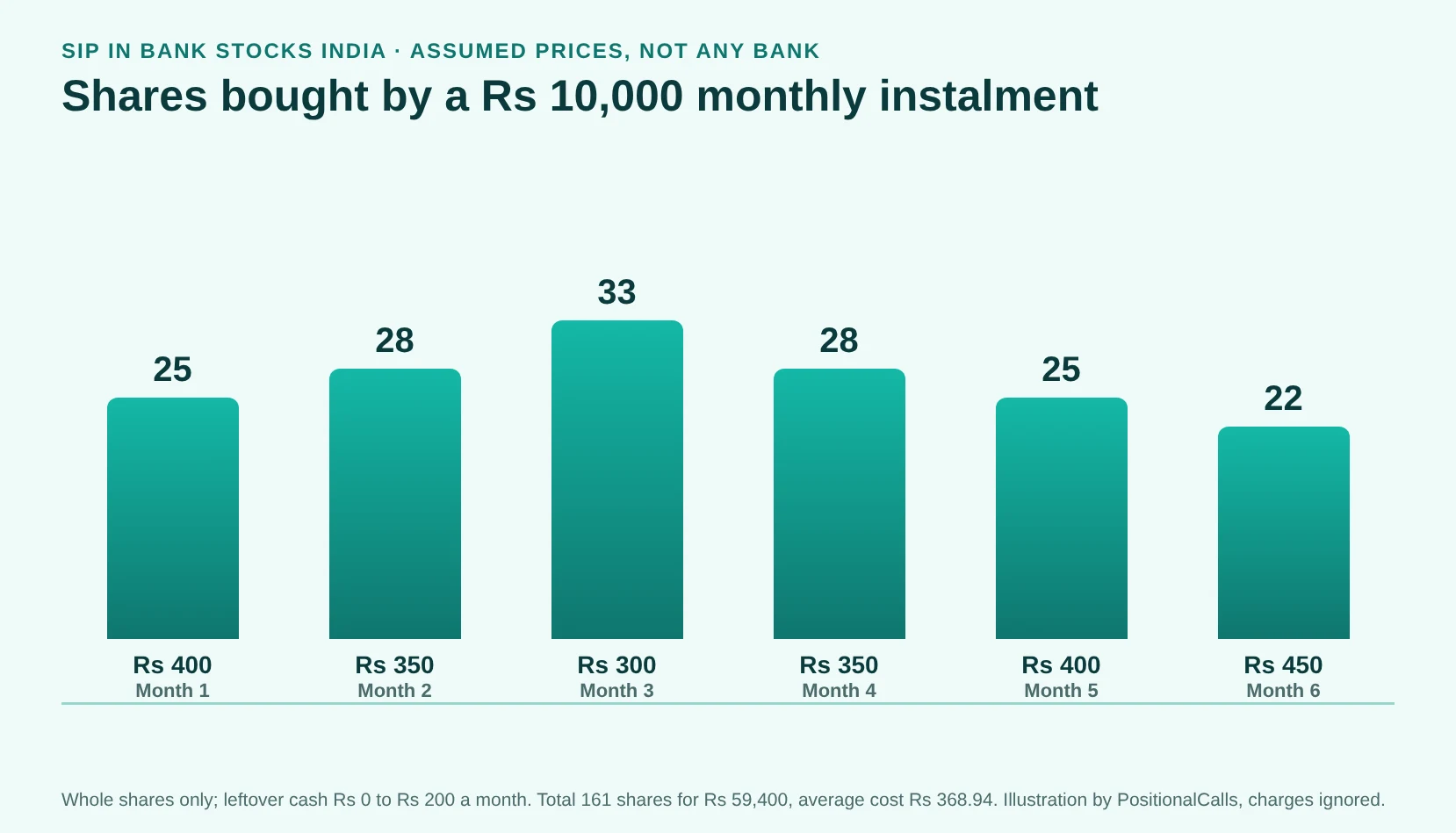
Averaging buys more shares when the price is low and fewer when it is high, so in the first assumed path below Rs 10,000 a month gave an average cost of Rs 368.94 against a simple average price of Rs 375, but in a steady rise a lump sum would have done better.
| Month | Path A price (Rs) | Path A shares | Path B price (Rs) | Path B shares |
|---|---|---|---|---|
| 1 | 400 | 25 | 300 | 33 |
| 2 | 350 | 28 | 330 | 30 |
| 3 | 300 | 33 | 360 | 27 |
| 4 | 350 | 28 | 390 | 25 |
| 5 | 400 | 25 | 420 | 23 |
| 6 | 450 | 22 | 450 | 22 |
| Total | 161 shares, Rs 59,400 | 160 shares, Rs 58,830 |
Cite this table: Illustration with assumed prices, not quotes for any bank; each month buys whole shares with Rs 10,000 and leaves the remainder uninvested; charges ignored; calculation by PositionalCalls.
Path A dips to Rs 300 and recovers to Rs 450. The SIP bought 161 shares for Rs 59,400, an average cost of Rs 368.94, and at Rs 450 they are worth Rs 72,450, a gain of about 22.0%. A lump sum of Rs 60,000 at Rs 400 would have bought 150 shares for Rs 60,000, worth Rs 67,500, a gain of 12.5%. Path B rises steadily from Rs 300 to Rs 450. The SIP bought 160 shares for Rs 58,830, worth Rs 72,000 at Rs 450, a gain of about 22.4%. A lump sum of Rs 60,000 at Rs 300 would have bought 200 shares, worth Rs 90,000, a gain of 50%.
The lesson is not that a SIP wins or loses. A SIP gives a smoother entry and removes the need to pick a day, while a lump sum gains more if prices only rise and loses more if they only fall. Neither path says anything about banks, because the prices are made up. A third case, a long fall without recovery, would leave a SIP holder with more shares of a falling stock, which is why the choice of bank matters more than the habit.
A step-up plan
The earlier page also said raising the instalment each year “improves long-term returns significantly”, without a number. A step-up raises the amount you put in, not the return on it. As arithmetic, Rs 10,000 a month raised 10% each year for five years invests about Rs 7,32,612, against Rs 6,00,000 with no step-up (my calculation). The extra Rs 1,32,612 is money you added. Whether it paid off depends on the prices, as in the paths above.
PositionalCalls WhatsApp channel
Learn stock investing step by step
- Plain-word guides on costs, tax and SIPs
- Bank results explained without tips
- A message when this page is updated
5. Whole shares, leftover cash and failed instalments
Shares trade on the exchange in whole units, so some cash is left over from a Rs 10,000 instalment whenever the price does not divide evenly, and an instalment can fail if your balance is short or the share hits an upper circuit.
In path A the monthly leftover was Rs 0, Rs 200, Rs 100, Rs 200, Rs 0 and Rs 100 (my calculation), which is small. It becomes a larger share of the instalment when the share price is high. A Rs 10,000 instalment buys only a few shares of a share priced near Rs 3,000, and none of one priced above Rs 10,000. A OneTradeJournal table shows fractional quantities such as 3.45 shares, but it does not say brokers allow this, and I found no broker rule on carrying leftover cash forward. Prices of lower-priced bank shares are a different question, covered in my bank stocks under Rs 100 page.
Failures matter because they break the schedule. On Upstox a SIP can fail for insufficient balance, or because a share is in an upper circuit with too little liquidity, and the system retries up to five times and then cancels. A OneTradeJournal explainer notes that a skipped instalment breaks the averaging. Keep the balance in the account on the trigger date, and check that the SIP is still active every few months.
6. How is a stock SIP taxed?
In a SIP in bank stocks India style plan, each instalment is a separate purchase with its own holding period, so a sale can mix short-term and long-term lots, and dividends from the shares are taxed in your hands.
| Item | Treatment stated by the source | Where to check |
|---|---|---|
| Sold within 12 months | Short-term capital gain at 20%, plus surcharge and cess as applicable | My capital gains guide |
| Sold after 12 months | Long-term capital gain at 12.5% above Rs 1.25 lakh a year, plus surcharge and cess | My capital gains guide |
| Which lot is sold | First in, first out, so the oldest instalment goes first | Broker statement |
| Dividends | Taxed in the recipient’s hands | My dividend tax guide |
| Section 80C | Equity SIP shares do not qualify, except ELSS funds | Income Tax Department |
Cite this table: Tax treatment per OneTradeJournal (19 June 2026) for gains arising on or after 23 July 2024; I did not recompute it; confirm on official sources.
Rates and thresholds change, so I do not rely on this table alone. My capital gains tax on shares guide and my dividend tax in India guide cover the current rules. If you plan to hold for income, my high dividend bank stocks in India 2026 page shows what banks declared for FY26. The point for a SIP is practical: after a year of monthly instalments you hold twelve lots, and selling the oldest first means the long-term rate applies to them first.
7. Stock SIP or a fund SIP?
A stock SIP puts you in specific shares in your own account with your own charges and no manager, while a fund SIP buys units in a pooled portfolio, so the choice is between control and simplicity, not between good and bad.
| Factor | Stock SIP in a bank share | Mutual fund SIP |
|---|---|---|
| What you hold | Shares of one company, in your demat account | Units of a fund holding many companies |
| Diversification | One bank per SIP; all-bank SIPs stay in one sector | Depends on the fund; a banking fund is also one sector |
| Amount buys | Whole shares on the exchange; I found no broker rule on fractions | Units, which can be fractional |
| Transaction tax on sale | STT 0.1% on delivery sale | STT 0.001% on equity fund unit sale, per my STT guide |
| Ongoing cost | Brokerage, DP charges on sale and any demat maintenance charge | Fund expense ratio, which I did not check |
| Dividends | Paid to you per share | Depend on the fund’s option |
| Decisions | You choose shares and amounts | The fund manager chooses |
Cite this table: Comparison by PositionalCalls; fund-side costs were not researched here, and no fund is named or recommended.
The earlier page said a SIP in bank stocks India investors run “instead of mutual funds” gives “higher long term returns”, with no data. I cannot support that, and I do not claim the reverse. If you want bank exposure without choosing individual shares, a banking index or sector fund exists, but I have not compared any, so I name none.
8. What does the bank data say before you start a SIP in bank stocks India?
In Q2 FY27 the nine large banks on my data page grew profit by 4.7% to 38% with gross NPA of 1.04% to 2.55%, and the ten public sector banks on my other page grew profit by 8.4% to 41.4%, so the group is healthy but not uniform.
| Measure | Large banks (my best bank stocks page) | Public sector banks (my PSU page) |
|---|---|---|
| Banks covered | Nine: SBI, HDFC Bank, ICICI, Axis, Kotak, Bank of Baroda, Union, PNB, Canara | Ten, including Indian Bank, Bank of India, Bank of Maharashtra, Central Bank, UCO |
| Profit growth, Q2 FY27 | +4.7% to +38%; group about +16.8% | +8.4% to +41.4%; group about +19.0% |
| Gross NPA | 1.04% to 2.55% | 1.25% to 2.55% |
| NIM, where found | 2.58% to 4.31% | 2.55% to 2.94% (five banks) |
| Items that flatter growth | Axis provisions down 52.2%; Bank of Baroda treasury gain; SBI year-ago gain | Indian Bank operating profit +46.58% vs +18% without NSE-related gains |
| Capital adequacy found | One bank in the first set | Four of ten |
Cite this table: Q2 FY27 data from my best bank stocks and PSU bank stocks pages, which cite company results as reported by the press; filings not opened; group growth is my calculation.
Three points follow for a SIP. First, a monthly habit does not fix a weak bank, because averaging into a share whose profit or asset quality is deteriorating adds more of the problem. Second, one-off gains make a single quarter hard to read, so check several quarters before each yearly review. Third, a SIP into several banks is still a bet on one sector, with shared drivers such as interest rates, credit growth and asset quality. For the sector view, see my banking sector outlook 2026, and for the numbers bank by bank see my best bank stocks in India 2026 data page and PSU bank stocks in India 2026 pages.
9. How do you set up and review a SIP in bank stocks India?
Decide the goal and amount first, pick the broker feature and schedule, check what each instalment costs, set a review date, and track the bank data and the SIP’s status instead of the share price.
- Fix the goal and amount: choose a monthly amount you can keep paying through a fall, since a stopped SIP stops averaging.
- Check your broker’s feature: confirm whether it supports amount or quantity, the schedule, eligible shares and what happens on failure.
- Know the costs: add STT, stamp duty and brokerage to the buy side, and DP charges and STT to the sale.
- Choose banks from the data, not a list: use the filings and my data pages, and think about how many banks and which kinds.
- Pick a date and keep the balance: keep money in the linked account on the trigger date.
- Review on a schedule: read each quarter’s results for profit and its source, NPA and capital adequacy, and note any one-off gains.
- Plan the tax: keep a record of each lot’s buy date for the capital gains rules, and see my capital gains tax on shares guide.
- Do not chase the amount: raising the instalment during a fall adds exposure to a falling stock, and the earlier claim that it improves returns had no data.
If you also want income from the shares, see my high dividend bank stocks in India 2026 page, which shows declared FY26 dividends and the data behind them. Each page keeps to its own question, so this one does not repeat them.
10. What are the risks of a SIP in bank stocks India investors run?
The main risks are a falling share that you keep buying, a one-sector concentration, one-off gains that mislead the data, higher interest rates squeezing margins, costs and failed instalments, and tax that depends on each lot.
A second set of risks is behavioural. A SIP feels safe because it is automatic, but the amount, the choice of banks and the decision to continue are still yours. Brokerage ratings and targets were not used here, because a rating is an opinion and not a company fact. This page uses no price data for real banks, so it cannot say whether any bank looks expensive or cheap.
11. What most people miss about SIP in bank stocks India
- What stands out: the costs are small per instalment, about 0.12% on the buy side in my calculation, but a SIP also faces sale-side STT and DP charges, which people forget.
- Easy to miss: in a steady rise, my assumed-price example shows a lump sum gaining more than the SIP, so averaging is not an advantage in every market.
- What would change the picture: a change in STT or capital gains rates, a broker changing its SIP rules, or the next quarter’s results after the interest-rate rise.
- Caution: this page does not say which bank to buy or how much. It explains the tool and shows where the data is thin.
Bottom line
A SIP in bank stocks India investors set up is a scheduling tool with small per-instalment costs, a tax that depends on each lot, and no promise of better returns. In my assumed-price examples it lowered the average cost when prices dipped and trailed a lump sum when they only rose. The data on the banks themselves matters more than the monthly habit, so read the filings and review each quarter.
Next read: see the bank data on the best bank stocks in India 2026 data page.
Part of the Sector Outlook series on PositionalCalls.
PositionalCalls WhatsApp channel
Keep the SIP basics in one place
- Charges and tax rule updates
- Bank data updates each quarter
- Updates when rules or results change
FAQs on SIP in bank stocks India
What is a SIP in bank stocks India investors can run?
It is a recurring broker order that buys a fixed amount or quantity of chosen bank shares on a schedule, usually monthly, into your own demat account. Each instalment is a separate lot. It is not a mutual fund, and it gives no assured return, because the share prices still move.
How do I start a SIP in bank stocks India brokers offer?
Open the share’s buy page in your broker’s app, change the order type to SIP if the broker supports it, set the amount or quantity and the weekly day or monthly date, and keep money in the linked account. On Upstox, I checked that the first order runs the same day and later ones at 11 AM.
Which bank stocks are best for SIP?
This page does not name them, because PositionalCalls gives no buy or sell calls and the right banks depend on your goal and risk. My best bank stocks and PSU bank stocks data pages compare Q2 FY27 profit, NPA and margins for large banks, so you can apply your own criteria.
How much does a stock SIP cost?
On the buy side about Rs 11.86 on a Rs 10,000 instalment, or 0.12%, from STT of 0.1%, stamp duty, exchange and SEBI fees and GST, with brokerage assumed zero (my calculation). Sale-side STT, DP charges and any brokerage are extra. Check your contract note, because rates can change.
Is a SIP in bank stocks India safe?
No. A SIP does not remove the risk of the shares falling, and it can keep buying a weakening bank. It spreads your entry over time, but a one-sector holding still depends on rates, credit growth and asset quality. Read each bank’s filings, not only the price, before and during the plan.
Is a stock SIP better than a mutual fund SIP?
Neither is better in general. A stock SIP gives control over shares and holds them in your demat account, with your own charges. A fund SIP gives a pooled, managed portfolio and fractional units. A banking fund is also one sector. I did not compare fund costs, so I name no fund.
What happens if a stock SIP instalment fails?
The instalment is skipped, which breaks the averaging. On Upstox a SIP can fail for insufficient balance or an upper circuit with low liquidity, and the system retries up to five times and then cancels. Other brokers differ, so read your broker’s terms and keep the balance in place.
Does averaging guarantee a profit?
No. In my assumed-price example a SIP in bank stocks India style plan lowered the average cost to Rs 368.94 when prices dipped and recovered, but in a steady rise a lump sum gained 50% against 22.4% for the SIP. A long fall would leave a SIP holder with more shares of a falling stock.
How is a stock SIP taxed?
Each instalment is a separate lot. Per a OneTradeJournal summary, gains within 12 months are taxed at 20% and after 12 months at 12.5% above Rs 1.25 lakh a year, plus surcharge and cess, and dividends are taxed in your hands. Rates can change, so my capital gains and dividend tax guides, linked on this page, cover the rules.
What should I monitor each quarter for a SIP in bank stocks India plan?
Track each bank’s net profit and its source, NIM, gross and net NPA and capital adequacy, whether the SIP ran and any change in charges. The next update is the December-quarter results, which will show the first effect of the October rate rise, per secondary reports, on bank margins.
Sources
- OneTradeJournal: Stock SIP in India, how it works, costs and tax, 19 June 2026, modified 28 September 2026; an explainer I have not verified independently.
- Upstox community: FAQs on the Stock SIP feature; one broker only.
- The Week: bank credit grows 17.94%, 30 October 2026; RBI data.
- PositionalCalls: STT in India guide (STT rates).
- PositionalCalls: best bank stocks in India 2026 (Q2 FY27 data on nine banks).
- PositionalCalls: PSU bank stocks in India 2026 (Q2 FY27 data on ten banks).
- Reserve Bank of India: policy statements, circulars and statistics.
- Named, not linked: broker terms for Zerodha, Groww, Angel One and ICICI Direct, which I did not check, and the press coverage of bank results used on my data pages, as of 14 November 2026, 6:15 PM IST. No broker contract note, BSE or NSE filing was opened.

Shubham Chaudhary is the founder of PositionalCalls, an independent Indian stock market research website. He writes company fundamentals, quarterly results analysis, IPO analysis and sector research for NSE and BSE listed companies, with a focus on banking stocks, insurance and long-term value investing. Every article is built from primary sources such as RBI, SEBI, NSE and BSE filings and company annual reports, and states its risks plainly in simple language for retail investors.
Coverage areas Our research standards- Numbers checked against NSE, BSE and SEBI filings
- Risks and limits stated in every article
- No paid promotions or broker tie-ups
- Articles updated when new filings arrive