
Sector Outlook · NBFCs
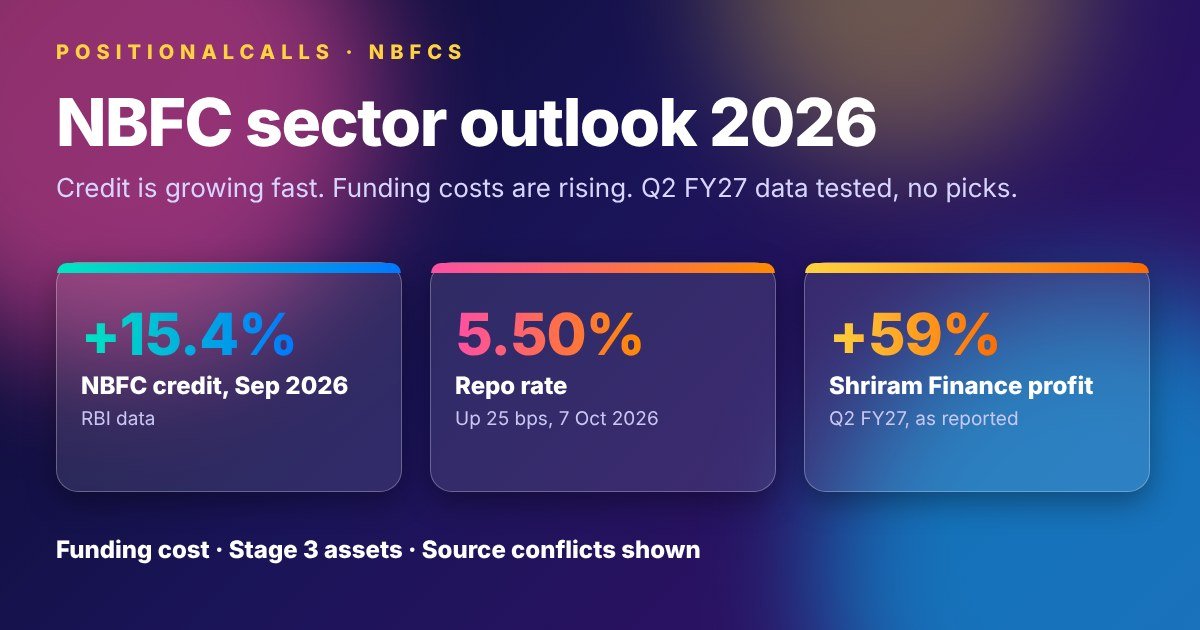
This NBFC sector outlook 2026 page tests RBI credit data, the October rate hike and Q2 FY27 results of five lenders against dated sources, records where numbers disagree and gives no stock picks.
Quick answer
The NBFC sector outlook 2026 is faster credit growth with squeezed margins. NBFC credit grew 15.4% in September 2026 and five large lenders reported higher Q2 FY27 profit. But the repo rate rose to 5.50%, funding costs are rising, and gross stage 3 assets are growing faster than loans at some lenders.
Key takeaways on the NBFC sector outlook 2026
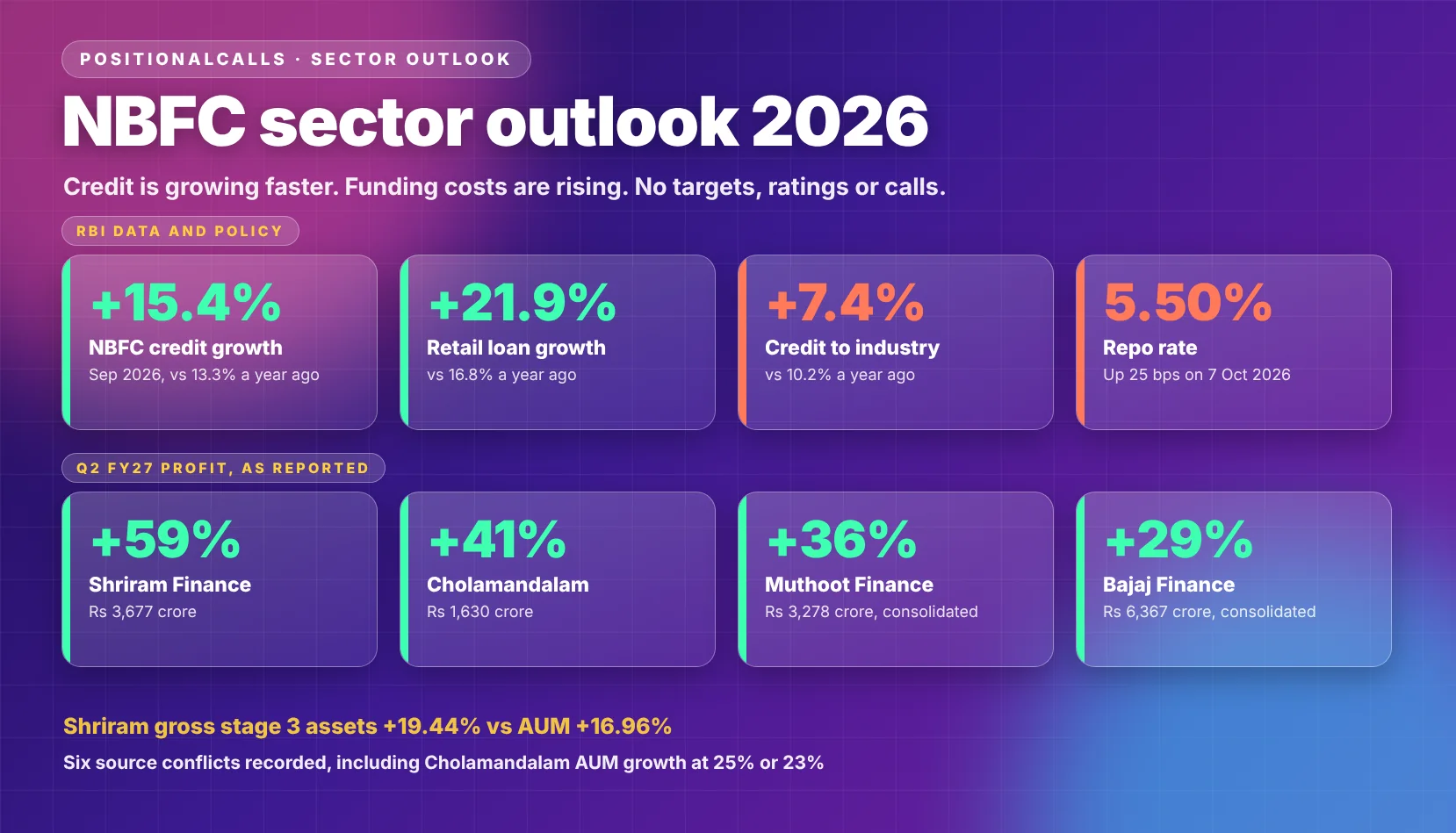
- Growth: NBFC credit rose 15.4% in September 2026, led by retail loans at 21.9%.
- Funding: the repo rate rose 25 basis points to 5.50%, and two brokerages flag margin pressure.
- Profit: Q2 FY27 profit rose at all five lenders checked, from 18% to 59%.
- Quality: reported asset quality is mixed, with gross stage 3 rising at Shriram Finance.
- Doubt: six source conflicts are recorded, including Cholamandalam’s AUM growth at 25% or 23%.
In plain words: finance companies are lending more, mostly retail and gold loans, and reporting higher profit. The cost of the money they borrow has started to rise, and the data on loan quality is good but not clean.
Data note: as of Saturday, 21 November 2026, 12:00 PM IST. RBI figures are from its sectoral deployment of credit press releases of 7 September and 6 November 2026 and its Bulletin of 23 October 2026. Company figures are from Q2 FY27 releases and reports for the quarter ended 30 September 2026, as relayed by the sources named. I did not open the exchange filings, and lines marked as my arithmetic are my own calculation.
NBFC sector outlook 2026: where does the sector stand in November 2026?
The NBFC sector outlook 2026 shows credit growth that has accelerated, with a funding-cost problem arriving in the second half. Non-banking financial companies, which include housing finance companies, made up 12.7% of India’s total financial sector assets at end-March 2025, the second-largest segment after scheduled commercial banks, according to the RBI Bulletin of 23 October 2026. The table collects the latest dated figures this page uses.
| Measure | Latest figure | Period | Source named |
|---|---|---|---|
| NBFC credit growth | 15.4% year on year, against 13.3% a year earlier | September 2026 | RBI, sectoral deployment of credit, 6 November 2026 |
| NBFC retail loan growth | 21.9%, against 16.8% a year earlier | September 2026 | RBI, 6 November 2026 |
| NBFC credit to industry | 7.4%, against 10.2% a year earlier | September 2026 | RBI, via the November release |
| Policy repo rate | 5.50% after a 25 basis point increase | 7 October 2026 | RBI Monetary Policy Committee |
| Total NBFC credit | More than Rs 55 trillion, up from Rs 27 trillion five years earlier | 31 March 2026 | S&P Global Market Intelligence, citing the RBI |
| Top layer of NBFC regulation | Empty; no NBFC flagged as a systemic risk | September 2026 | S&P Global Market Intelligence |
Cite this table: NBFC sector snapshot, PositionalCalls, Saturday, 21 November 2026, 12:00 PM IST, figures as reported by the sources named.
Two readings of this table are worth keeping apart. The first is volume: lenders are writing more retail loans, and the RBI data show the acceleration is broad across housing, gold and vehicle loans. The second is cost: the rate hike of 7 October 2026 raised the price of money for lenders that borrow from banks and bond markets. This page treats the first as established by RBI data and the second as the open question.
Forecasters have already priced in a strong year, and they differ on the details. The table sets them side by side, because a brokerage estimate of profit and an RBI count of credit measure different things in any NBFC sector outlook 2026 article.
| Forecaster | What it says | Horizon | Measure |
|---|---|---|---|
| Motilal Oswal | Coverage profit after tax up 24% in FY27 and 18% in FY28; diversified lenders up 40%, vehicle financiers up 39%, housing finance up 8% | FY27 and FY28 | Profit after tax, brokerage universe |
| Emkay Research | Strong first half of FY27 despite margin pressure from higher funding costs; spreads to contract | 1HFY27 | Growth and margins |
| JM Financial | About 20% AUM growth in Q2 FY27, with rising funding costs a margin risk | Q2 FY27 | AUM growth |
| ICRA | NBFC-retail assets under management to cross Rs 30 lakh crore by FY27; growth to stay range-bound | FY27 | Assets under management |
| Nomura | NBFCs to outpace banks with 17% growth over the next decade | Ten years | Credit growth |
Cite this table: Forecasts for Indian NBFCs, PositionalCalls, Saturday, 21 November 2026, 12:00 PM IST, as reported; each is one source’s estimate and measures differ across rows.
The forecasts agree on direction and disagree on speed, which is why this page does not average them. Motilal Oswal’s note also assumed that interest rates could rise 25 to 50 basis points over the following six to nine months, and the first 25 basis points arrived on 7 October.
What does RBI data show about credit in the NBFC sector outlook 2026?
NBFC credit growth rose to 15.4% in September 2026, and the lift came from retail loans and agriculture, not from industry. The RBI collects the data from major NBFCs and housing finance companies, so it is the broadest official count available. The table sets September against the year before and against July.
| Segment | September 2026 | September 2025 | Note |
|---|---|---|---|
| Total NBFC credit | 15.4% | 13.3% | July 2026 was 14.9% against 10.6% a year earlier |
| Retail loans | 21.9% | 16.8% | July 2026 was 21.4% against 13.7% |
| Agriculture and allied | 17.8% | 5.2% | Sharp recovery |
| Industry | 7.4% | 10.2% | Infrastructure growth subdued |
| Services | 17.3% | 23.0% | Moderated |
Cite this table: NBFC sectoral credit growth, PositionalCalls, Saturday, 21 November 2026, 12:00 PM IST, RBI press releases of 7 September and 6 November 2026.
The RBI release says housing loans, loans against gold jewellery and vehicle loans accelerated within retail, and that commercial real estate, trade and transport operators also saw higher credit growth. Industry credit growth fell from 10.2% to 7.4%, and the RBI’s earlier July release attributed that to subdued infrastructure lending, a major part of the segment.
Is NBFC credit growth in the NBFC sector outlook 2026 healthy?
The RBI Bulletin of 23 October 2026 describes the sector as showing resilience, robust profitability and consistent improvement in asset quality, and says total assets kept growing at a double-digit pace to end-December 2025. It also reports that borrowings accelerated for both upper-layer and middle-layer NBFCs. Faster borrowing supports faster lending, but it also raises the stakes on funding cost, which is why the next section matters.
Household debt is the counterweight. S&P Global Market Intelligence cited an RBI report putting household debt at about 45.5% of GDP in September 2025, and the RBI’s Financial Stability Report flagged rising household debt and rapid growth in gold-backed loans. For bank-side credit data, see banking sector outlook 2026 and banking sector earnings.
How does the October rate hike change the NBFC sector outlook 2026?
The RBI raised the repo rate by 25 basis points to 5.50% on 7 October 2026, and NBFCs feel that faster on the borrowing side than on the lending side. The Monetary Policy Committee decided unanimously, and Moneylife reported that it shifted its stance to calibrated tightening. The table traces what changes for a lender.
| Step | What happens | Why it matters for an NBFC |
|---|---|---|
| Repo rate rises 25 basis points to 5.50% | Bank lending rates and bond yields drift up | NBFCs borrow from banks and markets, so cost of funds rises |
| Borrowing costs reprice | Floating-rate bank loans reprice quickly; fixed-rate bonds reprice at refinancing | Margins narrow until yields on loans catch up |
| Lending yields adjust | Floating-rate retail loans reprice; fixed-rate vehicle and gold loans lag | Lenders with pricing power protect spreads better |
| Transmission is incomplete | An RBI research paper found policy rates reach NBFC borrowing and lending rates only partly | Higher borrowing costs and risk perception dampen adjustment |
Cite this table: Rate transmission to NBFCs, PositionalCalls, Saturday, 21 November 2026, 12:00 PM IST, based on the RBI policy statement and an RBI Bulletin paper as reported by Business Standard.
Emkay Research expects most NBFCs to see spreads contract and flagged elevated funding costs, a possible RBI rate hike, revised insurance commission norms and West Asia tensions as risks, in a note dated 6 October 2026, one day before the hike. Motilal Oswal’s 5 October update estimated about 20% growth in net interest income and about 24% growth in profit after tax in Q2 FY27, with margins diverging: Shriram Finance expected to expand and Cholamandalam and Mahindra Finance expected to contract on higher incremental funding cost.
Lenders with unsecured or high-yield books can offset some of the rise. Motilal Oswal noted that diversified lenders could partly offset margin pressure by raising the share of higher-yielding unsecured loans, which also raises credit risk. For the rate path itself, see RBI repo rate.
What did NBFCs report for Q2 FY27 in the NBFC sector outlook 2026?
All five lenders checked reported higher Q2 FY27 profit, from 18% to 59%, on AUM growth of 17% to 42%. The table lists each result as reported, with the period and the source. Figures are for the quarter ended 30 September 2026.
| Lender | Q2 FY27 profit | Loan book (AUM) | Source named |
|---|---|---|---|
| Bajaj Finance | Consolidated Rs 6,367 crore, up 29% | Rs 5,846.2 billion, up 26.5%; my conversion Rs 5,84,620 crore | Multibagg, Finology, PL Capital |
| Bajaj Housing Finance | Rs 757 crore, up 18% | Rs 1,58,190 crore, up 25%; disbursements Rs 19,930 crore | Sahi, Multibagg |
| Shriram Finance | Standalone Rs 3,677.03 crore, up 59.37% | Rs 3,29,021.72 crore, up 16.96%; disbursements Rs 54,079 crore, up 25.71% | PSU Connect, Investywise |
| Cholamandalam Investment | Rs 1,630 crore, up 41% | Rs 2,68,009 crore, up 25%; disbursements Rs 35,872 crore, up 47% | Multibagg, Quartr |
| Muthoot Finance | Consolidated Rs 3,278 crore, up 36%; standalone Rs 2,977 crore, up 27% | Consolidated Rs 2,09,317 crore, up 42%; gold loans Rs 1,93,212 crore, up 46% | JM Financial, India IPO |
Cite this table: NBFC Q2 FY27 results, PositionalCalls, Saturday, 21 November 2026, 12:00 PM IST, as reported; this page does not rank the lenders.
Profit grew faster than the loan book at Bajaj Finance, Shriram Finance and Cholamandalam, but not at Bajaj Housing Finance, where profit rose 18% against AUM growth of 25%, or at Muthoot Finance, where consolidated profit rose 36% against AUM growth of 42%. At Shriram Finance the gap is widest: profit rose 59% on AUM growth of about 17%, helped by a net interest margin of 9.52% against 8.19% a year earlier and a cost-to-income ratio of about 22.5% to 22.9%. The sources give slightly different cost ratios, listed in the conflicts section.
What drove growth in the NBFC sector outlook 2026 lender by lender?
| Lender | Growth driver reported | Guidance reported |
|---|---|---|
| Bajaj Finance | Mortgages and urban and rural consumer finance; MSME expected to recover in H2 | FY27 AUM growth of 26% to 27% and a medium-term 23% to 25%, per Multibagg |
| Shriram Finance | Commercial vehicles, MSME, passenger vehicles, gold loans; passenger EVs up 106% | FY27 AUM growth trimmed to 15% to 17%; credit cost guidance kept near 2%, per Compounding AI |
| Cholamandalam | Vehicle finance disbursements up 31% to Rs 17,801 crore; consumer ecosystem up 103% | Capital raise of up to Rs 5,000 crore proposed; AUM guidance 20% to 23% |
| Muthoot Finance | Gold loans; AUM rose Rs 15,658 crore in the quarter | Gold loan growth guidance for FY27 raised by a further 10%, per India IPO |
Cite this table: Growth drivers and guidance, PositionalCalls, Saturday, 21 November 2026, 12:00 PM IST, as relayed by the sources named; guidance is management’s, not this page’s.
Lender pages for the largest names are on the site: Bajaj Finance Q2 results, Bajaj Finserv Q2 results and Manappuram Finance Q2 results. The all-results view is the Q2 FY27 results scorecard.
How clean is asset quality in the NBFC sector outlook 2026?
Reported asset quality is mixed: headline gross NPA ratios improved at Bajaj Finance, while stage 3 assets grew faster than loans at Shriram Finance. The table puts the main ratios next to each other.
PositionalCalls WhatsApp channel
Follow sector pages in one place
- New sector outlooks as they are posted
- Results summaries without tips
- A message when a page is updated
| Lender | Asset quality figures | Margin or cost figures |
|---|---|---|
| Bajaj Finance | Gross NPA 1.06% against 1.24%; net NPA 0.42% against 0.60%; stage 2 and 3 assets 2.02% of loans against 1.87% in Q1 | Cost of funds 7.31%, down 9 basis points on the quarter; net interest margin down 10 to 12 basis points on the quarter |
| Shriram Finance | Gross stage 3 4.65% against 4.57%; net stage 3 2.31% against 2.49%; gross stage 3 assets up 19.44% against AUM up 16.96% | Net interest margin 9.52% against 8.19%; credit cost 2.03% of assets |
| Muthoot Finance | Standalone gross NPA rose sequentially, per Multibagg | Q1 FY27 margin compression of about 300 basis points, per 360 ONE Capital |
| Sector, RBI | Resilience and consistent improvement in asset quality, per the October 2026 Bulletin | Policy transmission to NBFC rates is incomplete |
Cite this table: Asset quality and margins, PositionalCalls, Saturday, 21 November 2026, 12:00 PM IST, as reported by the sources named.
Two cautions apply. First, Bajaj Finance’s gold-loan stage 2 and 3 assets rose by Rs 1,047 crore in Q2 FY27 even as its headline gross NPA fell, so the headline ratio hides a rising line item. Second, Shriram Finance’s management said stage 2 and 3 movement is normal in retail asset-backed lending and already priced in, and that the construction-equipment spike is a denominator effect, with absolute gross stage 3 in that segment falling from Rs 874 crore to Rs 862 crore. Both views are on record, and this page does not choose between them.
Also notable is that Shriram Finance’s expected resumption of securitisation, or direct assignment, towards the end of the quarter did not happen, with no assignment transfers in Q2 FY27, according to Compounding AI’s summary of the call. Funding mix matters more when rates are rising, so that is a line to check in Q3.
Where do sources disagree on the NBFC sector outlook 2026?
Six conflicts appear in the Q2 FY27 data, and each changes how strong a number looks. The table shows both versions and the one this page uses.
| Item | Version A | Version B | How this page handles it |
|---|---|---|---|
| Shriram Finance Q2 net interest income | Rs 8,661.04 crore, up 38.2% (PSU Connect, company release) | Rs 8,410 crore, up 40% (Sahi) | Uses the company release figure |
| Shriram Finance Q2 profit | Rs 3,677.03 crore standalone, up 59.37% | Rs 3,680 crore (Sahi) and Rs 3,683.81 crore (Compounding AI) | Uses the standalone release figure |
| Shriram Finance cost-to-income ratio | 22.9% (Sahi) | 22.52% (Sovrenn) | Shows the range; did not open the filing |
| Shriram Finance FY27 AUM guidance | Trimmed to 15% to 17% (Compounding AI, Finimize) | 18% target described as on track (Cofacto analysis) | Uses the trimmed range from the call summaries |
| Cholamandalam AUM growth | 25% to Rs 2,68,009 crore (Multibagg, Quartr) | 23% in a Cofacto table for the finance subsidiary | Uses 25%, which matches the reported AUM figure |
| Muthoot Finance standalone Q2 profit | Rs 2,977 crore (JM Financial, Free Press Journal) | Rs 2,978 crore (India IPO) | Uses Rs 2,977 crore; a rounding gap |
Cite this table: Source conflicts in NBFC data, PositionalCalls, Saturday, 21 November 2026, 12:00 PM IST, as recorded from the sources named.
Most of these are definition gaps: standalone against consolidated, parent against subsidiary, or a figure quoted before and after the final filing. The one that changes the reading is Shriram Finance’s guidance. Two call summaries say management trimmed it to 15% to 17%, while another analysis treated 18% as still on track, and I did not open the call transcript to settle it.
What are the risks to the NBFC sector outlook 2026?
Six risks could make the NBFC sector outlook 2026 wrong, and two are visible in reported numbers. Red marks risks that already show in results, amber marks measures to watch, and blue marks risks that depend on future events.
How do the risks connect in the NBFC sector outlook 2026?
The risks feed each other. A rate rise lifts funding costs, which pushes lenders towards higher-yielding unsecured loans, which raises credit risk, which shows up as stage 3 assets a few quarters later. That chain is why this page treats a single quarter of profit growth as a signal to check, not a conclusion.
Bottom line
The NBFC sector outlook 2026 is strong on growth and uncertain on margins. Credit is accelerating and profit is up at every lender checked, but the rate hike has started to raise funding costs, and the quality data is good rather than clean.
What should you watch next in the NBFC sector outlook 2026?
Watch the RBI’s October credit data, the December policy meeting and Q3 FY27 results. The table gives each item and the figure to compare it against.
| Item to watch | Why it matters | Compare against |
|---|---|---|
| RBI sectoral credit data for October 2026, early December | Shows whether NBFC credit growth holds above 15% | September: 15.4%; retail 21.9% |
| RBI policy meeting, December 2026 | Decides whether funding costs rise further | Repo rate 5.50% from 7 October 2026 |
| Cost of funds in Q3 FY27 results | Tests whether margins narrow as brokerages expect | Bajaj Finance cost of funds 7.31% in Q2 |
| Gross and net stage 3 ratios in Q3 results | Tests whether stage 3 keeps outgrowing loans | Shriram Finance gross stage 3 4.65%, net 2.31% |
| Gold loan growth and asset quality at Muthoot Finance | Tests the concentration risk in gold lending | Gold loan AUM up 46%; standalone gross NPA rose sequentially |
| Shriram Finance securitisation | Tests funding mix | No assignment transfers in Q2 FY27 |
Cite this table: NBFC watch list, PositionalCalls, Saturday, 21 November 2026, 12:00 PM IST, dates as reported; later dates may move.
The RBI publishes the monthly NBFC credit release about five weeks after month-end, and the September data came on 6 November 2026. If your decision depends on one month, use the quarterly results, because they include margins and asset quality that the credit release does not.
How should you read NBFC data in the NBFC sector outlook 2026?
Read growth first, then funding cost, then asset quality, and never treat one quarter as a trend. The steps below work for any NBFC or RBI release.
- Check whether the figure is AUM, disbursements or credit outstanding, because they grow at different speeds.
- Check whether profit is standalone or consolidated.
- Read the cost of funds before the net interest margin, since funding drives margins in a rising-rate year.
- Read gross and net stage 3 together, and whether stage 3 assets grew faster than loans.
- Open management guidance and check whether it changed from the last quarter.
What are the main NBFC measures in the NBFC sector outlook 2026?
| Measure | What it counts | Where it comes from | Common trap |
|---|---|---|---|
| Assets under management | Loans a lender manages, including those sold or assigned | Company releases | Not the same as RBI credit outstanding |
| Disbursements | New loans paid out in the period | Company releases | Grows faster than AUM in a recovery |
| Net interest margin | Net interest income as a share of average assets | Company results | Moves with cost of funds |
| Stage 3 assets | Loans overdue by more than 90 days under Ind AS | Company results | Gross and net differ by provisions |
| Credit cost | Provisions and write-offs as a share of assets | Company results | Can fall because of write-offs, not recovery |
Cite this table: NBFC measures explained, PositionalCalls, Saturday, 21 November 2026, 12:00 PM IST, general definitions.
For a sector page, the useful question is whether growth is paying for its own funding. In a rising-rate year, check whether the cost of funds rose faster than the yield on loans. Check the date, since the NBFC sector outlook 2026 is a moving picture, and this page carries its own Updated line.
What pages sit beside the NBFC sector outlook 2026?
The bank pages, the insurance outlook and the lender results pages give the surrounding layer.
- Sector hub: sector outlook India, the sector pages
- Banks: banking sector outlook 2026 and best bank stocks in India
- Insurance: insurance sector outlook 2026
- Lender results: Bajaj Finance Q2 results and Manappuram Finance Q2 results
- Rates and dates: RBI repo rate and earnings calendar
This page is the sector view. It does not rank lenders or give targets. The results pages show company figures, so use them for that job.
Sources for the NBFC sector outlook 2026 page
Every figure comes from the sources below, read on 21 November 2026. I did not open exchange filings, investor presentations or the RBI Financial Stability Report text for each figure, so use the links to reach the primary source.
- RBI: Sectoral Deployment of Credit by NBFC, September 2026 (6 November 2026)
- RBI: Sectoral Deployment of Credit by NBFC, July 2026 (7 September 2026)
- RBI Bulletin: Performance of the NBFC Sector, Review for 2025 (23 October 2026)
- RBI: Monetary policy statement, 7 October 2026
- Moneylife: Repo rate raised to 5.50%, 7 October 2026
- Business Standard: Monetary policy transmission to NBFCs remains incomplete
- S&P Global Market Intelligence: Higher margins, wider reach drive growth of shadow banks in India, 15 September 2026
- Kotak Neo: RBI Financial Stability Report 2026
- IBEF: NBFCs enter new cyclical recovery, Motilal Oswal, 31 August 2026
- Motilal Oswal: NBFCs sector update, 5 October 2026
- IANS via NewKerala: Emkay on NBFCs, 6 October 2026
- NewKerala: JM Financial on NBFC AUM growth in Q2 FY27
- Analytics Insight: 360 ONE Capital on NBFC growth and margins
- BCG: India NBFC Sector Roundup FY26, June 2026
- NewKerala: NBFC growth outlook, LIC Housing Finance guidance
- Multibagg: Bajaj Finance Q2 FY27 profit and guidance
- Multibagg: Bajaj Finance asset quality and gold-loan shift
- Sahi: Bajaj Housing Finance Q2 disbursements and AUM
- PSU Connect: Shriram Finance Q2 FY27 results
- Compounding AI: Shriram Finance Q2 FY27 earnings call
- Investywise: Shriram Finance Q2 FY27 earnings call highlights
- Multibagg: Cholamandalam Q2 FY27 PAT rises 41%
- Arthneeti: Cholamandalam Q2 FY27 earnings
- JM Financial: Muthoot Finance Q2 net profit
- India IPO: Muthoot Finance Q2 FY27 net profit
Where a source is a news report on company data, the report is named, not the company. If any figure differs from the primary release, the primary release governs.
Disclaimer: PositionalCalls is not a SEBI-registered research analyst or investment adviser. This page is general information and gives no target, rating or buy or sell call. Figures may have changed since the date shown.
PositionalCalls WhatsApp channel
Keep sector updates together
- Quarterly result summaries
- Budget and policy changes
- Links to new sector pages
NBFC sector outlook 2026: frequently asked questions
What is the NBFC sector outlook 2026 for India?
Credit growth is accelerating while margins face pressure. RBI data show NBFC credit up 15.4% in September 2026, with retail loans up 21.9%, but the repo rate rose 25 basis points to 5.50% on 7 October 2026. Q2 FY27 profits rose at five large lenders. This page tests that view against dated data and makes no stock call.
How fast is NBFC credit growing in 2026?
The RBI reported NBFC credit growth of 15.4% year on year in September 2026, against 13.3% a year earlier and 14.9% in July 2026. Retail loans grew 21.9%, agriculture 17.8%, industry 7.4% and services 17.3%. Housing, gold and vehicle loans accelerated, so the NBFC sector outlook 2026 is retail-led, not industry-led.
What did the October 2026 RBI rate hike do to NBFCs?
The Monetary Policy Committee raised the repo rate by 25 basis points to 5.50% on 7 October 2026 and moved to a calibrated tightening stance. NBFCs borrow from banks and bond markets, so a rate rise lifts funding costs faster than lending yields. Brokerages Emkay and Motilal Oswal flag margin pressure as the main watch item.
Which NBFCs reported Q2 FY27 results in this NBFC sector outlook 2026 page?
Five: Bajaj Finance, Bajaj Housing Finance, Shriram Finance, Cholamandalam Investment and Muthoot Finance. Profit rose 29%, 18%, 59%, 41% and 36% respectively, as reported. The page lists each result with its period and source and shows where sources disagree. It does not rank the lenders or give a target.
Is NBFC asset quality improving in 2026?
Reported measures are mixed. Bajaj Finance’s gross NPA fell to 1.06% from 1.24%, but its combined stage 2 and 3 assets rose to 2.02% from 1.87% in Q1. Shriram Finance’s net stage 3 improved to 2.31% while its gross stage 3 rose to 4.65%. The RBI Bulletin of October 2026 calls the sector resilient.
Why do sources disagree on NBFC numbers?
They use different measures and cut-off times. Shriram Finance’s Q2 net interest income is Rs 8,661 crore in the company release and Rs 8,410 crore in one report. Cholamandalam’s AUM growth is 25% in one source and 23% in another. The NBFC sector outlook 2026 conflicts table lists each pair and says which version this page uses.
What are the main risks in the NBFC sector outlook 2026?
Six risks: higher funding costs after the rate hike, gold price swings in a fast-growing gold loan book, gross stage 3 assets growing faster than loans at some lenders, rupee-linked foreign borrowing costs, monsoon and inflation effects on rural borrowers, and slower housing finance growth. Each is sourced in the risks section of this page.
Does this NBFC sector outlook 2026 page recommend stocks?
No. PositionalCalls is not a SEBI-registered research analyst or investment adviser. This page reports company and RBI figures with sources, labels its own arithmetic and records where sources disagree. It gives no target, rating or buy or sell call, and it leaves out brokerage picks. Open the filings before you decide anything.
What do forecasts say about NBFC profit in FY27?
Motilal Oswal expects profit after tax for its NBFC coverage to grow 24% in FY27 and 18% in FY28, with diversified lenders up 40% and vehicle financiers up 39% in FY27. It expects housing finance profit to grow 8%. These are one brokerage’s estimates, shown as such, and they assumed rates could rise 25 to 50 basis points.
How often is the NBFC sector outlook 2026 page updated?
After each RBI monthly NBFC credit release, each results season and each policy meeting. The RBI publishes sectoral NBFC credit data about five weeks after month-end, so September’s data arrived on 6 November 2026. Check the Updated line and the data note first, since every figure carries the date of its source.

Shubham Chaudhary is the founder of PositionalCalls, an independent Indian stock market research website. He writes company fundamentals, quarterly results analysis, IPO analysis and sector research for NSE and BSE listed companies, with a focus on banking stocks, insurance and long-term value investing. Every article is built from primary sources such as RBI, SEBI, NSE and BSE filings and company annual reports, and states its risks plainly in simple language for retail investors.
Coverage areas Our research standards- Numbers checked against NSE, BSE and SEBI filings
- Risks and limits stated in every article
- No paid promotions or broker tie-ups
- Articles updated when new filings arrive