
Learning · Mutual funds and tool
An SWP calculator tells you whether a mutual fund corpus can pay a fixed amount every month, and for how long, but the answer depends on the return, the yearly step-up and the order of good and bad years. This SWP calculator covers all three, with worked examples on Rs 1 crore, the tax rules for FY 2026-27 and the points where sources disagree.
Quick answer
An SWP calculator shows how long a mutual fund corpus lasts when you withdraw a fixed amount every month. On Rs 1 crore at 8% a year, Rs 50,000 a month is never used up and leaves Rs 3,43,42,538 after 30 years, while Rs 80,000 a month runs out in 22 years and 1 month.
SWP calculator: key takeaways
- Rule: each month the fund redeems units for your withdrawal, and the rest keeps earning the return.
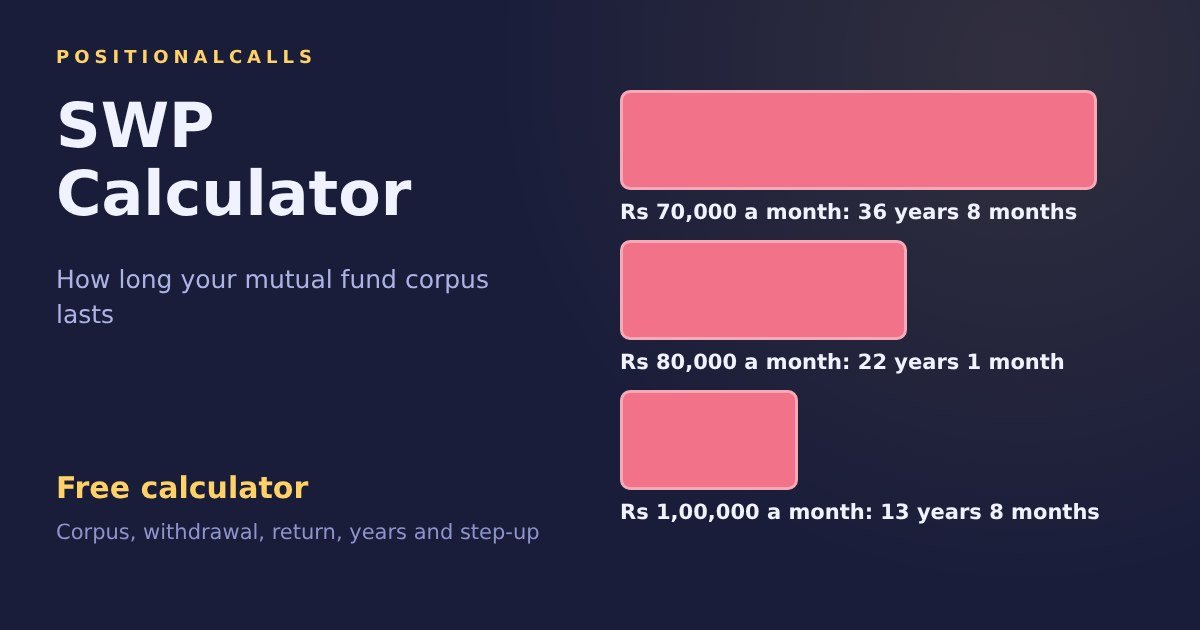
- Example: Rs 1 crore at 8% with Rs 80,000 a month lasts 22 years and 1 month; with Rs 70,000 it lasts 36 years and 8 months.
- Safe rate: the US 4% rule is calibrated to lower inflation, and several Indian sources suggest 3% to 3.5%.
- Tax: only the gain on redeemed units is taxed, first in, first out.
- Risk: a bad start can empty the corpus even when the average return looks fine.
In plain words: an SWP is the reverse of a SIP. Instead of putting a fixed amount in every month, you take a fixed amount out of a mutual fund, and the fund sells just enough units to pay it. What is left stays invested. An SWP calculator repeats that month by month, so you can see whether the money lasts before you set the plan up.
Data note: as of Wednesday, 18 November 2026, 11:59 PM IST. Tax rules come from DSP, INDmoney, Bigul, Sahi and the Tata Mutual Fund tax reckoner. Method points come from Finnovate. Safe withdrawal views come from Shriram Finance, Business Today, Retirewise, PlanMyFIRE and iVentures. SCSS figures come from Angel One, Business Today and Upstox. Figures marked my calculation use the model on this page. No fund factsheet or AMC statement was opened.
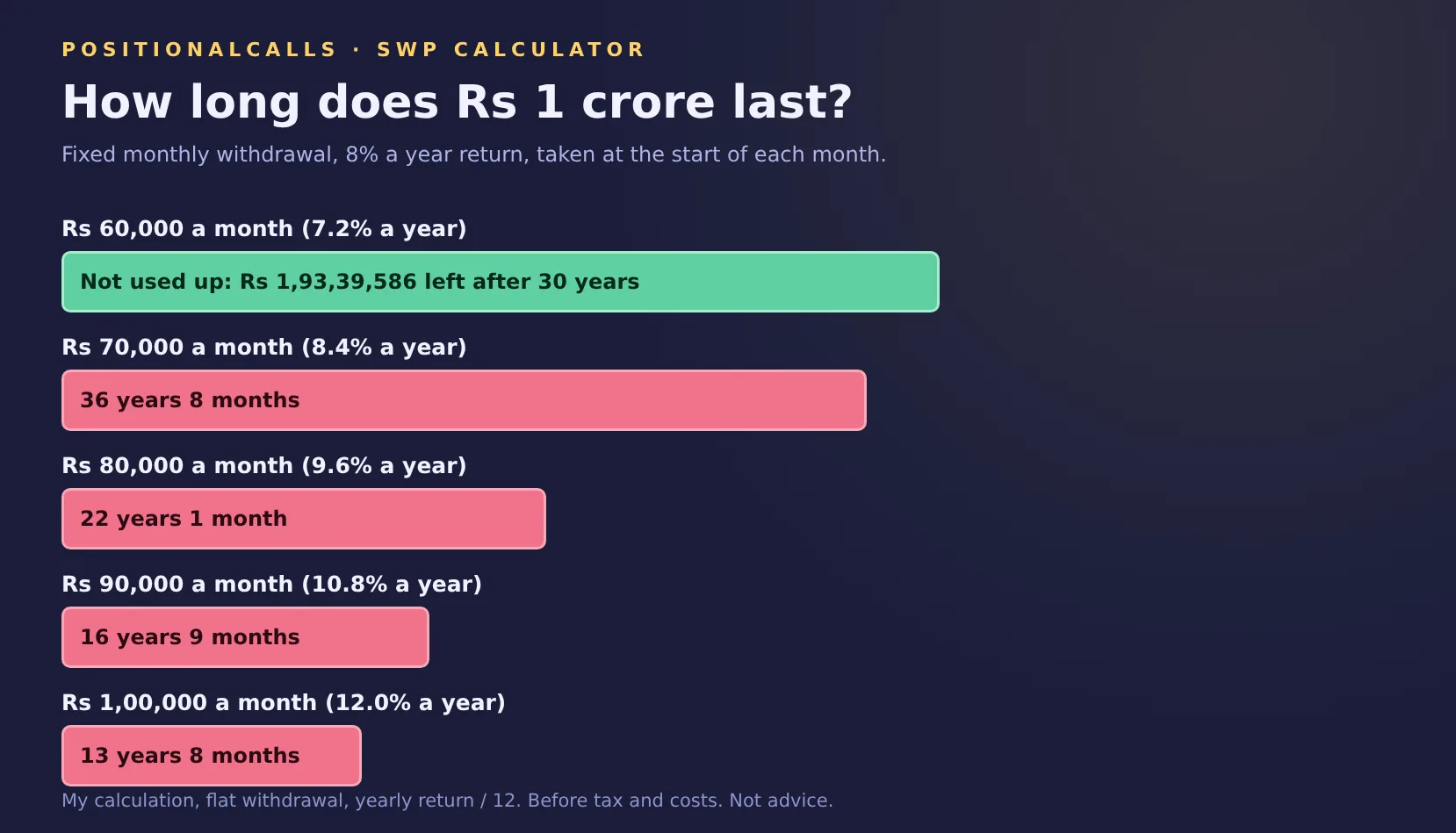 How long Rs 1 crore lasts at different monthly withdrawals. Source: PositionalCalls calculation at 8% a year.
Use this SWP calculator to see how long your corpus lasts
Enter the corpus, the first-year monthly withdrawal, the expected return, the years and a yearly step-up, and the SWP calculator shows the balance left, the total withdrawn and the level withdrawal that would use the corpus up exactly. The defaults are Rs 1 crore, Rs 50,000 a month, 8% for 30 years and no step-up, which leave Rs 3,43,42,538.
Use 0 for a flat withdrawal. Use 5 or 6 to raise the withdrawal each year for inflation.
Press Calculate SWP to see the result.
How does this SWP calculator work?
Following Finnovate, the SWP calculator takes each withdrawal at the start of the month, before that month’s growth, and applies the yearly step-up once a year. The yearly return is divided by 12 to get a monthly rate, which is the common method. If the balance cannot cover a withdrawal, the SWP calculator reports the month in which the corpus runs out. It also repeats the run with a return two points lower, so you can see how much room the plan has.
What does this SWP calculator not include?
Finnovate says its calculator does not model fees, exit loads or taxes, and the same applies here, so every balance is before those costs. The SWP calculator also assumes one steady return, which real funds never deliver, and it ignores the day your fund actually processes the redemption. Use it to compare plans against each other rather than to predict a rupee amount.
What is the SWP calculator formula and a worked example?
An SWP calculator applies the same step every month: balance = (balance − withdrawal) × (1 + monthly rate), so Rs 1 crore with Rs 50,000 a month at 8% leaves Rs 3,43,42,538 after 30 years. Finnovate writes the closed form as B(n) = P(1+i)^n − W(1+i)((1+i)^n − 1) ÷ i, with P as the corpus, W the withdrawal and i the monthly rate, and Rupee Rubric prints the same idea without the start-of-month factor.
| Corpus | Monthly withdrawal | Return | Years | Balance left | Total withdrawn |
|---|---|---|---|---|---|
| Rs 1,00,00,000 | Rs 50,000 | 8% | 30 | Rs 3,43,42,538 | Rs 1,80,00,000 |
| Rs 1,00,00,000 | Rs 50,000 | 8% | 10 | Rs 1,29,88,119 | Rs 60,00,000 |
| Rs 1,00,00,000 | Rs 60,000 | 8% | 20 | Rs 1,36,91,195 | Rs 1,44,00,000 |
| Rs 50,00,000 | Rs 25,000 | 10% | 20 | Rs 1,74,97,945 | Rs 60,00,000 |
| Rs 1,00,00,000 | Rs 50,000 | 10% | 20 | Rs 3,49,95,891 | Rs 1,20,00,000 |
Cite this table: PositionalCalls, “SWP calculator”; my calculation with the withdrawal at the start of each month and the yearly return divided by 12.
The balance on its own can mislead, because a corpus that grows while you withdraw looks safe even when the withdrawal is eating into the real value of the money. Rs 1 crore at 10% with Rs 50,000 a month grows to Rs 3,49,95,891 in 20 years, yet the Rs 50,000 itself buys much less by then. The SWP calculator therefore shows the withdrawal rate in year 1, which is the withdrawal times 12 divided by the corpus, so Rs 50,000 on Rs 1 crore is 6%.
Why do different SWP calculators give different answers?
Calculators differ in three ways. Some take the withdrawal at the start of the month and others at the end. Some divide the yearly return by 12, while Finnovate converts it with (1+r)^(1/12) − 1. Some add a yearly step-up and others do not. ClearTax prints a future-value formula for the withdrawals, A = B((1+r/n)^nt − 1) ÷ (r/n), and Motilal Oswal prints a monthly-withdrawal formula. If your result differs by a small amount from another SWP calculator, check these three settings first.
How long will your corpus last at different withdrawals?
On Rs 1 crore at 8% a year, a withdrawal of Rs 60,000 a month or less is never used up, Rs 70,000 lasts 36 years and 8 months, and Rs 1 lakh lasts only 13 years and 8 months. The line between a plan that survives and one that does not is close to the return itself: a withdrawal near 8% of the corpus a year, which is Rs 66,667 a month, takes out roughly what the fund earns.
| Monthly withdrawal | Rate in year 1 | Result at 8% | Result at 10% | Result at 12% |
|---|---|---|---|---|
| Rs 60,000 | 7.2% | Not used up | Not used up | Not used up |
| Rs 70,000 | 8.4% | 36 years 8 months | Not used up | Not used up |
| Rs 80,000 | 9.6% | 22 years 1 months | Not used up | Not used up |
| Rs 90,000 | 10.8% | 16 years 9 months | 25 years 2 months | Not used up |
| Rs 1,00,000 | 12.0% | 13 years 8 months | 17 years 8 months | 38 years 8 months |
Cite this table: PositionalCalls, “SWP calculator”; my calculation on Rs 1 crore, flat withdrawal from the start of each month.
Rupee Rubric makes the same point in words: if the fund earns 6%, a corpus slowly depletes. A small change in the return moves the result a lot. At Rs 1 lakh a month the corpus lasts 13 years and 8 months at 8% but 38 years and 8 months at 12%, so the return you type into an SWP calculator matters more than any other input.
What return should an SWP calculator assume?
ITR Stats gives indicative ranges of 10% to 12% for equity, 8% to 10% for hybrid and 6% to 8% for debt funds, and Finnovate gives 7% to 12% for an SWP overall, both as historical ranges and not guarantees. A prudent way to use the SWP calculator is to run your plan at the middle figure and then two points lower. If the plan only works at the high end, the withdrawal is too large.
What is a safe withdrawal rate for an SWP in India?
The 4% rule says withdraw 4% of the corpus in year 1 and raise the rupee amount with inflation, but several Indian sources say 3% to 3.5% is safer, which means Rs 29,167 to Rs 33,333 a month on Rs 1 crore. Finnovate attributes the 4% rule to Bengen (1994), based on a 50/50 US equity and bond portfolio, about 2% inflation and a 30-year horizon.
| Corpus lasts | Level monthly withdrawal at 8% | Level monthly withdrawal at 10% |
|---|---|---|
| 15 years | Rs 94,932 | Rs 1,06,572 |
| 20 years | Rs 83,090 | Rs 95,705 |
| 25 years | Rs 76,670 | Rs 90,119 |
| 30 years | Rs 72,891 | Rs 87,032 |
Cite this table: PositionalCalls, “SWP calculator”; my calculation: the flat monthly withdrawal that takes Rs 1 crore to zero at the end of the period, start-of-month method.
The table shows the level withdrawal that exactly uses the corpus up, with no step-up. It is the ceiling, not a recommendation, because it leaves nothing at the end and does not rise with prices. Shriram Finance says inflation in India has stayed at 6% to 7%, against 2% to 3% in the US, and suggests starting at 3% to 3.5%. Retirewise says using 4% with Indian inflation could empty a corpus five to seven years early, which is its estimate and not something I reproduced.
How big a corpus does a safe rate need?
A 3% to 3.5% rate means 29 to 33 times yearly spending. OnePercentClub gives both a 33x to 35x multiple and a 29x to 33x multiple on the same page, and PlanMyFIRE uses 3.3% as its default. iVentures cites an average CPI of 6.64% from 2004 to 2024 and says research on India suggests about 3.0% for average investors. It also gives 18.1 additional years of life expectancy at age 60 from the SRS 2018-22, which is an average, so a plan for a couple should run longer than that. Use the SWP calculator with a long period, such as 30 years, to see the gap between the level withdrawal and the 3.5% figure.
How does a yearly step-up change the SWP calculator result?
A step-up raises the withdrawal every year to keep up with prices, and it shortens the life of the corpus a lot: Rs 1 crore at 8% with Rs 50,000 a month is never used up when flat, but lasts 24 years and 2 months with a 5% step-up and 21 years and 4 months with 6%. Finnovate notes that a step-up improves inflation protection but can shorten the corpus unless the starting corpus and the returns are strong.
| Plan on Rs 1 crore at 8% | Flat | 5% step-up | 6% step-up |
|---|---|---|---|
| Rs 50,000 a month: how long it lasts | Not used up | 24 years 2 months | 21 years 4 months |
| Rs 50,000 a month: balance after 20 years | Rs 1,96,20,667 | Rs 60,95,156 | Rs 24,13,844 |
| Withdrawal in year 20 (Rs a month) | Rs 50,000 | Rs 1,26,348 | Rs 1,51,280 |
Cite this table: PositionalCalls, “SWP calculator”; my calculation, start-of-month withdrawal, step-up applied once a year.
A 6% step-up takes Rs 50,000 to Rs 1,51,280 a month in year 20 and Rs 2,70,919 in year 30. That is the price of keeping the same purchasing power, and it is why the SWP calculator has a step-up field. A step-up of 0 is a flat plan, while a step-up above inflation is aggressive, as Finnovate says. If you are unsure, run the same plan at 0%, 5% and 6% and look at which still lasts as long as you need.
What is sequence-of-returns risk in an SWP?
Sequence-of-returns risk is the damage done when poor returns come early, while you are also withdrawing: with the same 15 yearly returns in two different orders, Rs 1 crore and Rs 70,000 a month ran out in year 15 in one case and left Rs 1,07,45,970 in the other. Finnovate gives a similar example, with Rs 1 crore and Rs 80,000 a month at a 10% average: a bear market in years 1 to 4 empties the corpus in year 11, while a bull market first leaves Rs 57.8 lakh.
| Order | Yearly returns, years 1 to 15 | Result for Rs 1 crore and Rs 70,000 a month |
|---|---|---|
| Bad years first | -20, -10, 5, 10, 15, 20, 12, 10, 12, 15, 10, 12, 10, 8, 12 (%) | Corpus runs out in year 15 |
| Same returns reversed | 12, 8, 10, 12, 10, 15, 12, 10, 12, 20, 15, 10, 5, -10, -20 (%) | Rs 1,07,45,970 left after 15 years |
Cite this table: PositionalCalls, “SWP calculator”; my illustration with invented yearly returns that average 8.07%; not a forecast or a backtest.
The mechanism is simple. A withdrawal during a fall sells more units at a low NAV, so fewer units remain to recover. A flat-return SWP calculator cannot show this, which is why it is only a first check. Rupee Rubric calls it the most dangerous scenario for retirees and Retirewise says an SWP is a feature of a fund, not a retirement strategy.
PositionalCalls WhatsApp channel
Get mutual fund and retirement explainers on WhatsApp
- Tax and rate changes, dated
- Calculators explained without tips
- Links to updated guides
How can an SWP calculator plan for bad years?
Finnovate and Rupee Rubric both suggest keeping 12 to 24 months of expenses in a liquid or stable instrument outside the SWP, so you can spend from it in a bad year. Retirewise describes a three-bucket version with money for 0 to 3 years in safe assets. In the SWP calculator, a simple test is to lower the return by two points, which the result table does for you, and to check the plan still lasts as long as you need.
How is an SWP taxed in FY 2026-27?
An SWP is a series of unit redemptions, and only the gain on the units sold is taxed: for an equity fund, 20% short-term if held 12 months or less and 12.5% long-term on gains above Rs 1.25 lakh a year. DSP, in a page updated on 17 June 2026, writes the gain as units redeemed × redemption NAV minus units redeemed × purchase NAV, with units sold first in, first out.
| Current NAV vs cost NAV | Gain share of each withdrawal | Gain on Rs 50,000 a month for a year | Long-term tax on that gain (before cess) |
|---|---|---|---|
| 110 vs 100 | 9.1% | Rs 54,545 | Rs 0 |
| 130 vs 100 | 23.1% | Rs 1,38,462 | Rs 1,683 |
| 150 vs 100 | 33.3% | Rs 2,00,000 | Rs 9,375 |
| 200 vs 100 | 50.0% | Rs 3,00,000 | Rs 21,875 |
Cite this table: PositionalCalls, “SWP calculator”; my calculation using DSP’s method for equity units held over 12 months, a Rs 1.25 lakh exemption and 12.5%; cess, surcharge and other gains ignored.
DSP’s own example has Rs 50 lakh at a NAV of Rs 100, which is 50,000 units. With the NAV at Rs 130, a Rs 26,000 monthly SWP redeems 200 units, costing Rs 20,000, so the gain is Rs 6,000 and not Rs 26,000. INDmoney gives a similar equity case of a Rs 40,000 withdrawal that holds Rs 33,000 of capital and Rs 7,000 of gain, taxed only on the Rs 7,000 after the Rs 1.25 lakh yearly exemption.
Do the SWP tax rates apply to every fund?
No. DSP says the equity rules apply to hybrid funds with 65% or more in equity, and INDmoney gives the same threshold. For debt funds bought after 1 April 2023, DSP says gains are taxed at your slab rate whatever the holding period. Bigul says Budget 2026 made no change to capital gains rates or holding periods, and the Tata Mutual Fund reckoner for 2026-27 shows 12.5% and 20% for equity. Incorpx says the Income-tax Act 2025 took effect on 1 April 2026, so section numbers may differ from those printed on older pages.
Is tax deducted when an SWP is paid?
DSP says there is generally no TDS for resident investors, and the full withdrawal is credited to the bank account, so you report the gains in your return using the fund house statement. The same page says IDCW above Rs 5,000 per investor per fund house in a year may attract TDS. The Rs 1.25 lakh exemption applies across all equity-oriented investments in the year, per DSP, so other sales use it too. See the dividend tax in India guide for the IDCW side.
Is an SWP better than FD interest, SCSS or the dividend option?
An SWP can be more tax-efficient and can grow with the market, but an FD or SCSS pays a known amount, so the choice is a trade between certainty and tax and growth. Finnovate compares the three on return, payout, liquidity, tax, limit and eligibility.
| Feature | Mutual fund SWP | Bank FD | SCSS |
|---|---|---|---|
| Return | Market-linked, indicative 7% to 12% | 6.5% to 7.5% for seniors | 8.2%, set by the government |
| Payout | Monthly, from the amount you choose | Monthly, quarterly or yearly | Quarterly |
| Tax | Only the gain; equity LTCG 12.5% above Rs 1.25 lakh | Interest at slab rate; TDS above Rs 40,000 | Interest at slab rate; TDS above Rs 50,000 |
| Limit and eligibility | No limit; anyone | No limit; anyone | Rs 30 lakh per person; age 60 and above |
Cite this table: Finnovate, “SWP vs FD vs SCSS”, as published; ranges are indicative, and the SWP column is not guaranteed. PositionalCalls has not opened a bank rate sheet.
The SCSS rate is 8.2% for October to December 2026, unchanged for the ninth straight quarter per Business Today, and Angel One lists the same rate with the Post Office Monthly Income Scheme at 7.4%. Upstox works out Rs 61,500 a quarter, or Rs 20,500 a month, on the Rs 30 lakh limit, which matches my check of 30,00,000 × 8.2% ÷ 4. Compare it with the FD calculator and the PPF calculator.
How does the SWP calculator compare with the dividend option?
INDmoney’s example is a Rs 50,000 cash inflow in the 30% bracket. As IDCW, the whole Rs 50,000 is taxed at the slab rate, about Rs 15,000. As an SWP, Rs 42,000 is your own capital and Rs 8,000 is gain, so tax applies only to the Rs 8,000. FundsIndia adds that even a monthly dividend option does not oblige the fund to pay every month. Use the SWP calculator for the amount, and compare the tax separately.
When does an FD still win?
INDmoney says an FD wins if you need a guaranteed return and cannot accept market swings, and Holistic Investment says an SWP carries market risk and returns are not fixed. A mix is common: Finnovate suggests SCSS for guaranteed income, a liquid or FD buffer, and an SWP from equity or hybrid funds for the rest. Holistic Investment shows a Rs 60,000 income split as Rs 40,000 from an equity SWP, Rs 15,000 from debt and FD interest and Rs 5,000 from gold or REITs, which is one example, not a rule.
How do you set up an SWP and check it with the calculator?
Choose the fund, the amount, the date and the frequency with your fund house or platform, then use the SWP calculator to confirm the withdrawal is below the level that lasts as long as you need. INDmoney describes it as withdrawing a fixed amount monthly, quarterly or yearly, with the fund redeeming enough units at the NAV on that date.
A practical order is as follows. First, write down the monthly spending you want the SWP to cover. Second, enter it with the corpus, a cautious return and a 30-year period in the SWP calculator, and read the withdrawal rate in year 1. Third, compare it with the level figure in the table above and with the 3% to 3.5% range. Fourth, add a step-up and see how the years change. Fifth, lower the return by two points and check again. Only then choose the fund category and the amount.
INDmoney’s example is Rs 50 lakh in a balanced advantage fund with Rs 50,000 withdrawn on the 5th of each month at a NAV of Rs 100, which redeems 500 units, taking 50,000 units to 49,500. That is Rs 6 lakh a year, or 12% of the corpus, and INDmoney warns the rate may deplete the corpus unless returns match it. Dhanika says most platforms, including Groww, Kuvera, MF Central and AMC sites, let you change an SWP amount online without charge, though I did not check each one. Review the plan once a year against the SWP calculator.
Which fund category is used for an SWP?
One calculator page says hybrid or balanced advantage funds are typical choices because of lower volatility than pure equity, which is a calculator-site claim, and I do not repeat the fund names it lists. The category decides the tax rule, as above, and the exit load on your fund house may apply, which INDmoney does not cover on that page. Check the scheme document before you start.
Where do sources differ on SWP calculator results?
Sources differ on the corpus needed with a step-up, on the safe withdrawal rate and on the sample results of other calculators, so check any outside SWP calculator against its own settings. The points below are the ones I could test.
| Claim | Source | My calculation | Status |
|---|---|---|---|
| Rs 50,000 a month for 30 years at 10% needs about Rs 60 lakh | Finnovate | Rs 57.5 lakh level; Rs 60 lakh gives a Rs 52,219 withdrawal | Close |
| The same with a 6% step-up needs about Rs 80 lakh | Finnovate | About Rs 1.01 crore; Rs 80 lakh lasts 20 years 2 months | Not reproduced |
| Rs 75 lakh, Rs 30,000 a month rising 6%, 10% return lasts about 22 years | Sarvkit | 51 years 10 months | Not reproduced |
| Safe rate is 4% | Finnovate, attributed to Bengen (1994) | Not tested | US-based |
| Safe rate is 3% to 3.5% | Shriram Finance, Business Today, Retirewise | Not tested | Several Indian sources |
Cite this table: PositionalCalls, “SWP calculator”; Finnovate, Sarvkit, Shriram Finance, Business Today and Retirewise as named; my calculation with start-of-month withdrawals and the yearly return divided by 12.
I could not tell why the two step-up claims differ. Finnovate states its figure without a working I could see, and Sarvkit’s description may use a different convention. My model is the same one used throughout this page, so the gap is a reason to read how any SWP calculator treats the step-up and the timing, not a ruling on either page. The Finnovate Indian withdrawal ranges, 3% to 4% for 30 years or more and 4% to 6% for 20 to 25 years, have no source on the page, so I have not used them as evidence.
I did not open any fund factsheet, scheme information document or AMC capital gains statement, the Income-tax Act 2025 or the Budget 2026 speech. Tax statements rest on DSP, INDmoney, Bigul, Sahi and the Tata Mutual Fund reckoner, and Business Today and Angel One for the SCSS rate.
What mistakes should you avoid when using an SWP calculator?
The most common mistakes are entering a high return, ignoring the step-up, forgetting tax and costs, and treating a balance that grows as proof the plan is safe. Each can make an SWP calculator look more comfortable than the real plan.
First, using the best return. A plan that only works at 12% is not a plan, as the table above shows for Rs 1 lakh a month. Second, leaving the step-up at zero. A flat Rs 50,000 loses purchasing power every year, and the SWP calculator result with a step-up is the honest one. Third, forgetting that this page excludes tax, exit load and the expense ratio, as Finnovate’s calculator does, which means the real balance is lower. Fourth, taking a rising balance as a sign of safety when the withdrawal is not rising.
Fifth, using one average return and ignoring the order of years, which Rupee Rubric and Finnovate both flag. Sixth, putting the whole corpus in one fund type. Seventh, copying the 4% rule without noting it comes from US conditions. Eighth, forgetting other income: if the SCSS, the NPS annuity or a pension covers part of the spending, the SWP calculator needs a smaller withdrawal. Ninth, comparing with the EMI calculator logic in reverse: an EMI repays a loan on a fixed schedule, while an SWP draws down an asset whose value changes.
PositionalCalls WhatsApp channel
Mutual fund and retirement updates in one channel
- Tax and small savings rate changes
- Plain-English explainers
- Links to new guides
SWP calculator: frequently asked questions
What does an SWP calculator do?
An SWP calculator shows what happens to a mutual fund corpus when you take a fixed amount out every month. You enter the corpus, the withdrawal, the expected return and the years, and it gives the balance left or the time until the corpus runs out. This SWP calculator also adds a yearly step-up and a level withdrawal that lasts the full period.
How long will Rs 1 crore last with an SWP?
On my calculation at 8% a year, Rs 1 crore lasts 22 years and 1 month with Rs 80,000 a month, and 36 years and 8 months with Rs 70,000. At Rs 50,000 a month it is never used up and Rs 3,43,42,538 remains after 30 years. Enter your own return in the SWP calculator.
What is a safe SWP withdrawal rate?
The US 4% rule comes from Bengen’s 1994 research, per Finnovate. Shriram Finance, Business Today and Retirewise say 3% to 3.5% suits India better because inflation is higher. Treat these as starting points, not guarantees. On Rs 1 crore, 3.5% is Rs 29,167 a month in year 1, and the SWP calculator shows what a step-up does to it.
Is an SWP taxed on the full withdrawal?
No. DSP says only the gain on the units redeemed is taxable, and units are redeemed first in, first out. If the NAV is Rs 130 and the cost was Rs 100, a Rs 26,000 withdrawal carries Rs 6,000 of gain. Equity funds held over 12 months pay 12.5% on gains above Rs 1.25 lakh a year.
What happens to an SWP if the market falls early?
The same average return can give very different results depending on its order. In my example of Rs 1 crore with Rs 70,000 a month, a bad start ran the corpus out in year 15, while the reverse order left Rs 1,07,45,970. Finnovate suggests keeping 12 to 24 months of expenses outside the SWP. Test lower returns in the SWP calculator.
Should the SWP amount rise every year?
If you want the purchasing power of the first withdrawal to hold, it has to rise, but a step-up shortens the corpus. On my calculation, Rs 1 crore at 8% with Rs 50,000 a month is never used up with a flat withdrawal, yet it lasts 21 years and 4 months with a 6% yearly step-up. Set the step-up field in the SWP calculator.
Is SWP better than FD interest for monthly income?
It depends on risk and tax. INDmoney says FD interest is fully taxed at your slab rate, while an SWP taxes only the gain portion, but an FD is guaranteed and an SWP is not. Finnovate lists SCSS at 8.2% as a government-set option for those aged 60 and above, with a Rs 30 lakh limit.
Is SWP better than the IDCW or dividend option?
INDmoney says an SWP from a growth plan is usually better for predictable income, because IDCW is taxed in full at your slab rate and the fund decides whether to pay. DSP adds that IDCW above Rs 5,000 a year per investor per fund house may attract TDS, while a resident SWP generally has none.
Does an SWP calculator include tax, exit load and expense ratio?
Most do not. Finnovate says its calculator leaves out fees, exit loads and taxes, and this SWP calculator does the same, so the balance it shows is before those costs. Use the tax section of this page and your fund’s factsheet, and add the costs by lowering the return you enter.
Is this SWP calculator page investment advice?
No. PositionalCalls is not a SEBI-registered research analyst or investment adviser. This SWP calculator shows arithmetic from the numbers you enter and the rules as the cited sources describe them. It does not say which fund, withdrawal amount or return suits any person, and it publishes no buy, sell or avoid calls.
Sources for the SWP calculator page
- DSP: how SWP.
- Finnovate: SWP calculator.
- INDmoney: what is.
- INDmoney: SWP taxation.
- Rupee Rubric: SWP calculator.
- ClearTax: SWP calculator.
- Motilal Oswal Mutual Fund: goal calculator.
- ITR Stats: SWP calculator.
- Sarvkit: free SWP.
- Dhanika: SWP calculator.
- Taxlaibility: SWP calculator.
- Shriram Finance: safest retirement.
- Business Today: retiring with.
- Retirewise: beware of.
- Retirewise: sequence of.
- OnePercentClub: what is.
- PlanMyFIRE: is the.
- iVentures: safe withdrawal.
- Bigul: capital gains.
- Sahi: LTCG tax.
- Tata Mutual Fund: tax reckoner.
- Incorpx: income tax.
- Business Today: small savings.
- Angel One: small savings.
- Upstox: SCSS interest.
- FundsIndia: SWP versus.
- Holistic Investment: SWP vs.
- Holistic Investment: IDCW vs.
- Not opened: any fund factsheet or scheme document, AMC capital gains statements, the Income-tax Act 2025, the Budget 2026 text and bank FD rate sheets; Bigul, Sahi and the Tata reckoner points rest on search snippets; statements are from the sources above, and calculations are mine.
PositionalCalls.com is an independent research site founded by Shubham Chaudhary. PositionalCalls.com is not a SEBI-registered research analyst or investment adviser. Investments in securities markets are subject to market risks. Read all related documents carefully before investing. Returns are never guaranteed. Mutual fund investments are subject to market risks. This page is educational and publishes no subscribe, avoid, buy, sell, rating or target calls. Sources: fund house, broker, calculator and news pages as named; no factsheet, Act or AMC statement opened; no view on whether any fund, withdrawal or return suits any person.

Shubham Chaudhary is the founder of PositionalCalls, an independent Indian stock market research website. He writes company fundamentals, quarterly results analysis, IPO analysis and sector research for NSE and BSE listed companies, with a focus on banking stocks, insurance and long-term value investing. Every article is built from primary sources such as RBI, SEBI, NSE and BSE filings and company annual reports, and states its risks plainly in simple language for retail investors.
Coverage areas Our research standards- Numbers checked against NSE, BSE and SEBI filings
- Risks and limits stated in every article
- No paid promotions or broker tie-ups
- Articles updated when new filings arrive