
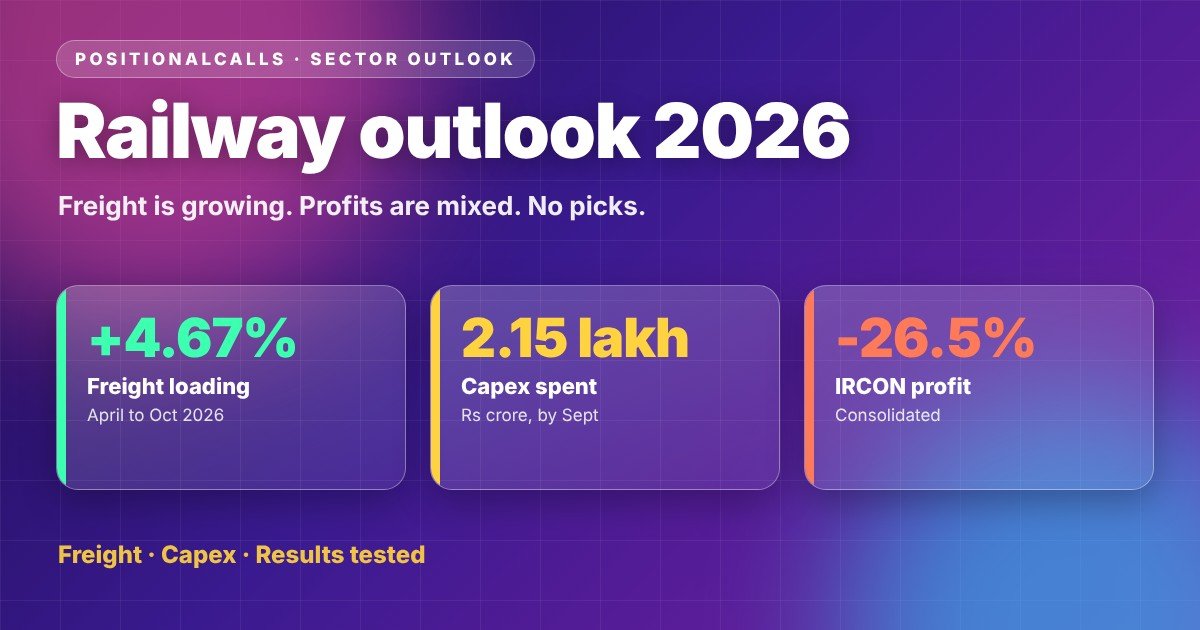
Sector Outlook · Railways
This railway sector outlook 2026 page tests Indian Railways’ freight loading, capex pace and Q2 FY27 results of listed railway companies, records where numbers disagree and gives no stock picks.
Quick answer
The railway sector outlook 2026 is firm volumes and capex with mixed company profits. Freight loading rose 4.67% in April to October, about Rs 2.15 lakh crore of the Rs 2,93,030 crore capex was spent by September, and IRFC profit rose 10.2%, but IRCON and IRCTC profits fell.
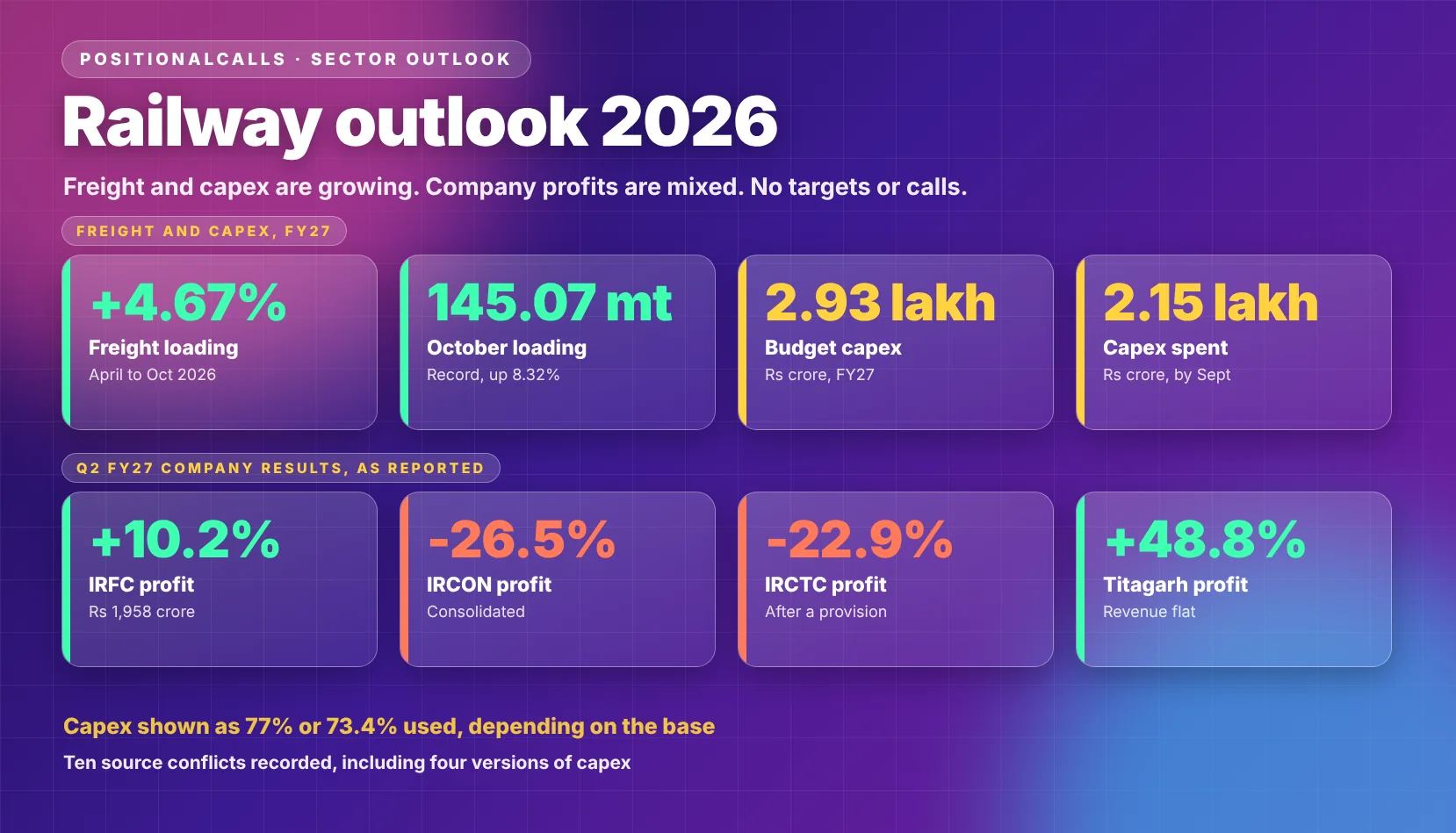
Key takeaways on the railway sector outlook 2026
- Freight: loading grew 4.1% in April to September, 6.14% in September and 8.32% in October.
- Capex: spending ran at 30% of the budget by May and 39% by July, and was about Rs 2.15 lakh crore by September.
- Results: IRFC and Titagarh profits rose, while IRCON, RITES and IRCTC profits fell.
- Orders: Jupiter Wagons reported about Rs 5,850 crore, Texmaco Rs 10,940 crore and IRCON Rs 21,296 crore, down 10.8% on a year.
- Doubt: ten source conflicts are recorded, including four versions of Budget capex.
In plain words: The government is spending record amounts on railway tracks, trains and safety, and the railways are hauling more goods than a year ago. Companies that build for the railways, finance them or sell tickets for them are not all earning more, though. Spending only turns into company profit once projects are delivered and paid for.
Data note: as of Saturday, 21 November 2026, 1:15 PM IST. Freight and capex figures are from Ministry of Railways, PIB and Budget releases as relayed by the sources named, and company figures are for the quarter ended 30 September 2026 as relayed by the sources named. I did not open the exchange filings, the PIB release or the Budget papers, and lines marked as my calculation are my own arithmetic. Analysis only: no buy or sell calls, targets or price zones.
Latest update
- 21 November 2026, 1:15 PM IST: freight data run to October 2026 (released 4 November), capex to September, and company results to RVNL on 14 November.
Railway sector outlook 2026: where does the sector stand in November 2026?
The railway sector outlook 2026 shows record capex, freight volumes growing at a moderate pace, and company profits that diverge. The table collects the latest dated figures this page uses.
| Measure | Latest figure | Period | Source named |
|---|---|---|---|
| FY27 Budget railway capex | Rs 2,93,030 crore, up 10.5% on the revised estimate | Budget 2026-27 | PRS Legislative Research |
| Capex spent | About Rs 2.15 lakh crore, about 77% on a Rs 2.81 lakh crore base | April to September 2026 | Maritime Gateway |
| Freight loading | 978.78 million tonnes, up 4.67% | April to October 2026 | Construction World, PSU Connect |
| October freight loading | 145.07 million tonnes, up 8.32%, a record for October | October 2026 | Swarajya, Maritime Gateway |
| Passengers carried | 443.8 crore against 431.4 crore | April to October 2026 | Newkerala, DD India |
| IRFC profit | Rs 1,958.48 crore, up 10.2% | Q2 FY27 | Kotak Neo, PSU Connect |
Cite this table: Railway sector outlook 2026 snapshot, PositionalCalls, Saturday, 21 November 2026, 1:15 PM IST, figures as reported by the sources named.
Two readings of this railway sector outlook 2026 table are worth keeping apart. The first is public spending and traffic: both are growing, and October’s freight growth of 8.32% was the fastest of the recent months. The second is company earnings: revenue grew at most railway names, yet profit fell at IRCON, RITES and IRCTC, as the results section shows.
The sector overlaps with other pages on this site. Project awards tie to the infrastructure sector outlook 2026, wagon and equipment makers to the capital goods sector outlook 2026 and coal movement to the Coal India Q2 results page. This page stays on railway spending, freight and the listed railway names.
How fast is Railways spending its FY27 capex in the railway sector outlook 2026?
Railways spent about 77% of one reported budget base by September, ahead of the pace through July. The table shows the spending path from the three disclosures I found, with the base each one used.
| Period | Spent | Share of budget | Base used | Source named |
|---|---|---|---|---|
| April to May 2026 | Rs 84,000 crore | About 30% | Rs 2,81,030 crore annual capital budget | Angel One, Whalesbook |
| April to July 2026 | Rs 1,14,973 crore | About 39% | Rs 2,93,030 crore budget grant | Newkerala, IANS, from a Lok Sabha reply |
| April to September 2026 | About Rs 2.15 lakh crore | About 77% | Rs 2.81 lakh crore budget estimate | Maritime Gateway |
Cite this table: Railway sector outlook 2026 capex path in FY27, PositionalCalls, Saturday, 21 November 2026, 1:15 PM IST, as reported; the bases differ, so the shares are not strictly comparable.
The bases are the catch. The Budget capex is Rs 2,93,030 crore, which Construction World describes as Rs 2.81 trillion of gross budgetary support plus Rs 120 billion of extra-budgetary resources. The July figure uses the larger base and the September utilisation uses the smaller one, so 39% and 77% do not sit on one scale. On Rs 2,93,030 crore, Rs 2.15 lakh crore is 73.4%, which is my calculation.
What does the FY27 Budget set in the railway sector outlook 2026?
| Budget item, 2026-27 | Figure | Source named |
|---|---|---|
| Capital expenditure | Rs 2,93,030 crore, up 10.5% on the revised estimate for 2025-26 | PRS |
| Budget support for capex | Rs 2,78,030 crore, financing 95% of capex | PRS |
| Internal revenue | Rs 3.02 lakh crore, up 8.4% | PRS |
| Traffic revenue split | 62% from freight (Rs 1.89 lakh crore), 29% from passengers (Rs 87,300 crore) | PRS |
| Revenue expenditure | Rs 2,99,500 crore, up 8.1% | PRS |
| High-speed rail | Seven corridors of nearly 4,000 km, expected to attract about Rs 16 lakh crore | PRS, Free Press Journal |
Cite this table: Railways FY27 Budget figures, PositionalCalls, Saturday, 21 November 2026, 1:15 PM IST, as reported by PRS from the Budget documents.
Capex growth of 10.5% compares with budgeted internal revenue growth of 8.4%, so the spending plan is growing faster than the revenue that pays for part of it. PRS notes that the transporter’s internal revenue is inadequate to finance its capital expenditure, which is why 95% of capex rests on central support.
How is railway freight loading moving in the railway sector outlook 2026?
Freight loading growth has quickened from 4.1% in the first half to 8.32% in October, but the seven-month rate is 4.67%. The table shows the path.
| Period | Loading | Growth | Source named |
|---|---|---|---|
| April to September 2026 | 833.7 million tonnes | Up 4.1%; freight revenue up 3.7% | Swarajya |
| September 2026 | 135.35 million tonnes against 127.52 | Up 6.14% | Swarajya |
| October 2026 | 145.07 million tonnes against 133.93 | Up 8.32%, a record for October | Swarajya, Maritime Gateway |
| April to October 2026 | 978.78 million tonnes against 935.10 | Up 4.67% | Construction World, Maritime Gateway |
Cite this table: Indian Railways freight loading path, PositionalCalls, Saturday, 21 November 2026, 1:15 PM IST, as reported by the sources named from Ministry of Railways data.
October alone added 11.14 million tonnes, just over a quarter of the 43.68 million tonnes added in the first seven months, per Maritime Gateway. Railways expects to end FY27 near 1,750 million tonnes and targets 3,000 million tonnes by 2031, per Swarajya. The check in the derived-numbers section shows what the rest of the year must deliver to get there.
Which commodities drove October loading?
| Item, October 2026 | Figure | Source named |
|---|---|---|
| Food grains | Loading up 26.3% | PSU Connect, Indian Masterminds |
| Domestic coal | Loading up 16% | Indian Masterminds |
| Coal rakes supplied per day | 469.8 against 393.2, up 19.5% | Construction World |
| Passengers in October | 64.72 crore | Newkerala |
Cite this table: Railway commodity detail for October 2026, PositionalCalls, Saturday, 21 November 2026, 1:15 PM IST, as reported.
Coal matters most for revenue: PRS notes that freight revenue cross-subsidises passenger services and that freight is concentrated in a few commodities. A coal-led gain is therefore good news for volume, but volume and revenue growth can part. In April to September, loading grew 4.1% but freight revenue only 3.7%.
What did railway companies report for Q2 FY27 in the railway sector outlook 2026?
Revenue grew at most railway companies, but profit ranged from an 11% fall at RITES to a 48.8% rise at Titagarh. Figures are for the quarter ended 30 September 2026, as reported.
| Company | Q2 FY27 revenue | Q2 FY27 profit | Source named |
|---|---|---|---|
| IRFC | Revenue from operations Rs 7,866.41 crore, up 23.5% from Rs 6,371.89 crore | Rs 1,958.48 crore, up 10.2% from Rs 1,776.98 crore | PSU Connect, Kotak Neo |
| RVNL, consolidated | Rs 4,700.96 crore, up 8.79% on Q1; down 8.2% on the year on this site’s Q2 FY26 base | Rs 253.71 crore, up 10.06% on the year and 59.04% on Q1 | PSU Connect, this site’s RVNL page |
| IRCON, consolidated | Rs 2,271.66 crore, up 14.9% | Rs 100.34 crore, down 26.5% | PSU Connect, Indian Masterminds |
| RITES, consolidated | Rs 556.83 crore, up 1.5% | Rs 97.06 crore, down 11.0% | Multibagg |
| Titagarh Rail Systems | Rs 793 crore, down 0.8% on the year and up 3.7% on Q1 | Rs 63.2 crore, up 48.8% | Sovrenn, an AI summary |
| Jupiter Wagons, consolidated | Rs 772 crore, from Rs 671 crore in Q1 | Rs 46 crore | Multibagg |
| Texmaco Rail, standalone | Rs 863 crore, up 14.6% on Q1 | Rs 36 crore, down 30.1% on Q1; consolidated Rs 110 crore on one source | Multibagg, Sahi |
| IRCTC | Rs 1,333.07 crore, up 16.3% | Rs 263.56 crore, down 22.9%, after a Rs 116.3 crore Rail Neer provision | This site’s IRCTC page |
Cite this table: Railway sector outlook 2026 company results, Q2 FY27, PositionalCalls, Saturday, 21 November 2026, 1:15 PM IST, as reported; this page does not rank the companies.
Each profit line needs a qualifier. RVNL’s 10.06% rise is on the year, while the 59.04% headline is against Q1. IRCON’s profit fell even as revenue rose, and Texmaco’s 30.1% fall is against a Q1 that included a Rs 20 crore deferred tax reversal, while its profit before tax rose to Rs 51.2 crore from Rs 44.1 crore. Titagarh’s revenue was flat on the year yet profit rose 48.8%. The site’s RVNL Q2 results and IRCTC Q2 results pages carry the company detail.
How do margins and operating detail compare in the railway sector outlook 2026?
| Company | Operating detail | Source named |
|---|---|---|
| IRFC | Net interest margin 1.50% annualised; net worth Rs 60,573.35 crore; zero NPAs; interim dividend Rs 1.15 per share; H1 profit Rs 3,885.69 crore, up 10.31% | Kotak Neo, Free Press Journal |
| RVNL | H1 profit Rs 413.23 crore, up 13.25%; H1 operating cash flow Rs 589.39 crore against negative Rs 1,254.83 crore a year earlier | PSU Connect |
| IRCON | H1 revenue Rs 4,227.49 crore, up 12.3%; H1 earnings per share Rs 2.08 against Rs 3.22; international share of order book 9% | PSU Connect, Multibagg, Arthneeti |
| RITES | EBITDA margin 22.1% against 24.4%; revenue milestones shifted 10 to 15 days into Q3; second interim dividend Rs 1.90 | Multibagg |
| Titagarh | EBITDA Rs 107 crore, up 28%; 51 metro cars invoiced against 30 in Q1 | Sovrenn, an AI summary |
| Jupiter Wagons | EBITDA Rs 94 crore at a 12% margin; management expects margins to return toward 14 to 15% | Multibagg, Sovrenn |
| Texmaco Rail | EBITDA margin 10.2% against 10.8% in Q1 and 10.9% a year earlier | Multibagg |
Cite this table: Railway company operating detail, Q2 FY27, PositionalCalls, Saturday, 21 November 2026, 1:15 PM IST, as reported.
The railway sector outlook 2026 comparison shows a split between asset-light and project businesses. IRFC’s profit rose with a stable margin, wagon makers saw revenue recover from Q1, and the project and consultancy names RITES and IRCON saw earnings fall. The wider EPC picture sits in the infrastructure sector outlook 2026.
What do order books say in the railway sector outlook 2026?
Order books range from about Rs 5,850 crore at Jupiter Wagons to Rs 21,296 crore at IRCON, and IRCON’s is down 10.8% on a year. The table sets out the reported books.
| Company | Order book | Detail | Source named |
|---|---|---|---|
| IRCON | Rs 21,296 crore on 30 September 2026 | Railways Rs 16,271 crore, highways Rs 3,538 crore, other Rs 1,487 crore; Rs 23,865 crore a year earlier | Investywise, Stocktwits |
| RITES | Rs 9,388 crore | Rs 446 crore of orders added in Q2 | Multibagg |
| Jupiter Wagons | About Rs 5,850 crore | About Rs 3,600 crore in wagons, close to 10,000 wagons | Multibagg, Sovrenn |
| Texmaco Rail | Rs 10,940 crore consolidated | Rs 9,874 crore outside Indian Railways on a Rs 9,983 crore comparison scope; export wagons Rs 5,883 crore | Multibagg |
| Titagarh Rail Systems | Rs 28,600 crore to Rs 38,700 crore | A range on one AI summary; the higher figure includes joint ventures | Sovrenn |
| RVNL | Not retested on this page | See this site’s RVNL result page | This site |
Cite this table: Railway order books, Q2 FY27, PositionalCalls, Saturday, 21 November 2026, 1:15 PM IST, as reported; the Titagarh row rests on one secondary source.
IRCON’s book is the one that shrank, from Rs 23,865 crore to Rs 21,296 crore, though management’s stated aim is about Rs 25,000 crore by the end of FY27 and an international share rising from 9% to 15%, per Sovrenn. Texmaco’s book is almost entirely outside Indian Railways on its own measure, while Jupiter Wagons says its book also includes new railway orders.
Is the wagon wheelset shortage over?
Management at Texmaco said the wheelset issue is going smooth, with no major shortage expected from the second half of FY27. Titagarh’s Q2 FY26 revenue and profit fell because of wheelset constraints, per Nuvama quoted by Business Standard, and Jupiter Wagons expects capacity of 600 to 800 wagons a month from the second half. Supply looks easier than a year ago, but these are management statements, not delivery data.
What drives railway orders in the railway sector outlook 2026?
Orders come from Budget capex, high-speed rail, safety spending, freight growth and wagon demand, with private wagon buyers the least certain. The table lists each driver with the evidence in the sources.
| Driver | Evidence | Source named |
|---|---|---|
| Budget capex | Rs 2,93,030 crore, up 10.5% | PRS |
| High-speed rail | Seven corridors of nearly 4,000 km and about Rs 16 lakh crore of expected investment; Titagarh targets 192 Vande Bharat coaches by FY28 | PRS, Sovrenn |
| Safety and Kavach | Safety spending of Rs 1,20,389 crore in 2026-27; Kavach spending of Rs 3,875 crore to June against Rs 2,066 crore allocated for 2026-27; 7,190 locomotives and 1,200 EMU and MEMU rakes to be equipped | IANS, Newkerala |
| Freight growth | FY27 loading goal near 1,750 million tonnes and 3,000 million tonnes by 2031; coal rakes per day up 19.5% | Swarajya, Construction World |
| Private wagon market | Expected at 12,000 to 15,000 wagons a year; Texmaco claims 40% to 45% share | Sovrenn |
| Financing | IRFC signed a Rs 4,200 crore term loan with DVC for renewable energy projects, a sign of diversification | Indian Masterminds |
Cite this table: Drivers of railway orders in 2026, PositionalCalls, Saturday, 21 November 2026, 1:15 PM IST, as reported by the sources named.
PositionalCalls WhatsApp channel
Follow sector pages in one place
- New sector outlooks as they are posted
- Results summaries without tips
- A message when a page is updated
Is Indian Railways ordering enough wagons for the railway sector outlook 2026?
Titagarh said wagon output had slowed for lack of order visibility and that option-quantity orders from Indian Railways give visibility for three to four quarters, per Sovrenn’s summary. Jupiter Wagons says its book includes new railway orders, and Texmaco says about 70% of its book was private at 31 March. The evidence does not show whether railway wagon ordering has recovered, so the order-book table is the better guide.
What do the derived numbers show in the railway sector outlook 2026?
Ten checks tie reported figures together and show what the rest of FY27 must deliver. Every row in this table is my calculation from the sourced figures above.
| Check | My calculation | Reading |
|---|---|---|
| Capex utilisation on the larger base | 2.15 / 2.9303 = 73.4% | Against 77% on the Rs 2.81 lakh crore base |
| Capex left for the second half | 2,93,030 less about 2,15,000 = about 78,030 crore, or 26.6% | About Rs 13,000 crore a month against about Rs 35,800 crore a month in the first half |
| Implied August to September spend | About 2,15,000 less 1,14,973 = about 1,00,000 crore | About Rs 50,000 crore a month, against about Rs 28,700 a month to July; the sources use different bases |
| Loading needed to reach 1,750 million tonnes | (1,750 less 978.78) / 5 = 154.2 million tonnes a month | 6.3% above October’s record 145.07 |
| Freight revenue against volume | 3.7% revenue growth less 4.1% volume growth = 0.4 points behind | Revenue per tonne lagging in April to September |
| IRFC cost against income | Finance costs 5,917.08 / 4,544.42 = up 30.2%; revenue up 23.5%; income / finance costs = 1.34 times | Costs grew faster, so profit grew 10.2% |
| IRCON book and cover | 21,296 / 23,865 = down 10.8%; 21,296 / (2,271.66 x 4) = 2.3 years | Smaller book, about two years of cover |
| Jupiter Wagons growth and cover | H1 revenue 671 + 772 = 1,443 against 1,245 = up 15.9%; 5,850 / (772 x 4) = 1.9 years | Wagon book of Rs 3,600 crore over about 10,000 wagons is about Rs 36 lakh a wagon |
| IRCTC provision add-back | 263.56 + 116.3 = 379.86, up 11.1% on 342.02 | Rough view that ignores the tax effect of the provision |
| Texmaco and Titagarh margins | Texmaco PBT 51.2 / 44.1 = up 16.1%; Titagarh EBITDA 107 / 793 = 13.5% | Texmaco’s profit fall is a tax effect; Titagarh’s margin is not a reported figure |
Cite this table: Railway sector outlook 2026 derived numbers, PositionalCalls, Saturday, 21 November 2026, 1:15 PM IST, my calculation from the sourced figures.
What does the capex pace imply for the second half?
In the railway sector outlook 2026, the first half used about Rs 2.15 lakh crore, so the Budget figure leaves roughly Rs 78,030 crore for six months unless the outlay is raised. That is a much slower pace than the first half. Either spending slows, or the larger base is not the one in use, which is why the capex bases in the conflicts table matter.
What do management and Budget documents say about railways, as reported?
Reported views are constructive on volumes and capacity and cautious on margins, and none of them is a stock call on this page. The table lists statements with dates and sources, and later results will test each forecast against reported figures.
| Source | Date | Reported view | Source named |
|---|---|---|---|
| PRS Legislative Research | 4 February 2026 | Freight revenue cross-subsidises passenger services; capex relies on central support for 95% of its funding | PRS |
| Ministry of Railways | With September data, October 2026 (date not verified) | Expects to end the year near 1,750 million tonnes; target of 3,000 million tonnes by 2031 | Swarajya |
| Texmaco management | Q2 FY27 call | Vision 2030 aims for at least double revenue and mid-teens margins, from 10.2% in FY26 | Sovrenn |
| Jupiter Wagons management | Q2 FY27 call | Margins to return toward 14% to 15% over the next few quarters; one report says a full return is expected in FY28 | Sovrenn, Multibagg |
| Titagarh management | 10 November 2026 | 1,000 wagons a month by Q4 FY27; high-speed rail by FY2030 | Sovrenn, an AI summary |
| IRCON management | Q2 FY27 presentation | Order book of about Rs 25,000 crore by end FY27 | Sovrenn |
| IRFC chairman | Q1 FY27 | Diversification under IRFC 2.0 with a zero-NPA book | Daily Pioneer |
Cite this table: Management and Budget views on railways, PositionalCalls, Saturday, 21 November 2026, 1:15 PM IST, as reported; each is a single-source item and none is a stock recommendation.
Do the company targets agree on wagon capacity?
They differ by company, not by view: Jupiter Wagons guides to 600 to 800 wagons a month and Titagarh to 1,000, while Texmaco gives its own market-share claim. This page gives no call and does not repeat any broker’s stock names or price targets.
Where do sources disagree on the railway sector outlook 2026?
Ten conflicts appear in the data, and each changes how a number reads. The table shows both versions and the one this page uses.
| Item | Version A | Version B | How this page handles it |
|---|---|---|---|
| FY27 railway capex | Rs 2,93,030 crore (PRS, Free Press Journal) | Rs 2.92 trillion (Business Standard); Rs 2.81 trillion (Construction World); Rs 2.78 lakh crore (PIB via News On AIR) | Uses Rs 2,93,030 crore; Rs 2,78,030 crore is budget support |
| First-half utilisation | About 77% on Rs 2.81 lakh crore (Maritime Gateway) | 73.4% on Rs 2,93,030 crore, my calculation | Shows both and labels the base |
| Capex path bases | 30% of Rs 2,81,030 crore by May (Angel One) | 39% of Rs 2,93,030 crore by July (Lok Sabha reply) | Shows the base beside each share |
| IRCON profit | Rs 122 crore, down 34% (PSU Connect headline) | Rs 100.34 crore, down 26.5%, consolidated (Indian Masterminds) | Uses the consolidated Rs 100.34 crore |
| IRCON revenue growth | 14.9% consolidated (PSU Connect) | 12.9% standalone (Indian Masterminds); 11.9% (Investywise headline) | Uses consolidated; labels the basis |
| RVNL profit growth | Up 10.06% on the year | Up 59.04% on Q1 (PSU Connect headline) | Gives both with the period |
| Titagarh order book | Rs 28,600 crore | Rs 38,700 crore, including joint ventures (Sovrenn range) | Shows the range as one source |
| Texmaco order mix | About 70% private at 31 March (Sovrenn) | 99% outside Indian Railways at September (Multibagg) | Different categories and dates; shows both |
| Texmaco prior-year profit | Rs 63.92 crore consolidated (Business Standard) | Rs 64.6 crore (Sahi) | Does not compute a growth rate from either |
| October coal growth | Domestic coal loading up 16% (Indian Masterminds) | Coal rakes per day up 19.5% (Construction World); another headline says 22.5% | Measures differ; shows loading and rakes apart |
Cite this table: Railway sector outlook 2026 source conflicts, PositionalCalls, Saturday, 21 November 2026, 1:15 PM IST, as recorded from the sources named.
Which conflict matters most for comparing railway companies?
Most of these are definition gaps: standalone against consolidated, gross against net outlay, and year against quarter. The two that change the reading are the capex base and the IRCON profit line, and the railway sector outlook 2026 on this page does not rest on either.
What are the risks to the railway sector outlook 2026?
Six risks could make the railway sector outlook 2026 wrong, and two are visible in reported numbers. Red marks risks that already show in data, amber marks measures to watch, and blue marks risks that depend on future events.
The risks feed each other: a smaller order book means less revenue to absorb costs, and slow wagon ordering feeds the margin pressure that wagon makers say they expect to ease.
Bottom line
The railway sector outlook 2026 is firm on capex and volumes and mixed on company profit. Freight loading is growing, spending is ahead of last year’s pace, and IRFC and Titagarh grew profit, but IRCON, RITES and IRCTC did not, so spending alone does not settle the outlook.
What should you watch next in the railway sector outlook 2026?
Watch November freight loading, second-half capex and wagon orders. The table gives each item and the figure to compare it against.
| Item to watch | Why it matters | Compare against |
|---|---|---|
| November freight loading, due early December (date not verified) | Tests whether October’s 8.32% growth holds | October: 145.07 million tonnes; April to October: 978.78 |
| Capex disclosed for October to December | Tests the second-half pace | About Rs 2.15 lakh crore by September |
| Indian Railways wagon orders | Tests order visibility for wagon makers | Jupiter Wagons about Rs 5,850 crore; Texmaco Rs 10,940 crore |
| IRCON order inflow | Tests the Rs 25,000 crore target | Rs 21,296 crore on 30 September |
| Titagarh wagon output | Tests the 1,000 wagons a month target | Target for Q4 FY27 |
| Q3 FY27 results, January and February 2027 | Tests profit recovery at IRCON and RITES | IRCON Rs 100.34 crore; RITES Rs 97.06 crore |
Cite this table: Railway watch list, PositionalCalls, Saturday, 21 November 2026, 1:15 PM IST, dates as reported; later dates may move.
Freight and capex data say nothing about profit, so use the quarterly results and check which profit line is quoted.
Railway sector outlook 2026 in Hinglish: short summary
Railways ka capex aur freight loading dono badh rahe hain, lekin companies ke profit mixed hain. April se October 2026 mein freight loading 4.67% badhi, aur October mein 145.07 million tonnes ka record raha. Budget capex Rs 2,93,030 crore hai aur September tak lagbhag Rs 2.15 lakh crore kharch hua.
IRFC ka Q2 profit 10.2% badha, lekin IRCON ka consolidated profit 26.5% aur IRCTC ka 22.9% gira. Sources ke beech capex ke numbers mein farak hai, isliye base dekhna zaroori hai. Yeh sirf jaankari hai: koi target, rating ya buy-sell salaah nahi.
What pages sit beside this railway page?
The company results pages and the other sector outlooks give the surrounding layer.
- Sector hub: sector outlook India, the sector pages
- Company results: RVNL Q2 results, IRCTC Q2 results and Coal India Q2 results
- Related sector pages: capital goods sector outlook 2026, infrastructure sector outlook 2026 and power sector outlook 2026
- Scorecard: Q2 FY27 results scorecard
This page is the sector view. It does not rank companies or give targets. The results pages show the company figures, so use them for that job.
Sources for this railway page
Every figure comes from the sources below, read on 21 November 2026. I did not open exchange filings, the PIB release or the Budget papers for each figure, so use the links to reach the primary source. The IRCTC and RVNL prior-period figures come from this site’s own result pages.
- PRS: Demand for Grants 2026-27, Railways
- Business Standard: Railways capex FY27
- News On AIR: Rs 2.78 lakh crore for Railways
- Free Press Journal: Budget railway capex
- Millennium Post: Railways Budget FY27
- Construction World: Railways capex utilisation
- Angel One: Railways capex April to May
- Whalesbook: Railways capex first two months
- Newkerala: Railways capex till July
- IANS: Railways capex and Kavach
- Maritime Gateway: Railways first-half capex
- Maritime Gateway: October freight record
- Construction World: October freight growth
- Swarajya: October freight loading
- Swarajya: September freight loading
- PSU Connect: October freight loading
- Indian Masterminds: October freight loading
- Newkerala: October freight and passengers
- DD India: October freight loading
- Kotak Neo: IRFC Q2 FY27
- PSU Connect: IRFC Q2 FY27
- Free Press Journal: IRFC H1 FY27
- Indian Masterminds: IRFC Q2 FY27
- Daily Pioneer: IRFC Q1 FY27
- PSU Connect: RVNL Q2 FY27
- PSU Connect: IRCON Q2 FY27
- Indian Masterminds: IRCON Q2 FY27
- Investywise: IRCON Q2 FY27
- Arthneeti: IRCON Q2 FY27
- Multibagg: IRCON H1 FY27
- Sovrenn: IRCON Q2 FY27
- Stocktwits: IRCON Q2 FY26 order book
- Multibagg: RITES Q2 FY27
- Multibagg: RITES margin
- Sovrenn: Titagarh Q2 FY27 concall
- Business Standard: Titagarh Q2 FY26
- Multibagg: Jupiter Wagons Q2 FY27
- Sovrenn: Jupiter Wagons concall
- Quartr: Jupiter Wagons Q2 FY26
- Multibagg: Texmaco Q2 FY27
- Multibagg: Texmaco order book
- Sahi: Texmaco Q2 consolidated profit
- Sovrenn: Texmaco Q2 FY27
- Business Standard: Texmaco Q2 FY26
Where a source is a news report on company or ministry data, the report is named, not the company. If any figure differs from the primary release, the primary release governs.
PositionalCalls WhatsApp channel
Keep sector updates together
- Quarterly result summaries
- Budget and policy changes
- Links to new sector pages
railway sector outlook 2026: frequently asked questions
What is the railway sector outlook 2026 for India?
Capex and freight volumes are firm, but company profits are mixed. Budget capex is Rs 2,93,030 crore, about Rs 2.15 lakh crore was spent in April to September, and freight loading rose 4.67% in April to October. IRFC profit grew 10.2%, while IRCON consolidated profit fell 26.5% and IRCTC profit fell 22.9%.
How much is Indian Railways spending on capex in FY27?
The Budget sets FY27 railway capex at Rs 2,93,030 crore, 10.5% above the revised estimate, per PRS. Railways spent Rs 1,14,973 crore by July, about 39%, and roughly Rs 2.15 lakh crore by September. Other pages quote Rs 2.92, 2.81 or 2.78 lakh crore, which appear to count different items, as the conflicts table shows.
How fast is railway freight loading growing in 2026?
Indian Railways loaded 978.78 million tonnes in April to October 2026, up 4.67% from 935.10 million tonnes. October loading was 145.07 million tonnes, up 8.32% and a record for the month. September growth was 6.14%, so the pace has quickened, though the cumulative rate is still below 5%.
How did railway companies do in Q2 FY27?
Results split. IRFC profit rose 10.2% to Rs 1,958.48 crore, Titagarh profit rose 48.8% on flat revenue, and Jupiter Wagons reported revenue of Rs 772 crore. RVNL profit rose 10.06% on the year, but IRCON consolidated profit fell 26.5%, RITES profit fell 11% and IRCTC profit fell 22.9%.
Why do sources disagree on railway capex numbers?
They count different bases and dates. Budget capex appears as Rs 2.93, 2.92, 2.81 and 2.78 lakh crore, first-half utilisation as 77% or 73.4%, and IRCON profit as Rs 122 crore or Rs 100.34 crore. Standalone against consolidated figures, gross against net outlays and rounding explain most gaps. The conflicts table records ten.
What are the main risks in the railway sector outlook 2026?
Six risks stand out: freight revenue lagging volume, profit falling despite revenue growth at IRCON and IRCTC, a slower second-half capex pace, a lower IRCON order book, coal concentration and wagon order visibility. Freight revenue grew 3.7% in April to September against 4.1% volume growth, so revenue per tonne is lagging on my calculation.
Is the railway sector outlook 2026 a call to buy railway stocks?
No. This page gives no target, rating, entry or exit level and no buy or sell call, and it leaves out brokerage stock preferences. It reports freight, capex and company figures with sources and dates, and it shows which numbers conflict. Treat it as analysis only, and check each company’s filing before acting.
How is the railway sector different from infrastructure and capital goods?
Here the railway sector means the transporter’s capex and traffic, wagon and rolling stock makers, railway project firms, IRFC and IRCTC. Infrastructure covers roads, ports and power projects, and capital goods covers electrical equipment and engines. They share customers, and some names appear in several lists. This page stays on railway spending, freight and the listed railway names.
What do wagon makers say about FY27 orders?
Jupiter Wagons reported an order book of about Rs 5,850 crore, with about Rs 3,600 crore in wagons, and guided to 600 to 800 wagons a month from the second half. Titagarh targets 1,000 wagons a month by Q4 FY27, per one third-party summary. Texmaco says wheelset supply is going smooth.
What should I watch next in the railway sector outlook 2026?
Watch November freight loading, second-half capex spending, wagon order inflows and Q3 FY27 results. Compare October’s 145.07 million tonnes and the Rs 2.15 lakh crore spent by September. Reaching the roughly 1,750 million tonne FY27 loading goal needs about 154 million tonnes a month for the rest of the year, my calculation.

Shubham Chaudhary is the founder of PositionalCalls, an independent Indian stock market research website. He writes company fundamentals, quarterly results analysis, IPO analysis and sector research for NSE and BSE listed companies, with a focus on banking stocks, insurance and long-term value investing. Every article is built from primary sources such as RBI, SEBI, NSE and BSE filings and company annual reports, and states its risks plainly in simple language for retail investors.
Coverage areas Our research standards- Numbers checked against NSE, BSE and SEBI filings
- Risks and limits stated in every article
- No paid promotions or broker tie-ups
- Articles updated when new filings arrive