
Sector outlook · Auto
Looking for an auto sector outlook 2026 built on filed numbers and not on opinion? This page replaces the February version with Q2 FY27 results for six companies, October retail data, EV share, exports and the RBI rate rise, and it separates base effects from real change.
Quick answer
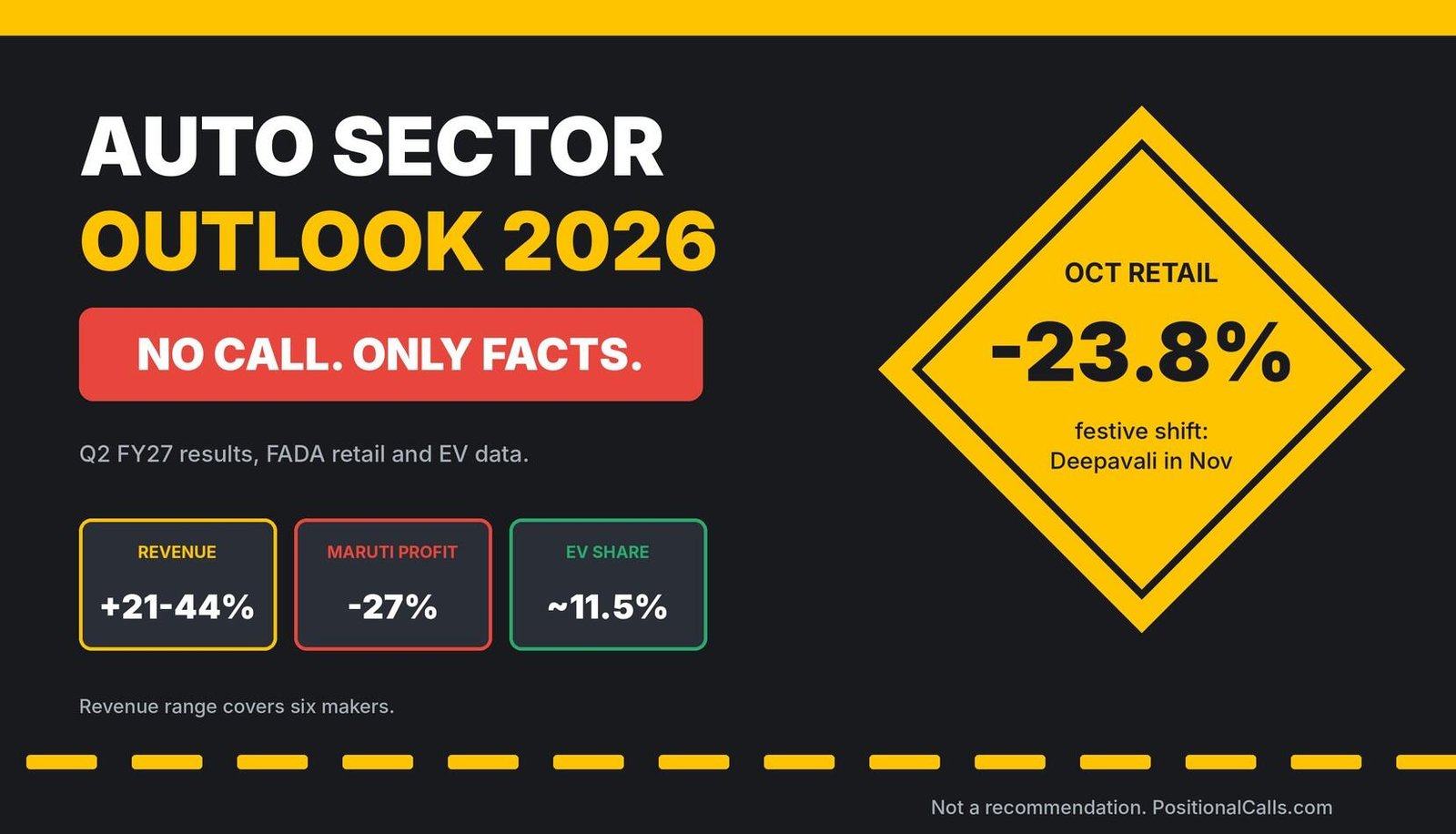
The auto sector outlook 2026 is strong volumes with split margins. Six makers grew Q2 FY27 revenue 21% to 44%, but Maruti’s profit fell 27% as its EBITDA margin dropped to 8.93%, while October retail sales fell 23.8% against a festive-heavy base and EV share reached about 11.5%.
Latest update (Friday, 13 November 2026, 3:15 PM IST): Maruti, M&M, Tata Motors, Bajaj Auto, TVS and Hero have reported Q2 FY27. Eicher Motors, Tata Motors Passenger Vehicles and Ashok Leyland had not reported when I checked, so they are not counted. I could not open the exchange filings, so company figures are headline-level from press reports.
Key takeaways
- No call: this auto sector outlook 2026 has no target, rating or price zone. The February version’s “institutional inflows” and valuation lines are removed because they had no data.
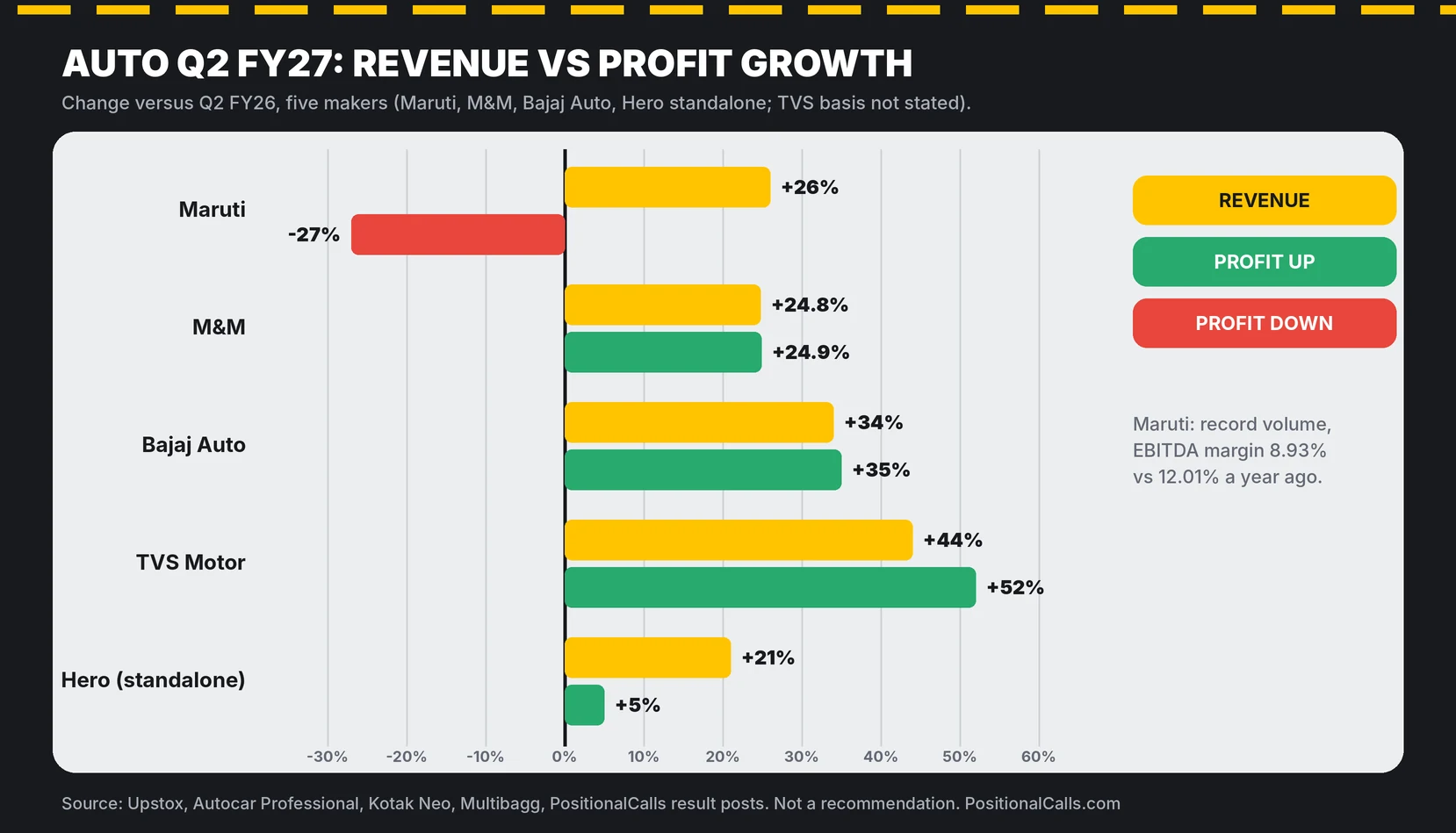
- Revenue: Maruti +26%, M&M +24.8%, Bajaj Auto +34%, TVS +44%, Hero +21% (standalone) and Tata Motors +36.3%, against a Q2 FY26 base that sat before the September 2025 GST cut.
- Profit: Maruti’s profit fell 27% to Rs 2,415 crore; TVS rose 52%, Bajaj Auto 35% and M&M 24.9%. Hero’s consolidated +41% includes a Rs 397 crore one-time gain; standalone was +5%.
- Margins: Maruti’s EBITDA margin fell to 8.93% from 12.01%; M&M’s standalone margin to 15.17% from 18.44%; TVS rose to 13% from 12.7%.
- Retail: FADA shows October retail sales down 23.8% year on year and up 25.05% on September, because Deepavali fell in November this year.
- EV: EV registrations hit a record 3.55 lakh in October, about 11.5% of sales against about 6% a year earlier (FADA, via IANS).
In plain words: carmakers and two-wheeler makers sold far more vehicles than a year ago, partly because last year’s base was depressed by the wait for a tax cut. The weak spot is margin: rising input costs cut Maruti’s and M&M’s profit per rupee of sales.
Data note: Figures are as of 13 November 2026, 3:15 PM IST and cover the quarter to 30 September 2026. They follow Upstox, Autocar Professional, Kotak Neo, Multibagg, Free Press Journal, Investywise, IANS and my own M&M and Tata Motors posts. Derived numbers are my calculation. Where sources differ I show both.
In this post
What does the auto sector outlook 2026 look like in one view?
The auto sector outlook 2026 is strong volumes with split margins. Six makers grew Q2 FY27 revenue 21% to 44%, EV share reached about 11.5% and exports rose, but input costs cut Maruti’s and M&M’s margins and October retail sales fell 23.8% against a festive-heavy base.
The February 2026 version of this page described stable-to-positive demand, easing input costs, stable interest rates and margin recovery. The September quarter supports the demand and EV halves of that view and contradicts the input-cost, margin and interest-rate halves. I rebuilt the page around reported numbers so that every claim can be checked against a company or a named source.
| Theme | What the data shows | Direction for the auto sector outlook 2026 |
|---|---|---|
| Revenue | Six makers grew 21% to 44%; Maruti volume +26.5% | Positive, flattered by the base |
| Profit | Maruti -27%; TVS +52%, Bajaj Auto +35%, M&M +24.9%; Hero +5% standalone | Mixed |
| Margin | Maruti and M&M lower; TVS higher | Negative for four-wheelers |
| Retail | October -23.8% year on year; +25.05% on September | Distorted by festive timing |
| EV | About 11.5% of October sales against about 6% | Positive |
| Exports | Bajaj Auto +40%, TVS +35%, Maruti -2.1% | Positive for two-wheelers |
| Rates | Repo raised to 5.50% on 7 October | Risk to vehicle finance |
Cite this table: Summary table, PositionalCalls, from company results and FADA data, as of 13 November 2026, 3:15 PM IST.
What did Q2 FY27 show across six auto companies?
Revenue rose at all six, from 21% at Hero (standalone) to 44% at TVS. Profit rose at five and fell 27% at Maruti. Tata Motors, which sells commercial vehicles after the demerger, swung to a Rs 1,253 crore profit from a loss.
| Company (Q2 FY27) | Revenue (Rs crore) | Revenue growth | Net profit (Rs crore) | Profit growth | Basis |
|---|---|---|---|---|---|
| Maruti Suzuki | 53,340 | +26% | 2,415 | -27% | Standalone |
| Mahindra & Mahindra | 57,553 | +24.8% | 4,588 | +24.9% | Consolidated, owners |
| Bajaj Auto | 20,003 | +34% | 3,354 | +35% | Standalone |
| TVS Motor | 17,103 | +44% | 1,377 | +52% | Not stated |
| Hero MotoCorp | 14,687 | +21% | 1,456 | +5% | Standalone |
| Hero MotoCorp (consolidated) | 14,971 | +23% | 1,861 | +41% | Includes Rs 397 crore gain |
| Tata Motors (commercial vehicles) | 25,338 | +36.3% | 1,253 | From a loss of 867 | Consolidated |
Cite this table: Q2 FY27 results per Upstox, Autocar Professional, Kotak Neo, Multibagg, Free Press Journal and my M&M and Tata Motors posts; bases differ and are labelled.
The six companies are not added because the bases differ: standalone, consolidated and, for TVS, unstated. Bajaj Auto’s consolidated profit of Rs 3,436 crore (+62%) and consolidated revenue of Rs 25,126 crore (+59%) are higher than its standalone figures, and Hero’s consolidated profit includes a one-time gain. The point is the pattern: revenue grew in every case, and profit growth ranged from -27% to +52%. Figures are as reported by the named sources, and any derived number is marked as my calculation.
Where the sources disagree
- Maruti profit: Rs 2,415 crore (-27%) at Upstox, Free Press Journal and Autocar Professional; Rs 2,466 crore (-26%) at one aggregator. I use Rs 2,415 crore.
- Bajaj Auto profit: Rs 3,354 crore standalone (+35%) and Rs 3,436 crore consolidated (+62%) are both reported; one source labels the consolidated figure with a different growth rate.
- Bajaj Auto exports: 40% in the article body and 41% in its subtitle.
- Hero profit: Rs 1,861 crore consolidated (+41%) and Rs 1,456 crore standalone (+5%); the Rs 397 crore one-time gain explains most of the gap.
- TVS basis: Kotak Neo does not say whether the figures are standalone or consolidated.
- Tata Motors profit: Rs 1,253 crore, with Rs 1,254 crore and Rs 1,257 crore also reported.
How much of the Q2 growth in the auto sector outlook 2026 is a base effect?
A large part. GST cuts and festive demand lifted dispatches from late September 2025, per SIAM coverage, so Q2 FY26 contains weeks before the cut. SIAM’s domestic passenger vehicle wholesales rose 36.5% in August 2026 and 21.8% in September on that comparison.
| SIAM wholesale data (as reported) | Reading | Year on year |
|---|---|---|
| Domestic passenger vehicle dispatches, August 2026 | 4.39 lakh units | +36.5% |
| Passenger vehicle wholesales, September 2026 | 4.54 lakh units | +21.8% |
| Maruti total volume, Q2 FY27 | 696,654 units | +26.5% (record) |
| Maruti H1 FY27 volume | 1,379,378 units | +27.9% |
| Bajaj Auto total vehicles, Q2 FY27 | 1,548,884 units | +19% |
| TVS two- and three-wheelers, Q2 FY27 | 1.9 million units | +27% |
Cite this table: SIAM wholesale data per Autocar Professional and New Kerala headlines (not opened in full) and company results per Upstox, Kotak Neo and Autocar Professional.
I did not open the SIAM releases, so the August and September figures are headline-level. The test of demand is therefore the comparison with September, not with last year: FADA shows October retail up 25.05% month on month. Revenue growth of 21% to 44% for the quarter is partly price and mix as well as volume, and I do not split it.
Why did margins split across the auto sector outlook 2026?
Four-wheeler margins fell and two-wheeler margins held. Maruti’s EBITDA margin was 8.93% against 12.01%, and M&M’s standalone margin 15.17% against 18.44%, while TVS rose to 13% from 12.7% and Hero’s standalone margin was 13.4%.
| Company | EBITDA margin Q2 FY27 | Year ago or comparison | Change, points (my calculation) |
|---|---|---|---|
| Maruti Suzuki | 8.93% (EBITDA Rs 4,764 crore) | 12.01% (Rs 5,085 crore) | -3.08 |
| M&M (standalone) | 15.17% (Rs 6,718 crore) | 18.44% | -3.27 |
| TVS Motor | 13% (Rs 2,219 crore, +47%) | 12.7% | +0.3 |
| Hero MotoCorp (standalone) | 13.4% (Rs 1,968 crore, +8%) | +10 bps on Q1 | Not found year on year |
| Tata Motors (CV, consolidated) | 10.9% (Rs 2,770 crore) | Not found | Not found |
| Bajaj Auto | Not found | Not found | Not found |
Cite this table: EBITDA margins per Upstox, Kotak Neo, Multibagg and my M&M and Tata Motors posts; definitions may differ.
Maruti’s own explanation, per Upstox, is adverse commodity prices linked to the West Asia conflict, unfavourable currency, higher manufacturing overheads, higher depreciation from a new facility and model dies, and lower non-operating income from mark-to-market losses. Hero says its gross margin fell 30 basis points on the quarter and cites commodity costs. I did not find commodity price data, so I do not quantify the input-cost effect myself. The February page said input costs had eased and margins were recovering; the Q2 evidence for four-wheelers says the opposite.
What do retail sales show, and why did October fall?
FADA reports October 2026 retail sales of 31.72 lakh units, down 23.8% on October 2025 and up 25.05% on September. FADA attributes the fall to a very strong base, because Navratri and Deepavali both fell in October 2025 and this year Deepavali moved into November.
| FADA October 2026 | Units | Year on year | Month on month |
|---|---|---|---|
| All vehicles | 31,72,466 | -23.80% | +25.05% |
| Two-wheelers | 23,21,419 | -28.35% | +29.67% |
| Passenger vehicles | 5,07,768 | -14.23% | +18.86% |
| Commercial vehicles | 1,15,140 | +2.29% | +11.19% |
| Electric vehicles (all) | About 3.55 lakh | +44.88% | Record |
Cite this table: FADA data released 6 November 2026, per IANS via the Telangana outlet and Autocar Professional; three-wheeler and tractor lines not found.
The year-on-year fall is therefore a timing comparison, not a demand verdict. November will carry the Deepavali sales, so FADA’s November data, due in early December, is the cleaner test (my reading). Passenger vehicles fell less than two-wheelers, and commercial vehicles grew slightly. I did not find FADA’s inventory data, so I cannot say whether stocks built up.
How are two-wheelers doing in the auto sector outlook 2026?
Exports and EVs carried the two-wheeler quarter. Bajaj Auto’s domestic two-wheeler volume rose only 1.82% to 607,416 units while exports rose 43.21% to 676,545, and TVS grew motorcycles 28% and scooters 29%.
| Company | Volume data, Q2 FY27 | Growth |
|---|---|---|
| Bajaj Auto | Two-wheelers 1,283,961; domestic 607,416; export 676,545 | +20%; domestic +1.82%; export +43.21% |
| TVS Motor | Motorcycles 858,000; scooters 825,000; mopeds 157,000; three-wheelers 78,475 | +28%; +29%; +12%; +47% |
| Hero MotoCorp | Wholesale volume (units not found) | +10.5%; ICE +8.4%; EV +98% |
| FADA, October retail | Two-wheelers 23,21,419 | -28.35% year on year |
Cite this table: Two-wheeler volumes per Autocar Professional, Kotak Neo, Multibagg and FADA via IANS.
The February page said rural recovery would lift two-wheelers. I found no rural-demand data in these sources, so I cannot test it. What the data show is that Bajaj Auto’s domestic volume was nearly flat while its exports surged, and that FADA’s retail two-wheeler figure fell the most in October because of the festive base.
PositionalCalls WhatsApp channel
The numbers, then the margin check
- Auto results as they are filed
- Monthly sales data explained
- Links to updated outlooks
What do commercial vehicles show in the auto sector outlook 2026?
Tata Motors’ commercial vehicle business reported revenue of Rs 25,338 crore, up 36.3%, and wholesales of 135.1k, up 42%, while FADA shows October commercial vehicle retail up 2.29%. Eicher and Ashok Leyland had not reported.
| Item | Reading | Source |
|---|---|---|
| Tata Motors consolidated revenue | Rs 25,338 crore (+36.3%) | My Tata Motors post |
| Tata Motors EBITDA | Rs 2,770 crore (10.9%) | My Tata Motors post |
| Tata Motors wholesales | 135.1k (+42%); international 21.1k (+177%) | My Tata Motors post |
| Bajaj Auto commercial vehicles | 264,923 units (+17%) | Autocar Professional |
| FADA October commercial vehicle retail | 1,15,140 (+2.29%) | FADA via IANS |
| Eicher Motors and Ashok Leyland | Not reported when I checked | Previews on this site |
Cite this table: Commercial vehicle readings per my Tata Motors post, Autocar Professional and FADA; the Tata Motors figures are for the commercial vehicle entity only.
The February page tied commercial vehicles to infrastructure spending. I have no capex or construction data on this page, so that link is untested. For the entity, see Tata Motors Q2 results FY27, which covers commercial vehicles only and not Tata Motors Passenger Vehicles.
How fast is the EV transition in the auto sector outlook 2026?
Fast on registrations: FADA reports a record 3.55 lakh EVs in October, up 44.88%, about 11.5% of sales against about 6% a year earlier. TVS sold 186,186 EVs (+133%), Hero’s Vida retail was 66,000 (+74%), and Bajaj Auto’s Chetak revenue passed Rs 2,000 crore.
| EV data, Q2 FY27 or October 2026 | Reading | Growth |
|---|---|---|
| EV registrations, October (FADA) | About 3.55 lakh | +44.88% |
| EV share of sales, October | About 11.5% | About 6% a year earlier |
| TVS Motor EV sales | 186,186 units | +133% (80,009 a year ago) |
| Hero MotoCorp Vida retail | 66,000 units | +74%; wholesale EV +98% |
| Bajaj Auto Chetak revenue | More than Rs 2,000 crore | Volumes more than doubled |
| Bajaj Auto Chetak and electric three-wheelers | Close to 200,000 units | About one-third of domestic sales revenue |
Cite this table: EV data per FADA via IANS, Kotak Neo, Multibagg and Autocar Professional; the 11.5% figure is a single IANS-reported ratio and segment penetration was not given.
The EV share rose by about 5.5 points in a year (my calculation from the two reported ratios). Hero says Vida became gross-margin positive in the quarter, per Multibagg. I found no EV margin data for the other makers, so I cannot say whether growth is profitable across the sector.
How important are exports to the auto sector outlook 2026?
Exports are the strongest growth line for two-wheelers. Bajaj Auto’s total exports rose 40% to 778,528 units, led by Africa and Latin America, and TVS exports rose 35% to about 500,000 units. Maruti’s exports fell 2.1% to 108,119 (my calculation).
| Company | Export volume, Q2 FY27 | Year ago or growth |
|---|---|---|
| Bajaj Auto (total) | 778,528 | +40% |
| Bajaj Auto (two-wheelers) | 676,545 | +43.21% |
| TVS Motor | About 500,000 | +35% (about 400,000) |
| Maruti Suzuki | 108,119 | 110,487 a year ago (-2.1%) |
| Tata Motors (international wholesales) | 21.1k | +177% |
Cite this table: Export volumes per Autocar Professional, Kotak Neo, Upstox and my Tata Motors post.
The February page said component makers were benefiting from supply-chain diversification. I did not find Q2 component-maker data for this page, so I removed that claim; see the Bosch Q2 results FY27 post for one supplier.
Do rates and financing matter for the auto sector outlook 2026?
They matter for demand, but I found no vehicle-loan data. RBI raised the repo rate by 25 basis points to 5.50% on 7 October 2026 and changed its stance to calibrated tightening, after the Q2 quarter ended. October CPI was 6.09%.
The February page assumed stable interest rates; that no longer holds. A higher repo rate can raise vehicle loan rates, but I found no lender or dealer data showing it has, so this is a risk, not a finding. Bank credit grew 17.94% in mid-October per RBI data, and the banking sector outlook 2026 page covers that, the rate path and the RBI repo rate history. The India CPI inflation October 2026 post covers the 6.09% reading.
| Item | Reading | Source |
|---|---|---|
| Repo rate | 5.50% after a 25 bp rise on 7 October 2026 | Aggregator page; RBI statement not opened |
| Stance | Calibrated tightening | Aggregator page |
| October CPI | 6.09% | My CPI post |
| Bank credit growth | 17.94% (15 October) | RBI data via The Week |
| Vehicle loan rates or approval data | Not found | None |
Cite this table: Rate readings as reported; vehicle-finance data was not found.
What are the key risks to the auto sector outlook 2026?
The main risks are input costs and currency (as at Maruti), a demand test in November after the festive shift, higher financing costs after the October rate rise, a fading base effect, EV profitability and export cycles.
What did the February version of this auto sector outlook 2026 say, and what changed?
The February version used qualitative labels with no figures. Q2 FY27 supports its demand and EV views, contradicts its input-cost, margin and interest-rate views, and offers no data for rural demand, infrastructure, institutional flows and valuations, which I removed or marked untested.
| February statement | Q2 FY27 evidence | Status |
|---|---|---|
| Passenger vehicle demand stable to positive | Maruti volume +26.5%; October retail -14.23% on a festive base | Supported, with a base caveat |
| Two-wheeler rural recovery | No rural data found; Bajaj domestic +1.82% | Untested |
| Commercial vehicles infrastructure-driven | No capex data; CV retail +2.29% | Untested |
| EV adoption rising | About 11.5% share, TVS EV +133%, Vida +74% | Supported |
| Input costs easing, margin recovery | Maruti 8.93% against 12.01%; M&M 15.17% against 18.44% | Contradicted for four-wheelers |
| Stable interest rates | Repo raised to 5.50% on 7 October | Contradicted |
| Institutional inflows and valuation multiples | No data on the original page or this one | Removed |
Cite this table: February 2026 auto sector outlook statements tested against Q2 FY27 figures by PositionalCalls.
The February page also linked to banking and IT outlooks and a PSU banks piece; the current links are in the related box.
What should I watch next for the auto sector outlook 2026?
Watch five public readings: FADA’s November retail data, the remaining Q2 results (Eicher, Tata Motors PV, Ashok Leyland), margins in the December quarter, vehicle-finance rates and EV share.
| Indicator | Latest reading | Where it appears | What it tells you |
|---|---|---|---|
| Retail sales | October -23.8% year on year; +25.05% on September | FADA monthly release | Whether demand held once Deepavali sales landed |
| Remaining results | Eicher, Tata Motors PV, Ashok Leyland pending | Exchange filings | Whether margin pressure spreads |
| EBITDA margin | Maruti 8.93%; TVS 13% | Q3 FY27 results | Whether input-cost pressure eases |
| Financing costs | Repo 5.50% | RBI, lenders | Whether the rate rise reaches buyers |
| EV share | About 11.5% in October | FADA, VAHAN data | Whether the share holds above 10% |
Cite this table: Watch table compiled by PositionalCalls; readings as of as of 13 November 2026, 3:15 PM IST.
- Open the company’s results release on NSE or BSE and note revenue, EBITDA and profit before tax.
- Check whether profit is standalone or consolidated and for one-time gains, as at Hero.
- Compare the EBITDA margin with the year-ago quarter, not only the previous quarter.
- Read volumes, exports and EV lines separately before the headline.
- Use FADA data for retail and company data for wholesale, and do not mix them.
Use the earnings calendar for upcoming dates, and read how PositionalCalls researches for how figures here are checked.
What do most people miss when they read an auto sector outlook 2026?
Most miss that revenue growth is flattered by a base that sat before the GST cut, that Maruti’s profit fell while volume hit a record, and that October’s retail fall is a festive-timing effect, not a verdict on demand.
- Base effect: Q2 FY26 sat before the September 2025 GST cut, so growth of 21% to 44% is not a clean run-rate.
- Margin: Maruti sold a record 696,654 units and earned 27% less profit.
- One-time gain: Hero’s consolidated profit growth of 41% includes Rs 397 crore; standalone is 5%.
- Timing: Deepavali fell in October 2025 and November 2026.
- Source quality: aggregators contradict each other on Maruti, Bajaj Auto and Hero profit; the filing is the check.
Bottom line
The sector reads as strong volumes, a base effect, split margins and fast EV adoption, with November retail data and the December quarter as the next tests. Maruti’s margin fell to 8.93% while TVS’s rose to 13%. This page gives no call. See Maruti Suzuki Q2 results FY27 for one company in detail. For the other sectors, see the sector outlook India hub.
PositionalCalls WhatsApp channel
Never miss an update
- Results dates and sector data
- Numbers explained without tips or targets
- Updated posts as they go live
Auto sector outlook 2026: frequently asked questions
What is the auto sector outlook 2026?
The auto sector outlook 2026 is strong volumes with split margins. Six makers grew Q2 FY27 revenue 21% to 44%, EV share reached about 11.5% and exports rose, but input costs cut Maruti’s and M&M’s margins and October retail sales fell 23.8% against a festive-heavy base.
Is the auto sector outlook 2026 positive or negative?
The auto sector outlook 2026 is mixed on the evidence: positive on volumes, EV adoption and two-wheeler exports, negative on four-wheeler margins and the rate cycle. Much of the revenue growth is a base effect. This page gives no investment call and no target for any company.
Why did Maruti profit fall 27% in Q2 FY27?
Maruti’s profit fell 27% to Rs 2,415 crore even though revenue rose 26% and volume hit a record. Its EBITDA margin fell to 8.93% from 12.01%, which Upstox attributes to commodity prices linked to the West Asia conflict, currency, overheads, depreciation and mark-to-market losses. Another source shows Rs 2,466 crore.
Why did October auto retail sales fall 23.8%?
FADA attributes the fall to a very strong base, because Navratri and Deepavali both fell in October 2025 and Deepavali moved into November this year. Retail sales rose 25.05% on September. Passenger vehicles fell 14.23% and two-wheelers 28.35%, so November data is the cleaner test for the auto sector outlook 2026.
How fast is EV adoption in India?
FADA reports record EV registrations of about 3.55 lakh in October 2026, up 44.88%, about 11.5% of sales against about 6% a year earlier, per IANS. TVS sold 186,186 EVs (+133%) and Hero’s Vida retail was 66,000 (+74%). Segment-level penetration was not given.
Which auto companies grew profit in Q2 FY27?
TVS rose 52% to Rs 1,377 crore, Bajaj Auto 35% to Rs 3,354 crore (standalone), M&M 24.9% to Rs 4,588 crore and Hero 5% standalone (41% consolidated with a Rs 397 crore one-time gain). Maruti fell 27%. Eicher, Tata Motors PV and Ashok Leyland had not reported.
How much of auto revenue growth is a base effect?
A large part. GST cuts and festive demand lifted dispatches from late September 2025, per SIAM coverage, so Q2 FY26 includes weeks before the cut. SIAM passenger vehicle wholesales rose 36.5% in August 2026 and 21.8% in September. I did not split price, mix and volume effects in the auto sector outlook 2026.
Does the RBI rate rise hurt auto demand?
RBI raised the repo rate to 5.50% on 7 October 2026, after the Q2 quarter ended. A higher rate can raise vehicle loan costs, but I found no lender or dealer data showing it has, so it is a risk and not a finding. The December-quarter and November retail data are the first evidence.
Are auto exports growing?
Two-wheeler exports are. Bajaj Auto’s total exports rose 40% to 778,528 units, led by Africa and Latin America, and TVS exports rose 35% to about 500,000. Maruti’s exports fell 2.1% to 108,119 (my calculation). The auto sector outlook 2026 therefore depends on the segment.
Where can I verify these auto numbers?
Check each company’s results release on NSE and BSE, FADA’s monthly retail release and SIAM’s wholesale data. I could not open the filings, SIAM releases or the Deccan Herald FADA article, so figures are headline-level from press and aggregator sources. This page is not advice.
Sources
- NSE India: corporate announcements: the results filings.
- BSE India: corporate announcements: the results filings.
- Upstox: Maruti Suzuki Q2 FY27, 27 October 2026.
- Autocar Professional: Bajaj Auto Q2 FY27.
- Kotak Neo: TVS Motor Q2 FY27; basis not stated.
- Multibagg: Hero MotoCorp Q2 FY27; an automated summary.
- Free Press Journal: Hero MotoCorp Q2 FY27; headline only.
- Telangana outlet (IANS): October 2026 vehicle retail (FADA), 6 November 2026.
- Autocar Professional: FADA October passenger vehicle retail; headline only.
- Autocar Professional: SIAM August 2026 dispatches; headline only.
- Morung Express: SIAM September passenger vehicle wholesales; headline only.
- YourStory: GST cuts and October 2025 dispatches (SIAM); headline only.
- World Trade Scanner: RBI raises repo rate to 5.50%; an aggregator page, RBI statement not opened.
- SIAM: industry wholesale data.
- FADA: monthly retail data.

Shubham Chaudhary is the founder of PositionalCalls, an independent Indian stock market research website. He writes company fundamentals, quarterly results analysis, IPO analysis and sector research for NSE and BSE listed companies, with a focus on banking stocks, insurance and long-term value investing. Every article is built from primary sources such as RBI, SEBI, NSE and BSE filings and company annual reports, and states its risks plainly in simple language for retail investors.
Coverage areas Our research standards- Numbers checked against NSE, BSE and SEBI filings
- Risks and limits stated in every article
- No paid promotions or broker tie-ups
- Articles updated when new filings arrive