IPO research · Final outcome
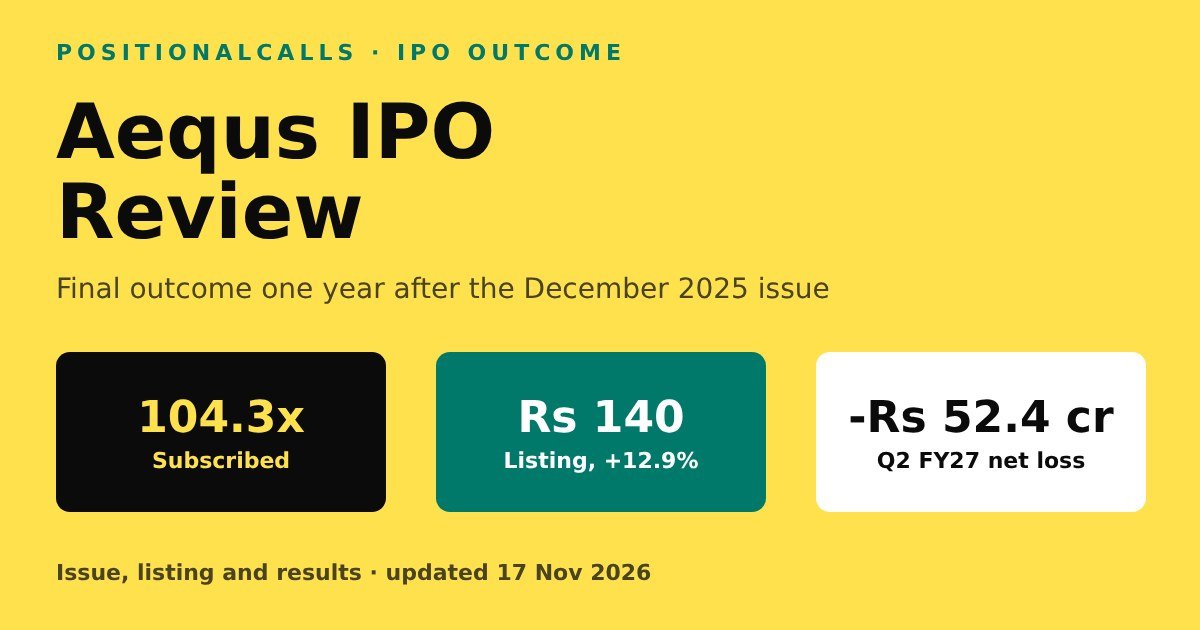
This Aequs IPO review replaces the December 2025 pre-issue preview with the full record: the Rs 921.81 crore issue, 104.3 times subscription, a listing at Rs 140 that missed the grey market, and the results through the September 2026 quarter, with every source conflict shown.
Quick answer
The Aequs IPO raised Rs 921.81 crore at Rs 118 to Rs 124, closed 104.30 times subscribed on 5 December 2025 and listed on 10 December at Rs 140, up 12.9%. Grey market quotes had implied about 35%. The September 2026 quarter showed a Rs 52.4 crore net loss on 45% higher revenue.
Latest update (Tuesday, 17 November 2026, 5:00 PM IST): this Aequs IPO review was rebuilt after listing and two sets of results. The earlier version was written before the IPO, said bidding “will be open from 3 to 5 December”, quoted a grey market premium of Rs 43 to Rs 44 and a 35% listing premium, and carried drafting notes meant for the author. It also showed a price-to-book figure I could not reproduce. The actual subscription, listing and results are below, and the drafting notes and the unverified ratio are removed.
Aequs IPO review: key takeaways
- Issue: Rs 921.81 crore, of which Rs 670 crore (73%) was fresh capital and Rs 251.81 crore was an offer for sale (my calculation).
- Demand: 104.30 times overall, with institutions at 122.93 times and retail at 81.03 times.
- Listing: Rs 140 on NSE and BSE (+12.90%), Rs 27 to Rs 30.5 below the grey market level (my calculation).
- Results: revenue up 45% in Q2 FY27, but a net loss of about Rs 52.4 crore and an EBITDA margin of 6%.
- Price path: 52-week high Rs 294.90, a 16% fall after the Q2 results and Rs 209.39 in a November 2026 data point.
In plain words for this Aequs IPO review: Aequs Limited makes precision parts, mostly for aircraft, plus parts for consumer products. An IPO is a company’s first sale of shares to the public. A fresh issue brings new money to the company, while an offer for sale lets existing owners sell. GMP is an unofficial dealer premium and EBITDA is operating profit before interest, tax and depreciation.
Data note: as of Tuesday, 17 November 2026, 5:00 PM IST. Issue, subscription and listing figures come from Chittorgarh, Angel One, IPO Watch, Kotak Neo, Business Standard and 5paisa. Results come from Inc42, Angel One, Kotak Neo and Univest. Business description, FY23 to FY25 figures and customer concentration are carried from the earlier version of this page and were not re-checked against the prospectus, which I did not open. Calculations are marked “my calculation”.
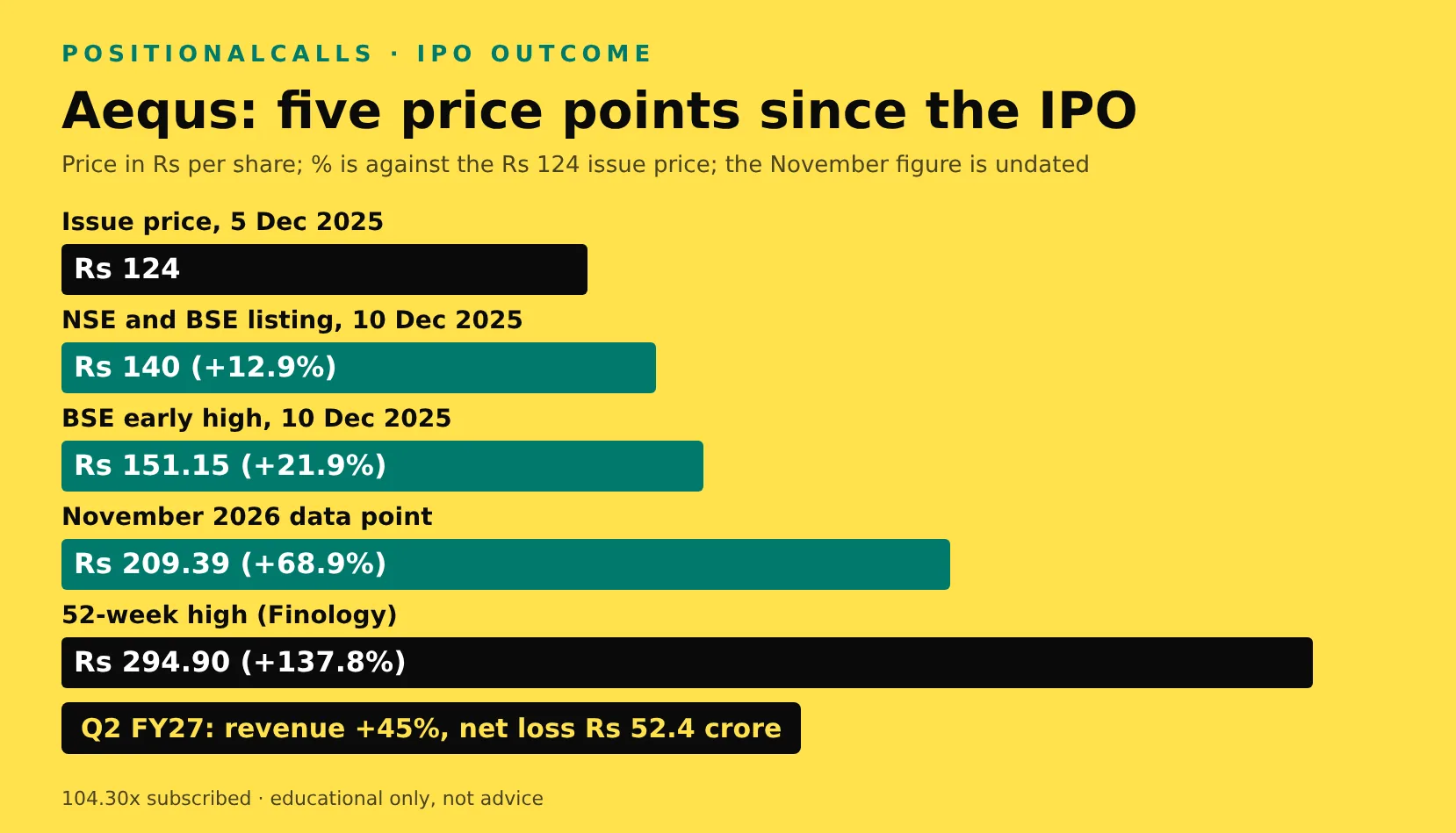 Aequs IPO review in five price points: issue price, listing price, early high, 52-week high and a November 2026 data point.
What are the key numbers in this Aequs IPO review?
The Aequs IPO was a book-built issue of Rs 921.81 crore at Rs 118 to Rs 124 a share, made up of a Rs 670 crore fresh issue and an offer for sale of Rs 251.81 crore. Aequs Limited is a precision manufacturer based in Karnataka, and the shares trade on NSE and BSE under the symbol AEQUS.
| Metric | Figure | Why it matters |
|---|---|---|
| Issue size | Rs 921.81 crore (7,43,39,651 shares) | Chittorgarh, Kotak Neo and Business Standard agree on the total. |
| Fresh issue | Rs 670 crore (5.40 crore shares) | The part that went to the company, 73% of the issue (my calculation). |
| Offer for sale | Rs 251.81 crore (2.03 crore shares) | Selling shareholders received this money, 27% of the issue (my calculation). |
| Price band and issue price | Rs 118 to Rs 124; issue price Rs 124 | The top of the band was used for the issue price. |
| Lot and minimum bid | 120 shares; Rs 14,160 at Rs 118, Rs 14,880 at Rs 124 | Minimum retail cheque (my calculation). |
| Retail limit | 13 lots, 1,560 shares, Rs 1,93,440 | Above this a bid moves to the NII category (my calculation). |
| Anchor round | Rs 413.92 crore from 33 anchors, 44.90% of the issue | Chittorgarh and Muthoot Securities; share is my calculation. |
| Category split | QIB 75%, NII 15%, retail 10% | Standard split for a loss-making company under SEBI rules. |
| Market value at Rs 124 | About Rs 8,316 crore | Carried from the earlier version; Outlook Business says over Rs 8,300 crore. |
Cite this table: PositionalCalls, “Aequs IPO Key Numbers, as of 17 November 2026”; Chittorgarh, Kotak Neo, Angel One, Muthoot Securities, Outlook Business.
These are the fixed facts of this Aequs IPO review. The sections that follow add what happened afterwards: how the book filled, how the listing compared with the grey market, how the share price moved and what two years of results show.
When did the Aequs IPO open, close and list?
The Aequs IPO opened on Wednesday, 3 December 2025, closed on Friday, 5 December, saw allotment on Monday, 8 December and listed on Wednesday, 10 December 2025. Anchor investors were allotted shares on Tuesday, 2 December.
| Event | Date | Note |
|---|---|---|
| Anchor allotment | Tue 2 Dec 2025 | Rs 413.92 crore at Rs 124 per Chittorgarh |
| Issue opens | Wed 3 Dec 2025 | Retail was 11.79 times by the end of day 1 per 5paisa |
| Issue closes | Fri 5 Dec 2025 | UPI mandate cut-off 5 PM; 104.30 times subscribed |
| Basis of allotment | Mon 8 Dec 2025 | Registrar: Kfin Technologies |
| Refunds and demat credit | Tue 9 Dec 2025 | Zerodha and Bajaj Finserv Markets timelines |
| Listing | Wed 10 Dec 2025 | NSE and BSE |
Cite this table: PositionalCalls, “Aequs IPO Dates, as of 17 November 2026”; Chittorgarh, Zerodha, 5paisa, Bajaj Finserv Markets.
This Aequs IPO review keeps the dates short. The anchor lock-ins ended on 6 January and 7 March 2026 per Chittorgarh (Zerodha counts one day later). Our how to apply for an IPO in India guide explains the steps and the 5 PM cut-off for retail bids.
How was the Aequs IPO subscribed in this Aequs IPO review?
The Aequs IPO was subscribed 104.30 times overall, with institutions at 122.93 times, non-institutional investors at 83.61 times and retail at 81.03 times. Almost all of the institutional demand arrived on the last day.
| Category | Day 1 (3 Dec) | Day 2 (4 Dec) | Final (5 Dec) |
|---|---|---|---|
| Qualified institutional buyers (ex anchor) | 0.68x | 0.75x | 122.93x |
| Non-institutional investors | 3.49x | 17.47x | 83.61x |
| Retail investors | 11.79x | 34.34x | 81.03x |
| Total | 3.48x | 11.44x | 104.30x |
Cite this table: PositionalCalls, “Aequs IPO Subscription by Day, as of 17 November 2026”; days 1 and 2 from 5paisa, final from Angel One and IPO Watch.
Three points stand out in this Aequs IPO review. Institutions bid after the retail crowd, so the QIB multiple was only 0.75 times at the end of day 2 and then jumped to 122.93 times, which is why mid-issue totals understate the final book. Retail demand of 81.03 times means that about one valid retail application in 81 could expect a lot (my calculation: 1 divided by 81.03, about 1.2%, assuming one lot each).
What did the demand tell this Aequs IPO review about the listing?
Very little about the size of the first-day gain. In this Aequs IPO review, an issue that drew more than 100 times the shares on offer and about 81 times in the retail quota still listed only 12.9% higher. That is a useful corrective to the common rule that heavy subscription means a big pop, and our IPO listing gains scorecard shows the same test across five other issues.
What was the Aequs listing price, and how did GMP compare?
Aequs listed on 10 December 2025 at Rs 140 on both NSE and BSE, 12.90% above the Rs 124 issue price, and touched about Rs 151 in early trade. One lot of 120 shares gained Rs 1,920 at the listing price (my calculation).
| Item | NSE | BSE |
|---|---|---|
| Issue price | Rs 124 | Rs 124 |
| Listing price | Rs 140 (+12.90%) | Rs 140 (+12.90%) |
| Early high | About Rs 151 (+7.9% over listing) | Rs 151.15 (+8.0% over listing) |
| One-lot gain at listing (120 shares) | Rs 1,920 | Rs 1,920 |
| Market value at listing | About Rs 9,400 crore | Angel One; my estimate is Rs 9,388 crore |
Cite this table: PositionalCalls, “Aequs IPO Listing Day, as of 17 November 2026”; Business Standard, Kotak Neo, Angel One; percentages are my calculation.
How accurate was the Aequs GMP?
| Date | GMP (Rs) | Implied listing price | Source |
|---|---|---|---|
| 1 Dec 2025 | 40 | Rs 164 | Finology |
| 3 Dec 2025 | 47 | Rs 171 | Finology |
| 4 Dec 2025 | 46 | Rs 170 | Finology |
| 5 Dec 2025, last day | 43 (Finology) or 46.5 (Business Standard, 37.5%) | Rs 167 or Rs 170.5 | Finology; Business Standard |
| 10 Dec 2025, actual listing | – | Rs 140 (+12.90%) | Business Standard |
Cite this table: PositionalCalls, “Aequs IPO GMP Versus Listing, as of 17 November 2026”; implied prices are my calculation; GMP is unofficial and the trackers disagree.
In this Aequs IPO review the grey market was wrong by a wide margin: a last-day quote of Rs 43 implied 35%, and the shares listed 12.9% higher, a gap of about 22 percentage points, or Rs 27 per share (my calculation). Business Standard noted that the listing price was significantly below grey market estimates. The earlier version of this page repeated the Rs 43 to Rs 44 quote as a sign of “strong early demand”, which is exactly how a quote can mislead. Treat GMP as a mood gauge in any Aequs IPO review, as our IPO GMP meaning guide explains. For the price rules on listing day, see IPO listing day rules.
How has the Aequs share price done since listing in this Aequs IPO review?
The Aequs share price listed at Rs 140, reached a 52-week high of Rs 294.90, fell about 16% intraday on 27 October 2026 after the Q2 results, and a November 2026 data point shows Rs 209.39. The last figure has no exact date, so check a live quote.
| Date | Price (Rs) | Against Rs 124 issue price | Against Rs 140 listing | Source |
|---|---|---|---|---|
| 10 Dec 2025 (listing) | 140 | +12.9% | – | Business Standard |
| Dec 2025 (monthly data point) | 137.49 | +10.9% | -1.8% | Digrin |
| 8 Sep 2026 | 231.90 | +87.0% | +65.6% | Univest |
| 26 Oct 2026 (previous close, approx.) | 242.4 | +95.5% | +73.1% | Kotak Neo and Angel One, implied |
| 27 Oct 2026, 10:34 AM (NSE) | 201.55 (-16.86%) | +62.5% | +44.0% | Kotak Neo |
| Nov 2026 (data point, date not shown) | 209.39 | +68.9% | +49.6% | Digrin |
| 52-week high | 294.90 | +137.8% | +110.6% | Finology |
| 52-week low | 113.65 | -8.3% | -18.8% | Finology |
Cite this table: PositionalCalls, “Aequs Share Price Path, as of 17 November 2026”; percentages are my calculation; the snapshot dates of Finology and Digrin are not shown, so these are context, not a live quote.
The path in this Aequs IPO review was not a straight line. The stock held near its listing price for three months, rose steadily through 2026 to a high of Rs 294.90 and then fell back. In this Aequs IPO review, at Rs 209.39 the stock sits about 29% below that high and about 69% above the issue price (my calculation). Gains are taxed when you sell; see our capital gains tax on shares guide.
Aequs declared its Q2 FY27 results on the evening of 26 October 2026, and Angel One and Kotak Neo reported the shares down 16.42% at Rs 202.60 (10:16 AM) and down 16.86% at Rs 201.55 (10:34 AM) on 27 October, which implies a previous close near Rs 242.4 (my calculation). Revenue rose 45%, but the loss widened and the EBITDA margin fell.
Was the Aequs IPO a fresh issue or an offer for sale, and where did the money go?
It was both, but mostly fresh capital: Rs 670 crore went to the company and Rs 251.81 crore went to selling shareholders.
| Part | Shares | Amount (Rs crore) | Share of issue |
|---|---|---|---|
| Fresh issue | 5.40 crore | 670.00 | 73% |
| Offer for sale | 2.03 crore | 251.81 | 27% |
| Total | 7.43 crore | 921.81 | 100% |
Cite this table: PositionalCalls, “Aequs IPO Fresh Issue and OFS, as of 17 November 2026”; Chittorgarh and Kotak Neo for the split; percentages are my calculation.
The earlier version of this page said about Rs 433.17 crore of the fresh issue would repay borrowings and about Rs 64 crore would buy machinery. I carry that without re-checking it against the prospectus.
Since the IPO, management has also described a Rs 650 crore warrant issue to the promoter group, to be used for expansion, joint ventures and working capital through December 2027, per Kotak Neo. This Aequs IPO review treats the warrants as a separate funding step from the IPO.
What does Aequs do, and why does it matter to this Aequs IPO review?
Aequs is a precision manufacturing company with a core in aerospace parts and a smaller consumer segment, built around an aerospace manufacturing cluster in Belagavi, Karnataka.
- Aerospace: engine components, landing gear, structural parts, cargo interiors and assemblies for programmes such as the A220, A320, B737, A330, A350, B777 and B787, per the earlier version of this page.
- Consumer: precision plastics, electronics and appliance components made at Hubballi and Koppal for global consumer brands.
- Footprint: Belagavi, Hubballi and Koppal in Karnataka, plus facilities in France and the United States.
- Order book: management put the aerospace order book at US$1.1 billion in October 2026, per Kotak Neo.
The earlier version showed the dependence: aerospace gave 88.23% of net external revenue in H1 FY26 and the top 10 customers gave 82.51% of revenue (carried, not re-checked). Deep qualification with aircraft makers is the strength, and losing one large customer would matter a lot. Management targets revenue of four to six times the FY2026 base by 2031 per Kotak Neo, which is a target and not a forecast.
PositionalCalls WhatsApp channel
Get IPO outcome updates on WhatsApp
- Listing and results, dated
- Plain-English IPO explainers
- Links to updated IPO guides
What do the Aequs financials show in this Aequs IPO review?
Aequs lost Rs 102.35 crore in FY25 on revenue of about Rs 924.6 crore, and in the September 2026 quarter it lost about Rs 52.4 crore on revenue of Rs 409.1 crore, up 45% on the year.
| Rs crore | FY23 | FY24 | FY25 |
|---|---|---|---|
| Total income | 840.54 | 988.30 | 959.21 |
| EBITDA | 63.06 | 145.51 | 107.97 |
| Net profit or loss | -109.50 | -14.24 | -102.35 |
| Net worth | 251.91 | 807.17 | 707.53 |
| Total borrowings | 346.14 | 291.88 | 437.06 |
Cite this table: PositionalCalls, “Aequs Annual Financials, as of 17 November 2026”; carried from the earlier version of this page (consolidated, as then reported) and not re-checked.
FY25 revenue from operations was about Rs 924.6 crore per Trendlyne, which gives an EBITDA margin of 11.68% and a loss margin of 11.07% (my calculation, matching the ratios on the earlier page). Total income and revenue from operations are different lines, which is why the table shows Rs 959.21 crore and the text shows Rs 924.6 crore. Since listing, the quarters look like this.
| Quarter | Revenue from operations (Rs crore) | Net profit or loss (Rs crore) | Source note |
|---|---|---|---|
| Q1 FY26 (Jun 2025) | About 256 | About +3.6 | Fyers; Inc42 (Free Press Journal shows 3.92) |
| Q2 FY26 (Sep 2025) | 281.6 | -20.6 | Kotak Neo |
| Q3 FY26 (Dec 2025) | About 326 | Not found | Fyers |
| Q4 FY26 (Mar 2026) | About 367 | -54.09 | Fyers; Free Press Journal |
| Q1 FY27 (Jun 2026) | 395.55 | -53.23 | Inc42, Sahi |
| Q2 FY27 (Sep 2026) | 409.1 | -52.39 | Univest, Angel One, Inc42 |
Cite this table: PositionalCalls, “Aequs Quarterly Results, as of 17 November 2026”; rounded revenue figures are the Fyers net revenue values, and the Q3 FY26 loss is not in the sources I could open.
The pattern is the point of this Aequs IPO review. Revenue rose every quarter from about Rs 256 crore to Rs 409.1 crore, yet the loss stayed between Rs 52 crore and Rs 54 crore for the last three reported quarters, so operating leverage has not shown up yet. In Q2 FY27, EBITDA was Rs 24.5 crore against Rs 44.3 crore a year earlier, a fall of about 45%, and the margin dropped to about 6% from about 16% (my calculation). Aerospace revenue rose 44% and aerospace EBITDA rose 24%, while the consumer segment, where revenue rose 52%, remains below break-even, per Kotak Neo and Angel One.
Management said consumer volumes ramped slower than planned and set 50% utilisation as the break-even level for that segment. It cut planned consumer capex to Rs 200 to Rs 300 crore and guided to total capex of Rs 500 to Rs 550 crore, much of it for aerospace, per Kotak Neo. A quarter is a short window and does not say whether the plan will work.
What does this Aequs IPO review say about the Aequs valuation?
At the issue price Aequs was valued at about Rs 8,316 crore, or 8.7 times FY25 total income, and at Rs 209.39 the same share count gives about Rs 14,042 crore, or 9.4 times the last four quarters of revenue (my calculation). This Aequs IPO review gives arithmetic, not a view on whether the price is right.
| Measure | Figure | How it is derived |
|---|---|---|
| Shares in issue (estimate) | About 67.06 crore | Rs 8,316 crore divided by Rs 124 (my calculation) |
| Market value at Rs 124 | About Rs 8,316 crore | Carried from the earlier version |
| Market value at Rs 140 listing | About Rs 9,388 crore | 67.06 crore shares times Rs 140; Angel One says nearly Rs 9,400 crore |
| Market value at Rs 209.39 | About Rs 14,042 crore | 67.06 crore shares times Rs 209.39; Arthneeti showed Rs 15.8K crore at Rs 236 |
| Value at issue price over FY25 total income | About 8.7 times | Rs 8,316 crore divided by Rs 959.21 crore |
| Value at Rs 209.39 over last four quarters of revenue | About 9.4 times | Rs 14,042 crore divided by Rs 1,497.65 crore (326 + 367 + 395.55 + 409.1) |
| Earnings per share | -3.19 (trailing) | Digrin; a price-to-earnings ratio is not meaningful |
Cite this table: PositionalCalls, “Aequs Valuation Arithmetic, as of 17 November 2026”; the share count is an estimate, later warrants would add shares, and the Q3 and Q4 FY26 revenue values are rounded Fyers figures.
The sales multiple barely changed, from 8.7 times to 9.4 times, so the share price rose with revenue and not through a higher rating on each rupee of sales. The market pays that multiple for a business that is still loss-making.
Who holds Aequs, and when do the lock-ins end in this Aequs IPO review?
Promoters held 59.09% in September 2026 per Finology, with 25.36% of that holding pledged, and a lock-in on 25.80 crore additional promoter shares ends on 8 December 2026 per a BSE circular summary.
| Item | Figure | Source and caveat |
|---|---|---|
| Promoter holding, Dec 2025 to Sep 2026 | 59.08% to 59.09% | Finology |
| Promoter pledge, Jun 2026 | 0.00% | Finology |
| Promoter pledge, Sep 2026 | 25.36% of promoter holding | Finology; about 10.0 crore shares (my calculation) |
| Additional promoter shares, 1-year lock-in | 25.80 crore, until 8 Dec 2026 | BSE circular summary on a third-party site; about 38.5% of shares (my calculation) |
| Anchor lock-ins | Ended 6 Jan and 7 Mar 2026 | Chittorgarh |
Cite this table: PositionalCalls, “Aequs Promoters and Lock-ins, as of 17 November 2026”; the circular was not opened directly, so confirm the dates on the exchange site.
In this Aequs IPO review, a pledge means that shares are given as security for a loan, and it is a fact to watch, not a fault in itself. It went from none in June 2026 to 25.36% of promoter holding in September 2026, and I could not confirm why. The 8 December date matters because a block of about 38.5% of all shares, about Rs 5,403 crore at Rs 209.39, becomes free to trade (my calculation). A lock-in ending adds the possibility of supply, and it does not say that anyone will sell.
What are the main risks in this Aequs IPO review?
The main risks are continuing losses, a thin margin, customer and sector concentration, a consumer segment below break-even, promoter pledging and a rich valuation.
The business also has real strengths, including a US$1.1 billion aerospace order book, 44% aerospace revenue growth and deep qualification with large aircraft makers. An Aequs IPO review that lists only the strengths is incomplete, and one that lists only the risks is too. The honest reading holds both: fast revenue growth and a long order book on one side, and losses, thin margins and concentration on the other. That balance is why this Aequs IPO review gives no rating and keeps the sources and conflicts in view so that you can form your own judgment. If you cannot afford to lose the money, a diversified fund is a safer route than a single stock.
How does this Aequs IPO review compare with other recent IPOs?
Aequs drew 104 times the shares on offer and listed 12.9% higher, which is the same gain Groww delivered on 17.6 times, and far below the 65% that BLS Polymers delivered in November 2026. The comparison below uses the same measures for each issue.
| IPO | Overall subscription | Retail subscription | NSE listing gain | Last-day GMP implied |
|---|---|---|---|---|
| Aequs (Dec 2025) | 104.30x | 81.03x | +12.90% | 35% to 37.5% |
| Groww (Nov 2025) | 17.60x | 9.43x | +12.0% | About 11% |
| BLS Polymers (Nov 2026) | Carried from our scorecard | 128.4x | +65.3% | Not compared |
| EAAA India Alternatives (Nov 2026) | 5.25x | 1.03x | +0.63% | Rs 54 on 2 Nov |
Cite this table: PositionalCalls, “Aequs IPO Compared With Other Recent IPOs, as of 17 November 2026”; Groww, BLS and EAAA figures from our guides and scorecard; gains are my calculation from issue and NSE listing prices.
The table shows the limit of reading a retail book in an Aequs IPO review. Across the November 2026 issues in our scorecard, retail demand lined up with the size of the gain, but Aequs had retail demand of 81 times and a gain of 12.9%, almost the same as Groww’s 12% on 9.43 times. Four issues are not a rule. What they show is that the grey market and the order book can both overstate a debut, and that the gain on day one says little about what follows: Groww’s shares ran far higher in the year after listing and Aequs’s shares rose and then fell back. Read our Groww IPO analysis and our EAAA India Alternatives IPO guide for the other two, and our Mahanadi Coalfields IPO and Crystal Crop Protection IPO guides for the issues that are open.
What does the Aequs IPO review teach about listing gains?
Aequs shows that heavy subscription and a high grey market premium can still end in a modest listing, and that a listing price is not a view on the business.
This Aequs IPO review sits beside our scorecard. For how the November 2026 IPOs compare, see our IPO listing gains November 2026 scorecard, which also covers the Mahanadi Coalfields and Crystal Crop Protection issues that are open. Browse every guide in our IPO category.
- What stands out: revenue grew 45% in a year while the loss grew 2.5 times, so growth has not yet turned into profit.
- Easy to miss: a lock-in on about 38.5% of the shares ends on 8 December 2026, and 25.36% of promoter shares were pledged in September 2026.
- What would change the view: the Q3 FY27 results, consumer volumes reaching 50% utilisation, or a change in aerospace orders.
- Caution: this is reasoning from reported numbers, not a forecast or a buy call.
Bottom line
This Aequs IPO review shows a Rs 921.81 crore issue that closed 104 times subscribed, listed 12.9% higher against a grey market that implied about 35%, and has since grown revenue 45% while still losing money. The price has moved far from Rs 124, so the old IPO question no longer applies to a buyer at the current price. This is education, not advice: read the filings and speak to a registered adviser.
PositionalCalls WhatsApp channel
IPO updates in one channel
- Subscription and listing results, dated
- GMP explained without tips
- Links to new IPO pages
Aequs IPO review: frequently asked questions
What was the Aequs IPO price band and lot size?
The Aequs IPO price band was Rs 118 to Rs 124 per share and one lot was 120 shares, so a retail bid cost Rs 14,160 at the floor and Rs 14,880 at the top (my calculation). The issue opened on 3 December 2025, closed on 5 December and fixed its issue price at Rs 124. Face value is Rs 10 per share.
How many times was the Aequs IPO subscribed?
The Aequs IPO closed about 104.30 times subscribed on 5 December 2025: institutions (QIB, excluding anchors) 122.93 times, non-institutional investors 83.61 times and retail 81.03 times, per Angel One and IPO Watch. An earlier 5 PM reading showed 101.63 times. Retail odds of a lot were roughly 1 in 81, or 1.2% (my calculation).
What was the Aequs listing price?
Aequs listed on 10 December 2025 at Rs 140 on both NSE and BSE, a 12.90% premium to the Rs 124 issue price, per Business Standard and Kotak Neo. The stock touched about Rs 151 in early trade. One lot of 120 shares gained Rs 1,920 at the listing price (my calculation). This Aequs IPO review found that the grey market had pointed to a much larger gain.
Did the Aequs IPO GMP predict the listing correctly?
No. This Aequs IPO review found the grey market premium was Rs 43 to Rs 46.5 on the last day, implying Rs 167 to Rs 170.5, or 35% to 37.5% above Rs 124. The actual listing was Rs 140, so the shares listed Rs 27 to Rs 30.5 below the grey market level (my calculation). GMP is unofficial and can mislead.
Is the Aequs IPO a fresh issue or an offer for sale?
It was both. A fresh issue of Rs 670 crore went to the company and an offer for sale of Rs 251.81 crore went to selling shareholders, which together make the Rs 921.81 crore issue. The fresh part is 73% of the total (my calculation), so most of the money reached Aequs. The earlier version of this page showed the same split.
How is Aequs doing financially after listing?
In the September 2026 quarter, Aequs reported revenue from operations of Rs 409.1 crore, up 45% from Rs 281.6 crore, and a net loss of about Rs 52.4 crore against Rs 20.6 crore a year earlier. EBITDA fell to Rs 24.5 crore from Rs 44.3 crore, a margin of about 6%, per Kotak Neo and Inc42 in this Aequs IPO review.
How has the Aequs share price done since listing?
The Aequs share price listed at Rs 140, ended December 2025 near Rs 137, and reached a 52-week high of Rs 294.90 per Finology. It fell about 16% intraday on 27 October 2026 after the Q2 results, and a November 2026 data point shows Rs 209.39, about 69% above Rs 124 (my calculation). Check a live quote before acting.
What are the main risks in the Aequs business?
The biggest risks in this Aequs IPO review are continuing net losses, a 6% EBITDA margin in Q2 FY27, customer concentration (the top 10 clients gave 82.51% of revenue in the earlier version of this page), aerospace cyclicality and a consumer segment that has not reached break-even. Promoter pledging was 25.36% of promoter holding in September 2026, per Finology.
When does the Aequs promoter lock-in end?
A BSE circular summary lists 25.80 crore additional promoter shares locked in until 8 December 2026, one year from allotment, with a further group locked in until December 2028. I could not open the circular itself, so confirm the dates on the exchange site. This Aequs IPO review treats the date as a supply event, not a price forecast.
Does this page recommend buying Aequs?
No. PositionalCalls.com publishes no subscribe, buy, sell, rating or target calls. This Aequs IPO review records the issue, the subscription, the listing and the results, and shows the sources and conflicts. The shares trade far above the IPO price, so the old apply-or-avoid question no longer applies. Read the filings and speak to a registered adviser.
Sources for this Aequs IPO review
- SEBI: filings and public issue documents, regulator, not opened for this update.
- Chittorgarh: Aequs IPO details, tracker, anchor round and lock-in dates.
- Angel One: Aequs IPO allotment status, broker, final 104.30 times and share counts.
- IPO Watch: Aequs IPO listed at a 12.90% premium, tracker, final subscription and listing.
- PTI via The Week: Aequs IPO receives 101.63 times subscription, wire, provisional close.
- 5paisa: Aequs IPO, broker, day-wise subscription.
- Kotak Neo: Aequs IPO details, broker, subscription and listing.
- Business Standard: Aequs IPO last day, GMP at 37%, press, last-day GMP.
- Business Standard: Aequs lists at 13% premium, press, listing.
- Angel One: Aequs shares listed at about 13% premium, broker, market value at listing.
- Finology: Aequs IPO and GMP table, tracker, GMP by date.
- Finology: Aequs share price, tracker, 52-week range and pledge.
- Digrin: Aequs price history, tracker, monthly data points.
- Zerodha: Aequs IPO, broker, timeline and anchor lock-in.
- Inc42: Aequs Q2 loss widens, revenue up 45%, press, Q2 FY27.
- Angel One: Aequs share price falls over 16% after Q2, broker, results-day move.
- Kotak Neo: Aequs Q2 FY27 results, broker, EBITDA, capex and guidance.
- Univest: Aequs Q2 results FY27, tracker, Q2 loss.
- Arthneeti: Aequs Q2 FY27 earnings, tracker, market value and segments.
- Free Press Journal: Aequs Q2 and H1 results, press, half-year loss.
- Fyers: Aequs quarterly results, broker, rounded quarterly revenue.
- BSE circular summary: listing of Aequs shares, third-party summary, lock-in dates.
- Legal Suvidha: Aequs promoter pledge, secondary news, single source.
- Carried from the earlier version of this page and not re-checked: FY23 to FY25 financials, business description, customer concentration and use of proceeds.
- PositionalCalls: IPO GMP meaning.
PositionalCalls.com is an independent research site founded by Shubham Chaudhary. PositionalCalls.com is not a SEBI-registered research analyst or investment adviser. Investments in securities markets are subject to market risks. Read all related documents carefully before investing. Returns are never guaranteed. This page is educational and publishes no subscribe, buy, sell, rating or target calls. How this Aequs IPO review was researched: issue, subscription, listing and results figures were compared across the sources above, every derived number was recomputed, and conflicting figures are shown. Corrections are published in the Data note.

Shubham Chaudhary is the founder of PositionalCalls, an independent Indian stock market research website. He writes company fundamentals, quarterly results analysis, IPO analysis and sector research for NSE and BSE listed companies, with a focus on banking stocks, insurance and long-term value investing. Every article is built from primary sources such as RBI, SEBI, NSE and BSE filings and company annual reports, and states its risks plainly in simple language for retail investors.
Coverage areas Our research standards- Numbers checked against NSE, BSE and SEBI filings
- Risks and limits stated in every article
- No paid promotions or broker tie-ups
- Articles updated when new filings arrive