
IPO basics · Explainer
How to apply for an IPO in India, step by step: what you need, how the UPI mandate works, the Rs 2 lakh retail limit, how lot size sets your minimum bid, the last-day cut-offs and what happens after you bid. It carries a bid calculator and a worked example from the Crystal Crop Protection IPO.
Quick answer
To apply for an IPO in India, open the issue in your broker app, choose a price in the band and the lots, enter your UPI ID and approve the mandate request before the cut-off. The money is only blocked. A retail bid can go up to Rs 2 lakh, and listing follows on T+3.
Latest update (Monday, 16 November 2026, 12:00 PM IST): first version of this guide. The rules come from the SEBI circulars of 5 April 2022 and 9 August 2023, as reproduced by Taxguru, and from Chittorgarh and CalcGuru. I did not open the SEBI circulars on sebi.gov.in or the exchange circulars. The Crystal Crop Protection figures are the issue details reported by Chittorgarh and Upstox, and they are an example, not a view on that IPO.
Key takeaways
- What you need: a demat account, a bank account on UPI and a PAN. Credit cards are not accepted.
- Limits: up to Rs 2 lakh is the retail category; above that you bid as a non-institutional investor. UPI works for individuals up to Rs 5 lakh.
- Minimum bid: one lot at the lowest price. For Crystal Crop that is 55 shares, Rs 14,245 at Rs 259 (my calculation).
- Money: the amount is blocked, not paid. Only allotted shares are debited.
- Deadlines: UPI mandates until 5 PM on the closing day, bank ASBA until 4 PM, but brokers can close earlier.
- One PAN, one application. A duplicate can reject all of them.
In plain words: an IPO is a company selling shares to the public for the first time, and you bid for a number of lots at a price within a band. Your bank blocks the money while you wait. If you get shares, only that amount is taken and the rest is released. If you do not, you get all of it back. Nothing on this page tells you to apply or to skip any IPO.
Data note: as of Monday, 16 November 2026, 12:00 PM IST. Category limits, the one-application rule, the cut-off price rule and the SME note come from Chittorgarh and CalcGuru. The UPI limit of Rs 5 lakh comes from SEBI circular SEBI/HO/CFD/DIL2/CIR/P/2022/45 of 5 April 2022 and the T+3 timetable from SEBI circular SEBI/HO/CFD/TPD1/CIR/P/2023/140 of 9 August 2023, both as summarised by Taxguru. Derived figures are my calculation. PositionalCalls is not SEBI-registered and gives no apply or avoid view on any IPO.
What does it mean to apply for an IPO?
To apply for an IPO is to place a bid for a number of lots of a company’s shares at a price within the announced band, while the issue is open. You do not pay up front: your bank blocks the amount, and only shares that are allotted to you are paid for.
An initial public offering, or IPO, is the first time a company offers its shares to the public. The issue stays open for a few days, usually three. In that window the company accepts bids through brokers, banks and the exchange platform. After it closes, the company and the registrar decide who gets shares. In most categories that decision is made by lottery, because bids can be many times the shares on offer.
That is why an IPO application is different from buying a share on the exchange. A bid is a request, not a purchase. Chittorgarh says an application is not valid until the amount is debited or a lien is placed on it, and that duplicate applications are rejected at allotment. Everything below, from the UPI mandate to the cut-off times, follows from that one fact: your bid only counts if the money is blocked in time.
This guide explains how to apply for an IPO in India for the mainboard route, which is what most investors use, and notes where SME issues differ. It uses the Crystal Crop Protection IPO as a worked example because its band, lot and dates are public: a price band of Rs 259 to Rs 272, a lot of 55 shares, and bidding from 18 to 20 November 2026, as reported by Chittorgarh and Upstox. The example shows how the numbers work. It is not a view on whether to bid.
What do you need before you apply for an IPO?
You need a demat account, a bank account linked to a UPI ID, and a PAN. Chittorgarh says a demat account is mandatory and a credit card cannot be used.
| Requirement | Why it is needed | Source |
|---|---|---|
| Demat account | Allotted shares are credited here. Chittorgarh says a demat account is mandatory to submit an IPO application | Chittorgarh |
| PAN linked to the demat account | One application per PAN. The PAN ties the bid to one investor | Chittorgarh; CalcGuru |
| Bank account on UPI | The UPI mandate blocks the amount in this account. Credit cards are not accepted | Chittorgarh |
| A UPI ID that is active and linked to that bank | The mandate request is sent to this ID. An unapproved request means no valid bid | Chittorgarh (approve the mandate request) |
| Enough balance for the amount blocked | The block is taken at the top of the band for a cut-off bid | CalcGuru |
Cite this table: PositionalCalls, “What You Need to Apply for an IPO in India, as of 16 November 2026, 12:00 PM IST”; Chittorgarh and CalcGuru.
Who can use UPI and who needs ASBA
The UPI route is open only to retail investors. Chittorgarh says so directly, and SEBI’s 5 April 2022 circular, as summarised by Taxguru, requires individual investors bidding up to Rs 5 lakh to use UPI through a broker, depository participant, registrar or syndicate member that is listed on the exchange website for this activity. If your bid is larger, or you prefer your bank, you apply through net banking ASBA with a bank that is a self-certified syndicate bank.
ASBA stands for Applications Supported by Blocked Amount. It is the older process on which UPI bidding is built: the same blocking idea, with the instruction given through your bank or UPI app rather than a cheque. The difference you will notice is the channel, not the principle.
How to apply for an IPO using UPI, step by step
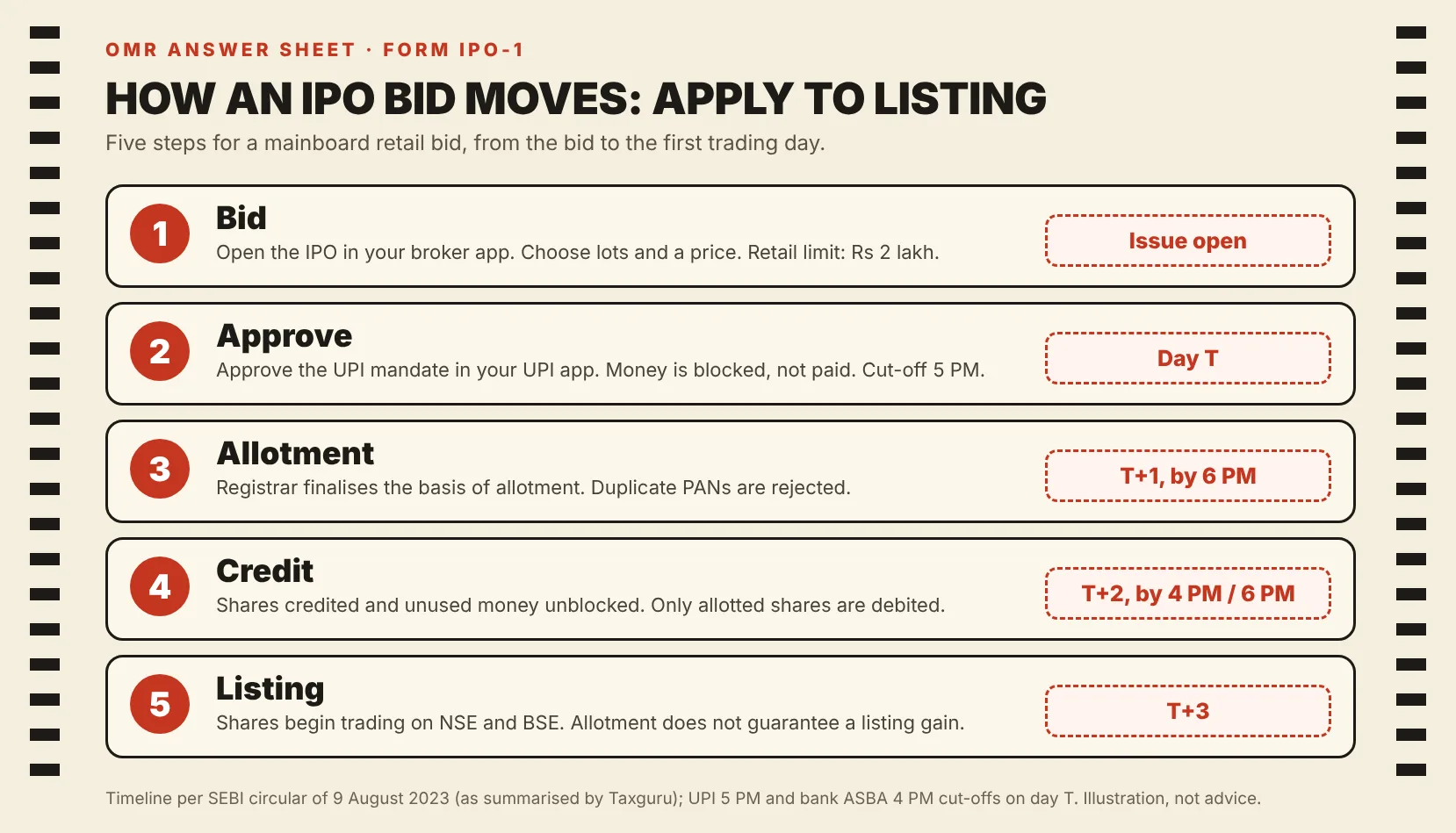
Open the IPO in your broker app, choose the price and lots, enter your UPI ID, submit, then approve the mandate request in your UPI app before the cut-off. Your bid is valid only after you approve it.
- Find the issue. Open the IPO section of your broker or bank app. Issues appear when they open. Check the dates, the price band and the lot size shown there against the exchange notice.
- Choose the category. Retail individual investors bid up to Rs 2 lakh. Pick “retail” or “individual” unless you are bidding more.
- Enter the bid. Select the number of lots and the price. You can bid at any price in the band, or at cut-off for a mainboard retail bid. The app shows the amount that will be blocked.
- Enter your UPI ID. Use the ID linked to the bank account you want blocked. A wrong or inactive ID means no mandate request arrives.
- Submit the application. The broker sends the bid to the exchange. At this point it is not yet valid.
- Approve the mandate. A request arrives in your UPI app. Approve it with your UPI PIN. Chittorgarh tells investors to approve the UPI mandate request once received. This is the step that blocks the money.
- Confirm the status. The broker app should show the bid as “applied” or “bid placed” and the exchange acknowledgement. Keep the application number.
The most common slip is step six. A bid that is submitted but never approved in the UPI app has no money behind it, so it does not count. Do this on the opening day, not the closing day, so you have time to correct a wrong UPI ID. For the limit, the cut-off and what to do when the request fails, see our UPI mandate for IPO guide.
Hinglish summary: IPO mein apply karne ke liye demat account, UPI aur PAN chahiye. Broker app mein IPO kholo, lots aur price chuno, UPI ID daalo aur UPI app mein mandate approve karo. Paisa sirf block hota hai, katta tabhi hai jab shares allot ho. Ek PAN se ek hi application karo.
Which category do you apply in: retail, small NII or big NII?
In a mainboard IPO, a retail individual investor bids up to Rs 2 lakh, a small non-institutional investor bids above Rs 2 lakh up to Rs 10 lakh, and a big non-institutional investor bids above Rs 10 lakh. The category follows from the size of your bid.
| Category | Bid size | Share of the issue reserved | Can use UPI? |
|---|---|---|---|
| Retail individual investor (RII) | Up to Rs 2 lakh | At least 35% of the issue (CalcGuru, ICDR) | Yes, up to Rs 5 lakh for individuals |
| Small NII (sNII) | Above Rs 2 lakh, up to Rs 10 lakh | Part of the non-institutional share | UPI is allowed for individuals up to Rs 5 lakh |
| Big NII (bNII) | Above Rs 10 lakh | Part of the non-institutional share | Use net banking ASBA |
| Qualified institutional buyer (QIB) | Institutions, not individuals | Up to 50% of the issue | No |
Cite this table: PositionalCalls, “IPO Application Categories in a Mainboard Issue, as of 16 November 2026, 12:00 PM IST”; Chittorgarh and CalcGuru, citing the ICDR Regulations 2018.
For the Crystal Crop Protection IPO, Chittorgarh reports that retail investors are reserved not less than 35% of the net issue, non-institutional investors not less than 15% and qualified institutional buyers not more than 50%. A smaller reserved share generally means more competition for the same lots, but the exact subscription only becomes known when the issue is open and the exchange publishes it, so no number is shown here.
Why the Rs 2 lakh line matters
One consequence is worth knowing. The Rs 2 lakh line is a category rule, not an advantage rule. Bidding above Rs 2 lakh moves you into the non-institutional bucket, where the allotment method is different, so a larger bid is not simply a bigger retail bid. If you want the retail route, stay at or below Rs 2 lakh.
How does IPO lot size set your minimum and maximum bid?
A lot is the smallest block of shares you can bid for, and your minimum bid is one lot at the lowest price in the band. To find your maximum retail bid, divide Rs 2 lakh by the cost of one lot at the top of the band and round down.
| Item | Calculation | Result (my calculation) |
|---|---|---|
| Lot size | Set by the company | 55 shares |
| Price band | Reported by Chittorgarh and Upstox | Rs 259 to Rs 272 |
| Minimum bid, one lot at the low end | 55 x Rs 259 | Rs 14,245 |
| One lot at the top of the band | 55 x Rs 272 | Rs 14,960 |
| Most lots under Rs 2 lakh at Rs 272 | Rs 2,00,000 / Rs 14,960 = 13.4, so 13 lots | 13 lots, 715 shares |
| Cost of 13 lots at Rs 272 | 13 x 55 x Rs 272 | Rs 194,480 |
| Cost of 14 lots at Rs 272 | 14 x 55 x Rs 272 | Rs 209,440, above the retail limit |
Cite this table: PositionalCalls, “Crystal Crop Protection IPO: Minimum and Maximum Retail Bid, as of 16 November 2026, 12:00 PM IST”; band and lot as reported by Chittorgarh and Upstox; the calculations are mine.
How to read the lot-size table
Chittorgarh says the quantity you bid must be a multiple of the minimum lot size. CalcGuru says lots are sized between Rs 10,000 and Rs 15,000, which fits the Rs 14,245 to Rs 14,960 range here, but I did not find the circular behind that range, so treat it as a general pattern. The prospectus and the exchange notice state the actual lot for each issue.
The numbers above are an illustration of how to calculate a bid. They are not a statement about whether the Crystal Crop Protection IPO is priced well, and a higher or lower price within the band does not make the bid better or worse by itself.
PositionalCalls WhatsApp channel
Get IPO how-to guides on WhatsApp
- Open, close and allotment dates
- Rules explained without tips
- Links to updated IPO guides
IPO bid calculator: how much will be blocked, and which category?
Enter the price, the lot size and the number of lots. The calculator shows the amount blocked, the category the bid falls in and whether UPI can be used. It is an illustration of the rules above, not an application.
Illustration, not advice. Categories follow the mainboard limits of Rs 2 lakh and Rs 10 lakh; SME issues have different minimums.
Try the Crystal Crop figures: at Rs 272 and 55 shares, one lot shows Rs 14,960 and a retail category; 13 lots show Rs 1,94,480, still retail; 14 lots show Rs 2,09,440 and the small non-institutional category. The calculator does not check the issue’s real band or lot, so enter them from the exchange notice.
What is the cut-off price option when you apply for an IPO?
Cut-off price means you agree to pay whatever final price the company sets within the band. Chittorgarh says only retail investors in mainboard IPOs can bid at cut-off, and in SME IPOs cut-off bidding is not permitted.
How the blocked amount works with a cut-off bid
CalcGuru adds how the money works. For a cut-off bid, the amount blocked is taken at the top of the band, and any difference is released once the final price is fixed. If the final price is the top of the band, nothing is released. If it is lower, the difference comes back to your account, and the shares are allotted at the lower price.
| Bid type | Price you pay | Amount blocked | Who can use it |
|---|---|---|---|
| Specific price in the band | The price you chose | At your chosen price | All investors |
| Cut-off price | The final price set by the company | At the top of the band, difference released | Retail investors in mainboard IPOs only |
Cite this table: PositionalCalls, “Specific Price vs Cut-off Bid, as of 16 November 2026, 12:00 PM IST”; Chittorgarh and CalcGuru.
A bid at a price below the final price is not valid, which is why cut-off is popular: it removes the risk that the price is fixed above what you bid. The cost is that you must have the top-of-band amount available in your account. Whether that trade-off suits you is your own call. This page only describes how the option works.
What is the last time to apply for an IPO on the closing day?
On the closing day, UPI mandates can be accepted until 5 PM and online ASBA via 3-in-1 accounts until 5 PM, but bank ASBA closes at 4 PM and physical forms at 3 PM, as per the SEBI timetable. Many brokers close their own window earlier.
| Channel on the closing day (T) | Retail cut-off | Non-retail cut-off |
|---|---|---|
| UPI mandate acceptance | 5 PM | Not applicable (UPI is for retail) |
| Online ASBA via 3-in-1 account | 5 PM | 3 PM (electronic) |
| Bank ASBA (UPI, internet or mobile banking) | 4 PM | 4 PM |
| Physical application | 3 PM | 12 PM |
Cite this table: PositionalCalls, “Closing-Day Cut-Offs, as of 16 November 2026, 12:00 PM IST”; SEBI circular of 9 August 2023 as reproduced by Taxguru; confirm in the exchange notice.
The exchange accepts applications from 10 AM to 5 PM on open days, per Chittorgarh, and its timing list gives 5 PM as the cut-off on the issue closure date. CalcGuru says the SME bidding window closes at 4 PM. Chittorgarh says the online ASBA window for retail investors generally closes between 2 PM and 4 PM depending on the bank or broker.
Why the sources show different deadlines
These sources do not agree on a single retail deadline, and that is the point: there are two clocks. The exchange has a closing time, and your broker has a cut-off before it so the application can be processed. The safe reading is to treat the earliest time shown in your own app as the real deadline. For the Crystal Crop Protection IPO, which closes on Friday, 20 November 2026 per Chittorgarh and Upstox, that means applying on 18 November rather than on the last afternoon. Our UPI mandate for IPO guide compares the cut-off times that different sources give.
What happens after you apply for an IPO?
After the issue closes on day T, the basis of allotment is finalised on T+1, shares are credited and unused money unblocked on T+2, and trading starts on T+3, as per the SEBI circular of 9 August 2023.
| Day | What happens | Time limit (SEBI timetable) |
|---|---|---|
| T (closing day) | Bids close; funds-blocked confirmations go to the registrar | UPI ASBA by 9:30 PM; direct and syndicate ASBA by 7:30 PM |
| T+1 | Rejections finalised; basis of allotment completed; exchange approval | Basis of allotment by 6 PM; exchange approval by 9 PM |
| T+2 | Fund transfer, unblocking and share credit | Unblocking by 4 PM; share credit initiated by 2 PM and completed by 6 PM |
| T+3 | Listing and trading begin | Newspaper advertisement no later than T+4 |
Cite this table: PositionalCalls, “IPO Timeline After the Issue Closes, as of 16 November 2026, 12:00 PM IST”; SEBI circular SEBI/HO/CFD/TPD1/CIR/P/2023/140 of 9 August 2023, as reproduced by Taxguru.
What the T+3 rule changed
The circular cut the listing timeline from T+6 working days to T+3. It was voluntary for issues opening on or after 1 September 2023 and mandatory for issues opening from 1 December 2023, as per Taxguru. The days are working days, so a market holiday moves the calendar dates. For any live issue, the dates published by the company and the exchange are the ones to follow. Chittorgarh marks the Crystal Crop allotment, refund and listing dates as tentative.
To see what you received, check the registrar’s page after the basis of allotment. Our guide to how to check IPO allotment status covers that step. CalcGuru reports that delayed unblocking carries compensation of Rs 100 per day or 15% a year, whichever is higher, citing a SEBI circular of 16 March 2021. I did not verify that circular, so treat the figure as reported.
Why do IPO applications get rejected?
Applications are rejected mainly for duplicate bids on one PAN, an unapproved UPI mandate or funds that were never blocked, and ineligible channels such as credit cards. A rejection means the bid never counted; it is not a decision on you.
| Reason | What the sources say | How to avoid it |
|---|---|---|
| More than one application on a PAN | Chittorgarh: one application per PAN; duplicates are accepted at application but rejected at allotment. CalcGuru: multiple applications in the same category are liable to rejection | Apply once per PAN. Family members use their own PAN and demat account |
| UPI mandate not approved | Chittorgarh: approve the mandate request once received; an application is not valid until a lien is placed | Approve in the UPI app straight after submitting, before the cut-off |
| Credit card used | Chittorgarh: you cannot apply for an IPO through a credit card | Use UPI or ASBA from a savings account |
| No demat account | Chittorgarh: a demat account is mandatory | Open and link one before the issue opens |
| Wrong or inactive UPI ID | Not stated by a single source; a general cause of a missing mandate request | Check the ID against your UPI app on the opening day |
Cite this table: PositionalCalls, “Common IPO Application Rejection Reasons, as of 16 November 2026, 12:00 PM IST”; Chittorgarh and CalcGuru; the last row is a general cause, not a quoted rule.
The rows in the table that name a source are stated rules. The last row is a practical cause, and I did not find a published rule for it. Regardless of the reason, a rejected application releases the blocked money, so you do not lose the amount, only the chance of allotment in that bid. If the cause was an unapproved or failed mandate, see why a UPI mandate for IPO fails.
What is different when you apply for an SME IPO?
For SME issues filed after March 2025, CalcGuru reports a minimum application of two lots and above Rs 2 lakh, a 4 PM closing time and no cut-off option. Older issues may differ, so read each prospectus.
| Point | SME IPO | Mainboard IPO | Source |
|---|---|---|---|
| Minimum application | Two lots and above Rs 2 lakh for issues opening on or after 1 July 2025 (ICDR Reg 267(2)) | One lot | CalcGuru |
| Cut-off price | Not permitted | Allowed for retail | Chittorgarh; CalcGuru |
| Bidding closes on the last day | 4 PM for all categories | 5 PM for retail | CalcGuru |
| Retail participation | Earlier issues may still admit retail bids; newer filings can exclude bids under Rs 2 lakh | Retail up to Rs 2 lakh | Zerodha, 28 May 2025 |
Cite this table: PositionalCalls, “SME vs Mainboard IPO Application, as of 16 November 2026, 12:00 PM IST”; CalcGuru, Chittorgarh and Zerodha; check the prospectus for the issue.
The practical reading is that SME rules changed in 2025 and the date a company filed its prospectus decides which rule applies. That is why an SME IPO that your friend applied to last year may have had a smaller minimum than one that opens under the newer rule. Whichever you look at, the same blocking logic and the one-PAN rule still apply.
What do most people miss when they apply for an IPO?
- Approval is the bid. Submitting in the broker app is not enough; the mandate must be approved in the UPI app.
- Brokers close earlier than the exchange. The exchange runs to 5 PM, but your app may stop at 2 PM to 4 PM.
- A bigger bid is not a better bid. Above Rs 2 lakh you move to a different category with a different allotment method.
- One PAN, one application. A second application can reject every one of them.
- Blocked is not spent. Only allotted shares are debited, but the money is unavailable until it is released.
What should you check before the IPO closes?
Check the dates and the price band, your balance, your UPI ID, that you have one application per PAN, and that your bid shows as approved in the UPI app, well before your broker’s cut-off.
- Open the exchange notice or the prospectus and read the open and close dates, the price band and the lot size.
- Check that your demat account and bank account are linked, and your UPI ID is active.
- Work out the amount: lots x lot size x price (use the calculator above), and confirm the balance covers it.
- Check that no other application has been made on your PAN.
- Apply on the opening day and approve the UPI mandate in the same session.
- Keep the application number, then follow the registrar page for the basis of allotment on T+1.
If you only remember one thing from this guide on how to apply for an IPO, make it this: an IPO bid is valid only when the money is blocked, so approve it early and apply once. To see how shares are shared out, read IPO investor categories. For SME issues, see SME vs mainboard IPO, and for what follows allotment, read the IPO listing day rules and IPO tax in India.
PositionalCalls WhatsApp channel
IPO updates in one channel
- Rule and deadline changes, dated
- Plain-English IPO explainers
- Links to new IPO pages
How to apply for an IPO: frequently asked questions
How do I apply for an IPO in India?
To apply for an IPO in India you need a demat account, a bank account linked to UPI and a PAN. Open the IPO in your broker app during the issue window, pick the price, lots and UPI ID, then approve the mandate request in your UPI app. The amount is blocked, not paid, until allotment.
What is the minimum amount to apply for an IPO?
The minimum amount to apply for a mainboard IPO is one lot at the lowest price in the band. In the Crystal Crop Protection IPO that is 55 shares at Rs 259, or Rs 14,245 (my calculation from the reported band and lot). The lot size is fixed by the company, so the minimum changes with each issue.
What is the maximum a retail investor can bid in an IPO?
A retail individual investor can bid up to Rs 2 lakh in one mainboard IPO. A bid above Rs 2 lakh puts you in the small or big non-institutional category. At the Rs 272 top of the Crystal Crop band, 13 lots cost Rs 1,94,480, and 14 lots cost Rs 2,09,440 (my calculation).
What is the last time to apply for an IPO on the closing day?
On the closing day, the SEBI timetable lets UPI mandates be accepted until 5 PM, while bank ASBA applications close at 4 PM. Many brokers close their own window earlier, so Chittorgarh says the retail window generally shuts between 2 PM and 4 PM. Check your broker app on the opening day.
Can I apply for an IPO more than once with the same PAN?
No. Chittorgarh says investors may submit only one IPO application per PAN number, and duplicate applications are rejected at allotment. Family members with their own PAN and demat account can each apply. Applying twice with one PAN does not improve your chances; it can cancel every application under that PAN.
Is my money deducted when I apply for an IPO?
No. When you apply for an IPO through UPI or ASBA, the amount is blocked in your bank account, not debited. Only the value of shares actually allotted is debited after the basis of allotment, and the rest is released. Per CalcGuru, this happens on T+2. If nothing is allotted, the full amount is unblocked.
What is the cut-off price option in an IPO application?
Cut-off price means you accept whatever final price the company sets within the band. Chittorgarh says only retail investors in mainboard IPOs can bid at cut-off, and it is not allowed in SME IPOs. The block is taken at the top of the band, and any difference is released after the price is fixed.
Can I apply for an IPO using a credit card or without a demat account?
No to both. Chittorgarh states that you cannot apply for an IPO through a credit card and that a demat account is mandatory to submit an IPO application. The UPI route is open only to retail investors, so larger bids go through net banking ASBA with your bank.
Why do IPO applications get rejected?
The common reasons are a second application on the same PAN, a UPI mandate that is not approved in time, and funds that are not blocked. Chittorgarh says an application is not valid until the amount is debited or a lien is placed. A rejected application is not an allotment decision; it simply never counted.
How do SME IPO applications differ from mainboard ones?
For SME issues filed after March 2025, CalcGuru reports a minimum application of two lots and above Rs 2 lakh, bidding that closes at 4 PM and no cut-off option. Older SME issues may still allow retail bids, so read each prospectus. Chittorgarh describes the SME retail minimum as 2 lots, which conflicts.
Sources
- Chittorgarh: IPO application, meaning, process, charges, time, chapter page, 2026.
- CalcGuru: How to apply for an IPO in India, UPI, ASBA, cut-off price, limits and deadlines, 2026.
- Taxguru: SEBI circular on revision of UPI limits in public issues, circular dated 5 April 2022.
- Taxguru: SEBI circular on reduction of listing timeline to T+3, circular dated 9 August 2023.
- Zerodha: no more retail participation in SME IPOs, 28 May 2025.
- Chittorgarh: Crystal Crop Protection IPO, issue details.
- Upstox: Crystal Crop Protection IPO opens 18 Nov, issue details.
- PositionalCalls: Crystal Crop Protection IPO and how to check IPO allotment status.

Shubham Chaudhary is the founder of PositionalCalls, an independent Indian stock market research website. He writes company fundamentals, quarterly results analysis, IPO analysis and sector research for NSE and BSE listed companies, with a focus on banking stocks, insurance and long-term value investing. Every article is built from primary sources such as RBI, SEBI, NSE and BSE filings and company annual reports, and states its risks plainly in simple language for retail investors.
Coverage areas Our research standards- Numbers checked against NSE, BSE and SEBI filings
- Risks and limits stated in every article
- No paid promotions or broker tie-ups
- Articles updated when new filings arrive