
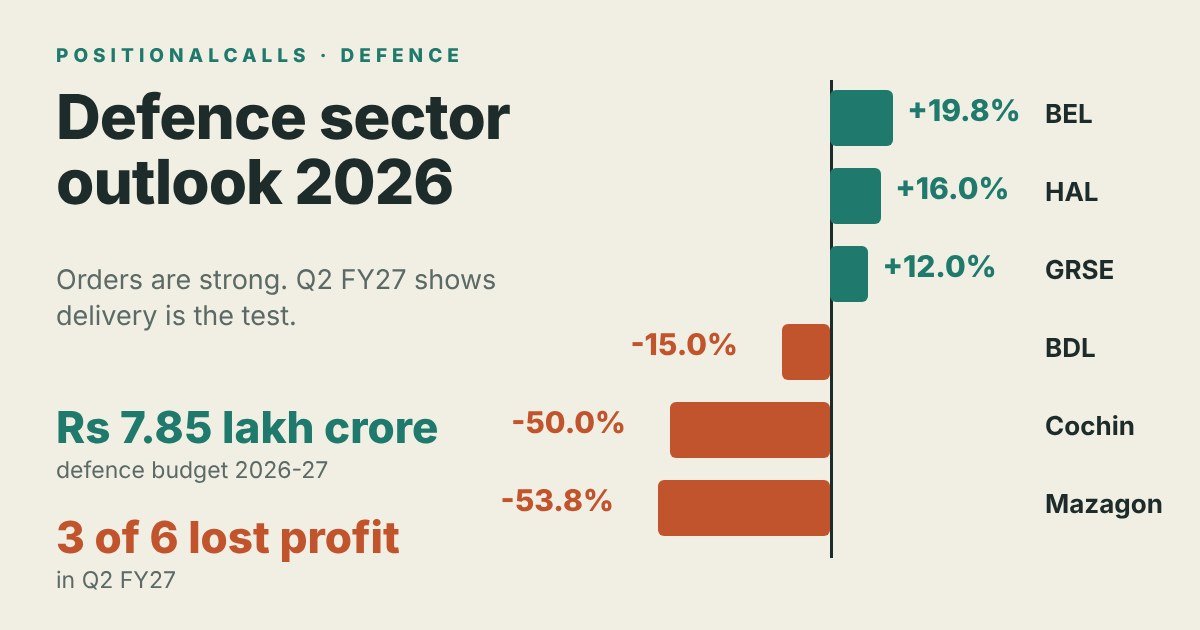
Sector Outlook · Defence · Updated for Q2 FY27
This defence sector outlook 2026 covers the Budget, Defence Acquisition Council approvals, the Q2 FY27 scorecard for HAL, BEL, Bharat Dynamics and the shipyards, exports, risks, an order-book cover calculator and a table of source conflicts. It gives no target or call.
Quick answer
The defence sector outlook 2026 is strong on demand and unproven on delivery. The Budget gave defence Rs 7.85 lakh crore and the Defence Acquisition Council cleared about Rs 2.12 lakh crore on 26 October 2026. But in Q2 FY27, profit fell at Bharat Dynamics, Mazagon Dock and Cochin Shipyard, while HAL and BEL grew.
Key takeaways on the defence outlook
- Demand: in the defence sector outlook 2026, a Rs 7.85 lakh crore budget, Rs 2.19 lakh crore capital outlay and three large approval rounds in 2026.
- Results: five of six companies grew revenue in Q2 FY27, but three of six saw profit fall.
- Orders: HAL’s order book is about 7.7 times its FY26 revenue; BEL’s fell 7.7% in a year.
- Policy: the Defence Acquisition Procedure 2026 stresses indigenous content and the capacity of bidders.
- Risk: delivery, margins and supply chains, not demand, decide the next two years.
In plain words: the defence sector outlook 2026 is simple. The government has promised to spend a great deal on defence and to buy most of it from Indian firms. The firms have large order books. The open question is how fast they can build and deliver, because revenue and profit arrive only when equipment is delivered and accepted.
Data note: as of Friday, 20 November 2026, 9:30 PM IST. This defence sector outlook 2026 takes figures from the pages named in the sources list, read as search extracts and company result summaries, not from exchange filings or the Budget document. Order-book dates differ by company and are shown. Valuation figures are as reported on 12 November 2026. Where sources differ, the page says so.
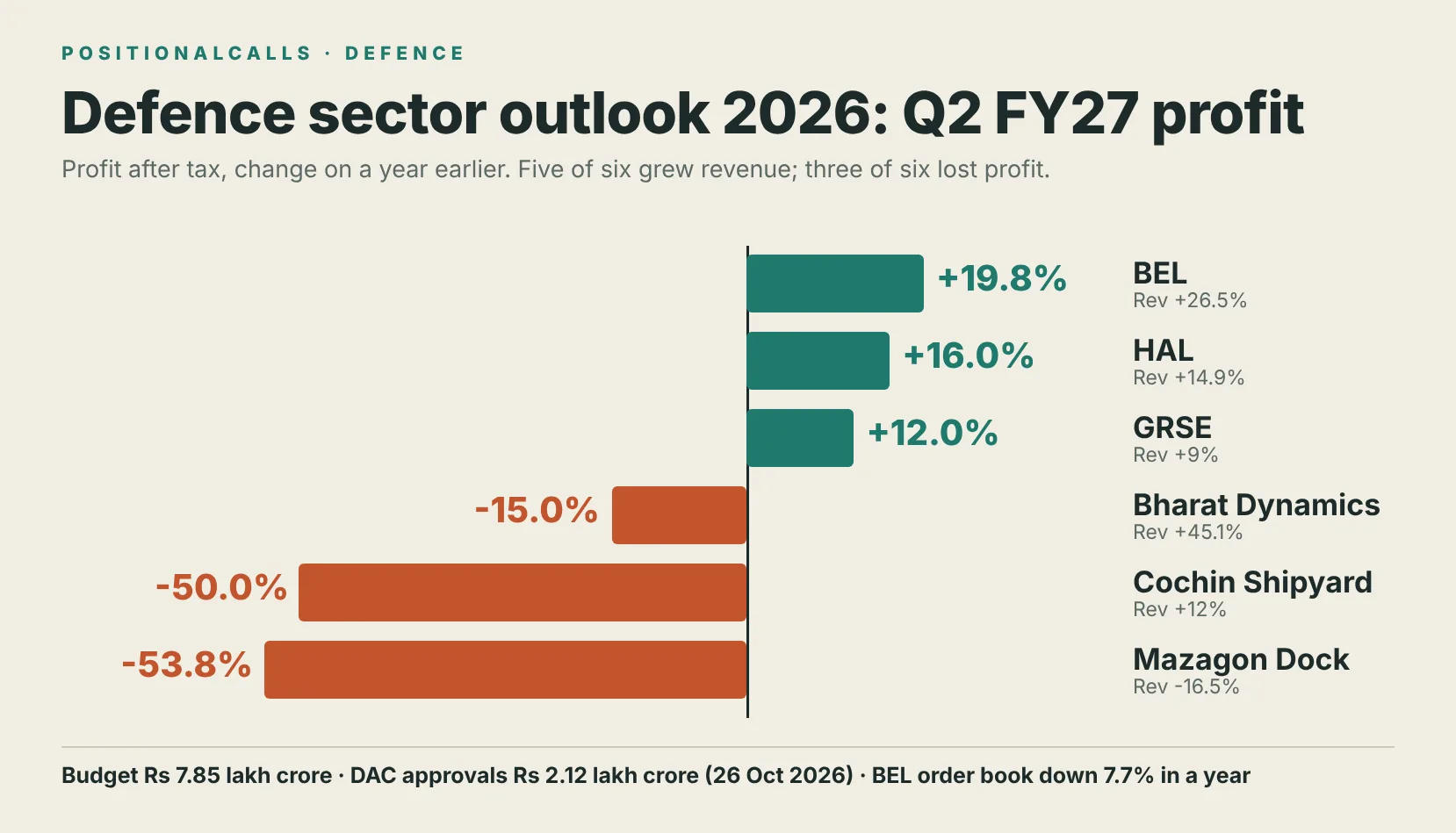 Q2 FY27 profit change for six defence names, against the Rs 7.85 lakh crore budget.
Defence sector outlook 2026: what is the short answer?
Demand is not the problem in the defence sector outlook 2026; delivery is. The Union Budget 2026-27 gave the Ministry of Defence Rs 7.85 lakh crore, the Defence Acquisition Council has cleared three large rounds of proposals this year, and the government says most of the money goes to Indian industry.
Against that, the September-quarter results behind the defence sector outlook 2026 were uneven. HAL grew revenue 14.9% and profit 16%, BEL grew revenue 26.5% and profit 19.8%, and the shipbuilder GRSE grew profit 11.8%. Bharat Dynamics profit fell 15%, Mazagon Dock profit fell about 54% and Cochin Shipyard profit fell 50%, per Upstox, Investywise and India IPO. Order books that look large on paper do not guarantee quarterly earnings.
| Question | Short answer | Source |
|---|---|---|
| Is government demand rising? | Yes, defence budget up 15.19% to Rs 7.85 lakh crore | PIB |
| Are approvals large? | Yes, Rs 2.12 lakh crore on 26 October 2026 alone | Ministry of Defence |
| Is revenue growing? | Mostly, five of six companies in Q2 FY27 | Upstox, India IPO, Investywise |
| Is profit growing? | Mixed, three of six fell | Upstox, Investywise, India IPO |
| Are order books converting? | Slowly, HAL FY26 revenue up 7% against a 7.7x order book | The Core, my calculation |
Cite this table: Defence outlook summary, PositionalCalls, Friday, 20 November 2026, 9:30 PM IST, per PIB, Ministry of Defence, Upstox, India IPO, Investywise and The Core.
What drives the defence sector outlook 2026 beyond the budget?
Three things: how fast approvals become contracts, how fast contracts become deliveries, and whether margins hold while they do. The Core wrote in December 2025 that 2026 would be about execution, with success depending less on announcements and more on how quickly companies turn orders into deliveries. The Q2 FY27 numbers on this page are the first full test of that claim.
What does the Union Budget 2026-27 give defence?
The defence sector outlook 2026 starts with Rs 7.85 lakh crore for defence, up 15.19% on the previous budget estimate, with capital outlay of Rs 2.19 lakh crore and Rs 1.39 lakh crore reserved for domestic industry. The Press Information Bureau calls it the highest allocation among all ministries, at 14.67% of central government expenditure.
| Item | 2026-27 | Comparison | Source |
|---|---|---|---|
| Ministry of Defence allocation | Rs 7.85 lakh crore | Up 15.19% on 2025-26 budget estimate | PIB |
| Capital outlay (modernisation) | Rs 2.19 lakh crore | Up 21.84% from Rs 1.80 lakh crore | Ministry of Defence, Business Today |
| Capital acquisition budget | Rs 1.85 lakh crore | Up about 24% from Rs 1.48 lakh crore | Millennium Post |
| Reserved for domestic industry | Rs 1.39 lakh crore | About 75% of capital acquisition | PIB, Millennium Post |
| Aircraft and aero engines | Rs 63,733 crore | Air Force capacity | Deccan Herald |
| Share of central expenditure | 14.67% | Highest among ministries | PIB |
Cite this table: Union Budget 2026-27 defence allocation, PositionalCalls, Friday, 20 November 2026, 9:30 PM IST, per PIB, Ministry of Defence, Business Today, Millennium Post and Deccan Herald.
The Ministry of Defence said the budget was set after Operation Sindoor, and the 2026-27 figure is nearly three times the Rs 2.53 lakh crore of 2013-14, per PIB. For companies, the number that matters is the capital acquisition budget, because that is what buys new equipment. By my calculation, the Rs 2.19 lakh crore capital outlay is 27.9% of the total allocation, so most of the budget still goes to salaries, pensions and running costs.
What did the defence budget look like before the defence sector outlook 2026?
Business Standard says the 2025-26 allocation was Rs 6.81 trillion against Rs 6.22 trillion in 2024-25, and Business Today says capital outlay was Rs 1.80 lakh crore at the budget stage and Rs 1.86 lakh crore at the revised stage. The pattern is steady growth, with the capital head growing faster than the total.
How big are the Defence Acquisition Council approvals?
For the defence sector outlook 2026, three approval rounds total about Rs 5.6 lakh crore, and the October round alone was Rs 2.12 lakh crore with about 82% from Indian industry. The total is my addition of the three amounts below, and an approval is not a contract.
| Date | Approved (Acceptance of Necessity) | Indian industry share | Source |
|---|---|---|---|
| 27 March 2026 | About Rs 2.38 lakh crore, including S-400 systems and Dhanush guns | Not stated in the extract | Asianet Newsable |
| 7 September 2026 | About Rs 1.10 lakh crore | About 98% | Outlook Business |
| 26 October 2026 | About Rs 2.12 lakh crore | About 82% | All India Radio, PSU Connect |
| FY26 total, to 27 March 2026 | Rs 6.73 lakh crore across 55 proposals | Not stated | Asianet Newsable |
| FY26 contracts signed, to 27 March 2026 | Rs 2.28 lakh crore across 503 proposals | Not stated | Asianet Newsable |
Cite this table: DAC approvals 2026, PositionalCalls, Friday, 20 November 2026, 9:30 PM IST, per Asianet Newsable, Outlook Business, All India Radio and PSU Connect.
Is an approval the same as an order?
No. The table shows the gap. In FY26 the council approved proposals worth Rs 6.73 lakh crore, while contracts signed that year came to Rs 2.28 lakh crore, about a third, by my calculation. An Acceptance of Necessity is the first step, followed by an invitation to bid, trials, price negotiation and a contract. Companies book an order only at the last step, and revenue follows delivery.
That is why the October headline of Rs 2.12 lakh crore does not translate directly into company order books. Business Standard noted in January that the sector should see low double-digit revenue growth in Q3 FY26 and a bigger jump in Q4, which depended on contracts already signed, not on fresh approvals.
How did defence companies perform in Q2 FY27?
The defence sector outlook 2026 meets its first test in Q2 FY27: revenue rose at five of six listed names and profit rose at three, with Mazagon Dock showing the sharpest fall. The table uses the latest results reported for the quarter to 30 September 2026, with HAL and BEL consolidated and Bharat Dynamics standalone, per Upstox.
| Company | Revenue (Rs crore) | Revenue change | Profit after tax (Rs crore) | Profit change | Margin signal |
|---|---|---|---|---|---|
| HAL | 7,613 | +14.9% | 1,936 | +16.0% | EBITDA margin 22.85% from 23.50% |
| BEL | 7,291 | +26.5% | 1,541 | +19.8% | EBITDA margin about 28% from about 29% |
| Bharat Dynamics | 1,664 | +45.1% | 183 | -15% | PAT margin 11.03% from 18.82% |
| Mazagon Dock | 2,446 | -16.5% (mine) | 346 | -53.8% (mine) | EBITDA margin 18.4% from 33.0% |
| GRSE | 1,827 | +9% | 172 | +12% | Net margin 9.47% from 9.17% |
| Cochin Shipyard | 1,249 | +12% | 54 | -50% | EBITDA margin 4.04% from 6.57% |
Cite this table: Q2 FY27 defence scorecard, PositionalCalls, Friday, 20 November 2026, 9:30 PM IST, per Upstox, Kotak Neo, Multibagg, Investywise and India IPO.
What happened at HAL and BEL?
HAL’s profit grew despite a lower operating margin because other income rose from Rs 887.67 crore to Rs 988.30 crore and its share of joint venture profit rose from Rs 7.34 crore to Rs 96.52 crore, per Upstox. BEL’s profit grew more slowly than revenue because materials and traded goods absorbed more of sales. Its H1 FY27 profit rose 14.81% to Rs 2,589 crore. The HAL and Bharat Dynamics result pages on this site carry the quarter in more detail.
Why did Bharat Dynamics and the shipyards fall?
Upstox says Bharat Dynamics’ expenses rose 61.7%, faster than its 45.1% revenue growth, with a large change in work-in-progress inventory, and other income of Rs 167.07 crore cushioned the result. At Cochin Shipyard, Elara Securities’ Harshit Kapadia said margins are low because much of the revenue comes from bought-out items in a missile vessel programme. GRSE received its next-generation corvette order about nine months late, which he said pushes the execution pickup from FY28 to FY29.
Mazagon Dock’s consolidated H1 FY27 revenue was Rs 5,389 crore against Rs 5,555 crore a year earlier, down about 3.0%, and H1 profit was Rs 897 crore against Rs 1,202 crore, down about 25.4%, by my calculation from the Investywise summary of its investor presentation.
How do the three public-sector names in the defence sector outlook 2026 differ?
They sell different things, so their quarters behave differently. HAL builds aircraft, helicopters and engines, and its revenue depends on delivery of platforms such as the Tejas Mk1A and the Prachand helicopter, whose deliveries start in FY29 per Business Standard. BEL sells defence electronics such as radars and air-defence systems, and Motilal Oswal says demand for radars, avionics and electronic warfare is long-term. Bharat Dynamics makes missiles, and Upstox says it won a Rs 1,307 crore order in October 2026 with a 42-month execution period, so that revenue arrives over years.
Why are defence order books not turning into revenue?
In the defence sector outlook 2026, an order book is a promise of future work, and the pace of work depends on engines, components, testing and customer acceptance. The Core says HAL reported a record order book in FY26 but only a 7% rise in revenue, to Rs 33,089 crore, against an order book above seven times that.
| Company | Order book (Rs crore) | As of | Revenue base used (Rs crore) | Cover, years (mine) |
|---|---|---|---|---|
| HAL | 2,54,538 | 31 March 2026 | 33,089 (FY26) | 7.7 |
| BEL | 68,717 | 1 October 2026 | 25,648 (H1 FY27 times two) | 2.7 |
| Bharat Dynamics | 26,176 | 31 March 2026 | 6,656 (Q2 FY27 times four) | 3.9 |
Cite this table: Order-book cover, years of revenue, my calculation from company figures, PositionalCalls, Friday, 20 November 2026, 9:30 PM IST, per Sahi, The Core, Kotak Neo and Upstox.
The cover figures are rough. They divide the order book by one year of revenue, mix standalone and consolidated bases, and use order-book dates that differ by up to six months. Bharat Dynamics’ quarterly revenue is lumpy, so its 3.9 is an illustration. The point is the gap between HAL’s 7.7 years of cover and its 15% half-year growth.
Is the claim that order books keep growing still true?
Not for BEL. Its order book of Rs 68,717 crore on 1 October 2026 was down from Rs 72,258 crore on 1 July 2026, about 4.9%, and from Rs 74,453 crore on 1 October 2025, about 7.7%, by my calculation. Compounding AI reads this as behind management’s FY27 inflow guidance of more than Rs 55,000 crore, because order wins of about Rs 4,310 crore announced between 31 July and 21 October did not offset execution. Management had said the inflow was weighted to January to March.
How do guidance and results compare for the defence sector outlook 2026?
| Company or body | Guidance or forecast | Reported | Source |
|---|---|---|---|
| ICRA, sector | FY26 revenue up 15-17% | HAL FY26 revenue up 7%, not like-for-like | Tribune, The Core |
| Nirmal Bang, sector | Q4 FY26 revenue up about 4% | Backend-loaded execution | Business Today |
| HAL, FY27 | Revenue up 10-12%, EBITDA margin 30-31% | H1 revenue up 15%, Q2 EBITDA margin 22.85% | Sahi, Multibagg, Upstox |
| BEL, FY27 | Revenue growth above 15%, inflow above Rs 55,000 crore | H1 revenue up 25.97%, order book falling | Compounding AI, Indian Masterminds |
Cite this table: Guidance versus reported, PositionalCalls, Friday, 20 November 2026, 9:30 PM IST, per Tribune, The Core, Business Today, Sahi, Multibagg, Upstox, Compounding AI and Indian Masterminds.
HAL’s revenue is running ahead of guidance while its margin is far below it. Compounding AI says the 22.83% it computes excludes other income, so the two figures may use different definitions, and I did not reconcile them. DSIJ, citing a Motilal Oswal note on management commentary, says 27 airframes were ready in September 2026 and the first 10 aircraft are expected by March 2027.
PositionalCalls WhatsApp channel
Follow defence results and policy
- DAC approvals and order news in plain words
- Company results without tips
- A message when this page is updated
Order-book cover calculator: how many years of work is on the books?
This defence sector outlook 2026 calculator divides an order book by annual revenue and then shows how long the book lasts if revenue grows at a rate you choose. It runs in your browser and stores nothing, and the preset numbers come from the table above.
Order-book cover calculator
A higher growth assumption shortens the time to work off the book, which is the point: the faster a company delivers, the sooner the order book is converted. The calculator does not know about new orders, cancellations, margins or payment terms, and it is not a forecast of any company.
What do the Defence Acquisition Procedure 2026 and indigenisation change?
For the defence sector outlook 2026, the draft Defence Acquisition Procedure 2026 puts more weight on indigenous content and on whether a bidder has capacity, which favours firms that can deliver over firms that only hold large books. Trendlyne says it lets the government check how busy a company already is before awarding large contracts.
Motilal Oswal, quoted by Business Standard, says the updated procedure emphasises technologies “Owned by India”, raises indigenous content requirements and simplifies procurement categories to speed up acquisition. It also warns that prolonged geopolitical disruption could affect supply chains and execution timelines for some programmes. Trendlyne adds that Solar Industries’ defence order book has nearly tripled in a year and its defence revenue rose 72% in Q3 FY26.
| Indicator | Figure | Period | Source |
|---|---|---|---|
| Domestic share of capital acquisition budget | About 75% | 2026-27 | PIB |
| Domestic procurement share, ICRA basis | 61% to 75% | FY17 to FY25 | ICRA via NewKerala |
| Domestic share of contract approvals | 54% to 92% | FY19 to FY25 | Business Standard |
| Private order book (Crisil) | Rs 40,000 crore to about Rs 55,000 crore | FY25 to FY26 expected | The Core |
| Private share of production | 24%, about Rs 42,000 crore | FY26 | Asianet Newsable |
Cite this table: Indigenisation indicators, PositionalCalls, Friday, 20 November 2026, 9:30 PM IST, per PIB, ICRA, Business Standard, The Core and Asianet Newsable.
In the defence sector outlook 2026, the two domestic-share series measure different things, so they should not be compared. One is a share of procurement, the other of approved contracts. Neither says how much of a platform’s content is made in India, which is why an indigenisation headline does not tell you who earns the margin.
What do production and exports say about the defence outlook?
Behind the defence sector outlook 2026, production hit a record Rs 1.78 lakh crore in FY26, up 15.6%, and exports hit a record Rs 38,424 crore, up 62.66%. The Ministry of Defence set a goal of Rs 3 lakh crore of production and Rs 50,000 crore of exports by FY29, though some reports say FY30 for exports.
| Measure | FY25 | FY26 | Goal |
|---|---|---|---|
| Defence production | Rs 1.54 lakh crore | Rs 1.78 lakh crore, up 15.6% | Rs 3 lakh crore by FY29 |
| Private sector production | 22% share | 24%, about Rs 42,000 crore | Not stated |
| Defence exports | Rs 23,622 crore | Rs 38,424 crore, up 62.66% | Rs 50,000 crore by FY29 or FY30 |
| Public sector exports | Rs 8,389 crore | Rs 21,071 crore, up 151% | Not stated |
| Private sector exports | Rs 15,233 crore | Rs 17,353 crore, up 14% | Not stated |
Cite this table: Defence production and exports, PositionalCalls, Friday, 20 November 2026, 9:30 PM IST, per Asianet Newsable, The Statesman and The Federal.
What do the production and export goals imply each year?
By my calculation, reaching Rs 3 lakh crore of production by FY29 from Rs 1.78 lakh crore needs about 19.0% growth a year for three years, above the 15.6% of FY26. Exports of Rs 50,000 crore need about 9.2% a year by FY29 or about 6.8% a year by FY30, far below FY26’s 62.66%. The export goal looks easier than the production goal, but a few large deals can move exports sharply either way.
Public-sector firms supplied 54.84% of FY26 exports and private firms 45.16%, per The Statesman. The jump in public-sector exports from Rs 8,389 crore to Rs 21,071 crore is the main reason the headline growth is so high, so it may not repeat at the same pace.
Where do private defence companies fit?
Private firms made 24% of FY26 production, about Rs 42,000 crore, per Asianet Newsable, and Crisil expects their combined order book to reach about Rs 55,000 crore by the end of FY26 from Rs 40,000 crore in FY25, per The Core. Business Standard named Solar Industries, Paras Defence, BEML and BEL as possible Q3 FY26 winners on execution, and Trendlyne says Solar Industries’ defence revenue rose 72% in Q3 FY26 with Pinaka rocket supplies due from Q4. Their order books are smaller than HAL’s, so a single quarter swings them more.
What do valuations and share moves show for defence companies?
For the defence sector outlook 2026, as reported on 12 November 2026, HAL traded at 33.6 times trailing earnings, BEL at 45.7 times and Bharat Dynamics at 77.3 times, and their year-to-date returns ranged from a gain of 8.6% to a fall of 30.1%. These are Upstox’s figures and not a view on any share.
| Company | Trailing P/E | Year-to-date return | Order book date |
|---|---|---|---|
| HAL | 33.6x | +8.6% | 31 March 2026 |
| BEL | 45.7x | +1.3% | 1 October 2026 |
| Bharat Dynamics | 77.3x | -30.1% | 31 March 2026 |
Cite this table: Valuation snapshot as of 12 November 2026, PositionalCalls, per Upstox, trailing twelve months to September 2026.
Bharat Dynamics’ multiple is high because profit fell while the price had already dropped, so a high ratio can reflect low earnings rather than a high price. Business Today’s June 2026 coverage said execution risks and delivery timelines were not yet fully priced in, while Sahi noted in January that defence stocks rose more than 40% in 2024-25 and then gave back gains. I take no side; the table shows what was reported.
How should you read a defence result without being misled?
To use the defence sector outlook 2026, read six things in order: revenue growth, margin, other income, order-book date, order inflow and the delivery schedule. The Q2 FY27 results show why each one matters.
- Revenue growth: Bharat Dynamics grew 45.1% and still lost profit, so growth alone proves little.
- Margin: HAL’s EBITDA margin fell to 22.85% from 23.50% while profit rose.
- Other income: HAL’s rose by about Rs 100 crore and BDL’s by about Rs 47 crore, per Upstox, and both cushioned profit.
- Order-book date: HAL’s and BDL’s figures are from 31 March 2026, BEL’s from 1 October 2026, so they are not like-for-like.
- Order inflow: a falling book, as at BEL, means execution outran new wins.
- Delivery schedule: HAL’s Tejas Mk1A and GRSE’s corvette programme set when revenue is booked.
| Evidence | Would strengthen the outlook | Would weaken it |
|---|---|---|
| Contracts signed | Rise towards the Rs 6.73 lakh crore approved in FY26 | Stay near Rs 2.28 lakh crore |
| BEL order inflow | Book rises in Q3 and Q4 FY27 | Book keeps falling |
| HAL margin | EBITDA margin moves towards 30-31% guidance | Stays near 23% |
| Tejas Mk1A | First 10 aircraft delivered by March 2027 | Slips again |
| Shipyard margins | Cochin and Mazagon margins recover | Bought-out items keep margins low |
Cite this table: Evidence that would confirm or weaken the outlook, PositionalCalls, Friday, 20 November 2026, 9:30 PM IST, per Upstox, DSIJ, Asianet Newsable and India IPO.
What are the risks to the defence sector outlook?
The risks to the defence sector outlook 2026 are slow delivery, margin pressure, supply-chain disruption, uneven quarters, concentration in government-owned firms and thin private order books. Business Standard says supply-chain and execution risks persist even as spending and policy support the outlook.
- Delivery: HAL’s FY26 revenue grew 7% against a record order book, per The Core, and Tejas Mk1A deliveries remain the swing factor.
- Margins: HAL, BEL and Bharat Dynamics all saw material costs take a larger share of revenue, per Upstox.
- Order inflow: BEL’s order book fell for two quarters against a strong approval backdrop.
- Lumpy quarters: Bharat Dynamics revenue rose 45.1% while profit fell 15%.
- Supply chains: Motilal Oswal warns that prolonged geopolitical disruption could delay programmes.
- Late orders: GRSE’s corvette order came about nine months late, per India IPO.
- Private scale: Crisil puts the combined private order book at about Rs 55,000 crore, small beside HAL’s Rs 2.5 lakh crore.
None of these is a forecast of failure. They are the places where the Q2 FY27 results already show strain, which is why the defence sector outlook 2026 depends on conversion, not on new approvals.
Where do the sources disagree on defence numbers?
Sources on the defence sector outlook 2026 disagree on capital outlay, the export goal year, HAL’s order book rounding, Bharat Dynamics’ order book and Mazagon Dock’s order book. This page records each rather than choosing silently.
| Item | Version A | Version B | What this page does |
|---|---|---|---|
| Defence capital outlay 2026-27 | Rs 2.19 lakh crore, up 21.84% (PIB, MoD) | Rs 2.31 lakh crore, up 20.1% (Motilal Oswal) | Uses Rs 2.19 lakh crore |
| Total allocation | Rs 7.85 lakh crore (PIB) | Rs 7.84 lakh crore (Deccan Herald) | Uses Rs 7.85 lakh crore, rounding |
| Export goal year | FY29 (Ministry of Defence, 5paisa) | FY30 (The Statesman, NewKerala) | Says FY29 or FY30 |
| Production in FY26 | Rs 1.78 lakh crore (Asianet) | Rs 1.8 lakh crore (NewKerala, rounded) | Uses Rs 1.78 lakh crore |
| HAL order book | Rs 2,54,538 crore (Sahi) | Rs 2.55 lakh crore (Kotak Neo) | Uses Rs 2,54,538 crore |
| Bharat Dynamics order book | Rs 26,176 crore, 31 March 2026 (Upstox) | About Rs 25,500 crore early 2026 (Motilal Oswal) | Uses Rs 26,176 crore |
| Mazagon Dock order book | Rs 16,443 crore, 30 September 2026 (Investywise) | Expected above Rs 1 trillion by FY27 (Nirmal Bang, 2025) | Leaves it out of the cover table |
Cite this table: Defence source conflicts, PositionalCalls, Friday, 20 November 2026, 9:30 PM IST, per PIB, Motilal Oswal, Deccan Herald, 5paisa, The Statesman, Asianet, Sahi, Kotak Neo, Upstox, Investywise and Business Today.
The Mazagon Dock gap is the largest and I could not reconcile it. Investywise notes the Rs 16,443 crore line appears in the standalone section of the presentation summary, so it may not be the consolidated book, and I did not open the presentation. I left it out of the cover table for that reason.
Which defence terms should you know?
Six terms decide how to read the defence sector outlook 2026: Acceptance of Necessity, order book, book-to-bill, OB/OI, DPSU and the capital acquisition budget. The table defines each as used in the sources.
| Term | Meaning | Why it matters |
|---|---|---|
| Acceptance of Necessity (AoN) | In-principle approval of a need by the Defence Acquisition Council | Not an order; no revenue yet |
| Order book | Value of signed contracts not yet executed | Shows visibility, not speed |
| Book-to-bill | Order book divided by annual revenue | Nirmal Bang puts DPSUs at about four times |
| OB/OI | Order book to operating income, ICRA’s measure, 4.4 times at FY25 end | Same idea as cover |
| DPSU | Defence public sector undertaking, such as HAL, BEL, BDL | Government-owned, order flow set by the Budget |
| Capital acquisition budget | Money for buying new equipment, Rs 1.85 lakh crore in 2026-27 | The pool that feeds new contracts |
Cite this table: Defence terms decoded, PositionalCalls, Friday, 20 November 2026, 9:30 PM IST, per Ministry of Defence, ICRA and Nirmal Bang.
What should you watch next in the defence sector?
For the defence sector outlook 2026, watch signed contracts against approvals, BEL’s order inflow, HAL’s Tejas Mk1A deliveries, margins at the DPSUs and the next Budget. Each has a date or a clear marker in the sources.
- Contracts: whether signed contracts, Rs 2.28 lakh crore in FY26, rise towards the Rs 6.73 lakh crore of approvals.
- BEL inflow: management had said a large share of expected orders would arrive in January to March 2027.
- HAL deliveries: the first 10 Tejas Mk1A aircraft by March 2027, per the DSIJ report citing Motilal Oswal.
- Margins: whether HAL’s EBITDA margin moves towards its 30-31% guidance.
- Results: Q3 FY27, reported after the December quarter ends.
- Budget: the capital acquisition budget in February 2027.
The company pages for HAL and Bharat Dynamics carry the quarter’s details, and the sector outlook India hub lists the other sectors. HAL’s and Bharat Dynamics’ order-book figures are from 31 March 2026, so a fresh order-book number in a later release will show whether the quarter added to the book or ran it down.
What does this outlook leave out?
The defence sector outlook 2026 here leaves out private-sector companies in detail, drone and electronics start-ups, global comparisons, and any view on whether a share is cheap or dear. It covers the listed public names, the Budget and the approval pipeline.
- No filings read: I did not open exchange filings, investor presentations or the Budget document; figures rest on the named pages.
- No broker targets: I left out brokerage ratings and price targets on purpose.
- No forecasts: the cover and growth figures are arithmetic on reported numbers.
- Selected names: BEML, Solar Industries, Data Patterns and others are not covered.
When will this defence sector outlook 2026 change?
When a source corrects a number, a new approval or contract changes the pipeline, or the next results arrive. The update line at the top shows the last real change.
PositionalCalls WhatsApp channel
Keep defence updates in one place
- Quarterly result summaries
- Budget and procurement changes
- Links to new sector pages
Defence sector outlook 2026: frequently asked questions
What is the defence sector outlook 2026 for India?
Demand is strong and delivery is the test. The Union Budget gave defence Rs 7.85 lakh crore, and the Defence Acquisition Council cleared about Rs 2.12 lakh crore of proposals on 26 October 2026. September-quarter results were mixed, with profit falling at three of six listed names.
How big is the defence budget for 2026-27?
The Ministry of Defence got Rs 7.85 lakh crore in the Union Budget 2026-27, up 15.19% on the previous year’s budget estimate, per the Press Information Bureau. Capital outlay is Rs 2.19 lakh crore, up 21.84%, and Rs 1.39 lakh crore is reserved for domestic industry. One broker note gives a different capital figure, which the conflicts table records.
Why are defence order books not turning into revenue quickly?
Delivery depends on engines, components, certification and test schedules, not on the order itself. The Core says HAL’s FY26 revenue grew only 7% to Rs 33,089 crore against an order book above seven times that. Business Standard adds that supply-chain and execution risks persist, which is why this defence sector outlook 2026 tracks conversion, not inflows.
Which defence companies reported Q2 FY27 results?
HAL, BEL, Bharat Dynamics, Mazagon Dock, GRSE and Cochin Shipyard all reported for the September quarter. Revenue rose at five of the six and fell at Mazagon Dock. Profit rose at HAL, BEL and GRSE and fell at Bharat Dynamics, Mazagon Dock and Cochin Shipyard, according to Upstox, Investywise and India IPO.
Is a Defence Acquisition Council approval the same as an order?
No. An Acceptance of Necessity is an in-principle administrative approval of a need. It is followed by a request for proposals, trials, cost negotiation and a signed contract before a company books an order. That gap is why the defence sector outlook 2026 treats approvals as a pipeline, not as revenue, and why order books can fall even in a year of large approvals.
Did BEL’s order book rise or fall in Q2 FY27?
It fell. BEL reported an order book of Rs 68,717 crore on 1 October 2026, against Rs 72,258 crore on 1 July 2026 per Compounding AI and Rs 74,453 crore on 1 October 2025 per Angel One. That is a drop of about 4.9% in the quarter and 7.7% in a year, by my calculation, while revenue grew 26.5%.
How much of India’s defence procurement goes to Indian companies?
The budget reserves Rs 1.39 lakh crore, about 75% of the Rs 1.85 lakh crore capital acquisition budget, for domestic industry. The Ministry of Defence said about 82% of the proposals cleared on 26 October 2026 and about 98% of those cleared on 7 September 2026 would come from Indian industry. These are approvals, not signed contracts.
What are the main risks to defence companies in India?
The sources point to slow delivery against large order books, margin pressure from material costs, supply-chain disruption, lumpy quarterly revenue and thin private-sector order books. Government ownership concentrates order flow. The risks section of this defence sector outlook 2026 lists them with sources.
Does this page recommend any defence stock?
No. PositionalCalls is not a SEBI-registered research analyst or investment adviser, and this page gives no target, rating or call. It reports figures from the sources named, shows my own arithmetic where labelled, and records where sources disagree. Valuation figures are as reported on 12 November 2026 and are not a view on any share.
When will this defence sector outlook 2026 be updated?
When something material changes: a new Defence Acquisition Council approval, a large contract, a company guidance change, or the Q3 FY27 results due after the December quarter. The update line at the top shows the date of the last real edit.
Sources for this defence outlook
- The Core: for India’s defence manufacturers, 2026 will be all about execution.
- The Core: order books are not translating into delivery.
- Press Information Bureau: Defence in Union Budget 2026-27.
- Business Today: Budget 2026 defence spending.
- Millennium Post: Rs 7.85 lakh crore defence outlay.
- Business Standard: strong order book, investment outlook.
- Business Standard: Motilal Oswal sector of the week, defence.
- Business Today: defence Q4 preview, Nirmal Bang.
- Upstox: HAL, BEL and BDL Q2 revenue and profit.
- Kotak Neo: BEL Q2 FY27 results.
- Compounding AI: BEL Q2 FY27 results analysis.
- Investywise: Mazagon Dock Q2 FY27 presentation.
- India IPO: GRSE versus Cochin Shipyard after Q2.
- Ventura Securities: GRSE Q2 FY27 results.
- Sahi: HAL FY27 outlook and order book.
- DSIJ: HAL and Tejas Mk1A deliveries.
- All India Radio: DAC clears about Rs 2.12 lakh crore.
- Outlook Business: DAC clears Rs 1.10 lakh crore.
- Asianet Newsable: DAC clears Rs 2.38 lakh crore.
- The Statesman: defence exports FY26.
- Asianet Newsable: defence output FY26.
- Trendlyne: India reshapes its defence cycle.
- Tribune: ICRA sector forecast.
- NewKerala: ICRA defence report.
- Angel One: BEL Q2 FY26 order book.
- Multibagg: BEL Q2 FY27.
- Multibagg: HAL Q2 FY27.
- Indian Masterminds: BEL Q2 FY27.
- Deccan Herald: defence outlay.
- 5paisa: defence exports FY26.
- The Federal: defence exports.
- PSU Connect: DAC Rs 2.12 lakh crore.

Shubham Chaudhary is the founder of PositionalCalls, an independent Indian stock market research website. He writes company fundamentals, quarterly results analysis, IPO analysis and sector research for NSE and BSE listed companies, with a focus on banking stocks, insurance and long-term value investing. Every article is built from primary sources such as RBI, SEBI, NSE and BSE filings and company annual reports, and states its risks plainly in simple language for retail investors.
Coverage areas Our research standards- Numbers checked against NSE, BSE and SEBI filings
- Risks and limits stated in every article
- No paid promotions or broker tie-ups
- Articles updated when new filings arrive