
Learning · Monetary policy
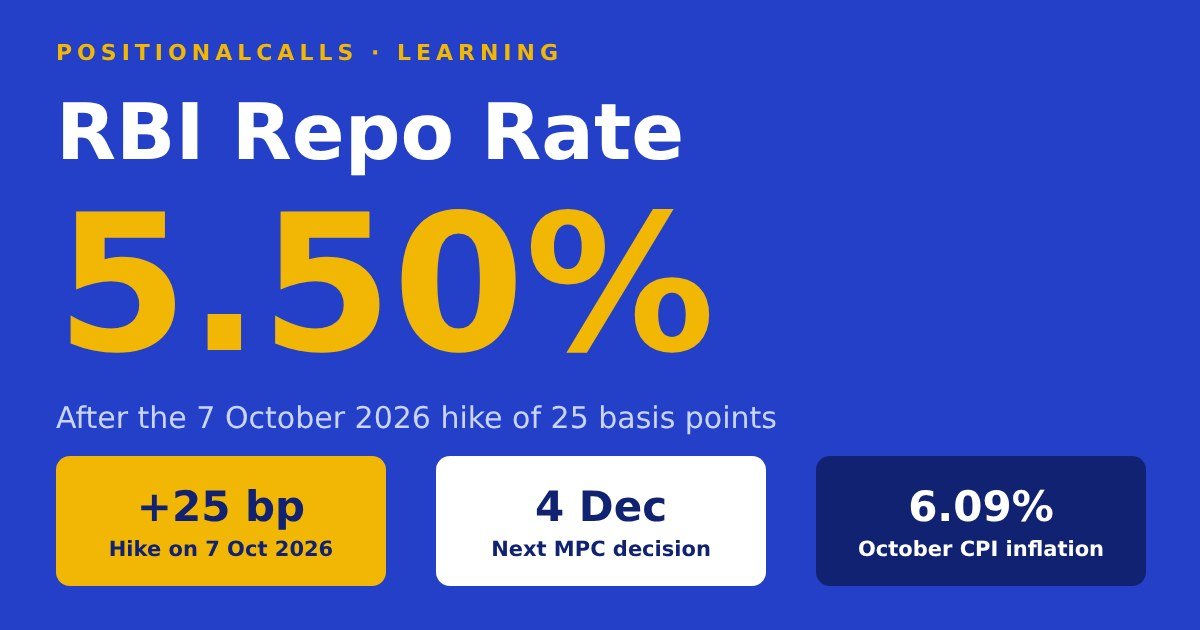
This guide to the RBI repo rate gives the current rate, the 7 October 2026 hike, every policy rate, the MPC calendar, October CPI at 6.09% and what a 25 basis point change does to a loan EMI, with sources and no calls.
Quick answer
The RBI repo rate is 5.50% after the Monetary Policy Committee raised it by 25 basis points on 7 October 2026 from 5.25%, and moved its stance to calibrated tightening. The next decision is due on 4 December 2026. Floating-rate loans linked to the repo rate reset at the next scheduled date.
RBI repo rate: key takeaways
- Level: the RBI repo rate is 5.50%, the standing deposit facility rate 5.25%, and the marginal standing facility rate and bank rate 5.75% (CorpLawUpdates).
- Direction: the 7 October 2026 move was a hike of 25 basis points, after four holds at 5.25% in 2026.
- Stance: calibrated tightening, by a 4 to 2 vote; two members preferred neutral.
- Inflation: October CPI was 6.09%, above the 6% upper tolerance band, and the RBI’s own Q3 FY27 projection peaks at 6.0%.
- Loans: a 25 basis point rise adds about Rs 16 a month per lakh borrowed (my calculation).
- Scope: a data guide as of 17 November 2026; it contains no subscribe, buy, sell, rating or target calls.
In plain words for the repo rate: it is the price at which the central bank lends money to banks for a short time. A basis point is one hundredth of a percentage point, so 25 basis points is 0.25%. EMI is the fixed monthly instalment on a loan. EBLR is an external benchmark lending rate, a loan rate tied to a market benchmark such as the repo rate. CPI is the consumer price index, the main measure of retail inflation.
Data note: as of Tuesday, 17 November 2026, 7:40 PM IST. Rates and projections come from secondary reports of the RBI’s 7 October 2026 policy (CorpLawUpdates and 5paisa), the August 2026 policy (SCC Online, Angel One, Outlook Money) and MoSPI’s CPI release of 12 November 2026. I tried to open the RBI’s own statement and the page did not load, so no RBI document was read. Calculations are marked “my calculation”.
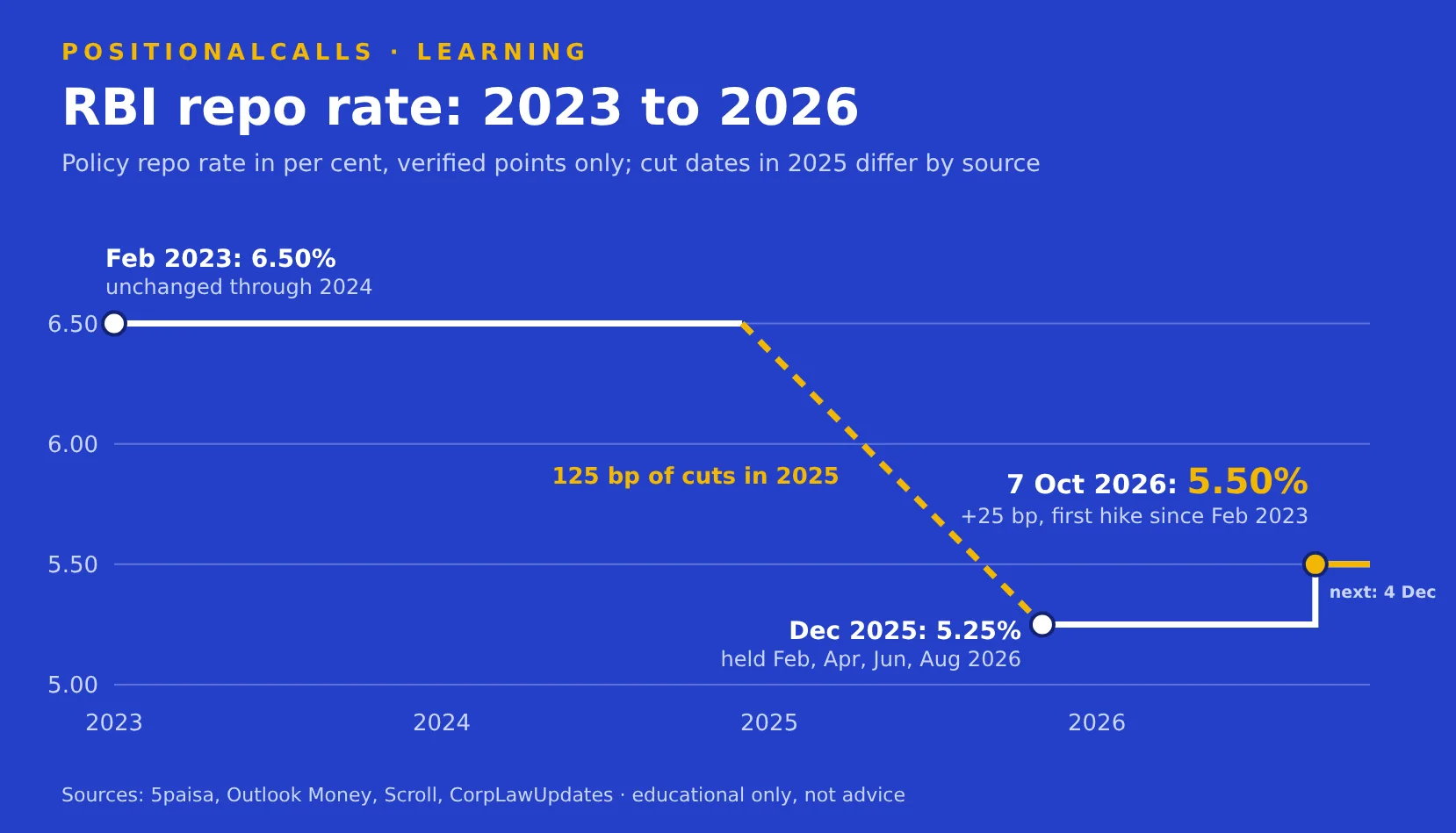 The repo rate in one picture: from 6.50% in 2023 to 5.25%, then 5.50% after the 7 October 2026 hike.
What is the current RBI repo rate and every other policy rate?
The RBI repo rate is 5.50% after the Monetary Policy Committee raised it by 25 basis points from 5.25% on 7 October 2026, and every rate in the corridor moved with it. The table lists the policy rates as reported by CorpLawUpdates, a secondary site that cites RBI press releases I could not open, with the earlier values from August 2026 reports by Angel One and Anantam IAS.
| Policy rate | Before 7 Oct 2026 | After 7 Oct 2026 | Change |
|---|---|---|---|
| Policy repo rate (LAF) | 5.25% | 5.50% | +25 bp |
| Standing deposit facility (SDF) | 5.00% | 5.25% | +25 bp |
| Marginal standing facility (MSF) | 5.50% | 5.75% | +25 bp |
| Bank rate | 5.50% | 5.75% | +25 bp |
| Fixed-rate reverse repo | 3.35% | 3.35% | unchanged |
| Cash reserve ratio (CRR) | 4.50% | 4.50% | unchanged |
| Statutory liquidity ratio (SLR) | 18.00% | 18.00% | unchanged |
Cite this table: PositionalCalls, “RBI policy rates, before and after 7 October 2026”; CorpLawUpdates, Angel One, Anantam IAS and 5paisa.
The earlier values for the fixed-rate reverse repo, CRR and SLR are shown as unchanged because CorpLawUpdates lists them as unchanged in October. The repo, SDF, MSF and bank-rate rows all rose by the same 25 basis points, so the width of the corridor stayed at 0.50 percentage points (my calculation). 5paisa describes the move as the first repo rate hike since February 2023, and Governor Sanjay Malhotra announced it after the 5 to 7 October meeting.
One date detail is unresolved. CorpLawUpdates says the new repo rate took effect “with immediate effect on 7 October 2026”, while its own FAQ says banks revised benchmark rates “effective from 8 October 2026”. The two can both be true, since a bank’s own benchmark can change a day after the policy, but the page does not explain it. Use 7 October for the policy decision and check your lender’s notice for your loan.
What does the RBI repo rate mean and how does the corridor work?
The RBI repo rate is the rate at which the central bank lends overnight and short-term money to banks against government securities, and it sets the centre of the corridor that guides every other short-term rate in the system. When the committee raises the repo rate, borrowing from the central bank costs more, and that cost is meant to spread to loan and deposit rates across the economy.
The Monetary Policy Committee has six members and is chaired by the Governor. Moneylife reports that the six-member panel voted on the August 2026 decision, and CorpLawUpdates reports the October vote split four to two on the stance. The committee’s legal target is consumer price inflation of 4%, with a tolerance band of 2% to 6%. The 6% upper limit is the line that the October CPI print crossed, which is why the inflation section below matters for the repo rate.
How does the RBI repo rate corridor work?
Three rates form the corridor. The standing deposit facility is the floor: banks can park surplus cash with the RBI at 5.25% without giving collateral. The marginal standing facility is the ceiling: banks can borrow extra overnight at 5.75% in an emergency. The repo rate of 5.50% sits in the middle. CorpLawUpdates says the corridor anchors the weighted average call rate, the rate at which banks lend to each other overnight. It gives no specific call-rate figure, and I did not find one in my sources.
| Rate | Level | Role in the corridor | Gap to the repo rate |
|---|---|---|---|
| Marginal standing facility | 5.75% | Ceiling; emergency overnight borrowing | +0.25 pp |
| Repo rate | 5.50% | Centre; the policy rate | 0.00 pp |
| Standing deposit facility | 5.25% | Floor; surplus cash parked with the RBI | -0.25 pp |
| Fixed-rate reverse repo | 3.35% | Separate window, unchanged | -2.15 pp |
Cite this table: PositionalCalls, “The repo rate corridor after 7 October 2026”; CorpLawUpdates. Gaps are my calculation.
The CRR and SLR are different tools. The CRR is the share of deposits banks must hold as cash with the RBI, 4.50% in the October reports, and the SLR is the share they must hold in government securities, 18.00%. Neither changed on 7 October, so the October decision worked through the repo rate and the stance, not through bank reserve requirements.
What is the RBI repo rate timeline from 2023 to 2026?
The RBI repo rate was 6.50% after the February 2023 hike, fell by a cumulative 125 basis points during 2025 to 5.25% in December 2025, stayed there for four meetings in 2026, and rose to 5.50% on 7 October 2026. The table keeps only the facts that at least two sources agree on.
| Date | Decision | Repo rate | Stance | Source |
|---|---|---|---|---|
| February 2023 | Last hike before October 2026 | 6.50% | not covered | 5paisa |
| During 2025 | Cuts totalling 125 bp, the last in December; sources differ on meeting dates | to 5.25% by December | not covered | 5paisa, Outlook Money |
| December 2025 | Cut of 25 bp from 5.50% | 5.25% | Neutral | 5paisa, Outlook Money, Scroll |
| February 2026 | Held | 5.25% | Neutral | Scroll |
| April 2026 | Held | 5.25% | Neutral | Scroll |
| 5 June 2026 | Held, unanimous | 5.25% | Neutral | Outlook Money |
| 5 August 2026 | Held, unanimous (62nd MPC) | 5.25% | Neutral | SCC Online, Angel One, Moneylife |
| 7 October 2026 | Hike of 25 bp | 5.50% | Calibrated tightening (4 to 2) | CorpLawUpdates, 5paisa |
Cite this table: PositionalCalls, “Repo rate decisions, 2023 to 2026”; sources named in the table. Where sources disagree, see the conflicts section.
The sequence matters because the 7 October hike reversed only a fifth of the 2025 easing: 25 basis points of 125 (my calculation). The RBI repo rate of 5.50% is 1.00 percentage point below the 6.50% of 2023 (my calculation). That is a plain fact about level, not a view on whether the rate should be higher or lower. A reader who sees the pattern of four holds followed by one hike should also see that the same committee that held in August changed course two meetings later, so earlier statements are a record, not a rule.
The 5paisa page reports 6.50% after the February 2023 hike, and its own text mentions a cutting cycle in 2025. Outlook Money gives a different split of the 2025 cuts (50 basis points in April and June, 25 in August) than the CorpLawUpdates history page. Because the cumulative figure of 125 basis points and the December 2025 cut to 5.25% are the points all sources share, those are the ones used here.
What did the RBI decide on 7 October 2026?
The committee raised the repo rate by 25 basis points to 5.50%, shifted the stance from neutral to calibrated tightening by a 4 to 2 vote, and raised its FY27 growth projection to 7.1% while lifting its inflation projection to 5.2%. The repo decision itself was unanimous, per CorpLawUpdates; the 4 to 2 split was on the stance, with Dr Nagesh Kumar and Prof Ram Singh preferring to stay neutral.
5paisa reports that the Governor said a near-term rate cut is off the table and that the next action could be another hike or a pause. That is the Governor’s guidance as relayed by a secondary site, not a forecast from PositionalCalls. “Calibrated tightening” means the committee is prepared to remove accommodation in measured steps. It does not commit the repo rate to move at the next meeting, and the December decision is not known.
What are the RBI’s growth and inflation projections?
| Period | Real GDP growth | CPI inflation | Note |
|---|---|---|---|
| FY2026-27 full year | 7.1% | 5.2% | GDP raised by 40 bp, per CorpLawUpdates |
| Q2 FY27 (Jul to Sep 2026) | 7.2% | 4.9% | Quarter has ended |
| Q3 FY27 (Oct to Dec 2026) | 6.9% | 6.0% | Projected inflation peak |
| Q4 FY27 (Jan to Mar 2027) | 6.8% | 5.7% | |
| Q1 FY28 (Apr to Jun 2027) | 7.1% | 5.6% | |
| Q1 FY27 actual (background) | 7.8% | not stated | Reported growth, per CorpLawUpdates |
Cite this table: PositionalCalls, “RBI projections, 7 October 2026 policy”; CorpLawUpdates. Projections are the RBI’s, not PositionalCalls’.
In August 2026 the RBI’s FY27 projections were 6.7% for growth and 5.0% for inflation, per Basis Point Insight and SCC Online. October therefore raised growth by 0.4 percentage points and inflation by 0.2 percentage points (my calculation). CorpLawUpdates also lists FY27 core inflation at 4.4% in the projection table while citing 4.2% for August in its text, so I do not use a core figure as fact.
The committee’s minutes were scheduled for 21 October 2026 at 5:00 PM IST, per CorpLawUpdates. I did not open them, so this page does not say which members voted for what beyond the two named dissenters on the stance. When the December decision arrives, the new repo rate, the stance and the vote split are the three facts to check first.
How does inflation connect to the RBI repo rate?
October CPI inflation was 6.09%, up from 5.54% in September, and it is the first reading above the RBI’s 6% upper tolerance band in about two years, per Swarajya and other outlets citing MoSPI. The release came on 12 November 2026 on the new base year of 2024=100, and food inflation rose to 8.94% from 7.74%.
| Measure | September 2026 | October 2026 | Change |
|---|---|---|---|
| Headline CPI inflation | 5.54% | 6.09% | +0.55 pp |
| Food inflation | 7.74% | 8.94% | +1.20 pp |
| Rural headline CPI | 6.08% | 6.63% | +0.55 pp |
| Urban headline CPI | 4.88% | 5.41% | +0.53 pp |
| All-India CPI index (2024=100) | 109.49 | 110.05 | +0.51% |
Cite this table: PositionalCalls, “CPI inflation, September and October 2026”; MoSPI press release of 12 November 2026 as reported by Adda247 and The Policy Edge. Changes are my calculation.
The framing of “first breach” differs. Swarajya says the 6% limit was breached for the first time in two years, while DSIJ says for the first time under the revised CPI series. Both are consistent with a 6.09% reading, so I quote the number and not the framing. August CPI is 4.83% in one report and 4.8% in another, which is the same figure rounded.
How does inflation compare with the RBI repo rate?
One way to read the repo rate against inflation is the gap between them, often called the real policy rate. It is arithmetic, not a forecast. The table uses the 5.50% rate against four inflation figures.
| Inflation figure | Value | Repo rate minus inflation (my calculation) |
|---|---|---|
| September 2026 CPI | 5.54% | -0.04 pp |
| October 2026 CPI | 6.09% | -0.59 pp |
| RBI FY27 projection | 5.2% | +0.30 pp |
| RBI Q3 FY27 projection (peak) | 6.0% | -0.50 pp |
Cite this table: PositionalCalls, “Repo rate against inflation”; MoSPI via Adda247, CorpLawUpdates. A quarterly projection is an average; a monthly print is a single month.
A negative gap means inflation is above the policy rate, a positive gap the opposite. The month and the quarter are different yardsticks, so the table does not rank them. ThePrint ran a headline saying the odds of a December hike had risen after the October print. That is the outlet’s reading, and I do not adopt it. The point for this guide is the sequence of dates: the committee decides on 4 December, and the November CPI figure arrives on 14 December, ten days later. For the full inflation breakdown, see the October 2026 CPI page.
PositionalCalls WhatsApp channel
Get RBI policy updates on WhatsApp
- Rate decisions, dated
- Plain-English policy explainers
- Links to updated rate guides
How does the RBI repo rate change affect loans and EMIs?
A 25 basis point rise in the repo rate adds about Rs 16 a month per Rs 1 lakh borrowed on a 20-year floating loan, once the lender’s rate resets (my calculation). CorpLawUpdates says floating retail and MSME loans linked to an external benchmark take the change on the next scheduled reset date, and that banks must reset such rates at least once every three months. Its text also warns that some lenders lengthen the tenure instead of raising the EMI.
The illustration below assumes a 20-year loan and a rate rising from 9.00% to 9.25%. Those loan rates are assumptions chosen for round numbers, not any bank’s actual rates. The EMI uses the standard formula for equal monthly instalments, and I rounded to the nearest rupee.
| Loan amount | EMI at 9.00% | EMI at 9.25% | Rise per month | Rise per year |
|---|---|---|---|---|
| Rs 25 lakh | Rs 22,493 | Rs 22,897 | Rs 404 | Rs 4,848 |
| Rs 50 lakh | Rs 44,986 | Rs 45,793 | Rs 807 | Rs 9,684 |
| Rs 1 crore | Rs 89,973 | Rs 91,587 | Rs 1,614 | Rs 19,368 |
Cite this table: PositionalCalls, “EMI effect of a 25 basis point rise, 20-year loan”; my calculation, illustrative rates.
The annual column is the monthly rise times twelve (my calculation). The result of about Rs 16 per lakh per month matches the figure in CorpLawUpdates’ own FAQ, which is a useful cross-check on the arithmetic.
What if the EMI stays the same after an RBI repo rate rise?
If a lender keeps the EMI at Rs 44,986 on the Rs 50 lakh loan and the rate rises to 9.25%, the loan runs for about 253 months instead of 240, which is 13 extra months (my calculation). This is the tenure extension that CorpLawUpdates warns about. The EMI looks unchanged, but the total interest paid rises. Check your loan statement after a reset for both the EMI and the remaining tenure.
Three facts decide how fast your loan responds to the repo rate. First, whether the loan is linked to the repo rate or to another benchmark, which is written in the sanction letter. Second, the reset period, which CorpLawUpdates says is at least once every three months for these loans. Third, the spread your lender adds on top, which the repo rate decision does not change. Fixed-rate loans do not move at all until they are refinanced. CorpLawUpdates does not discuss the older MCLR-linked loans, and I did not find a source for them, so this page does not cover them.
What does a higher RBI repo rate mean for deposits and banks?
A higher RBI repo rate generally raises what banks earn on new loans before it raises what they pay on deposits, but the pace differs by bank, and I did not find a verified list of deposit rate changes after 7 October 2026. The qualitative effects below are standard mechanics, not forecasts, and the table separates who is affected from what I could verify.
| Group | Direction of the effect | Timing | What I verified |
|---|---|---|---|
| Floating-rate borrowers | EMI or tenure rises | At the next reset, at least every 3 months for EBLR loans | Reset rule per CorpLawUpdates; no bank-by-bank data |
| Fixed deposit savers | New deposit rates tend to rise | Set by each bank, with a lag | No list of changed rates found |
| Fixed-rate borrowers | No change until refinancing | Not applicable | General mechanics only |
| Banks | Loan yields reprice faster than some deposits | Varies by loan mix | No post-hike bank data opened |
| Bond holders | Prices of existing bonds tend to fall when yields rise | Immediate on yield moves | Not researched for this page |
Cite this table: PositionalCalls, “Who is affected by a repo rate rise”; mechanics are general, not specific to 7 October 2026.
On the bank side, I did not open any post-hike market data, so this page makes no statement about how bank shares or bond yields moved on or after 7 October 2026. For company-level data on lenders, the dated result pages are SBI Q2 FY27 and Bank of Baroda Q2 FY27, and the wider picture is in the banking sector outlook. For the state-run lenders as a group, see PSU banks capital rotation.
The repo rate also touches other sectors through borrowing costs. Housing is the clearest example, because loans are large and long, and the real estate sector outlook covers that side. A reader who holds a floating home loan and savings in fixed deposits sits on both sides of the same rate, so a rise can help one balance and hurt the other. That is arithmetic about a household, not advice to move money.
What is the RBI repo rate decision calendar for FY27?
The Monetary Policy Committee meets six times in FY27, and the next RBI repo rate decision is due on 4 December 2026, followed by 3 to 5 February 2027. The table uses the schedule from 5paisa and cross-checks the August and October dates against the August policy reports.
| Meeting | Dates | Status | Repo rate outcome |
|---|---|---|---|
| 1 | 6 to 8 April 2026 | Completed | Held at 5.25% (Scroll) |
| 2 | 3 to 5 June 2026 | Completed | Held at 5.25%, unanimous (Outlook Money) |
| 3 | 3 to 5 August 2026 | Completed | Held at 5.25%, unanimous; minutes 19 Aug (SCC Online) |
| 4 | 5 to 7 October 2026 | Completed | Raised to 5.50%; minutes 21 Oct (CorpLawUpdates) |
| 5 | 2 to 4 December 2026 | Upcoming | Decision due 4 December |
| 6 | 3 to 5 February 2027 | Upcoming | Date per 5paisa |
Cite this table: PositionalCalls, “MPC meetings, FY27”; 5paisa, SCC Online, Outlook Money, Scroll and CorpLawUpdates.
The August row is a cross-check of dates: SCC Online reports the 62nd meeting ran 3 to 5 August 2026. That makes October the 63rd by count, though I did not see that number confirmed. Another CorpLawUpdates page listed the August meeting as 4 to 6 August, which does not match SCC Online, Angel One or Outlook Money, so I use 3 to 5 August.
The calendar shows one structural fact. The CPI release for November 2026 is due on 14 December, per the MoSPI-based reports, which falls after the 4 December decision. The December committee will therefore decide using the October reading of 6.09% and its own projections, not the November figure.
What mistakes do readers make about the RBI repo rate?
Most errors come from treating the policy rate as the rate on a loan or deposit, or from reading an old article as current. These are the ones worth avoiding.
- Using stale posts: articles saying the repo rate was “held at 5.25%” or “cut” describe the period before 7 October 2026. The rate is 5.50%.
- Confusing the repo rate with your loan rate: your lender adds a spread, so a 25 basis point rise moves your rate by 25 basis points only after the reset.
- Assuming deposits move the same day: deposit rates are set by each bank and often follow later.
- Mixing up the stance and the rate: the stance is the committee’s guidance, the rate is the decision. The October change was both.
- Quoting a projection as a fact: the RBI’s 6.0% Q3 inflation figure is a projection, and the 6.09% October figure is data.
- Reading a headline about odds as a decision: reports on what may happen in December are the outlet’s view, and the committee’s decision is not known until 4 December.
A simple order helps: check the current repo rate, then the stance, then the latest CPI print, then the date of the next meeting. This page lists all four in the first sections.
What should readers track before the next RBI repo rate decision?
Four dated items sit before the next RBI repo rate decision on 4 December 2026, and each can be checked against a primary source. The table lists what to check and what the last reading was.
| Item to track | Last reading | Next date | What a change would tell you |
|---|---|---|---|
| Repo rate | 5.50% | 4 December 2026 | Whether the committee holds, raises or cuts |
| Policy stance | Calibrated tightening | 4 December 2026 | Whether the guidance changes back toward neutral |
| CPI inflation | 6.09% for October | 14 December 2026 (November data) | Whether inflation stays above the 6% band |
| Food inflation | 8.94% for October | 14 December 2026 | Whether the October jump persists |
| Lender notices | Not found | At your loan’s reset date | Whether your EMI or tenure changed |
Cite this table: PositionalCalls, “Items to track before 4 December 2026”; CorpLawUpdates, MoSPI via Adda247 and 5paisa.
A conditional reading helps without forecasting. If the committee changes the repo rate on 4 December, the corridor moves with it and a new reset cycle begins for linked loans. If the rate is held at 5.50%, the October levels stay in place, and the stance wording then becomes the main new fact. Neither outcome is predicted here. The committee’s own statement and minutes are the sources to open once they are published, and this page will be updated after the decision.
For dates of company results that fall in the same period, the earnings calendar is kept up to date. Rate decisions and result seasons often overlap, but they are different events, and a decision on the repo rate does not change a company’s reported numbers.
Where do the sources disagree on the RBI repo rate?
Several details of the repo rate record differ between outlets, and I list each so a reader can check the RBI’s own statements. In every case I used the version that two or more sources share, or marked the item as unresolved.
| Item | Version A | Version B | What I used |
|---|---|---|---|
| February 2026 decision | Held at 5.25% (Scroll) | Cut to 5.25% from 5.50% (CorpLawUpdates history page) | Held; the last cut was December 2025 |
| 2025 cut dates | April and June 50 bp each, August 25 bp (Outlook Money) | 25 bp cuts in April, June, August and December 2025 and February 2026 (CorpLawUpdates history page) | Only the 125 bp total and the December cut |
| Effective date of the hike | 7 October 2026 (CorpLawUpdates text) | 8 October for bank benchmarks (CorpLawUpdates FAQ) | 7 October for the policy |
| August 2026 meeting dates | 3 to 5 August (SCC Online, Anantam IAS) | 4 to 6 August (CorpLawUpdates) | 3 to 5 August |
| FY27 core inflation | 4.4% (CorpLawUpdates projection table) | 4.2% for August (same page, text) | Neither used |
| Stance wording | Neutral to calibrated tightening (CorpLawUpdates, 5paisa) | 5paisa also mentions a neutral stance in another section | Calibrated tightening |
Cite this table: PositionalCalls, “Source conflicts, RBI repo rate record”; sources named in the table.
Conflicts like these are common in secondary coverage, because sites summarise and sometimes copy each other. For any decision involving money, open the RBI press release for the date in question. That check matters more for the repo rate than for most numbers, because every later calculation on a loan or deposit rests on it.
PositionalCalls WhatsApp channel
RBI and inflation updates in one channel
- MPC dates and CPI data, dated
- Data reviews without tips
- Links to new guides
New age tech stocks: frequently asked questions
What is the RBI repo rate?
The RBI repo rate is the interest rate at which the Reserve Bank of India lends short-term money to banks against government securities under its liquidity adjustment facility. It is the main policy rate set by the six-member Monetary Policy Committee. Banks price floating-rate loans off it, so a change flows to borrowers, though not on the same day.
What is the RBI repo rate after the 7 October 2026 decision?
The RBI repo rate is 5.50%, up 25 basis points from 5.25%, per CorpLawUpdates and 5paisa, who both cite the 7 October 2026 policy. The same decision moved the stance from neutral to calibrated tightening by a 4 to 2 vote. This is the first hike since February 2023, per 5paisa. RBI’s own statement could not be opened.
When is the next RBI repo rate decision?
The next Monetary Policy Committee meeting is 2 to 4 December 2026, with the RBI repo rate decision due on 4 December, per CorpLawUpdates and 5paisa. After that, the meeting is 3 to 5 February 2027. The November CPI print is scheduled for 14 December, after the December decision, so the committee will not see it first.
What was the RBI repo rate before the October 2026 hike?
It was 5.25%, the level reached when the RBI cut by 25 basis points from 5.50% in December 2025, per 5paisa, Scroll and Outlook Money. The committee held it in February, April, June and August 2026. The 2025 easing totalled 125 basis points, per 5paisa. Sources differ on the individual 2025 meeting dates, so this page does not list them.
How does the RBI repo rate affect my home loan EMI?
Floating loans linked to the repo rate pass a change on at the next scheduled reset date, per CorpLawUpdates. As an illustration, a 25 basis point rise on a Rs 50 lakh, 20-year loan moves the EMI from Rs 44,986 at 9.00% to Rs 45,793 at 9.25%, a Rs 807 increase (my calculation). Your lender’s rate and reset terms are in your sanction letter.
Will fixed deposit rates rise after the RBI repo rate hike?
Not automatically. Each bank sets its own deposit rates, and they usually move after funding costs shift, so changes arrive at different times for different banks. I did not find a verified list of deposit rate changes after 7 October 2026, so this page gives none. Check the rate card on your bank’s site for the tenure you want.
Is the RBI repo rate the same as the bank rate?
No. After 7 October 2026 the repo rate is 5.50%, the standing deposit facility rate is 5.25% and the marginal standing facility rate and bank rate are both 5.75%, per CorpLawUpdates. The standing deposit facility rate is the floor and the marginal standing facility rate is the ceiling of the corridor, a 0.50 percentage point band (my calculation).
Why did inflation matter for the October 2026 RBI repo rate decision?
The RBI’s projections show the pressure: FY27 CPI inflation of 5.2%, with Q3 FY27 at 6.0% as the peak, per CorpLawUpdates. In August the projection was 5.0%, per SCC Online. Then October CPI came in at 6.09% on 12 November, above the 6% upper tolerance band, per MoSPI-based reports. I have not seen the statement’s full reasoning.
Can the RBI repo rate change between meetings?
The repo rate usually changes at scheduled Monetary Policy Committee meetings, six a year. Between meetings the RBI manages liquidity through its other tools without changing the policy rate. The FY27 calendar is 6 to 8 April, 3 to 5 June, 3 to 5 August, 5 to 7 October, 2 to 4 December 2026 and 3 to 5 February 2027, per 5paisa.
Does PositionalCalls predict the RBI repo rate?
No. PositionalCalls is not a SEBI-registered research analyst or investment adviser and publishes no subscribe, buy, sell, rating or target calls. This page records the RBI repo rate decisions, dates, inflation data and arithmetic with sources and labels my calculations. Reports on what others expect for December are quoted as their views, not mine.
Sources for the RBI repo rate
- CorpLawUpdates: RBI repo rate hike to 5.50%, October 2026, secondary.
- 5paisa: RBI MPC meeting schedule and October 2026 decision, broker.
- 5paisa: RBI keeps repo rate unchanged at 5.25%, August 2026, broker.
- SCC Online: RBI repo rate unchanged, August 2026, legal press.
- Angel One: RBI keeps repo rate unchanged at 5.25%, broker.
- Moneylife: RBI keeps repo rate unchanged, August 2026, press.
- Anantam IAS: RBI holds repo rate as inflation risks persist, explainer.
- Basis Point Insight: RBI holds repo rate at 5.25%, press.
- Outlook Money: RBI retains repo rate at 5.25%, press.
- Outlook Money: RBI MPC meet 2026, press.
- Scroll: RBI keeps repo rate unchanged at 5.25%, press.
- CorpLawUpdates: current policy rate page (conflicting history), secondary.
- MoSPI: Press release of CPI for October 2026, government.
- Adda247: retail inflation rises to 6.09% in October 2026, press.
- The Policy Edge: October 2026 retail inflation above 6%, press.
- Swarajya: retail inflation breaches the 6% limit, press.
- ThePrint: October retail inflation and December odds, press.
- DSIJ: retail inflation rises to 6.09%, press.
- IndianPayCalculator: CPI inflation 5.54% in September 2026, press.
- Not opened: the RBI’s own monetary policy statements and press releases; the figures are from the secondary sources above.
- PositionalCalls: October 2026 CPI page.
PositionalCalls.com is an independent research site founded by Shubham Chaudhary. PositionalCalls.com is not a SEBI-registered research analyst or investment adviser. Investments in securities markets are subject to market risks. Read all related documents carefully before investing. Returns are never guaranteed. This page is educational and publishes no subscribe, buy, sell, rating or target calls. How this page on the RBI repo rate was researched: secondary reports of RBI policy and MoSPI data as named in the sources, no RBI statement opened because the page did not load, no paid placement, and no position held by the author in any company named. Corrections are welcome through the contact page.

Shubham Chaudhary is the founder of PositionalCalls, an independent Indian stock market research website. He writes company fundamentals, quarterly results analysis, IPO analysis and sector research for NSE and BSE listed companies, with a focus on banking stocks, insurance and long-term value investing. Every article is built from primary sources such as RBI, SEBI, NSE and BSE filings and company annual reports, and states its risks plainly in simple language for retail investors.
Coverage areas Our research standards- Numbers checked against NSE, BSE and SEBI filings
- Risks and limits stated in every article
- No paid promotions or broker tie-ups
- Articles updated when new filings arrive