
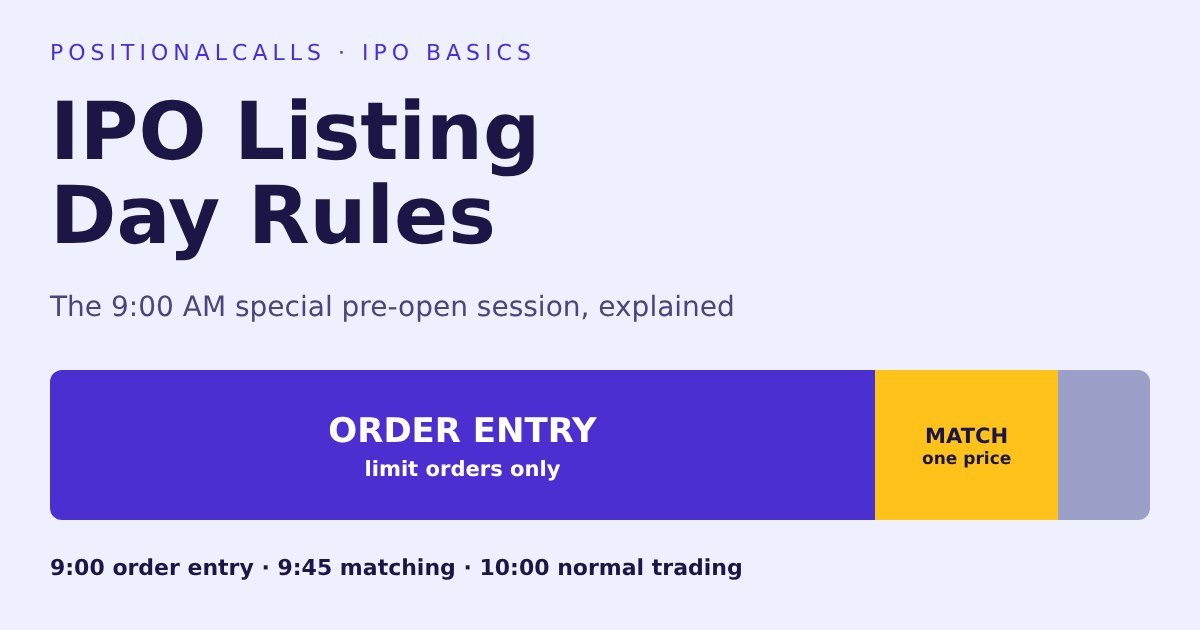
IPO basics · Explainer
IPO listing day rules in India explained: the 9:00 AM special pre-open session, how the listing price is found, which orders are allowed, the circuit and operating limits, trade-for-trade settlement, and what changes for SME issues, with a worked example.
Quick answer
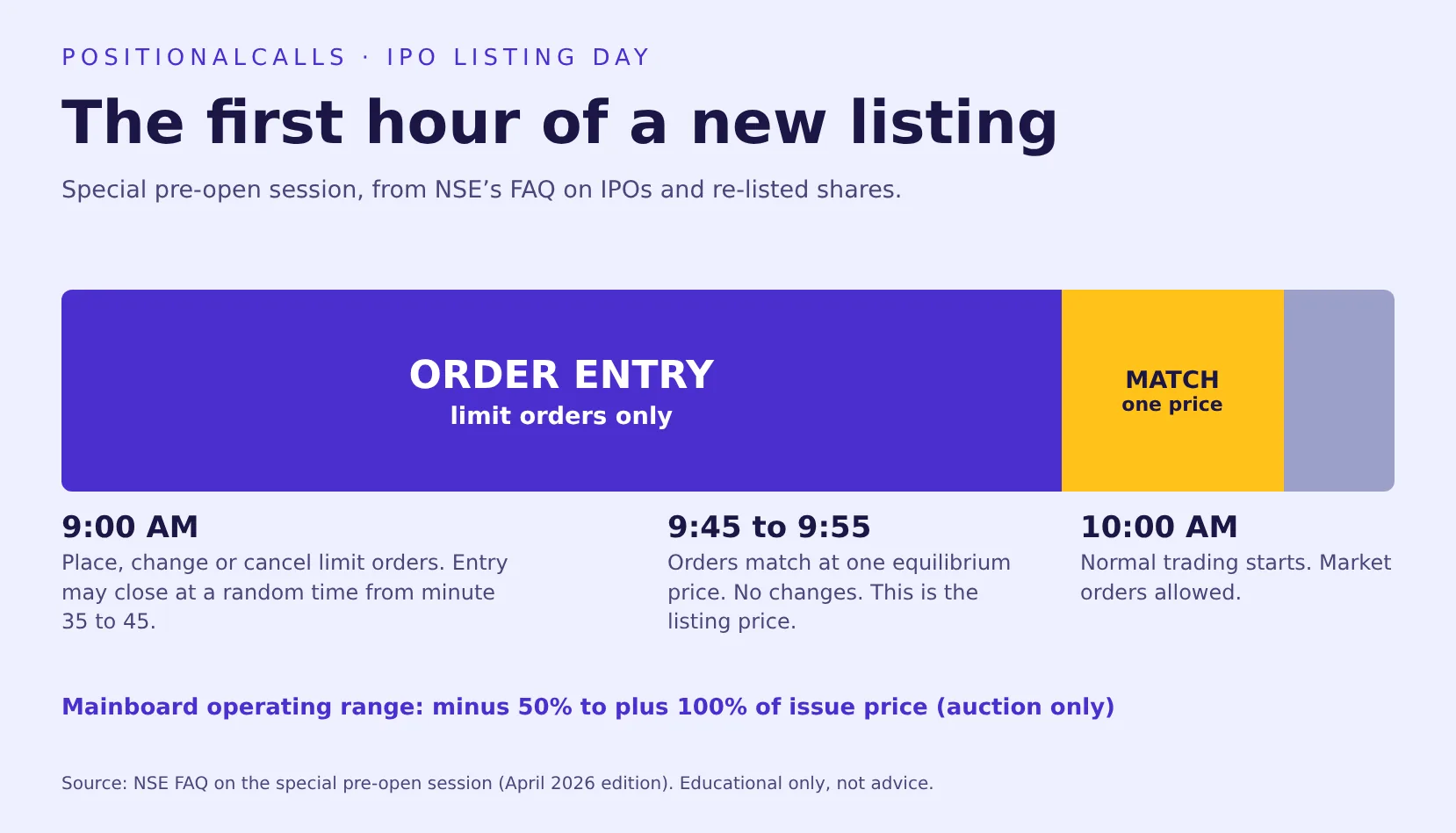
Under the IPO listing day rules, trading starts with a special pre-open session. Limit orders are collected from 9:00 to 9:45 AM, matched at one equilibrium price from 9:45 to 9:55 AM, and normal trading begins at 10:00 AM. That equilibrium price becomes the listing price.
Latest update (Monday, 16 November 2026, 12:00 PM IST): first version of this guide. The session timings, price discovery and operating ranges come from NSE’s FAQ on the special pre-open session in the capital market segment (April 2026 edition, filed May 2026), which I opened. The listing day circuit bands and trade-for-trade rules come from Chittorgarh and are secondary. I did not open the SEBI or exchange circulars behind them.
Key takeaways
- One price for everyone: the pre-open call auction finds a single equilibrium price.
- Limit orders only: you set the price you will accept.
- No price band in the auction: a wide dummy operating range applies instead.
- Group matters afterwards: smaller issues may trade trade-for-trade first.
In plain words: a new share has no trading history, so the exchange cannot open it at yesterday’s close. Instead, it collects buy and sell orders for 45 minutes, finds the one price at which the most shares can trade, and opens the stock there. Nothing on this page tells you to buy or sell any listing.
Data note: as of Monday, 16 November 2026, 12:00 PM IST. The Crystal Crop Protection issue price used in the examples is the Rs 272 top of the reported band, and the 55-share lot is as reported by Chittorgarh and Upstox. The listing prices in the examples are hypothetical, not forecasts.
What happens on IPO listing day?
On IPO listing day the shares begin trading on the exchange. Under the IPO listing day rules, trading starts with a special pre-open session from 9:00 to 10:00 AM that finds the first price, and normal trading follows from 10:00 AM until the market closes.
An issue lists on the third working day after it closes for issues covered by SEBI’s reduced timeline. Chittorgarh says the reduction to three working days applies to issues opening on or after 1 December 2023, though several of its FAQs still describe the older six-day timeline. INDmoney also states the three-day timeline. Our apply guide covers the full T+3 steps.
Why IPO listing day rules use a special session
A share that has never traded has no previous close to anchor its price. The exchange therefore runs a call auction in which buyers and sellers submit limit orders and one price is chosen. NSE’s FAQ says this session applies to mainboard and SME IPOs on their first day of trading and to re-listed securities on the first day they resume trading.
PositionalCalls is not SEBI-registered, and this guide explains the IPO listing day rules. It does not say whether to hold or sell any listing.
The IPO listing day rules timeline: special pre-open session
NSE’s FAQ sets three windows: order entry, modification and cancellation from 9:00 to 9:45 AM, order matching from 9:45 to 9:55 AM, and a buffer from 9:55 to 10:00 AM, after which normal trading begins.
| Time | Phase | What happens |
|---|---|---|
| 9:00 to 9:45 AM | Order entry | Limit orders can be placed, modified and cancelled; random closure between the 35th and 45th minute |
| 9:45 to 9:55 AM | Order matching | Orders match at one equilibrium price; the opening price is set; no modification or cancellation |
| 9:55 to 10:00 AM | Buffer | Transition to the normal market, with system-driven random closure |
| 10:00 AM onwards | Normal market | Regular trading, including market orders |
Cite this table: PositionalCalls, “IPO Listing Day Rules: Special Pre-Open Timeline, as of 16 November 2026”; NSE FAQ on the special pre-open session (April 2026 edition).
The random closure in the last ten minutes of order entry means order entry can end anywhere between the 35th and 45th minute, so a late limit order is not guaranteed to be included. Chittorgarh describes the same windows and adds that the listing price is the equilibrium price from the matching window, though it gives 9:55 AM in one table and 10:00 AM in an FAQ as the time it is announced.
The general pre-open session is a different thing
Choice India reports that from 7 September 2026 NSE restructured its regular pre-open session, 9:00 to 9:15 AM, into two phases with matching from 9:10 AM. That article does not mention the special IPO session, so I do not claim the IPO timings changed. Use the NSE FAQ I read, from May 2026, for the IPO session, and check the exchange’s latest circular before listing day.
How the IPO listing price is found
The listing price is the single equilibrium price at which the maximum volume can be traded. If more than one price qualifies, the exchange picks the one with the smallest order imbalance, and then the one closest to the base price, which for an IPO is the issue price.
NSE’s FAQ says orders are matched at one price, and that price becomes the open price. Only limit orders are accepted, and the price is chosen by the rules in the table below. Because everyone who trades in the matching window trades at the same price, the listing price is not the highest bid or the lowest ask. It is the price at which the most shares change hands.
| Step | Rule | Source |
|---|---|---|
| 1 | Choose the price at which maximum volume is executable | NSE FAQ |
| 2 | If several prices tie, choose the one with minimum order imbalance | NSE FAQ |
| 3 | If imbalances tie, choose the price closest to the base price | NSE FAQ |
| Base price for an IPO | The issue price, including for SME IPOs | NSE FAQ |
| If no price is found | Moves to the normal market at the base price, or at the price discovered on the other exchange | NSE FAQ |
Cite this table: PositionalCalls, “How the IPO Listing Price Is Found, as of 16 November 2026”; NSE FAQ on the special pre-open session.
When NSE and BSE find different prices under the IPO listing day rules
NSE’s FAQ says that where the two exchanges’ equilibrium prices differ by more than the applicable price band, a common equilibrium price is computed and uniform bands are set around it. Chittorgarh illustrates a common price as a volume-weighted average of the two exchanges’ prices. Its example is (120 x 300 + 100 x 500) / 800 = Rs 107.50, which I checked, but it is an illustration and not a rule I could verify in the circular.
Which orders you can place under the IPO listing day rules
Only limit orders are accepted in the special pre-open session. Order modification, cancellation and trade changes are not allowed during matching, and unmatched limit orders move to the normal market at their limit price.
| Question | Answer | Source |
|---|---|---|
| Market orders in pre-open? | Not accepted; only limit orders | NSE FAQ; Chittorgarh |
| Change or cancel during matching? | Not allowed | NSE FAQ |
| What happens to unmatched orders? | Those within the range move to the normal market at their limit price, by price-time priority | NSE FAQ |
| If no price was discovered? | Unmatched IPO orders still move to the normal market | NSE FAQ |
| Market orders after 10:00 AM? | Normal market rules apply | INDmoney |
Cite this table: PositionalCalls, “Orders on IPO Listing Day, as of 16 November 2026”; NSE FAQ, Chittorgarh, INDmoney.
A limit order is a price, not a promise
The practical meaning is that a limit order states a price you will accept and is not a promise of execution. A buy limit set far below the equilibrium price may not trade, and it then waits in the normal market at that limit price. This describes how the order types work, not a recommendation to use any price.
A walk through the IPO listing day rules from 9:00 to 10:00 AM
Following the IPO listing day rules in order: place a limit order after 9:00 AM, wait through matching from 9:45, see the listing price by 10:00 AM, and trade normally after that. The steps below follow NSE’s FAQ.
- Before 9:00 AM. Confirm the listing date and that allotted shares have been credited to your demat account.
- 9:00 AM. The special pre-open session opens. Place a limit order if your broker app allows it, as market orders are not accepted.
- 9:00 to 9:45 AM. You can modify or cancel orders. Order entry can close at a random time between the 35th and 45th minute.
- 9:45 to 9:55 AM. Orders match at one equilibrium price. Changes and cancellations are not allowed during matching.
- 9:55 to 10:00 AM. The buffer period. Unmatched limit orders within the range move to the normal market.
- 10:00 AM. Normal trading begins, with the opening price set by the auction.
How this differs from the grey market premium
The grey market premium, or GMP, is an unofficial figure quoted before listing. It is not an exchange price, and it can be wrong or zero. The listing price is different: it is the equilibrium price found in the exchange’s own call auction. The GMP pages on this site show the premium as reported, and the IPO listing day rules above show how the actual price is set.
Operating range and circuit limits on IPO listing day
There is no price band in the special pre-open session. NSE applies a dummy operating range instead: minus 50% to plus 100% of the issue price for a mainboard IPO. After the session, Chittorgarh describes a listing day band of plus or minus 5% for issues up to Rs 250 crore and plus or minus 20% above that.
| Item | Rule | Source |
|---|---|---|
| Price band in the special pre-open session | None; a dummy circuit filter (operating range) applies | NSE FAQ |
| Mainboard IPO operating range | Minus 50% to plus 100% of the base price | NSE FAQ |
| Re-listed securities | Minus 85% to plus 50% of the base price | NSE FAQ |
| SME IPO operating range | FAQ lists minus 20% to plus 90%, and elsewhere describes a 20% floor below issue price; self-contradictory | NSE FAQ |
| Range flexing | In multiples of 10%; none from 9:35 to 9:45 AM; none for SME IPOs | NSE FAQ |
| Listing day band, issue up to Rs 250 crore | Plus or minus 5% | Chittorgarh |
| Listing day band, issue above Rs 250 crore | Plus or minus 20% | Chittorgarh |
Cite this table: PositionalCalls, “IPO Listing Day Ranges and Circuit Limits, as of 16 November 2026”; NSE FAQ, Chittorgarh.
PositionalCalls WhatsApp channel
Get IPO listing-day explainers on WhatsApp
- Listing date and rule changes, dated
- Plain-English IPO terms, no tips
- Links to updated IPO guides
What the operating range means for the IPO listing day rules
With the Rs 272 top of the Crystal Crop band as the base price, the dummy operating range for a mainboard IPO works out to Rs 136 at the low end and Rs 544 at the high end (my calculation). That range is a technical limit for the auction, not a forecast of where the listing will price.
Trade-for-trade and the first 10 days after listing
Under a 2012 SEBI circular, as cited by Chittorgarh, IPOs up to Rs 250 crore trade in the trade-for-trade segment for the first 10 days after listing. Issues above Rs 250 crore trade in the rolling segment.
| Exchange | Group | Basis | Settlement | Intraday |
|---|---|---|---|---|
| BSE | A | Market cap at least Rs 1 lakh crore | Rolling | Yes |
| BSE | B | Issue size above Rs 250 crore | Rolling | Yes |
| BSE | T | Issue size up to Rs 250 crore | Trade for trade | No |
| NSE | EQ | Issue size above Rs 250 crore | Rolling | Yes |
| NSE | BE | Issue size up to Rs 250 crore | Trade for trade | No |
Cite this table: PositionalCalls, “Trade-for-Trade Groups for New IPOs, as of 16 November 2026”; Chittorgarh citing SEBI circular CIR/MRD/DP/02/2012.
In trade-for-trade, every trade is settled on its own, and square-off within the day is not allowed, so intraday buying and selling of the same stock is not possible. Chittorgarh notes that exchanges review groups periodically and announce changes, so the group on your listing day is in the exchange notice.
The Crystal Crop Protection issue is reported at Rs 455.49 crore, which is above Rs 250 crore. Under the rule as Chittorgarh cites it, that places an issue of this size in the rolling segment (NSE series EQ), but that is my reading of a secondary summary, so confirm it on listing day. The issue details are on our Crystal Crop Protection IPO page.
Do the IPO listing day rules apply to SME listings?
Yes, NSE’s FAQ says the special pre-open session applies to SME IPOs on their first day of trading, with no range flexing. The operating range figures for SME issues are contradictory in that FAQ, so check the circular.
The FAQ says the base price for an SME IPO is the issue price, as for mainboard issues. It lists minus 20% to plus 90% for the SME operating range and also describes a floor of 20% below issue price and a cap of 90% above, which does not fully agree with itself. Chittorgarh’s listing chapter gives no SME-specific listing time, circuit or group rules.
After listing, SME shares trade in price-linked lots and have a market maker, as set out in our SME vs mainboard IPO guide. That is why a sale of a small holding can differ from a sale on the main board, even though the listing-day auction mechanics are the same.
IPO listing day rules at a glance: mainboard and SME
The same special pre-open session applies to mainboard and SME IPOs. The differences are in the operating range, range flexing and the segment that follows, so the table puts them side by side.
| Point | Mainboard IPO | SME IPO | Source |
|---|---|---|---|
| Special pre-open session | Applies on the first trading day | Applies on the first trading day | NSE FAQ |
| Base price | Issue price | Issue price | NSE FAQ |
| Operating range in the session | Minus 50% to plus 100% | FAQ self-contradictory: minus 20% to plus 90%, or a 20% floor | NSE FAQ |
| Range flexing | In 10% steps; none 9:35 to 9:45 AM | None | NSE FAQ |
| Order types | Limit only in the session | Limit only in the session | NSE FAQ |
| Segment after listing | EQ or BE by issue size | Not covered in the sources read | Chittorgarh |
| Trading unit afterwards | One share | Price-linked lot | SEBI paper, see SME guide |
Cite this table: PositionalCalls, “IPO Listing Day Rules: Mainboard vs SME, as of 16 November 2026”; NSE FAQ, Chittorgarh, SEBI consultation paper (14 October 2026).
The last row comes from SEBI’s October 2026 consultation paper as covered in our SME guide. It describes the current lot-based trading of SME shares, which the paper proposes to change to single-share trading. That is a proposal, not a rule, so for any listing the exchange notice sets the lot.
A worked IPO listing day example
Take one lot of the Crystal Crop Protection IPO: 55 shares at the Rs 272 top of the band, so the cost is Rs 14,960 (my calculation). The table shows the gain or loss per lot at hypothetical listing prices.
| Listing price (hypothetical) | Change from issue price (my calculation) | Gain or loss on one lot |
|---|---|---|
| Rs 250 | Minus 8.09% | Loss of Rs 1,210 |
| Rs 272 | No change | No gain or loss |
| Rs 300 | Plus 10.29% | Gain of Rs 1,540 |
| Rs 340 | Plus 25.0% | Gain of Rs 3,740 |
| Rs 408 | Plus 50.0% | Gain of Rs 7,480 |
Cite this table: PositionalCalls, “Listing Gain or Loss on One Crystal Crop Lot, hypothetical, my calculation, 16 November 2026”; Chittorgarh, Upstox.
These IPO listing day rules examples are arithmetic, not forecasts of any listing. A listing price depends on orders in the auction. The gain is before brokerage and STT, and a sale at a gain is taxed as short-term capital gain, as explained in IPO tax in India. For one lot at Rs 300, that tax is Rs 320.32 on the Rs 1,540 gain, on the sources’ 20% plus 4% cess (my calculation).
Why the IPO listing price is not the closing price
The listing price is the opening price from the auction. Normal trading from 10:00 AM can move the price up or down within the day’s band, so the close can differ from the listing price. The band for the rest of the day is described above and is not a promise about where the price will go.
Selling on IPO listing day
If you were allotted shares and they are in your demat account, you can place a limit order to sell in the pre-open session or sell in the normal market. Whether you can also trade intraday depends on the segment and on your broker.
The allotment must be credited first. Our allotment status guide shows where the result and credit appear. Chittorgarh’s Zerodha example says intraday long positions are allowed on listing day with full margin, while short selling is not allowed unless you hold the allotted shares in your demat account. It stresses that margin rules vary by broker.
| Situation | What the sources say |
|---|---|
| Allotted shares in demat | Can be sold on listing day with a limit order or in the normal market |
| No allotment, want to buy | Place a limit order; market orders are not accepted in pre-open |
| Short sell without holding | Not allowed on listing day in the Zerodha example |
| Trade-for-trade segment | No intraday square-off |
Cite this table: PositionalCalls, “Selling and Buying on IPO Listing Day, as of 16 November 2026”; NSE FAQ, Chittorgarh.
None of this says what to do. It describes what the IPO listing day rules allow. A sale at a gain is a taxable event, so see IPO tax in India for how it is treated.
Checklist before IPO listing day
Before listing day, confirm the listing date, your allotment, the exchange notice on the group and band, and your broker’s rules for pre-open orders.
- Check the listing date in the exchange notice and on the issue page.
- Confirm the shares are credited to your demat account, if you were allotted.
- Read the exchange notice for the group, such as EQ or BE, and for the price band.
- Check whether your broker app accepts pre-open limit orders for IPOs.
- Decide your limit price before 9:00 AM, since market orders are not accepted and order entry can close between 9:35 and 9:45 AM.
- Note that a sale at a gain creates a short-term capital gain.
The IPO listing day rules are the same set of mechanics for every issue, but the group and band depend on the issue size. That is why the notice for your own issue matters more than a general rule.
What most people miss about IPO listing day rules
The points readers most often get wrong are the order types, the lack of a price band in the auction and the effect of issue size on the group.
- No market orders in the auction. Only limit orders are accepted until normal trading starts.
- The first price is one price for all. It is the equilibrium price, not the highest or lowest order.
- The dummy range is not a circuit. The minus 50% to plus 100% range applies inside the auction only.
- Issue size sets the group. Up to Rs 250 crore means trade-for-trade for 10 days, per Chittorgarh.
- The regular pre-open changed in September 2026. That is not the IPO session.
Bottom line
The IPO listing day rules start with a 9:00 to 10:00 AM special pre-open session that finds one listing price from limit orders, followed by normal trading at 10:00 AM. The band, the group and the SME details depend on the issue, so read the exchange notice. This guide is educational and does not recommend buying or selling any listing.
PositionalCalls WhatsApp channel
IPO updates in one channel
- Rule and deadline changes, dated
- Plain-English IPO explainers
- Links to new IPO pages
IPO listing day rules: frequently asked questions
What are the IPO listing day rules in India?
The IPO listing day rules are that trading begins with a special pre-open session from 9:00 AM to 10:00 AM. Orders are collected until 9:45 AM, matched at one equilibrium price between 9:45 and 9:55 AM, and normal trading starts at 10:00 AM, per NSE’s FAQ on the special pre-open session. Only limit orders are accepted.
At what time does an IPO list on NSE and BSE?
IPO shares list on the exchanges at 9:00 AM with the special pre-open session starting, and regular trading begins at 10:00 AM, per NSE’s FAQ and Chittorgarh. Under the IPO listing day rules, the listing price is the equilibrium price found in the matching window between 9:45 and 9:55 AM, so it is known before 10:00 AM.
How is the IPO listing price decided?
The listing price is the single equilibrium price at which the maximum volume can be traded in the pre-open call auction. NSE’s FAQ says that if several prices qualify, the one with the smallest order imbalance wins, and then the one closest to the issue price. If no price is found, trading opens at the issue price.
Can I place a market order on IPO listing day?
Not in the special pre-open session. NSE’s FAQ and Chittorgarh say only limit orders are accepted, and order changes and cancellations are not allowed during matching. Unmatched limit orders within the applicable range move to the normal market at their limit price, where the usual order types apply from 10:00 AM.
What is the circuit limit on IPO listing day?
Chittorgarh says the listing day band is plus or minus 5% for issues up to Rs 250 crore and plus or minus 20% above that. NSE’s FAQ describes a wider dummy operating range of minus 50% to plus 100% of the issue price for a mainboard IPO inside the pre-open session only. Check the exchange notice for your issue.
What is trade-for-trade settlement for a new IPO?
Chittorgarh says that under a 2012 SEBI circular, IPOs up to Rs 250 crore trade in the trade-for-trade segment for the first 10 days after listing, called group T on BSE and BE on NSE. Intraday is not allowed there. Issues above Rs 250 crore trade in the rolling segment, where intraday is allowed.
Do the IPO listing day rules apply to SME IPOs?
Yes, the special pre-open session applies to SME IPOs too, per NSE’s FAQ, which says no range flexing happens for them. But the FAQ gives conflicting operating-range figures for SME issues, with one line saying minus 20% to plus 90% and another describing a floor of 20% below issue price. Check the circular before relying on either.
What happens if no equilibrium price is found?
For an IPO, NSE’s FAQ says the security moves to the normal market at the base price, which is the issue price, or at the price discovered on the other exchange. All unmatched limit orders within the range move to the normal market. For re-listed securities the rule differs, since orders are cancelled.
Can I sell IPO shares on the listing day?
If you were allotted shares and they are in your demat account, you can place a limit order to sell in the pre-open session or sell in the normal market after 10:00 AM. Chittorgarh’s Zerodha example says short selling on listing day is not allowed unless you hold the shares. Brokers’ intraday margin rules vary.
Did the pre-open session change from 7 September 2026?
The Choice India report says the general equity pre-open session, 9:00 to 9:15 AM, was restructured from 7 September 2026, with matching starting at 9:10 AM. It does not mention the special IPO session, so I do not assume any change there. The NSE FAQ I read, from May 2026, shows the 9:00 to 10:00 AM structure.
Sources
- NSE: FAQ on the special pre-open session in the capital market segment, April 2026 edition, filed May 2026.
- Chittorgarh: IPO listing, timings, circuits and trade-for-trade, chapter page, undated, secondary.
- INDmoney: IPO listing day, what time an IPO lists, 2026, undated, secondary.
- Choice India: NSE revises the pre-open session structure from 7 September 2026, 2026.
- Chittorgarh: Crystal Crop Protection IPO, issue details.
- Upstox: Crystal Crop Protection IPO opens 18 Nov, issue details.
- PositionalCalls: IPO tax in India, how to apply for an IPO in India and Crystal Crop Protection IPO.
PositionalCalls.com is an independent research site founded by Shubham Chaudhary. PositionalCalls.com is not a SEBI-registered research analyst or investment adviser. Investments in securities markets are subject to market risks. Read all related documents carefully before investing. Returns are never guaranteed. How this was researched: the NSE FAQ was opened directly on 16 November 2026; the circuit bands and trade-for-trade rules are from a secondary source and were not checked against the SEBI circulars.

Shubham Chaudhary is the founder of PositionalCalls, an independent Indian stock market research website. He writes company fundamentals, quarterly results analysis, IPO analysis and sector research for NSE and BSE listed companies, with a focus on banking stocks, insurance and long-term value investing. Every article is built from primary sources such as RBI, SEBI, NSE and BSE filings and company annual reports, and states its risks plainly in simple language for retail investors.
Coverage areas Our research standards- Numbers checked against NSE, BSE and SEBI filings
- Risks and limits stated in every article
- No paid promotions or broker tie-ups
- Articles updated when new filings arrive