
IPO basics · Tax explainer
IPO tax in India explained: how listing gains and later sales are taxed as short-term or long-term capital gains, the rates, the Rs 1.25 lakh exemption, how the holding period and cost are counted, how losses are set off and how to report it, with worked examples.
Quick answer
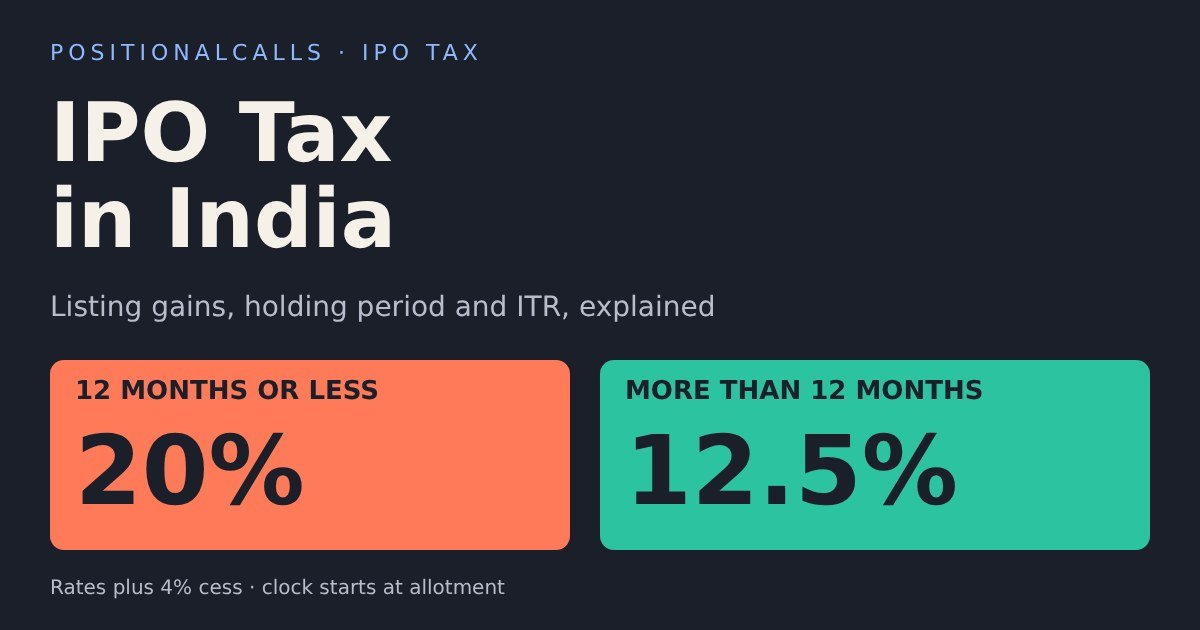
IPO tax in India is capital gains tax on listed shares. Selling within 12 months of allotment gives short-term gains taxed at 20%. Selling after 12 months gives long-term gains at 12.5% above Rs 1.25 lakh a year. Cess of 4% is added, and the cost is the allotment price.
Latest update (Monday, 16 November 2026, 12:00 PM IST): first version of this guide. Rates and rules are from IPO Market (reviewed 18 July 2026), INDmoney and Bajaj Finserv. I did not open the Income-tax Act, 2025 or a CBDT notification. This is general information and not tax advice, so ask a qualified tax adviser about your own return.
Key takeaways
- No tax at allotment: tax arises only when you sell at a profit.
- Listing-day gains are short-term: 20% flat plus 4% cess.
- The clock starts at allotment: not at listing.
- Losses can help: short-term losses offset both kinds of gains.
In plain words: getting IPO shares is not taxed. When you sell them for more than the issue price, the profit is taxed. If you sell within a year it is taxed at one rate, and if you hold longer, at a lower rate with a yearly tax-free slice. This guide explains the rules and does not tell you to hold or sell.
Data note: as of Monday, 16 November 2026, 12:00 PM IST. The Crystal Crop figures use the reported band top of Rs 272 and a 55-share lot. The sale prices in the examples (Rs 250, Rs 300 and Rs 400) are my hypothetical illustrations, not forecasts of any listing.
How is IPO tax in India charged?
IPO tax in India is capital gains tax. Receiving shares in an IPO is not taxed. When you sell them on the exchange for more than the allotment price, the profit is taxed as a short-term or long-term capital gain, depending on how long you held the shares from the allotment date.
An IPO share becomes a normal listed equity share once it lists. IPO Market and INDmoney treat the sale of IPO shares like any other sale of listed shares on which securities transaction tax (STT) has been paid, which is why the concessional rates apply. The difference in IPO tax in India is only the starting point: the cost is the issue price, and the clock starts on the allotment date.
When IPO tax in India is charged, and when it is not
That makes the tax simple in structure. There is no tax when you apply, when money is blocked or when a refund is released, because nothing has been sold. Tax arises on a sale. A listing-day sale falls within 12 months of allotment, so the gain is short-term.
PositionalCalls is not SEBI-registered and is not a tax adviser. The rates below come from secondary articles that I name, and the Income Tax Department portal is the authority.
IPO tax rates at a glance
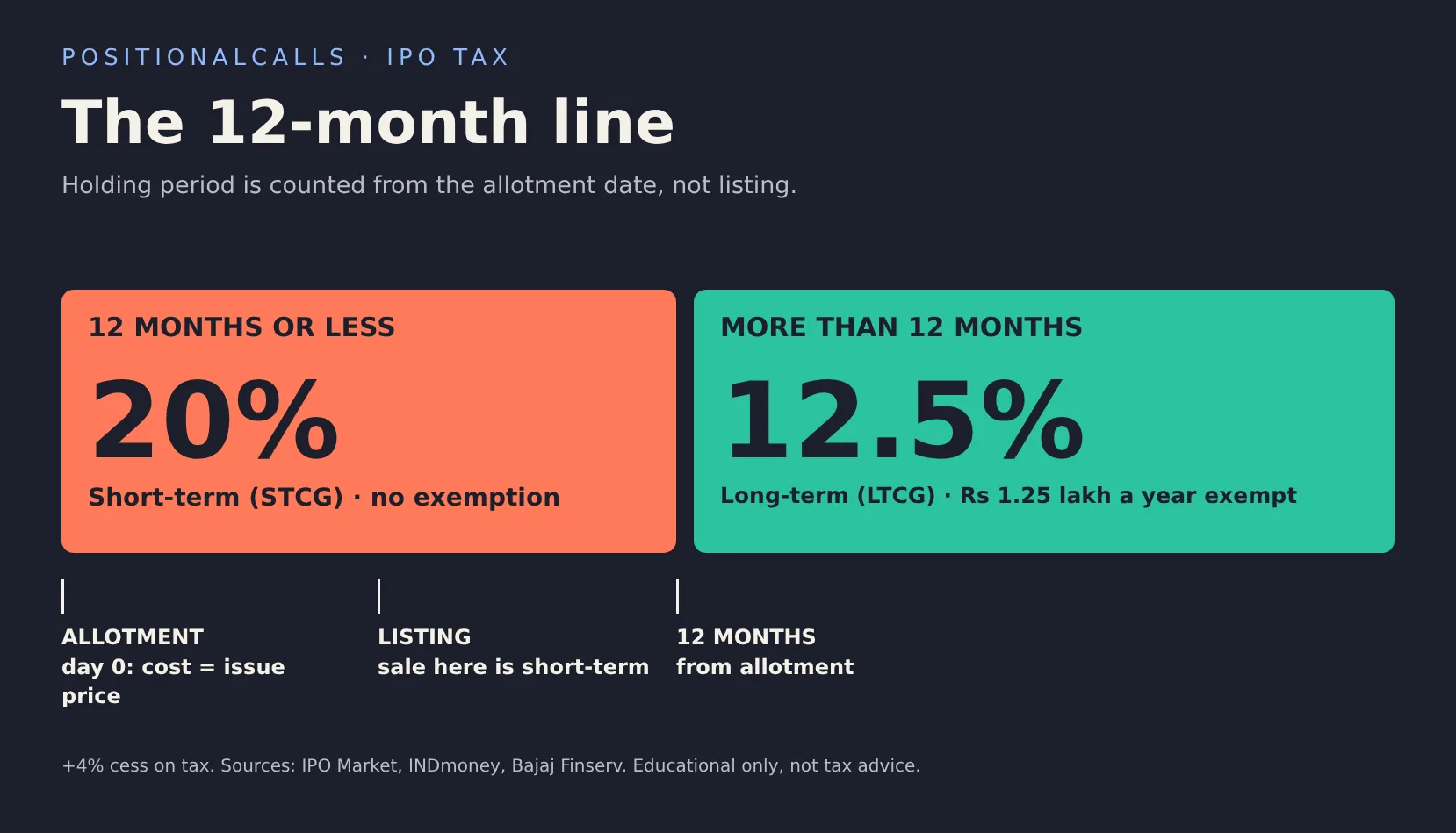
Short-term gains on IPO shares are taxed at a flat 20%, long-term gains at 12.5% above Rs 1.25 lakh a year, and a 4% health and education cess is added to the tax.
| Item | Short-term (STCG) | Long-term (LTCG) |
|---|---|---|
| Held for | 12 months or less from allotment | More than 12 months from allotment |
| Rate | 20% flat | 12.5% |
| Exemption | None | First Rs 1.25 lakh of LTCG in a year |
| Cess | 4% on the tax | 4% on the tax |
| Effective rate with cess | 20.8% | 13% on taxable LTCG |
| Indexation | Not applicable | Not available |
| Section cited | 111A | 112A |
Cite this table: PositionalCalls, “IPO Tax in India: Rates, as of 16 November 2026”; IPO Market, INDmoney, Bajaj Finserv.
Cess, surcharge and indexation
IPO Market says the 20% and 12.5% rates apply from 23 July 2024, replacing 15% and 10%. The Bajaj Finserv summary says Budget 2026-27 kept both rates and the Rs 1.25 lakh exemption unchanged and raised only futures and options STT. Surcharge may apply at higher incomes, but IPO Market notes it without giving rates, so I do not quote one. The section numbers are those of the 1961 Act, as in the note at the top.
The effective rates follow from the arithmetic: 20% plus 4% of that tax gives 20.8%, and 12.5% plus 4% gives 13% (my calculation).
Holding period and cost: the two numbers that set IPO tax in India
The holding period starts on the allotment date, when shares are credited to your demat account, not on the application or listing date. The cost of acquisition is the IPO allotment price.
INDmoney says the holding period starts from the allotment date and not the listing date, and IPO Market says the same. That matters near the 12-month line: the long-term rate needs a holding of more than 12 months, so count from the allotment date and confirm the exact day with a tax adviser before selling close to the anniversary.
| Event | Taxed? | Why |
|---|---|---|
| Application and UPI block | No | No sale; money is only held |
| Allotment | No | No tax charged on receiving shares |
| Refund of unallotted money | No | No sale and no gain |
| Sale at listing or within 12 months | Yes, STCG | Held 12 months or less from allotment |
| Sale after more than 12 months | Yes, LTCG above exemption | Held more than 12 months from allotment |
Cite this table: PositionalCalls, “When IPO Shares Are Taxed, as of 16 November 2026”; IPO Market, INDmoney.
Cost of acquisition for IPO shares
For cost, use the allotment price per share, not the listing price. Brokerage and exchange charges on the sale count as transfer expenses, and IPO Market says STT is not deductible. Your demat statement and contract note show the allotment price and quantity.
Worked examples of IPO tax in India
Each example uses a real price band and a lot but a hypothetical sale price. Gains are sale value minus allotment cost, taxed at 20% plus 4% cess if short-term, with STT and brokerage ignored for clarity.
Take one lot of the Crystal Crop Protection IPO: 55 shares at the Rs 272 top of the band, so the cost is Rs 14,960 (my calculation). The sale prices below are hypothetical.
| Case | Sale price | Sale value | Gain or loss | Tax (my calculation) |
|---|---|---|---|---|
| One lot sold on listing day | Rs 300 | Rs 16,500 | Gain Rs 1,540 | STCG Rs 308 + cess Rs 12.32 = Rs 320.32 |
| One lot sold at a loss | Rs 250 | Rs 13,750 | Loss Rs 1,210 | No tax; the short-term loss can be set off |
| 13 lots (715 shares) sold within a year | Rs 300 | Rs 2,14,500 | Gain Rs 20,020 | STCG Rs 4,004 + cess Rs 160.16 = Rs 4,164.16 |
| One lot held over 12 months | Rs 400 | Rs 22,000 | Gain Rs 7,040 | No LTCG tax if total LTCG for the year is within Rs 1.25 lakh |
Cite this table: PositionalCalls, “IPO Tax Examples, Crystal Crop Lot, my calculation, 16 November 2026”; hypothetical sale prices.
Examples from the sources
INDmoney gives a listing-day case: 200 shares issued at Rs 500 and sold at Rs 750 is a gain of Rs 50,000, STCG tax of Rs 10,000 and cess of Rs 400, a total of Rs 10,400. It also gives an LTCG case: a gain of Rs 2,00,000 less the Rs 1,25,000 exemption leaves Rs 75,000, taxed at 12.5% for Rs 9,375, plus cess of Rs 375, a total of Rs 9,750. I checked both calculations and they agree.
The LTCG exemption applies to all long-term gains in the year, not only to IPO shares, so other gains use up the same Rs 1.25 lakh. INDmoney adds that unused exemption does not carry forward.
Three paths for IPO shares and how IPO tax in India treats each
After allotment there are three broad paths: sell on listing, sell within the first year, or hold beyond 12 months. The first two are short-term and the third is long-term, by the sources’ rules.
| Path | Holding period | Gain treated as | Rate (plus 4% cess) |
|---|---|---|---|
| Sell on listing day | Days from allotment | Short-term (STCG) | 20%, no exemption |
| Sell within 12 months | 12 months or less | Short-term (STCG) | 20%, no exemption |
| Sell after more than 12 months | More than 12 months | Long-term (LTCG) | 12.5% above Rs 1.25 lakh a year |
| Sell part, keep part | Each sale is tested on its own date | Part STCG, part LTCG if dates differ | As above for each sale |
Cite this table: PositionalCalls, “Three Paths for IPO Shares, as of 16 November 2026”; IPO Market, INDmoney.
The table describes how the rules classify a sale, not which path is better. A sale is tested on its own date, so if you sell part of an allotment early and the rest later, each part is classified by its own holding period. The cost per share stays the allotment price for both parts. Listing-day sales are the ones most readers meet first, because many IPO sales happen on the first day.
How to calculate IPO tax in India step by step
Subtract the allotment cost from the sale value, pick the rate by holding period, apply the 4% cess and subtract any LTCG exemption and set-off losses. Brokerage on the sale reduces the gain, while STT does not.
- Find the cost. Multiply shares by the allotment price. For one Crystal Crop lot at Rs 272, that is Rs 14,960.
- Find the sale value. Multiply shares by the sale price, from your contract note.
- Subtract transfer expenses. Brokerage and exchange charges on the sale count; STT does not.
- Classify by holding period. Count from the allotment date to the sale date.
- Apply the rate. 20% for short-term. For long-term, 12.5% on the amount above Rs 1.25 lakh of total LTCG in the year.
- Add 4% cess on the tax, and offset any eligible losses first.
The table applies those steps to one Crystal Crop lot at the Rs 272 top price, with hypothetical sale prices and a short-term sale. I ignore brokerage and STT, so real figures will differ.
PositionalCalls WhatsApp channel
Get IPO and tax explainers on WhatsApp
- Tax rate changes, dated
- Capital gains explained without tips
- Links to updated guides
| Sale price | Sale value | Result | Tax with cess (my calculation) | Value after tax |
|---|---|---|---|---|
| Rs 230 | Rs 12,650 | Loss Rs 2,310 | Nil | Rs 12,650 |
| Rs 250 | Rs 13,750 | Loss Rs 1,210 | Nil | Rs 13,750 |
| Rs 272 | Rs 14,960 | No gain or loss | Nil | Rs 14,960 |
| Rs 300 | Rs 16,500 | Gain Rs 1,540 | Rs 320.32 | Rs 16,180 |
| Rs 330 | Rs 18,150 | Gain Rs 3,190 | Rs 663.52 | Rs 17,486 |
| Rs 360 | Rs 19,800 | Gain Rs 4,840 | Rs 1006.72 | Rs 18,793 |
Cite this table: PositionalCalls, “IPO Tax in India, One Crystal Crop Lot at Different Sale Prices, my calculation, 16 November 2026”; hypothetical sale prices.
Tax is a fixed 20.8% of any gain here, and a sale below the allotment price creates a loss and no tax. The rate does not step up with the size of the gain, because the short-term rate is flat as the sources state it.
IPO losses: set-off and carry-forward
A short-term capital loss from an IPO can be set off against both short-term and long-term gains. A long-term loss can be set off only against long-term gains. Unabsorbed losses carry forward for 8 years if the return for the loss year is filed on time.
| Loss type | Can be set off against | Carry-forward |
|---|---|---|
| Short-term capital loss | Short-term gains and long-term gains | 8 years, if the return was filed on time |
| Long-term capital loss | Long-term gains only | 8 years, if the return was filed on time |
Cite this table: PositionalCalls, “Capital Loss Set-off Rules, as of 16 November 2026”; IPO Market, INDmoney.
Why timely filing matters for losses
This is why a listing-day loss is not wasted for tax purposes. A Rs 1,210 short-term loss, as in the example above, could reduce a gain elsewhere in the same year. The condition that matters is filing your return for the loss year on time, because both IPO Market and INDmoney say the carry-forward is lost otherwise. The statutory wording is in the Act, so confirm with an adviser.
None of this is a reason to sell or hold. It describes how a loss, once it exists, is treated.
STT and charges: what is and is not deductible
Securities transaction tax is charged when you sell and is not deductible against the gain. Paying it is what qualifies the gain for the concessional 20% and 12.5% rates. Allotment itself attracts no STT.
INDmoney says STT is 0.1% on the sell side for delivery trades and that allotment attracts none. IPO Market says STT is not deductible, while brokerage and exchange-related charges on the sale count as transfer expenses. The Bajaj Finserv summary lists Budget 2026-27 changes only to futures and options STT and does not mention equity cash-market STT, so I do not state a changed cash-market rate.
| Charge | Treatment | Source |
|---|---|---|
| STT on sale (delivery) | Paid on the sell side; not deductible | INDmoney; IPO Market |
| STT at allotment | None | INDmoney |
| Brokerage on the sale | Counts as a transfer expense | IPO Market |
| Exchange-related charges on the sale | Counts as a transfer expense | IPO Market |
Cite this table: PositionalCalls, “STT and Charges on IPO Shares, as of 16 November 2026”; INDmoney, IPO Market.
Where the exact charges come from
Your broker’s current charge schedule sets the exact figures, so check it before computing a precise net gain.
How to report IPO gains in your ITR
IPO gains go in Schedule CG of ITR-2 for salaried investors with capital gains, or ITR-3 if you also have business income such as F&O trading. Short-term gains fall under Section 111A and long-term gains under Section 112A.
| Item | What to report | Source |
|---|---|---|
| Form | ITR-2 for salaried investors; ITR-3 with business income | IPO Market; INDmoney |
| Schedule | Schedule CG | IPO Market; INDmoney |
| Short-term gain | Under Section 111A | IPO Market; INDmoney |
| Long-term gain | Under Section 112A, with scrip-level details | IPO Market |
| Per-transaction details | ISIN, company, shares sold, allotment date, sale date, sale price, cost per share | INDmoney |
Cite this table: PositionalCalls, “Reporting IPO Gains in the ITR, as of 16 November 2026”; IPO Market, INDmoney.
Details your return needs for IPO shares
The acquisition date you enter is the allotment date. IPO Market also says gains before and after 23 July 2024 had to be reported separately for the year of the rate change. Form names and schedule numbers can change with the new Income-tax Act, so use the form your filing portal shows for the year.
Your broker’s capital gains statement lists each sale with the allotment date and cost, which makes the entries simpler. For the steps before the sale, see how to apply for an IPO in India and how to check IPO allotment status.
Records to keep for IPO tax in India
Keep the allotment confirmation, the demat statement and the contract note for every IPO share you sell, because they carry the allotment date, the allotment price and the sale details your return needs.
- The allotment message or registrar result with the number of shares and the price.
- The demat statement showing the credit date, which is the allotment date.
- The contract note for the sale, with the price, quantity and charges.
- The broker’s annual capital gains statement.
- A note of any short-term loss, so it can be carried forward if needed.
These records also help if a notice or a query arises later. The mechanics of the allotment result are in our allotment status guide.
Checklist before you file: IPO tax in India
Before filing, match each IPO sale to its allotment, confirm the holding period, total the year’s long-term gains against the Rs 1.25 lakh exemption and list any losses to set off or carry forward.
- List every IPO share you sold in the financial year, with allotment date and sale date.
- Mark each sale as short-term or long-term by counting from the allotment date.
- Use the allotment price as the cost for each share.
- Total all long-term gains, from IPO shares and other shares, and apply the single Rs 1.25 lakh exemption.
- Note short-term losses, which can offset both kinds of gains.
- Pick the right form, ITR-2 or ITR-3, and report in Schedule CG.
- File on time, so any loss can be carried forward for 8 years.
The checklist is a way to organise the numbers. It is not a substitute for your adviser, who can see your whole income. The IPO tax in India rules in this guide are those the sources state for listed shares sold on an exchange with STT paid.
What the sources do not cover on IPO tax in India
The sources I read leave five points open: SME shares, intraday versus delivery on listing day, surcharge rates, the new Act’s section numbers and the financial year label. Check each before you rely on a figure.
- SME shares: IPO Market does not cover SME-specific treatment, and INDmoney does not either. See SME vs mainboard IPO for how SME trading differs.
- Intraday or delivery: IPO Market says a listing-day sale is typically short-term and does not discuss intraday treatment.
- Surcharge: noted without rates.
- New Act numbering: sources cite the 1961 Act sections.
- Year label: INDmoney is undated, though it covers FY 2025-26 filing.
These gaps are why the page tells you to confirm with the tax portal or an adviser. A figure I could not source is left out and not guessed.
What most people miss about IPO tax in India
The points readers most often get wrong are the start of the holding period, the loss set-off rules and the idea that a listing-day gain is tax-free.
- The clock starts at allotment. Not at listing, and not at application.
- A listing-day gain is not exempt. It is short-term, with no threshold.
- The Rs 1.25 lakh exemption is shared. It covers all long-term gains in the year.
- A short-term loss is useful. It can offset both kinds of gains.
- File on time to keep losses. Late filing can forfeit the carry-forward.
Bottom line
IPO tax in India is capital gains tax at 20% for sales within 12 months of allotment and 12.5% above Rs 1.25 lakh for later sales, plus 4% cess. The cost is the allotment price, and the holding period starts at allotment. This guide is educational, not tax advice, and does not tell you to hold or sell.
PositionalCalls WhatsApp channel
IPO and tax updates in one channel
- Rule and rate changes, dated
- Plain-English explainers
- Links to new IPO pages
IPO tax in India: frequently asked questions
How is IPO tax in India calculated?
IPO tax in India is capital gains tax on listed shares. Gains from shares sold within 12 months of allotment are taxed at 20% (STCG), and gains after 12 months at 12.5% (LTCG) above Rs 1.25 lakh a year, plus 4% cess, as per the sources I read. The cost is the IPO allotment price.
Is listing day profit taxable in India?
Yes. A sale on listing day is within 12 months of allotment, so the gain is short-term capital gain taxed at a flat 20% plus 4% cess, with no exemption threshold, per IPO Market and INDmoney. No tax is charged when shares are allotted. Tax applies only when you sell at a gain.
When does the holding period start for IPO shares?
For IPO tax in India the holding period starts on the allotment date, when shares are credited to the demat account, and not on the application or listing date. INDmoney and IPO Market both say this. Shares held more than 12 months from allotment qualify for long-term capital gains treatment.
What is the LTCG exemption on IPO shares?
The first Rs 1.25 lakh of long-term capital gains in a financial year is exempt, and the 12.5% rate applies to gains above it. INDmoney says unused exemption does not carry forward, and that it covers all LTCG for the year, not only IPO shares. Check the figure for your year before filing.
Can I set off an IPO loss against other gains?
Yes, within limits. A short-term capital loss can be set off against both short-term and long-term gains, while a long-term loss can be set off only against long-term gains. INDmoney and IPO Market say unabsorbed losses carry forward for 8 years, but only if the return for the loss year is filed on time.
Which ITR form is used for IPO gains?
ITR-2 is used by salaried individuals with capital gains and no business income, while ITR-3 is for those with business income, including F&O traders, per IPO Market and INDmoney. Short-term gains go under Section 111A and long-term gains under Section 112A in Schedule CG, with scrip-level details such as the ISIN.
Is STT deductible when I sell IPO shares?
No. IPO Market says securities transaction tax is not deductible. INDmoney says STT of 0.1% applies on the sell side for delivery trades and that allotment itself attracts none. Paying STT is what qualifies the gain for the concessional 20% and 12.5% rates, while brokerage and similar charges count as transfer expenses.
Is there tax when I apply for an IPO or get refunded?
No capital gains tax arises when you apply, when money is blocked, or when a refund is released, because no sale has happened. Tax arises only when you sell allotted shares at a profit. The Rs 14,960 blocked for one Crystal Crop lot at the top price is not income, since it is only a hold on your balance.
Does the same IPO tax in India apply to SME shares?
The sources I read do not address SME shares separately, so I cannot confirm any difference. They describe rules for shares listed on a recognised exchange with STT paid. Because SME lots and trading differ, check your own contract notes and ask a tax adviser before assuming the same treatment applies to an SME listing gain.
Did Budget 2026-27 change IPO tax in India?
The Bajaj Finserv summary says Budget 2026-27 kept the LTCG and STCG rates unchanged and raised only futures and options STT. It does not mention any change to equity cash-market STT. The rates in this guide took effect on 23 July 2024, per IPO Market, so confirm any new year’s rates on the tax portal.
Sources
- IPO Market: how to report IPO profits and losses in your ITR, reviewed 18 July 2026.
- INDmoney: IPO taxation in India, STCG, LTCG, STT and ITR, 2026, undated.
- Bajaj Finserv: capital gains tax in India 2026, FY 2026-27 summary.
- Chittorgarh: Crystal Crop Protection IPO, issue details.
- Upstox: Crystal Crop Protection IPO opens 18 Nov, issue details.
- PositionalCalls: IPO investor categories, how to apply for an IPO in India and Crystal Crop Protection IPO.
PositionalCalls.com is an independent research site founded by Shubham Chaudhary. PositionalCalls.com is not a SEBI-registered research analyst or investment adviser and does not give tax advice. Investments in securities markets are subject to market risks. Read all related documents carefully before investing. Returns are never guaranteed. How this was researched: rates and rules were read from the secondary sources above on 16 November 2026; the Income-tax Act, 2025 and CBDT notifications were not opened.

Shubham Chaudhary is the founder of PositionalCalls, an independent Indian stock market research website. He writes company fundamentals, quarterly results analysis, IPO analysis and sector research for NSE and BSE listed companies, with a focus on banking stocks, insurance and long-term value investing. Every article is built from primary sources such as RBI, SEBI, NSE and BSE filings and company annual reports, and states its risks plainly in simple language for retail investors.
Coverage areas Our research standards- Numbers checked against NSE, BSE and SEBI filings
- Risks and limits stated in every article
- No paid promotions or broker tie-ups
- Articles updated when new filings arrive